Lowell, MA; One Investor's Story

Lowell, MA; One Investor's Story

Member since 2017 · 28 posts · 46 votes

PART 1: 

INVESTING IN REAL ESTATE, the Why, the Where, the What, the How, and the How Much:

In mid-2017 my wife and I decided to go back to what had been one of our passions in the mid-90's, the ownership and management of real estate. We had been successful in the past, but our professional careers caused us to relocate multiple times, preventing further investments in real estate. We are at this point rooted in the Boston suburbs; it made sense to go back into real estate one more time.

Why: And why were we interested in real estate? We learned very early on that real estate provides investors with:

  • 1. The ability to make money through cash flow, debt satisfaction, capital appreciation, and tax deferment,
  • 2. Risk mitigation through use of insurance, inflation hedge, and capital protection, and
  • 3. The not insignificant joy derived from business ownership.

The reasons are therefore obvious: there’s money to be made, the investment is relatively safe, and we have control over it.

Where: We started searching for properties in areas in Massachusetts we knew relatively well… Waltham, Watertown, Arlington, Medford, Malden and Everett. What we found was that property prices in these areas were too high, leaving them in a negative cash-flow condition even when using 25% as down payment!  We are conservative investors, and want to see our investments produce positive cash flow, so those towns did not make the cut.
So we fired up the computer and ranked all cities in Massachusetts on average rental revenue as compared to average property costs, and prioritized them based on distance to our home in Waltham. Out of the top 20 cities, the first one was Springfield, which we did not consider due to distance, a 2-hour drive, each way, on a good day! Second on the list was Lowell, a clear possibility at a mere 20 miles or so from home. A cursory review of existing properties for sale confirmed that Lowell was indeed a city with potential for good financial returns. Other potential cities included Worcester, Framingham, Haverhill and Lawrence, but they were lower on the list and farther away… so of to Lowell we went! A little background on Lowell first…

Lowell was incorporated as a city in the early 1800’s as America’s first, large-scale planned industrial community, relying on its rivers and canals to provide cheap and reliable transportation and waterpower to the mills. Lowell’s industrialization was extremely fast… by 1840, Lowell had become the principal manufacturing center of the United States!  That legacy is clearly visible today as one walks downtown, with its many repurposed mills as modern residential units and canals surrounded by restaurants and nightlife.  The University of Massachusetts at Lowell brings vitality and reputation to the town, the National Historical Park brings further connectivity to its past while the Merrimack and Concord Rivers provides sporting opportunities as well.

Now, to be fair, Lowell’s reputation within the state of Massachusetts is not the best. Between the impact of the opioid epidemic in the Northeast, and the perceived decaying economic conditions, few in the state speak well of it. In fact, our own reaction when Lowell bubbled up in our analysis was one of… “Lowell? We don’t want to go there do we?” But, we also know that perceptions are often rooted in old thinking, often times not linked to reality; we wanted to see for ourselves, we were willing to give Lowell a chance!

So we visited Lowell, and we liked what we saw, a lot! Lowell has a strong resemblance to Jersey City and Union City, New Jersey, cities where we invested before… old industry towns, older but solid properties, working class population and a strong immigrant flavor as well. What the city may lack in sophistication, it makes up with character and grit. The presence of commuter trains, and its closeness to major interstate highways means that most of its residents find it acceptable to commute to Boston, where higher paying jobs are plenty, while continuing to benefit from the lowest cost of living Lowell provides. We were convinced… Lowell was in our future.

By the end of the year we had further narrowed our area of interest to that of two specific zip codes, in the Southern part of the city. This area (our “Farm Area”) comprises a number of distinct neighborhoods, no more than 1.5 miles from its center point, all basically surrounded by major highways and with no river crossing delays, a significant advantage to daily commuters. The inventory of properties in the Farm Area is significant, with over 2,000 multi-family properties to choose from.  So out shopping we went!

PART II "The How and the How Much" Next week!

20Reply
196 views

Most Popular Reply

Derreck WellsPro Member
Specialist · Pelham, NH · Member since 2013 · 547 posts · 269 votes
6y

@John Stetson I live in Pelham and I'm frequently in Nashua. I promise you that someone is lying to you. Nashua is not on anyone's top 10 safest cities lists. Nashua is just like Lowell, but over the border into NH. It has a few nice neighborhoods, just like Lowell, but the rest is drug infested with homeless people sleeping in parks, just like Lowell. 

It actually ranks 53rd out of the 79 cites in our state. https://www.safewise.com/blog/...

Granted, the crime rate is probably lower then comparable sized cites in MA, but that's because we are a constitutional carry state, meaning anyone that meets the Federal Laws can carry a gun, so the criminals are afraid to rob us because we shoot back. 

See this reply in the discussion

36 Replies

Jump to latestLatest
  • Contractor · Revere MA · Member since 2019 · 15 posts · 11 votes
    7y

    @Hector Rodriguez I’m looking forward to hearing part 2. I live in reading and am looking to get into buying rentals. Lowell seemed interesting to me, I was also looking in southern New Hampshire as well but it seems as if inventory is not as abundant as Lowell.

  • Real Estate Agent · Watertown, MA · Member since 2015 · 366 posts · 77 votes
    7y

    Great info Hector, well done!

  • Rental Property Investor · Boston, MA · Member since 2019 · 5 posts · 4 votes
    7y
    Great post! We’re also looking into investing in Lowell since it’s relatively more reasonable. Another place we’re thinking about is Salem, wondering if you guys have any thoughts on that town?
  • Member since 2017 · 28 posts · 46 votes
    7y
    Originally posted by @Gillian Gong:

    Great post! We’re also looking into investing in Lowell since it’s relatively more reasonable. Another place we’re thinking about is Salem, wondering if you guys have any thoughts on that town?

     Hi Gillian,

    The process we followed to identify where to invest was a very mechanical one.  

    1. First thing we did was identify the largest 20 cities in Massachusetts (you can easily find that information in the web, but here is the link to the official 2010 Census).
    2. Second we identified average home values and rental prices for each town (there are several sources for this information, Zillow Research is one example)
    3. Lastly, we divided average annual rental rates in each town by the average cost of homes in those towns.  Our results from back in 2017 are below...

    Note that the idea here wasn't to identify individual property cash flows or Net Operating Income, but strictly to identify what town to invest in.  The use of gross rental revenue divided by asset cost is by the way a version of accounting's Asset Turnover Ratio applied to Real Estate (I am by the way not an accountant, so this may be wrong! :-)).

    The map of all of these cities / towns is plotted below.  Note the purple lines are the Metro Routes, the circular area highlighted cities within 35 miles from our home, the yellow and blue markers denote the cities of primary interest for us...

    As you can see, Salem didn't make the list, but only because of size.  Out of curiosity, I just ran the numbers for Salem and came up with an annual rental revenue on cost ratio of ~6.7% for Salem, middle of the pack.  That may be acceptable for you, especially considering other variables such as expected appreciation, average age of homes, and how close Salem is to where you live.  It just didn't make our cut.  This highlights the fact that other towns may in fact be better options in the MA Metro Area for the "Conservative, Cash-Flow Oriented" investor, we just chose to focus on the largest 20 cities / towns.

    Is this the best or most accurate way to quantitatively rank / prioritize areas of interest?  Maybe, maybe not.  Making decisions on where to invest based on average prices and rents is admittedly an overly simplistic approach.  You would also have to go in and explore the Town (as we did, see above), and assess it for variables such as population and rental trends, demographics, availability of multi-family properties, economic activity, availability of mass transportation, etc... but the approach has worked for us so far.

    I'm curious about what the readers may think of this method and / or what other methods are being used out there to select cities / towns to invest in.

    Thanks again Gillian for the question.

    Hector

  • Colleen F.Pro Member
    Investor · Narragansett, RI · Member since 2013 · 8k+ posts · 4k+ votes
    7y

    @Hector Rodriguez  Very data driven. Good way to narrow it down. I would say it is good to be closer to your rentals to start with. It can save you $$$ when they say they this doesn't work and you find out it is operator error...  I think you missed some metro lines though because both Acton, Salem and Attleboro should have something going through them. 

    @Gillian Gong

      I have looked for rentals in Salem as a consumer, it is close enough to jobs that it has a strong demand for rentals and they are hard to find. We did find something so so for my son but if you have a good product there is demand. Salem has generally good neighborhoods. When you go into some MA cities you need to look street by street, in Salem we saw better areas and worse but none that were a real no go but maybe we missed it. Not sure how it works out in relation to housing prices. Taxes are a killer in some towns too.  

  • Rental Property Investor · Boston, MA · Member since 2019 · 5 posts · 4 votes
    7y
    Thank you Hector and Colleen for your detailed reply! Our thought is that since we’re relatively new and we’re willing to sacrifice higher cash flow in more blue collar area, so we could have better tenants and less headache. We did a tour last month and we were surprised how nice the area is! The only issue is that price in Salem has already risen and maybe we estimated too conservatively, I’m still seeing negative cash flow for most of the areas with 25% down. Another question, I’m curious about, are you guys managing properties yourself or by property managers? I was wondering if property manager is willing to take multi family with only 2 units:)
  • Greater Boston, MA · Member since 2014 · 30 posts · 16 votes
    7y

    I love this post! I have been saying for years that Lowell is the best place to invest! Can’t wait for next week!! 

  • Member since 2017 · 28 posts · 46 votes
    7y
    Originally posted by @Gillian Gong:


    Another question, I’m curious about, are you guys managing properties yourself or by property managers? I was wondering if property manager is willing to take multi family with only 2 units:)

    Hi Gillian,

    I'm sure property managers will take you up on managing your property, especially considering that this may be the first of several?  A question I would ask you in return is, do you really think you need the assistance of a PM for one property?

    I know I am not in the majority here with this opinion, but I believe that every owner should at some point have the experience of managing properties themselves... learning how things really work.  In your case, with a "relatively healthy" and well-maintained property, why not manage it yourself?  You can get a service company to maintain your heating and cooling systems for $25 a month (e.g. HomeServe), and others to do the same for drain problems and the like.  Screening tenants is really not that complicated (as long as you're rigorous and follow a system), especially with the available electronic tools to conduct background, eviction and employment checks (e.g. SmartMove TransUnion) and Venmo to collect rents.

    I'll have much more to say about this topic in a few weeks... but my opinion is that a new owner should manage their first couple of properties on their own.

    Hector 

  • Member since 2017 · 28 posts · 46 votes
    7y

    PART II "The What and the How""

    Now that we knew there were viable investment opportunities in Lowell, the rest was easy… it was no longer a matter of if we would buy, but of what, when and how much we were willing to pay. As far as what to invest in, relevant opportunities include single-family, multi-family and apartment buildings. We will at this point not pursue single family investments due to the typical low cash flows associated with them, at least in our area of interest.[1] Apartment buildings are not realistic at this time due to limited capital, opportunities and experience. Multi-family properties on the other hand are affordable, provide good cash flow, and can be financed easily.

    What we want is relatively clear… we look for:

    • 2-4 family properties,
    • Providing a minimum 12% cash-on-cash return,
    • Which are comfortable and of good design,
    • Which will rent in the low-to-mid rental rates, and
    • Which may need basic improvements, but which won’t require structural repairs.

    Real estate property is often classified using letters A (New), B (10-15 years old), C (30+ years old, potentially in need of updates) and D (old and likely uninhabitable.) Class C property is clearly our sweet spot. Class C properties are affordable to purchase, and therefore affordable to rent; this characteristic makes it attractive to our prospective tenants and are a solid fit for us as defensive investors.

    [1] We may invest in 1-family properties based on exceptions (e.g. advantageous price, part of a block of properties, property can be easily split into a 2-family, etc.).

    How:

    We acted quickly, contacted two agents whom we knew well (and who continue to provide tremendous help) and got the process started. Within days we had scheduled visits to several properties… memories came flashing back! There really was no difference between the properties we used to own in NJ in ‘98, and the ones available in Lowell in ’18… none at all. We placed offers on the following properties:

    • November 13th ‘17- Powell St – large 3-family, solid, needed some updates. It went under contract at full price immediately before we presented our offer! In hindsight, we are glad we ended up not buying this property. It needed to be completely repainted, and needed entirely new heating systems. It may have been a little too much to buy as our first property after our long hiatus.
    • November 16th ’17 - Agawam St – two 2-family properties, good condition. We ended up placing offers 15% under asking and purchased them almost 10% under asking price. These properties are solid, with garages and parking, and will be permanent assets for us.
    • November 16th ’17 – Pine Hill Rd – 2-fam property in good condition. Placed offer under asking price… seller never responded. It appears that he was carrying a high mortgage, limiting his flexibility. This house didn’t sell in ‘18.
    • November 24th ’17 – Durant St – 2-fam property, side-by-side. Had offer accepted, but we pulled out after some retaining wall issues were identified after inspection. In hindsight, again, we’re glad we did not buy this property. It was on the other side of the river, much less convenient for commuters and relatively far from our Agawam properties as well.
    • December 10th ’17 – Myrtle St – 2-fam property in good condition. Placed offer under asking, eventually sold over asking.
    • January 9th 18 – Agawam – 3-family property with “rehab qualities.” We placed an offer but it went over asking price to a cash buyer.
    • February 13th ’18 – Elm St – 3-fam in good condition. Had offer accepted, which we pulled out from due to some issues identified during inspection, which the seller was unwilling to address to our satisfaction.
    • November 14th ’18 – Central, a 1-family with ready made additional unit. Fantastic numbers. Went over asking price.
    • November 27th ’18 - Whipple, a 1-family with a full ground level basement in need of renovation. Great numbers. We were able to purchase this property early on in ’19.

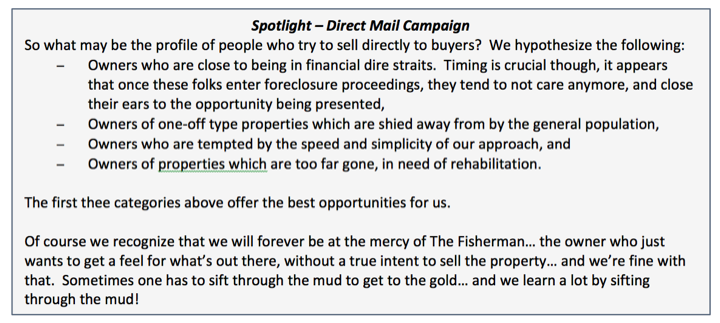
    While it feels like a lot of action when one reads about it, fact is that the speed at which deals were appearing in the MLS was not sufficient for us… good deals were far too infrequent, and there was a lot of competition for them. Was there another way? We had heard of "direct mail" campaigns, where buyers contact potential sellers directly via mail, inquiring about potential interest in selling their properties directly to us. We tried it… and it worked!!!

    We crafted simple, hand-written letters (OK, photocopied, hand-written letters) and sent them to all owners of multi-family properties in just two of the six neighborhoods of interest. We received our first call within 3-4 days of sending the letters, and eventually visited six properties through this first campaign!

    1. Agawam St – Good 2-fam property. Interesting to us as it was right across from our two Agawam properties. The Owner was however clearly fishing and not really interested in selling. He was still holding the property at year-end. (UPDATE: Property still held by the same owner today).
    2. Moore St – A great rental property. 2-family. The Seller asked for more time, and eventually listed the property in the MLS through a family friend. We were a little disappointed he didn't call us back. The property was still listed as of the end of the year. (UPDATE: Property never sold and is still held by the same owner today).
    3. Griffin St – A good 2-fam property. We liked it and presented the Sellers with a documented offer, never received a formal response. Property was still held by the same owner at year-end. (UPDATE: Property was listed last week and went under contract two days later).
    4. Andrews St – A 2-fam property with some promise, but we were too far apart in price. (UPDATE: We ended up purchasing this property in '19!)
    5. Lawrence – A large 2-fam property, with a built-out attic as well as a spacious walkout basement. Each apt 3-BR’s. We presented an offer, which was quickly accepted. 
    6. Central – A beautiful, well maintained 2-fam property and a 1-fam house in an adjacent plot of land. The owner had built a bridge connecting both properties (he owned them for over 30 years), which made it impossible to sell to separate buyers. He was therefore looking for a single buyer to take both… when our letter showed up! It took a while to finalize the paperwork with the City (we had to put both properties under a single deed), but we were able to buy our best property yet; low maintenance and high rents.
    7. Central – A large mixed-use property, in need of too much work. We passed.

    We sent an additional batch of letters once we came back into the market later in the year and once again had some responses… we saw some interesting properties, although none panned out this time, this approach has worked well in ‘19 again, but I'll cover that in a few months...

    While the MLS will in fact continue to be the main source of deals, we now know that Direct Mail is an effective way to pursue them as well. In both instances where we ended up purchasing properties directly from the owner (in '18) we found highly motivated sellers, who, for different reasons, did not want to go through the hassle of listing their properties in the MLS. We expect the financial returns of both of these properties to exceed expectations for years to come.

    Next Week: Part III, "The How Much"

  • Member since 2017 · 28 posts · 46 votes
    7y

    Part III How much?

    Ok, this sounds good, but how much should you pay for rental real estate? How do you know what’s fairly priced and what’s not? This is where the rubber meets the road; nothing matters if one ends up paying too much! Pay too much and the house may barely pay for itself, or it may not pay for itself at all. And why do folks end up paying too much? Let us outline some typical reasons:

    • “Ah, I know the rents are low, but that house is so beautiful!” Newsflash: renters care about “beautiful” a little… they care about cleanliness, space and usability much more.
    • “Look at the size of the lot, we may be able to build another house there!” Right, are you actually going to build that house in there? Otherwise that’s just another plot to mow, maintain, and keep clean of debris for years to come!
    • “It’s OK if I don’t make money right away, I’ll make the money back when I sell…” Maybe, but that’s a speculative play, a bet, wishful thinking… and that’s not our play.

    Mistakes like these and others just like them are prevalent in the tombstone of many real estate investors. “Maybe’s”, “If’s” and rosy expectations have the same value of “I love you’s” written in a sandy beach; solid cash-on-cash returns is the only factor that really matters here.

    The errors above are those of commission, but there are errors of omission as well, such as:

    • “That house is filthy and it needs to be painted…” Clean it and paint it! That’s where the term “sweat equity comes from!
    • “That backyard is too small…” The investor that says this is thinking about where he / she wants to live… not about what the tenants need. For us, the smaller the yard the better the investment is.
    • “Did you see that tenant??? OMG!” Yeah, we understand, when all things are equal we would always choose the property with the nice and respectful middle aged couple with no kids, no pets, and excellent credit… but don’t let the imperfect tenant prevent you from pursuing a good deal. If it gets real bad, the law will be on your side.

    These and many other similar reasons prevent investors from pursuing financially solid deals. What would prevent us from pursuing a deal? A neighborhood where crime is an issue, a house in need of structural work, or a house where the financial returns are just not there… that’s about it. The other issues are either irrelevant or short-term nuisances that are in the end relatively easy to address.

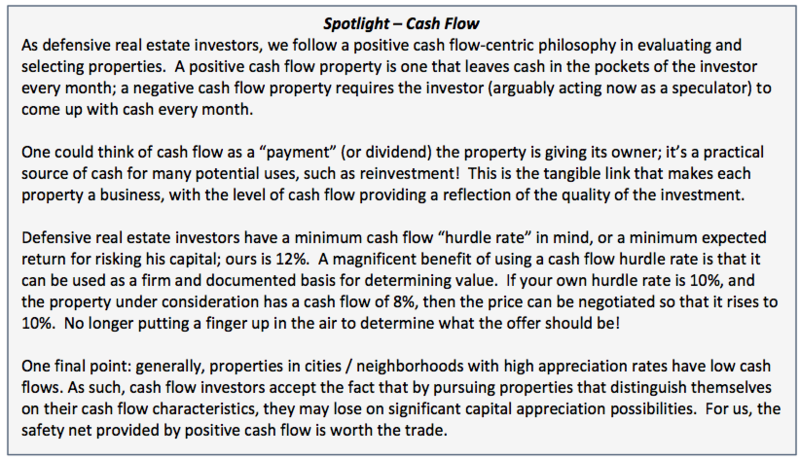
    From a financial perspective, our primary attention is given at all times to the identification of undervalued properties, preferably substantially undervalued properties. We consider a property providing 12% cash-on-cash returns to be undervalued; returns over 15% would be an indication of a property being significantly undervalued.

    And how do we determine value? Perhaps a real example may be of interest to you:

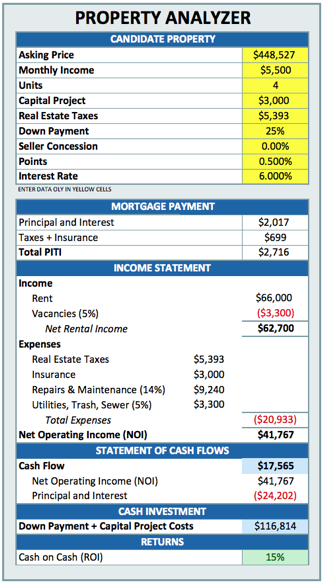
    This homegrown “Property Analyzer” tool (an excel spreadsheet, easy to change if conditions warrant) is what we use to evaluate all potential opportunities. It includes all relevant data points needed to make valid investment decisions, yet it’s simple to use, requiring data entry only on those cells highlighted in yellow.

    The screenshot above is the actual assessment completed for one of the properties we purchased in 2018. All numbers are either accurate (as is the case with interest rates and taxes), or conservative (as is the case with vacancies, maintenance and insurance costs).

    The Capital Project line item allows us to enter an estimate on the financial investment that may be required in the first 12 months of ownership to bring the property up to our operating standards.

    The monthly income variable does benefit from our knowledge of the market as we enter the numbers we expect to have at the 12-month mark, as opposed to the current rents.

    We do not engage in fancy “what if” scenarios to juice results. If the cash-on-cash results are greater than 12%, we’re interested, if they are not, we’re not. On the example above, cash-on-cash returns were 15%... we were all over it.

                                                                              * * * * * * *

    Next week: Property Management!

  • Member since 2017 · 28 posts · 46 votes
    7y

    Property Management - Rents and Vacancies:

    As we have demonstrated, fair financial returns hinge on us being able to purchase properties at the right price, but we also need to be able to charge and collect fair market rents, while avoiding vacancies.

    And what is a fair market rent? The Department of Housing and Urban Development (HUD) is a Federal agency responsible for national policy and programs that address America's housing needs. HUD does actually a very good job here as it develops city-specific Fair Market Rents (FMRs)[1], which are used to determine rental payments for a slew of Federal programs such as Section 8. Lowell has its own FMR with target median rents for studios, 1-bedroom, 2-bedroom, 3-bedroom and 4-bedroom units.

    We like to use the FMRs because they are justifiable, aligned with our expected rents based on our properties, and if achieved, they actually provide a fair return on our investment. We of course adjust FMRs for variables such as parking, utility coverage, unit condition, etc.

    What we have found so far is that when purchasing properties, rents are seldom where they should be, so we end up having to raise them, upwards to 50%! Once the adjustment is made, tenants invariably move on (only one remained at the end of '18 from previous ownership), but we also quickly find new ones, screened based on our relatively high selective criteria, at the new market-driven rate.

    Rent is one key variable; vacancy is the other.

    The unit of product sold in this business is the “monthly rent.” This monthly rent (our product) is not only relatively expensive (~$1,400 a unit for us), but it has a non-negotiable “expiration date”; once the 1st of the month goes by, you can just about kiss your monthly rent goodbye. As Property Managers we manage renovations, place advertisements and screen tenants with the 1st of the month always in mind. With 11 rental units as of the end of 2018, our “inventory” for the year consisted of 132 monthly rents… we hate for any of them to “expire” and go to waste!

    We’d like to get into some of the specifics here, because we learned something that, while logical, is still surprising in its magnitude. Renting in late spring and summer is way easier than renting in the winter! (We know, duh!) We had two basically identical units at one of our properties, the one available in the winter was in the 1st floor (generally more desirable), with a renovated kitchen and newly finished hardwood floors, yet remained vacant for an uncomfortable handful of weeks before it was rented. The second floor unit, available in early summer, had 20+ applicants the first weekend! Timing definitely matters… something we will no doubt take deep into consideration going forward.

    [1] Office of Policy Development and Research – Fair Market Rents

    Spotlight – Tenant Relations

    While one has to be firm with tenants, we have found that treating them with respect, quickly responding to their calls and addressing their issues expeditiously helps maintain good relationships, and it also helps in keeping vacancies low. We do value our tenants… without them, our business will flounder.

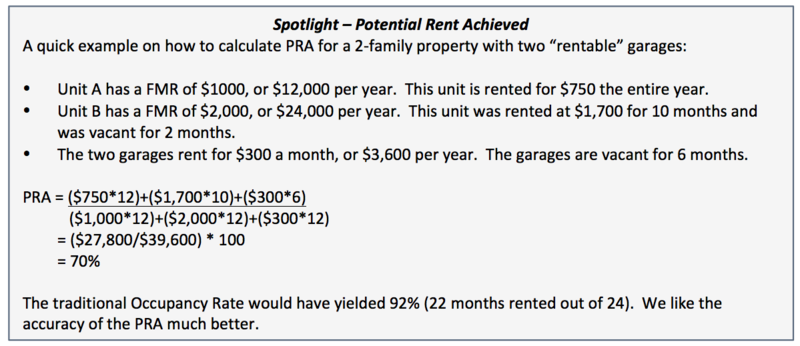
    And how do we measure our performance? We have developed our own metric to evaluate our ability to collect fair market rents as well as vacancies; we call it “Potential Rent Achieved” or PRA and we review it every month. 

    Unlike traditional vacancy rates (or the converse occupancy rates), the PRA recognizes that there are differences in rental prices between apartments, meaning, a vacancy for a unit with a monthly rent of $1,000 is not the same as one with a monthly rent of $2,000. The PRA also takes into account the actual collected rent, and we explain: it would be easy to achieve very high occupancy rates, just give people a huge discount, and your occupancy rates will be close to 100%! 

    Finally, the PRA incorporates other potential revenue sources such as garages and parking; if they are available, and if there’s a market for them, then they should be taken into account on occupancy / vacancy rate calculations… we find that they seldom are. The PRA is a much more accurate way of portraying occupancy / vacancy performance versus the more simplistic vacancy rate (see Spotlight below for an example).

    We pay intense focus to our PRA during our monthly Operational Reviews, tracking underperforming units and prioritizing renovations based on potential increases to rent. We know that driving for higher PRAs results in capital investments and forced vacancies, but we also know these are needed steps if we are to maximize long term ROI.

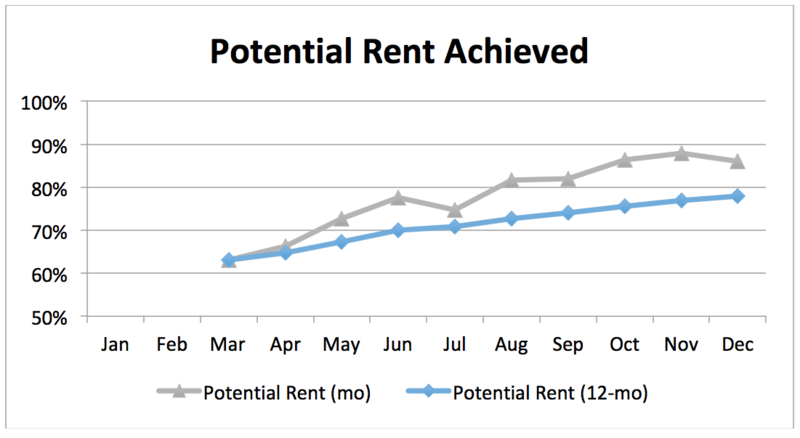
    Below is our PRA throughout 2018.

    In ’18, our PRA went from the low 60’s into the high 80’s by the end of the year, a remarkable achievement, yet the result of focus and hard work. We hope to be consistently above 90% by the end of ’19!

    Next Week: Property Management, Evictions!!!

  • Member since 2017 · 28 posts · 46 votes
    7y

    Property Management - Evictions:

    Evicting tenants is likely to be no one’s idea of fun; we had to go through the process once in ’18. One of our Tenants (with a pre-existing tenancy prior to our purchase) could not afford the rent anymore and indicated her intention to leave in mid-July. We proceeded to document her request, had her sign it and waited for mid-August to roll around. It soon became evident that the Tenant had no intention to vacate the unit on her own and we started the eviction process through the Court in late August.

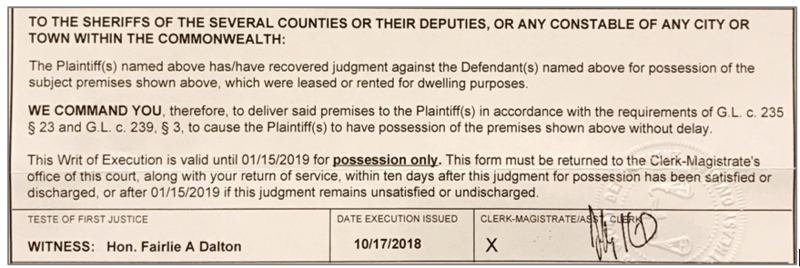
    Letters were sent, the Tenant was served and our date in Court was scheduled for October 1st. Throughout the process we treated the Tenant with utmost respect and care, acknowledging her struggles. Her constant commitments to “leave next week” never held… and after July 1st we never received rent. We agreed through arbitration for her to vacate the property by the 8th of October… we committed through the arbitration to not force an order to vacate to be executed until the 15th. The 8th came and went, the 15th came and went, and the Tenant retained possession of the apartment. Only when the Court issued the official letter, ordering the Sheriff to take possession of the Unit, did she finally leave… on October 21st.

    Snapshot of actual “Execution for Possession: Trial Court of Massachusetts, Housing Court Department”

    We followed the letter of the Law, and moved expeditiously to evict… it still took 3 months to do so. The total losses were actually quite exorbitant; $6,000 in lost rent and another ~$6,000 in unit refresh. The rent was increased from $1,050 to $1,500 per month (the new tenant moved in on 31DEC18)… although the returns on that $12,000 come to 40% a year, it will take us almost two and a half years to recoup the cost. Way too long. We hope to do a good job in selecting our tenants going forward, it’s the best way to avoid this.

    Next Week, Maintenance!

  • Contractor · Revere MA · Member since 2019 · 15 posts · 11 votes
    7y

    Massachusetts evictions are a nightmare. The courts let deadbeats linger around forever

  • Member since 2017 · 28 posts · 46 votes
    7y

    Maintenance:

    Hey Landlord, my toilet is clogged!

    This is probably one of the main reasons why real estate investors eventually drop out of the game. The stress of knowing that a tenant call in the middle of the month, or in the middle of the night, for sure means that something bad just happened eventually becomes too much for some. Leaking sinks, water in basement, “no heat” calls, we dealt with all of them in Year One… and I’m sure we’ll have to deal with them every year, for years to come.

    “Ah but I’ll just have someone else manage the properties” you say, “and I won’t have to deal with that.” Many real estate experts tell you to hire a Property Manager to handle the property management duties; with all due respect, I beg to differ, at least at first! Paying 4-12% of gross rents is a tremendous drag on profitability and it is one advise we do not follow. Maybe when one owns 20+ properties that will be the case, but at first, when one is starting up, it is unrealistic to expect that one can receive a fair financial return by paying others to run and manage the properties for you.

    Managing the properties ourselves is also serving as a tremendously valuable experience because,

    • We get to better understand the impact expenses have on financial performance,
    • It helps us fine-tune tenant selection processes, and
    • One gets to know the properties and the market better.

    Is it easy? But of course not! We have found that hiring and retaining quality help to be most challenging. Plenty of individuals want to help, but most struggle doing so. Let me give you some real examples:

    • William the Handyman was skilled, but untidy and at times a little unhinged. 
    • Ryan the Handyman could do the work, but was slow, unresponsive and a thief. 
    • Paul the Plumber did some good work, then did not respond our calls anymore. Leo the Electrician was very good, but one day did not respond to calls anymore. 
    • Dave the HVAC guy did some good work and then disappeared, while we owed him money… 
    • ditto for Greg the HVAC guy too! 
    • Rick the Mason did some work, got some advance money and then disappeared… at least he left some tools behind. 
    • Eric the Mason also disappeared before finishing the work. 

    Did we say we have struggled with finding quality help???   Jeez!  Sometimes it is easy to understand why some folks struggle in life... they don't follow through, have limited work ethic, which limits their credibility and their future.

    While we have found we are handy with tools (did I say I became a licensed contractor??? I got my CSL in Massachusetts! Yeah baby!) and can do work of sufficient quality, we need to find help. We have made some big strides on this in 2019!  But more on that in a few weeks...

    Next week: Taxes!

  • Member since 2017 · 28 posts · 46 votes
    7y

    A slight detour this week to write about Real Estate Price Trends in Lowell...

    Most real estate investors want to know if prices are going up or down.  As one of our five key sources of profitability, it is important to us as well... and we track it very closely, every week! Now, what prices to track?  One can of course track prices at the US or State levels, but those are of value only to get a sense on macro-economic conditions, the story they tell may not correlate to where we all as investors invest; one has to look deeper than that.

    Zillow, for example, is a good source of estimates.  What they do is calculate, every month, the average estimated value of every house in a particular city and then they present that as a trend.  The key here is to understand that Zillow is presenting an estimate of current values based on sales... not what has actually happened.  

     I prefer to use the median value of properties actually sold and not an estimate.  On this topic, Zillow states that "While interesting (using the median), this measure is problematic because it is influenced by the mix of housing sold in the period of time associated with the metric."  While in the face of it this is a valid concern, I only grant the point if one is dealing with a situation where the sample number is very small.  So, if you live in a city where only a few dozen properties sell every year, you may be better off with the estimate outfits like Zillow provide, in order to avoid the volatility that the median price presents.  If you get 100+ property transactions per year, rely on actual sales instead!

    Transactions of 1-4 family properties in Lowell number between 750-950 a year, relying on actual data is the way to go.  

    In Massachusetts, The Warren Group provides (for a fee) information on ALL real estate transactions in the state.  Seller, buyer, date of transaction, price, address, type of property... it's all there.  A wealth of information to create all sorts of outputs and charts!

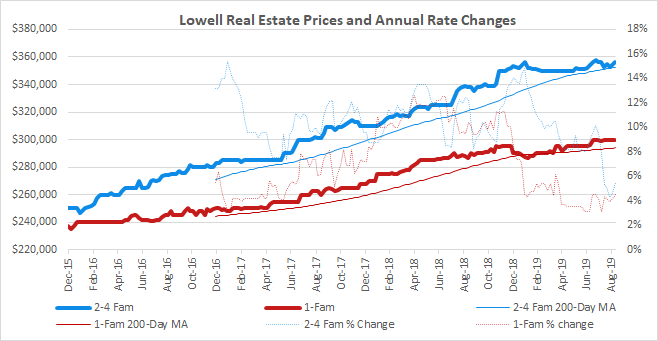
    The charts below tracks what I follow and update every week:

    • Thick blue and red lines - they show average prices of all 2-4 family and 1-family properties sold in the preceding 12 months.
    • Thin blue and red lines - they show the 40-week (200-day) moving average of those same prices.  These lines are the better ones to look for when one is trying to identify the underlying major trend.
    • The blue and red dotted lines - they show the percentage change in median prices on a year-on-year basis.

    So, this chart tells us that while real estate prices in Lowell are still in an uptrend, the rate of that price growth is slowing a bit; year-on-year growth last week was 5% versus 14% 9 months ago.

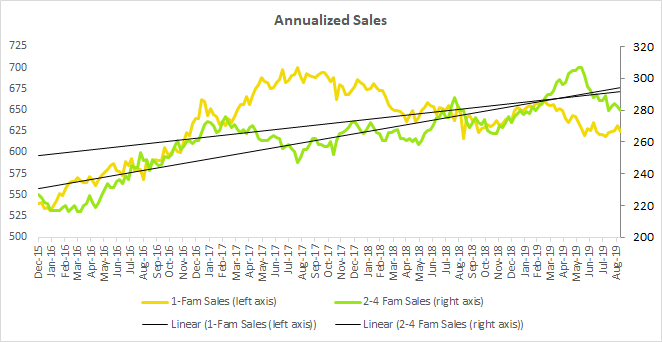
    What does the rate of annualized sales in Lowell say?

    This chart tells an interesting story; 

    1. While sales of 1-Fam properties have been trending up when one looks at sales from 2015 on, they have been in fact trending down for the last two years.  It helps us conclude that prices of 1-Fam properties have reached a level which keeps many of the traditional buyers of properties in the area on the sidelines.  We'll see if the movement of people priced out from areas closer to Boston eventually reverses this trend.
    2. Sales of 2-4 Fam properties continues to be in an overall uptrend.  Prices are still rising, and sales are also rising... this bodes well for the multi-family market in Lowell for at least a while longer.

    I show these charts not only to show you what I do, and the value you can get out of the activity, but also to demonstrate that each one of you can do the same for the areas where you operate!  It's a bit of hard work, but nothing like knowing for sure, without estimates or black boxes, what's actually going on.  People may tell me what they think is going on, I know what's going on... so can you.

    I''ll continue sharing these charts periodically with you from now on.

    I will chat a little about taxes and the topic of cost segregation next week... 

  • New to Real Estate · Lowell, MA · Member since 2019 · 10 posts · 5 votes
    7y

    Awesome charts and findings! As a newcomer, I hope to work as effectively as this one day. I hope those lowell MFH reach a plateau soon, I need a house!!

  • Member since 2017 · 28 posts · 46 votes
    7y
    Originally posted by @Gustavo Costa:

    Awesome charts and findings! As a newcomer, I hope to work as effectively as this one day. I hope those lowell MFH reach a plateau soon, I need a house!!


    Hi Gustavo,

    You may hit it right if you do decide to wait, or you may be sitting for a long time! 

    So, run your numbers, make sure you're getting your target cash-on-cash returns (speculation in this market may cost you), and jump in!  There are a number of towns (arguably most if not all of the Gateway Cities) where the numbers still work... for now at least. 

    HeckRod

  • New to Real Estate · Lowell, MA · Member since 2019 · 10 posts · 5 votes
    7y

    @Hector Rodriguez Extremely informative article, appreciate it!I still have a little bit more saving to do before I'm ready, but will keep this in mind when planning where to invest.

    Thanks

  • Member since 2017 · 28 posts · 46 votes
    7y

    TAXES!

    While the Tax Code has been full of potential real estate deductions for many years, the Tax Cuts and Jobs Act (TCJA) Congress passed late in ’17, will put several of those deductions on steroids at least through the end of 2022. Depreciation, and Cost Segregation in particular, will supercharge returns until then.

    And what is depreciation? Basically, all physical property decays, and must be eventually replaced. Depreciation is the tax feature that allows the real estate investor to recoup the value lost through that decay process. So, if depreciation is an expense, why is there a benefit? The depreciation benefit generally arises from two sources:

    1. The expense claimed on taxes is often times greater than what is actually accrued in real life. How so? The current Tax Code allows the real estate investor to fully depreciate buildings over no more than 27.5 years, yet buildings, with the benefit of some maintenance, routinely exceed that time frame by many, many years. So one gets to claim a deduction for an expense that has not occurred yet!
    2. The expense is actually a non-cash expense, allowing the investor to obtain a cash benefit for a non-cash expense.

    We know, depreciation can be a bit hard to understand, so let’s complicate it a little bit more! Within a property, some assets last a long time (e.g. roof) and others less so (e.g. carpet). Yet, when one depreciates the property over 27.5 years, all of the assets are depreciated as if they lasted for that long… this is where cost segregation comes in.

    Cost segregation is the process of conducting a formal study that identifies and values all building components as well as their lifetime expectations. This process allows the real estate investor to segregate each asset, and accelerate their depreciation. Up until TCJA, and after segregating costs, all personal property (such as appliances) could be depreciated over 5 years and land improvements over 15. TJCA now allows investors to deduct all land improvements and personal property in a single year!

    Spotlight – How Cost Segregation Works

    Here’s an example of how Cost Segregation works in real life.

    We conducted a Cost Segregation study for one of our properties with a total depreciable basis of $392,504, which would have been normally depreciated over 27.5 years. Of that amount, $48,956 and $27,689 were classified as 5-year and 15-year property respectively. On to three scenarios:

    1. Depreciation, no Cost Segregation: $392,504/27.5 years = $14,273 per year
    2. Depreciation, Cost Segregation pre-TCJA: ($315,859/27.5) + ($48,956/5) + ($27,689/15) = $23,123 per year
    3. Depreciation, Cost Segregation today: ($315,859/27.5) + $48,956 + $27,689 = $88,131

    So, on this house, completing the cost segregation study allowed us to claim an additional $73,858 ($88,131 minus $14,273) in depreciation expense, which at a 32% tax rate meant an actual, real, cash in our pockets benefit of $23,634!

    So as you can see, cost segregation was big for us in ’18, significantly influencing total depreciation, which provided a significant proportion of our profit in ‘18. It is true that we were able to recognize this profit by offsetting ordinary income from other personal sources... this benefit would not have been available without it, and may not be available in the future, but it was certainly there for us in ‘18.

    Next Week: A little background on interest rates and their impact / non-impact on real estate...

  • Member since 2017 · 28 posts · 46 votes
    7y

    INTEREST RATES (Or the Price of Debt):

    Please note that the write-up below was completed right at the end of 2018, with interest rates trending up, a condition which reversed immediately and throughout 2019... this brings light to a great lesson, don't attempt to predict where variables such as interest rates are going, there's a 50-50 chance you're going to be wrong!

    Let’s move now to interest rates, arguably understood better in terms of debt pricing (or the cost of borrowing money), and why they go up and down.

    Both private market behaviors and the U.S. Federal Reserve (the Fed) influence interest rates:

    • The private market - As with any good or service in a free market economy, price boils down to supply and demand. When demand for money is weak, lenders charge less to lend; when demand is strong, they’re able to charge more. Demand for loans changes with the business cycle. During a recession, fewer people are buying cars or houses (and therefore looking for new mortgages or auto loans) or seeking financing to start up or grow businesses. Eager to increase lending, banks put their money “on sale” by dropping the rate. The opposite of course happens during times of economic growth.
    • The Fed - While the Fed doesn’t actually set mortgage rates, it determines the federal funds rate, which influences consumer interest rates. It raises the rate when it wants to cool the economy (lower the risk of high inflation rates), and lowers it when it wants to encourage lending to prop up a weakening economy. When the federal funds rate decreases, it becomes less expensive for banks to borrow from other banks. Those lower costs are often passed on to consumers in the form of lower interest rates on lines of credit, auto loans and mortgages. The opposite of course happens during times of economic growth.

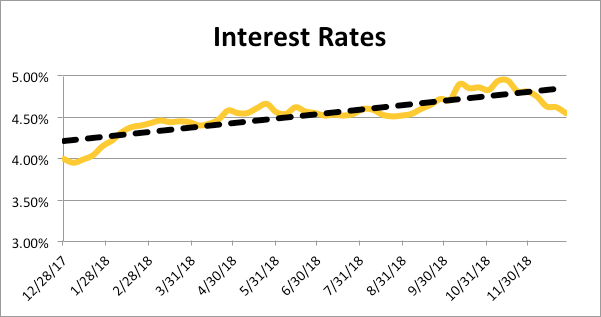
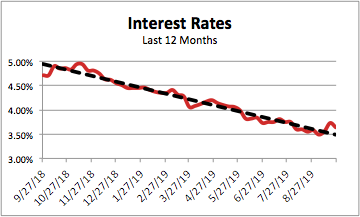
    After many years of down trends in interest rates, reaching the lowest ever in our lifetimes back in ’12, 30-year mortgage rates[1] have been creeping up, almost a full percentage point in ’18; they are expected to continue to go up, at least through ‘19.

    [1] 30-Year Fixed Rate Mortgage Average in the United States

    What does this mean for real estate? The answer depends on whether one is asking about cash-on-cash returns or appreciation of real estate. Let’s elaborate:

    Cash-on-Cash Returns: When the price of debt goes up, interest expense goes up, therefore, if the investor is to maintain profit margins at the same level, rental rates have to keep pace, and go up. Rental rates however may not go up as fast as interest rates… when this happens, cash-on-cash returns goes down.

    Real Estate Appreciation Rates: It surprises many to learn that property values do not always come down in an environment of rising interest rates; we’re actually seeing evidence of this today.[1] As we presented above, interest rates have been going up for the last 5-6 years, yet the “real estate boom” has continued. While rising rates eventually does have a negative impact on the price of real estate, the following factors may be more important in the short-term:

    • The economy - In times of strong economic growth, wages increase, and borrowers are more confident about their job status, making them more willing to borrow to buy real estate.
    • Inflation - Higher interest rates are often associated with inflationary periods, during which real assets, such as real estate, rise in value as well.
    • Pace of interest rate increase - If they are increasing gradually, as has been the case in the last three years, impacts on real estate prices will be muted at best.

    Bottom line, as long as we continue to see economic growth, an increase in interest rates may correspond to increased appreciation of real estate. However, continuously increasing interest rates, or rates that rise too fast, are likely to cause demand for real estate to slow, and associated average sales price to drop as well.

    [1] The Impact of Rising Interest Rates on Commercial Real Estate


    Afterword:  Now, this is what interest rates have done since then... so, never predict!!!

    I'll speak a little about our 2018 returns next week...

  • Member since 2017 · 28 posts · 46 votes
    7y

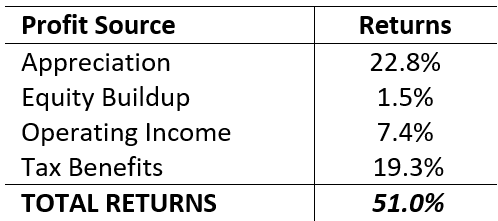
    We started operations on March 6, 2018 with the long-term economic goal of exceeding the financial returns of relevant benchmarks through investments in real estate; we feel cautiously optimistic about the future of this business. Business intrinsic value at the end of the year was $493,281 and total returns on invested cash was 51.0%, coming from the following four sources:

    There are actually five sources of real estate returns which we define as follows:

    • Appreciation (change in value of property) – this profit source will come in waves, in the long-term to our benefit, in the short-term sometimes not. Although we expect annualized leveraged returns to average 6-10%, they will fluctuate between -20% (yes, minus 20%!) and 30% on any given year.
    • Write Up / Down - A Write-Up is a documented and verifiable increase made to the book value of an asset because its carrying value is less than fair market value.  Conversely, a Write-Down is a a documented and verifiable reduction in the book value of assets whose fair market value has fallen below its book value. These will result in meaningful changes to returns for specific properties but will be random and non-predictable single events in nature.  We did not accrue any such write up / downs in '18.
    • Equity buildup (what one gains as the property is paid off) – this profit source will be the most consistent and sustainable in the long-term; loans will continue to be paid for on a monthly basis, adding to our level of ownership for many years to come. We can predict a long-term annual return linked to equity buildup of 2-4%.
    • Operating Income [Cash Returns] – this profit source is likely to be sustainable, but it will be variable due to timing of renovations and macro-economic variables, which influence vacancies and rental rates. We target an annualized long-term cash return of 12%+ from established (owned for over 12 months) properties; due to appreciation rates, a 7-9% is probably more realistic.
    • Tax benefits – although tax law has been favorable to real estate owners for many, many years, ’18 was fantastic due to the late ‘17 changes to the Tax Code. As the value of our investment grows, we expect this profit source to dwindle in future years to no more than 1-2% per year.

    Reaching conclusions over any short period of time, such as one year, is folly, as the short period tends to exaggerate performance. We believe a more meaningful time frame would be five years, and we look forward to the next four in order to build a credible track record, which will lead to more meaningful bench-marking opportunities. That said, and for comparison purposes only, below was the performance of three broad financial indices in ‘18:

    Do we expect this type of return to be consistent? No. This level of out-performance is unlikely to ever be repeated.

    I'll write a little about real estate cycles in a couple of weeks...

  • Contractor · Revere MA · Member since 2019 · 15 posts · 11 votes
    6y

    @Gustavo Costa try Nashua NH. Rents are the same prices are 60% less than Lowell. Median income in Nashua is double what it is in Lowell. It’s been in the top 10 safest cities in America for over ten years straight. And best of all you do not pay state income tax on your profits because their is none in NH. And evictions are far easier to deal with than libtard mass

  • Rental Property Investor · Hollis, NH · Member since 2018 · 108 posts · 36 votes
    6y
    Love reading your posts hector! Great insight! Would you mind sharing the letter you sent out to prospective sellers? 

    Thanks,
    Rick

    Originally posted by @Hector Rodriguez:

    PART II "The What and the How""

    Now that we knew there were viable investment opportunities in Lowell, the rest was easy… it was no longer a matter of if we would buy, but of what, when and how much we were willing to pay. As far as what to invest in, relevant opportunities include single-family, multi-family and apartment buildings. We will at this point not pursue single family investments due to the typical low cash flows associated with them, at least in our area of interest.[1] Apartment buildings are not realistic at this time due to limited capital, opportunities and experience. Multi-family properties on the other hand are affordable, provide good cash flow, and can be financed easily.

    What we want is relatively clear… we look for:

    • 2-4 family properties,
    • Providing a minimum 12% cash-on-cash return,
    • Which are comfortable and of good design,
    • Which will rent in the low-to-mid rental rates, and
    • Which may need basic improvements, but which won’t require structural repairs.

    Real estate property is often classified using letters A (New), B (10-15 years old), C (30+ years old, potentially in need of updates) and D (old and likely uninhabitable.) Class C property is clearly our sweet spot. Class C properties are affordable to purchase, and therefore affordable to rent; this characteristic makes it attractive to our prospective tenants and are a solid fit for us as defensive investors.

    [1] We may invest in 1-family properties based on exceptions (e.g. advantageous price, part of a block of properties, property can be easily split into a 2-family, etc.).

    How:

    We acted quickly, contacted two agents whom we knew well (and who continue to provide tremendous help) and got the process started. Within days we had scheduled visits to several properties… memories came flashing back! There really was no difference between the properties we used to own in NJ in ‘98, and the ones available in Lowell in ’18… none at all. We placed offers on the following properties:

    • November 13th ‘17- Powell St – large 3-family, solid, needed some updates. It went under contract at full price immediately before we presented our offer! In hindsight, we are glad we ended up not buying this property. It needed to be completely repainted, and needed entirely new heating systems. It may have been a little too much to buy as our first property after our long hiatus.
    • November 16th ’17 - Agawam St – two 2-family properties, good condition. We ended up placing offers 15% under asking and purchased them almost 10% under asking price. These properties are solid, with garages and parking, and will be permanent assets for us.
    • November 16th ’17 – Pine Hill Rd – 2-fam property in good condition. Placed offer under asking price… seller never responded. It appears that he was carrying a high mortgage, limiting his flexibility. This house didn’t sell in ‘18.
    • November 24th ’17 – Durant St – 2-fam property, side-by-side. Had offer accepted, but we pulled out after some retaining wall issues were identified after inspection. In hindsight, again, we’re glad we did not buy this property. It was on the other side of the river, much less convenient for commuters and relatively far from our Agawam properties as well.
    • December 10th ’17 – Myrtle St – 2-fam property in good condition. Placed offer under asking, eventually sold over asking.
    • January 9th 18 – Agawam – 3-family property with “rehab qualities.” We placed an offer but it went over asking price to a cash buyer.
    • February 13th ’18 – Elm St – 3-fam in good condition. Had offer accepted, which we pulled out from due to some issues identified during inspection, which the seller was unwilling to address to our satisfaction.
    • November 14th ’18 – Central, a 1-family with ready made additional unit. Fantastic numbers. Went over asking price.
    • November 27th ’18 - Whipple, a 1-family with a full ground level basement in need of renovation. Great numbers. We were able to purchase this property early on in ’19.

    While it feels like a lot of action when one reads about it, fact is that the speed at which deals were appearing in the MLS was not sufficient for us… good deals were far too infrequent, and there was a lot of competition for them. Was there another way? We had heard of "direct mail" campaigns, where buyers contact potential sellers directly via mail, inquiring about potential interest in selling their properties directly to us. We tried it… and it worked!!!

    We crafted simple, hand-written letters (OK, photocopied, hand-written letters) and sent them to all owners of multi-family properties in just two of the six neighborhoods of interest. We received our first call within 3-4 days of sending the letters, and eventually visited six properties through this first campaign!

    1. Agawam St – Good 2-fam property. Interesting to us as it was right across from our two Agawam properties. The Owner was however clearly fishing and not really interested in selling. He was still holding the property at year-end. (UPDATE: Property still held by the same owner today).
    2. Moore St – A great rental property. 2-family. The Seller asked for more time, and eventually listed the property in the MLS through a family friend. We were a little disappointed he didn't call us back. The property was still listed as of the end of the year. (UPDATE: Property never sold and is still held by the same owner today).
    3. Griffin St – A good 2-fam property. We liked it and presented the Sellers with a documented offer, never received a formal response. Property was still held by the same owner at year-end. (UPDATE: Property was listed last week and went under contract two days later).
    4. Andrews St – A 2-fam property with some promise, but we were too far apart in price. (UPDATE: We ended up purchasing this property in '19!)
    5. Lawrence – A large 2-fam property, with a built-out attic as well as a spacious walkout basement. Each apt 3-BR’s. We presented an offer, which was quickly accepted. 
    6. Central – A beautiful, well maintained 2-fam property and a 1-fam house in an adjacent plot of land. The owner had built a bridge connecting both properties (he owned them for over 30 years), which made it impossible to sell to separate buyers. He was therefore looking for a single buyer to take both… when our letter showed up! It took a while to finalize the paperwork with the City (we had to put both properties under a single deed), but we were able to buy our best property yet; low maintenance and high rents.
    7. Central – A large mixed-use property, in need of too much work. We passed.

    We sent an additional batch of letters once we came back into the market later in the year and once again had some responses… we saw some interesting properties, although none panned out this time, this approach has worked well in ‘19 again, but I'll cover that in a few months...

    While the MLS will in fact continue to be the main source of deals, we now know that Direct Mail is an effective way to pursue them as well. In both instances where we ended up purchasing properties directly from the owner (in '18) we found highly motivated sellers, who, for different reasons, did not want to go through the hassle of listing their properties in the MLS. We expect the financial returns of both of these properties to exceed expectations for years to come.

    Next Week: Part III, "The How Much"

  • Member since 2017 · 28 posts · 46 votes
    6y

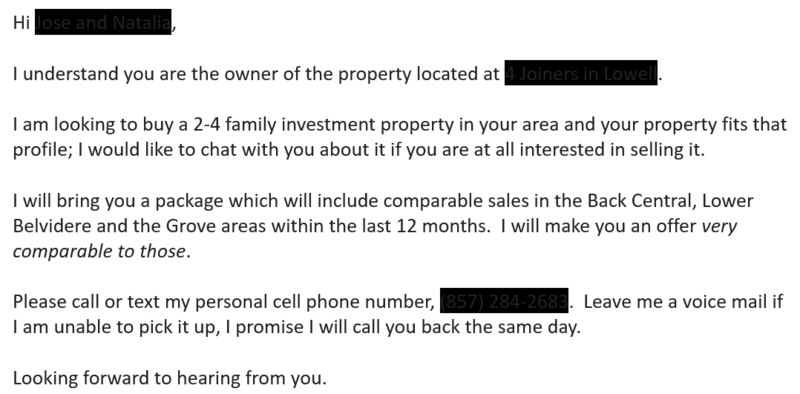
    Of course!  See below... I change the specific language from time to time, but what you see below is just about what I use.  I hand write it using black Sharpie's, leaving the name and address blank, and make a couple of hundred copies.  I then hand write the names and specific addresses for all those properties I'm interested in (using the same Sharpie's of course).  

    My wife and I have purchased four additional properties in 2019, and two of them were acquired using this method... it's a bit tedious, but it actually works.

  • Derreck WellsPro Member
    Specialist · Pelham, NH · Member since 2013 · 547 posts · 269 votes
    6y

    @John Stetson I live in Pelham and I'm frequently in Nashua. I promise you that someone is lying to you. Nashua is not on anyone's top 10 safest cities lists. Nashua is just like Lowell, but over the border into NH. It has a few nice neighborhoods, just like Lowell, but the rest is drug infested with homeless people sleeping in parks, just like Lowell. 

    It actually ranks 53rd out of the 79 cites in our state. https://www.safewise.com/blog/...

    Granted, the crime rate is probably lower then comparable sized cites in MA, but that's because we are a constitutional carry state, meaning anyone that meets the Federal Laws can carry a gun, so the criminals are afraid to rob us because we shoot back. 

Join the conversationCreate a free account to reply, vote on answers and follow this thread.