Did I do something wrong? ATL, Ga Deal Analysis (awful returns)

Did I do something wrong? ATL, Ga Deal Analysis (awful returns)

New to Real Estate · Atlanta, GA · Member since 2020 · 25 posts · 23 votes

Hi all,

I've just recently started looking into real estate investing and wanted to go ahead and start posting the deals I analyze. I’m currently not looking to buy this home (you’ll see why if you read) but I am looking to improve my deal analysis skills! The returns on the current home I just analyzed looks so bad I wanted to see if anybody could see if there's some huge mistake I made or if it's really this bad.

*Overview at the bottom*

Deal Analysis

This is my second deal analysis so I’m sure there’s a lot of things I didn’t take into account, if you notice anything I could do differently please let me know.

The house I’m looking at right now has been on the market for a while but to make this deal work the numbers are extremely unrealistic. Here is the address if anyone wants to look it up on Zillow, 199 14th, Atlanta, Georgia 30309 Unit # 1802
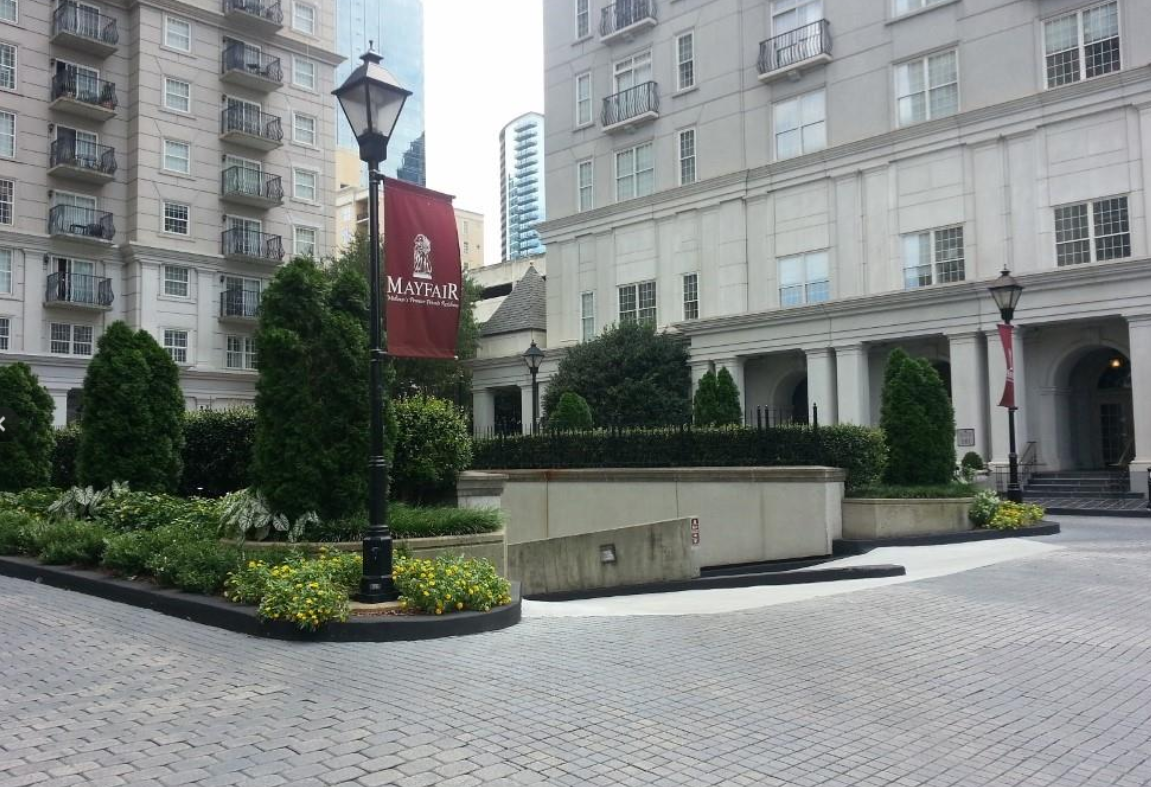
Pricing

It’s a condo currently listed for $375,000 and condos in the same area sold for around the same amount last I checked, but all the recently sold Condos were recently renovated and this one is not, it’s actually pretty ugly. Most the the changes would be cosmetic changes so rehab cost shouldn’t be too much thus I’d put it’s actual home value at $300-330k.

Listing Price: $375,000

Estimate HV: $330,000

Rent

The condo itself is a 2Bd/2bth but the bathrooms themselves are extremely tiny. The floorplan is roommate style suites so the roommates would only really have to interact with each other in the kitchen or dining area. Around 1215 SqFt, right next to Piedmont Park (which is great for the active folks!)

I’ve talked to a few of my friends and most of them said that they’d be perfectly happy paying about $1000-1100 a month but most of them are college students. Based on the apartment I’m living in right now, the rent I’m paying, and the amenities I get for what I’m paying, if I were to look at that property as somewhere I myself would want to find rent in, I’d be willing to pay $900 at most as it is right now. Other listings on Zillow for the same sort of apartment are renting for $1000/month but they’re also a bit outdated, which is probably why they’re still up for rent. I also think even if I do renovate this home I wouldn’t be able to rent it out for too much due to the extremely small size of the bathrooms, and I don’t think it’d be worth to make the demo for a few extra bucks a month of rent.

I don’t expect rent prices to be increasing too much soon since I’ve heard of a lot of development occurring near GT housing. There’s been quite a lot of construction happening in Atlanta for the past few years.

Has the following Amenities:

Parking + Gated community

Small gym

Library

Rent Estimates (After Reno): $2000-2100/month (both rooms)

Rent appreciation estimate: 2% a year? (I’m not sure about how to calculate this)

Location

In terms of location I’d say it’s an B+ to A class neighborhood as it’s right next to piedmont park and a very short walk to the Marta Station. This leads me to speculate that in the far future when Atlanta becomes the big city I think it’ll be, this Condo will probably be worth a lot more in the future, so this is actually an ideal unit for a long term buy and hold (if you have other cashflow to deal with the expenses).

Expenses

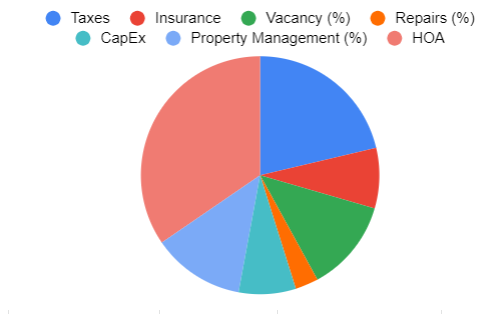
I’m just going to post a picture of the spreadsheet I used for this.

Excluding the Mortgage, the four main expenses here are the HOA fees, Taxes, Property management fees for when expansion occurs, and vacancy being tied with Property Management Fee. Taxes are actually a huge expense most likely due to how high the housing prices in Midtown Atlanta have become. This leads to the actual returns of this property.
Returns
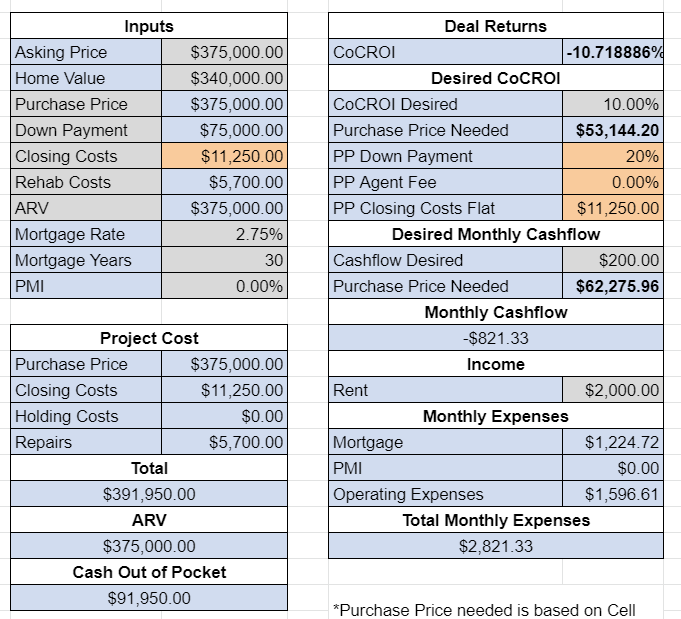
Overall it looks like this deal is pretty awful, at least with the variables in place right now. Which are as follows.

Vacancy: 10%

Repairs: $50

PM: 10%

HOA: $522

The only thing we could really change is the vacancy but this is difficult to do without incurring additional expenses to do so. If we bought the house for the asking price and put a down payment of 20%, then our monthly cashflow would actually be negative and our CoCROI is -10.7%. In terms of a rental property this is a pretty bad deal. In order to get a CoCROI of 10% you would need to buy the property for $53,144 which if you submitted that offer to the seller they’d just laugh in your face, even though this property has been on the market for a while I highly doubt they’d accept an offer so low.

I’ve read that closing costs for legal documents getting signed are somewhere around 3% of the home value which is where the number for closing costs comes from. This would mean you would need to pay $91,950 Cash just for this negative return, assuming the seller pays for the Agent’s closing costs.

To at least break even on the expenses you would need to pay $123,514 which is a third of the asking price.

To make at least some cashflow ($200/month) you would need to pay $62,275 which is around 16% of the asking price, which I highly doubt the seller would agree to.

Due to the expenses and the HOA fee, this property looks to be a pretty bad investment without completely slashing the prices of the home, which the seller is unlikely to do. I'm also wary about buying homes with HOAs since you may be hit with an assessment fee and basically undo all the cashflow you built up.

Rehab

Rehab are just estimates and I have almost no idea what I’m doing but here’s the numbers I used.

The other section is what I would expect to remodel the kitchen sink and counters.

Deal Overview

Listing Price: $375,000

Home Value: $330,000

Assumptions

30 year mortgage

2.75% interest rate

20% down (no PMI)

Purchase Price for

10% CoCROI: $53,144

Break Even: $123,514

$200 Monthly Cashflow: $62,275

Rent: $2000/month

Location: B+ to A

House: B+

Operating Expenses: $1,596.61

Overall, as is and to make it work the numbers are either awful or unrealistic. If anybody has any feedback on the deal analysis, or what I could do better/differently, please let me know!

Thanks,

Damien

4Reply
124 views

Most Popular Reply

Investor · North Richland Hills, TX · Member since 2013 · 1k+ posts · 1k+ votes
5y

If the value is $330K but the asking price is $375K why do you even care to do a detailed analysis? It's a bad deal simply based on the instant loss that you would incur if you bought it.

The goal is to buy below after repair value, not above it.

The second negative about this deal is the fact that its a condo. You are not buying a building. You're buying air space in a building. Oh, and HOA of $522/mo? Run from it!

Only buy condos if you can buy the majority of units which in turn would give you control over HOA and other owners.

See this reply in the discussion

39 Replies

Jump to latestLatest
  • Rental Property Investor · Finger Lakes, NY · Member since 2018 · 35 posts · 36 votes
    5y

    @Damien Lee I won't jump on you about bringing a bad deal, but to hone your skills I'd suggest finding the number that does work for this deal (this is with the caveat that you should run away from that gross HOA fee). They are asking $375k correct? That clearly doesn't work, so now re-run the number at $300k, then at $250k, etc etc....until you find the cashflow you want. If you've ever seen Brandon Turner's webinars, he says there's always a number that makes it work. Friendly reminder just because they are asking $375k doesn't mean you need to pay that.

  • Multifamily Syndicator · Houston, TX · Member since 2016 · 1k+ posts · 2k+ votes
    5y

    This totally happens when you first catch the real estate bug and you want to do all this work. 

    But, honestly, all of this activity is fantastic but you need to ensure that you are directing your energy levels in the right activities if not you can get frustrated from the real estate bug. Attrition is high in real estate investing precisely because of this phenomenon, in my opinion. 

    The initial excitement wears off and may quickly turn into full-blown frustration when the deals don't pencil out. What I would suggest is that you create a set of criteria for underwriting and narrow your list to ONE asset class. Then start analyzing from there. 

    I think BiggerPockets Ultimate Beginner's guide is a great way to get started and condos could work but that HoA fee will get ya! Looking into buy and rentals and/or possibly house hacking. If you like big spreadsheets with numbers flying all over the place, then find an investor in your market and underwrite large commercial deals for them while they train you as an apprentice.

    Your process looks well thought out, but it is wise to practice with intention. 

  • Rental Property Investor · Chicago and mainly invests in KS remotely · Member since 2018 · 360 posts · 314 votes
    5y

    many people have already talked about the HOA thing, but I just want to congratulate you on the excel analysis. Really good. I would try to convert the capex part to include a sqft and num bath estimate, for example a 2000 sqft house with 2 bath will have different capex than a 1000 sqft house with 1 bath. Certain things like roofing, foundation, siding, flooring, painting are all tied to sqft.

  • Real Estate Broker · Redwood City, CA · Member since 2014 · 679 posts · 888 votes
    5y

    @Damien Lee nice work. The numbers are similar to typical SF Bay Area condos. 
    A class properties will have lower or negative cash flow, as expected. 

    There is nothing wrong with buying a negative cash flow property. Most properties in SF bay areas are like that.

    More money are made with appreciation than cash flow. That is a simple fact.

    Too many newbies have no clue what they are doing, and try to chase high cash flow. That is the most awkward thing I have seen on BP. Cash flow will only help you to hold the property, appreciation will make you rich.

    In 2009, when I first started buying rental in SF Bay Area, I focused on cash flow only.

    If I took more risk and focused more on prime location with negative cash flow, I will make a lot more money. A big lesson.

  • Rental Property Investor · Inlet Beach, FL · Member since 2018 · 199 posts · 111 votes
    5y

    Good analysis.

    Bad deal.

    I can't speak to the rehab costs and after-renovation value since I am not familiar with the area.

    I feel I'm in the same boat. I want to just analyze deals and get feedback that my analysis is sound. Not necessarily looking to make a deal on an investment at the moment.

  • Investor · Birmingham, AL · Member since 2016 · 315 posts · 206 votes
    5y

    @Damien Lee

    You can buy a brand new all brick Sfh in Calera Alabama for under 185k. Rent about 1200-1300 month with no maintenance for 10-15 years.

    I did 3 years ago. Bought 150 k and value 180 k today. Taxes and insurance are about $2200 year. Taxes and insurance for my Birmigham homes valued at 88k each with taxes and insurance $2100 a year.

    Good luck.

  • Investor · North Richland Hills, TX · Member since 2013 · 1k+ posts · 1k+ votes
    5y

    Market analysis is all about population trends. The metrics are: population growth, income growth, jobs growth, property values growth. That applies to the metro/city level.

    If the city looks good, then look at a particular suburb and zip code to see if they are populated with desired renters. E.g., median income $50-70K, diverse economy, low crime, good schools. Then you look at the property values and rents. Ideally rents should be less than 20% of the median income (30% is the max, but you want some room to raise rents). Property values are important to determine your ARV.

    Once you have these three metrics (income, rents, and property values) for a given area, any house in that area becomes very easy to pre-qualify: 
    - can you rent it for the going rents in the area?
    - if yes, can you buy it for less than similar properties sold for in the last 3-6 months?
    - if you're satisfied with the discount, go for a detailed analysis.

  • Rental Property Investor · Escondido, CA · Member since 2017 · 679 posts · 550 votes
    5y

    @Damien Lee In your initial posting you asked for input on the analysis.

    To me there are a few areas I would question in addition to what has already been said about HOA fees. You show 2.75% interest in the mortgage. That's only realistic if you occupy yourself. For investment property you probably have to add about 1% extra, I would assume you can get between 3.5-4% right now.

    In the pictures, you also show $11500 closing costs. That is really high. I did not see if there is an explanation why it is so high or what might be included that isn't normally, but it pretty high in my experience.

    Several people have given some input on their process. I am pretty sure people on BP know that I am a big fan and invest myself only in turnkey deals. That also includes the ability to get the 1% rule in B/C+ areas. I bring this up because I did not read that you said anything about the overall goal.

    Do you want to invest to get appreciation and keep buying, renovating, then renting for some time and hoping for the appreciation to then sell?

    Or, like me, do you invest to gain cash flow and reach what I call the "Time Freedom Point' where I no longer need to exchange time for money and have enough passive income from my properties to have the freedom to do with my time what I want? If you want that as your goal, you would want to find deals that meet that goal or, as I do because I don't have time or be close enough to search, renovate and then hand to PM company to manage. I just go to my TK provider and buy from them, they do everything for me and I keep focusing on making money to be able to keep investing and adding to my portfolio and get to my Time Freedom Pont as soon as possible.

    With the $80K+ you need for downpayment and reno, you could buy 3 of the kind of properties I typically buy, get cash flow form day 1 and be much more passive than you seem to plan on being. Yes, people are right to state that is a bad deal in this case, but your goals really need to be established first and then you can start analyizing.

    Maybe you could describe your goals. Then it could guide what kind of approach to investing make the most sense to meet those goals. When you describe that, you might want to mention your risk tolerance. Mine is very low, so I am happy with TK investing, Others want more for taking more risk.

  • Investor · Atlanta, GA · Member since 2020 · 253 posts · 240 votes
    5y

    Hey @Damien Lee, if you're looking for 1% deals in Atlanta, I suggest looking in the outskirts and surrounding counties. Kind of tough to find one percenters inside of the perimeter.

  • New to Real Estate · Atlanta, GA · Member since 2020 · 25 posts · 23 votes
    5y

    Thanks again for all the feedback! I’ll definitely take this into account for my next analysis! Again, I really appreciate everyone helping me out! (responses broken up in two parts)

    @Audrey X.

    That makes a lot of sense. I was wondering why I saw so many renovated condos but still saw a decent amount of the condos still for rent. Thanks for the advice! I’ve never actually thought about building a new home, maybe when I have more capital/I’m further along in my investing career I can consider it!

    @Jingru Sui

    That makes sense. Currently since I’m just starting out and don’t have the cashflow to support an appreciation play I probably won’t be able to consider this. Do you know what specific suburbs would be a good idea to look at? I also feel like suburbs far from the city wouldn’t benefit from Atlanta’s growth for a few years which is the main reason I wasn’t exactly looking at them

    @Neal Shue

    Wow, that’s actually an amazing story! There’s probably no way I can replicate that. On the topic of Turnkeys, I’m very wary towards them since I’ve heard that most of them are pretty terrible at calculating the numbers and they try to make a bad deal look good just to sell you on the property and make money. Obviously that’s not what your experience with them have been. Plus just starting out I think I would want to have a higher return even if it comes with a little more risk. Do you have any advice on how exactly you vetted your turnkey companies to not fall into the common traps/pitfalls that I’ve heard of about Turnkey property investing? I’m glad that you were able to find a partner you could trust and figured out how to deal with the whole Covid situation!

    @Maryanne Cameron

    Please refer towards the end of the analysis. You’ll be able to see purchase price necessary for 10% CoCROI, Break even, and $200 Monthly cashflow!

    @Ola Dantis

    Understood! Thank you for pointing this out! I think I’m going to start looking towards markets out of state that have numbers that actually make sense to practice now. I’m not too worried about finding a deal since my main purpose is to learn and not find deals. Although I’m sure I will get weary once I actively start looking for them!

    @Allen L.

    Thank you! It took me quite some time to make the sheet! My next goal for this sheet is to read the book someone else had previously mentioned on estimating rehab costs and factor that into the spreadsheet for more accurate estimates. Hearing your feedback just makes it an even higher priority for me since I realize how important accurate numbers are.

  • New to Real Estate · Atlanta, GA · Member since 2020 · 25 posts · 23 votes
    5y

    Responses Part 2!

    @David Song

    This makes sense but currently I’m not at a stage where I can do this. If I had outside cashflow to support this property that’d be fine but since I don’t I’d need to use the money from my W2 job which leaves me less money to invest in more properties thus making it harder to take advantage of compounding returns and thus exponential growth. There’s also talk about the 1031 Exchange being repealed by Biden (however unlikely it’s still a risk) and the fact that Atlanta has already been rising by so much it may not reach the same rapid levels of growth as previous years. I don’t know nearly enough about how a market appreciates so it would feel more like gambling than investing should I try an appreciation play at this point. Later on when I have more cashflow this is definitely something I’d consider but not while starting out.

    @David A Lisowski

    Thanks for the feedback!

    @John Patton

    Gotcha, I haven’t even considered buying a new home. I think for now I want to be able to build some equity in my deals or not have to worry about whether or not a new house will be able to cashflow, but this is something to consider!

    @Nick B.

    Thank you! Are the metrics applied such as Pop. Growth, Income, Job, and Property Value Growth all only for Metro or can they also be applied to more suburban areas? Is there a resource I can look at to find more information? This is definitely a systematic approach that I’ll try to be adopting in the future!

    @Axel Meierhoefer

    Thanks for pointing that out! I didn’t even consider this, I was using numbers I had gotten for when I was looking at a house hack before I found out about BP, which is where the 2.75% came from, but I didn’t realize interest would be different for investments.

    I was actually wondering about closing costs. Is there a reasons it’s always 3% of the actual home value or is it just a rule of thumb? It doesn’t make sense to me that a $100K house would have the same closing cost % as a $1 Mill house for the paperwork.

    Again, for Turnkey properties I'm a bit wary on all the negatives that I've heard about them (such as them running bad numbers, making bad deals look good, and purposely having a high tenant turnover rate). Do you have a criteria when looking for Turnkeys or a process to vet them? Right now I have a more aggressive approach but a less risky approach is definitely something I'll look towards in the future later in my REI career. I also think to get to my time freedom point faster, I'll need to leverage my time as I don't have as much capital.

    Currently my end goal is to get to 5-15k cashflow/month by the end of 6-7 years at the latest. I think 10K is definitely doable and 15K is very ambitious, but I’ll have to see and adjust as I get more experience. Thank you for the feedback!

    @Duane Alexander

    Gotcha, that makes sense. Ultimately I was thinking about investing out of state after running the numbers in metro atlanta.

  • Rental Property Investor · Escondido, CA · Member since 2017 · 679 posts · 550 votes
    5y

    @Damien Lee Thanks for responding. Different lenders use different ways to calculate closing costs and in my experience, they are not always a percentage of the value of the property. My nationwide lender has another approach that keeps closing costs lower and applies a different formula.

    I have seen the negativity about turnkey on BP as well and started writing about my own success. Here is a thread from a few weeks ago that got a lot of attention,  explains a lot of the aspects that lead to success investing with turnkey providers and refutes some of the myth:

    https://www.biggerpockets.com/...

    I like to caution you a little. Your approach as you have described it does not appear to be more aggressive to me than what I do with my turnkey investing. Your deals (so far) are not performing well enough and you carry all the risk trying to do something that turnkey companies have 100x more experience in.

    That's not on you. That the media and the community as a whole. We are being told that finding deals, analyzing deals, renovating deals, financing deals, being property managers on finished deals - is all something one can do as a side job, maybe supported by reading a few books and then be as good or better at it and make more profits than the organizations that made exactly that sequence their full-time profession. The really good turnkey providers have been around for decades and find-reno-sell-manage properties at a rate of dozens/month. Why do we believe that we can do that better than these good TK providers can - as a side job? I don't believe it and like you to be careful.

    If you like to discuss it, let me know and we can talk about it

  • Investor · North Richland Hills, TX · Member since 2013 · 1k+ posts · 1k+ votes
    5y
    Originally posted by @Damien Lee:

    Responses Part 2!

    @Nick B.

    Thank you! Are the metrics applied such as Pop. Growth, Income, Job, and Property Value Growth all only for Metro or can they also be applied to more suburban areas? Is there a resource I can look at to find more information? This is definitely a systematic approach that I’ll try to be adopting in the future!

    Metrics can (and should) be applied to all market "units" (state, metro, suburb, zip). Think of it as of a view from a descending airplane. The resources are a plenty. city-data.com and datausa.io are commonly used.

  • Mooresville, NC · Member since 2019 · 20 posts · 14 votes
    5y

    Hi Damien, 

    I didn't get through the vetting of the turnkey companies. I was skeptical like you are today. I am considering Turnkey investing again and I am starting researching. 

    Neal


Join the conversationCreate a free account to reply, vote on answers and follow this thread.