This image shows today’s air quality index for Portland, OR. I wonder how these annual wild fires will affect home prices in another 10-15 years from now along the entire West coast as folks change their mindset on what makes a “good quality” large city. Will there be a mass migration of more folks out of OR, WA, CA as these wildfires continue to swallow up millions of acres of land? If yes, to which cities?
A large city that has year-round warm weather, no hurricanes, no tornadoes, no wild fires is what will win in massively appreciating home prices 10-15 years from now. I think that such a PERFECT city is certainly not on the West Coast!! Folks, as climate change decimates wildlife, what city do you think will emerge as winners for real estate investors?

What are you talking about? With the aggressive fire suppression over the last 100 years the west is seeing dramatically LESS acres burned every year than the historical average. We need MORE acres burned per year, not less. Historically the west has had smoky air all summer, every year. It's normal.
This image shows today’s air quality index for Portland, OR. I wonder how these annual wild fires will affect home prices in another 10-15 years from now along the entire West coast as folks change their mindset on what makes a “good quality” large city. Will there be a mass migration of more folks out of OR, WA, CA as these wildfires continue to swallow up millions of acres of land? If yes, to which cities?
A large city that has year-round warm weather, no hurricanes, no tornadoes, no wild fires is what will win in massively appreciating home prices 10-15 years from now. I think that such a PERFECT city is certainly not on the West Coast!! Folks, as climate change decimates wildlife, what city do you think will emerge as winners for real estate investors?

Good question!
I feel like climate change has to factor into our thinking more and more each year.
I think about Phoenix, AR: huge population gains, really attractive real estate market, but for how much longer can that city be livable? The average high temperature is over 100 degrees for 100 days of the year!
The Sun Belt is getting warmer too...
Forest fires aside, the Pacific Northwest might be the best best in America.
What are you talking about? With the aggressive fire suppression over the last 100 years the west is seeing dramatically LESS acres burned every year than the historical average. We need MORE acres burned per year, not less. Historically the west has had smoky air all summer, every year. It's normal.
In my opinion, people will gravitate to cities that have the same social mindset they do. Wildfires and air quality aside, Portland and the west coast take climate change and environmental regulations more seriously than other parts of the country. I believe that people will seek out places to live that match their own mentality.
I think that such a PERFECT city is certainly not on the West Coast!!
Before I get called a nut case, I think the fires are due in part to:
1) Govt mismanagement. If you notice all the fires are in public lands, not private (there are plenty of those here) forests. Helps to actually go in and thin out stuff instead of neglecting it Of course, ask govt if they could improve their performance and we get the climate change and we need a new tax response.
2) A governor that is incredibly indecisive. A high-up fire chief quit saying he disagreed and one of the major fires had started small in mid-August and nothing was done until we got a wind storm a week ago that made it major.
3) While I have sympathy for those that lost their homes, like in Napa, building in the middle of a large forest isn't great risk management.
" I believe that people will seek out places to live that match their own mentality. "
Until it doesn't. Hence the diapsora from Cali to places like NV, TX, ID and AZ.
Cali (and OR) don't seem to realize that the people that leave have skills, money and jobs. Leaving behind the people that don't have skills, money and jobs and are more expensive to govt.
I think that such a PERFECT city is certainly not on the West Coast!!
Before I get called a nut case, I think the fires are due in part to:
1) Govt mismanagement. If you notice all the fires are in public lands, not private (there are plenty of those here) forests. Helps to actually go in and thin out stuff instead of neglecting it Of course, ask govt if they could improve their performance and we get the climate change and we need a new tax response.
2) A governor that is incredibly indecisive. A high-up fire chief quit saying he disagreed and one of the major fires had started small in mid-August and nothing was done until we got a wind storm a week ago that made it major.
3) While I have sympathy for those that lost their homes, like in Napa, building in the middle of a large forest isn't great risk management.
its not all forest dwellings.. think the Oakland fire a few decades ago.. 4500 homes burnt down.. same terrain as West hills of PDX just above town.. fire got going tiny roads and boom jumped from house to house.. so imagine the entire hillside above Burnside to the top of the hill and almost every single home burned down.. ?? that's what happened there.
then the Napa fires same thing the one that came off of Atlas peak jumped into Silverado Country club and took down a few hundred homes.. and none of those are in a forest.. I used to live there..
then the one that started in Calistoga and went over to Santa Rosa same thing.. not really big forest land like what's burning in our national forests then jumps into a residential neighborhood ( Coffey creek and burns down thousands of homes..) it would be like a fire jumping into north Bethany and burning down entire neighborhoods..
The town of Paradise was set in the Pines.. so that would be like Sisters getting torched ..
When you go up into the foothills of the Sierras the chaparral ( much like most of so cal) is so thick there is no stopping it.. and your correct the urbanization of what was rural lands is causing way more homes to burn than 30 to 50 years ago.. 30 to 60 years ago land guys were busting up those areas for weekend homes or retirement lots.. Its the part of the industry I started my sales career in.. in those days you could have a 100 lot subdivision with maybe 4 homes in it.. fast foreword to today and maybe that development is now 70 to 90% built out and smack dab in the middle of high danger fire areas.
Oregon is lucky in a way with the land use. you simply cant urbanize the forests.. so yes a lot of forest land has burnt down and a few of the old logging towns.. but if the land development had followed what happened in CA and the forest had many more recreational subdivisions it would have been far worse in the loss of homes category.
Wildfires aside, one effect of climate change I think about is drought. Many people say scarcity of water will be the source of future wars and I can certainly understand why. I do think about that when looking at areas to invest in as we've seen some areas around us have wells go dry and this continues at an increasingly alarming rate as we draw down our aquifers and ground water through agriculture, industrial use and population growth in areas that have no natural sources of water. I have no desire to own homes that become unlivable because there isn't enough water so although high precipitation areas can have more maintenance on the physical structure of homes, I think it's a worthwhile tradeoff for readily available water.
@Rob Malda you don’t think the increasingly large wildfires in the west are at all related to 20 years of mega drought and climate change?
Absolutely not. The aggressive suppression and resulting stored fuel is the main cause of large fires: https://www.propublica.org/art...
We need to burn more to reduce the stored fuel to historical levels.
@Rob Malda you don’t think the increasingly large wildfires in the west are at all related to 20 years of mega drought and climate change?
Absolutely not. The aggressive suppression and resulting stored fuel is the main cause of large fires: https://www.propublica.org/art...
We need to burn more to reduce the stored fuel to historical levels.
I agree with you that fire suppression and an increase in fuel is a contributing factor, however I think most climate scientists are saying that the last 20 years of mega drought and climate change are the leading cause.
@Rob Malda you don’t think the increasingly large wildfires in the west are at all related to 20 years of mega drought and climate change?
Absolutely not. The aggressive suppression and resulting stored fuel is the main cause of large fires: https://www.propublica.org/art...
We need to burn more to reduce the stored fuel to historical levels.
I agree with you that fire suppression and an increase in fuel is a contributing factor, however I think most climate scientists are saying that the last 20 years of mega drought and climate change are the leading cause.
We need more climate change . . .
"During the 800s-1300s AD, Wine Grapes Were Grown At Latitudes Where Polar Bears Now Roam"
@Rob Malda you don’t think the increasingly large wildfires in the west are at all related to 20 years of mega drought and climate change?
Absolutely not. The aggressive suppression and resulting stored fuel is the main cause of large fires: https://www.propublica.org/art...
We need to burn more to reduce the stored fuel to historical levels.
think about 200 years ago.. the native indians did their own versions of controlled burns.. and lightening fires happened every year all over the west.. I know up north of the SF bay there used to be control burns in the areas of heavy chaparral and brush areas.. I suspect control burns are going to find their way back into our forest management ..
The cities that will thrive are those that will erect seawalls, manage forests, build homes and businesses efficiently to ever improving seismic and energy efficiency standards, manage growth reasonably and provide a safe environment for raising kids. Beyond that, it's throwing a dart in a pitch black room.
@Susan Tan I found this list some time ago. I don’t necessarily agree with every city/area listed, but still think of it often.
https://www.nytimes.com/2016/10/20/science/9-cities-to-live-in-if-youre-worried-about-climate-change.html
Based on projections of future sea levels and flooding in combination with the movement of growing zones north, I’m beginning to think that Tennessee is the new Florida. Some growers just over the East TN border have already had luck growing citrus. I also believe the Great Lakes region will become increasingly important. They are a plethora of natural resources and effect the local weather in a powerful and fairly predictable way.
Climate change has been a hoax ever since Al Goer sold it to a Saudi Arabian company ( Who drills oil like its going out of style )
'Climate change' is not causing the fires and no scientist who actually knows something about forestry thinks that. You are parroting some kind of a left-wing talking point. There is no drought. There is no explosion of fires in recent history. It's the opposite - acres burned are way down compared to historical averages and where they should naturally be:
https://www.fs.fed.us/research/sustain/docs/indicators/indicator-316.pdf
'Climate change' is not causing the fires and no scientist who actually knows something about forestry thinks that. You are parroting some kind of a left-wing talking point. There is no drought. There is no explosion of fires in recent history. It's the opposite - acres burned are way down compared to historical averages and where they should naturally be:
https://www.fs.fed.us/research/sustain/docs/indicators/indicator-316.pdf
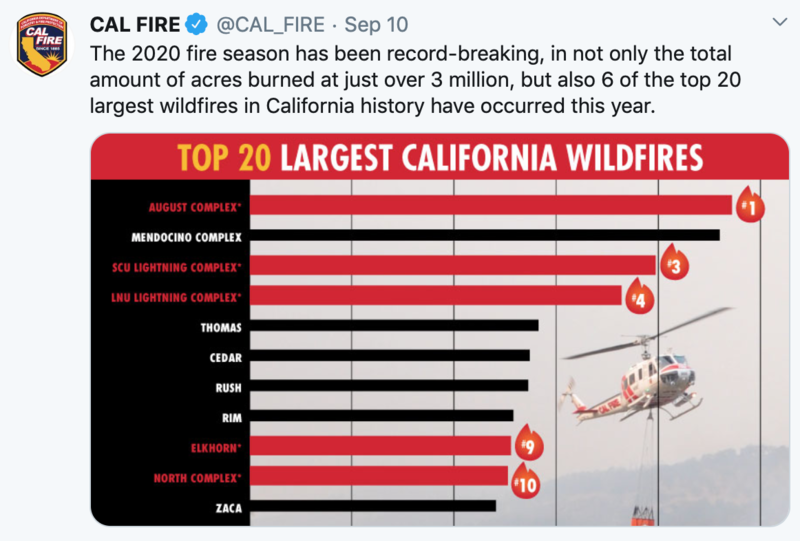
Did you read the article you just shared? First of all, it's from 2010, and since then we have experienced the bulk of the largest wildfires in recorded history, which are getting dramatically worse every year. California has had 6 of the top 20 wildfires in its history this year alone including 3 of the top 4 and the fire season is just getting started there.

Secondly, the article you shared clearly states there is indeed a drought caused by climate change. This quote is from the article: "Climate change may manifest itself with prolonged or more frequent drought. Drought-caused tree mortality is immediately noticeable," and further states that "Over the past 24 years, the proportion of moderate and high burn severity on forested lands has increased from a proportion of 31 to 50 percent of the burned forested area (table 16-2)." These are direct quotes from what you shared.
The current drought and increase in severe wildfires over the past several years is an easily measurable result that anyone who studies these things and believes in science agrees on. The very article you shared, and every other article I've ever read about climate change and forest fires written by experts and peer reviewed, clearly supports the fact that we are in a prolonged drought which is increasing the frequency and intensity of wildfires. This has been exacerbated by the past 100 years of forest management policy which was mainly based on fire suppression, but the leading cause is a warming climate.
LOL, no. Look at the chart again: https://www.fs.fed.us/research/sustain/docs/indicators/indicator-316.pdf
The largest wildfires were 100 years ago and earlier, today the acres burned are minuscule compared to where they need to be. It's really not hard to find data for the past 10 years if you cared: https://fas.org/sgp/crs/misc/IF10244.pdf
As you can see the number of fires is down over the last 10 years, and acres burned are flat. Saying that we are experiencing the largest wildfires in history is nonsense - look at the charts. Global warming is irrelevant, you can't both blame moisture (hurricanes) and lack of moisture (draught) on global warming.
LOL, no. Look at the chart again: https://www.fs.fed.us/research/sustain/docs/indicators/indicator-316.pdf
The largest wildfires were 100 years ago and earlier, today the acres burned are minuscule compared to where they need to be. It's really not hard to find data for the past 10 years if you cared: https://fas.org/sgp/crs/misc/IF10244.pdf
As you can see the number of fires is down over the last 10 years, and acres burned are flat. Saying that we are experiencing the largest wildfires in history is nonsense - look at the charts. Global warming is irrelevant, you can't both blame moisture (hurricanes) and lack of moisture (draught) on global warming.
Ok so it's apparent that you're looking at the charts but not reading what you're sharing. This is a direct quote from what you just shared:
"The 2015 fire season was the largest on record".
2020 is on pace to pass 2015. From the same article you just shared: "As of September 1, 2020, nearly 40,000 wildfires have burned over 4.0 million acres this year. The nationwide preparedness level is at the maximum level (5)."
Eight of the 10 largest fires in California history have burned in the past decade. On Sept. 9, the massive August Complex became the largest fire in the state's history.