Hey Folks...just curious if any of the accredited investors lurking on BP have looked into Cardone Capital. I see he touts this particular arm of his company quite a bit lately, offering preferred returns during the "hold" phase and returns on invested capital on the exit side with multi family acquisitions.
I was so curious I had to sign up. I figured it would put me on a mailing list forever, but what the heck
I saw the PPM for Reserve at Ormond Beach.
They offered 6% preferred and a 65/35 split for everything after on returns and full capital back then 65/35 during disposa fees 1% asset management, 1% acquisition, and 1% disposition.A basic deal on a crowdfunding site (like RealCrowd or CrowdStreet) is 8-10% preferred and 80/20 or 70/30 split. 3-5% fees? Also lower minimums on crowdfunding sites and more experienced general partners.
Other points
Overall, my opinion is that it is inferior to most any deal you will see on CrowdStreet or RealCrowd. I do watch his real estate show every Monday, he teaches basics of commercial investing. It is not bad, you just have to filter out the stupid stuff like "retail is dead" and "any other syndication is stealing your money" He says he has a large percentage invested in every deal but if I am reading the PPM right then he has exactly 0% invested once it is fully funded. He sold 8,330,000 million worth of shares and that is the full equity stack. But he teaches the basics like NOI for people just learning. And he is entertaining to be sure.
Hope that helps satisfy your curiosity.
I would not invest any money in Cardone Capital. His fees are exhorbitant in comparison to industry standards. I have 2 friends that syndicate investments in vehicles, one in office and one in multifamily. They both charge 8-9 percent preferred, 1 percent in acquisition, 4 percent in property management as a percent of revenues, and 80/20. They are institutional grade but operate with small balance funds and family offices.
I like Grant Cardone...his model works for lower end returns while staying passive. I prefer single family homes though, which he hates.
I think the Cardone method is great and he does an excellent job. However, Grant often bashes on other types of real estate investing when it often just makes more sense. Yes, SFR are either 100% or 0% occupied and there are many other faults, but very rarely can an investor afford to buy 24 units with their first purchase. Overall, I love CC and would invest with them to diversify, but he is a salesman at the end of the day, and it works on many people where they believe his method is the only way to go.
@Brad Park please explain more on how it’s worked for you
Hey Folks...just curious if any of the accredited investors lurking on BP have looked into Cardone Capital. I see he touts this particular arm of his company quite a bit lately, offering preferred returns during the "hold" phase and returns on invested capital on the exit side with multi family acquisitions.
I know some people who've done it.
It's 100% passive, the checks roll in after month or two.
Steady 5%-10% returns.
I'm going to comment as someone who works in an institutional real estate investment firm but hasn't had the time to dig into GC's PPM's but has seen his platform mentioned before.
Very interesting! May be worth looking into if someone wanted to completely hands off.
I noticed Grant Cardone just announced he had to lay off 42 of his staff (about 120 staff left) in addition to contract laborers, vendors, etc., due to the recent crash.
https://www.youtube.com/watch?v=sYVXW8yvtoA
Going to be very interesting (or very ugly) over the next several weeks with all these newbie real estate syndication players who just started within the last few years.
I noticed Grant Cardone just announced he had to lay off 42 of his staff (about 120 staff left) in addition to contract laborers, vendors, etc., due to the recent crash.
https://www.youtube.com/watch?v=sYVXW8yvtoA
Going to be very interesting (or very ugly) over the next several weeks with all these newbie real estate syndication players who just started within the last few years.
Yeah - Meet Kevin (YouTube) is all over him - lol
As Warren Buffet says a rising tide lifts all boats but when that tide retreats you see who is swimming naked.
Last 10 years anyone could of made money in real estate. These next 10 will separate the men from the boys.
Everything has changed and nothing makes sense. Its all such a house of cards.
“As Warren Buffet says a rising tide lifts all boats but when that tide retreats you see who is swimming naked.”
...or who is swimming 10X naked
(I feel somewhat bad making jokes at someone else’s expense, but he’s a media figure so it’s a bit different. Sorry Grant;)
When Mike Tyson was asked by a reporter whether he was worried about Evander Holyfield and his fight plan he answered; “Everyone has a plan until they get punched in the mouth.”
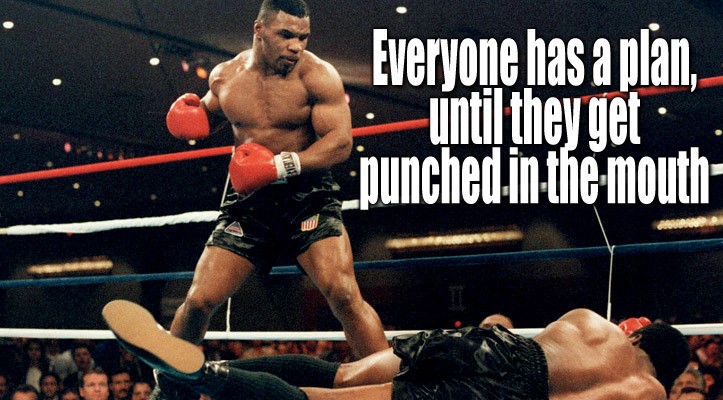
What Tyson said is similar to the old saying “no plan survives first contact with the enemy”. But does this mean that there is no need to plan? Absolutely not.
Holyfield was no doubt smarter and more strategic than Tyson (hard not to be), but was Tyson right? Tyson was a brawler, awesome at powerfully fighting his way out of a corner and landing devastating blows. Could Holyfield have planned to have half of his ear bitten off? How did he respond to Tyson’s unpredictable nature.
Holyfield won. Despite the massive 15/2 odds against him. He won. However had he blindly followed his plan when things had changed he may not have. The question is how you adapt your plan when you get punched in the mouth. There are two key things here
To bring this back to the workplace. If you’ve created a detailed work plan for your team that fully utilizes your people and equipment and key people call in sick or a machine breaks down. What do you do?
Both Tyson and Holyfield were right, plans shouldn’t survive the first punch in the mouth but you need one in the first place to be able to adapt it for changes in reality…
“Victorious warriors win first and then go to war, while defeated warriors go to war first then seek to win” Sun Tzu, the Art of War.
So, be like Holyfield, put a plan together in sufficient detail to “win first” but ensure you can adapt this plan so that one “punch in the mouth” does not result in defeat. Holyfield won with a TKO in the 11th round after Tyson tried to bite his other ear.
Some things you just can’t plan for!
I noticed Grant Cardone just announced he had to lay off 42 of his staff (about 120 staff left) in addition to contract laborers, vendors, etc., due to the recent crash.
https://www.youtube.com/watch?v=sYVXW8yvtoA
Going to be very interesting (or very ugly) over the next several weeks with all these newbie real estate syndication players who just started within the last few years.
Yeah - Meet Kevin (YouTube) is all over him - lol
YOU have to figure he got all his march rent.. so he must be preemptively making moves..
I noticed Grant Cardone just announced he had to lay off 42 of his staff (about 120 staff left) in addition to contract laborers, vendors, etc., due to the recent crash.
https://www.youtube.com/watch?v=sYVXW8yvtoA
Going to be very interesting (or very ugly) over the next several weeks with all these newbie real estate syndication players who just started within the last few years.
Yeah - Meet Kevin (YouTube) is all over him - lol
YOU have to figure he got all his march rent.. so he must be preemptively making moves..
Yes, he said March renewals were good but is estimating of his 8,000 families renting about 15 - 20% won't be able to pay their rent for April.
He stated he has $4.5M per month in mortgages.. $1 Billion in debt with around 3,200 investors.
April will be bad but May and June is where we will see astronomical numbers across the board. This is when the forum topics will shift from "How will Coronavirus impact RE" to "Can I do a loan forbearance or delay payments?"
I noticed Grant Cardone just announced he had to lay off 42 of his staff (about 120 staff left) in addition to contract laborers, vendors, etc., due to the recent crash.
https://www.youtube.com/watch?v=sYVXW8yvtoA
Going to be very interesting (or very ugly) over the next several weeks with all these newbie real estate syndication players who just started within the last few years.
Yeah - Meet Kevin (YouTube) is all over him - lol
YOU have to figure he got all his march rent.. so he must be preemptively making moves..
Yes, he said March renewals were good but is estimating of his 8,000 families renting about 15 - 20% won't be able to pay their rent for April.
He stated he has $4.5M per month in mortgages.. $1 Billion in debt with around 3,200 investors.
April will be bad but May and June is where we will see astronomical numbers across the board. This is when the forum topics will shift from "How will Coronavirus impact RE" to "Can I do a loan forbearance or delay payments?
I made this comment on other threads.. One of my bizz partners owns a 150 unit complex in the Northwest Solid B.. his PM sent e mail telling him to prepare for 40% non pays.. I personally don't think it will be that bad.. However the PM manages 8 to 10k doors from Sacramento to SEattle all along the I 5 corridor so he is an expert.. I am thinking though he just wants to prepare the owners and if it comes in at 10 to 20% like Cordone is thinking then its a win.. Although the property has less than 600k in total debt against it.. so its just operating expenses and he keeps his properties pristine so he says he runs about 40% in operating costs prior to debt service which So basically no pay means no retained earnings for the month .. No pay for those leveraged to the max is a much more serious situation.
when I brokered the deal them they paid cash.. I was like holy cow.. why no debt so you can make better returns.. they lived through the Japanese crash and once they exited they are VERY conservative with debt.
Could you guys help me clear up GC (or syndicators in general) fees? When they say 1% each for acquisition, management, and disposal, what is that 1% of? Is it of the total invested by each person? Or just of profits? Or...?
It should be detailed out in the PPM but generally acquisition fee is based on purchase price, asset and property management fees are based on total collected income (monthly), and disposition fee is based on sale price or, if a refinance, the new loan amount.
Could you guys help me clear up GC (or syndicators in general) fees? When they say 1% each for acquisition, management, and disposal, what is that 1% of? Is it of the total invested by each person? Or just of profits? Or...?
It should be detailed out in the PPM but generally acquisition fee is based on purchase price, asset and property management fees are based on total collected income (monthly), and disposition fee is based on sale price or, if a refinance, the new loan amount.
Thanks! I had a look through one of GC's PPM's and found the details:
Fees Paid to the Manager in Conjunction with the Acquisition and Disposition of the Asset and Management of this
Entity:
Annual Asset Management Fee: one percent (1%) of capital under management calculated and paid quarterly
Asset Acquisition Fee: one percent (1%) of the purchase price of real estate asset
Asset Disposition Fee: one percent (1%) of the sale price of real estate asset
Participation: thirty-five percent (35%) of net distributable profit from operations subject to payment of Class A Preferred Return
and Member distributions per the Operating Agreement.
That fee structure is not outrageous, but if you meet syndicators personally, you can probably do better. For example, I invest in deals where there is neither an acquisition fee nor a disposition fee, or maybe one of those fees but not both.
In my investments, the sponsor gets 15 or 20% instead of 35%, but there is no preferred return. Whether that part is actually better can be debated. But I like investing in a specific property, not a fund, because then I can make a decision based on the property.
Maybe what could be appealing about Cardone to a new investor is that the entry point is lower. The minimum investment is something like $10,000 as opposed to the $50,000 that is typical for many syndicators.
That fee structure is not outrageous, but if you meet syndicators personally, you can probably do better. For example, I invest in deals where there is neither an acquisition fee nor a disposition fee, or maybe one of those fees but not both.
In my investments, the sponsor gets 15 or 20% instead of 35%, but there is no preferred return. Whether that part is actually better can be debated. But I like investing in a specific property, not a fund, because then I can make a decision based on the property.
Maybe what could be appealing about Cardone to a new investor is that the entry point is lower. The minimum investment is something like $10,000 as opposed to the $50,000 that is typical for many syndicators.
I am curious, how to you find these kind of deals structures? I am guessing you would have to put up ~$1M or more and become a co-partner/GP to get those type of terms.
@Paul B. you're right, the terms @John Stanley mentioned are good terms and contrary to popular belief there are groups who offer deals without acquisition fees. Pref return is good because it aligns the interest of the General Partner and Limited Partner; but like you said, this can be debated. All the terms in the PPM should be considered. There's not one right or wrong way of doing things.
@Andrey Y. these types of terms are out there, (albeit 15% is hard to come by). Though, putting up $1M or becoming a GP isn't necessary. Again, like Paul mentioned, depending on the company, you could put as little as $50,000 down.
I am a student in Brad Sumrok's program and the deals that his students offer tend to be more investor-friendly (in terms of structure) than many big-name syndicators. I have invested in these deals for as little as $25,000, but the minimum is typically $50,000.