Anyone invest with Nighthawk Equity?

Most Popular Reply

Rental Property Investor · Pearland, TX · Member since 2018 · 8 posts · 30 votes
6y

In case anyone else finds this thread, a word of warning about Nighthawk or any other large syndication firm with an associated social media influence. 

Media personalities (Nighthawk Equity/Micheal Blank, Rand Partners/Jake and Gino, Rod Khleif, Simple Passive Cashflow/Lane Kawaoka, etc..)will use their influence to build their brand/name first. Objectively the process works like this:

  1. Use their media (podcast, blog, etc.) to pool capital from listeners/viewers to gain access as GP on deal
  2. Create equity group as a standalone business
  3. Transition to a syndication coaching service 
  4. Use coaching service (students) to bring deals to the equity business

Where an investor needs to be careful (I invested with one of the above), is how this translates to risk the LP takes on when they partner with the equity business. In my deal I thought the track history of multimedia personality would equate to lower risk on my first syndication investment. Not the case. Quite the opposite. 

What I know believe to have happened is that a coached student brough the deal to the "face" of the equity group. Then the teacher, experienced member, face of the group will present it to investors as a deal they stamp their name and reputation on. What really happens is that seasoned GP members are there in name only. The inexperienced member(s) of the general partnership that brought the deal are left to manage the deal. The more experienced general partners see this as passive income stream. The general partners are not active in the deal post closing, they are there only to advise when things go wrong. 

And wrong they went for my deal. I won't name the company but holding group I partnered with held over 75M and 2000+ doors before I decided to jump in with them. Here is a list of the issues that transpired with my deal:

  • They pushed Closing date multiple times. Leaving investment money dead for two months by not doing anything.
  • First distribution was one month behind
  • First distribution was severely under Pro Forma (5K in utility overage)
    First quarter operation saw overages in CAPEX (Pro Forma was off 10x actual figure)
  • Second and possibly third distributions canceled due to more utility and CAPEX overages (issue is still not resolved with property)

Initially, I thought this was just bad luck, and I acknowledged this kind of risk when I signed up for it. Now, I have changed my mind. The syndication now admits proper due diligence before closing was not done (they got ONE bid for repair work on a multimillion dollar property!). And they are in no rush to solve the issue. I'll tell you why. 

It doesn't affect the general partners. Not one bit. Most syndications will advertise decent COC returns (mine was 7% at aquisistion moving towards 10% when property is unloaded) for the LPs and GPs get their cut on the exit. For my deal the occupancy is at 100%, reno is on schedule, rents are getting pushed, and capex items are getting addressed. Great for when the property is sold (again for GPs not LPs). But the mis-management hurts the LPs on the path to 5 year hold and release. My 7% (said to be a conservative figure) COC is now an actual 1.6% after one year. 

I would have made more money by just putting my money in a online high yield savings account. 

Maybe my experience is not typical, and I hope so but Bigger Pockets needs more truth on real estate. Even if you work with a team, some memebers will get the short end of the stick while others will profit exponentially more. 

    See this reply in the discussion

    49 Replies

    Jump to latestLatest
    • Rental Property Investor · RVA · Member since 2016 · 5k+ posts · 4k+ votes
      7y

      For anyone needing clarification, Nighthawk Equity is Michael Blank's company.

      I have not invested with them but I have reviewed a few of their deals

    • Danny RandazzoPro Member
      Apartment Syndicator · Charleston, SC · Member since 2016 · 973 posts · 728 votes
      7y

      @Pat Quinn what is your concern or interest? You might want to talk to @Dan Handford since he has interviewed someone from nighthawk on his podcast

    • Investor · Indianapolis, IN · Member since 2018 · 1k+ posts · 756 votes
      7y

      Great question. Would love to hear the responses. Or maybe someone that has paid for mentoring with Michael Blank. 

    • Investor · Greenville, SC · Member since 2016 · 5k+ posts · 13k+ votes
      7y

      Michael Blank and Nighthawk follow the student army approach for deal sourcing.  Many of the students find opportunities and Michael helps them analyze, close, and fund the deal.

    • Rental Property Investor · RVA · Member since 2016 · 5k+ posts · 4k+ votes
      7y

      @Justin Goodin Re: mentoring references I will send you a name

    • Rental Property Investor · Atlanta Metro, GA · Member since 2017 · 62 posts · 10 votes
      7y

      @Justin G. Has anyone paid for mentoring with Michael Blank? I’m considering doing it but would like to hear from people that have done it first.

    • Real Estate Consultant · Evergreen, CO · Member since 2018 · 1k+ posts · 726 votes
      7y

      Nighthawk is legit. One of the top 10 syndicators in my opinion. They always have a few deals going on. Keep in mind most syndicators today want to oversubscribe at 120-125% because some investors don't follow through after the capital call.

    • Investor · Indianapolis, IN · Member since 2018 · 1k+ posts · 756 votes
      7y

      @Joe Ansley you are going to pay $25,000 for a mentoring program? To each their own, but you can do a lot with 25k. I’m spending time educating myself and working towards my goals. I think 25k is crazy. And I’m a huge Michael Blank fan. 

    • Rental Property Investor · Atlanta Metro, GA · Member since 2017 · 62 posts · 10 votes
      7y

      @Justin G.I didn’t realize Michael Blank was $25,000. Doesn’t he have some less expensive options?

    • Developer · San Diego, CA · Member since 2017 · 18 posts · 5 votes
      7y

      To the original question, I guess that's a no.

    • Specialist · Tampa, FL · Member since 2012 · 933 posts · 492 votes
      7y

      @Pat Quinn, I picked up the skill of underwriting taking his course using the SDA analyzer. Was also in his deal makers mastermind program and was very helpful in helping me in crafting the skill of underwriting, ultimately giving me the confidence that I needed to start making offers and pursuing deals in the market place.

    • Investor · Syracuse, NY · Member since 2018 · 22 posts · 6 votes
      7y

      @Pat Quinn Hi Pat, I have not invested with Nighthawk, but I paid for Michael's ultimate apartment guide video platform last year. I found it to be a huge help with cutting my learning curve down tremendously, I still reference the videos to this day. As a student, its always nice to know I could bring a deal to their deal desk as long as it meets their criteria. But I know his platform helped me, I'm almost there to getting a 24 unit under contract this week and also looking to close on a 60 unit syndication next month with my partners, which I found both deals, only because he helped teach me what to look for. Here is why I would pay 25k for the mentorship. Your committed to doing this, cross the river and burn the boat committed. You have an extremely busy life already with kids and the W2 so you want to leverage their resources to speed up the process. If you're someone who can't dedicate 10-20 hours extra per week to education, calling owners and brokers, underwriting, and growing your investor list, it might be better to put that 25k in something passively for now and just learn from that process. You can certainly do this, but if you're not committed then you're wasting 25k.

    • Rental Property Investor · St. Paul, MN · Member since 2016 · 3k+ posts · 3k+ votes
      7y

      I know Michael well and partnered with him on a deal (not Nighthawk). Working with Michael has been great. He is trustworthy and ethical in my opinion and I would trust his Nighthawk operation. As @Mike Dymski said, the deals that Nighthawk brings to the table are brought by students of his. Nighthawk then analysis them and helps asset manage them. I haven't looked at any of their deals, so I cannot speak to the quality of them. 

    • Investor · Alameda, CA · Member since 2016 · 132 posts · 170 votes
      7y

      @Pat Quinn - I joined the entry level version of Michael Blank's coaching program a couple years ago when I was stepping up my underwriting skills. It was well structured, well run and highly beneficial.

      I have also invested as an LP in 1 Nighthawk student deal. The deal is delivering on pro forma, communication has been proactive and professional.

      ---

      On a related note, it's my personal belief that coaching programs are an investment in one self. The dollar amount someone is willing to pay entirely depends on the mentees goals, communication style and learning approach. I know multiple investors who paid way more than $25k for a REI coach and achieved an ROI from dozens of deals that far exceeded the coaching expense. They applied the skills they acquired from the coaching partnership. Their professional successes were enabled by their coaching relationships (and hustle, and creativity, and support from family/friends, and... and. and.. and....). Soapboxing, complete.

    • Investor · Fort Collins, CO · Member since 2018 · 165 posts · 127 votes
      7y
      Originally posted by @Justin Goodin:

      @Joe Ansley you are going to pay $25,000 for a mentoring program? To each their own, but you can do a lot with 25k. I’m spending time educating myself and working towards my goals. I think 25k is crazy. And I’m a huge Michael Blank fan. 

       I share your sentiment, but I had a friend who paid 25-30k for a mentorship program, and now he is the underwriter doing syndication deals and he has his mentor double checking everything he does before the deal even gets started to make sure the underwriting is good, and the deal makes sense. This "mentorship" also gets him access to his mentors network and net worth. This alone is letting him get started MUCH faster into syndications.

      If you are not making 6 figures or have a healthy net worth saved it may not be for you. But these mentorships from what I have learned will get you on the fast track and in the round table with people who have 15-30 years experience so that you can become an active investor faster.

      This may not be the same for all mentorship programs. I personally will not pay this and plan to passively invest. But this is WHY some of these mentors charge the high $. They want a barrier to entry because most people are all talk. And someone who will pay 25-30k+ for their valuable time will make them 5-10x+ over a lifetime if they are serious about the career of an active real estate investor.

    • Rental Property Investor · Jersey City, NJ · Member since 2017 · 43 posts · 3 votes
      6y

      Can we not take the course and just invest in syndication deals with Michael as a passive investor?

    • Rental Property Investor · Pearland, TX · Member since 2018 · 8 posts · 30 votes
      6y
      Originally posted by @Kapil Patel:

      Can we not take the course and just invest in syndication deals with Michael as a passive investor?

      Yes.

    • Rental Property Investor · Pearland, TX · Member since 2018 · 8 posts · 30 votes
      6y

      In case anyone else finds this thread, a word of warning about Nighthawk or any other large syndication firm with an associated social media influence. 

      Media personalities (Nighthawk Equity/Micheal Blank, Rand Partners/Jake and Gino, Rod Khleif, Simple Passive Cashflow/Lane Kawaoka, etc..)will use their influence to build their brand/name first. Objectively the process works like this:

      1. Use their media (podcast, blog, etc.) to pool capital from listeners/viewers to gain access as GP on deal
      2. Create equity group as a standalone business
      3. Transition to a syndication coaching service 
      4. Use coaching service (students) to bring deals to the equity business

      Where an investor needs to be careful (I invested with one of the above), is how this translates to risk the LP takes on when they partner with the equity business. In my deal I thought the track history of multimedia personality would equate to lower risk on my first syndication investment. Not the case. Quite the opposite. 

      What I know believe to have happened is that a coached student brough the deal to the "face" of the equity group. Then the teacher, experienced member, face of the group will present it to investors as a deal they stamp their name and reputation on. What really happens is that seasoned GP members are there in name only. The inexperienced member(s) of the general partnership that brought the deal are left to manage the deal. The more experienced general partners see this as passive income stream. The general partners are not active in the deal post closing, they are there only to advise when things go wrong. 

      And wrong they went for my deal. I won't name the company but holding group I partnered with held over 75M and 2000+ doors before I decided to jump in with them. Here is a list of the issues that transpired with my deal:

      • They pushed Closing date multiple times. Leaving investment money dead for two months by not doing anything.
      • First distribution was one month behind
      • First distribution was severely under Pro Forma (5K in utility overage)
        First quarter operation saw overages in CAPEX (Pro Forma was off 10x actual figure)
      • Second and possibly third distributions canceled due to more utility and CAPEX overages (issue is still not resolved with property)

      Initially, I thought this was just bad luck, and I acknowledged this kind of risk when I signed up for it. Now, I have changed my mind. The syndication now admits proper due diligence before closing was not done (they got ONE bid for repair work on a multimillion dollar property!). And they are in no rush to solve the issue. I'll tell you why. 

      It doesn't affect the general partners. Not one bit. Most syndications will advertise decent COC returns (mine was 7% at aquisistion moving towards 10% when property is unloaded) for the LPs and GPs get their cut on the exit. For my deal the occupancy is at 100%, reno is on schedule, rents are getting pushed, and capex items are getting addressed. Great for when the property is sold (again for GPs not LPs). But the mis-management hurts the LPs on the path to 5 year hold and release. My 7% (said to be a conservative figure) COC is now an actual 1.6% after one year. 

      I would have made more money by just putting my money in a online high yield savings account. 

      Maybe my experience is not typical, and I hope so but Bigger Pockets needs more truth on real estate. Even if you work with a team, some memebers will get the short end of the stick while others will profit exponentially more. 

      • Realtor · Los Angeles, CA · Member since 2018 · 952 posts · 1k+ votes
        6y

        @Jesse Meyer, god bless you! And good on you for calling out some of the bigger offenders. I'd also mention Brad Sumrok, whom I say speak but have not invested in as either an LP or student. He's got a fantastic racket going. His network has (at least) two tiers of membership. Those on the lower tier have paid for the opportunity to invest as LPs in investments sponsored by those on the upper tier. Thing is, they're all students. Lower-tier members have paid for the opportunity to invest in deals sponsored by inexperienced operators. Oof!

      • Rental Property Investor · Dallas, TX · Member since 2015 · 501 posts · 504 votes
        6y

        @Jesse Meyer

        While I believe your story, I don't understand your comment that they are in no rush to solve the issue. I think you're saying that the GPs get paid on the exit, so they don't care if there is any cash flow during the holding period. I find it hard to believe that a GP collects no cash flow. Usually it's split between LPs and GPs, with the GPs taking anywhere from 10-50% of it, which means they certainly have an incentive to improve operations of the property as soon as they can. Furthermore, you should be getting a cut of the proceeds of the sale (again, GPs will take 10-50% depending on deal structure), so even though cash flow is disappointing, you should make something on the sale, if the GPs manage to get a good sale price. 

        I guess it's theoretically possible that a deal could be structured for all the cash flow to go to LPs and all the capital gain go to GPs, but I've never seen it before, and I certainly wouldn't invest in such a deal. 

      • Rental Property Investor · Dallas, TX · Member since 2015 · 501 posts · 504 votes
        6y
        Originally posted by @Jon Schwartz:

        @Jesse Meyer, god bless you! And good on you for calling out some of the bigger offenders. I'd also mention Brad Sumrok, whom I say speak but have not invested in as either an LP or student. He's got a fantastic racket going. His network has (at least) two tiers of membership. Those on the lower tier have paid for the opportunity to invest as LPs in investments sponsored by those on the upper tier. Thing is, they're all students. Lower-tier members have paid for the opportunity to invest in deals sponsored by inexperienced operators. Oof!

        You can invest with big-name experienced sponsors, who may simply be putting their name on the deal to give it credibility, and will have little to no role in the operations, and may command significant fees that allow them to get paid regardless of the deal's success. That's what Jesse has experienced. 

        Or you can invest with less experienced sponsors, whom you can get to know personally and decide first-hand whether you want to trust them with your money, have been trained by experienced sponsors, and structure their deals in a much more investor-friendly way (low or no fees, taking 10-20% of the proceeds at most). I chose the second option, which is what is you get when you invest with students of a mentoring program. That's my experience and it's worked out well for me so far. 

      • Realtor · Los Angeles, CA · Member since 2018 · 952 posts · 1k+ votes
        6y
        Originally posted by @Paul B.:

        @Jesse Meyer

        While I believe your story, I don't understand your comment that they are in no rush to solve the issue. I think you're saying that the GPs get paid on the exit, so they don't care if there is any cash flow during the holding period. I find it hard to believe that a GP collects no cash flow. Usually it's split between LPs and GPs, with the GPs taking anywhere from 10-50% of it, which means they certainly have an incentive to improve operations of the property as soon as they can. Furthermore, you should be getting a cut of the proceeds of the sale (again, GPs will take 10-50% depending on deal structure), so even though cash flow is disappointing, you should make something on the sale, if the GPs manage to get a good sale price. 

        I guess it's theoretically possible that a deal could be structured for all the cash flow to go to LPs and all the capital gain go to GPs, but I've never seen it before, and I certainly wouldn't invest in such a deal. 

        Paul, you're forgetting that the asset management fee is paid before the pref.

        If a building is in trouble, an inexperienced sponsor can at least keep the asset management fee in a good place. But to drive up revenue to the point where the preferred return is satisfied and then the GP is again earning operating income -- that can be difficult! It might require somebody with experience.

        Sponsors sell investors on an alignment of interest (and you'll definitely get that pitch hard from the sponsor-guru types), but an analysis of the math behind these transaction structures can prove otherwise. LPs have a much broader range of outcomes than GPs. Lemme see if I can find my handy graph....

        Found it:
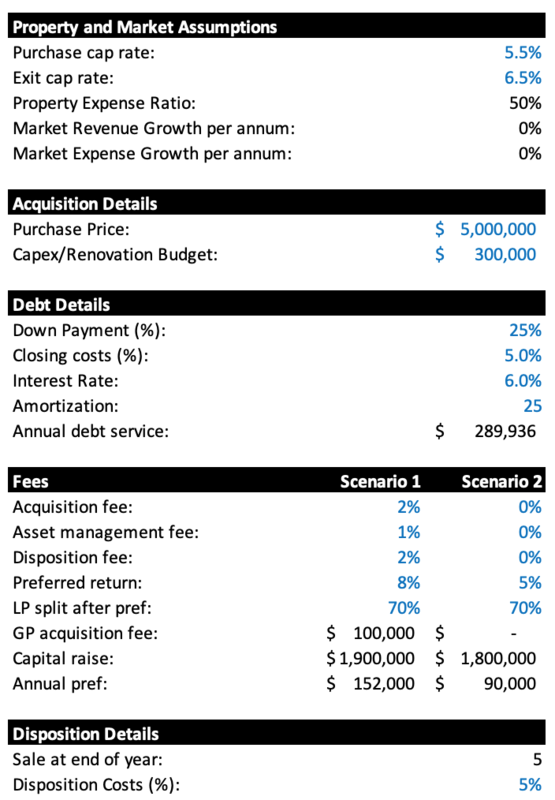
        The first image is a table of assumptions. The second image is a graph showing total LP returns vs. total GP returns on the Scenario 1 list of assumptions.

        To summarize: this is a fairly standard $5M value-add acquisition. We're assuming $300k of cap ex, a 2% acquisition fee, a 1% asset management fee, a 2% disposition fee, and an 8% cumulative preferred return. After the pref, it's a 70/30 split. Five-year hold. 5.5% cap rate going in, 6.5% cap rate going out. The standard stuff you see on pro forma's.

        In this example, the GPs have to increase NOI 30% for their investors break even. Less than this, the GPs will make money and the LPs will lose money. Furthermore, you'll notice that GP compensation doesn't rise much from 0% NOI growth to 45% NOI growth.

        What does this mean?

        On the GP side, you want triples and home runs, but don't sweat it too much because even base hits will be financially rewarding. But on the LP side, a base hit can leave you with a very modest return (if not a modest loss). This is not a true alignment of interests.

      • Realtor · Los Angeles, CA · Member since 2018 · 952 posts · 1k+ votes
        6y
        Originally posted by @Paul B.:
        Originally posted by @Jon Schwartz:

        @Jesse Meyer, god bless you! And good on you for calling out some of the bigger offenders. I'd also mention Brad Sumrok, whom I say speak but have not invested in as either an LP or student. He's got a fantastic racket going. His network has (at least) two tiers of membership. Those on the lower tier have paid for the opportunity to invest as LPs in investments sponsored by those on the upper tier. Thing is, they're all students. Lower-tier members have paid for the opportunity to invest in deals sponsored by inexperienced operators. Oof!

        You can invest with big-name experienced sponsors, who may simply be putting their name on the deal to give it credibility, and will have little to no role in the operations, and may command significant fees that allow them to get paid regardless of the deal's success. That's what Jesse has experienced. 

        Or you can invest with less experienced sponsors, whom you can get to know personally and decide first-hand whether you want to trust them with your money, have been trained by experienced sponsors, and structure their deals in a much more investor-friendly way (low or no fees, taking 10-20% of the proceeds at most). I chose the second option, which is what is you get when you invest with students of a mentoring program. That's my experience and it's worked out well for me so far. 

        Paul, I'm glad it's working out for you, but why would you prefer this to working with more experienced operators? I, too, get to know sponsors personally and I, too, decide first-hand whether or not to trust them. In my case, though, I avoid giving my money to anybody who hasn't been through a full economic cycle, for example. I suppose the discount in fees is attractive, but I'd invest in experience with market fees over investing in inexperience with discount fees any day.

        Plus, how much did it cost you to put yourself in your situation? Since you're in Dallas, I'm just assuming you're a Brad Sumrok student. How many months/years of returns did you forfeit for the opportunity? I haven't paid anything to gain access to my preferred sponsors because they don't charge for it. Why would they??

        I've been listening to a fantastic podcast called "The Dream" that explores multilevel marketing. What's scary is how similar the language of multifamily marketers is to the language used by guys like Sumrok and Khleif. Obviously Sumrok isn't running a pyramid scheme -- but with such a huge bull market in multifamily over the last ten years, is it getting close to one? What's the product? Multifamily buildings or the opportunity to provide capital to people who have previously signed up?

        These are the things I worry about when reviewing OMs tainted by gurus...

      • Developer · Cincinnati, OH · Member since 2018 · 1k+ posts · 3k+ votes
        6y
        Originally posted by @Jesse Meyer:

        In case anyone else finds this thread, a word of warning about Nighthawk or any other large syndication firm with an associated social media influence. 

        Media personalities (Nighthawk Equity/Micheal Blank, Rand Partners/Jake and Gino, Rod Khleif, Simple Passive Cashflow/Lane Kawaoka, etc..)will use their influence to build their brand/name first. Objectively the process works like this:

        1. Use their media (podcast, blog, etc.) to pool capital from listeners/viewers to gain access as GP on deal
        2. Create equity group as a standalone business
        3. Transition to a syndication coaching service 
        4. Use coaching service (students) to bring deals to the equity business

        Where an investor needs to be careful (I invested with one of the above), is how this translates to risk the LP takes on when they partner with the equity business. In my deal I thought the track history of multimedia personality would equate to lower risk on my first syndication investment. Not the case. Quite the opposite. 

        What I know believe to have happened is that a coached student brough the deal to the "face" of the equity group. Then the teacher, experienced member, face of the group will present it to investors as a deal they stamp their name and reputation on. What really happens is that seasoned GP members are there in name only. The inexperienced member(s) of the general partnership that brought the deal are left to manage the deal. The more experienced general partners see this as passive income stream. The general partners are not active in the deal post closing, they are there only to advise when things go wrong. 

        And wrong they went for my deal. I won't name the company but holding group I partnered with held over 75M and 2000+ doors before I decided to jump in with them. Here is a list of the issues that transpired with my deal:

        • They pushed Closing date multiple times. Leaving investment money dead for two months by not doing anything.
        • First distribution was one month behind
        • First distribution was severely under Pro Forma (5K in utility overage)
          First quarter operation saw overages in CAPEX (Pro Forma was off 10x actual figure)
        • Second and possibly third distributions canceled due to more utility and CAPEX overages (issue is still not resolved with property)

        Initially, I thought this was just bad luck, and I acknowledged this kind of risk when I signed up for it. Now, I have changed my mind. The syndication now admits proper due diligence before closing was not done (they got ONE bid for repair work on a multimillion dollar property!). And they are in no rush to solve the issue. I'll tell you why. 

        It doesn't affect the general partners. Not one bit. Most syndications will advertise decent COC returns (mine was 7% at aquisistion moving towards 10% when property is unloaded) for the LPs and GPs get their cut on the exit. For my deal the occupancy is at 100%, reno is on schedule, rents are getting pushed, and capex items are getting addressed. Great for when the property is sold (again for GPs not LPs). But the mis-management hurts the LPs on the path to 5 year hold and release. My 7% (said to be a conservative figure) COC is now an actual 1.6% after one year. 

        I would have made more money by just putting my money in a online high yield savings account. 

        Maybe my experience is not typical, and I hope so but Bigger Pockets needs more truth on real estate. Even if you work with a team, some memebers will get the short end of the stick while others will profit exponentially more. 

           Sorry to hear about your terrible experience.

          Getting the experienced GP to "rubber stamp" their student's deal is a terrible business model. Why trust a newbie to operate an apartment community?

          Moreover, you getting a pathetic 1.6% return on your money is ...well really bad. In our deals, we structure it so that the LP gets a 6-8% pref that is structured as debt so they get paid FIRST and the GP gets paid second if there's money left for the split.

          Also, we only do deals with project IRR of 30-40% so there's enough margin of safety or cushion for the investors because bad things sometimes happen in any investment. A 20% "mistake" typically wipes out the LPs when the project IRR is less than 30%.

          Lastly, your experience with capex being way over the estimate is one reason we decided to become vertically integrated. Due to our in-house construction and renovation company, our cost of renovation is 30-50% below how much it costs the typical syndicator.

        • Developer · Cincinnati, OH · Member since 2018 · 1k+ posts · 3k+ votes
          6y
          Originally posted by @Jon Schwartz:
          Originally posted by @Paul B.:

          @Jesse Meyer

          While I believe your story, I don't understand your comment that they are in no rush to solve the issue. I think you're saying that the GPs get paid on the exit, so they don't care if there is any cash flow during the holding period. I find it hard to believe that a GP collects no cash flow. Usually it's split between LPs and GPs, with the GPs taking anywhere from 10-50% of it, which means they certainly have an incentive to improve operations of the property as soon as they can. Furthermore, you should be getting a cut of the proceeds of the sale (again, GPs will take 10-50% depending on deal structure), so even though cash flow is disappointing, you should make something on the sale, if the GPs manage to get a good sale price. 

          I guess it's theoretically possible that a deal could be structured for all the cash flow to go to LPs and all the capital gain go to GPs, but I've never seen it before, and I certainly wouldn't invest in such a deal. 

          Paul, you're forgetting that the asset management fee is paid before the pref.

          If a building is in trouble, an inexperienced sponsor can at least keep the asset management fee in a good place. But to drive up revenue to the point where the preferred return is satisfied and then the GP is again earning operating income -- that can be difficult! It might require somebody with experience.

          Sponsors sell investors on an alignment of interest (and you'll definitely get that pitch hard from the sponsor-guru types), but an analysis of the math behind these transaction structures can prove otherwise. LPs have a much broader range of outcomes than GPs. Lemme see if I can find my handy graph....

          Found it:
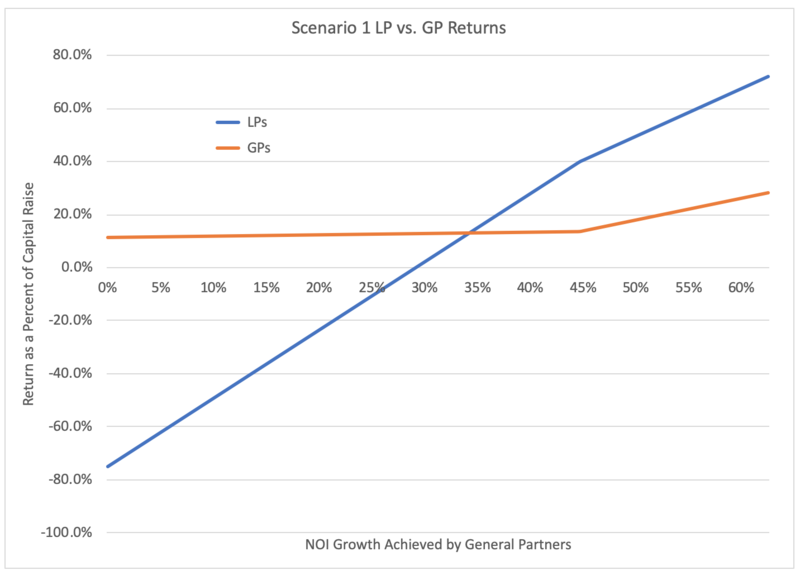
          The first image is a table of assumptions. The second image is a graph showing total LP returns vs. total GP returns on the Scenario 1 list of assumptions.

          To summarize: this is a fairly standard $5M value-add acquisition. We're assuming $300k of cap ex, a 2% acquisition fee, a 1% asset management fee, a 2% disposition fee, and an 8% cumulative preferred return. After the pref, it's a 70/30 split. Five-year hold. 5.5% cap rate going in, 6.5% cap rate going out. The standard stuff you see on pro forma's.

          In this example, the GPs have to increase NOI 30% for their investors break even. Less than this, the GPs will make money and the LPs will lose money. Furthermore, you'll notice that GP compensation doesn't rise much from 0% NOI growth to 45% NOI growth.

          What does this mean?

          On the GP side, you want triples and home runs, but don't sweat it too much because even base hits will be financially rewarding. But on the LP side, a base hit can leave you with a very modest return (if not a modest loss). This is not a true alignment of interests.

           Jonathan,

          This is the reason why we don't charge an asset management fee on our apartment deals.

          Our LPs truly get paid first with the 6% pref.

          And the GPs (us) are incentivized to deliver projects that cashflow - otherwise, we don't get paid.

          Our interest and the interest of our investors are 100% ALIGNED.

          The flip side is that the split we have is 30 LP/70 GP (on the smaller deals) and 50/50 on the bigger deals. 

          This is actually a BENEFIT for the LP. How? Because, we aim to deliver 18% investor IRR, with a 30/70 split, we need projects that have 30-40% project IRR. In other words, we become SELECTIVE in our projects - we are forced to find projects with SUPERIOR returns.

          The typical syndicator is happy with 20% project IRR and then he/she gives away 70-80% equity to the LP - but if something goes wrong, then all the profit is gone and the LP is left holding an empty bag!

        Join the conversationCreate a free account to reply, vote on answers and follow this thread.