
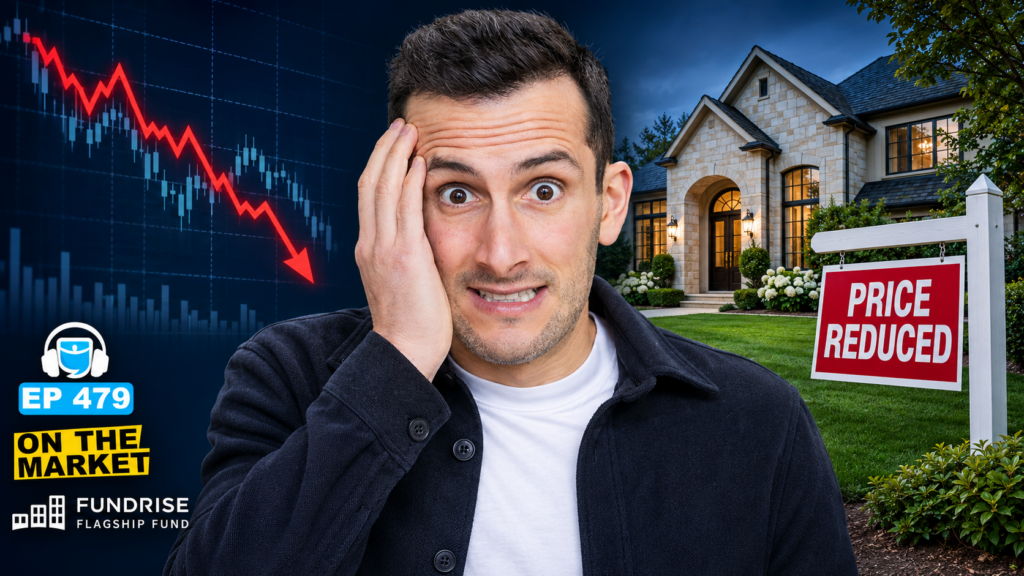
The stock market just had its worst month in years. The S&P 500 is down 5% since its recent high, the Nasdaq is down 11%, and the AI bubble still seems to be bursting. So when trillions of dollars get wiped out of the stock market, what happens to real estate—or, more importantly, what happens to the people who own it? Is this the catalyst for a recession, and by extension, lower mortgage rates? Or is steady inflation setting us up for a lose-lose—stagflation?
The bubble is starting to burst. We’ve been talking about it for months now, and it seems Americans are finally agreeing. But does this put you in a better position to buy a house? If a recession is around the corner, the Fed could flip and start lowering rates, but inflation may be too high to make that call. The richest Americans—the ones who own the most stock—just saw a solid chunk of their net worth get wiped out. Now, many can’t buy homes, so what happens to prices?
All these factors could combine to put us in a position where average Americans, like you and me, can buy at a more affordable price. But will housing slide far past that, into price crash territory? Today, we’re answering the question: if the stock market crashes, what happens to real estate?
Listen to the Podcast Here
Read the Transcript Here
Dave Meyer:
Could a declining stock market take down the real estate market with it? Because the stock market just had its scariest month in years. We had a one-day tech crash that erased trillions. We had the CEO of the world’s most valuable company get ousted because of a spy scandal, and we’re still seeing equities valuations at levels we’ve only seen once before, and that was right before the dot-com bust. For two years now, the stock market has been the quiet engine behind a lot of what’s going on in the housing market, because wealth that has been generated from the stock market funded down payments, all cash offers, and a lot of the luxury buyers who’ve been propping up home prices while everyone else sat on the sidelines. So the question is, what happens if this engine stalls? The conventional wisdom says a stock crash actually means lower mortgage rates and a housing rebound, but this time I’m not so sure because inflation is running hot.
The Fed is talking about hiking and they’re going to, and a stock selloff might not bring the relief everyone’s counting on. So today we’re covering where stocks actually stand, why I think a bubble is inevitable and may already be here, and the two catalysts that I’m watching for how the real estate market is going to react. Will the stock market take down real estate? You’ll find out today on this episode of On the Market. Let’s get to it.
Hey everyone, welcome to On the Market. I’m Dave Meyer, investor, housing analyst, chief investment officer at BiggerPockets. Today we’re talking a little bit about the stock market. We do this time to time, but today I think it’s super important that we take a look at it because November has been and continues to be a pretty wild month for the economy. We saw the midterms, obviously there was a selloff after that. We saw hot inflation. That’s not been good for the stock market. We now expect the Fed to raise rates even more in December. On top of that, the world’s most valuable company and the main engine behind the AI boom, Nvidia, their CEO has been ousted in a spy scandal that is inevitably going to be an awesome movie. We’re going to get to watch that in some time, but for now it’s tanking the stock market.
And although not all real estate investors care about the stock market, it’s going to matter. I really just think so. It’s why I talk about the stock market because these things are interrelated. A lot of real estate investors talk about the stock market, real estate market like they’re separate worlds, and there are times that they operate that way, but there are times when they’re deeply interconnected. And right now I think they’re interconnected. Stock and the wealth that is created in the last decade drives a lot of the consumer behavior of wealthy people and wealthy consumers are driving the majority of consumer spending right now. It’s why we’re seeing so much luxury homes have been doing really well in the last couple of years, even when affordable homes haven’t been selling and all of this stuff impacts the bond markets and mortgage rates. So today on the show, we’re talking about the intersection between the stock market and real estate and how this can all play out for you and for investors.
Let’s start at the top, which is where the stock market stands today. As of this Monday, this comes out on Thursday, but I do record these on Tuesday, so just two days in advance. But as of now, the S&P and NASDAQ were down five and 11% respectively from their October six highs. Just today, on Tuesday, they’re down about another 2%. So we’re in a pullback so far from S&P. It’s not in the official correction territory, which is a 10% drop. The NASDAQ, which is very tech heavy, is now officially in correction territory. Tech’s been getting hit really hard, but not yet in the bear market territory, which is what people define as a 20% drop or more. And this is just happening across the stock market. Not all stocks are getting hit, but the major indices are seeing big declines because tech’s getting crushed and we’re seeing AI get hit a little bit as well.
And although it’s felt like we’ve been in a bubble for a while, I’ve on the show warned multiple times that I think the stock market is in a bubble, it does seem like that is accelerating and we might already be in the correction now. It could pop up again, but I think a lot of the veneer on the round of the AI trade is gone and we’re going to see further declines or at least a much more volatile stock market. The day after the midterms, the NASDAQ 100 fell 6%. That was its worst day since March of 2020. We all remember what was going on then. That wiped out two and a half trillion dollars in market value in a day. And I know we throw around trillions now like it’s a normal number. That is not normal. Two and a half trillion dollars of getting wiped out in a day is incredibly big.
So we saw that, that was one catalyst. The other one is Nvidia. If you haven’t heard this story, I’m sure you have, but Jensen Wong, who is the CEO, quote unquote resigned, he was forced out by the board, on November 12th after reports of two affairs, including one who is suspected to be a Chinese spy. Wild story. So Nvidia lost more than 1.5 trillion from its valuation in just a week. It’s down 24% in a month. So we’re seeing those two things. And I think both of these events, both the midterms, some of the things you see with CoreWeave and some of the debt that’s going on there, what’s going on with Nvidia, are just catalysts for what people were already thinking, which is that the valuations that existed in the stock market were already too high. I personally have said it’s just a matter of when.
We are definitely in an AI bubble. When you get a transformative technology like this, AI, I’m not knocking on the technology. I’m just saying the amount people are paying to own part of AI companies is ridiculous. Yes, it’s a transformative technology and we’re getting this flood of capital into it because people are greedy and they want a part of it. You always get a bubble. I’ve talked about this. We talked about this with railroads twice in the United States. We had this amazing technology, railroads, still used today. People poured money into railroads. 50% of the track that got built in the late 1800s didn’t even get used. People were just speculating. Look at the fiber that was laid going up to the dot-com bust. A lot of that never got used. Railroads and internet, amazing technology, so is AI, but it doesn’t mean that we have the business model figured out and that investors are acting rationally around it.
If you haven’t been paying attention, just let me just explain one number here. There’s something called the S&P 500 Schiller Cape ratio. This just measures how highly priced the stock market is. Right now it’s at 41. That without context means nothing. The long run average is 17. So there’s a great stat for you. The dot-com bubble, which saw a 50% correction was at 44. We’re at 41, normal is 17. So could it potentially work out positively? Sure, but it’s priced for perfection. And I think a lot of the evidence suggests that there needs to be a correction in the stock market. And my gut, I do pay attention to this. I have a large stock portfolio. Significant portion of my net worth is in the stock market. And I put my money where my mouth is, just so you all know. In my own personal portfolio, I have diversified heavily away from the S&P 500 and stock.
I still have a lot of stock, but I’ve moved it into much more defensive positions over the last year because I don’t want to be exposed to a lot of AI stock. I own Nvidia. I’ve been very happy with that. I have not been happy with the 12% drop, but it happens and I expected it to happen, but some things I do continue to hold for a long term. But my gut says we’re already in the correction. And maybe we’ll see some spots of life where the market goes up again, but think about it. AI leader is down a third from its October fallout. The market reacted to the midterms by dumping anything tied to data center build outs. OpenAI already pulled out of their IPO for the year. The revenue for Anthropic, it’s an amazing company in terms of capabilities, but if you look at what they’re seeking to raise in terms of their revenue, it’s pricing for perfection, and there’s just a premium on these stocks that is starting to unwind.
It is incredibly hard to predict these things and to time these things, but if you’re asking me, I would say I think we’ve hit a top for the AI trade. How big a correction there’s going to be. Does it just trade sideways? I don’t know, but I have a hard time imagining the enthusiasm that we had September, October coming back in the next couple of months. And so we need to be prepared for that as investors. This could lead to changes in mortgage rates, in bond yields, in consumer behavior, in what’s going on in the housing market. And we need to talk about that. And we will right after this quick break, stick with us.
Welcome back to On the Market. I’m Dave Meyer. Today we’re talking about a potential stock market rash. Now, I’ve told you I think that the stock market is topped out. I could be wrong about this, but I am going to prepare for this because I think even the psychological shift, if we’re not hitting all time highs like we were for years and years and the market even starts trading sideways, and I think that’s the best case scenario right now, I think that this is going to spill into real estate. So let’s talk about why and how, because this to me is driving some of my own personal real estate decisions and I want to share what I’m thinking with all of you. So first up, will a stock market crash bring down rates? I get this question a lot. I see this a lot on Instagram.
And it’s a good question because a lot of times what you see is when the stock market does decline or stock investing conditions get worse, what happens is people, hedge funds, pension funds, foreign wealth funds, people have a lot of money. They take their money out of the stock market or some of their money more realistically, and they put into the safety of bonds. They don’t want to be in the risk of the stock market. They want to be in the safety of bonds. And how that works is when there is more demand for bonds, when more people want to lend to the government, the government says, “Great, we got plenty of debt. We’ll borrow from all of you, but instead of paying four and a half percent, we’re only going to pay 4%.” And that’s obviously just one example, but that demand for bonds brings down treasury yields, which brings down mortgage rates.
So that actually happens quite a lot. If you look at the historical playbook, stocks fall, investors flee to bonds, bond yields fall, mortgage rates fall. And if you go into a full-blown recession, then the Fed starts to cut rates. This is the playbook that we saw in 2001. When the stock market crashed then, we saw yields on 30-year treasuries go from 7% to 5.8%. Similar thing happened in 2008, 2009. They went from 6.3% to 4.7%. And so when you see these recessionary environments, yields usually fall, but it doesn’t always work that way. It’s not just a knee-jerk reaction because people who have money in the stock market or in the bond market are looking at multiple things and it’s not just equities valuations. There are other times that there have been recessions where rates stayed flat or even went up. If you look at the period from 1973 to 1975 or in the early 1980s, we had recessions, but because inflation was so high, rates didn’t go down.
If you look at the 30-year treasury yield, they’re about 8% in 1973. Then the next year, despite a recession, they went up to 9.2%. That was in the middle of a bad stock market period. And personally, if you ask me, does right now closely resemble 2008? I would say no, I don’t think so. But I think there are flavors of the early 1970s, there are flavors in the 1980s, and there are flavors of the dot-com bubble. So we need to look at what was happening there. And if we look at what was going on in the ’70s when we saw a recession, we saw a bear market in the stock market, but we saw rates go up, it’s because we had supply shock inflation. And I’ve done shows on this about what different types of inflation. There’s two types. There’s supply shock. This is where there is some disruption in global supply chains or the availability of a key commodity that causes prices to go up.
Probably sounds pretty familiar to you because it’s oil. It was oil in the ’70s too. There was an oil embargo and that caused inflation. We have an oil, not an embargo, it’s not as bad as the ’70s, but we have an oil supply shock that is causing prices to go up. That is kind of similar to what we have going on right now. And so if you ask how is the housing market going to get impacted, could a stock market crash bring down rates? I don’t think it’s as clear cut as it would be in a different scenario. If the stock market crashed a year ago before the war in Iran, I’d say, yeah, definitely yields are going to go down and that’s going to help the housing market and it’s going to boost. But now we have two conflicting forces pushing on rates. We have inflation, super, super strong influence on the bond market and mortgage rates, the strongest influence in my opinion.
And then we have stock markets in a flight to safety, like where are people going to put their money? If not in the stock market, will they go to bonds? I would say probably a little bit, and that will probably bring down yields a bit and why I think yields will probably come down a little bit next year. But is it going to see the big relief that you would see in a low inflationary environment? No. Normally when the stock market crashes and if there’s a corresponding recession, think about 2001 or even 2008, stock market crashed, there were a recession and we didn’t have inflation. So yeah, rates came down. Housing eventually recovered because it’s very sensitive to the lower rates. That helps bring the entire economy out of a recession. That is not what’s happening here. Until we win the battle on inflation, we’re not going to get much lower rates.
Investors might flee from stock, but they might put their money in gold. They might put their money in Bitcoin. They might put their money in debt from AI companies or private credit or debt from other countries instead of the United States that don’t have the same level of inflationary pressure. Now, I’m not saying that. I do think rates will come down if the stock market crashes, but don’t expect it to go into the fives, maybe high fives if the crash is really bad. If we have a 40% correction in the stock market, maybe it gets into the low fives, but I don’t think we’re going to get huge relief from that. The second thing here is it’s not just bond investors, but the Fed, their hands are kind of tied too, because even if the stock market corrects, if inflation is still high, they might still hike rates and that’s going to further hurt the stock market and it could hurt consumers and it’s going to hurt commercial real estate.
And so the Fed, their hands are tied in this scenario. Maybe they would cut rates if unemployment really started to go up, but it’s not going to be until after there’s a lot of pain. I think the Fed would let the stock market fall rather than risk 1970 style spiral. And I think they’re right in that. Inflation is awful. It’s so bad for an economy and stagflation is awful. And if you cut rates at the same time when the stock market falls and there’s a supply shock, you really do risk stagflation. And so in my mind, the Fed would be right to keep rates high and say, “Yeah, we’re going to get a recession, but at least we don’t have a recession and inflation because that’s what stagflation is, by the way. That’s the definition is you get a recession and inflation at the same time.
And we are at real risk of that. That could absolutely happen. And so I don’t think the Fed’s going to come in and save anything either unless we win the war on inflation. So that’s my take. If we have a mild correction, a medium correction where stocks go down 20%, 25%, which I do think is possible, rates will come down a little bit, but not a ton. If stocks go down 40%, maybe we’ll get rates in the fives. That is definitely possible. But you have to think about what happens to psychology of people in that environment, right? Is the housing market all of a sudden going to bounce back because rates go into the fives while people’s stock portfolios went down 40%? I don’t necessarily think so. And I think there’s sort of two different things that we need to consider because different segments of the housing market could react differently to a potential stock market decline.
First is the luxury buyer, and then the second is kind of everything else. We’re going to get to this because this is a key breakdown in what to buy and how to underwrite deals, but we do have to take one more quick break. We’ll be right back.
Welcome back to On the Market. I’m Dave Meyer. Today we’re talking about could a stock market crash take the housing market down with it. We’ve talked about why a stock market crash right now might look a little different than in the past because inflation is high because of a supply shock. And even in a recession, supply shock inflation doesn’t go away just because the stock market crashed. We don’t all of a sudden get oil from the Strait of Hormuz. There might be some demand destruction and so we’ll get slightly lower inflation and it will solve itself over a couple of years, but it’s not going to happen immediately. And so that’s the main thing to think about. And this to me is going to spill into the housing market in two different ways. The first is with luxury buyers. The second is for everyone else.
Let’s first talk about luxury buyer because this is a part of the story I don’t think people are paying enough attention to. For the last couple of years, we’ve really been in two different housing markets. The middle market of normal people buying homes has been pretty frozen, right? We’ve seen pending sales hit their lowest level since 2014. Pending sales are down in all 50 of the biggest metros. We’re seeing contracts canceled. Meanwhile though, in that weird great stall that we’ve been in, luxury has been the strongest part of the market. If you actually look at the median luxury price of homes, they’re up nearly 5% year over year, right? That’s pretty big. Luxury pending sales have been up most of this year. A lot of this happened in San Francisco, but it’s happening all over the country. Luxury homes are still selling. And I want to underscore one of the main reasons I want to make this show is because so much of that luxury demand, in my opinion, is coming from the stock market.
Who buys luxury homes? People who own stocks. And it’s been a good year. It’s been a good several years for people who own stocks. It’s been a good decade for people who own stocks. Right now, just think about this. 50% of consumer spending comes from people who are in the top 10% of earners, and those top 10% of earners own roughly 90% of stocks and mutual funds. Think about that. The people who own 90% of the stock make up 50% of the economy. Their spending, including on homes, is very impacted on the stock market. Now, these people might be so rich, their income might be so high that they don’t care, but I have to believe, and this is just my opinion, my interpretation of the data, is that if the stock market declines 20% or more, these folks are going to not be wanting to spend as much money.
Stock gains have been turning into down payments and all cash offers. That’s what’s held up prices while affordability crushed everyone else. So if stocks fall, we have to imagine that this wealth effect reverses in some way, and that’s going to happen across the economy, but it’s definitely going to happen in housing. In my opinion, luxury segments in tech heavy metros where there’s a lot of wealth concentration are going to get hit hard. San Francisco has been riding high, might not be for so long. Austin, Seattle, where I live, already getting really crushed. I think it’s going to get even worse. Now, some markets won’t be super exposed, like more blue collar kinds of neighborhoods or just affordable cashflow markets in the Midwest, Northeast stuff we’ve talked about that don’t really rely on stock-funded buyers as much are going to be okay. And if you combine that, a lower stock market with rates that don’t fall that much, I think we’re going to see a big hit to the luxury segment of the housing market.
And I think we’re going to see a big hit to consumer spending, which could lead to a recession. That’s kind of my thesis for 2027 is that the stock market’s going to lower consumer spending. We’re going to see less capital expenses coming from the AI superscalers that has been propping up GDP. We’re going to get a recession, we’re going to get higher unemployment. And yes, rates will come down a bit, but they can’t come down that much because of inflation and that’s going to hurt the housing market, particularly in this luxury segment. But could it help the lower ends of the market? I think so. I actually think what we’ll see is some more activity at the lower, more affordable end of the spectrum, because maybe if we get mortgages back into the mid sixes, maybe even in the low sixes, I think that’s an optimistic, it could happen.
I could see that happening next year. I think what we see is normal people jumping back into the housing market, people who aren’t reliant on the stock market, who have stable jobs that aren’t really at risk from AI displacement. Affordability will improve. We’ll see prices come down, we’ll see mortgage rates come down, and that is the recipe. So I don’t think this is going to cause a total collapse in the housing market. What I think investors need to pay attention to is this could cause a reversal in what parts of the housing market are hot and what parts are weak. We might see much more weakness in the luxury section, more strength in the more affordable sections of the market. That’s my base case scenario, right? I think there are actually three scenarios of how this could play out. The first is that I’m wrong about the stock market.
That’s obviously possible. Maybe we have a correction in the stock market. It goes down a little bit, but the stock market, it just kind of goes flat for a little while. Maybe it even goes up. I could be completely wrong. And in that case, mortgage rates stay around 7%, housing stays in this great stall because luxury stays the strength and affordable stuff is weaker. The more likely scenario, the thing that I think we’re going to see for at least a while, I don’t think this is going to last for years and years, but I think maybe for the next year or so, if we’re looking at 2027, what we’re going to see is sort of this stagflationary bear market where stocks fall. It could be 10, it could be 20, it could be 30%. Inflation stays hot. It will come down a little bit, but it won’t get down below 2%.
And so I don’t know if the Fed will hike in that scenario, but they’ll keep it high. And then we start to see the luxury market hurt and the whole housing market decline. I think it’s more of a 1970s playbook. The housing market did not crash in the 1970s, but transaction volume went down, prices were a little bit flat, and I think that’s what we get. I think we get negative home prices next year on a national basis because yes, affordable markets will do a little bit better, but the luxury tech metros are going to get hurt. So I think that’s the most likely scenario. The third scenario is a classic recession where the stock market falls and that causes inflation to break. The Fed pivots, they drop rates, housing demand comes back quickly. That’s the upside case in my mind. I know a recession doesn’t sound great, but it’s better than stagflation.
And I think it’s somewhat inevitable and we kind of need to get it over with in my personal opinion. So I’d rather that, I would hope that a recession and stocks falling lead to lower inflation, but I don’t think it’s going to be quick. I think it’s going to take over a year for us to get where we need to be because of these external factors. The stock market is contributing to inflation, but so are tariffs and so is the war in Iran. And without those going away, it’s hard to imagine a quick return to acceptable levels of inflation. So to me, I’m planning on the stagflationary bear market. I think that that’s the most likely scenario, but I’m also positioning myself for a classic recession and underwriting, assuming that one of these two things were wrong. And if I’m wrong and the stock market’s fine, it’s okay.
My portfolio will continue to do okay. So what I’m doing is the same thing I’ve been talking about, underwriting at today’s rates, assuming no refi, fixed rate debt only. I’m trying to keep a lot of liquidity to take advantage of opportunities both in the stock market and real estate because I think there’s going to be much better buys in the next year or two than there are right now. And then the main thing I’m thinking about is being careful at the high end because I think luxury flips, high end STRs, anything dependent on wealthy buyers and tech metros is not going to be doing very well right now. Maybe buying from a flipper, buying from a builder who is building luxury and is struggling to face buyers, that’s a good idea. But if you have to sell those things in the next couple of years, I wouldn’t do it.
I’m favoring cash flow over appreciation. I’ve been talking about this for four years, affordability. I love it. I think it makes so much sense. It’s a key component of my own hypothesis. Still going to look for motivated sellers, but I think buying deep, being patient, this thing is just starting to unwind in my mind, and I think it’s a risky time in the housing market and the stock market, and that leads to opportunity 100%. Risk creates opportunity, but keep dry powder, be very conservative in what you actually buy, be very disciplined about what you actually buy and keep an eye out for the switch I’m talking about. I think the luxury market is at serious risk right now, and there might be a boost to affordable markets, not just yet, but in the next six to 12 months. So those are the things, those are the opportunities I’m looking for, buying luxury at a discount, maybe a return to strength in the affordable segments of the market.
That’s the big change that I’m eyeing now with this change in the stock market, but we’re going to have to wait and see and I will absolutely keep you posted about what’s going on in the real estate market, how it’s being impacted by rates and by the stock market and everything else here on the market for the rest of this year and well into the future. Thank you so much for watching this episode. I’m Dave Meyer. This is On the Market. We’ll see you next time.
Help Us Out!
Help us reach new listeners on iTunes by leaving us a rating and review! It takes just 30 seconds and instructions can be found here. Thanks! We really appreciate it!
In This Episode We Cover
- Why a market crash and looming recession may not be enough to lower mortgage rates meaningfully
- The richest Americans are in for a rude awakening
- A massive risk for the Fed—do they improve affordability while risking stagflation?
- Signs that the AI bubble is already starting to pop (even if we see a mild recovery)
- The homes that will have the biggest discounts thanks to a stock market correction or crash
- And So Much More!
Links from the Show
- Join the Future of Real Estate Investing with Fundrise
- Get Tickets to BPCON2027 in Denver and Local Events Nationwide!
- Join BiggerPockets for FREE
- Sign Up for the Investor Brief Newsletter
- Find Investor-Friendly Lenders
- Dave’s BiggerPockets Profile
- Grab Dave’s Book, Real Estate by the Numbers
- On the Market 413 – Real Estate Isn’t as Safe From Inflation as You Think
Interested in learning more about today’s sponsors or becoming a BiggerPockets partner yourself? Email [email protected].
