
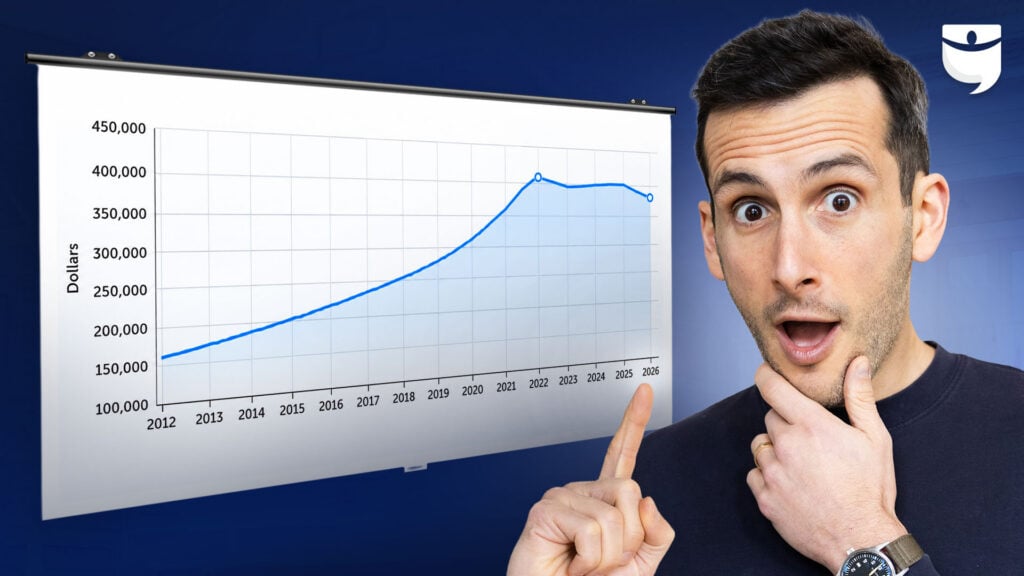
Home prices just went negative, ending an (almost) 13-year streak of year-over-year price increases. Sellers are out of options, buyers are leaving the market, and the Fed is eyeing another round of rate hikes, with sticky inflation ruining the chances of real estate price appreciation.
Is this bad news? If you’re a seller, it’s hard to argue it isn’t. If you’re a buyer, your window of opportunity for getting great deals at a discounted price just widened. But with home prices flipping negative and sellers stuck in a tough position, are we actually sliding toward a housing market crash instead of continuing the long, slow, painful correction we’ve been witnessing?
In this November housing market update, we’re giving the real chances of a real estate crash forming, sharing what has to happen for mortgage rates to reverse and start heading back down to the 6% rate range, and why buyers have undeniable control over home sellers, with proof that your next rental better be bought for less than list price. We’ve been saying it for months—prices are getting too good to pass on. Are you taking advantage?
Click here to listen on Apple Podcasts.
Listen to the Podcast Here
Read the Transcript Here
Dave:
Housing prices are falling. For the first time in three and a half years, the median American home price is lower than it was a year ago. It’s not a crash, but it is a dip. And we didn’t get this kind of dip even with previous 7% mortgage rates, a five-year inflation spike, and everyone on YouTube saying the bubble is about to pop for the last few years. So we need to pay attention. And this drop is happening at the exact moment inflation is heating back up. The Fed is hiking again, and the number of homeowners who are underwater just hit its highest level since 2018. So what is this? Is it the beginning of something bad? Is this the crash so many people have called for? Or is it something else entirely? Today on the November housing market update, we’re going to figure out which one it is and what you should actually do about it.
Hey everyone. Welcome to the BiggerPockets Podcast. I’m Dave Meyer, chief investment officer at BiggerPockets. This is our monthly housing market update. Last month, I told you the supply surge was here, and now we have October data and the other shoe is starting to drop. Prices which has been stubbornly holding up even as inventory piled up finally blinked. The big headline for today is that prices turn negative for the first time since 2023, and even that brief period in 2023 was kind of just a blip as rates went up. I think this could actually be the beginning of the first sustained price drops in US housing since 2012. So of course we got to talk about that today, but there is so much else to cover as well. Here’s what we’re going to get into in today’s episode. First, of course, we’ll talk about the market.
We’ll talk about prices, sales, inventory, and where things are actually moving regionally using brand new October data. And there’s a lot here this month, a lot to consider and to discuss. Next, we’ll talk about inflation and what this means for the Fed. If you were paying attention, you saw that we got a hot CPI print for October. Fed is definitely in a hiking cycle for the first time in three years. And I want to explain what that does and more importantly, what it doesn’t do to your mortgage rate and the market. And third, we’ll get to our monthly risk report because we talk about this every single month. We just got new numbers in the November mortgage monitor from ICE, and there’s one number in there I really think every investor needs to see. And of course, along the way, we’ll be interpreting what this means for real estate investors and want you all to pay attention to this one because this stuff really does matter.
Markets like the one where we’re in are risky, they have opportunity, but they’re also kind of where the next five years of returns actually get made. It’s not during boom times where you make the most money. It’s in these awkward, weird transitions like the one that we’re in right now. And if you understand what’s shifting right now, you get to buy in your terms instead of the markets and get great returns that could sustain you for years or even decades to come. So that’s the plan. But before we jump in, just want to give a quick thanks to our sponsors, PSF Network. PSF Network is a fractional real estate platform that allows users to buy and invest in real estate by the square foot rather than having to purchase whole properties or buying arbitrary shares. To learn more, go to psfnetwork.com. All right, let’s jump into our market recap.
Big headline here is the streak is over. According to Redfin, the median US sale price in October was $388,600, which is down 0.4% year over year. And just as a reminder, in the housing market, year over year is what we care about. Things happen month to month all the time. That is usually because of what is known as seasonality. Prices go up in the spring and summer months, then they come down in the fall and winter months. That is normal. But when we compare October from 2025 to 2026 and see a decline, that is notable and is a very big difference from what we’ve been seeing. It’s the first decline since May of 2023. And it’s really notable because prices have risen pretty much every single month going back 13 years. There was a handful of months in 2023 when rates were going up and people were kind of pausing to see what was going on.
But really for 13 years, this streak has continued. And if you look at how rapidly things are changing, that’s why I think we might be in a sustained decline because just two months ago in August, prices were up two and a half percent year over year. So that is notable. But of course we also have to recognize a 0.4% decline, you’re probably wondering, does that really matter that much? Honestly, no. For one month, no, it doesn’t, but it’s the direction of the market that matters more than the magnitude of the decline right now. And the fact that we have seen this flip, I think really matters. Now we’re going to talk about what this means, but I just want to call out that this is not a surprise. If you have been listening to the show, The Housing Market Update, the stuff that I talk about here on our sister podcast on the market all the time, I’ve been saying that home prices were going to turn negative.
I do a prediction every year on the show, and I said last November that my range for national home prices in 2026 was going to be between negative 4% and plus 2%. So if you average that out, my guess was at this time this year, we’d be somewhere around negative 1% and Redfin now has us at negative 0.4% for October. I think November will be really darn close to that negative 1% I predicted. So not trying to take a victory lap, I’m just saying that this is exactly if you study the market, what you should be expecting. It’s been brewing for years now. Affordability in the housing market needs to get better for the market to improve. And we get that either from mortgage rates, which we’re going to talk about, wage growth, like are people getting paid more? The answer is no. Wage growth in real terms, inflation adjusted terms is negative right now or prices going down, which is exactly what we’re seeing right now.
So not a surprise, but we should talk about how the market is declining. So let’s break down what’s going on behind the scenes. Demand is the real story and that is the big change because anytime you see a market decline, prices go up or down, right? It’s always a function of supply and demand. And demand right now to me is the big story. It’s the big thing that has changed over the last few months. Pending sales, which is a great measure of demand. It’s basically how many people go out and sign contracts to purchase a home, fell 3.6% month over month, which is a lot, considering that they’re already down 15% year over year. And we’re already at the lowest level since 2013. So other than that blip in April 2020 toilet paper weekend when no one was doing anything, I don’t really count that.
If you look at all relatively normal months in the housing market, lowest it’s been in a very, very long time. In short, people aren’t buying homes. And you might say, sure, that’s been happening for years. Kind of true. Sure. We’ve had abnormally low demand for a while. We measure this by total home purchases in a year. That’s about four million since rates started going up. Normal is like five and a quarter million. But seeing it go even below that is unusual because that four million level has been pretty stable. From 2022 to two months ago, it’s been pretty consistent. So are there less transaction? Is there less demand? Yes. But was it in a free fall? Absolutely not. It’s been incredibly stable. Now it is falling. In fact, closed sales, the actually completed purchases fell their lowest level since 2023. We had been at existing home sales running at about 4.1 million.
I just saw a number today that said we’re at about 3.75 million. That is a huge decline. And the reasoning for this is obvious, right? It’s simple. Mortgage rates averaged almost 7.4% in October, according to Redfin, which is a three-year high. If you look at where they were just in September, they were at 6.9%. If you look at where they were at the beginning of the year, they were close to 6%. And there is both a real mathematical and a psychological impediment to demand when you hit 7%. People want a 6% in front of their mortgage. They’re not going to buy as much. And we are seeing that reflected in the data. As Chen Zhao, who’s been a guest on the show before, she is the head of economics at Redfin. She put it this way, and I think it perfectly sums it up. She said, “It’s a buyer’s market, but not many people can afford to buy.” That’s really the whole market in one sentence, and I think the opportunity for investors.
Because if you think about that, and we’ll talk about this more later, if you think about it, it is a buyer’s market. You have the leverage as a buyer, but you don’t have a lot of competition. Not a lot of people are buying. That’s where opportunity exists. But again, demand is the story of what’s changing. Let’s talk about the supply side though, because that really matters about where this goes from here. Because even though there’s less demand, we are actually seeing an important nuance in the data that really people don’t like to talk about because it’s not as sensationalist, it doesn’t get as many clicks, but there are fewer sellers right now. Fewer people are actually choosing to sell their home. New listings, which is the measure of people who put their home up for sale for the first time, fell month over month. It is down 4% year over year and it is down 1% month over month.
Now, those aren’t huge declines, but what it tells us is that sellers are reacting rationally and how you would expect in this kind of market. Less people are buying homes, I’m not going to sell my home. That’s how they’re reacting to it. So that tells us, is the bottom falling out of the market? Not right now. At least there is not panic selling existing. That said, inventory will go up. I made this prediction over the summer when it was clear the war in Iran wasn’t ending anytime soon, that we would see prices go down, we’d see new listings go down, but we would see active inventory go up. All those things have turned out to be true. Active listings are up now 1% from September and the highest since early 2020. Now, if you’re wondering how does this happen? How do you get lower new listings and higher inventory?
It’s simple. Basically, the properties that do get listed aren’t selling quickly. They’re sitting on the market longer. Inventory is not rising because sellers are flooding the market. It isn’t rising because of distress. It’s rising because homes aren’t selling. Stuff is sitting. And this matters because a crash, almost all instances of a crash need forced selling. You need to have people flooding the market with more and more inventory, and that’s not it. We have reluctant sellers. When demand drops, a lot of people who would consider selling just don’t. They just don’t sell. That is self-correcting mechanism in the market that shows us, yes, we’re in a correction as I’ve been talking about for years, but are we in a crash? I don’t think so. The data does not suggest that. So as an investor, like I said, it creates opportunity, right? Stuff sitting on the market longer.
We are in a buyer’s market, which is a great time to use your leverage, but the bottom isn’t falling out right now. And we’ll talk about some of the other sources of forced selling like foreclosures and delinquencies towards the end of the show in our risk report. But let’s just talk about this as an opportunity right now because buyer leverage is super high right now. Let me just read to you a couple of stats that demonstrate this. The percentage of homes that are selling below list price are now 61%. So the majority of homes not selling for list price. The number of homes that have a price cut, highest in Redfin’s history at 36%. Pending sales that fell out of contract, this really spooks sellers. This is one of the things that creates leverage. The best leverage is they get it under contract and then it gets canceled.
That gives you a lot of leverage, 15%. And the average sale to list ratio, which is basically they list it for $100,000, what does it sell for? On average, $96,000. 4% off list price is the average on a typical deal. So these are the opportunities that investors should be seeing right now. You got to be careful, you got to buy below market comps, but the leverage is here for the first time, I don’t even know, since 2015 possibly. It’s been a really long time since we’ve had this much leverage as buyers. Now of course, and I say this every time and just know that this is always true that real estate is regional. I’m talking about the national market, but in some markets it’s just full on buyer’s market. I live in Seattle. Prices are down 5% year over year here. I can tell you right now it is a buyer’s market for sure.
Austin continues to get absolutely destroyed. It’s been down for years and it’s down another six and a half percent this year. Nashville, a previous darling of the pandemic boom, down 5%. So keep in mind that what I’m talking about is a national basis. You really need to understand your market. If you’re in a market like Seattle where things are sitting longer, inventory is going up, you got a lot of options. Be patient, but also be aggressive. I know this sound like sort of contradictory things, but be aggressive in making offers and looking for deals. Be patient and wait to actually execute on something until you find a slamming deal because you can find it if you’re patient, but be active in the market. If you’re in a market like San Francisco, you’re going to have to treat it differently. Or if you’re in areas in New Jersey or Pittsburgh, you’re going to have to treat it differently.
So make sure that you are studying your own market information before you go out there and make offers. You can find a lot of this information for free on Zillow or Redfin or whatever. So that’s what’s going on in the market. And if you want to know what’s coming next, we got to sort of start looking at what’s happening behind the scenes in terms of risk and affordability. If prices are softening, could we get a rate cut that comes down to bail everyone out? To answer that, we got to talk about inflation and the Fed because the CBI report we got the other day does not help. We’re going to get to that right after this quick break. Stick with us.
Welcome back to the BiggerPockets Podcast. I’m Dave Meyer. We are doing our November 2026 housing market update. We talked about the market before. Now let’s turn our attention to the big news that is going on with the Fed and mortgage rates. We just got data in November for October about inflation and it wasn’t good. It was a pretty ugly report. The headline CPI’s Consumer Price Index, it’s the most notable way we measure inflation in the United States. It went up 0.4% in October alone. So that’s just one month. If you extrapolate that out, that means annualized, that would be close to 5%. It’d be 4.8%. And that’s after a 0.6% jump in September. So just the last two months, prices went up 1%. That is a lot. That is not good for the economy. That’s the headline CPI. But I think perhaps even more concerning was that the core CPI, which excludes energy costs like gasoline, which is a large driver of inflation right now, and food, another large driver of inflation right now, if you take those things out of it, inflation still went up 0.3%.
That’s three months in a row at 0.3%. That means even without all this volatile stuff and oil prices and all that, in the last three months, core CPI went up almost 1%. So that means that inflation is spreading to other parts of the economy. It is not just energy. We are seeing that energy, because it is so much a part of everything in the economy, it’s bleeding into food, not to mention that a lot of fertilizer goes through strait of Hormuz. So we’re seeing fertilizer prices go up, that translates into higher food prices. We’re seeing the cost of services go up, which is not great because service inflation is incredibly sticky and almost never comes back down. And basically everything else has gone up. It’s something that I said would happen back in February. Actually, I’ve been talking about this for two years. Tariffs are inflationary.
We’re seeing that in the economy. The war in Iran has created a lot of inflationary and pressure as well. And so this is a problem. This is something that is not going to go away overnight. We get inflation reports in arrear looking backwards, but actually the Cleveland Federal Reserve has this thing called the Nowcast where they forecast inflation in real time. They’re looking at almost 4% year over year, so actually getting worse than it is right now. This sucks. I’ll just be honest. It’s terrible for everyone. It’s turned real wage growth negative. Spending power for the average American is going down. It hurts all of us every day as we go out and buy things. That’s all true. But because this is a real estate show, let’s talk about what this means for mortgage rates. First and foremost, the Fed is going to raise rates.
It’s going to happen. It’s just a question of when and how much. I don’t know if it’s at the next meeting. I don’t know if it’s 25 basis points or 50, but I’m just going to tell you right now, the Fed is going to raise rates. This is very clear. The jobs market is outperforming. Inflation is worse than expected. This is a classic situation where they’re going to raise rates, it’s going to happen. So if you are in the rate cuts are coming in 2026 camp, we’re all going to be saved. I’m sorry. We’re not even debating when the Fed cuts anymore. We’re debating how many times and how frequently it happens from here. And again, just like the housing market going down and seeing prices going down, this is not a surprise. I’ve been talking about this for a while, that inflation is worse than people think.
I said this a year and a half ago that I think it was going to come back and we are seeing that right now. I was predicting that based on tariffs. No one really saw the war in Iran coming, but that has also pushed up inflation as well. So the rate cuts are not going to happen. And that does matter for the housing market. It matters for commercial real estate because those mortgages are much more tied to short-term lending rates. It’s going to matter for people who have HELOCs and that kind of stuff, but it doesn’t really matter for 30-year fixed rate mortgages. For the residential market, we care about bond rates. And so what happens with the Fed, not as important, but what happens with inflation is super important. Mortgage rates in the US are set largely by what’s going on with the bond market, specifically the 10-year US Treasury, and bond investors are super sensitive to inflation.
When inflation goes high, bond yields go up, that takes mortgage rates up with them. And we’re just seeing this right now. Just in September alone, the 10-year treasury spiked 53 basis points. That is a lot. Just for context, it’s normally about 4.2, 4.3, 0.5 over the last couple of years. It hit 5.3 in October. And I know that might not sound like a huge difference. I promise you it is hugely consequential because that means if we went from 4.3 to 5.3 in the last year, that’s the whole reason mortgage rates have gone up. Now they’ve come back down a little bit, but they’re still above 5% as of today, and we’re seeing mortgage rates in the low sevens accordingly. And so I encourage you to remember that it is not what goes on with the Fed. It’s what happens with inflation. And if we want mortgage rates to go down, we need inflation to go down.
That is absolutely how it works. And I’m going to say something a little contradictory here, but I think it’s true that because of that fact and how wrong a lot of people get this and talk about the Fed completely wrong, I actually think a Fed rate hike might be one of the better things that we can do for mortgage rates. If they lowered rates right now, what would it say to the bond market? It would tell them that they are not serious about inflation and that would freak out bond investors and yields would go up. Mortgage rates would go up if they lowered rates right now. I know that sounds crazy, but it’s true. I said this a year ago when they were cutting rates. I said, “I bet you if they cut rates, mortgage rates go up.” And that’s what happened. We saw that.
Even though they were cutting rates last year, yes, rates went down a little bit, but right after the cuts, mortgage rates went up. And I think it’s because bond investors care so much about inflation, they want to see the Fed is serious about fighting inflation, which they do by raising interest rates. So is it going to fix mortgage rates in the short term? No. But if you have a bond market that believes that the Fed is taking inflation seriously and they’re going to do what they can to battle inflation over the long run, that is the best way for us to get sustained lower mortgage rates. So I personally support a Fed rate. I think it makes a lot of sense. Inflation, I don’t have time to get into it today. It crushes an economy. It is so bad for an economy. The Fed has to take this seriously, and I’m glad to see that they are.
So this is good for the long-term health of the housing market. It’s not going to fix anything in the short term, but I just want to call out as I usually do, don’t count on mortgage rates coming down. Even though everything I just said that I think it’s a good policy for them to raise the federal funds rate because I think that will help in the long run, underwrite your deals with mortgage rates as they are today. If you’re going to get an arm, get a long one. I think arms are going up in popularity. They can have their time in place. They can work for some types of deals. I’m not always against arms, but if you’re buying an asset that you want to hold for 30 years, don’t get an arm because who knows? Rates could go up, right? We’ve seen mortgage rates way higher than they are today.
I’m not saying they’ll necessarily go that way. I am encouraged by what the Fed is doing right now, but don’t count on it. So plan on rates near 7%, and this is not because I’m trying to be pessimistic. I’m trying to be realistic. Inflation is hot right now. The Fed is hiking. Even if that works, it’s going to take a while. Frankly, the Fed raising rates is probably not enough. We need probably the war in Iran and oil prices to come down for this to significantly change in the short term. I think any pullback on tariffs would probably help, but that will still take months for those things to be reflected. So plan on higher rates. And if they come down, great. It’s a bonus, but just underwrite like they won’t. And because of this reality, I don’t like being the bearer of this news, but because of this reality, it’s why I think prices are going to continue to go down because remember I said affordability has to improve in the market and there are three ways that happens, real wages, mortgage rates, prices.
Real wages and mortgage rates are moving in the wrong direction, which means the adjustment has to come in price. But let’s talk about how big of a price correction could happen because obviously there’s a huge spectrum and difference between a 2% drop and a 20% drop in how you invest. So we’re going to get to that right after this break. Stick with us.
Welcome back to the BiggerPockets Podcast. I’m Dave Meyer. Today is our November housing market update. We’ve talked about the market. We’ve talked about mortgage rates. Now let’s talk about risk because as I said right before the break, I think prices are going to come down. I though that this year, that’s ultimately what wound up happening. And I think this trend is going to continue. Prices are softening, sales are falling, rates are stuck, the Fed is hiking. That combination is exactly what you expect for a correction. It’s also a combination that makes you look and say, how much risk is in the market right now? Is it a good time to invest? So let’s jump into that. First, the good news. If you look at the health of the housing market in general and how much risk there is, there’s a lot of good news. The main point is mortgage holders have a ton of equity, the most ever, by far $17.5 trillion in homeowner equity.
That’s wild. It’s up 1.4% year over year. There’s another measure called tappable equity, which is basically people can refinance or pull money out of their home and still maintain 20% down. That market is massive. It’s $11 trillion. The average homeowner is tappable equity of $204,000. That is unbelievable. So if you just look at are people going to panic sell and need to offload properties, the answer is no, right? Equity rich owners don’t really do distress sales. They sell on their own terms or they don’t sell at all. That is the core reason why when people compare what’s happening right now to 2008, it doesn’t really match up. It’s one of the core reasons I should say. There’s also a lot about credit quality and all of this different stuff, the lock-in effect. This is one area where there is not risk at all, right? The second thing we need to look at though is delinquencies because frankly, distress is more important in my opinion in delinquencies because even if you’re underwater on your mortgage, you don’t get foreclosed on.
You just don’t. You only get foreclosed on if you stop paying your mortgage, and that’s why we look at delinquencies. So delinquencies are rising, but they’re still quite normal. They are in a normal band that we would expect to see. The national delinquency rate is 3.66%. That is up a little bit month over month, which normally happens this time of year. There’s seasonality to this as well, but it’s up 24 basis points year over year. That is notable, but still below every pre-pandemic September that we have on record. So not something that’s really concerning right now, but we got to dig into the data because there is some nuance to this. If you break down the data of different types of mortgages, there is some distress. It’s not in conventional mortgages, the GSEs, Fannie Mae, Freddie Mac, very low levels of distress there. FHA loans really spiked a lot.
In 2025 and the beginning of this year, we saw FHA loan delinquency go from like four or 5% closer to 6%. Doesn’t sound like a lot, but that does matter. But the good news is over the last couple of months, it’s actually declined and leveled down. It’s still closer to 6% than it was a year ago. So I’m not saying it’s gotten all better, that problem is not solved, but it’s not like a runaway train, right? It’s not just getting worse every single month, which again, if we were seeing or experienced the beginning of a crash, we’d probably see this going up rapidly or not. It’s actually flattened and declined a little bit over the last couple of months. Now, if you look at VA loans, veterans loans, that is going up as well. And so that one hasn’t leveled off. It’s still close to that 4% level, but keep in mind that FHA and VA loans is less than a quarter of the market.
So even though there’s distress, we’re talking about 5% distress on 23% of the market, right? It’s less than 5% of the total market that is experiencing some distress. I’m not writing that off. That is more stress in the market than we have seen in a long time, but it is also still better than where we were in 2019 and it’s not even in the same sentence as where we were in 2009, 2010, anything like that. So in my opinion, overall stress in the market remains pretty low. That said, we’re going to see foreclosure numbers continue to tick up because distress happened a year ago and it takes a year or two to get to the foreclosure stage, right? People are delinquent, then they’re serious delinquent, then they’re pre-foreclosure, then they’re active foreclosure, then they’re foreclosure sales. That’s the pipeline. And people are working their way through that unfortunately, but the number of people going into the beginning of that funnel, it’s going down.
So we’re not in any sort of emergency. Keep that in mind as you hear this data about foreclosure numbers going up. It is true, but it’s well within a normal range. We’re at an artificially low range for a while. Now it’s somewhat normal. So foreclosures have normalized off historic lows. It’s not some wave. If you’re waiting for some flood of bank-owned deals, you’re going to be waiting a while. Now, the other area of distress that I want to call out is there are now 1.1 million underwater borrowers. This is 2% of mortgage holders. Basically, if you sold your house, you’d have to bring cash to the closing table to get out of your loan. That’s pretty serious. Another three and a half million sellers have less than 10% equity. So if you factor in commissions, they might need to bring cash to the closing table too.
2% of mortgage holders being underwater is not great. But again, these people are not forced to sell. They don’t have to do anything if they’re making their mortgage payments. But this underwater is highly concentrated in two ways. First, it is concentrated in FHA and VA loans, like we were talking about. This tends to be folks on the lower end of the credit spectrum, and so we’re seeing delinquencies go up there. And because you put less down, the Chance that you have negative equity is up. If you only put three and a half percent down, your market goes down 4%, you’re underwater. If you put 20% down and your market goes down 3%, you’re not underwater. So it makes sense that these low down payment programs have a higher rate of being underwater. The other thing you should know is it’s highly regional. Almost the vast, vast, vast majority of these underwater mortgages are taking place in the American South.
So places like Austin, Texas, San Antonio, all across Florida, in Phoenix, some places in Colorado, we’re starting to see it as well. And I think it will continue, but again, it’s not widespread. All this to say, I think the risk in the market is not in the current data. If you look at where data is today, there really just isn’t that much risk on a historical perspective. So if we continue on this trajectory, I think, yeah, we’ll probably see very modest price declines next year. Low single digits. I don’t know exactly, but off the top of my head, say negative two, negative 5%, somewhere in there probably on a national basis. Normal correction. Where the risk lies, in my opinion, comes down to the labor market because if we see these AI fears actually come true and we see seven, 8% unemployment, we’re going to see more distress in the market, 100% that will happen, but it just hasn’t manifest yet.
The labor market is holding up better than I think anyone, at least certainly better than I thought it would. And if that continues, we’re just in the great stall. It just continues. If we see unemployment go up, there’s an interesting thing that will happen. So will we see more distress? Yes, we will. But it’s probably the function of a recession or a stock market crash or a combination of the two. And if that happens, yes, we will have more distress, but that is the other thing other than beating inflation that could bring down mortgage rates. So we will get more distress, but we will probably get more buyers. And this is the reason I think the risk of a full scale crash remains low even if the labor market gets a bit worse. Now, if we’re talking 10 plus percent unemployment, some people at AI talking about 20% unemployment, that is completely unprecedented in the history of the United States, going back basically to the great depression.
It hasn’t happened in a hundred years. If that happens, yeah, there’s going to be some problems in the housing market for sure, but there’s no evidence. There’s a lot of speculation that can happen. It’s not happening right now. So if you’re worried about risk in the market, that’s where I’d pay the most attention. So that’s what we got for our show today. Let’s just recap here and put together all the pieces. Prices turn negative nationally. This is true. Demand is at a 13-year low. Inventory at a six-year high. Inflation’s really accelerating. The Fed is hiking and risk is there in some parts of the market, but this is also an opportunity, right? If you are a buy and hold owner, don’t panic. Don’t go sell things because you just saw that prices are going down. It’s a paper loss. You have fixed rate debt, you got reserves, it’s cashflowing, you don’t need to sell things.
You can if you see better opportunities out there, but you don’t need to. So take a breath there. The second thing is buyers with dry powder, this is your market. Not because prices are cheap yet, because leverage has shifted to you and there are not a lot of buyers. If you are a buyer right now, you’re going to have a tremendous amount of negotiating leverage. So absolutely use it. Third thing to remember, rough market for flippers. If you’re holding onto something for a short period of time, this is an incredibly difficult market to be in, so just be really careful. Flippers can invest in a correction. It’s the transition from a seller’s market to a buyer’s market that hits flippers and we are in that transition. We haven’t hit the full transition yet, so there are a lot of flippers caught in between. So just be careful as we go through this transition.
Once prices go down and you could buy at a better price, then things are okay again, but we’re still in that weird transitionary stage, so it’s a time to be extra cautious. That’s our show for today, everyone. Thank you so much for watching this episode of our housing market update. I’m Dave Meyer for BiggerPockets, and I’ll see you all soon.
Watch the Episode Here
Help Us Out!
Help us reach new listeners on iTunes by leaving us a rating and review! It takes just 30 seconds and instructions can be found here. Thanks! We really appreciate it!
In This Episode We Cover:
- The home price growth streak that just ended after more than a decade of consistent appreciation
- Buyer power hits a recent high (61% of homes are selling BELOW list price!)
- The Fed’s next move and why a rate hike could actually cut mortgage rates
- Why forced selling (the main ingredient for a crash) isn’t as likely as you think
- Real estate investors: it’s time to get serious (but cautious when you buy)
- And So Much More!
Links from the Show
- Join BiggerPockets for FREE
- Join us at the BiggerPockets Conference October 2-4 in Orlando. Buy tickets
- Let Us Know What You Thought of the Show!
- Sign Up for the BiggerPockets Real Estate Newsletter
- Find an Investor-Friendly Agent in Your Area
- Sign Up for the Investor Brief Newsletter
- BiggerPockets Agent Finder
- Apply to Be a BiggerPockets Podcast Guest!
- BiggerPockets Pro Membership
- Connect with Dave
Interested in learning more about today’s sponsors or becoming a BiggerPockets partner yourself? Email [email protected].
