
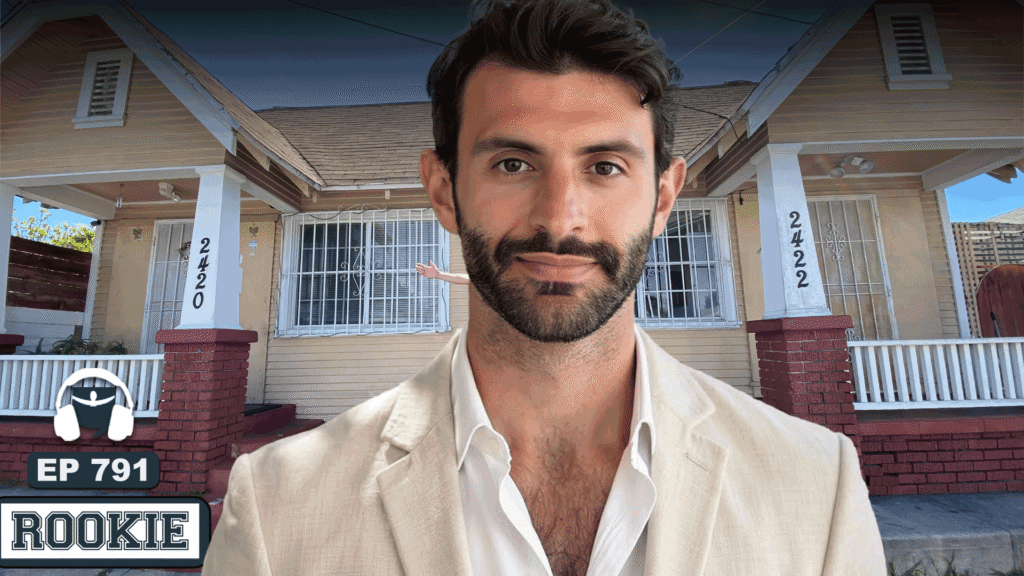
Two duplexes, four rental units—that’s all Erik Caci needs to retire comfortably. Most real estate rookies aim to buy 10, maybe even 20, rentals. But for Erik, just two in the right market might be enough to guarantee a financially free future. And the best part? He bought two duplexes with under 20% down (and you can, too)!
Welcome back to the Real Estate Rookie podcast! After Erik changed careers, he was forced to move to everyone’s favorite city to invest in (heavy sarcasm): Los Angeles, California. But with rent and home prices among the highest in the country, Erik had few options until a 100-year-old home that had been on the market for three months popped up on his feed.
It had all the best parts of an old home—charm, historic architecture, mold, termites, and a bad roof! So instead of putting 20%, or even 10%, down, he put down just 3.5% and saved the rest for renovations. Plus, he needed to move out a tenant before he could house hack. We won’t spoil how the renovation went, but in today’s show, Erik shares how this duplex unfolded, why he bought another similar property afterward, and why renovations aren’t so scary when you have your reserves ready.
Click here to listen on Apple Podcasts.
Listen to the Podcast Here
Read the Transcript Here
Ashley:
Eric Cochi found a century old duplex that had sat on the market for more than 90 days. He bought it for $665,000 with about $23,000 down through an FHA loan and planned to live in one unit. But getting in with three and a half percent down did not mean the rest was cheap. When the unit became vacant, he found mold and a bigger renovation than he’d expected. So today we’ll follow Eric’s first two duplexes in a tough market. We’ll unpack how he found the first deal, negotiated for a vacant unit, paid for repairs and measured the monthly shortfall. Then we’ll see who it changed on his second purchase and how a rookie can test a similar plan against their own income and reserve. This is the Real Estate Rookie Podcast, and I’m Ashley Kare. And unfortunately today I am solo without my wonderful co-host, Tony J.
Robinson, but don’t worry, he’ll be back on the next episode. But I do want to welcome Eric to the show. So Eric, thank you for joining me.
Eric:
Of course. Thanks so much for having me.
Ashley:
Now, before investing, what did your life, your work, your career, your finances look like before you even knew what real estate investing was?
Eric:
Yeah, good question. I started out honestly working retail. That’s kind of where I started out in my sales journey and was working in retail in high school and then into college. While I was in college, broke into luxury retail. So I worked for Louis Vuitton in college and then after college, there is where I really learned my love for working with people and maybe client development and maintenance and everything of the sort. So that’s kind of what life looked like before my current W-2, which is medical device sales. I’ve been in med device for five years now and it’s what took me out from the East Coast out here to Los Angeles. So that’s kind of what life before looked like. I was definitely more of a fixed income, whereas I believe with med device, I was able to branch off into larger investment strategies or at least start that journey.
Ashley:
So when did you first realize what real estate investing was? Was it someone that introduced it to you? How did you even learn about it?
Eric:
Yeah, so I actually, once I did have my first year of med device under my belt out here in LA and was making more of a higher W2 income, that is when I started trying to find out how I wanted to invest. I did listen to the personal finance podcast for some time and there there was an episode, I believe it was either on house hacking or even just a reference to BiggerPockets. And this had to be back in, I would say 2021. So that’s when I pivoted and started listening to BiggerPockets and learning more about the all encompassing real estate investing and what could be done.
Ashley:
Now what ended up being your first property that you purchased?
Eric:
So first property, it was actually a condo when I was still on the East Coast. I was living in New Jersey and thought I was going to be in that New Jersey, New York City market with MedDevice. So I did buy a condo and about four or five months later relocated out to LA for a different opportunity. And so I had it for a little bit, had considered maybe renting it out, but ultimately decided after a year to just sell that. But I at least was able to see what the process looked like or at least run numbers for the first time without really knowing too much.
Ashley:
Now with that condo, when you ended up moving, did you end up selling it?
Eric:
Yeah, I kept it and moved out here and probably had it for about six months or so. And again, was going back and forth on renting it or not, but couldn’t keep up with that mortgage as well. So ultimately decided to sell it. The market, it was not far from New York City, so it did appreciate over that year of time. So I was pretty good to break even on it and just get out without losing too much money.
Ashley:
Now you moved to LA, which is another expensive market. So what strategy did you decide to do once you decided you wanted to also invest in LA?
Eric:
Yeah, so once I did get out here and started learning more about real estate investing, I was then needing to figure out which strategy I would like to go with. And honestly, whether I liked it or not, the strategy for a city like LA was going to be house hacking. And then the conversation was, did I want to do a single versus a multi? Could I afford a multi and things of that nature. But I knew I was going to have to either rent out rooms or units to make the math work properly to cover a mortgage.
Ashley:
Now, is this the Jefferson Park duplex that you’re referring to, that it’s your first one?
Eric:
Yeah, the Jefferson Park property was my first.
Ashley:
Okay. So take us through finding that deal. So there was a price drop and it was more than 90 days on Zillow. Why did that make you look and what did you actually verify before offering on this property?
Eric:
So I feel like at this time, after doing all of my analysis and starting to look at the market, I was really just going on Zillow every night and definitely had a list of saved properties and favorites. And this one just wasn’t moving over time. So saw it extended past the 60 days. I’m pretty sure it even hit 90, and I did see a price drop as well. I loved just the look of it. It looked like it had good bones. It was in a more so up and coming neighborhood. And so there was something that I was drawn to, and over time with it sitting on the market, I just pulled the plug and messaged, I think it was the seller’s agent about it before I had talked to my realtor at that time. But yeah, I just wanted to go and see it and vet it for myself a little bit.
Ashley:
And this property was also a hundred years old, which on the East Coast is pretty common, but I feel like not as common on the West Coast. So was there a lot of rehab or anything that needed to be done to this property?
Eric:
Yeah. No, I mean, it was definitely one of the first. It was built in 1924. So like I said, we did get to go and see it and it had good bones and I could see the vision for it. But other than that, it did need a full cosmetic and a bit more even of a facelift essentially. And it was also in, this is another piece to it, but it is in a historic preservation overlay zone. So that at least was interesting to me in regard to keeping the integrity of the architecture in that area. LA is an area or a market that I feel like knew or the amount of space isn’t nearly as used for buzzwords as charming or restored or has a lot of character. And those are really highly sought after. So the historic zone was of interest to me. People are flipping these bungalows and they look incredible.
So I saw it as more of an opportunity whereas a lot of others kind of slept on this property.
Ashley:
Yeah. So I guess let’s go over that historic protection as in what does it mean? What do you have to follow? What are the rules with buying a property that is zoned this way?
Eric:
Yeah, so essentially that historic preservation, I’m not allowed to change any of the architecture with it. And certain things such as roof, siding, exterior paint color and windows all has to be cleared by the HPOZ committee in that area. So yeah, it’s essentially just to restore the look of these properties. And these are 1920s bungalows. They were built really well and just ensuring that this neighborhood doesn’t turn into a bunch of high rises in X amount of time.
Ashley:
I feel like a lot of investors would run away from that. And as you said, a lot of people overlook this property because of that. It’s just another approval. They need to get somebody else to make a decision on the property they’re purchasing, but you actually saw it as an opportunity. How difficult was it to actually work with the historical society on this?
Eric:
Honestly, it wasn’t nearly as hard as I though. I think I knew going into it I wasn’t going to be changing the architecture of the building. So if it was coming down to getting the windows approved and the paint color approved and a new roof, again, I’m not changing it, so getting the color of the shingles approved, it wasn’t going to be a huge hurdle for me. And I also kind of learned a bit about who’s running it and they’re actually in the neighborhood, so it’s someone that I could actually pick up the phone and call if I had any questions on those limitations. I think another part too that was really interesting was just I had to do market analysis as we do, and the neighborhood right next to Jefferson Park is West Adams, which between 2016 and 2024 had the highest property value growth out of all of LA.
And so for this neighborhood to be its sister neighborhood, I knew it was going to continue in this gentrification. So that kind of eased my mind in regard to starting a project here.
Ashley:
And this property had tenants in both units, but in order for you to house hack this property, you needed to have one of the tenants move out. So how did you make vacant delivery of the property upon closing part of your offer? And how maybe would you have done it differently or would you have kept it the same?
Eric:
Yeah, this was me not really knowing how these things work and kind of having to trial by fire a bit. I’m also in sales, so if you don’t ask, you don’t get it. And so I hear no all the time. So I had nothing to lose by asking if they could deliver a vacant unit. Also too, so crazy, I mean unless you live in LA and view all these houses, but most of these multifamilies that are on the market are fully rented out. So it’s actually kind of rare to find a vacant unit. So it wasn’t vacant, but essentially before consulting with my realtor, because the thing is I didn’t want to get him involved until I knew it was maybe a viable option, but I just in those initial emails had said we could put an offer down, but a unit has to be delivered vacant.
So I kind of just got the ball rolling with that. It was a property like we talked about that sat on the market for so long and they did a price drop. I know at this point they’re looking to sell it and offload it. And so if the only way they’re going to do that is by providing a vacant unit, maybe they’d be interested in doing so, which they ultimately were and got a tenant out by doing Cash for Keys.
Ashley:
I have a property that I’m selling right now that the people who are purchasing it want a house hacked too. So we had to give notice that we’re not going to renew the lease for the person that’s living in one of the units. And with the way that New York state laws are, it’s a 90-day notice, which would be way past our closing. Even though closings take long in New York, it wouldn’t take this long. And so we’re looking at options for Cash for Keys. And I understand that the seller actually did this in your situation too. How much was that amount that they actually paid for Cash for Keys?
Eric:
I believe they paid, it was either 25 or 30,000. 20 to 25.
Ashley:
Maybe I need to go and be a tenant for somebody that’s thinking of selling in LA.
Eric:
Right? 20 to 25 is the going rate.That’s kind of the average even if you Google it. And there was a time limit too because they had agreed to those terms. And so we start escrow. They had to be out in, I think it was 45 days. And so I think it was either 25 or 30 to expedite the process a bit and get them out.
Ashley:
Yeah. Which I mean, if you’re selling a property and that’s the only way you’re actually going to sell it, I mean, this property has already sat on the market for a while. They’ve already decreased the price. Paying a portion of your proceeds to actually get the deal done means you’re going to get a little less in your pocket, but maybe worth it to be done with this property and to move on to something else. So what was the full purchase price that you purchased this property for and how much cash did you actually need at closing for this property?
Eric:
So ultimately, originally I wanted to put maybe five to 10% down, and then after
Ashley:
A
Eric:
Walkthrough and inspections, understanding
Ashley:
That
Eric:
I had to do a new roof and some of the internal work as well. So then I started entertaining FHA just because I hadn’t previously. So I ended up going 3.5% down payment, which was a little over 23,000. And then closing costs, I had to pay about 5,000. So coming in right around 30 total. Closing costs out here again are 15 to 20,000, which I know can vary state by state. But between I think maybe a credit for the sewer line and them splitting the half with me, I think there was about 10,000 left, but we went five and five to split it.
Ashley:
So
Eric:
About 30K all in before renovations.
Ashley:
And what were some of the other things that came up during the inspection that you guys ended up splitting the cost for?
Eric:
Good question. Honestly, I think it was just the total. I think just whatever was left from a credit, maybe it was a credit for the sewer, potentially foundation too, which didn’t need a ton of work, a few thousand dollars, but ultimately there was about 10K left. They did five, I did five, just to call it even. Yeah.
Ashley:
Now, after you did close on the property, how was your estimate for what needed to be done for the sewer line, for example? And was there any other rehab or anything like that that came about after you closed on the property that was not found during the inspection?
Eric:
Yeah, I think me and my realtor walked it. I’ll never forget,
Ashley:
But we
Eric:
Knew what
Ashley:
We
Eric:
Were getting into
Ashley:
A bit.
Eric:
And I’m really grateful that I did decide to go with the 3.5 and have some more money for the renos, because honestly, it looked way worse without furniture hiding everything. So it was extremely dirty. The wall, I honestly couldn’t believe it was… It almost wasn’t habitable, to be honest. And once everything was stripped, you could kind of see the condition of the floors and the walls and the mold on the walls. And so it was turning into a property that I was just going to move in and chip away project by project to almost a full gut before I’m moving in with my partner and our dogs essentially.
Ashley:
Yeah. And how does that end up working out? You have this plan to move in and now you’re going to be paying a mortgage and rent at your other place for the length of this rehab project. To start, what was your first step as to when you decided, okay, we actually need to rehab this before we can move in, what was the first thing that you did?
Eric:
So first thing, we did that walkthrough and I kind of then understood what needs to be done. I have to have someone come look at this property and quote it out. Luckily, square footage-wise, it’s not huge. It’s about 650 square feet. It is a two bed, one bath, has a living room and kitchen all in one. So it’s cozy little unit. So I knew it wouldn’t be too, too long for work, but I did have to get a quote to see what those cosmetic and mold remediation would look like starting out. So kind of unconventional route, but had asked my realtor for a general contractor and maybe a couple other friends in the industry. But ultimately in the neighborhood I was renting in the apartment, I was more like Mid-Wilshire Miracle Mile for anyone listening who knows, but another gentrified area in LA, it’s beautiful, but there was one house that stood out.
It was more modern for sure and had a different design element. And honestly, I asked those owners who helped design their property. They gave me his information, his name was Adam, and I had Adam come and walk my property. Adam works on houses that are millions and millions of dollars, and so he did come and check it out and it’s out of his budget for the most part, but he was able to refer me to a contractor he works for for smaller projects, and I was able to bring Adam on in some capacity. We worked something out where I was going to pay him for helping design the unit essentially. So restoration, but make it a little bit more modern. It was going to be a rental unit, so it did have to get a laundry machine and a dishwasher in and how to maximize that space properly.
Ashley:
So what did that first renovation actually end up costing you, and how did you pay for it? And then how long, I guess, did it actually take before it was ready for you to move in?
Eric:
Yeah, so we were a little bit stuck on time. Our yearly rent was going to be up in about a month and a half. So I did have about 45 days, and that was kind of the timeline that I gave them. And just knowing the size of the unit, I thought it would be possible. And it was, honestly, at the end of the day, so it was great. The day we were moving in, they were finishing the door hinges, so it was really tight, but we were able to get it within that month and a half mark since our rent was coming up. But all in all cost, I remember the scope of work being about $26,000, and really the main reno was the bathroom and the kitchen setup, but that didn’t include any of the fixtures or the appliances. So I would say total would be about $40,000.
Mold remediation, let’s call it $45,000.
Ashley:
The mold remediation, was it as bad or as expensive as you expected it to be?
Eric:
Honestly, I thought it could have been worse. I mean, throughout inspections, they check for asbestos, so I knew it wasn’t something too major, but the spot in the bedroom where it was, was kind of large in the ceiling and part of the wall. So I think that cost was about $6,000. But if they can guarantee it’s fully out of the property, that’s a small price to pay for me and at the time, kind of small family living there, as well as renters moving forward. And that’s kind of a non-negotiable, had to get done. Yeah.
Ashley:
I just think there’s this big stigma around mold. When people sees mold in a property, it’s like, oh no, nope, not going to deal with it. But it’s actually one of the easiest things to do, even if it is expensive or is going to cost $6,000. I did a whole attic before, and I think it was 5,000 for the attic, but compared to what I was going to be able to sell this property for, $5,000 was nothing. And I think that if there is some kind of repair or something like that, that scares you as a rookie investor, find out what the process is to actually fix it and what the cost associated with it is, and become an expert in hiring a contractor to do that thing. And then you can go and buy all these properties that other people don’t want because they’re scared of something that can actually be fixed and remediated, like in your case, the mold.
So I think that’s just probably another reason why people walked away from this property is because they were scared of things like mold and it ended up being a great property for you.
Eric:
Yeah. And it really was only in that one spot in the bedroom. And to your point, and maybe it had to take me closing on it and getting in it to not be deterred, because at that point, I’m all in on this property.
Ashley:
You had no other choice.
Eric:
But yeah, when you think of mold, it could be so daunting. You’re probably thinking it’s just something that grows and you don’t know too much about it. Could it be everywhere? And so probably all those blanket statements or questions around it deter people. But if you do, like you said, your research on it and understand it can be treated. Same with termites or foundation work, to what extent are these properties needing the work? And so once you do a deep dive, I think that’s where you can find the diamond in the rough in these larger cities where the prices are so high.
Ashley:
Yeah. And I think your real estate agent is a great resource for if you don’t even know where to start to find a contractor for a specific thing. I was looking at a house recently where there was something wrong in the foundation. My agent’s like, “I got a foundation guy. He’s the best. We all use him within my brokerage. Let’s call him and let’s get him out here and let’s get an estimate.” I had never done with this kind of repair at all, and my agent already had a guy ready to recommend, ready to send him in. So that’s a great resource if you do run into an issue you’ve never dealt with before to find a contractor for it.
Eric:
Yeah, that was probably really daunting, just not knowing who to get to fix all these problems, even just cosmetic, but having someone who’s been in the business, it’s just like that’s a resource who has so many contacts, a realtor, so why not utilize them? And they’re using people that either they use for their clients on their houses. These are vetted –
Ashley:
Contractors.
Eric:
Contractors that they’ve used before.
Ashley:
Okay. So you’ve finished the rehab and now you moved into one property. What is the rent that is coming in from the other property, and what is your monthly housing costs that you are actually paying compared to what your mortgage, utility, and all your monthly expenses are?
Eric:
Yeah, and there’s pros and cons to doing FHA, and ultimately you’re going to have a larger mortgage with putting so little down. So the quick math of it was the mortgage was going to be $5,000. And so with this property being a longer play, the logic behind it was just figuring out if two units could cover $5,000. So whether that’s 25 a piece, they were basically identical except one had a driveway and a little shed on one side. So if I could realistically see each unit going for 2,500 when all was said and done, then it made sense to me. So that was kind of the logic behind it. Starting out though, and I don’t want to go on too much of a tangent, but California, as we all know, tenants rule. It’s tenant law, good luck landlords.
Ashley:
I’m in New York. I know.
Eric:
Yeah, it’s the same situation. And so I do have a real estate attorney who I was able to talk everything through, and really the easiest and fastest way to get someone out is cash for keys. And having put so much money into the reno, I was like, “No, I’m not kicking these tenants out quite yet.” They were also great tenants. They’ve been there for 12 plus years and they treat it’s their home, so they take care of this property. So below market value, they were paying, I want to say 1,550.
Ashley:
Oh, and it should have been market rate was 2,500?
Eric:
Roughly, yeah. But the thing is, unit wasn’t rented, or I’m sorry, unit wasn’t renovated, so they are living in a property that probably hasn’t been touched since the ’80s or so. But yeah, I think it was around 1,550 to 600. Nope, 1,550 to 1,600 when I took that over. So I had to cover that delta while I was in my unit.
Ashley:
So really your play here wasn’t to cash flow on the property, it was to own a property, have the tenant pay a portion of your mortgage, have that mortgage pay down, build equity in the property, and also bank on appreciation in a fast growing area.
Eric:
Yeah, the play on this was buy and hold for sure. This is a property that… I’m in sales right now, I’m in med device. I am an advocate for the W-2, especially just starting out in real estate investing, but I don’t want to do it forever. Who does? And so honestly, this house paid off in 30 years is, at this point in time, $5,000 in my pocket. In 30 years, upwards of six, $7,000 coming in a month. Two of these, that’s a retirement fund. So that was kind of the logic behind buying here and holding these properties.
Ashley:
This is why I love having you on today, Eric, because a lot of people just get so caught up on cash flow and to be able to quit your W-2 job, which I completely understand wanting to leave your W-2, but if that means buying a property now rather than waiting for interest rates to drop or waiting until you find the perfect deal, if you’re able to house hack, reduce your own personal expenses, even though you’re not 100% covering the mortgage payment of the property, that is going to help you build wealth a lot faster. And just like you said, looking down the road, this is a retirement play for you as to you don’t need a thousand properties. You and your plan, you need two. How easy is that to get two properties and then your set?
Eric:
No, that’s exactly it. It’s like quality versus quantity, and I’ve heard some guests, of course, and it’s so enticing to figure out how to buy 20 out in the Midwest, and we’ll talk about that further later. But the quality versus quantity, I was like, these four units will produce over 10, $12,000 when they are paid off, and that’s just two multifamilies here in LA. So the goal, or at least why I’m an advocate for the W-2, is it’s allowing me to do all of this and experiment, but there’s a solid level of protection associated with it. And honestly, the W-2 is how I’ve been able to make the numbers work here in L.A. Without that, I could never purchase here or take on a hit like that monthly. So yeah, it’s allowed me to do what I’m able to do here.
Ashley:
Okay, so moving on to your next property, you decided to house hack again and you chose the Hollywood duplex. So what features or deal terms made it a better fit for you for your second house hack?
Eric:
So basically I was in the Jefferson Park house for almost two years and was able to, yes, there was that initial reno, but then was able to chip away at the other pieces to it, some work on the siding, exterior paint, termites, a little foundation work, things of that nature, windows, new windows we put in. And so after that, it was kind of done and ready to be rented. So at that point, I wanted to move on to another property. I just so happened to close a really big deal within work because I wasn’t sure if I’m going to then rent and take a beat in an apartment or if I’m able to buy something else. And with closing a larger deal within my W-2, I was able to purchase something else. So got a tenant in and was moving into here. I’ll speak to why Hollywood was an attractive market, but essentially L.A.
Is broken up across all these neighborhoods. Sometimes it is pockets street by street, but what I realized living down in Jefferson Park was it was about 20 minutes far from your central bubble of Beverly Hills, West Hollywood, Hollywood, and it was a little too far. So we found a great renter for it and it made sense and they’re down in that area, but I just knew that this location was going to rent no matter what I price it at. It’s right off Sunset. There are so many things five minutes away from here. So the location was the best I’ve ever seen One of these properties within this budget.
Ashley:
Now with this property, you decided to only put 12% down, or I guess not only, but you decided to put 12% down, but compared to the three and a half percent you did on that first duplex. So why did you choose that amount and did you use a different loan this time?
Eric:
Yeah, so I mean, I really learned a lot from the first property. So now just looking back a little bit, 5,000 mortgage, the two units will cover it at some point, but not quite yet. But at least now one is rented for 2,500 and the other is doing about 1,750. So I’m still throwing about, let’s say six, $700 at that one duplex, but that’s all I’m paying towards the mortgage. So it’s still a win for me. But in the second one, I wanted to get the numbers even closer or break even. And so that essentially was going to come down to putting a larger down payment. So that’s where I decided to do 12%. Also, this property didn’t need nearly as much work. And so there were a lot of green flags just initially looking at this one that wasn’t on the other property.
Ashley:
Now with putting in more money down, you’re really reducing your risk. If for some reason you came into a cash crunch or lost your W-2 job where you still have this mortgage payment to pay, by putting more down, you’re reducing the amount of your mortgage. And if you come into a situation where you have a lot of capital to be able to do that, how did you calculate though how much you should save for reserves for both of your properties?
Eric:
Yeah, great question. I think from having the first one for two years at that point, I kind of knew what could come up with an older property and we’ve had our fair share of toilets not working, this electrical light’s out. I feel like I saw so much in those two years that taught me just what I needed to have a buffer. And I think I would’ve even put more down if I didn’t want to keep a chunk for reserves. So I also knew there was going to be some cosmetic work that this unit needed. Again, this was a duplex, so one was rented, so I really just had to worry about the unit I was moving into. So just quick math on it, what I needed here, what I had to put down and what I wanted to save for reserves. So the other two kind of dictated what I wanted to save for reserves, but I didn’t see it, it wasn’t going to be necessary to keep more than let’s say 20 to 30 grand available for both properties at this time with having the other one doing so much work on it and coming into this one with a solid inspection done.
Ashley:
Now looking at the two duplexes today, what are they bringing in monthly each of them? And then what are your estimated costs for each of them each month that you have?
Eric:
Total mortgage payments or total mortgage every month is 9,600. So one property is 5,000, the second one is 4,600. So currently one is rented, the renovated one for 2,500. The other two are rented for 1,550 and 1,750. What’s the math on that?
Ashley:
This is where we need Tony because he’s like the math wizard and he’ll calculate all of these numbers for us.
Eric:
Let me do it quick. 1,550 plus 1,750. Okay, so 5,800 and I’m paying 96. So I’m covering a delta of 3,800.
Ashley:
And you’re living in one unit?
Eric:
That’s the thing. I am living in one unit. So this unit is… What’s interesting about this one and ultimately why I wanted this property other than the location was that this side, whereas my previous one didn’t, but this side had the driveway. So most of these duplexes, just one side is going to have it. So this side had the driveway and it also had a garage, two car tandem garage. It’s like 275 square feet that someone was looking to do something with. They put air conditioning in, like a split unit, and they also put in recessed lighting.
Although the unit itself is one bed, one bath, 625 square feet, there’s this extra bonus room. I’m just thinking in my head, I mean, I know musicians out here, artists out here, people who want an office or a little granny flat. I just see so much value with that plus the driveway. Why am I going on a tangent? Oh, because what I’m saying is yes, I’m in that 3,800 delta, but this unit, I’m almost done with it and then we’ll rent it out. We’ll go for, let’s say roughly 2,800. Then I’m just left paying $1,000 to cover four units here in the heart of LA. That’s a win for me.
Ashley:
I can’t stress this enough because initially a lot of rookies may hear that and be like, “You’re paying a thousand dollars for these other people to live in your properties. They’re not cash flowing. Why would you do this? Is it a bad investment?” Look at people who invest in the stock market. They literally are putting their money into an investment and they don’t see it. You are putting a thousand dollars into these properties that are appreciating. There’s mortgage paid on someone else’s paying off the property for you, and it is an investment. Yes, you are sending that money away every single month, but in the long run, it is going to be a huge benefit to you with having these paid off properties at some point.
Eric:
Totally. I mean, it’s a form of savings as just like the stocks. I’m throwing a thousand dollars at savings and these three tenants, well, it’d be four tenants at that point, are throwing $8,600 at my savings. With the market as it is too, and just LA being LA, they’re always going to appreciate. We hear about people leaving California because it’s not making sense anymore. They’re not leaving LA. The bubble keeps expanding and the prices keep going up. So that also adds to the risk involved here or lack thereof, for me at least.
Ashley:
And I think too, your plan is to keep your W2 job for the meantime. It’s not like you’re trying to exit out of your job. And correct me if I’m wrong, but I would assume that you can easily afford that thousand dollar payment a month where if someone else is coming in and they maybe only make $3,000 per month and that’s what they have to live on and then they’re paying a thousand dollars, if it is going to be a struggle for you to actually cover that cost every month, then yes, it probably is a bad deal for you. You don’t want to stress yourself out trying to make sure you can make the mortgage payment every single month, but if you can easily afford that investment every single month, then yes, this is something that you could look at as an investment opportunity for you.
But I just wanted to give that word of caution.
Eric:
Yeah, no, absolutely. And that’s the thing that I love about real estate investing is you can do as much or as little or you can figure out something that’ll fit within your budget and buy box essentially. This may work for me and someone may listen and be like, “Well, that’s crazy. I can’t do that.” Okay, well, you might not be in a sales job right here in LA, but I’m sure you can figure out the numbers in your market some way. So this just happens to work for me. I can cover that thousand dollars once I am out of here. And that’s the thing, I’m not moving into an apartment next that’s going to cost me five grand. I’m going to be a bit frugal with it to help cover that thousand because no matter how much I make or anyone makes, as long as you with real estate investing, just be smart with your money and yeah, you kind of have to get creative with it.
So really being so smart across the board, not to toot my own horn, but that’s how I’m able to do these things. It’s not just throwing shit at the wall and hoping it sticks.
Ashley:
And I think too, think a thousand dollars split over your four tenants, in several years there could be enough room to increase your rents per each unit where it’s not a huge significant amount put on each tenant, but you could probably cover that deficit within several years just by increasing rents by a little bit every single year upon renewal.
Eric:
A hundred percent. The Hollywood house will break even a lot sooner, but the Jefferson Park house is going to break even. Both of them are. So you’re right, that thousand dollars we can raise, that’s the other thing in LA is in New York too, but there is the rent stabilization ordinance. So I can only raise it roughly about two to 4% a year, but every single year we are and chipping away at those two units. So you’re right, that delta’s getting smaller and smaller until they both break even. And that’s going to happen within the next, let’s say 10 years.
Ashley:
Unless you’re listening from New York City where there’s just the rent frees, you cannot do that.
Eric:
Oh my gosh. So it’s even better here. Got it.
Ashley:
Yeah. Who would’ve thought? Now, one question I have before we wrap up here is on your W-2 income. So as a sales job, I would think that a lot of your income is based off of your commission. How did that affect you applying for loans for these rental properties?
Eric:
Yeah, honestly, that was a little stressful at times because… So I did move jobs about a year ago, and I’m in a position now after just putting in my time in med device where I was able to get a healthy salary as well as commission. But the job I had first and for about four years in med device was commission only. They’d give you a bit of a draw, but there’s no base involved. So it was also capital equipment, which not to go too far into it, but that is those larger pieces in a hospital that are not selling every month. These deals would take a year to two years to facilitate some of these major paychecks.
Wait, what was the question? Oh, so I would go previously months without taking in a big check, and so that didn’t really look great, but then you can show a month that you’re making six months worth of your average per se, and it would kind of make up for it. So I definitely had to show my history across years of how much I was making, whereas now in this role of the base in commission, it’s definitely a bit easier to do so. And having the one property under my belt for this one made it a lot easier too. There’s already proof of concept here. So yeah, the more you do, the easier it gets in regard to people or in regard to your credibility.
Ashley:
But now I’ve learned that you’re actually looking at shifting your strategy and looking at single family Burr deals in the Midwest, which we touched on the Midwest a little bit, but why did you decide to change markets and what would you need to verify before you actually decide to invest in one remotely?
Eric:
Yeah, so I know not to… I hope I didn’t speak negatively on it earlier because now that’s what I’m doing, but essentially my tactic here can only work at a certain pace. So let’s say I can get a property or a new multifamily or condo or something of the sort only every, let’s say one and a half to two years because I’m using my own capital. I could use private money here in LA, but I’m never going to get the margin that I could in the Midwest. So if I’m borrowing and I would need a lot more, so let’s say I need something like $500,000 to a million here, that doesn’t mean the property’s then going to go for two million. The margins just don’t make sense here. Whereas out there, if I have 150, could I turn it into 300? Yeah, and pay a private money lender back.
Ultimately, it came down to the point of do I just want to get one of these every couple years or do I want to scale? And from my first to my second, how quickly I was able to renovate this one and make those calls and get it done, I want to scale. I don’t want to wait another two years. So ultimately I started shopping around for a mentor or a consultant.
I think something that’s really important, not to go too much on a tangent, but you’re never too, and this is what this is all about, but you’re never too old to learn. I have a coach for my programming and my nutrition, and then I’m also looking for a high performance coach to help with work and the growing real estate platform. So why not get someone to assist me with the houses?
Ashley:
Especially when you’re doing such a huge pivot.
Eric:
Yeah.
Ashley:
Completely different.
Eric:
Totally different that I don’t know. At a certain point I was like, okay, maybe I’m buying something for 70,000, but I’ve already purchased something for 700,000. I still don’t know that market. The numbers might not be as high, but I want to still make sure it works out properly. So ultimately started interviewing some of the, honestly, BiggerPockets, either hosts and/or members that have come on and spoke to things. I had a couple conversations that some hit, some didn’t really, but one seemed really, one spoke to me pretty well, and that was working with or chatting with Brian Waters. So he was on there and listened to his and just wanted to learn a little bit more. So we hopped on a call. He’s also out here in California, has purchased out here, kind of understands the lay of the land. He’s also a firefighter. I was selling patient resuscitation devices for years, so I was selling devices that he’s used before.
So there were just some familiarities there. And yeah, his approach was, again, more quality versus quantity. Doesn’t have, let’s say, I mean, I’m sure he will at some point, but doesn’t have 500 people to all asking him questions right now. And so I thought I could get a lot more one-on-one with him. So ultimately decided to start learning about what he was doing, which is burring out in a couple Midwest markets essentially. And that’s how ultimately I figured out that’s how I’m going to be able to scale and utilize private money.
Ashley:
Well, we need the insider information. What are those specific markets that you’re looking at in the Midwest?
Eric:
Imagine I’m like, legally, I can’t say. No. So the markets Brian focused on and I’ve learned a lot about, and I’m also interested, main one is going to be in Tennessee. It’s going to be Memphis. And then his other larger market that I haven’t done as much research on, but he looks at Detroit as well.
Ashley:
Oh, interesting. Okay. We had a guest on Instagram. She was the Detroit investor and her name was Ashley, and she had a lot of success in Detroit several years ago where a lot of people were just hating on Detroit. And she came on, I think, rookie podcast twice and just proved people wrong with the numbers she was getting on properties.
Eric:
I mean, I think the things like Chicago is still a great market and let’s say Tennessee, Nashville too, but they’re already on the map, too far on the map that you can find properties, but the numbers aren’t going to make as much sense. So looking at a Memphis or a Detroit, I think are genius. And he’s kind of already built a team to facilitate the boots on the ground out there. So yeah, I’ve learned a lot from him and have been able to craft the next steps and what I’m going to be doing in 2027, and also what I’m going to be utilizing investors for to help me scale. So it’s been a great few months with him so far, but yeah, highly advised if you’re looking to break into a market or a different strategy, use your resources and learn from someone who’s doing it successfully.
Ashley:
Well, Eric, thank you so much for coming on Real Estate Rookie today. Where can people reach out to you and find more information about what you are doing?
Eric:
Thank you so much for having me. This was great. I’ve been listening to BiggerPockets for years now, and especially real estate rookie. So listening to you and Tony week after week and learning how I’ve figured out what I want to do and what’s going to work for me has come from listening to all these different strategies. So thank you so much. To reach out to me, I would say my main platform’s going to be Instagram. So Erik Cacci, E-R-I-K C-A-C-I. And there it does have my real estate investing company, Gather West, is linked to that. So you’ll be able to see the projects we’re working on and where we’re going through there. But yeah, I would say my main is probably going to be the best one.
Ashley:
Well, Eric, Tony’s going to be really upset. He missed this episode since he does live in LA himself and could relate to a lot of your market insights there. But also he did recently look at a couple Midwest markets himself too. So yeah, I’m going to have to tell him he’s going to have to go back and listen to our episode together.
Eric:
It’s the move. I think it’s the move. But yeah, these two will be golden gooses that I’ll hopefully have forever or be able to pull equity out of and use for more projects. So that’s it.
Ashley:
Yeah. And I think this was such a great episode for rookies to not get caught up in the cashflow play as to you’ve built this stable portfolio and you have this strong foundation before you went in and kind of are going to experiment in a sense in the Midwest market. You did something that was very risk adverse and secure. You house hacked for those two deals to make them work for you, and now you just have built this solid foundation for yourself for building wealth.
Eric:
Thanks. Yeah, we’re on our way.
Ashley:
Yeah. Well, thank you guys so much for joining me. I’m Ashley and Tony will be back on our next episode. Thank you guys so much and we’ll see you next time.
Help Us Out!
Help us reach new listeners on iTunes by leaving us a rating and review! It takes just 30 seconds and instructions can be found here. Thanks! We really appreciate it!
In This Episode We Cover:
- Why just two rentals in the right real estate market could be enough to retire you
- Putting just 3.5% down on your first (or next) rental property with the house hacking strategy
- Buying “historic” houses and the renovation approval process to be prepared for
- Why your rentals don’t need to cash flow to be worth the investment
- Stay in LA? Why Erik may switch up his strategy and invest in these two overlooked markets
- And So Much More!
Links from the Show
- Ashley’s BiggerPockets Profile
- Tony’s BiggerPockets Profile
- Join BiggerPockets for FREE
- Real Estate Rookie Facebook Group
- Real Estate Rookie YouTube
- Ask Your Question for a Future Rookie Reply
- “Like” Real Estate Rookie on Facebook
- Follow Real Estate Rookie on Instagram
- Sign Up for the Real Estate Rookie Newsletter
- Find Investor-Friendly Lenders
- Sign Up for BiggerPockets Pro to Unlock Free Property Management from RentRedi, Automated Bookkeeping from Baselane, and More!
- The “Repeatable” Strategy That Helped Him Buy 6 Rentals in 6 Months (Working 9-5) w/Brian Waters
- Connect with Erik
- Erik’s Instagram
Interested in learning more about today’s sponsors or becoming a BiggerPockets partner yourself? Email [email protected].
