How do YOU Screen for your Markets (specifically out of state)

How do YOU Screen for your Markets (specifically out of state)

New to Real Estate · CA · Member since 2020 · 15 posts · 3 votes

Hello BP Community,

I wanted to ask everyone how they conduct market research, what you're processes are, and how you go about filtering all 50 states, to exclude states from your research and how you choose states(cities) or areas of interest to take a deep dive in.

Ex. The way I've narrowed it down is by:

  • Gathering data from all 50 states (population growth, median income, crime, price-to-rent, etc.)
  • Filter out states that have rent laws
  • Filter out blue states (not because of political beliefs but from my understanding they have less rules and regulation and I believe that in the current climate we're in with COVID and all people are going to flock to areas that don't have as much regulation)
  • Highlight states that people retire in more than others
  • Because of short-term rental becoming a trending way to invest, filter out states that impose regulation/rules against short-term rentals using platforms like Air BNB, etc.
  • Also, using ZILLOW, I type in my parameters (homes under $125,000, sqft. > 1000, 2bd+/1bth+, made 1950+) and I see where there's more volume in specific states (like Texas or Ohio for example); with this parameter I can exclude quiet a few states because I dont see any hardly volume on Zillow given my parameters above. 
  • Take natural disasters into account (more hesitant to invest in areas were theres lots of hurricanes, tornados, fires, etc.)
  • CURRENTLY, i've weeded it down to about 20 states 

Im curious to know how others conduct their research to build strong bias for a specific market. (Basically, if someone asks you why you choose this state to invest in out of state, there's more to it than "Its a HOT market, blah blah blah.")

Please feel free to reach out an message me or comment. 


Isaiah A.

2Reply
68 views

Most Popular Reply

Greg H.Pro Member
Moderator
Broker/Flipper · Austin, TX · Member since 2013 · 4k+ posts · 4k+ votes
4y

I have flipped or had rentals in 22 different states over the years. My criteria is simple. I want to be able to sell it for more than I paid for it. All markets are local as I never pay attention to national trends

See this reply in the discussion

14 Replies

Jump to latestLatest
  • Greg H.Pro Member
    Moderator
    Broker/Flipper · Austin, TX · Member since 2013 · 4k+ posts · 4k+ votes
    4y

    I have flipped or had rentals in 22 different states over the years. My criteria is simple. I want to be able to sell it for more than I paid for it. All markets are local as I never pay attention to national trends

  • Brandon GoldsmithBusiness Member
    Real Estate Agent · Columbus, OH · Member since 2020 · 1k+ posts · 1k+ votes
    4y

    It seems like you are a more in-depth track than most investors. I would also not just look at these markets as whole states though because even in Ohio there are multiple good markets but they are still pretty different. I would identify what you are looking for in an ideal property as well and go from there. @Isaiah J Aragon

  • Remington LymanBusiness Member
    Real Estate Agent · Columbus, OH · Member since 2017 · 6k+ posts · 7k+ votes
    4y
    Originally posted by @Isaiah J Aragon:

    Hello BP Community,

    I wanted to ask everyone how they conduct market research, what you're processes are, and how you go about filtering all 50 states, to exclude states from your research and how you choose states(cities) or areas of interest to take a deep dive in.

    Ex. The way I've narrowed it down is by:

    • Gathering data from all 50 states (population growth, median income, crime, price-to-rent, etc.)
    • Filter out states that have rent laws
    • Filter out blue states (not because of political beliefs but from my understanding they have less rules and regulation and I believe that in the current climate we're in with COVID and all people are going to flock to areas that don't have as much regulation)
    • Highlight states that people retire in more than others
    • Because of short-term rental becoming a trending way to invest, filter out states that impose regulation/rules against short-term rentals using platforms like Air BNB, etc.
    • Also, using ZILLOW, I type in my parameters (homes under $125,000, sqft. > 1000, 2bd+/1bth+, made 1950+) and I see where there's more volume in specific states (like Texas or Ohio for example); with this parameter I can exclude quiet a few states because I dont see any hardly volume on Zillow given my parameters above. 
    • Take natural disasters into account (more hesitant to invest in areas were theres lots of hurricanes, tornados, fires, etc.)
    • CURRENTLY, i've weeded it down to about 20 states 

    Im curious to know how others conduct their research to build strong bias for a specific market. (Basically, if someone asks you why you choose this state to invest in out of state, there's more to it than "Its a HOT market, blah blah blah.")

    Please feel free to reach out an message me or comment. 


    Isaiah A.

     I did not screen my market at all. I just moved to Columbus, Ohio and started investing local.

    It does not matter where you start as long as you develop your Core 4. The core 4 is David Greene’s strategy for long-distance and made up of a realtor, contractor, property manager, and lender. Once you have this team in place, you should be able to confidently invest in any market.

  • Jonathan GreeneBusiness Member
    Real Estate Consultant · Madison, NJ · Member since 2016 · 6k+ posts · 7k+ votes
    4y

    Doing data on all 50 states is a gigantic waste of time in terms of finding your target market, but great for overall country knowledge. I think you are looking at it all wrong. What states or towns do you have a competitive advantage in already? Where have you lived in your life? Where do your closest family and friends live (the ones you like)? Those are areas that, if they match with good data, are your target markets because you either have more personal knowledge of the area or have real boots on the ground who you trust already. When you don't do this you are only working on metrics that are usually obsolete by the time you invest. A hot market now is already too late to join if you want the best investments in my opinion.

  • Real Estate Agent · Columbus, OH · Member since 2021 · 98 posts · 101 votes
    4y

    @Isaiah J Aragon You really broke down each market. Nice going. Although, I wouldn't rely on Zillow too much but your price points are spot on as far as BRRRR's. What 20 states are you considering? Also, I get taking into consideration natural disasters but why exclude those states? What rent laws are you talking about? I think when you make things more difficult that's when more obstacles occur, but on the other side of that I get it. Investing can seem huge, but the simpler the better. Happy Investing!

  • New to Real Estate · CA · Member since 2020 · 15 posts · 3 votes
    4y

    @Greg H.

    Being from California and looking to

    Invest somewhere out of state. What sort of things would you look at to help narrow it down to a few markets?

  • New to Real Estate · CA · Member since 2020 · 15 posts · 3 votes
    4y

    @Clay Boykin

    I don’t exclude any disaster areas but I guess just helps with filtering to find “the perfect states to look into” (which Isn’t necessarily the way to go about after what I’m seeing in the forum. Why do you say not to rely on Zillow?

    (Listings from agents preferred in your opinion?)

    The 20 states are FL, AL, IN, KT, IO, OK, AK, OH, LS, KS, MI, WV, TN, NB, GA, TX, WY. And just general rent control.

    Idk man. Just trying to weed it down make it simpler. 🤷🏽‍♂️ I think at this point I’m going to pick a handful of those states based on the various things others are saying in this forum and areas that I like or have an edge in and just start running deals.

    Gotta make it over the analysis paralysis but once I do I can figure out the core four, running deals and other stuff.

  • Investor · Coeur d'Alene, ID · Member since 2015 · 28 posts · 15 votes
    4y

    If the markets you're looking at seem inflated, which a lot are right now, you could throw in property tax disclosure status into the mix. 

  • Investor · The Creek, WV · Member since 2014 · 890 posts · 1k+ votes
    4y
    Originally posted by @Isaiah J Aragon:

    @Clay Boykin

    I don’t exclude any disaster areas but I guess just helps with filtering to find “the perfect states to look into” (which Isn’t necessarily the way to go about after what I’m seeing in the forum. Why do you say not to rely on Zillow?

    (Listings from agents preferred in your opinion?)

    The 20 states are FL, AL, IN, KT, IO, OK, AK, OH, LS, KS, MI, WV, TN, NB, GA, TX, WY. And just general rent control.

    Idk man. Just trying to weed it down make it simpler. 🤷🏽‍♂️ I think at this point I’m going to pick a handful of those states based on the various things others are saying in this forum and areas that I like or have an edge in and just start running deals.

    Gotta make it over the analysis paralysis but once I do I can figure out the core four, running deals and other stuff.

     What states are KT, IO, LS, and NB? I'm not even trying to be funny or rude, I have no idea which states you are referring to in these abbreviations.

  • Investor · Coeur d'Alene, ID · Member since 2015 · 28 posts · 15 votes
    4y

    @Derrick E.

    My best guess is Nebraska, Louisiana, Iowa, and Kentucky.

    Not OP, but an areas MLS may not license any or some available data to Zillow it's not a true picture of what's on the market. That's at least the biggest complaint I've heard outside of not being able to filter contingent accepting other offers.

  • Investor · The Creek, WV · Member since 2014 · 890 posts · 1k+ votes
    4y

    I was guessing Kentucky, Louisiana, and Iowa but had NO CLUE on the NB...you are probably correct that OP was meaning Nebraska. 

    As for Kentucky. I have rentals there and getting out of them with their current governor and his eviction moratorium. I wouldn't invest in any state that allows free-loading tenants to live in your property without paying rent. 

  • New to Real Estate · CA · Member since 2020 · 15 posts · 3 votes
    4y

    @Derrick E.

    Kentucky

    Iowa

    Louisiana

    Nebraska

    Sorry peeps…got the abbreviated wrong

  • Property Manager · Columbus, OH · Member since 2021 · 66 posts · 121 votes
    4y

    @Isaiah J Aragon Be careful of analysis paralysis.

  • Eric FernwoodBusiness Member
    Realtor · Las Vegas, NV · Member since 2014 · 995 posts · 1k+ votes
    4y

    Hello @Isaiah J Aragon,

    I applaud your methodical process. I went through the same exercise 15 years ago and knowing what I know now may be able to help you narrow down your search. I approached location selection based on metro areas, not states.

    Location

    I recommend selecting a location that meets all the following criteria.

    • Appreciation - The number one location selection criteria is appreciation. Inflation constantly erodes buying power; each year, it costs more to buy the same set of goods. If you buy in a location where pre-COVID prices and rents increased faster than the current inflation rate, you will continue to have the funds you need. If not, the initial cash flow will be the highest you will ever receive, and you will have a continuously declining standard of living.

      You may have noticed that I use rent increase and appreciation interchangeably. The reason is that appreciation and rents are tied together. If prices increase (appreciation), rent will follow, but with a 2 to 10-year lag depending on the market. What is happening with property prices today is an excellent indicator of what will happen with rents in the future.

    • Population Size - Greater than 1 million. Small towns may rely too much on a single business or market segment.
    • Population Growth - If people are moving into a location, many things have to be right. Never invest in any location where the population is stagnant or declining.
    • Crime - People and companies will not move to locations perceived as dangerous.
    • Operational Costs - Costs like property taxes, insurance cost, state income taxes, regulatory costs (ex: time and cost to evict), inspections, rent control, etc., have a tremendous impact on your return. Select a location with relatively low operational costs. Operational costs are a direct hit on profitability.
    • Disaster Risk - Some parts of the country are more prone to natural disasters. The best indicator for natural disaster probability is homeowners insurance cost. I would avoid states with high insurance rates. Note, even if insurance pays for all the damage your property suffers, you still lose. When a significant disaster occurs, people and jobs move to locations where they can make money today. The location may take years to recover, or it may never recover. ValuePenguin is a good source for the relative cost of insurance by state.

    I recommend you apply the above filters in the following order, from quickest to most time-consuming.

    1. Population size. - Wikipedia.com
    2. Disaster Risk - Homeowners insurance cost. Landlord insurance is 10% to 20% higher than homeowners, but there are good state-by-state comparisons for homeowners insurance. - valuepenguin.com
    3. Crime - One source of cities to avoid is Neighborhood Scout's 100 most dangerous cities. Avoid any city on this list.
    4. Population growth - Wikipedia.com
    5. Operational Costs - Your approach to eliminate blue states is good. I know of no blue state with reasonable operational costs. Another filter is property tax rates. For example, Texas has no state income tax, but it does have high property tax rates.
    6. Appreciation - Pre-COVID. Zillow research is the best option I know. Look at zipcode pre-COVID appreciation rates, not metro averages.

    At this point, you should have a small set of potential cities. The next thing you need to be successful is a good investment team.

    Investment Team

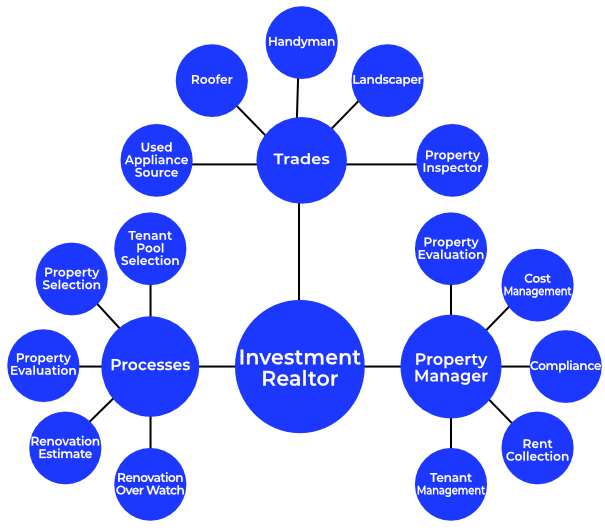
    If you needed surgery, you would not start medical school. Also, not just any doctor will do. You want a surgeon specializing in the kind of surgery you need, not a general practitioner. The same is true with real estate investing. You want to work with an investment team that already has the skills and contacts. Good investment teams are hard to find. Start with an investment Realtor (not an "investor-friendly" Realtor). Know that even in a large metro area, there is likely only one or at most two investment Realtors. While finding an investment Realtor may take time, the cost, risk, and time savings will be worth it. See the image below for the range of skills you need to succeed.

    If you select a city that conforms to all the criteria I listed and found a good local investment team, you should do well.

    FERNWOOD Team, KW VIP Realty520 Reviews
Join the conversationCreate a free account to reply, vote on answers and follow this thread.