First time Investor Questions -Is it too late to start?

First time Investor Questions -Is it too late to start?

Member since 2023 · 10 posts · 19 votes

1st time on the forum. 61 (my husband as well) years old and just starting out in the real estate investing arena. Truth be told, if I knew earlier what I am now learning I could have started earlier!! But all I can do now is move forward. I currently own a successful business with no plans to exit for at least 5 more years. My husband is a project manager with a local construction/renovation company. With that said, what is the best strategy for building wealth and creating cash flow with real estate in today's market? Buy & hold? Fix & Flip? BRRRR? Wholesaling? (not interested in house hacking). We have a good amount of equity in our current home, we have saved a good nest egg in standard investments (that we could tap into), and we do have $100k + in cash. Is it too late to really build wealth in a timely fashion so that we can enjoy our golden years eventually?

part two: best type of loan or place to acquire funds to start? HELOC? HML? PML? No money down? Sub2?

We have reached out to an investor realtor who was referred to us and who so far has been a wealth of knowledge. We will be talking loan/money strategy today as well, but would love to hear from all of you.

everyone's input is greatly appreciated!

1Reply
52 views

Most Popular Reply

Lender · Seattle, WA · Member since 2022 · 482 posts · 768 votes
2y

Hi Theresa,

If you are planning to buy a rental property while renting an apartment, lenders will have to count both of it as a liability. Typically investment properties requires 15%-25% down payment depending if it's a single family or multifamily. However, if you put it as a primary residence house, the only liability you will be counted towards is the monthly mortgage payment of the house and removing your rent expenses (since you moved out). The benefits of buying a primary or first time homebuyers is that rates are typically lower than investments because the governments incentives to buy houses even for 2-4units now. On the other hand, you can repeat the process every year through house hacking and rent out your current primary house by converting it as a rental and acquire another property. I'll be happy to connect if you have any questions or concerns. Wishing you all the best on your Real Estate Journey!

@Carlos Valencia @Albert Bui

See this reply in the discussion

14 Replies

Jump to latestLatest
  • Rental Property Investor · East Wenatchee, WA · Member since 2014 · 10k+ posts · 16k+ votes
    2y

    I'll be the first to say RE is not necessary to have comfortable 'golden years'.  Sounds like you've done very well and would do fine without it.  

    So no, not too late. You are comfortable (not running from a job you hate, not recently  laid off, etc) so  nothing on fire here.

    That said, if you guys have the energy and drive, he.sounds well positioned to fix a fixer to hold as a rental or rehab/reconfigure a nice house for rental or flip.  

    The best deals are situational off-market ones,  so get the word out you are looking and keep your ear towards finding one.  

    I'd probably get into long term rentals for tax reasons.  Diversity the way your income is taxed.  You've been paying a lot for a long time and I thank you for your service there @Theresa Hansen 👍

  • Wale LawalBusiness Member
    Real Estate Broker · Houston | Dallas | Austin, TX · Member since 2018 · 5k+ posts · 2k+ votes
    2y

    @Theresa Hansen

    Well done for deciding to go into real estate investment! It's never too late to get started, and your experience in building and business can come in handy for this new endeavour. In light of your circumstances, take into account the following real estate investing strategies:

    Fix and Flip, Buy and Hold, and BRRRR (Buy, Rehab, Rent, Refinance, Repeat)

    Always keep in mind that careful preparation, thorough research, and modifying your approach to suit your risk tolerance and financial objectives are the keys to successful real estate investment. You have the means to build a lucrative real estate portfolio and make wise judgements because of your distinct history and financial situation. To create a plan that fits your unique goals, think about speaking with a financial advisor or real estate professional.

    All the best!

  • Real Estate Agent · Atlanta, GA · Member since 2020 · 1k+ posts · 1k+ votes
    2y

    @Theresa Hansen, since you're nearing retirement, you should position your investment strategy toward cash-flow predominant assets. I wouldn't necessarily recommend flipping or wholesaling unless you want to start a new full-time business (those are not passive investment strategies in my opinion). 

    With the above-mentioned, you and your husband should explore rent-by-the-room properties (PadSplit & HomeRoom). With your husband's experience in project management, you all could save significantly on the rehab/set-up costs. If you're interested in learning more about the strategy, I'd be happy to connect/discuss. 

    Regarding finance, strategies such as seller finance, sub 2, and no money down are far and few between. Moreover, implementing and sourcing for these types of deals can also feel like a full-time job. While it depends on your financial position, I would recommend working with a conventional or DSCR lender and/or exploring the option of utilizing a HELOC.

    I hope this provides some guidance and clarity! 

  • Real Estate Agent · Los Angeles, CA · Member since 2018 · 2k+ posts · 1k+ votes
    2y

    There is no wrong way necessarily and every strategy will be dependent on your personal goals.

    At your age, I would imagine that cash flow is most important (versus focusing solely on appreciation). If that is the case you need to narrow down your goals such as how much you want/need to cash flow, how much management you want do with tenants, and how involved you want to be in the entire process. 

    Fix and flipping brings in money, but it isn't passive wealth. I also wouldn't do wholesaling for the same reason. Buy and Hold is likely the way to go (although I don't have a full picture of your situation). 

    Hope this helps!

  • Henry ClarkPro Member
    Developer · Member since 2020 · 4k+ posts · 4k+ votes
    2y

    No need to answer here.  You need to consider these questions.

    Where are you now $$$$$$?

    What live style or considerations do you want?  $$$$ to achieve.


    Do you want to be a Real Estate investor or just make money?  You can do both.

    What is your risk/reward level?

    How passive?  

    What is the market you want to invest around?

    Basically the more info available the more options you will have mentioned and they will be more precise.

    Going with the info you have supplied.  These are not suggestions, just options. Go with the assets you already have.    

    Step 1 is determining your risk reward.  How much money are you willing to invest relative to the risk?

    1.  Sell your house.  No taxes if your primary residence 2 of the last 5 years.  

    2.  Buy another house.  Buy the worst house in an upscale neighborhood in a great school system, in a great location.  Fix up and sell again after 2 years.  

    3.  Buy another house.  Spec home in a new neighborhood, great school system, pick a great lot location though.  Find a contractor or developer that needs to sell.    

    4.  Same type of neighborhoods above.  Buy Lots either at the beginning of the new subdivision or midway through it filling up.  

    5.  Buy a duplex or triplex and live in it.  And rent the others.

    6.  Build or buy a Self storage location and build a 1,200 square foot resident manager home for you to live in for $60,000.  The rest of your money from your home sale is now making money as storage. Reduces your personal living costs.  Deduct property taxes, electric, internet or cable, lawn care, etc.

    7.  You have a business?  Do you own the building?  If you don’t, buy a fixer upper commercial location.  Move your business into it.  Sign a 5 year contract with whoever you sale this to.  Your contract increases the value of the property.  Do this again after the 5 years.

    8.  Your husband does contractor work?  If you’re in a good area, start doing country subdivisions.  Lots only.  Not houses.     

    Use the lookup function. My name and the post. What happens if you die?  

    Lots of other options.  Depends on your assets, lifestyle, resources, desires.  Example.  Do you want to move to Italy or Korea?  Can be a great Real Estate move.  

  • Real Estate Agent · NJ · Member since 2021 · 569 posts · 127 votes
    2y

    Never too late! I started when I was 50, killing it ever since.

  • Lender · Seattle, WA · Member since 2022 · 482 posts · 768 votes
    2y

    Hi Theresa,

    If you are planning to buy a rental property while renting an apartment, lenders will have to count both of it as a liability. Typically investment properties requires 15%-25% down payment depending if it's a single family or multifamily. However, if you put it as a primary residence house, the only liability you will be counted towards is the monthly mortgage payment of the house and removing your rent expenses (since you moved out). The benefits of buying a primary or first time homebuyers is that rates are typically lower than investments because the governments incentives to buy houses even for 2-4units now. On the other hand, you can repeat the process every year through house hacking and rent out your current primary house by converting it as a rental and acquire another property. I'll be happy to connect if you have any questions or concerns. Wishing you all the best on your Real Estate Journey!

    @Carlos Valencia @Albert Bui

  • Member since 2023 · 10 posts · 19 votes
    2y

    Thank you for your input Matthew, we currently own a home that we are living in. Not interested in house hacking. Leaning more torwards fix n flip or medium/long term rentals. 

  • Investor · Panama City Beach, FL · Member since 2014 · 129 posts · 51 votes
    2y

    No, it is not too late to start.

    You have some great advantages that a lot of people just starting real estate don't.

    You have experience running a business, your husband understands construction, and you have more cash and equity then an 18 year old wholesaler could ever imagine.

    With that said, you need to be very careful how you deploy your cash. People think cash can fix all problems in a business. When really it hides them. I have seen a lot of people who get in to real estate with some amount of money, spend cash to scale but never take the time to build the processes for their business first.

    Good luck, be smart with when and where you spend money and you will do great!
      

  • Member since 2024 · 400 posts · 240 votes
    2y
    Quote from @Account Closed:
    Quote from @Theresa Hansen:

    1st time on the forum. 61 (my husband as well) years old and just starting out in the real estate investing arena. Truth be told, if I knew earlier what I am now learning I could have started earlier!! 

    @Theresa Hansen: You mention Subject To as an option.

    You have indicated a problem that you are close to retirement and would like more security. And as such, what are your options.

    Here is the strategy we've implemented. I'd be curious to hear your take on it.

    This is different than putting 20% down ($80,000 on a $400,000 property) on each property you buy. That is what most people do. That alone stops most potential investors. But, set that thought aside for a moment.

    What we are talking about here, is a different process. It starts with buying properties "off market". That means you don't find these on the MLS.

    A certain amount of people are willing to sell on Creative Finance, like Subject To, (Subto) & Seller Finance for various reasons that I explain. Once an agreement has been reached, the purchase & sale go through escrow just like any other transaction.

    The property can be used for a rental, fix & flip, STR or Lease Option, whatever crosses your mind. Yes, you'll need some training, but being trained properly is a good thing anyway. Don't let any mentor or coach tell you that you can do these for zero down.

    Usually you can find these for $15,000 or so in “up front” money.

    Here are the differences and why it can be done.

    By buying “off market”, the selling price can be reduced by the amount of the fees the seller would have to pay if they used a real estate agent. That can be a savings of $25,000 on a $400,000 property. Then, since you are taking over the seller’s loan, you have no loan origination fees and don’t have to use your credit. That saves you thousands of dollars.

    And since you are getting their 3% interest rate instead of a 7% from a bank, your payment is $1,602 instead of the bank’s $2,129. A monthly savings of $527 that goes into your pocket.

    Plus, since the seller has already been paying for a couple of years, the principal has been paid down $15,000.

    So, you are “in” for about $15,000 and have all of these great benefits. Do 3 a year and in 5 years you are retired, and having fun.

    And of course, You can continue doing these and build generational wealth.

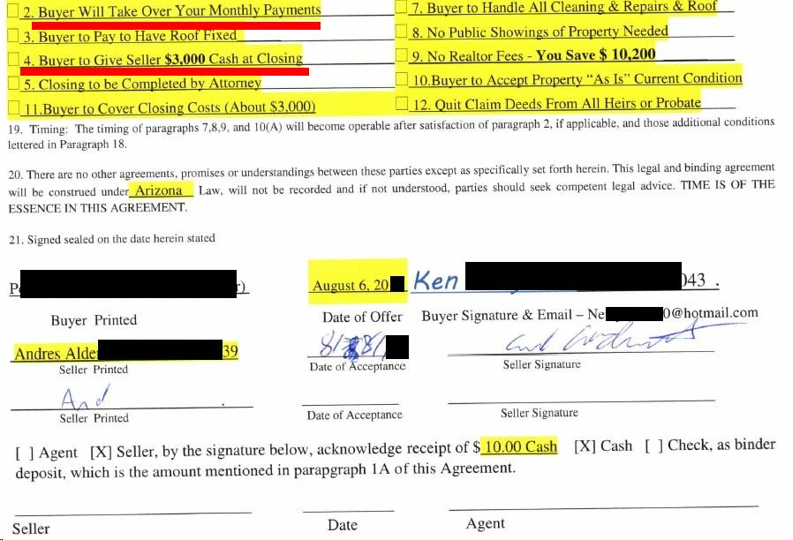
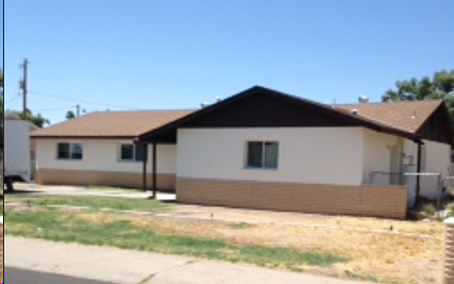
    Here is an example of what we did, we bought this property for taking over the payments plus $3,000 using Subto, the right way. With the purchase and sale agreement. (Click to enlarge)

    We saved them from having to pay $12,000 in realtor fees and other costs. It made sense for them because they needed to sell without going onto the MLS.

    So yes, these are plentiful, you just need to know how to look for them and what to do after you find them. It's a very quick and profitable way to invest and prepare for retirement.

     @Account Closed

    How do you find off-market, seller finance and sub to properties?  TIA.

Join the conversationCreate a free account to reply, vote on answers and follow this thread.