Starting out - get a quick start this spring doing terms deals

Starting out - get a quick start this spring doing terms deals

Investor · Sherman Oaks, CA · Member since 2008 · 6k+ posts · 3k+ votes

i'm starting this thread and I'm going to try to make a post every day on how to get a quick start this spring.

For 30 years I've done my best to give us our two offers a cash offer in terms of. Terms offers a more attractive because the seller generally makes more money. But Sellers need to be creative.

How do you find sellers that are willing to be creative?

I think the easiest way is to either find properties that are for sale already with long days on the market or DOM or look for expired listings

These people are trying to sell and they're not having a good time doing it the traditional way

So what do you do?

If your license, you can't really go after long days on the market folks because it goes against your ethics as an agent

But if you're not licensed, you can knock on their door and say I understand your agent as Mabel to sell your house in a while, would you be interested in doing outside the box and getting a possible solution to your house problem?

Now I know some of you might think you're interfering with a listing agreement between the seller and the agent. If the seller is not performing, getting a cash offer that's acceptable to the seller, then perhaps the seller can work out arrangement with the realtor

If it's an expired listing, I don't know if people realize this book many new agents go after expired listings, and they try to convince the home seller that their company or their marketing ability is better than what they had tried and they want to relist the house

If you are licensed, and you have a list of expired listings, you can knock on their door, and say, I understand you tried to sell before with an agent it didn't work out? Would you be open to a creative idea? It'll take me about 15 20minutes to go over it with you. Boom you're in the door.

Now  what kind of solution are you going to talk to him about?

Well the existing financing is high in the loan-to-value was high 95% loan to value, every little equity, and the cost to sell the house including the commissions, closing costs, sellers concessions, spruce up costs and holding costs, all these add up to a good amount of money to be taken out of the proceeds of the sale

So for number sequence it's 100,000 and you show the seller that it's going to take about 1012% of the value of the house if they owe 95% and they got to pay to get rid of the house

So what's the alternative? Well selling on terms entails, if you don't know, some going to rent to own arrangement, or rent them purchase arrangement, or some kind of subject to existing financing, or some kind of wraparound mortgage.

So for us in equity, you going to basically look at everything, the condition, with the sellers need, the urgency for the sellers, existing financing, their comfort level with the due on sale clause with such two in the wrapper on my goods, the lease to own, etc.

To ease for you to profit with no equity deal on the following:

One is you can lease with an option and then assign the deal for a fee. No lease options have different rules in different states. So you should have an attorney that knows lease options really well.

Secondly you can look at subject to existing financing or wrap around mortgages.

To show the difference what I usually do is roll I know y'all up and show the sellers that what's in it for them on the lease to own arrangement and what's in it for them on subject to, the lease to own their going to have to turn into investment property and get landlords insurance and they're responsible for maintenance, and they have to follow the state laws as far as being a landlord

I'm subject to, you buy the property subject to existing financing, and your exit is generally a lease to own or renting it out. Because the due on sale clause, I recommend that you try to get a quick sale within a year to be able to satisfy the existing financing being paid off in full

The nice thing about helping sellers of every little equity is that you don't need to get a bank loan to make some money, and you don't need great credit to be able to run a business that helps seller solve problems, especially Low or No equity.
9Reply
185 views

Most Popular Reply

Investor · North Richland Hills, TX · Member since 2011 · 789 posts · 403 votes
11y

@Brian Gibbons   I enjoy your posts....could you make them more lengthy? I tried to print them but ran out of ink.... WHEEE!!!!! :)

@Tim Macy LO's are alive and well in TX...but none knows it...(can you say opportunity!?!?!)

See this reply in the discussion

65 Replies

Jump to latestLatest
  • Rental Property Investor · Clarkston, GA · Member since 2012 · 2k+ posts · 1k+ votes
    11y

    @Brian Gibbons Wow great recipe for solving the sellers problem.  "Be the Dr".

  • Investor · Sherman Oaks, CA · Member since 2008 · 6k+ posts · 3k+ votes
    11y

    Thanks, @Curt Smith I appreciate it!

  • Investor · Sherman Oaks, CA · Member since 2008 · 6k+ posts · 3k+ votes
    11y

    So here is the 5 steps to Negotiating a Terms Deal

    1. Rapport Building
    2. Avoiding Let Me Think It Over
    3. Uncovering how motivated they really are
    4. Getting the lowest price (Wholesaling Only)
    5. The "What If" Step Close

    You need to get face to face with the seller first.

    Here are 5 prospecting ideas.

    A.. Listed Houses

    Houses that are listed with an agent generally are in an "exclusive right to sell" listing arrangement. This means that there's no one else that can list the house for sale. The commission is negotiated on the agreement, and if through their marketing a buyer comes even if the listing goes expired, if it is the procuring agent, meaning the agent responsible for sale is responsible for introducing the buyer to the seller, even on the lease 2 own and not a cash sale, they are still going to get their commission.

    See

    http://homebuying.about.com/od/realestateagents/qt...


    If you the real estate investor in your trying to get the seller to consider terms instead of cash and avoid the sales commission, the listing agreement is between the seller and the agent. 

    I basically say the following to the seller that has a listing sales arrangement with an agent:

    "Mr. Seller, you have a legal contract between you and agent regarding selling the house. 

    "I like you to SAVE the commission if possible but it's up to you. 6% a lot of money.

    "What you could do is go down to the broker's office and basically get in writing that the listing is going to be rescinded, and you no longer want their services. You also want them to say in writing that you owe them no money regarding selling their house, even if you sell it yourself.

    "You may want to get an attorney to make sure that the listing is expired and you can sell it yourself."

    In my the lease to own solution with the seller has a good amount of power and value if the seller can avoid paying the real estate commission.

    `````````````````````````````````````````````````````````````````````

    B. Expired listings

    Houses that have expired generally are asking too much money for the house. If the house has reasonably good location is in the reasonably good condition, and it is price correctly, and it's not messy inside, it generally sells at this price correctly.

    A survey of hundreds of realtors that basically said that over 80% of all expired listings are mispriced houses, meaning the sellers want to much money for the house.

    See

    http://homebuying.about.com/od/homeshopping/a/Buyo...

    I like expired listings the best, and I like to knock on their door and not mail them anything and not talk to them on the phone. 

     I know if you live in a rural area that's hard, or if you're an expensive area that have gated communities that's hard, but most middle-class neighborhoods it's easy to just knock on their door some Saturday afternoon, and have report ready to hand them.

    ******In the report you want to have a cover letter, the cover letter basically says the following:
    ```````````````````````````````````````````````````````````````````
    Dear Mr. and Mrs. Home Owner:

    I understand due to public record that you tried to sell with an agent, and it didn't work out. I'm very sorry for that situation that you had to deal with, and it must been very difficult to deal with

    I have a proposition for you; you may want to consider this proposition because it will not cost you anything to sell your house this way.

    I specialize in "lease to own" where the seller can get top sales price for their property, and avoid paying a real estate commission, which can be a lot of money. 

    They also avoid some of the costs to sell which include closing costs and other costs. Sometimes the total savings to you by doing lease to own is over 8%, which on a $200,000 property is $16,000.

    Enclosed are some articles from the Wall Street Journal, Money Magazine, Realtor.com, USA Today and some other public newspapers, about Lease to Own and Seller Financing.

    Many realtors don't know a thing about Seller Financing or Lease to Own, and their Brokers do not encourage their Agents to talk to Sellers about it.

    I currently have at least 2 "Lease to Own Buyers" that are interested looking at your house, that will give you full price for your house, and save you quite a bit of money.

    In order to properly explain this to you, I need to sit down with you and go through the positives and negatives of this decision, so that you can make a good decision about your home sale.

    I get paid from the buyer so you don't have to pay me anything.

    Please call xxx-xxx-xxxx so we can sit down for 30 minutes and go over the basics of how this works for you and your family.

    Sincerely,

    Brian Gibbons


    `````````````````````````````````````````````````````````````````````
    If you notice the letter stresses saving money and doesn't tell them how it works, and also educates the seller was some mainstream articles from national newspapers and realtor.com.

    Print the cover letter to a generic homeowner on good letterhead, and print the articles on good letterhead.

    You can use a binder clip to get them altogether.

    `````````````````````````````````````````````````````````````````````
    If there is no one home when you knock on the door, don't leave this free report in the mailbox, or or don't hand it to a child with the parents not home. That's a waste of time and paper.

    If an owner is not home and someone answers, I offer to come back.

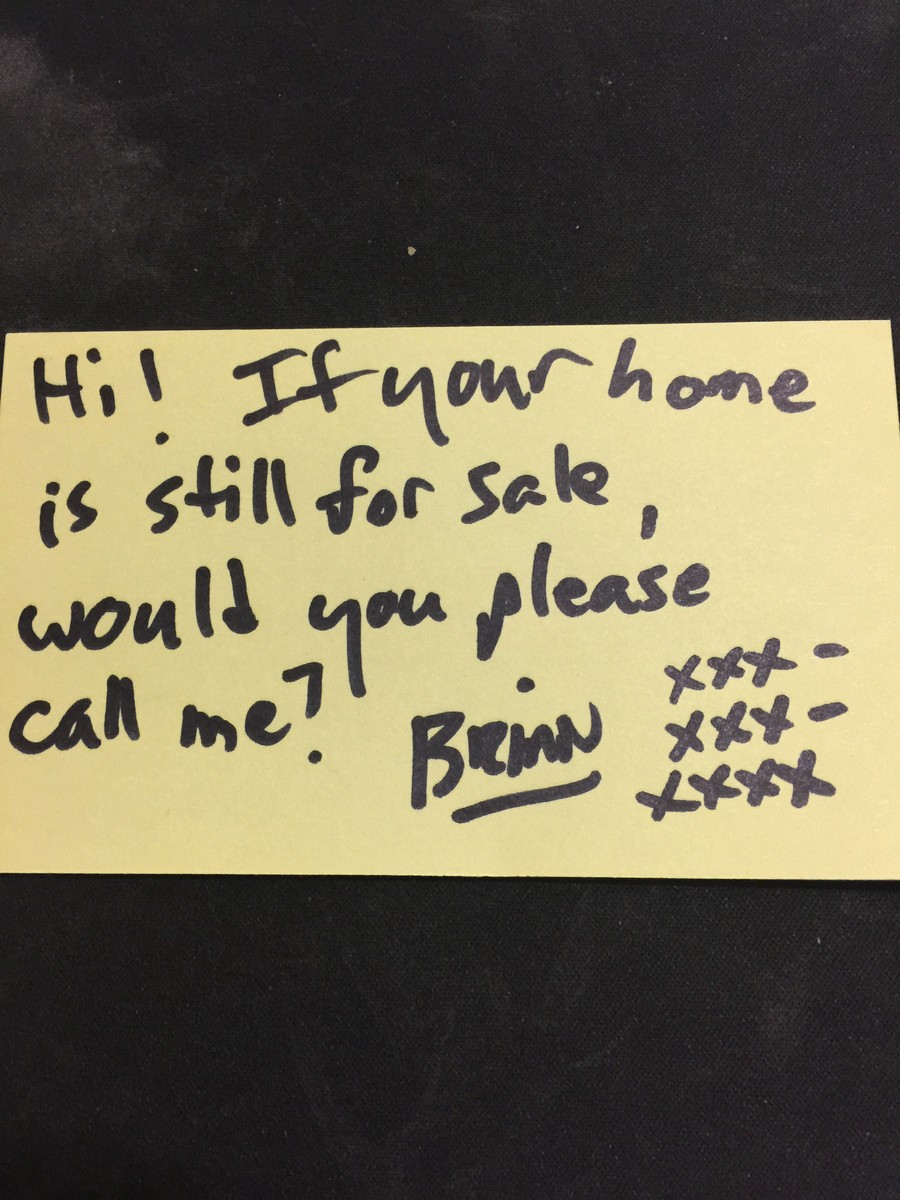
    If an owner is not home and no one answers, I will put a yellow sticky note on the door. I'll use a medium black sharpie pen, and I'll write something like,

    ``````````````````````
    Hi,

    If your home is still for sale, would you mind calling me please?

    Brian 


    ```````````````````````
    if someone calls you off your yellow stick notes, that means they haven't gotten their free report yet, so say something like, 

    "oh is your house for sale great, would you mind if I stop by and say hello and take a look at the house?" Keep it conversational.

    ```````````````````````
    C. FSBOs

    For sale buy owners they want speed and they want full price without an agent, that's what they want. They are generally very confused about how to sell the house themselves, how to negotiate with a buyer, how to market for buyers, what kind of paperwork to use, etc.

    Many sell via FSBO because they tried to sell an agent and it did not work out, or they have sold before with FSBO in hot sellers market, or an easy mortgage credit market.

    What I do with FSBOs is act like cash buyer, sounds like you're not really telling the truth doesn't it? 

     Well, if they accepted a wholesale all cash price I would be a cash buyer! 

    If you do the 2 and one half hour training negotiation with the seller and teach the seller "the costs to sell with an agent", versus renting it out, versus seller financing, it's all easier to deal with the FSBO.

    After I go through the 5 steps negotiation with the FSBO, I generally tell them I can get their house problem fixed in 30 to 45 days, so they want to hire me to get that done, at no cost to them, then they sign a letter of intent to lease or sell.

    ````````````````````````
    D. Landlords

    For many landlords of homes, they want tenants that are neat and tidy, pay the rent on time, and don't call at 2:00 am for backed up toilets. 

    So I generally act like a prospective tenant and walk through the property. 

     Most do-it-yourself landlords are very sophisticated, business like, and I just use this "one what if statement with them,"

    "Bill let me thank you for walking me through the property, looks like it's in great shape, I just have one question for you, and if you say no to it I understand, but if you say yes then maybe we can talk about it in more detail, so here's the question,

    "What if I could get you 24 payments at 1100 dollars which is what you want for the rent, and then you would allow me to buy the house, at a price that you can live with, and at a price I could live with. 

    With that be something we should even talk about or maybe not?"

    I leave them a very simple one page letter for landlords, the benefits of lease to own versus regular landlording and my contact details. I might even include a national article from realtor.com or from the Wall Street Journal about seller financing attached to the back.

    Many of do-it-yourself landlords wanted to not get involved with lease to own because they are buy-and-hold people, but you will never know unless you ask.
    `````````````````````````
    E. WE BUY HOUSES PEOPLE

    The last group of people are people who are trying to wholesale deals, people that are sending out yellow letters, postcards, bandit signs are up on telephone poles, and they get leads that have thin equity, and they can't do anything with them.

    1. You can find "we buy houses people" through the Internet, and just do a Google search, we buy houses Boston Massachusetts, sell your house Boston Massachusetts, you'll find some.

    If I find them on the Internet, I'll make an appointment to see them for lunch and talk about a marketing arrangement where I'll pay them to $250 for every lead that I convert into a sale. They are throwing the lead away anyway. They have nothing to lose.

    CAUTION: don't educate the wholesaler as far as how you are making money with terms deals! Just get the lead and pay the commission if you get a sale.

    2. You can go to REI a meetings and get in front of the group and say,

    "We help wholesalers make more money with the leads they have. We look for thin leads the don't have a lot equity. The house needs to be in a good school district and a quiet street. If you throwing away a leads at all please contact me in the back of the room."

    Now, on to the Negotiating with Home Sellers For Term Deals!

  • Real Estate Agent · San Antonio, TX · Member since 2014 · 311 posts · 176 votes
    11y

    @Brian Gibbons great thread!  I'm taking notes on everything.

    You seem to go to lease options as a good solution, but from what I understand they're just about dead in Texas.  I'm not sure if you know the states regs exactly, but I listened to a lawyer give a talk saying that the rules in place made them no longer a viable option.  Any insight would be appreciated!

  • Investor · Sherman Oaks, CA · Member since 2008 · 6k+ posts · 3k+ votes
    11y

    Hi Tim,

    See 

    http://lonestarlandlaw.com/Lease-Options.html

    And Contact @John Jackson

    I taught him Lease Options in 2002, he does alot of lease option TX assignments, over 500 I think,

    http://leasingtobuy.com/

  • Investor · North Richland Hills, TX · Member since 2011 · 789 posts · 403 votes
    11y

    @Brian Gibbons   I enjoy your posts....could you make them more lengthy? I tried to print them but ran out of ink.... WHEEE!!!!! :)

    @Tim Macy LO's are alive and well in TX...but none knows it...(can you say opportunity!?!?!)

  • Investor · Sherman Oaks, CA · Member since 2008 · 6k+ posts · 3k+ votes
    11y

    Hi @John Jackson

    Writing a book, want me to mail you a printer cartridge in Texas? HP cartridge?

  • Investor · North Richland Hills, TX · Member since 2011 · 789 posts · 403 votes
    11y

    @Brian GibbonsIf you were a caveman you would run out of tablets to carve on....

    They would do an archeological dig and find 10,000 tablets about lease options and creative financing on caves....

    Take care my brotha!!!

  • Sumter, SC · Member since 2013 · 105 posts · 10 votes
    11y

    Thanks @Brian Gibbons. I truly enjoy reading your post!!!

  • Investor · Sherman Oaks, CA · Member since 2008 · 6k+ posts · 3k+ votes
    11y

    Now for Negotiating with the sellers....

    First step is Building Rapport...

    So how you connect with the seller especially if you're shy or introverted?

    First look as good as you can. Business Dress.

    I think that you don't need to look like a banker but not looking like a slob either is important.


    a. Business hair cut
    b. pressed button down shirt, white or white or blue
    c. Gray slacks nice ones
    d. Really good business shoes, wingtips
    e. Navy blue blazer

    Why bother to look like a business person?

    Well if you have no deals, I think the "visual" will give you respect from sellers, and you want to close on the first visit, and you don't want to waste your time, you had better put a lot of effort into how you look.

    For women, business suit, white blouse, or red blouse or blue blouse. 

    Look like a banker or financial planner.

    ``````````````
    TOOLS

    a. Have a briefcase for God's sake. 

    Look like a professional business person. 

    Go to Marshall's a T.J. Maxx and buy a nice one.

    b. Stationary: 

    have lots of black pens, blue pens, red pens, felt tip markers, yellow pads, presentation folders, business cards, blank letter of intent forms, presentation sales book, etc.

    c. A note about your car: 

    if you're poor and you have very little money and you have a crappy car, parked it down the street and walked two minutes to the house.

    d. Thank you notes: 

    there are few business tools more powerful than a simple thank you note with a business card. Stamp, with an ink address stamped on the back for return address, and a note that says something like,

    "Thank you so much for investing little bit of time with me, and I'm certain of the ideas we talked about regarding your house situation will definitely help solve the problem you're trying to solve.

    Here's an extra business card, and please scotch tape it to the refrigerator so you can find my number easily.

    Best wishes,

    Brian Gibbons
    Innovative Property Solutions LLC"

    ````````````````````
    Now that we have the "image issue" out of the way we can work on the language.

    The language of building rapport

    How do you connect with the seller?
    How would you feel that there was some "expert investor" coming over to your house?

    Talking about financial issues in real estate?

    How cautious would you be as a seller?
    How guarded would you be as a seller?

    So you must take 5 to 10 to 15 minutes to build rapport.

    You must establish a connection.

    Many people don't know how to do that.

    Here's how to do it.

    1. Ask the seller questions about himself or herself


    You need to build bridges of common ground.

    People like people that have things in common with themselves. They're more comfortable with people that have similar interests and similar activities. Think about your activities that you're involved with.

    You want to draw the seller out to talk about themselves. 

    Dale Carnegie wrote "how to win friends and influence people" wrote about behavior of people. 

    People like to do business with people that they like and they trust. People like you and trust you if they have more things in common.


    Draw the seller out of their shell. 

    Get him or her talking about himself or herself whenever possible.

    As an example think of yourself walking into a house.

    You - hey of these your kids? (You point to a photo on the end table in the foyer)

    Seller - yes those are my kids, John, my oldest. Susie there in the middle. And Luke my youngest.

    You - How old are they now?

    Seller - John's 24, Susie's 18 and Luke is 15

    You - oh I have two children (bring out picture in your wallet) theres David 12 and Kelly 10. (building a bridge, creating commonality.)  So, does it get any easier when the get into their 20s ? (big smile)

    Seller - it sure does. You know I always thought it was just really important to remember that we were teenagers wants to.  And we survived it!  But looking back, I'm not sure my parents survived my teen years (notice seller is loosening up to you)

    You - I know exactly what you mean. I think I was probably the toughest of the bunch for my parents to raise (building a bridge). What is your oldest doing now?

    Seller - he's married with a child on the way. He lives in Boston and works for an engineering company out there.

    You - Wow! You're going to have a grandchild! That must be so exciting for you! How much longer until the due date?

    --------------------------------------------

    You get the idea, some people might call the "Small talk",

    I call it the glue that helps me build rapport, and allows people to like and trust me quickly.

    What you say if you're shy or you were brought up in a non-people house, where people didn't chitchat much?

    Here are some ideas...

    1) Where did you grow up?
    2) Do you have any kids?
    3) How old are they?
    4) What is it that you do for a living?
    5) How did you get started in that career?
    6) What do you like to do for fun?


    WARNING - just spent too much time building rapport, you are there to get a job done and go through all five steps properly.

    There comes a point where some new investors find themselves wasting hours of their time making friends with people BUT not closing any sales.

    There need to see if it's a fit for you and your company fairly quickly use within 15 minutes. The second step, the upfront agreement is important to get into right after building rapport.

    Another mistake is that you think that if step one is completed, you not to do any more about throughout the other four steps. You must build rapport as you go throughout the entire meeting with the seller. 

    I really want you to spend 5 to 15 minutes upfront building rapport before you move on to step two, but that doesn't mean you're done building rapport.

    Throughout the negotiation you need to gauge your level of connection with the seller, and look for opportunities to deep in this connection. But you need to balance this need to maintain a connection, with your equally important need to move the conversation forward to its conclusion. 

    ABC, always be closing.

    See

    http://search.yahoo.com/search?p=always+be+closing...

    Pretty harsh sales training, but I love that scene!
    The next post will be about setting up an upfront agreement or as I call it,

    How to Avoid the Objection, Let Me Think It Over.

  • Investor · Sherman Oaks, CA · Member since 2008 · 6k+ posts · 3k+ votes
    11y

    The upfront agreement - the second step in negotiating with home sellers

    Well the upfront agreement was designed to avoid some things.

    What would you want to avoid in a sales presentation?

    The classic "thank you but I want to think it over."

    Have you ever heard "a confused mind says no?"

    When you bring up "selling on terms" I think it's very confusing to most people. 

    So I keep it simple and I don't use "lease with option" terminology and "subject to existing financing" and "wraparound mortgage all-inclusive trust deed".

    The upfront agreement basically talks about what you are willing to do as a business person, and sets the stage for not coming back ever. I mean ever.

    Yes or no, not maybes.

    The letter of intent basically says,

    Name of owners, 

    property name, 

    today's date, 

    name of prospective purchaser, 

    name of purchaser's company, 

    intention to purchase on these terms as a principal.

    Purchase price

    if lease with option, market rent, 12 month term with extensions, exercise price, etc.

    If subject to, purchase price, date of possession, date first payment, date of walk through, etc.

    If wraparound mortgage AITD, purchase price, note payment, interest rate, etc.

    ````````````````

    The upfront agreement

    In order for the upfront agreement to work, you need to frame it as a very fair, 2 way business agreement.

    Here is a possible exchange...

    After the walk through, you're sitting at the kitchen table, looking at both mom and dad the sellers.

    I fold my hands and I looked very solemn, I try to give them is kind of an expression is possible, as sincere as possible, I have my legal pad, a pen, and a blank letter of intent in front of me.

    I also have a folder of comps and rental information on the subject property.

    So here's the upfront agreement...

    Investor: "So Bob and Susan thanks for the walk through, I just wanted to talk about how I'd like to see our business relationship work.

    My job is to look at the property, look at all the financial information, then make a decision, on the spot.

    To keep coming back over and over thinking about possible deals is not what I do. 

    What I do is 

    if the location is right, 

    the condition of the property is right, 

    the layout of the property is right, 

    the existing financing payments are right, and 

    the attitude of the sellers are right, 

     then my job is to put together the deal structure that works for me, 

    and I basically give the project the green light.

    Not a yellow light or a red light, but green light,

    the analogy here is that we go forward and get the paperwork done tonight.

    To keep coming back is not a good business plan, takes up too much time and nothing gets done.  We are both concerned about getting to a result, right?

    On your end, you want to make sure that you're happy with the terms that I propose, if you're one hundred percent happy with what I'm talking about, I would hope that you give me the "green light" on this proposal, and you feel comfortable that you finally got a solution to your house situation.

    I know it's stressful selling your house can be, I know it's confusing at times, but hopefully we can move forward and both give this situation a green light.

    Now if there's something that I'm not happy with, I'll tell you about it upfront, I won't worry about offending you, I'll just tell you,

    "sorry this is not good work for me."

    And then I'll pack up and move on to the next prospective home seller.

    I hope you won't be offended if a very honest and straightforward with you. I know you'll be disappointed, but I hope you appreciate the straightforward and direct approach I have.

    And lastly, if there's one thing that both of you do not like about my proposed solution, I would hope that you would do the same thing, and tell me,

    "Brian, this is good work from some sorry.

    That last condition is a deal breaker for us. I'm sorry it's not going to work out."

    Now I'm absolutely happy to accept that, and I'll be disappointed, but I understand that you have to have your terms and conditions totally acceptable. 

    And just not going to work out for you."

    So at the end of our talk today, if we both give "the green light", both say that the terms are acceptable, we'll sign the paperwork and move forward,

    on the other hand, if either of us give this talk "a red light", the other party will say "okay, I'm sorry feel that way."

    How does that sound, Bob and Susan, is that sound like a good way to do business regarding your house situation?"

    `````````````````````````````````````````````````````````````````````````````

    The psychology behind this is that you don't want to keep coming back.

    A possible conversation you might have at this time in the negotiation is...

    "Well it all sounds good but I want to run it by my attorney."

    The attorney objection comes up a lot especially in terms deals. When you're first starting it's so important to not get upset the objection. 

    And don't cut down attorney saying that they are all crooks were there just a kill deal, even though they are deal killers.

    When I say if they bring up the attorney objection is...

    "You know I do hear that now and then and I understand your concern. I want you to have legal advice and be comfortable with this decision about your home.

    Now I will tell you, unless your attorney is an expert with a lease with option, subject to existing financing, owner financing, and other legal remedies for your situation, he's probably have a say " don't do it."

    Then I reach for my nolo.com article, and go over the different seller financing possibilities.

    See

    http://www.nolo.com/legal-encyclopedia/seller-financing-home-sales-30164.html

    And I walk them through all the situations in the article, from lease purchase to subject to, to installment sale, to wraparound mortgage.

    "Bob and Susan, the way I handle this is I write down that you will have 72 hours to have your attorney converse with you about the situation, and if we don't have a written response from your attorney within that time, we will all presume that there are no objections.

    I would hate for you to be charged to pay $500 in attorneys fees and have the attorney say "Don't do it" and then have you waste that $500.

    So how do you feel if I right into the agreement that you have 72 hours to talk to your attorney about this, and if we don't have a written response within that time, we will presume that there are no objections?"

    ```````````````````````````````

    So this ends the second step of the upfront agreement, when talking the sellers about selling their home on terms.

    The next post is the third step, the motivation negotiation step, finding the real motivation of the sellers.

  • Investor · Sherman Oaks, CA · Member since 2008 · 6k+ posts · 3k+ votes
    11y

    I want to talk about trying to discover the sellers true motivation.

    the real estate investor has to figure out how the seller feels about certain issues like real estate agents, property managers, things of that nature.

    When you ask a question like, 

    "what were you hoping I could do for you here today?", 

    Really listen to what the seller says. 

    The only way can do this is to get the seller to volunteer some of their problems.

    I use negative phrasing and I sound a little naïve, I sound like Peter Falk in Colombo, you know that 70s show, 

    about that CALIF police Lieut., that dealt with all these rich people in Hollywood accused of homicide. 

    I love how he scratched his head, using his hands, and using phrases like 

    oh, by the way… 

    Can you explain that a little bit better for me because I don't quite get that...

    I know that probably makes you sound stupid, but it allows the sellers to be disarmed.

    If you said something like,

    "You know Mr. seller the good thing is that if you rent this place out you will enjoy working with your tenants collecting the rents and all that, right?"

    At 1st look that might sound a little weird, but what you trying to do is to elicit a response from the seller that he hates tenants.

    I made you asked them straight ahead, 

    "how you feel about tenants? Or 

    "Do you hate tenants or what?"

    That's not going to be effective.

    What is effective is... 

    "You know Mr. seller the good thing is that if you rent this place out you will enjoy working with your tenants collecting the rents and all that right?

    So if he hates tenants, the sellers going to say something like, 

    "I hate dealing with tenants, it's a big hassle, 

    my friend has a rental, he hates dealing with his tenants."

    By you need to act like Peter Falk here, and exclaim, 

    "Oh, a big hassle? (voice rises) I didn't realize that…

    So you need to practice phrasing the kind of situations that you want them to say that they're not interested in, but act naïve.

    This try another one okay?

    "So Mr. seller's probably not a problem if you don't sell right now, at least you can move into your new house, if it takes 6 to 9 months to sell this place at least you won't be a problem to cover both the payments right?"

    The most people at 1st look, that sounds like you're being silly, no one wants to pay a house for 6 to 9 months vacant.

    But if you get the response like this...

    Seller: "no I don't want to do that, it's going be a real financial strain for us to make but those payments."

    Timeline - Urgency
    You want to figure out the Seller's timeline or urgency. 

    A good way to do this is the following:

    "Mr. Seller you know I just need to have an understanding of when would you like this particular sale to happen? You want to happen in 6 months or 9 months ideally what would you like to have this property handled?"

    I love that same property handled. 

    What you want to hear from them if they truly motivated is something like...

    "God no. Not 6 months. I need to thing handled like this week or this month"

    Now we have a true motivated seller and they're going to be motivated to listen to you the Real Estate Solutions Provider, and to be agreeable to your creative offer.

    Logic does not sell, emotion sells.

    And remember one other thing:

    We buy for emotional reasons, we rationalize and defend our purchases with logical reasons.

    Think about buying a car, you don't think about the total payments, you think about how it feels and the status you get.

    So keep the motion high when you doing this 3rd step.

    Next - Getting the lowest price on wholesaling deals.

  • Mike HurneyPro Member
    Real Estate Investor · Boston, MA · Member since 2009 · 2k+ posts · 542 votes
    11y

    @Brian GibbonsWow, only thing you didn't include here from your course is the Cover page.

    Got a special price for folks here?

  • Investor · Sherman Oaks, CA · Member since 2008 · 6k+ posts · 3k+ votes
    11y

    Hi @Mike Hurney

    My aim or goal on this thread is to open up eyes to people starting out that there are many ways to make money today in real estate.

    In the book Shift by Gary Keller of Keller Williams, published I think in 2009 just after the crash, he talked in chapter 10 called creative financing.


    I'll paraphrase:

    Real estate agents to do well have to work much harder to get a listing appointment, because credit is now very difficult.
    If RE agents learned this business to train 2002 and 20066, 

    -when credit was terribly easy, 

    -liar loans were available, 

    -100% of value with no money down, 

    then they didn't need to learn how to do creative financing.

    Like Gary Keller, I started in real estate in the early 80s when interest rates were well over 10% for mortgages.

    I do a lot of wraparound mortgages and contract for deed purchases, because getting financing was almost impossible.

    The point of the creative financing chapter is this:

    As an agent, you need to be very creative in this credit strangled market.

    As a real estate investor, you need to make money with every lead.

    So let's talk about an example:

    a pretty house quiet street, owes 95,000, comps come in at 100

    The days are gone when you can overprice the house and do a price reduction.

    The $100K house will sit there for months and months if it's overpriced.

    If you really care about the seller having some success about fixing their house problem, you need to talk about selling on terms and selling on cash.


    @John Jackson

    and I are good friends. 

     He lives in Texas and has mastered lease option assignments in TX, not easy in TX.

    In 2002 he and I became friends, and I trained him on the basics of cooperative assignments, where you enter into a lease and an option with the seller as a principal, not as an agent but a principal.

    You then assign the deal for a fee of generally 3 to 5%.


    In the example above for $100K
    they owe $95,000

    If they listed for a $100K, sellers would have to pay the cost to sell, which include the following:
    - commissions 3 to 6%
    - closing costs 2%
    - sellers concessions 3 to 6%
    - vacancy costs we have to pay the PITI while is being sold, let's say $1000×4 months, and this includes electric , heat, watering lawns, garbge, and so forth
    - spruce up costs, such as painting a wall or replacing a carpet, or fixing a fence.

    Many sellers don't have a lot of cash in the bank, and they don't want to get more debt on a credit card fix up their house and they can sell it.

    So this particular seller would probably pay 10% to 15% of the value of the property to sell with an agent quickly. I believe very few agents actually fill out "net to seller sheets" 

    See 

    and when they go to closing there shocked is a little they get with all the expenses.

    So selling on terms might be a good idea for the seller, if we could find a buyer that would rent for a while and then buy the property without an agent's commission or closing costs. This is called lease to own.

    Understanding the mechanics of lease to own assignments I think varies from state to state. 

     I coach it nationally.

    But I call them "terms deals" which includes subject to, installment sales, wraparound mortgages, joint venture partners, private lenders, land trusts and more.

    In most states, if you enter into a lease and an option with the seller, and you're an agent, and you fully disclosure an agent in your acting as a principal, you're good to go as far as a business model.

    There are some states were lease options have some restrictions like Texas and North Carolina. I won't go into those here.

    And in Florida and OH and CA, you better be an agent to do them or the Dept of RE, who supervises agents will bring a "cease and desist" letter on your business activity.

    So, seriously, get licensed and declare you are acting as a principal.

    But the drill this thing down, if you advertise for a house that has a problem, you have flexibility in your solution.


    If you are working full time, use a service like www.PatLive.com to live answer the calls.

    Rules of thumb:

    If you are licensed:


    A pretty house with 90% loan-to-value, good school district, that might be a lease to own or subject to or a wrap.

    A pretty house with 80% loan-to-value, good school district, that might be a listing, a lease to own or subject to or a wrap.

    A pretty house with 50% or less loan-to-value, good school district, that might be a listing.

    An ugly house with 50% or less loan-to-value, good landlording area, is a good wholesaling deal.

    And an ugly house with 80% or more loan-to-value, no equity really, that's a short sale.

    Don't be a one trick pony, be a transaction engineer. 

    Give the seller cash offer (which that usually hate), but you've got to give it to them, and 

    2 terms offers, a sub 2 and a lease to own assignment, or owner financing.


    For biggerpockets folks Mike, I give a 20% discount on my training.

  • Investor · Sherman Oaks, CA · Member since 2008 · 6k+ posts · 3k+ votes
    11y

    Books I think You Need Now To Build a "Cash Or Terms RE Business"


    "Awaken the Giant Within" by Tony Robbins gets to your real motivation. If you do not know what your real "why" is read that book.

    "The Emyth Revisited" by Michael Gerber helps you visualize working "in your business" for a while, then working "on your business" and supervising.

    Being creative in deal making involves many skills. Listening well is one of the most critical. One of my favorite books about learning high level listening skills is "The 5 Essential People Skills: How to Assert Yourself, Listen to Others, and Resolve Conflicts" by Dale Carnegie Training. If you lack people skills, PLEASE read this. Also the classic, "How to Win Friends and Influence People." by Dale Carnegie.

    Selling is a skill, and ethical selling is important. "How to Master the Art of Selling" by Tom Hopkins is extremely valuable. If you are talking to wealthy people re: Private Lending, the best book I know is "Values Based Selling" by Bill Bacharach. It is written for financial planners and stock brokers to sell to the wealthy.

    Know the Fair Credit Reporting Act, the FTC, and how Credit Reports are created and improved are important when assisting seller financed home buyers getting home loans. "Hidden Credit Repair Secrets" by Mark Clayborne is a fine book to learn some interesting tactics to have to improve credit FICO scores.  www.MyFico.com is great too.

    How to Finance any Real Estate Any Place Any Time by James A Misko is one of my favorite "creativity books". We in REI are problem solvers, first and foremost. He goes into IRAs and Real Estate, Using Options, 1031 Exchanging, Combining Purchase with a Lease. Using Zero Coupon Bonds to Secure a Loan, Sale Lease Backs (not with distressed properties), using loan to equity options, and more. There are 45 examples to learn from. And he is a CCMI, and has been a NAR Instructor.

    Gary Keller of Keller Williams wrote a book called "Shift - How Top Real Estate Agents Tackle Tough Times", and in Chapter 10 he wrote about using Creative Financing to help Sellers and Buyers. Many times I will buy that book in mass and give it to real estate brokers that I like to work with. You can buy cheap slightly used books at Amazon, like for a buck!

    As far as never stopping to learn, the 2 references I use DAILY are "Dictionary of Real Estate Terms" by Barron's, and "Black's Law Dictionary" by Brian A Garner, et al.

    The books by the Wall Street Journal are awesome: "The Complete Homeowner's Guidebook" by David Crook, and "The Complete Money and Investing Guidebook" by David Kansas.

    Lastly, business savvy books I like to read at night:

    "What They Don't Teach you at Harvard Business School", by Mark H. McCormack, like how to run meetings, running a business, et al.

    And my all time favorite, "Swim with the Sharks" by Harvey MacKay, of MacKay Envelope Company and the Minnesota Twins. I have used that book to assist me run my businesses since 1986, especially see the chapter on Negotiation.


  • Investor · Sherman Oaks, CA · Member since 2008 · 6k+ posts · 3k+ votes
    11y

    4th Step: Getting the Price Down

    How to get the lowest price on a Wholesaling or Seller Financing Deal

    2 of my favorite real estate trainers were David Finkel and Peter Conti. I learned this almost 20 years ago from them.

    The 1st technique What did you realistically expect to get

    The 2nd technique using ranges

    The 3rd technique picture to's a fictitious buyer through an agent to knock 6% of the price

    ``````````````````````````````````````

    A mistake I find many investors that have trouble getting the seller to come down in a fashion that still keeps both you the buyer and the seller feeling good, it's a mistake in negotiating price. 

    How to get the sellers to participate in the financing? 

    Well need to maintain rapport throughout the entire negotiation that just the beginning.

    Being a bully forcing the seller to do all the repairs that you need to do, all the costs of closing, and how the house needs all this work it's not that attractive right now, this might work if you are purely wholesaling, but doesn't make you feel very good as a business operator.

    I like to use these 3 techniques right in a row....

    You: what was that price you wanted for the property again?

    Seller: I'm asking 500,000 for the property.

    You: Oh and what did you realistically expect to get for it?(1st technique)


    * Seller: realistically, I think of get 470, 480.

    * You: okay so you realistically expect to get around for 460, 470...(2nd technique)
    * right, that make sense to me.. That if it realtor came in here right now with a serious buyer was willing to give you that full 470, or sell, you probably turn that down home? (3rd technique)

    * Seller: no, at this point I'd probably take it just be done with it.

    * You: sure I understand. Let's see… 6% of 470000 is… Hang on a second.. It's been a long day for me.
    6% of hundred thousand is 6,000 ....and of 6% of 400,000 is 24,000,
    and 6% of 70,000 is 4200.

    (That's 24000+ 4200 or $26,200)

    (If you haven't heard me say this before, you need to play little dumb, play like Lieut. Colombo, scratch your head, the longer you can take with this calculation the better. If you just punch it in your calculator and go 470 thousand times .06, that's not powerful. What is powerful is the seller thinking God that's a lot of money, as much is possible.)

    Seller: jumping in.. That's 26,200.

    Investor: oh thanks for doing that, 26 200. Okay so the bottom line you'll be getting about 435,000, okay that makes sense.

    `````````````````````````````````````````````````````
    notes: number 1, what did you realistically expect to get, needs to be said with the right tonality. The word realistically, spread it out, elongated, and when use the expect to get part, say it at a higher voice.

    Notes: number 2, whatever the lowest prices seller gives you into a range with his number at the higher end and, if the seller does the object the low end of the range as a new point from which you'll negotiate.

    Notes: you buy language should be nodding up and down you say this

    Notes: the range you use is important to match your local market: a hot market is a smaller range, a slow market is a higher range.

    Notes: it's important that you use negative phrasing and it is important that you do the math slowly. To ensure that the seller feels comfortable with the final answer. So this lowest price is going to be your starting basis not the final price. If you're writing anything down, don't write anything down until you get to this starting basis price. In that example 435,000. And then when you write this number down you are legitimate ties an it as the top dollar price. You may need to negotiated lower or give him this price

    So what you just learn how to do is to simply and easily get the price down by lease 810% or more of the original asking price 

    ````````````````````````````````````````````

    Next - The Magical 2 words to use to never lose a negotiation.

  • Investor · Sherman Oaks, CA · Member since 2008 · 6k+ posts · 3k+ votes
    11y

    Step 5 - The Magical 2 words to use to never lose a negotiation

    I use this all the time when I deal with sellers. 

    It's one of the strongest things you can do to use these 2 words. 

    What if they were just 2 words that would guarantee would never be rejected by a seller ever again?

    Will it mean to you? How valuable would be to you?

    If I asked you donate $1000 to a favorite charity for these 2 words to never be rejected by seller ever again, which you pay it?

    You would?

    Here are the 2 words.... "What if…"

    Here's why they are so valuable,
    because they commit you to nothing
    but commit the other side to everything.

    So before you make this offer the seller has to tell you off the record so to speak that he or she would in fact say yes to that offer. It's a way to feel them out, and not lose the deal.

    It's may be too simple for some people but it works.

    `````````````````````````````````````````````````````
    Well Bob here's a possible idea, you might hate it but what if I were to be able to make up these back payments and by your property and just take over the payments from here on out. I'm not sure if I'd be willing to do this or not just yet, but what if I were able to talk my business partner into doing this, is that something we should even talk about or probably not?

    `````````````````````````````````````````````````````
    remember we've gone through the other 4 steps, and this "what if" step helps you understand if you're on track or not.

    If I'm talking about a subject to, wraparound mortgage, or a lease option assignment, I'll use a "what if" like this…

    "Bob and Susan we've gone through a lot of different ideas here today, we've looked at the cost to sell with an agent, with commissions, closing costs, sellers concessions, vacant house costs, and spruce up costs, we decided that relisting with an agent is not a good idea.

    We've also looked at traditional rentals, where you hire a property manager for 7 - 10% of collected rent, and paying for maintenance, and that wasn't the best idea but were open to looking at that.

    And lastly we looked at seller financing, where you might be willing to help a buyer buy the property on terms, where you would accept a payment that would be very close or equal to your PITI payment, and do this for about 24 payments, and then whatever the mortgage balance was in 24 payments from now, would be paid off in full without any other further costs to you.

    And just so I understand that last option look like the best option because you would net more money, am I reading that correctly?

    So, I do want to ask you this one question, 

    "what if I could draft a very simple agreement, that would allow a payment to come to you for 24 months that is approximately your PITI payment, and you turn this property into an investment property, where you get some tax advantages from the IRS to do that, and about 24 months from now, the house would be sold, and then you would have your mortgage paid off in full, with no additional costs, no closing costs or realtor commissions.....what if I can get that done for you, can you see any other reason why we couldn't go forward today and get a simple agreement signed today?"

    Now if you know the steps before this, 

    building rapport, 

    the upfront agreement to avoid the me think it over, 

    discovering the motivation of the seller, and 

    decreasing the asking price, 

    this "what if step" is just a trial close, and unless you really haven't done a good job with the 4 steps before, if this should be very easy, should be an easy close.

    The next step from here is a letter of intent that I ask the seller to sign. We are going to sign this letter of intent without a notary present, and the sellers then make an appointment to sign a lease and an option at a title company or an attorney's office with full notary witness of the lease and the option.

  • Investor · Sherman Oaks, CA · Member since 2008 · 6k+ posts · 3k+ votes
    11y

    Now that you've negotiated a" what if statement" you want to pull out a letter of intent.

    This basically talks about some very simple terms, for either owner financing, sub 2 or lease option assignments or sandwiches.

    The letter of intent should basically say the following, for a lease option assignment.

    `````````````````````````````````````````````````````````````````````````````

    (NOTE - THIS IS NOT A LEGAL DOCUMENT - TAKE TO YOUR ATTORNEY)

    Letter Of Intent to Lease with Option

    Subject property is at this address: ___________________________________________________________

    Owners of Record are: _____________________________________________________________________

    Legal Description is: _______________________________________________________________________

    Purchaser: (name of your LLC) _______________________________________________________________

    The above Owners of Record wish to enter into a Lease with an Option with the Purchasers.

    It is understood that the Owners of Record and the Purchasers understand the following:

    1. The Purchasers are licensed in the state of ____ to act as a real estate agent, but in this transaction is acting as a principal buyer and not "agent for".
    Please be advised that purchaser is a real estate investor that intends to enter into the agreements contemplated for the purpose of investing in real estate as a going business concern and to make a profit.

    2. The Owners of Record and the Purchasers agree to enter into a Lease and an Option To Purchase. This lease and option will have the following Terms and Conditions in items 3 - 12.

    3. The Rental Term for property's Rental Agreement shall be for 12 months with possible qty. (2) 12 month extensions.
    The rental amount per month paid in arrears is $________________ per month, starting on __________ (date).
    These terms may be changed with both Owners of Record and Purchasers written consent.

    4. The sales price shall be EITHER based on
    a) the AVERAGE comparable values that have sold in the last 3 months with attached Comparable Marketing Analysis or
    b) $____________________.
    These terms may be changed with both Owners of Record and Purchasers written consent.


    5. It is understood that the sales price cannot be higher than appraisal, as to assist the purchaser qualifying for a new mortgage.
    If the appraisal is less than the sales price, at the time of exercising their option, the owners of record and the purchaser both agree that the sales price will be based on the new appraisal.

    6. The option fee will be $_______________, and at the time the option is exercised, the option fee will be applied toward the purchase price.

    7. This letter of intent will act as escrow instructions for both the owners of record and the purchaser.

    8. It understood that this letter of intent is a "meeting of the minds" of general terms, and conditions, of the lease an option that will be signed with notary witness.

    9. It also understood that this letter of intent is not binding, but serves to communicate intention of the purchaser and owners of record.

    10. Time limit: either party, the purchaser or the owners of record, can cancel this letter of intent by simply not entering into a lease option by this date and time:
    Date:______________ Time:________________
    After this date and time, this letter of intent is void.

    11. Purchasers are allowed to assign their Lease and Option to a third-party without the consent of Owners of Record.
    Owners of Record realize and understand that the Purchasers will assign for a fee and to create a profit for Purchasers.
    Owners of Record realize that there is no fee paid from Owners of Record to Purchasers for entering into this letter of intent.

    12. Existing In-Force Listing Agreement
    ___ There is ___ There is not
    an existing in-effect listing agreement with a real estate agent.
    It is understood that if there is an existing in-effect listing agreement with an agent, that agreement may be in effect and a commission may need to be paid when the property is sold.

    ```````````````````````````````````````````````````````````````````

    Signatures

    Owner 1 x _________________________________ Printed Name _____________________________ Date ________________

    Owner 2 x _________________________________ Printed Name _____________________________ Date ________________

    ``````````````````````````````````````````````````````````````````

    Purchaser 1 x _________________________________ Printed Name _____________________________ Date ________________

    Member LLC Name _______________________________

    Purchaser 2 x _________________________________ Printed Name _____________________________ Date ________________

    Member LLC Name _______________________________


  • Real Estate Investor · chandler, AZ · Member since 2014 · 72 posts · 23 votes
    11y

    Great Information...thx for sharing.

  • Investor · Sherman Oaks, CA · Member since 2008 · 6k+ posts · 3k+ votes
    11y

    Okay the spring is starting and I just want to ask everybody

    are you ready to go talk to Sellars?

    In this thread is marketing ideas for expired listings, for listed houses, for landlords, for FSBOs, for we buy houses people that have thin leads

    In this post I'm going to keep it really simple

    Step one you need a good attorney

    Step two you need a good Rmlo

    Step three you need access to the MLS

    Step four you need a letter of intent to talk to Sellers about entering into a lease and option or subject to or wraparound mortgage

    Step five you need to know the basics of talking to sellers that have little equity

    Step six is you need to close on a letter of intent, and follow through to get the seller to sign either a lease with an option, a wrap around mortgage sale, or a subject to existing financing sale

    Step seven depends on whether or not you have a lease with option or sub two or wrap

    If it's a lease with option, you want to enter into a lease with option with the seller and your LLC. Then get the keys and place a large sign on their front yard

    If it's a sub to or a wrap, you want to take possession and have 30 days paid on the house upfront so that you can either rented out as an owner or lease purchase the property

    Hope that brings clarity to this process, on the seller side

  • Contractor · Columbia, SC · Member since 2014 · 241 posts · 68 votes
    11y

    @Brian Gibbons, I took what I was able to absorb from all this information you so kindly gave us, and applied it yesterday with a seller. We were unable to reach a deal as she wanted a big chunk of cash which made it over market value. Despite the fact she could no longer afford to make the payments on her vacant house. Go figure?

    But thank you, I will be pushing forward as a much better equipped investor thanks to you.

  • Investor · Sherman Oaks, CA · Member since 2008 · 6k+ posts · 3k+ votes
    11y

    @Christopher Goldie

    Here are some questions that I'd like you to report and I might be able to help you if you answer these questions

    What is market value based on comps

    What is existing financing balances and payments, arms or fixed

    What is her motivation for selling

    What is her timeline for selling

    What is her plan in case the house doesn't sell, rent?

    What kind of a quiet street is it, or is it busy

    What kind of condition is the house in?

    C, If your specific about these questions I can probably help you, including 

    what kind of big chunk of cash she wants

  • Jay HinrichsBusiness Member
    Real Estate Consultant · Summerlin, NV · Member since 2014 · 45k+ posts · 66k+ votes
    11y

    @Dev Horn

    @Brian Gibbons

      you guys need to hug it out... !!!

  • Investor · Sherman Oaks, CA · Member since 2008 · 6k+ posts · 3k+ votes
    11y

    @Jay Hinrichs

    You should hug that pretty girl I your profile picture!

  • Jay HinrichsBusiness Member
    Real Estate Consultant · Summerlin, NV · Member since 2014 · 45k+ posts · 66k+ votes
    11y

    @Brian Gibbons

      do that every night  !!  lucky guy I am .. its not every day a middle age bald dude ends up with a hot Norwegian  blond ....

Join the conversationCreate a free account to reply, vote on answers and follow this thread.