I’ve always heard “never sell,” but I’m curious...when do you think it does make sense to sell a property?
We all know the alternatives: keep it and rent it out, or do a cash-out refi to free up capital. Even in big life changes—like adding another family member, losing a loved one, or relocating to a new state, it’s still possible to rent the place out and keep the asset.
That said, I also know some folks just don’t want the extra stress of managing from afar, or they’d rather free up mental bandwidth and focus on other priorities.
For you personally, have you ever sold because of a major life change? Did you regret it or feel it was the right move?
Would love to hear experiences from people who’ve both held and sold in these situations.
Follow me and let’s go down the rabbit hole
I try to stay out of situations where I "need to sell". I want to be in situations where I choose to sell. Why would I choose to sell? The reasons are many, but usually they involve improving my total dollar returns or my return on time.
"Never Sell" is a very simplistic strategy. Because of that, it is also a dumb one.
Why do I call "never sell" a dumb strategy? Let's just look at one factor, depreciation. The moment you have owned a residential property for more than 27.5 years, you have used up all your depreciation expense. Your cashflow is now 100% exposed to ordinary income tax unless you have other offsets. You would be much better off swapping that house for another just like it and resetting the depreciation.
Now let's say you use accelerated depreciation. (You should.) If you do the math on that, somewhere around year 10-15 it stops making sense to continue owning that property. The math will tell you that simply swapping out that property for one just like it would improve your returns. I recently learned of a pair of brothers that would sell their houses to each other every so often for this very reason.
That is just one of many reasons why "never sell" is a bad strategy.
Don't forget that you "recapture" that depreciation, it's a delay not a gift.
https://www.investopedia.com/terms/d/depreciationrecapture.a...
Usually a 1031 exchange is beneficial. The best, in my opinion, is generational transfer done properly.
3 Ways To Transfer Real Estate To Future Generationshttps://www.forbes.com/sites/whittiertrust/2019/04/02/3-ways...
The real issue is hanging onto the property long enough for that to happen. It costs money to hang onto a property.
I started investing two years ago and obviously not at a stage where I would consider selling. But I also ask my the same question all the time as well.
I invest for cash flow with a goal of continuing to grow asset base and passive income and the way I think about it is my Return on Equity. If my deal has grew so much appreciation, I would definitely consider cashing out (either selling or refinance it). If the home appreciation (my equity gain) is growing in parallel to the rent increase, I'd consider keeping it and refinance, that way my equity left in the deal is still generating me ideal return. But if my equity gain significantly outpaced the rent growth, that means my equity is not working for me efficiently (ROE is lower than what I would get from a new deal after subtracting all potential costs), I may consider sell and exploring a new market / property where I can get even an even higher cash flow (of course, not a simple rent/price ratio consideration when choosing a market/property)..
Would be happy to hear your thoughts too!
I started investing two years ago and obviously not at a stage where I would consider selling. But I also ask my the same question all the time as well.
I invest for cash flow with a goal of continuing to grow asset base and passive income and the way I think about it is my Return on Equity. If my deal has grew so much appreciation, I would definitely consider cashing out (either selling or refinance it). If the home appreciation (my equity gain) is growing in parallel to the rent increase, I'd consider keeping it and refinance, that way my equity left in the deal is still generating me ideal return. But if my equity gain significantly outpaced the rent growth, that means my equity is not working for me efficiently (ROE is lower than what I would get from a new deal after subtracting all potential costs), I may consider sell and exploring a new market / property where I can get even an even higher cash flow (of course, not a simple rent/price ratio consideration when choosing a market/property)..
Would be happy to hear your thoughts too!
Thanks for sharing! You’re balancing cash flow and appreciation to build long-term wealth. I’ve always been more of a “if the cash flow looks good, I’m in” type. $600 a month minimum has been my buy signal.
I stick to Class C properties trending toward Class B, mostly small multifamily. Lately I’ve been focused on building more Section 8 cash flow. My best stretch was 10 by-the-room rentals for travel nurses at $1,000–$1,400 each, plus my long-term rentals. Cash flow far outpaced my cost of living and life was pretty dang fun.
For me, the balancing act is portfolio-based. I want enough cash-flowing deals to comfortably carry an appreciation play - maybe even a small hotel.
I try to stay out of situations where I "need to sell". I want to be in situations where I choose to sell. Why would I choose to sell? The reasons are many, but usually they involve improving my total dollar returns or my return on time.
"Never Sell" is a very simplistic strategy. Because of that, it is also a dumb one.
Why do I call "never sell" a dumb strategy? Let's just look at one factor, depreciation. The moment you have owned a residential property for more than 27.5 years, you have used up all your depreciation expense. Your cashflow is now 100% exposed to ordinary income tax unless you have other offsets. You would be much better off swapping that house for another just like it and resetting the depreciation.
Now let's say you use accelerated depreciation. (You should.) If you do the math on that, somewhere around year 10-15 it stops making sense to continue owning that property. The math will tell you that simply swapping out that property for one just like it would improve your returns. I recently learned of a pair of brothers that would sell their houses to each other every so often for this very reason.
That is just one of many reasons why "never sell" is a bad strategy.
I try to stay out of situations where I "need to sell". I want to be in situations where I choose to sell. Why would I choose to sell? The reasons are many, but usually they involve improving my total dollar returns or my return on time.
"Never Sell" is a very simplistic strategy. Because of that, it is also a dumb one.
Why do I call "never sell" a dumb strategy? Let's just look at one factor, depreciation. The moment you have owned a residential property for more than 27.5 years, you have used up all your depreciation expense. Your cashflow is now 100% exposed to ordinary income tax unless you have other offsets. You would be much better off swapping that house for another just like it and resetting the depreciation.
Now let's say you use accelerated depreciation. (You should.) If you do the math on that, somewhere around year 10-15 it stops making sense to continue owning that property. The math will tell you that simply swapping out that property for one just like it would improve your returns. I recently learned of a pair of brothers that would sell their houses to each other every so often for this very reason.
That is just one of many reasons why "never sell" is a bad strategy.
Don't forget that you "recapture" that depreciation, it's a delay not a gift.
https://www.investopedia.com/terms/d/depreciationrecapture.a...
Usually a 1031 exchange is beneficial. The best, in my opinion, is generational transfer done properly.
3 Ways To Transfer Real Estate To Future Generationshttps://www.forbes.com/sites/whittiertrust/2019/04/02/3-ways...
The real issue is hanging onto the property long enough for that to happen. It costs money to hang onto a property.
I try to stay out of situations where I "need to sell". I want to be in situations where I choose to sell. Why would I choose to sell? The reasons are many, but usually they involve improving my total dollar returns or my return on time.
"Never Sell" is a very simplistic strategy. Because of that, it is also a dumb one.
Why do I call "never sell" a dumb strategy? Let's just look at one factor, depreciation. The moment you have owned a residential property for more than 27.5 years, you have used up all your depreciation expense. Your cashflow is now 100% exposed to ordinary income tax unless you have other offsets. You would be much better off swapping that house for another just like it and resetting the depreciation.
Now let's say you use accelerated depreciation. (You should.) If you do the math on that, somewhere around year 10-15 it stops making sense to continue owning that property. The math will tell you that simply swapping out that property for one just like it would improve your returns. I recently learned of a pair of brothers that would sell their houses to each other every so often for this very reason.
That is just one of many reasons why "never sell" is a bad strategy.
Don't forget that you "recapture" that depreciation, it's a delay not a gift.
https://www.investopedia.com/terms/d/depreciationrecapture.a...
Usually a 1031 exchange is beneficial. The best, in my opinion, is generational transfer done properly.
3 Ways To Transfer Real Estate To Future Generationshttps://www.forbes.com/sites/whittiertrust/2019/04/02/3-ways...
The real issue is hanging onto the property long enough for that to happen. It costs money to hang onto a property.
I try to stay out of situations where I "need to sell". I want to be in situations where I choose to sell. Why would I choose to sell? The reasons are many, but usually they involve improving my total dollar returns or my return on time.
"Never Sell" is a very simplistic strategy. Because of that, it is also a dumb one.
Why do I call "never sell" a dumb strategy? Let's just look at one factor, depreciation. The moment you have owned a residential property for more than 27.5 years, you have used up all your depreciation expense. Your cashflow is now 100% exposed to ordinary income tax unless you have other offsets. You would be much better off swapping that house for another just like it and resetting the depreciation.
Now let's say you use accelerated depreciation. (You should.) If you do the math on that, somewhere around year 10-15 it stops making sense to continue owning that property. The math will tell you that simply swapping out that property for one just like it would improve your returns. I recently learned of a pair of brothers that would sell their houses to each other every so often for this very reason.
That is just one of many reasons why "never sell" is a bad strategy.
Don't forget that you "recapture" that depreciation, it's a delay not a gift.
https://www.investopedia.com/terms/d/depreciationrecapture.a...
Usually a 1031 exchange is beneficial. The best, in my opinion, is generational transfer done properly.
3 Ways To Transfer Real Estate To Future Generationshttps://www.forbes.com/sites/whittiertrust/2019/04/02/3-ways...
The real issue is hanging onto the property long enough for that to happen. It costs money to hang onto a property.
I try to stay out of situations where I "need to sell". I want to be in situations where I choose to sell. Why would I choose to sell? The reasons are many, but usually they involve improving my total dollar returns or my return on time.
"Never Sell" is a very simplistic strategy. Because of that, it is also a dumb one.
Why do I call "never sell" a dumb strategy? Let's just look at one factor, depreciation. The moment you have owned a residential property for more than 27.5 years, you have used up all your depreciation expense. Your cashflow is now 100% exposed to ordinary income tax unless you have other offsets. You would be much better off swapping that house for another just like it and resetting the depreciation.
Now let's say you use accelerated depreciation. (You should.) If you do the math on that, somewhere around year 10-15 it stops making sense to continue owning that property. The math will tell you that simply swapping out that property for one just like it would improve your returns. I recently learned of a pair of brothers that would sell their houses to each other every so often for this very reason.
That is just one of many reasons why "never sell" is a bad strategy.
Don't forget that you "recapture" that depreciation, it's a delay not a gift.
https://www.investopedia.com/terms/d/depreciationrecapture.a...
Usually a 1031 exchange is beneficial. The best, in my opinion, is generational transfer done properly.
3 Ways To Transfer Real Estate To Future Generationshttps://www.forbes.com/sites/whittiertrust/2019/04/02/3-ways...
The real issue is hanging onto the property long enough for that to happen. It costs money to hang onto a property.
This was a backward looking exercise, not an estimation of future appreciation. If you are considering selling you already know the exact amount of appreciation that has happened.
I try to stay out of situations where I "need to sell". I want to be in situations where I choose to sell. Why would I choose to sell? The reasons are many, but usually they involve improving my total dollar returns or my return on time.
"Never Sell" is a very simplistic strategy. Because of that, it is also a dumb one.
Why do I call "never sell" a dumb strategy? Let's just look at one factor, depreciation. The moment you have owned a residential property for more than 27.5 years, you have used up all your depreciation expense. Your cashflow is now 100% exposed to ordinary income tax unless you have other offsets. You would be much better off swapping that house for another just like it and resetting the depreciation.
Now let's say you use accelerated depreciation. (You should.) If you do the math on that, somewhere around year 10-15 it stops making sense to continue owning that property. The math will tell you that simply swapping out that property for one just like it would improve your returns. I recently learned of a pair of brothers that would sell their houses to each other every so often for this very reason.
That is just one of many reasons why "never sell" is a bad strategy.
Don't forget that you "recapture" that depreciation, it's a delay not a gift.
https://www.investopedia.com/terms/d/depreciationrecapture.a...
Usually a 1031 exchange is beneficial. The best, in my opinion, is generational transfer done properly.
3 Ways To Transfer Real Estate To Future Generationshttps://www.forbes.com/sites/whittiertrust/2019/04/02/3-ways...
The real issue is hanging onto the property long enough for that to happen. It costs money to hang onto a property.
This was a backward looking exercise, not an estimation of future appreciation. If you are considering selling you already know the exact amount of appreciation that has happened.
I try to stay out of situations where I "need to sell". I want to be in situations where I choose to sell. Why would I choose to sell? The reasons are many, but usually they involve improving my total dollar returns or my return on time.
"Never Sell" is a very simplistic strategy. Because of that, it is also a dumb one.
Why do I call "never sell" a dumb strategy? Let's just look at one factor, depreciation. The moment you have owned a residential property for more than 27.5 years, you have used up all your depreciation expense. Your cashflow is now 100% exposed to ordinary income tax unless you have other offsets. You would be much better off swapping that house for another just like it and resetting the depreciation.
Now let's say you use accelerated depreciation. (You should.) If you do the math on that, somewhere around year 10-15 it stops making sense to continue owning that property. The math will tell you that simply swapping out that property for one just like it would improve your returns. I recently learned of a pair of brothers that would sell their houses to each other every so often for this very reason.
That is just one of many reasons why "never sell" is a bad strategy.
Don't forget that you "recapture" that depreciation, it's a delay not a gift.
https://www.investopedia.com/terms/d/depreciationrecapture.a...
Usually a 1031 exchange is beneficial. The best, in my opinion, is generational transfer done properly.
3 Ways To Transfer Real Estate To Future Generationshttps://www.forbes.com/sites/whittiertrust/2019/04/02/3-ways...
The real issue is hanging onto the property long enough for that to happen. It costs money to hang onto a property.
Oh hell yea, thanks for bringing this up!
I try to stay out of situations where I "need to sell". I want to be in situations where I choose to sell. Why would I choose to sell? The reasons are many, but usually they involve improving my total dollar returns or my return on time.
"Never Sell" is a very simplistic strategy. Because of that, it is also a dumb one.
Why do I call "never sell" a dumb strategy? Let's just look at one factor, depreciation. The moment you have owned a residential property for more than 27.5 years, you have used up all your depreciation expense. Your cashflow is now 100% exposed to ordinary income tax unless you have other offsets. You would be much better off swapping that house for another just like it and resetting the depreciation.
Now let's say you use accelerated depreciation. (You should.) If you do the math on that, somewhere around year 10-15 it stops making sense to continue owning that property. The math will tell you that simply swapping out that property for one just like it would improve your returns. I recently learned of a pair of brothers that would sell their houses to each other every so often for this very reason.
That is just one of many reasons why "never sell" is a bad strategy.
Don't forget that you "recapture" that depreciation, it's a delay not a gift.
https://www.investopedia.com/terms/d/depreciationrecapture.a...
Usually a 1031 exchange is beneficial. The best, in my opinion, is generational transfer done properly.
3 Ways To Transfer Real Estate To Future Generationshttps://www.forbes.com/sites/whittiertrust/2019/04/02/3-ways...
The real issue is hanging onto the property long enough for that to happen. It costs money to hang onto a property.
I sold our STR due to an unexpected death in my family and the management was just too much. I regretted it for a few years, but 5?years out now and.
It was the right call. We are debating selling a duplex now due to the increase equity over the last 5 years. Lots of equity locked in one property that we could use to buy several more properties with growth potential. Such hard decisions!
I think it makes sense to sell a property is when it becomes a pain in the a$$. And I use $$ because if it is causing money issues, get rid of it. There is a 80/20 rule that says you spend about 80% of your time on 20% of your business. Get rid of the 20% and you will free up lots of time.
If you have lots of your time back, you can go make lots more $$.
I think it makes sense to sell a property is when it becomes a pain in the a$$. And I use $$ because if it is causing money issues, get rid of it. There is a 80/20 rule that says you spend about 80% of your time on 20% of your business. Get rid of the 20% and you will free up lots of time.
If you have lots of your time back, you can go make lots more $$.
Thanks for sharing! Things like weather events, economic shifts, and changes with tenants can really test a property. I guess that’s where picking the right one becomes so important, even though it’s something you really learn by experience. Hopefully any bumps along the way are small enough to keep playing the game!
I’d love to hear if you have a personal story about a property you chose to sell.

It's funny because I had the same mentality, yet I sold my first place, sold another one recently, and open to seeing another.
For me, it is about where to put the net proceeds. For example, I sold my first house hack and did a 1031 Exchange into a 4plex with a business partner and a triplex on my own. I sold one door and gained 7.
I would also say look at government regulations. I sold my condo because there was an eviction moratorium happening in Los Angeles at the time. I could put the best tenant in there and next day they could stop paying rent and there would be nothing I could do. I couldn't take the risk.
I’ve always heard “never sell,” but I’m curious...when do you think it does make sense to sell a property?
We all know the alternatives: keep it and rent it out, or do a cash-out refi to free up capital. Even in big life changes—like adding another family member, losing a loved one, or relocating to a new state, it’s still possible to rent the place out and keep the asset.
That said, I also know some folks just don’t want the extra stress of managing from afar, or they’d rather free up mental bandwidth and focus on other priorities.
For you personally, have you ever sold because of a major life change? Did you regret it or feel it was the right move?
Would love to hear experiences from people who’ve both held and sold in these situations.
Follow me and let’s go down the rabbit hole
Depends who you ask....Asking a Realtor is like asking your Barber if you need a haircut.
When we started out, we bought what we could afford and made our properties better. Now we sell when a product no longer meets our investment criteria (because the property is older than what we want to own or in a neighborhood where the schools are not up to our current standards) or when we want to get out all of the equity (rather than the smaller portion that we can re-fi out) so that we can buy something bigger. @Joe Villeneuve has a financial formula for selling if your goal is to maximize ROI; I think his formula would actually end up maximizing the growth of our portfolio if we could always swing the financing and keep up with renovations and stabilization (which we sometimes struggle to do as we grow)
I have always been of the mindset that I won't sell unless I have to or a property is no longer profitable. But I have started to change my mind. I have one property that is in a area that is rapidly getting built up, so it is likely to appreciate. And it cashflows $1000 a month. Seems like a dream come true, right? However, it is a single family and I have almost $200,000 of equity in it at this point. With that money, I could likely buy two local duplexes or one 4-plex. That means going from $1000 cashflow and $300 in principal pay down per month, to something like $800 cashflow and $600 principal pay down per month. Plus appreciation on $600,000s worth of real estate instead of appreciation on $200,000 worth of real estate. Even if that small $200,000 property were to appreciate faster, it still would need to appreciate 3x faster to keep up with the new purchase option.
I typically like to sell once I feel a property is stabilized and it will allow me to buy a bigger asset.
Some people refinance, but I prefer to sell to suck out all the equity and purchase the largest property I can. My strategy will likely change as my portfolio grows, but for now, this is what I tend to do.
I typically like to sell once I feel a property is stabilized and it will allow me to buy a bigger asset.
Some people refinance, but I prefer to sell to suck out all the equity and purchase the largest property I can. My strategy will likely change as my portfolio grows, but for now, this is what I tend to do.
@Ken M. Unless he is doing a 1031.
A 1031 is correct, I just don't consider the gain "realized" until it's cash, but I may be mistaken :-) It is simply deferred. Same as borrowing against equity, there is no tax consequence until the property is "cashed out".
I typically like to sell once I feel a property is stabilized and it will allow me to buy a bigger asset.
Some people refinance, but I prefer to sell to suck out all the equity and purchase the largest property I can. My strategy will likely change as my portfolio grows, but for now, this is what I tend to do.
Good question. Yes, we are aware of that which is why we utilize the 1031 exchange when we sell one property and purchase the next. This does put us in a time crunch when looking for the next deal, but having a little pressure isn't always a bad thing.
If you want to optimize ROE, sell or refinance when the return for an alternative investment is better (all financial impacts included).
Hello @Joseph Snyder,
When it is a good time to sell depends on your financial goals. If your goal is financial independence, the decision process is relatively straightforward. I created the following decision tree which I hope you find useful.
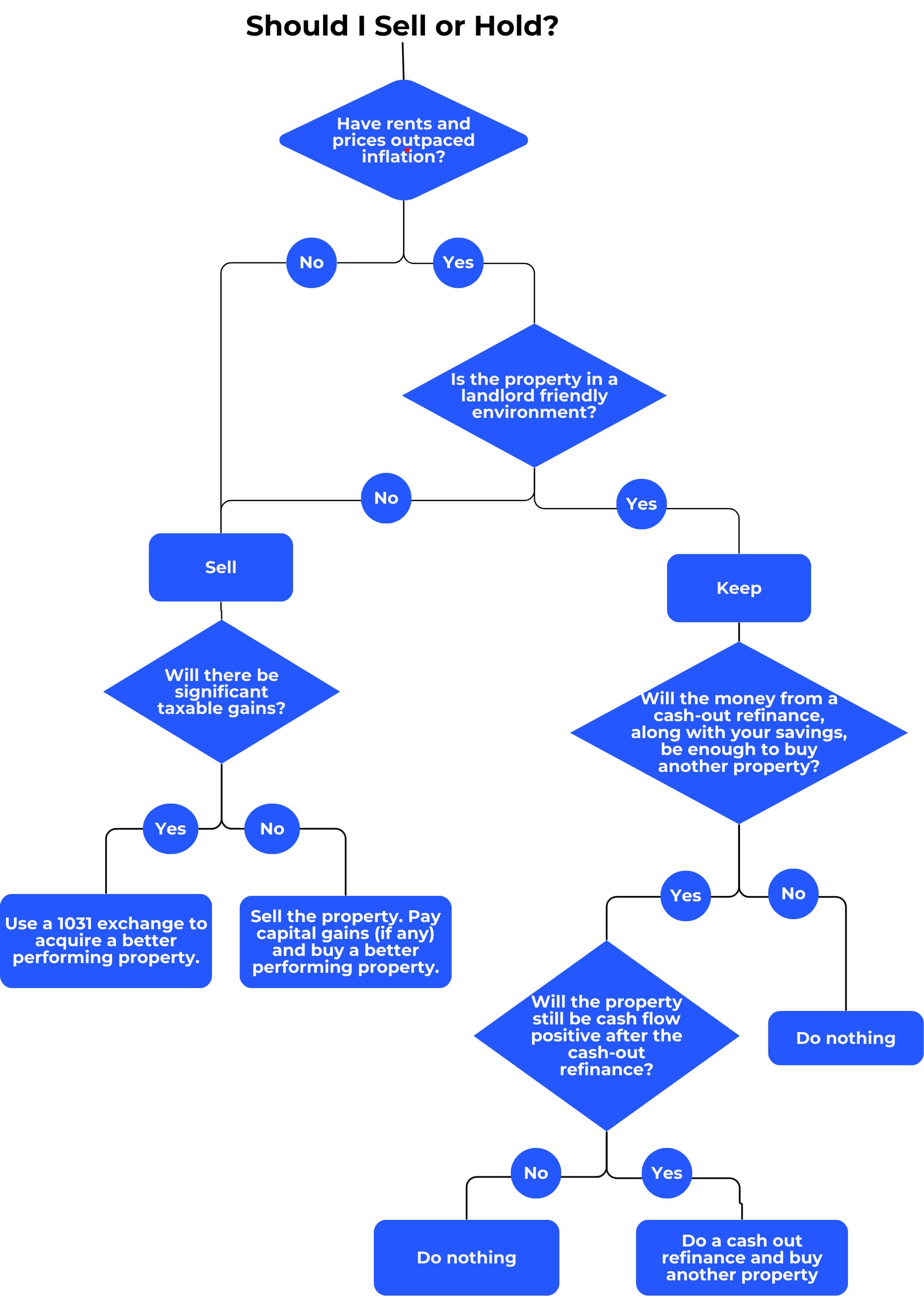
In summary, there is no fixed date when you should sell. What you should do depends on the property's performance and your goals. If your goal is lifelong financial independence, then rents increasing faster than inflation is essential. Let the property’s performance and your goals make the sell/refinance/1031 decision.
Hello @Joseph Snyder,
When it is a good time to sell depends on your financial goals. If your goal is financial independence, the decision process is relatively straightforward. I created the following decision tree which I hope you find useful.
In summary, there is no fixed date when you should sell. What you should do depends on the property's performance and your goals. If your goal is lifelong financial independence, then rents increasing faster than inflation is essential. Let the property’s performance and your goals make the sell/refinance/1031 decision.
This is great and really easy to follow. How do you usually calculate if rents have outpaced inflation? I know you just compare rent growth over time to the inflation rate for the same period, but I would love to hear how you approach it. Also, you might not need to sell at all. If you can add value with a few small changes under $10k in renovations, like adding a bedroom or doing minor upgrades such as light fixtures, paint, furniture, or converting to mid-term or short-term rental, you could see rents jump by several hundred dollars. That increase could bring you right back in line with inflation, even if it means spending a little more up front. I am definitely using this in my listing consultations. Nice work.
Hello @Joseph Snyder,
When it is a good time to sell depends on your financial goals. If your goal is financial independence, the decision process is relatively straightforward. I created the following decision tree which I hope you find useful.
In summary, there is no fixed date when you should sell. What you should do depends on the property's performance and your goals. If your goal is lifelong financial independence, then rents increasing faster than inflation is essential. Let the property’s performance and your goals make the sell/refinance/1031 decision.
"When is it actually a good time to sell real estate?"
When you say "Wait, what, you'll pay me how much?"
"When is it actually a good time to sell real estate?"
When you say "Wait, what, you'll pay me how much?"
It is a good time to sell real estate when you think there is another property / investment that will out perform your current property net over a 5 year period and cover your fees and taxes(assuming you are not doing a 1031 exchange).
@Joseph Snyder Sure, I will try my best
If you have an investment and it is making a 6% return(Cash on cash and appreciation), I likely wouldn't sell it unless I can make atleast more than 6% elsewhere. However, I also have to factor in costs to sell my investment. If the cost to sell my investment is $5,000
The new investment has to make atleast 6% and $5,000 to be a worthwhile investment. Ideally, you would recoop the $5,000 over a 5 year period.
It is a good time to sell real estate when you think there is another property / investment that will out perform your current property net over a 5 year period and cover your fees and taxes(assuming you are not doing a 1031 exchange).
@Joseph Snyder Sure, I will try my best
If you have an investment and it is making a 6% return(Cash on cash and appreciation), I likely wouldn't sell it unless I can make atleast more than 6% elsewhere. However, I also have to factor in costs to sell my investment. If the cost to sell my investment is $5,000
The new investment has to make atleast 6% and $5,000 to be a worthwhile investment. Ideally, you would recoop the $5,000 over a 5 year period.
@Joseph Snyder there is a key fundamental being overlooked and missed here.
One should NEVER get into an investment, ANY investment, without an exit strategy.
Your exit strategy will have the when and why.
On wall street with stocks, there is earnings reports. And everyone wait's on baited breath for how it all comes out. They take gambles if things come in better, worse or on par with expectations. And they make decisions to buy, sell or hold according to what comes out. That seems a really simple logical thing to do with any investment, be it stocks or investment real estate, right?
To start, you need to have expectations, meaning solid fact and math based projections and planning, means of measurement. Next is a schedule for weigh-in's. And lastly is simply deciding at what point one does what actions.
If something is bleeding out vs projected, at what point is it too much and time to get out? At what point are things over-inflated and it is best to take-profits?
All these decisions should be decided BEFORE getting into an investment.
If you leave it to figure out in-the-moment, odd's are you will be to reactive to have even noticed it happening until your late to things, which makes for panicked rushed decision making, which makes for really poor emotion centric decisions.
So how do you know when it's time to sell? You knew what it would look like long before it ever happened, you were waiting for it, ready for it, actions pre-thought and pre-planned so your just making execution decisions in the moment not trying to sort things from 0.
Hello @Joseph Snyder,
Thanks for the kind words.
“How do you usually calculate if rents…”
We compare the rent growth rate vs the inflation rate over a given period. We calculate the Compound Annual Growth Rate (CAGR = (Ending Median Rent / Beginning Median Rent) ^ (1/years) - 1) between 2015 and today, for properties that conform to our target property profile. On inflation, we usually use the inflation data from the Bureau of Labor Statistics.
Comparing the CAGR for rent and inflation is how we determine whether rents outpace inflation.
“Renovation enhancements…”
Determining what enhancements will significantly increase rent is more difficult than it seems. We do this in a two step process. First, we come up with a list of all renovation items that would make the house as attractive as possible to our target Tenant segment. We don't care about the cost at this point; we just want to get a consolidated list.
Next, we have a meeting with a team of people where we review each renovation line item and decide whether the ROI is sufficient. See the diagram below.
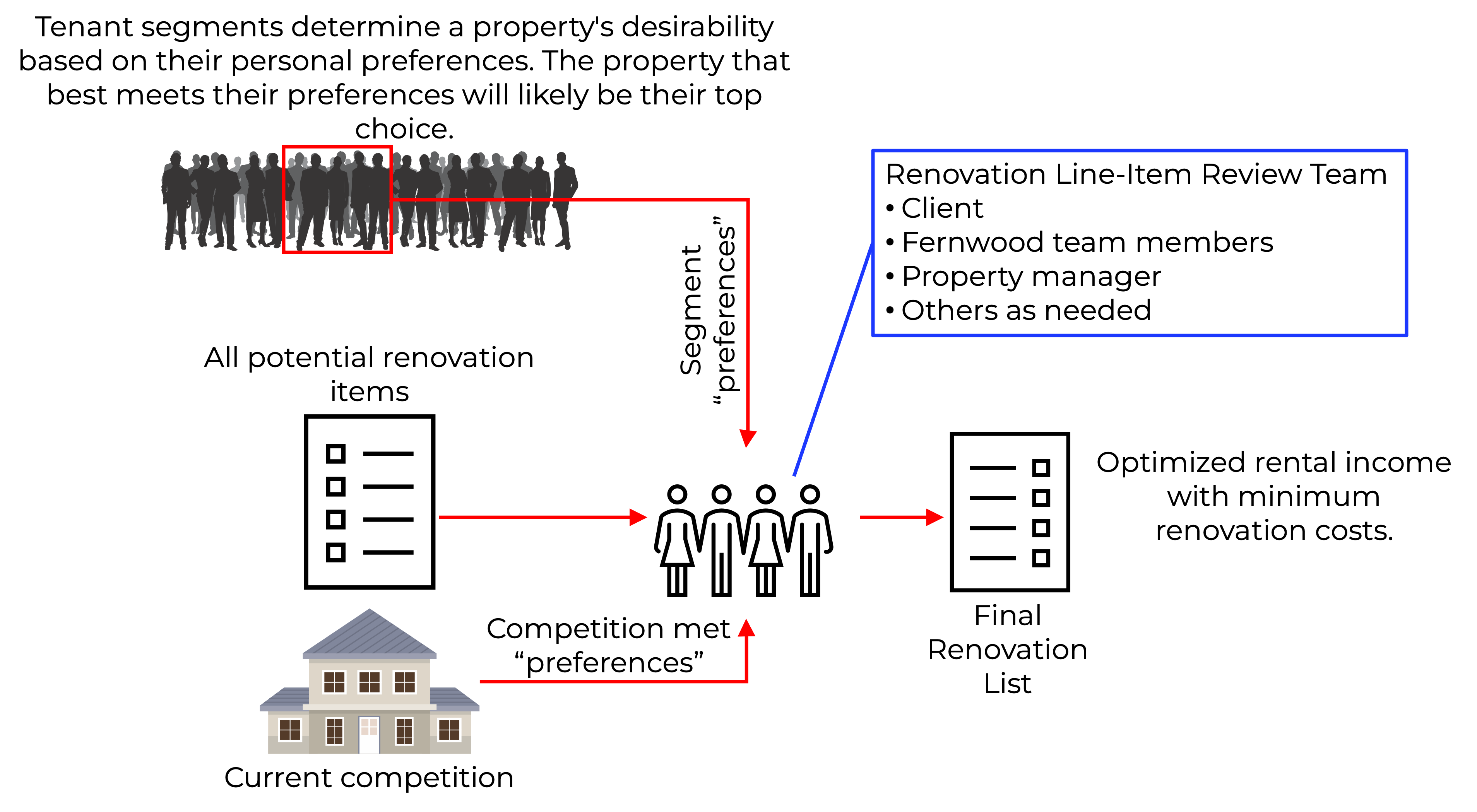
We start with a detailed list of potential renovations based on the preferences of our target tenant segment. Then we compare the property to competing available properties. Competition isn’t limited to the neighborhood—someone moving to Las Vegas for work may look on either side of town, so a comparable property could be across the city.
We also consider rent sensitivity. The more you spend on renovations, the higher the rent must be, which shrinks the pool of qualified tenants. Depending on market conditions, it can be smarter to limit upgrades to keep costs down and attract a broader tenant base.
As to using this on social media with a shoutout, please do. Thank you.
Joseph, if I wasn't clear or if you have other questions, please let me know.