I recently watched the bigger pockets podcast with Brad Dantonio as the guest. Brad bought 5 properties with cash in order to maximize cash flow and retire early. After thinking about it, wouldn't it be wise to do the same but while you are younger. Basically use the cash flow and your income to keep buying properties in cash. In terms of numbers it seems reasonable. First save and buy a property in cash that will cash flow $1,000 a month. Now along with your income you will save to buy another house with the additional $12,000 a year from cash flow. Keep doing that till you have 5 properties that will cash flow $5,000 a month. After that, if possible, you will be able to add your income and the 60k each year in cash flow to buy two houses.After that year, your total monthly cash flow goes up to $7000 a month. Looking at how this can safely snowball, is this a bad idea?
@Samuel Iwu Nearly everyone on this forum (all 1.4mm individuals) had a starting point of less than $100k cash. I would bet my bank account on 99% started with less than $100k. The reason why people don't purchase with cash is they simply don't have it.
Looking back, having the ability to do rehab projects with all cash is the easiest way to get rich. The catch? No one starts with $250k. Even lower priced markets where there is enough activity to justify flipping houses requires at least $100k - $150k of cash in order to complete a full purchase and rehab. That's a lot of cash. Something like 50% of Americans right now are a $1k expense away from financial turmoil so you can imagine how few people have $100k+ to invest.
I do agree that using cash is a great strategy. I'm over-leveraged at the moment with two hard money loans at 15% and I can tell you that I will never experience this again. I'm one economic decision away from potentially losing everything. Using cash mitigates this.
Since there's potential that we've already reached the peak of the housing market, leveraging yourself to the max is probably not a statistically wise decision. Jack's strategy is great on paper, but he just gave a scenario where there's 5 properties with $0 in reserves. That's one unfortunate break away from losing all 5 (hello 2007).
The way to make the most money with real estate is to control (purchase) as many properties as possible. Of course, this means you still have to do your math and purchase at the right price. Purchasing with 100% cash is great if you can get the property for a steal like from 2008 to 2010 when properties were 25 cents on the dollar. In fact, the properties were so cheap the banks would not give loans for less than $50,000 or $60,000.
When paying all cash because you cannot control as many properties. I will use small numbers for an example.
Suppose, you have $100k to invest. If you buy 1 house for $100k you have zero dollars left and you have only one house giving you cash flow. Your ability to make a profit depends entirely on 1 house. If that house turns out to be a dog your future is doomed. The same is true whether you pay cash for 10 properties vs. finaicing 50 properties with financing.
Now, lets look at using the same $100k, put $20k down and purchase 5 houses. Of course, your cash flow is almost nill, but there are several great things that will happen;
1) You will be able to increase the rents on 5 houses every year. the first 1 or 2 years you are depressed and think you made a huge mistake, but In a few years, after increasing rents, your will be bathing in cash. in 10 years you should be earning 5 times the cash flow you would have earned by paying cash for 1 property.
2) You never get rich from purchasing and renting properties. You get rich when properties appreciate in value. Now, you have the opportunity for 5 properties to increase $10,000, $50,000, or $500,000. Who knows, but with only one house whatever that amount will be only about 20% of what 5 houses will be.
3) If the single, lonely and only 1 house you purchased was a failure, maybe, a few of the other 4 houses will be a windfall.
The big money in real estate is when you have more properties appreciating in value. The rents you collect only help out with the little you get from social security.
Suppose, you business model is to blow your wad of cash on one house and save the cash flow to invest in another property in 5 years.That is a long long way down the road to success. Maybe, it sounds good in theory, but there are several bad things that can happen;
1) The cash flow from one house is not a significant amount of money and there is the high probability that you not have what it takes to put the money aside. It is safer to have a business model that inhibits failures and ensures success.
2) You will enjoy investing in real estate a lot more if you purchase 5 properties that are increasing in value at the same time vs. 1 property that generates a little cash flow.. Maybe, after giving a blank stare to the cactus as it grows for 5 years you will no longer be motivated to buy one more property and stare at the cactus for another 2 to 3 years. It sounds like a lonely boring life to me!
3) Who knows what the prices will be like in 5 years. Maybe they will be 100% higher and you will want to choke yourself for purchasing only one property when you had what it took, at the time, to purchase 5 properties where you would be living on Easy Street, today.
I have to tell you the same story I write almost every day about the 20-year old Japanese girl who ran away from Japan because her parents physically abused her. She came to this country with no money. She never got a job. She never had a driver's license. She was not married and never had a boyfriend. But, after being in this country she owned (mortgaged) 18 higher than middle-class properties. Most of the properties were brand new.
She did babysitting, earned $7,000 and purchase her first co-op with another Japanese girl. Her friend moved back to Japan and somehow they re-financed the co-op and the 20-year old bought out her partner's share. The Japanese girl used the re-finance money to purchase her first condo and rented it to about 12 college students. She kept re-financing and purchasing properties and in 7 years I figured she was worth $2.3 million.
Personally, I like to 'always be in the game'. I'm not letting the moss grow under my butt for 5 years and wait to see what will happen with the real estate market. I am not going to blow my wad of cash and lock myself into waiting 5 years to see what happens. I want flexibility. Buy 5! Sell two dogs. Upgrade to a more-sure thing. Buy two more. Double your investment capital every 1 to 2 years.
I completely see where you are coming from in terms of trying to generate massive wealth and massive net worth. I believe the difference in mindset is probably due to difference in locations. I currently live in Indiana where you can get a 3 bedroom 2 bath for around 100k maybe a little bit more in a good neighborhood. I always believed in the story of the hare and the tortoise, where slow and steady wins the race. For most people who invest in real estate the goal isn’t to gain financial freedom, not everyone wants to be a billionare. In terms of roi if you are diligent enough with your money and play smart you can get 5 properties in 5 year, each about a 10-12 percentage roi. You own the house so after that what comes out is all profit, cash flow and appreciation. In the same way that having only a few properties in my bag can cusses anxiety, Having over two million dollars of “good debt” and months where evictions and numbers not working out can stress a person too.
@Jack Orthman so based on your model of business. Purchasing 5 100k homes with 20k down using conventional loans and renting them out is a smart thing to do for a long run type of thing?
Assuming the homes are rent ready and don’t need much or any rehab at all?
@Samuel Iwu Nearly everyone on this forum (all 1.4mm individuals) had a starting point of less than $100k cash. I would bet my bank account on 99% started with less than $100k. The reason why people don't purchase with cash is they simply don't have it.
Looking back, having the ability to do rehab projects with all cash is the easiest way to get rich. The catch? No one starts with $250k. Even lower priced markets where there is enough activity to justify flipping houses requires at least $100k - $150k of cash in order to complete a full purchase and rehab. That's a lot of cash. Something like 50% of Americans right now are a $1k expense away from financial turmoil so you can imagine how few people have $100k+ to invest.
I do agree that using cash is a great strategy. I'm over-leveraged at the moment with two hard money loans at 15% and I can tell you that I will never experience this again. I'm one economic decision away from potentially losing everything. Using cash mitigates this.
Since there's potential that we've already reached the peak of the housing market, leveraging yourself to the max is probably not a statistically wise decision. Jack's strategy is great on paper, but he just gave a scenario where there's 5 properties with $0 in reserves. That's one unfortunate break away from losing all 5 (hello 2007).
@Spencer Cornelia thank you for the great insight. Everything you said is correct and I also thank you for giving your personal experience. In my situation the end goal is using these properties as rentals even if the economy crashes won’t the demand for places to rent increase? The reason I brought this up is I am about to graduate debt free and saving up 100k in two years after college wouldn’t be hard especially since I have no kids and can live with my parents. I am wondering if it’s a bad idea to do the cash plan I proposed, especially if I can do it instead of eventually over leveraging myself with a bunch of house loans. Is there an alternative you would recommend?
@Samuel Iwu Network, network, network. Spend the two years networking and learning. Then when you have some cash you will have options. Hopefully during those two years you will develop a strategy that works best for you.
What works for me and everyone else on this forum may not work for you. Find out what works for you.
Whatever route you choose, use as much cash as you can. Over leveraging yourself is a dangerous game. Some people on here will argue that you should leverage yourself as much as you can, but that's exactly what people did in 2006 and got wiped out.
You said, "For most people who invest in real estate the goal isn't to gain financial freedom." Are you serious?
Someone wants to give you a gift, but they don't want to cause any anxiety and they don't want you to worry about evicting tenants. Tell me which gift you prefer.
A - One $150,000 propperty with a $100,000 mortgage = $50,000 in assets.
B -Ten $150,000 propierties with $1,000,000 in mortgages = $500,000 in assets.
Maybe, to make your life more stress-free you should take the ten properties one at a time over a 20 or 30-year period.
There is Good Debt and Bad Debt
Bad Debt is the loan for the $90,000 your new car that was worth $60,000 the second you drove it off the lot. Bad Debt is the credit card you maxed out for all the crap you didn't need.
Good Debt is owning $100,000 for a property that is going to make you a $500,000 in 10 or 20 years. Who gets anxiety writing checks to mortgage companies when they are making millions of dollars with the mortgage company's money. The only people who fit this description would be crazy people. I write thousands of checks and make millions of dollars. I can't figure out why someone would get anxiety.
Your hare and tortoise story does not apply to investing. The reason the hare lost the races was not because it was slow. The reason the tortoise won the race was not because it was faster or smarter. The tortoise did not use any ingenuity. I can't even say there was a reason the tortoise has a reason to think it would win. How would the tortoise know the rabbit would take a nap.
As with real estate investing, there was no prize at the finish line. The hare lost the race because it was arrogant, over-confident and because it took a nap. There really is no moral to the story. The story does not tell children that if they walk slow they will win a 50k race. I always think of the hare and tortoise story as a cop-out for people who are slow.
@Samuel Iwu There is a middle ground here I want to point out. Maxing out leverage to get as many properties as possible can be very lucrative in the long run, but also very risky. As @Kenny Oliver pointed out, most homes will require a little bit of capital to get them rent ready so that needs to be factored in along with closing costs of all these properties which hasn't been mentioned. In the scenarios discussed above, an alternative could be to buy 2 properties with 25% down + closing costs (~30k each), invest what you need to get them rent ready, and make sure you start with at least 5k in reserve for each house in case you get hit with a quick unexpected expense before you've had time to build up reserves. You would likely have a little left over to start saving up for the next property and allow you to use leverage while still minimizing risk by having plenty in reserve for each property as @Spencer Cornelia alluded to.
@Samuel Iwu Welcome to BP from a fellow NWI person. I'm on your fence. As a wholesaler, I see too many buyers leveraging stuff to the max. Sure they build up portfolios quickly but they are one bad decision or bad luck away from some pain. There's no room for market correction. What's the point of having a rental that cash flows $100/m in a good market. Is it worth it to say you have a dozen properties and make $1200/m? But the tenants are paying down the mortgage- yeah, that means nothing when the properties are worth 5-10% less in a few years. That means nothing when they trash the place and the make ready is $5k- or 4 years of your cash flow. Saying that, I'm middle of the fence here. I started with cash but leveraged a few (at 60% LTV). Overall, my debt it 40% of my portfolio and only 20% of my gross income. A big part of it no one discusses is peace of mind. You can't put that on paper and into a spread sheet. If you have more comfort doing this without debt- do it. Don't let people you don't know try to convince you otherwise. If you have giant gonads and want to leverage everything 80% or more- go for it.
@Samuel Iwu
What I have been learning the past few weeks is that cash purchases can make bad deals cash flow and look good.
But, they are still bad deals.
Stay on the beaten path. Clearly define your strategy. Be patient. Win.
Interest rates are extremely low right now, all paying cash does is get you a 4% return on your money and a bit of peace of mind at best.
Having higher expenses and lower equity on each individual property helps protect you from lawsuits (suing a property that has minimal equity has minimal results) and also having lower profits per property optimizes your ratio of deprecation to earnings lessening your overall tax burden. With more properties your risk is spread further, sure won’t save you if you are buying bad deals but you won’t be faced with 1 vacancy wiping out all your revenues.
@Samuel Iwu Nearly everyone on this forum (all 1.4mm individuals) had a starting point of less than $100k cash. I would bet my bank account on 99% started with less than $100k. The reason why people don't purchase with cash is they simply don't have it.
Looking back, having the ability to do rehab projects with all cash is the easiest way to get rich. The catch? No one starts with $250k. Even lower priced markets where there is enough activity to justify flipping houses requires at least $100k - $150k of cash in order to complete a full purchase and rehab. That's a lot of cash. Something like 50% of Americans right now are a $1k expense away from financial turmoil so you can imagine how few people have $100k+ to invest.
I do agree that using cash is a great strategy. I'm over-leveraged at the moment with two hard money loans at 15% and I can tell you that I will never experience this again. I'm one economic decision away from potentially losing everything. Using cash mitigates this.
Since there's potential that we've already reached the peak of the housing market, leveraging yourself to the max is probably not a statistically wise decision. Jack's strategy is great on paper, but he just gave a scenario where there's 5 properties with $0 in reserves. That's one unfortunate break away from losing all 5 (hello 2007).
I lost everything back in early 2000s precisely because I was overleveraged, did not have reserves both for real estate and my car wash business.
BUT, had I bought everything cash afterwards, I would still be broke today.
So, there's a right balance.
You need leverage to acquire enough properties relatively quickly AND you need a lot of cash in the bank to so balance out the risks posed by debt.
Fortune 500 companies use debt to become richer. But the good ones that have sustainable business models - those companies that survive the test of time, have capital and operating reserves - and even have a "war chest" for mergers and acquisitions. And they sometimes have too much cash they buy back their own shares (and interestingly enough, they don't always pay down their debts either - which tells you that they believe in leverage).
So Balance is the key. Leverage to acquire a lot of properties quickly but balance it with having a healthy cash reserves and equity in those properties.
@Account Closed I'm sorry for the typo, I meant most people on here are looking for financial freedom. I'm also thankful of the responses I am getting in regards to this question. In all honest if everyone started taking loans to invest in real estate what would happen? ultimately the properties aren't yours until you pay them off right. If circumstances were to happen against the bank, do they have the right to take their property? (I don't know the answer to this question just asking).
Additionally a good deal for a normal investor that uses leverage and cash flows 200/mo, would be more effective if there were no mortgage right? a vacancy on a house with a mortgage is bad because then no one is performing the ultimate goal of paying of the mortgage. I am amazed by what most people on this forum are doing by using other people's money to build net worth and retire in peace. I believe it is a smart move to make.
@Ray Fisher that is exactly what I’m going through at the moment and your response is just what I needed. I currently own a home paid off that I live in and I have enough to purchase others for a down payment through conventional loans but I’m stuck at which niche I want to invest through.
The more I wait the more I’m losing money and it sucks!
Depends on what you mean by "safe".
Leverage compounds returns. The less leverage you use, or the faster you de-leverage, the worse your Return on Equity and IRR will be. Here's a visual (based on a set of assumptions found in my spreadsheet uploaded to the FilePlace):
https://www.biggerpockets.com/files/user/ScottTrench/file/all-cash-15-year-loan-30-year-loan
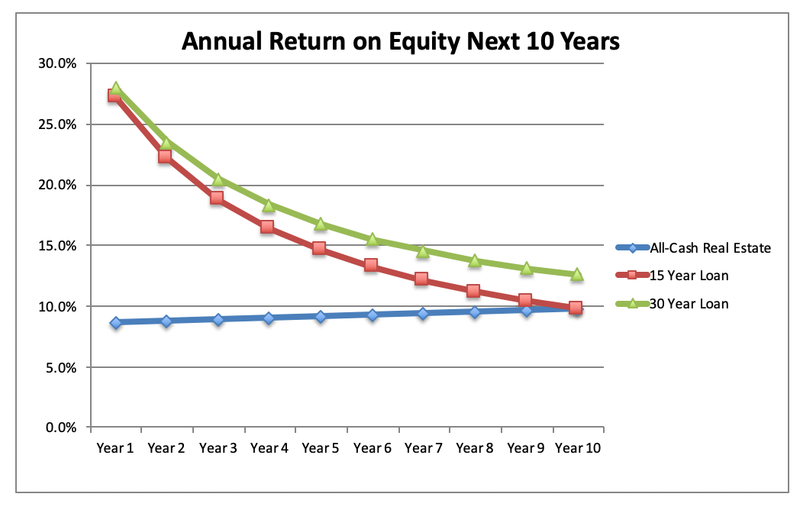
Imagine a median income earner who is extremely frugal. They make $50K per year and save $20K per year to invest in real estate. They are going to be at it for a helluva long time if they invest using all cash. They "safely" guarantee themselves decades in the rat race by failing to use leverage.
Another thing to note is that cash flow grows faster for the leveraged investor than the all cash investor. Imagine if you have $100K to invest. You buy one $100K property that rents for $1K and has expenses (no financing costs) of $500. After three years, inflation pulls rents and expenses up by 10% - your cash flow increases to $1.1K less $550 in expenses - for a cash flow of $550.
If you use leverage, you can buy five properties, not one. Inflation in this case over a 3-4 year period may pull rents from $5,000 to $5500. OpEx will increase from $2500 to $2750. Cash flow (non-financing related increases by $250 in this case. Represented visually, this phenomenon looks like this:
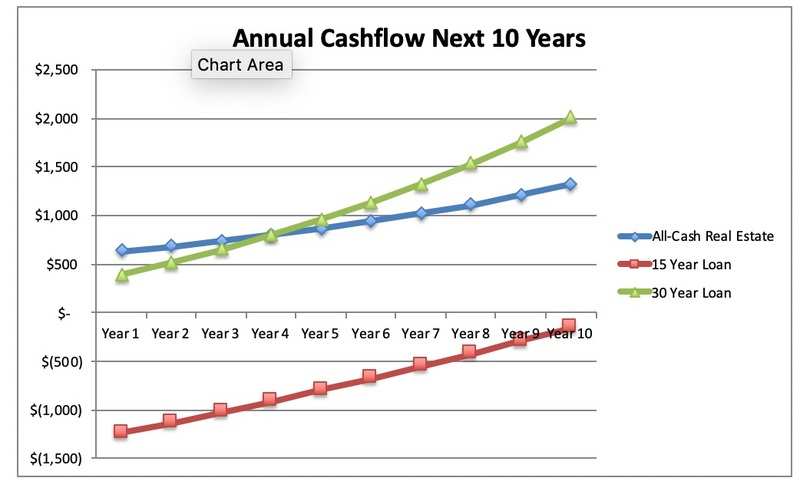
That's right - a leveraged investor will generate more free cash flow than an all cash investor in just a handful of years in average market conditions with average inflation. Bet few of you were expecting that! This is becuase financing costs are generally fixed, while inflation is the leveraged investor's friend.
What is risk? To me, risk is the probabilty of having less wealth over time. To me, risk is investing and getting a mediocre return in real estate with all the work in excess of stock investing. The low-risk option to me is to take the highest probability path towards high sustainable long-term returns.
Average Joe earning $50K per year and investing $20K per year has an extremely high probability (risk) of spending most of his adult life spinning his wheels in the rat race if he invests in real estate without leverage and spends several years accumulating cash such that he can invest in one giant lump. His risk of failing to live to his true potential is greatly lessened if he uses leverage intelligently to boost his chances of great long-term returns.
Of course - all things in moderation - cash cushion, great operating philosophy, etc. These things are critical. The investor who uses leverage and goes bankrupt posts an IRR of -100%.
What you're illustrating in your first post is just the benefit of compounding returns on dollars invested. I don't agree that buying cash is the best way to do this if you can effectively leverage the entirety of your investment funds. The key here is actually being able to place all of your funds in good investment property.
I just ran some numbers through my pro forma, and a property that's an 11% Cap rate has a cash on cash ROI of 25%+ with current commercial financing terms through a major bank.
If you buy 100k worth of property with cash:
You get an 11% rate of return.
You get to take home the sum of your net operating income.
If you buy 500k worth of property, with 100k cash down + financing:
You get a 27% rate of return after your mortgage payment is made.
You get to write off the interest on your mortgage payment.
You are paying off your debt and increasing your equity position over time, further adding to your returns.
It's kind of a no brainer to me. The only challenge is that it may be harder to find 500k worth of GOOD high cash flow property than is to find 100k.
@Account Closed
Jinx. :)
@Account Closed so what your saying is the idea of using cash flow to buy more properties isn’t a bad idea. That I should instead of buying a property with cash, I should leverage and then use the cash flow to buy more properties? What about buying a rehab property with cash low and then fixing it and renting it with no mortgage is that bad?
The same theory is maintained regardless of the situation- even with the rehab property. It doesn't matter how cheap you get the deal or how much equity you have- you'll always be in a better position with leverage (unless the property has a very low market value).
It all depends what your investment objective is and where you are in your timeline in your investment career. In the beginning you need to leverage because you need to scale and grow. (first 10yrs). In the middle (10-20yrs) the assets really begin to mature and your cash flow is high. You may not want to leverage and take on the necessary risk. In your tail end of your investment career (20yr+) you want zero debt and be chilling with no worries in the world collecting the checks.
It all starts with that you want and what your goals are. I am not interested in taking on risks in the later part of my life. I am not interested in accumulating 80+units with loans attached to them. What I am interested is making a ton of free cash flow with zero debt and having the time to spend all the money with no worries. Different strokes for different folks. No right or wrong way. It all depends on what you want.
You are not interested in 88 units with loans? Funny, how everyone thinks different and creates their own limitations. I purchased 110 units since 2001, made more than 30 million since 2001 and within the next few weeks will purchase 40 to 100 units in Las Vegas.
You really cannot say that owning more units causes more stress. With more units you have much less to worry about when you have tenant or repair problems.
Lots of wisdom already here. I'd also add that once you are in the game, you start gaining experience and connections that are not possible before. It doesn't have to be either/or. People around you will start noticing what you are doing and be curious about getting involved, especially if they have cash and no interest in doing the leg work.
@Samuel Iwu One of my favourite quotes: Equity is Vanity, Cash Flow is Sanity.
And of course, everyone here on BP knows that Cash Flow is KING! 👑👑👑
The reality is that one will be seriously hardpressed to find a property, especially an SFR that cash flows $1,000/month.
In any case, for fun and indulgence, let us do a quick calculation 🤗:
5 houses bought at, say, 200k all-cash basis (simple math): $1,000,000 initial outlay (I remember the save + work income then buy)
At $5,0000 a month with the $1M gone, you get about 6% annualized return for your money (5k x 12 = 60k a year [without any other expenses]).
Now, others will say well I can take that same $1M and deploy it in a much larger asset within the commercial realm and double that money in 5 years and get more than 5k a month.
At the end of the day, it all really depends on each investor's goals and what they have the stomach for... It is a fascinating thought 🤔🤔🤔