I have 100,000 and i dont know where to put it...
New to Real Estate · Hong Kong · Member since 2020 · 14 posts · 19 votes
If money was not an issue and i had 100,000 USD on the side to put for down payments, would investing in expensive cities like los angeles be a good idea because of the rental occupancy rate there, or would it be wiser to invest it in somewhere that has a lower occupancy rate but i can buy more with 100,000 in down payments.
If money was not an issue and i had 100,000 USD on the side to put for down payments, would investing in expensive cities like los angeles be a good idea because of the rental occupancy rate there, or would it be wiser to invest it in somewhere that has a lower occupancy rate but i can buy more with 100,000 in down payments.
Etienne, I'd invest for appreciation in a market like Los Angeles. If money's not an issue at present, and you want your money put to best use, invest in a place like LA (and I vote specifically for LA).
Let's just do some quick math:
Let's say $100K is going to be 25% down payment on one or several properties. In your appreciation market, you'll receive no cashflow, but the building will appreciate 5% per year. In the cashflow market, you'll earn a fantastic 15% cash-on-cash return but no appreciation. All financing terms are identical. Let's remove costs associated by buying and selling. To further simplify, let's say there's no principal paydown (since it will be equivalent in both examples).
What's your investment horizon? Let's say seven years...
In seven years, in your appreciation market, you'll own a property worth $562,840. You borrowed $300k to buy it, so you profit in year 7 is $262,840.
In the cashflow market, after seven years, you will have made $105,000 in cashflow. You'll have no profit in the sale of the building because it didn't appreciate.
Now, cashflow-lovers are going to make the following argument: cashflow is money-in-hand whereas appreciation is speculative.
They would be right that cashflow is money-in-hand in that you get it regularly, not as a big lump sum at the end. This makes the early cashflow payments more valuable than the later appreciation harvesting. However, if money is not a current concern, as is the case in this example, the actual value of those earlier payments is lower. To be really nerdy and mathy about it, you can use a much lower discount rate when analyzing the value of future earnings.
However, is appreciation speculative? In the Midwest, yes. In cities that have populations under 1M and might or might not be ascendant, absolutely. But in an international gateway city with a longterm average appreciation rate of 6.7% going back to 1975 -- meaning this longterm average incorporates the five recessions that have occurred since? Appreciation is far less speculative than Midwestern investors make it out to be, and to the extent that it is more speculative, the reward is much greater.
So, buy LA, my friend!
Best,
Jon
I like a market that cost less. My fav is affordable housing because there is just so much demand for it, cashflow is higher, Class C properties.
If money was not an issue and i had 100,000 USD on the side to put for down payments, would investing in expensive cities like los angeles be a good idea because of the rental occupancy rate there, or would it be wiser to invest it in somewhere that has a lower occupancy rate but i can buy more with 100,000 in down payments.
Etienne, I'd invest for appreciation in a market like Los Angeles. If money's not an issue at present, and you want your money put to best use, invest in a place like LA (and I vote specifically for LA).
Let's just do some quick math:
Let's say $100K is going to be 25% down payment on one or several properties. In your appreciation market, you'll receive no cashflow, but the building will appreciate 5% per year. In the cashflow market, you'll earn a fantastic 15% cash-on-cash return but no appreciation. All financing terms are identical. Let's remove costs associated by buying and selling. To further simplify, let's say there's no principal paydown (since it will be equivalent in both examples).
What's your investment horizon? Let's say seven years...
In seven years, in your appreciation market, you'll own a property worth $562,840. You borrowed $300k to buy it, so you profit in year 7 is $262,840.
In the cashflow market, after seven years, you will have made $105,000 in cashflow. You'll have no profit in the sale of the building because it didn't appreciate.
Now, cashflow-lovers are going to make the following argument: cashflow is money-in-hand whereas appreciation is speculative.
They would be right that cashflow is money-in-hand in that you get it regularly, not as a big lump sum at the end. This makes the early cashflow payments more valuable than the later appreciation harvesting. However, if money is not a current concern, as is the case in this example, the actual value of those earlier payments is lower. To be really nerdy and mathy about it, you can use a much lower discount rate when analyzing the value of future earnings.
However, is appreciation speculative? In the Midwest, yes. In cities that have populations under 1M and might or might not be ascendant, absolutely. But in an international gateway city with a longterm average appreciation rate of 6.7% going back to 1975 -- meaning this longterm average incorporates the five recessions that have occurred since? Appreciation is far less speculative than Midwestern investors make it out to be, and to the extent that it is more speculative, the reward is much greater.
So, buy LA, my friend!
Best,
Jon
@Etienne Dubois - It all depends on your long term goals. If you are a buy and hold investor, Cape Coral-Fl, Detroit-MI, Lansing-IL; whereas if you are looking for appreciation, Los Angeles would be a good market but you would need to do a JV with someone since $100,000 cannot purchase much in Los Angeles.
Anthony O. Porter
Porter's Property, LLC
@Jon Schwartz amazing analysis sir!
@Jon Schwartz Oh... Wow... Ok. So instead of tearing down that whole thing....Im going to point out the most obvious oversight...
You stated 100k is 25% down.
If he follows your plan, it means he is not only going to put his money in a
"non-interest" bearing,
non-early withdrawable,
non FDIC insured,
game of risk roulette with
yearly "in-game" spending requirements for scheduled maintenance costs,
an "out of state" renters rights water heater repair concierge premium,
"4 months same as burned cash" eviction moratorium,
and carries a "non-reimbursable" tenant hunt cashflow loss during game vacancies
and last but not least, a profit reduction coefficient of negative (300k * ((mortgage interest rate) +(2nd home interest rate modifier))...Aka interest on a 300k loan.
Interesting...
@Jon Schwartz Oh... Wow... Ok. So instead of tearing down that whole thing....Im going to point out the most obvious oversight...
You stated 100k is 25% down.
If he follows your plan, it means he is not only going to put his money in a
"non-interest" bearing,
non-early withdrawable,
non FDIC insured,
game of risk roulette with
yearly "in-game" spending requirements for scheduled maintenance costs,
an "out of state" renters rights water heater repair concierge premium,
"4 months same as burned cash" eviction moratorium,
and carries a "non-reimbursable" tenant hunt cashflow loss during game vacancies
and last but not least, a profit reduction coefficient of negative (300k * ((mortgage interest rate) +(2nd home interest rate modifier))...Aka interest on a 300k loan.
Interesting...
Wow, taking some big swings there, Gavin. I love it! I love the energy.
Let me address your points specifically and, in the process, make my argument more clear and try to understand what in the world you're talking about.
You stated 100k is 25% down.
Actually, the original poster asked about using $100K for down payments, and I'm using the standard, conservative 25% down for non-owner-occupied residential property.
If he follows your plan, it means he is not only going to put his money in a
"non-interest" bearing,
non-early withdrawable,
non FDIC insured,
Gavin, you appear to be describing a savings account here. The best rate I can find for an interest-bearing, liquid, FDIC-insured savings account is 1% (source: https://www.bankrate.com/banki...). Are you suggesting the original poster should put his $100K into a savings account? That's only going to yield $1000 in cashflow per year -- and he'll only get that much if he doesn't withdraw any funds. That's an awfully conservative approach! Are you aware of any real estate investment vehicles that bear interest, are liquid, and are FDIC-insured? If so, let us know!!
game of risk roulette with
Game of risk roulette? How do you mean? Are you saying that expecting appreciation gains is playing risk roulette? Since 1975, the Los Angeles MSA has achieve a longterm average appreciation rate of 6.7% according to the FHFA home price index. Here's the chart:
https://fred.stlouisfed.org/se...
In my example, I was accounting for an average appreciation rate of 5%. So I was being conservative by LA standards! I was also using a Midwest cash-on-cash return of 15% -- which I think is aggressive if the original poster is trying to run his portfolio from Hong Kong. Perhaps appreciation is uncommon in your town, but in Los Angeles, where we're surrounded by ocean on two sides and mountains on the other two, it's a fact of life. It won't be a consistent 6.7% each year, but jeez, this ain't Indianapolis!
yearly "in-game" spending requirements for scheduled maintenance costs,
an "out of state" renters rights water heater repair concierge premium,
I should have been more clear: in my example, when I said the appreciating property would have no cashflow, I meant no positive or negative cashflow. In other words, the income from the property covers all expenses, including property management and mortgage and capex reserves, but doesn't deliver a cent of cashflow beyond that. These properties exist in LA. Folks outside of California seem to think that appreciation is only possible on properties that have negative cashflow, or that properties in California only produce negative cashflow. Such is not the case; I don't buy anything with negative cashflow. So these maintenance costs are accounted for in my scenario.
"4 months same as burned cash" eviction moratorium,
You've probably heard by now that the CDC has ordered a national eviction moratorium (source: https://www.cdc.gov/coronaviru...), so this dilemma exists in any scenario. But let's address this, anyway. Our Los Angeles property would need a GRM of, say, 16 to be cashflow neutral. That means four months of rent would be $10,416. That's not enough to tip the scales; appreciation still wins.
and carries a "non-reimbursable" tenant hunt cashflow loss during game vacancies
Vacancy is accounted for in the cashflow neutral proposition, though I will take this moment to point out that LA has one of the lowest vacancy rates in the country. It was 4% pre-COVID, and with COVID and the unprecedented unemployment in LA right now, we're at about 6.5%. The national average pre-COVID, FYI, was 9%.
and last but not least, a profit reduction coefficient of negative (300k * ((mortgage interest rate) +(2nd home interest rate modifier))...Aka interest on a 300k loan.
Again, the debt service is accounted for in the cashflow neutral proposition. And anyway, both scenarios carried the same interest cost, so they negate each other. But here's my question, Gavin: are you against leverage? Are you arguing that the original poster is best served by buying a property in cash?
Let me expand that question: what are you proposing, Gavin? The oversights you pointed out where not oversights at all. (I should mention that the cashflowing property carried the same assumptions: that expenses, debt service, and vacancy were accounted for in the 15% cash-on-cash). What's your suggestion for the original poster?
Also, what's the argument behind your post? It seems to boil down to your not liking appreciating assets. Is that right?
Best,
Jon
@Jonathan Anderson
Ok. well since your entire argument, and the profitability of your plan, is based on one HUGE if.. which is if the owner of the property can rent the place for enough to cover ALL of the costs of ownership including, but not limited to
a 300k mortgage payment,
property taxes
scheduled maintenance
property management fees (as you stated)
misc repair costs
a quick check of the median listed price of a 2 bed condo in LA is, wouldn't you know 389,000.
So after 100k down, and the loan origination fees, looks like 400k total purchase is a great figure to go off of....
leaving us with roughly a 300k loan.
So, at 4% on a 30yr fixed = $1432.00/mo
property taxes escrow = $392/mo (random property listed at $379k)
property management = $100/mo (conservatively...)
scheduled maintenance = $100/mo (conservatively...)
1 repair per year ($480/yr) = $40/mo
Now, let's look at 2br SFR for rent. Im going to, for argument's sake, allow our 2br condo to be compared against 2br houses in terms of rental price, partially because it will still illustrate my point, and also, I did not feel like hunting through 1000 listings for apartment complex owned and managed studio-3br listings to find an example. We do have to count out apartment complex listings however, single unit privately owned condos, are in need of updating, and do not have the amenities that apartment complexes do for our 400k purchase price, unless there is a $200/mo HOA fee. Infact 400k +/- purchase price is the lowest anything is listed for in L.A.
So..while I would love to just assume avg median rent / avg media price, We can not. While the lowest we can find a condo for is 350k+, the avg median sales price is over 700k. So basically, at 400k, were looking at the low side of what is out there.
And just a quick glance at realtor.com, and we can see how this will play out...Keep in mind we are looking at 2br condos to purchase. And sure enough 2br houses are listed for rent all the way down to $1300/mo and 17 listed for less than $2k/mo.
So, did you do the math from above? our total (conservative) estimate for monthly costs came to $2064.00. Just to be safe, I repeated the search for rentals 2br+ in Los Angeles, SFR or Condos on zillow, and there are at least 30 listings for under $2k per month.
To be fair, I repeated the search for homes for sale for less than 400k on LA. I think we can both agree that mobile/manufactured housing should be removed as they are a depreciating asset which would invalidate the appreciation aspect of your argument. Zillow does have listings down to 320k. which would mean a lower monthly mortgage payment.
All in all, I'm still not seeing it actually work out. Looks to me like you can rent a place for less than the cost of ownership. (which is generally speaking the rule.... otherwise no one would ever rent.) which means that There is most likely going to be at least a little negative cash flow at 100k down.
But let's say we break even. Every day that property sits empty adds to negative cash flow.
I do not believe that investing in property is a bad idea at all. Your suggestion lumps in all of the possible rewards and disregards any risk. I believe that attempting to invest with the same monetary plan as one would purchase a primary residence is not investing at all. It is simply buying another liability that someone else is going to live in.
You want a great return on 100k. Buy a 100k house. Rent it for $500/mo. Let it appreciate 2% per year. Pay your property taxes, do your scheduled maintenance, and repairs, and walk with 5% per year, with almost no risk.
Or buy a house in LA....maybe break even on cash flow... and at the end of 7 years... maybe..maybe break even on house value.
Oh... forgot to mention forbes reported in december 2019 on L.A. awwww...no appreciation in 2019 for LA homes...
https://www.forbes.com/sites/johnwake/2020/12/31/no-house-price-appreciation-in-new-york-los-angeles-chicago-or-san-francisco/#cffec8f1af84
If you invested in L.A. with the 100k down strategy in 2019.... there goes that whole year of profit.
@Jon Schwartz Oh... Wow... Ok. So instead of tearing down that whole thing....Im going to point out the most obvious oversight...
You stated 100k is 25% down.
If he follows your plan, it means he is not only going to put his money in a
"non-interest" bearing,
non-early withdrawable,
non FDIC insured,
game of risk roulette with
yearly "in-game" spending requirements for scheduled maintenance costs,
an "out of state" renters rights water heater repair concierge premium,
"4 months same as burned cash" eviction moratorium,
and carries a "non-reimbursable" tenant hunt cashflow loss during game vacancies
and last but not least, a profit reduction coefficient of negative (300k * ((mortgage interest rate) +(2nd home interest rate modifier))...Aka interest on a 300k loan.
Interesting...
Wow, taking some big swings there, Gavin. I love it! I love the energy.
Let me address your points specifically and, in the process, make my argument more clear and try to understand what in the world you're talking about.
You stated 100k is 25% down.
Actually, the original poster asked about using $100K for down payments, and I'm using the standard, conservative 25% down for non-owner-occupied residential property.
If he follows your plan, it means he is not only going to put his money in a
"non-interest" bearing,
non-early withdrawable,
non FDIC insured,
Gavin, you appear to be describing a savings account here. The best rate I can find for an interest-bearing, liquid, FDIC-insured savings account is 1% (source: https://www.bankrate.com/banki...). Are you suggesting the original poster should put his $100K into a savings account? That's only going to yield $1000 in cashflow per year -- and he'll only get that much if he doesn't withdraw any funds. That's an awfully conservative approach! Are you aware of any real estate investment vehicles that bear interest, are liquid, and are FDIC-insured? If so, let us know!!
game of risk roulette with
Game of risk roulette? How do you mean? Are you saying that expecting appreciation gains is playing risk roulette? Since 1975, the Los Angeles MSA has achieve a longterm average appreciation rate of 6.7% according to the FHFA home price index. Here's the chart:
https://fred.stlouisfed.org/se...
In my example, I was accounting for an average appreciation rate of 5%. So I was being conservative by LA standards! I was also using a Midwest cash-on-cash return of 15% -- which I think is aggressive if the original poster is trying to run his portfolio from Hong Kong. Perhaps appreciation is uncommon in your town, but in Los Angeles, where we're surrounded by ocean on two sides and mountains on the other two, it's a fact of life. It won't be a consistent 6.7% each year, but jeez, this ain't Indianapolis!
yearly "in-game" spending requirements for scheduled maintenance costs,
an "out of state" renters rights water heater repair concierge premium,
I should have been more clear: in my example, when I said the appreciating property would have no cashflow, I meant no positive or negative cashflow. In other words, the income from the property covers all expenses, including property management and mortgage and capex reserves, but doesn't deliver a cent of cashflow beyond that. These properties exist in LA. Folks outside of California seem to think that appreciation is only possible on properties that have negative cashflow, or that properties in California only produce negative cashflow. Such is not the case; I don't buy anything with negative cashflow. So these maintenance costs are accounted for in my scenario.
"4 months same as burned cash" eviction moratorium,
You've probably heard by now that the CDC has ordered a national eviction moratorium (source: https://www.cdc.gov/coronaviru...), so this dilemma exists in any scenario. But let's address this, anyway. Our Los Angeles property would need a GRM of, say, 16 to be cashflow neutral. That means four months of rent would be $10,416. That's not enough to tip the scales; appreciation still wins.
and carries a "non-reimbursable" tenant hunt cashflow loss during game vacancies
Vacancy is accounted for in the cashflow neutral proposition, though I will take this moment to point out that LA has one of the lowest vacancy rates in the country. It was 4% pre-COVID, and with COVID and the unprecedented unemployment in LA right now, we're at about 6.5%. The national average pre-COVID, FYI, was 9%.
and last but not least, a profit reduction coefficient of negative (300k * ((mortgage interest rate) +(2nd home interest rate modifier))...Aka interest on a 300k loan.
Again, the debt service is accounted for in the cashflow neutral proposition. And anyway, both scenarios carried the same interest cost, so they negate each other. But here's my question, Gavin: are you against leverage? Are you arguing that the original poster is best served by buying a property in cash?
Let me expand that question: what are you proposing, Gavin? The oversights you pointed out where not oversights at all. (I should mention that the cashflowing property carried the same assumptions: that expenses, debt service, and vacancy were accounted for in the 15% cash-on-cash). What's your suggestion for the original poster?
Also, what's the argument behind your post? It seems to boil down to your not liking appreciating assets. Is that right?
Best,
Jon
What would be your risk assesment about maximum drawdown in LA?
If things don't go as expected how much value could a property in LA lose over a 5-year period?
@Gavin D. @Jon Schwartz let me say kudos to both of you for a very healthy conversation!
Transparency, I am a cash flow guy and look to build long term wealth with solid monthly income. So I like my Midwest market of Dayton OH where I live and invest.
With 100k, I would advise my clients to purchase 4 value add quads. We can buy quads for 80-100k that just need rents raised and freshened up all day long. So 100k is plenty to do that with. And.......it’s easy to REFI and pull cash out. Here is rounded numbers but ideal for my clients I represent as their realtor. If we can be all in on a quad for 80-90k, that’s puts us close to 20k to close. Rents raised to market and just some simple sprucing up, we can refi these at 120k appraisal and pull 75% out with fully amortized 30 year. Pulling 90k out on refi pays off initial loan and cash in, so we have 0 cash in at this point. These properties will positively cash flow around $1200 a month. So very doable is 4 quads and we will have close to $5,000 cash flow per month. If things go well, very easily we could do a fifth quad within 2-3 months and months 6-8 we can cash flow a little over $6,000 per month! This is easy
But Wait.........you pulled all of your cash back out, so let’s rinse & repeat!!!!!!! So I’m 12-16 months, with hard work could we cash flow over $12,000 per month? absolutely and we are left with our original 100k.
Or another scenario if we have a solid stock market, let’s put that 100k in a diverse portfolio and pull a credit line against that 100k. Most will give you 60% credit line at 4%, so let’s take that 60k credit line and lend to ourselves and 3 quads to start. Our 100k will not be affected and will continue to grow as long at the return is higher than our 4% interest credit line. Again, rinse and repeat!
I have hundreds of doors here and followed both these scenarios in different scenarios many times!
My numbers are rounded for ease, but very close to accurate and what’s doable!
LA is tricky, expensive, not landlord friendly and speculation at best, so I think you know where I stand
@Jonathan Anderson
Ok. well since your entire argument, and the profitability of your plan, is based on one HUGE if.. which is if the owner of the property can rent the place for enough to cover ALL of the costs of ownership including, but not limited to
a 300k mortgage payment,
property taxes
scheduled maintenance
property management fees (as you stated)
misc repair costs
a quick check of the median listed price of a 2 bed condo in LA is, wouldn't you know 389,000.
So after 100k down, and the loan origination fees, looks like 400k total purchase is a great figure to go off of....
leaving us with roughly a 300k loan.
So, at 4% on a 30yr fixed = $1432.00/mo
property taxes escrow = $392/mo (random property listed at $379k)
property management = $100/mo (conservatively...)
scheduled maintenance = $100/mo (conservatively...)
1 repair per year ($480/yr) = $40/mo
Now, let's look at 2br SFR for rent. Im going to, for argument's sake, allow our 2br condo to be compared against 2br houses in terms of rental price, partially because it will still illustrate my point, and also, I did not feel like hunting through 1000 listings for apartment complex owned and managed studio-3br listings to find an example. We do have to count out apartment complex listings however, single unit privately owned condos, are in need of updating, and do not have the amenities that apartment complexes do for our 400k purchase price, unless there is a $200/mo HOA fee. Infact 400k +/- purchase price is the lowest anything is listed for in L.A.
So..while I would love to just assume avg median rent / avg media price, We can not. While the lowest we can find a condo for is 350k+, the avg median sales price is over 700k. So basically, at 400k, were looking at the low side of what is out there.
And just a quick glance at realtor.com, and we can see how this will play out...Keep in mind we are looking at 2br condos to purchase. And sure enough 2br houses are listed for rent all the way down to $1300/mo and 17 listed for less than $2k/mo.
So, did you do the math from above? our total (conservative) estimate for monthly costs came to $2064.00. Just to be safe, I repeated the search for rentals 2br+ in Los Angeles, SFR or Condos on zillow, and there are at least 30 listings for under $2k per month.
To be fair, I repeated the search for homes for sale for less than 400k on LA. I think we can both agree that mobile/manufactured housing should be removed as they are a depreciating asset which would invalidate the appreciation aspect of your argument. Zillow does have listings down to 320k. which would mean a lower monthly mortgage payment.
All in all, I'm still not seeing it actually work out. Looks to me like you can rent a place for less than the cost of ownership. (which is generally speaking the rule.... otherwise no one would ever rent.) which means that There is most likely going to be at least a little negative cash flow at 100k down.
But let's say we break even. Every day that property sits empty adds to negative cash flow.
I do not believe that investing in property is a bad idea at all. Your suggestion lumps in all of the possible rewards and disregards any risk. I believe that attempting to invest with the same monetary plan as one would purchase a primary residence is not investing at all. It is simply buying another liability that someone else is going to live in.
You want a great return on 100k. Buy a 100k house. Rent it for $500/mo. Let it appreciate 2% per year. Pay your property taxes, do your scheduled maintenance, and repairs, and walk with 5% per year, with almost no risk.
Or buy a house in LA....maybe break even on cash flow... and at the end of 7 years... maybe..maybe break even on house value.
Oh... forgot to mention forbes reported in december 2019 on L.A. awwww...no appreciation in 2019 for LA homes...
https://www.forbes.com/sites/johnwake/2020/12/31/no-house-price-appreciation-in-new-york-los-angeles-chicago-or-san-francisco/#cffec8f1af84
If you invested in L.A. with the 100k down strategy in 2019.... there goes that whole year of profit.
Gavin, Gavin, Gavin...
First, to quickly address your counter example: A $100K house bought in cash and rented for $500/month is going to generate $6000/year in cashflow max. You're talking about a 5% return with almost no risk. You're saying that this $100K house has "almost no risk" of incurring more than $1000/year in maintenance and vacancy. Sure!
Now on to your gripping takedown of investing in LA:
Firstly, you don't make money in LA buying a condo. Secondly, you don't make money in LA by doing ten minutes of research and buying anything anywhere. The Los Angeles MSA has over twice the population of your entire state. A little more effort is required to invest here.
Let's take this listing as an example:
https://www.redfin.com/CA/Los-...
I know, the purchase price is $459K, which puts us over the $400K limit. My original post was demonstrating simple math between appreciation and cashflow, and this price point is in the ballpark of a $100K down payment, so let's proceed.
What numbers do you run on this listing? Here's what I get:
Rental Income: $2865
PITI (at 4% interest): $2206
Maint & Capex (10%): $287
Prop Mgmt (5%): $143
Vacancy (4%): $115
CASHFLOW: $114
PITI includes property taxes (1.27% annually in LA) and insurance. We don't mess around with escrowed taxes or insurance when we put 25% down, my friend.
So this inexpensive LA property cashflows. But we're not buying for cashflow, right? We're buying for appreciation. This property is just below downtown LA, an area which was been massively gentrified over the last decade. Nowhere in LA is growing faster (and becoming expensive faster) than downtown LA. (Obviously, yes, COVID will put a slowdown on that growth, but I think we'll be back in track in 12-18 months.)
Let's look at some maps!
All of the below maps were made with Census Bureau data, which you can download yourself at data.census.gov. I use Tableau to make my maps. The most recent annual data from the Census Bureau reflects 2018's data collection, so the range we're looking at is 2013-2018 (numbers reflecting 2019 will be published in October, and I can't wait to update these maps!). All of these maps represent census tracts in Los Angeles; census tracts are the smaller geographically area that the Census Bureau tracks.
Here's household formation 2013-2018:
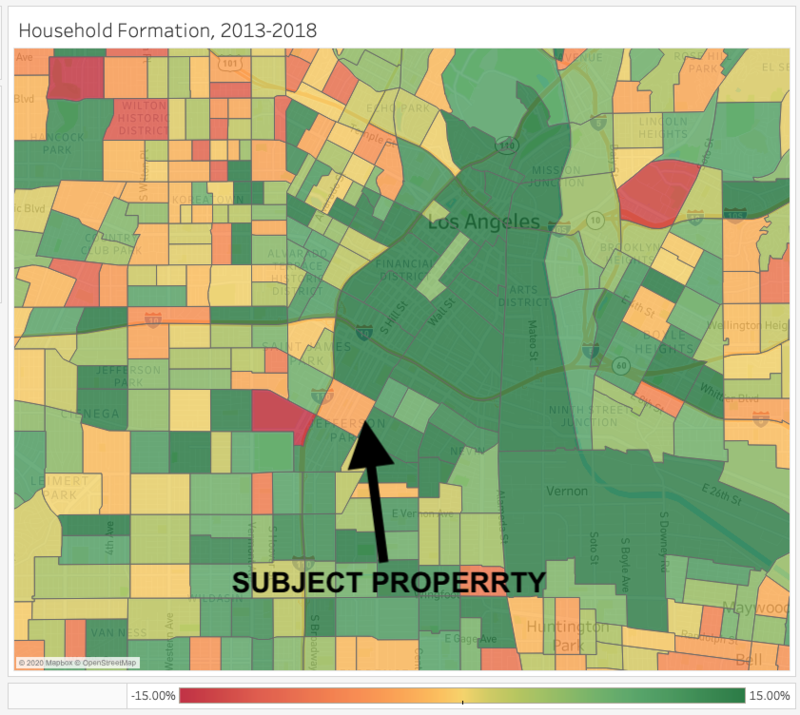
The bright green areas to the north of the subject property are downtown LA. Lots of people moving in! The subject property's census tract is a spot of orange surrounded by green. That's a good thing! Because look at this map of renters who have moved in within the last one year:
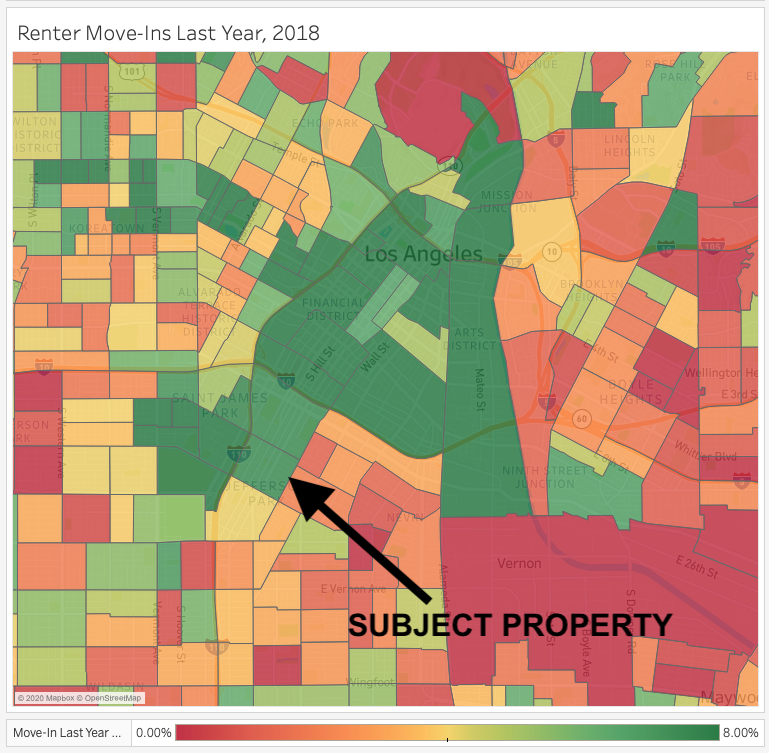
As you can see, now the green area extends down to our subject property. New renter households abound! And this is what we want -- more renters moving in means more demand means higher rents means more expensive buildings.
What's interesting, though, is that prices are lagging move-ins. Here's median home price growth, 2013-2018:

As you can see, at the very top of the map, the northern area of downtown LA has already seen robust home price appreciation. Our little census tract and the areas around it have not. Fantastic! We've identified the cusp, the edge of the path of progress. We're right on target!
That's the kind of analysis required to make money in LA real estate, and it's this kind of analysis that mitigates the risk such that one is not playing roulette.
@Todd Pultz, gotta ask, is this still speculation at best?
Thanks guys!
All the best,
Jon
@Jon Schwartz Oh... Wow... Ok. So instead of tearing down that whole thing....Im going to point out the most obvious oversight...
You stated 100k is 25% down.
If he follows your plan, it means he is not only going to put his money in a
"non-interest" bearing,
non-early withdrawable,
non FDIC insured,
game of risk roulette with
yearly "in-game" spending requirements for scheduled maintenance costs,
an "out of state" renters rights water heater repair concierge premium,
"4 months same as burned cash" eviction moratorium,
and carries a "non-reimbursable" tenant hunt cashflow loss during game vacancies
and last but not least, a profit reduction coefficient of negative (300k * ((mortgage interest rate) +(2nd home interest rate modifier))...Aka interest on a 300k loan.
Interesting...
Wow, taking some big swings there, Gavin. I love it! I love the energy.
Let me address your points specifically and, in the process, make my argument more clear and try to understand what in the world you're talking about.
You stated 100k is 25% down.
Actually, the original poster asked about using $100K for down payments, and I'm using the standard, conservative 25% down for non-owner-occupied residential property.
If he follows your plan, it means he is not only going to put his money in a
"non-interest" bearing,
non-early withdrawable,
non FDIC insured,
Gavin, you appear to be describing a savings account here. The best rate I can find for an interest-bearing, liquid, FDIC-insured savings account is 1% (source: https://www.bankrate.com/banki...). Are you suggesting the original poster should put his $100K into a savings account? That's only going to yield $1000 in cashflow per year -- and he'll only get that much if he doesn't withdraw any funds. That's an awfully conservative approach! Are you aware of any real estate investment vehicles that bear interest, are liquid, and are FDIC-insured? If so, let us know!!
game of risk roulette with
Game of risk roulette? How do you mean? Are you saying that expecting appreciation gains is playing risk roulette? Since 1975, the Los Angeles MSA has achieve a longterm average appreciation rate of 6.7% according to the FHFA home price index. Here's the chart:
https://fred.stlouisfed.org/se...
In my example, I was accounting for an average appreciation rate of 5%. So I was being conservative by LA standards! I was also using a Midwest cash-on-cash return of 15% -- which I think is aggressive if the original poster is trying to run his portfolio from Hong Kong. Perhaps appreciation is uncommon in your town, but in Los Angeles, where we're surrounded by ocean on two sides and mountains on the other two, it's a fact of life. It won't be a consistent 6.7% each year, but jeez, this ain't Indianapolis!
yearly "in-game" spending requirements for scheduled maintenance costs,
an "out of state" renters rights water heater repair concierge premium,
I should have been more clear: in my example, when I said the appreciating property would have no cashflow, I meant no positive or negative cashflow. In other words, the income from the property covers all expenses, including property management and mortgage and capex reserves, but doesn't deliver a cent of cashflow beyond that. These properties exist in LA. Folks outside of California seem to think that appreciation is only possible on properties that have negative cashflow, or that properties in California only produce negative cashflow. Such is not the case; I don't buy anything with negative cashflow. So these maintenance costs are accounted for in my scenario.
"4 months same as burned cash" eviction moratorium,
You've probably heard by now that the CDC has ordered a national eviction moratorium (source: https://www.cdc.gov/coronaviru...), so this dilemma exists in any scenario. But let's address this, anyway. Our Los Angeles property would need a GRM of, say, 16 to be cashflow neutral. That means four months of rent would be $10,416. That's not enough to tip the scales; appreciation still wins.
and carries a "non-reimbursable" tenant hunt cashflow loss during game vacancies
Vacancy is accounted for in the cashflow neutral proposition, though I will take this moment to point out that LA has one of the lowest vacancy rates in the country. It was 4% pre-COVID, and with COVID and the unprecedented unemployment in LA right now, we're at about 6.5%. The national average pre-COVID, FYI, was 9%.
and last but not least, a profit reduction coefficient of negative (300k * ((mortgage interest rate) +(2nd home interest rate modifier))...Aka interest on a 300k loan.
Again, the debt service is accounted for in the cashflow neutral proposition. And anyway, both scenarios carried the same interest cost, so they negate each other. But here's my question, Gavin: are you against leverage? Are you arguing that the original poster is best served by buying a property in cash?
Let me expand that question: what are you proposing, Gavin? The oversights you pointed out where not oversights at all. (I should mention that the cashflowing property carried the same assumptions: that expenses, debt service, and vacancy were accounted for in the 15% cash-on-cash). What's your suggestion for the original poster?
Also, what's the argument behind your post? It seems to boil down to your not liking appreciating assets. Is that right?
Best,
Jon
What would be your risk assesment about maximum drawdown in LA?
If things don't go as expected how much value could a property in LA lose over a 5-year period?
Juan,
What do you mean by "maximum drawdown"? I'm not familiar with that term.
The worst five-year period in LA was 2006-2011, during which time median home prices dropped 35%. It's worth noting that rents only dropped a few percentage points over that same period.
Jon
@Jon Schwartz yes ABSOLUTELY speculation when your driving factor is appreciation. That does not mean you can not mitigate risk of speculation by having knowledge, skill, great due diligence and an economy that cooperates with your speculation. You can be very successful with your strategy, so do not take my post as a knock to it. Just not my cup of tea!
This depends on what the investor goals are. If you are ok with waiting for monthly income and waiting for a successful exit potentially, this might be your strategy! I’m a wealth guy and cash flow guy and your strategy does not work for that. Doesn’t mean one is better than the other!
I know nothing about LA that means much! I would curious to here your most recent deal in LA personally that you would be willing to share. And I could give you one of my last deals. Then we can pick them both apart for pros and cons......???? Both strategies work, but I take monthly cash flow over waiting for appreciation every day and every deal!!! You can also both at same time on same property, but that becomes more difficult.
@Jonathan Anderson
Ok. well since your entire argument, and the profitability of your plan, is based on one HUGE if.. which is if the owner of the property can rent the place for enough to cover ALL of the costs of ownership including, but not limited to
a 300k mortgage payment,
Or buy a house in LA....maybe break even on cash flow... and at the end of 7 years... maybe..maybe break even on house value.
Oh... forgot to mention forbes reported in december 2019 on L.A. awwww...no appreciation in 2019 for LA homes...
https://www.forbes.com/sites/johnwake/2020/12/31/no-house-price-appreciation-in-new-york-los-angeles-chicago-or-san-francisco/#cffec8f1af84
If you invested in L.A. with the 100k down strategy in 2019.... there goes that whole year of profit.
While I think most of your points about the 400 k condo are correct, LA is not a market where you typically get cash flow. The best you can do is buy a multi family in a transitional area at a discount, rent it out to for enough cover your costs 100%, pay down the principal and hold it long term. If you hold it long term the chances of it *not* appreciating are slim. Nothing is certain though and you take a chance with most investments. The numbers have to work for that strategy, but I think it is valid.
The part I disagree with is this.
"Looks to me like you can rent a place for less than the cost of ownership. (which is generally speaking the rule.... otherwise no one would ever rent.) which means that There is most likely going to be at least a little negative cash flow at 100k down. "
This is not true in the LA rental market. The barrier is not the monthly payment in a lot of cases, but the ability to save up enough of a down payment to get a similar monthly payment (as their rental payment) in terms of P+I, taxes, insurance and necessary maintenance.
@Todd Pultz, no need to go tit for tat! I respect your strategy. I get defensive when guys like Gavin start pontificating with the assumption that their local market dynamics are universal. All real estate is local, folks!
I think we also have different understandings of what the word “speculation” means. For example, would it be speculation to include inflation in your projections? Most would say it’s not. Most would say it’s reasonable to underwrite a slow growth in expense costs and rental income, right? So then why do some investors argue that appreciation, even in markets where it’s a very powerful force, must be discounted as speculation? Your thoughts?
And please don’t fall back on the “Because Robert Kiyosaki said so!” defense!
Best,
Jon
@Jon Schwartz first I do not read books at All Even rich dad poor dad, so you won’t get any quotes from me lol!
Speculation is subjective. As we talk about inflation, speculating and adding those into underwriting you are making yourself plan for lower returns because you are saying your costs will go up. However, when you speculate on appreciation you are creating a plan based on adding $’s to yourself, completely the opposite and bigger risk
Either scenario you can be right now or pretty darn close, but if I’m wrong I would rather be wrong on inflation and save money oppose you speculating on appreciation and never making the money.
Our job in real estate is to reduce the risk as much as possible or at least to our comfort zone.
I read your profile quickly and I noticed your driver is your daughter and being able to pay education and college through passive income. First, my kids and family are my driver as well so that’s awesome your motivated through your kid! With that being said, if that’s truly your goal, I would challenge you to look at your current strategy and ask yourself if your reaching your goal listed in your profile through that strategy!
You can do both at the same time. I forget the numbers above you used for appreciation above by why not combine your strategy? Buy an under performing complex with leverage and an investor, do some minor repairs, raise rents and force appreciation? At 6 months, refinance into amortized loan and cash flow after taking everyone out? We just did this on a 21 unit we bought for 295k six months ago and it just appraised for refinance at 650k. We only put 30k into it using collected rents. After refinance we will have 0 cash in and be able to put close to 100k in our pocket for another deal, while this property cash flows very nicely!
@Gavin D. @Jon Schwartz let me say kudos to both of you for a very healthy conversation!
Transparency, I am a cash flow guy and look to build long term wealth with solid monthly income. So I like my Midwest market of Dayton OH where I live and invest.
With 100k, I would advise my clients to purchase 4 value add quads. We can buy quads for 80-100k that just need rents raised and freshened up all day long. So 100k is plenty to do that with. And.......it’s easy to REFI and pull cash out. Here is rounded numbers but ideal for my clients I represent as their realtor. If we can be all in on a quad for 80-90k, that’s puts us close to 20k to close. Rents raised to market and just some simple sprucing up, we can refi these at 120k appraisal and pull 75% out with fully amortized 30 year. Pulling 90k out on refi pays off initial loan and cash in, so we have 0 cash in at this point. These properties will positively cash flow around $1200 a month. So very doable is 4 quads and we will have close to $5,000 cash flow per month. If things go well, very easily we could do a fifth quad within 2-3 months and months 6-8 we can cash flow a little over $6,000 per month! This is easy
But Wait.........you pulled all of your cash back out, so let’s rinse & repeat!!!!!!! So I’m 12-16 months, with hard work could we cash flow over $12,000 per month? absolutely and we are left with our original 100k.
Or another scenario if we have a solid stock market, let’s put that 100k in a diverse portfolio and pull a credit line against that 100k. Most will give you 60% credit line at 4%, so let’s take that 60k credit line and lend to ourselves and 3 quads to start. Our 100k will not be affected and will continue to grow as long at the return is higher than our 4% interest credit line. Again, rinse and repeat!
I have hundreds of doors here and followed both these scenarios in different scenarios many times!
My numbers are rounded for ease, but very close to accurate and what’s doable!
LA is tricky, expensive, not landlord friendly and speculation at best, so I think you know where I stand
@Benjamin A Ersing absolutely, sent you a connection. Inbox me
@Jon Schwartz Oh... Wow... Ok. So instead of tearing down that whole thing....Im going to point out the most obvious oversight...
You stated 100k is 25% down.
If he follows your plan, it means he is not only going to put his money in a
"non-interest" bearing,
non-early withdrawable,
non FDIC insured,
game of risk roulette with
yearly "in-game" spending requirements for scheduled maintenance costs,
an "out of state" renters rights water heater repair concierge premium,
"4 months same as burned cash" eviction moratorium,
and carries a "non-reimbursable" tenant hunt cashflow loss during game vacancies
and last but not least, a profit reduction coefficient of negative (300k * ((mortgage interest rate) +(2nd home interest rate modifier))...Aka interest on a 300k loan.
Interesting...
Wow, taking some big swings there, Gavin. I love it! I love the energy.
Let me address your points specifically and, in the process, make my argument more clear and try to understand what in the world you're talking about.
You stated 100k is 25% down.
Actually, the original poster asked about using $100K for down payments, and I'm using the standard, conservative 25% down for non-owner-occupied residential property.
If he follows your plan, it means he is not only going to put his money in a
"non-interest" bearing,
non-early withdrawable,
non FDIC insured,
Gavin, you appear to be describing a savings account here. The best rate I can find for an interest-bearing, liquid, FDIC-insured savings account is 1% (source: https://www.bankrate.com/banki...). Are you suggesting the original poster should put his $100K into a savings account? That's only going to yield $1000 in cashflow per year -- and he'll only get that much if he doesn't withdraw any funds. That's an awfully conservative approach! Are you aware of any real estate investment vehicles that bear interest, are liquid, and are FDIC-insured? If so, let us know!!
game of risk roulette with
Game of risk roulette? How do you mean? Are you saying that expecting appreciation gains is playing risk roulette? Since 1975, the Los Angeles MSA has achieve a longterm average appreciation rate of 6.7% according to the FHFA home price index. Here's the chart:
https://fred.stlouisfed.org/se...
In my example, I was accounting for an average appreciation rate of 5%. So I was being conservative by LA standards! I was also using a Midwest cash-on-cash return of 15% -- which I think is aggressive if the original poster is trying to run his portfolio from Hong Kong. Perhaps appreciation is uncommon in your town, but in Los Angeles, where we're surrounded by ocean on two sides and mountains on the other two, it's a fact of life. It won't be a consistent 6.7% each year, but jeez, this ain't Indianapolis!
yearly "in-game" spending requirements for scheduled maintenance costs,
an "out of state" renters rights water heater repair concierge premium,
I should have been more clear: in my example, when I said the appreciating property would have no cashflow, I meant no positive or negative cashflow. In other words, the income from the property covers all expenses, including property management and mortgage and capex reserves, but doesn't deliver a cent of cashflow beyond that. These properties exist in LA. Folks outside of California seem to think that appreciation is only possible on properties that have negative cashflow, or that properties in California only produce negative cashflow. Such is not the case; I don't buy anything with negative cashflow. So these maintenance costs are accounted for in my scenario.
"4 months same as burned cash" eviction moratorium,
You've probably heard by now that the CDC has ordered a national eviction moratorium (source: https://www.cdc.gov/coronaviru...), so this dilemma exists in any scenario. But let's address this, anyway. Our Los Angeles property would need a GRM of, say, 16 to be cashflow neutral. That means four months of rent would be $10,416. That's not enough to tip the scales; appreciation still wins.
and carries a "non-reimbursable" tenant hunt cashflow loss during game vacancies
Vacancy is accounted for in the cashflow neutral proposition, though I will take this moment to point out that LA has one of the lowest vacancy rates in the country. It was 4% pre-COVID, and with COVID and the unprecedented unemployment in LA right now, we're at about 6.5%. The national average pre-COVID, FYI, was 9%.
and last but not least, a profit reduction coefficient of negative (300k * ((mortgage interest rate) +(2nd home interest rate modifier))...Aka interest on a 300k loan.
Again, the debt service is accounted for in the cashflow neutral proposition. And anyway, both scenarios carried the same interest cost, so they negate each other. But here's my question, Gavin: are you against leverage? Are you arguing that the original poster is best served by buying a property in cash?
Let me expand that question: what are you proposing, Gavin? The oversights you pointed out where not oversights at all. (I should mention that the cashflowing property carried the same assumptions: that expenses, debt service, and vacancy were accounted for in the 15% cash-on-cash). What's your suggestion for the original poster?
Also, what's the argument behind your post? It seems to boil down to your not liking appreciating assets. Is that right?
Best,
Jon
What would be your risk assesment about maximum drawdown in LA?
If things don't go as expected how much value could a property in LA lose over a 5-year period?
Juan,
What do you mean by "maximum drawdown"? I'm not familiar with that term.
The worst five-year period in LA was 2006-2011, during which time median home prices dropped 35%. It's worth noting that rents only dropped a few percentage points over that same period.
Jon
Thanks for your answer. So we could be looking at an average -35% if things did not work out..
It is a term used to get an idea of the risk that an investment, usually in the stock markets, entails..
«A maximum drawdown (MDD) is the maximum observed loss from a peak to a trough of a portfolio, before a new peak is attained. Maximum drawdown is an indicator of downside risk over a specified time period»
@Jon Schwartz Oh... Wow... Ok. So instead of tearing down that whole thing....Im going to point out the most obvious oversight...
You stated 100k is 25% down.
If he follows your plan, it means he is not only going to put his money in a
"non-interest" bearing,
non-early withdrawable,
non FDIC insured,
game of risk roulette with
yearly "in-game" spending requirements for scheduled maintenance costs,
an "out of state" renters rights water heater repair concierge premium,
"4 months same as burned cash" eviction moratorium,
and carries a "non-reimbursable" tenant hunt cashflow loss during game vacancies
and last but not least, a profit reduction coefficient of negative (300k * ((mortgage interest rate) +(2nd home interest rate modifier))...Aka interest on a 300k loan.
Interesting...
Wow, taking some big swings there, Gavin. I love it! I love the energy.
Let me address your points specifically and, in the process, make my argument more clear and try to understand what in the world you're talking about.
You stated 100k is 25% down.
Actually, the original poster asked about using $100K for down payments, and I'm using the standard, conservative 25% down for non-owner-occupied residential property.
If he follows your plan, it means he is not only going to put his money in a
"non-interest" bearing,
non-early withdrawable,
non FDIC insured,
Gavin, you appear to be describing a savings account here. The best rate I can find for an interest-bearing, liquid, FDIC-insured savings account is 1% (source: https://www.bankrate.com/banki...). Are you suggesting the original poster should put his $100K into a savings account? That's only going to yield $1000 in cashflow per year -- and he'll only get that much if he doesn't withdraw any funds. That's an awfully conservative approach! Are you aware of any real estate investment vehicles that bear interest, are liquid, and are FDIC-insured? If so, let us know!!
game of risk roulette with
Game of risk roulette? How do you mean? Are you saying that expecting appreciation gains is playing risk roulette? Since 1975, the Los Angeles MSA has achieve a longterm average appreciation rate of 6.7% according to the FHFA home price index. Here's the chart:
https://fred.stlouisfed.org/se...
In my example, I was accounting for an average appreciation rate of 5%. So I was being conservative by LA standards! I was also using a Midwest cash-on-cash return of 15% -- which I think is aggressive if the original poster is trying to run his portfolio from Hong Kong. Perhaps appreciation is uncommon in your town, but in Los Angeles, where we're surrounded by ocean on two sides and mountains on the other two, it's a fact of life. It won't be a consistent 6.7% each year, but jeez, this ain't Indianapolis!
yearly "in-game" spending requirements for scheduled maintenance costs,
an "out of state" renters rights water heater repair concierge premium,
I should have been more clear: in my example, when I said the appreciating property would have no cashflow, I meant no positive or negative cashflow. In other words, the income from the property covers all expenses, including property management and mortgage and capex reserves, but doesn't deliver a cent of cashflow beyond that. These properties exist in LA. Folks outside of California seem to think that appreciation is only possible on properties that have negative cashflow, or that properties in California only produce negative cashflow. Such is not the case; I don't buy anything with negative cashflow. So these maintenance costs are accounted for in my scenario.
"4 months same as burned cash" eviction moratorium,
You've probably heard by now that the CDC has ordered a national eviction moratorium (source: https://www.cdc.gov/coronaviru...), so this dilemma exists in any scenario. But let's address this, anyway. Our Los Angeles property would need a GRM of, say, 16 to be cashflow neutral. That means four months of rent would be $10,416. That's not enough to tip the scales; appreciation still wins.
and carries a "non-reimbursable" tenant hunt cashflow loss during game vacancies
Vacancy is accounted for in the cashflow neutral proposition, though I will take this moment to point out that LA has one of the lowest vacancy rates in the country. It was 4% pre-COVID, and with COVID and the unprecedented unemployment in LA right now, we're at about 6.5%. The national average pre-COVID, FYI, was 9%.
and last but not least, a profit reduction coefficient of negative (300k * ((mortgage interest rate) +(2nd home interest rate modifier))...Aka interest on a 300k loan.
Again, the debt service is accounted for in the cashflow neutral proposition. And anyway, both scenarios carried the same interest cost, so they negate each other. But here's my question, Gavin: are you against leverage? Are you arguing that the original poster is best served by buying a property in cash?
Let me expand that question: what are you proposing, Gavin? The oversights you pointed out where not oversights at all. (I should mention that the cashflowing property carried the same assumptions: that expenses, debt service, and vacancy were accounted for in the 15% cash-on-cash). What's your suggestion for the original poster?
Also, what's the argument behind your post? It seems to boil down to your not liking appreciating assets. Is that right?
Best,
Jon
What would be your risk assesment about maximum drawdown in LA?
If things don't go as expected how much value could a property in LA lose over a 5-year period?
Juan,
What do you mean by "maximum drawdown"? I'm not familiar with that term.
The worst five-year period in LA was 2006-2011, during which time median home prices dropped 35%. It's worth noting that rents only dropped a few percentage points over that same period.
Jon
Thanks for your answer. So we could be looking at an average -35% if things did not work out..
It is a term used to get an idea of the risk that an investment, usually in the stock markets, entails..
«A maximum drawdown (MDD) is the maximum observed loss from a peak to a trough of a portfolio, before a new peak is attained. Maximum drawdown is an indicator of downside risk over a specified time period»
Juan,
Thanks for sharing that term with me! It sounds like you're transitioning from equities to real estate; is that correct? The real estate market has some significant differences that you should be aware of (for example, liquid markets move fast and illiquid markets move slow; liquid markets lead the general economy and illiquid markets lag it).
Also, that -35% is definitely not average; it's the worst drop in history. I'm actually gearing up to do a thorough appreciation analysis of Los Angeles and other major MSA in the country. I'm looking for exactly what you asked about: what's the best case, worst case, average case, and median case for 5-, 10-, and 20-year holds in different markets. Is the potential gain symmetrical to the potential loss? Etc., etc., etc. PM me if you're interested in getting the numbers I find.
Best,
Jon
@Todd Pultz, that deal sounds killer! I liked you by the way you write, and now I like you all the more!
Are you investing in Dayton, where you live? Does it worry you that Dayton city hasn't seen population growth since 1959 and that the MSA's population peaked in 1970 (sources: https://en.wikipedia.org/wiki/..., https://worldpopulationreview....). Barring a strong counter narrative, those stats make me think "No wonder doors are so inexpensive" and "No wonder Todd doesn't put much stock in appreciation" and "No, thank you!"
Speaking of our speculation back-and-forth, I totally understand and respect your point of view, but I disagree. I think it's important for an investor to intelligently and conservatively factor all metrics into an investment decision. Otherwise, the investor might not be making the best investment.
For example, most business plans I've seen for multifamily value-add involve an expectation of tenant turnover. If one said, "Well, I'd rather be wrong to my benefit than to my detriment" and underwrites no tenant turnover, they might turn down an opportunity that's actually fantastic given the natural rate of tenant turnover. As investors, we have to consider all pieces of the puzzle.
Now, on to my strategy... Thanks so much for checking out my profile! I'm glad we connect as fathers. Let me tell you a little bit more about my scenario, connect it to the original poster, and then go into a deal or two.
I've built a successful career in the film industry; real estate investing isn't meant to be another job for me. I don't do it for cashflow; I do it to build wealth. I firmly believe that wealth is borne of equity -- derived from both forced and natural appreciation -- and that cashflow is your buffer to protect your equity.
(A quick metaphor: LA real estate is the Amazon of real estate. Amazon trades at an extremely high price-to-earnings ratio. It's like an expensive LA building that barely spins off any cashflow. And Jeff Bezos is the richest person on earth by owning just 11.2% of the company.)
I just turned 39, and given the ageism in my industry, I might be facing a more challenging environment in as little as ten years. My goal is to replace my income in ten years. I don't need any of that income between now and then. I might not need any of it in ten years, but I like to plan ahead!
I dug into the numbers, and my plan is to build equity in a high cap rate, high rent market like LA for most of the next decade, then sell those assets for cashflowing properties in the Southeast or Midwest. Running the numbers and looking at the ten-year supply-and-demand projections, LA is great for my plan!
When I saw this post, I clicked on the poster's profile. He's a 19-year-old in Hong Kong with $100K asking where to invest in the US. I get the impression that his situation is similar to mine: he doesn't need cashflow right now, and he's investing for longterm wealth. The numbers support investing smartly in a high-appreciation market over a cashflowing market, especially if the investor is overseas and has limited control of his assets.
Okay, back to my situation...
I'm not saying the only strategy worth pursuing is to buy and do nothing. No way! Nor do I limit myself to a single strategy. Lemme tell you about my two most recent deals...
Last year, I bought and househacked a duplex in an extremely nice part of Los Angeles. My wife wanted to move here, but I absolutely did not want to have the kind of mortgage required to live here. So I did some digging, found a couple of a really well located multifamily-zoned areas, and lo and behold, a wonderfully situated duplex hit the market.
We bought it, created $150K in equity by renovating it, and moved it. At this point, using conservative projections well below the longterm average, the forced appreciation, principal paydown, and natural appreciation on this property will pay for my daughter's college tuition. When my daughter goes to college, I'll refinance the property to pay for her school, and the property will still cashflow. We can move out at any time now and property will still cashflow. And we pay less now to live here than anybody else on the block is paying to live here.
(Side note: we also contribute the annual max to a 529 for my daughter's college tuition. I'm not literally going to bank my daughter's future on one asset in one market!)
One more:
I partnered with others to buy a fourplex for $1.6M and put in about $590K in renovation and carrying costs to convert each unit from a 2/1 to a 3/2. We project the post-reno, tenanted building will be worth $2.75M -- and that's a rental comp assumption, not an appreciation assumption. The plan is to refinance or sell, whichever makes the most sense.
Value-add is more complicated in LA because of tenant protections, but where there is friction, there is opportunity!
So, yeah... I don't really have a strong point to wrap this up with. Just wanted to explain myself. Hope you're well!
All the best,
Jon
@Todd Pultz ; Your numbers look great. How good is the Dayton OH rental market? Let’s connect .
I agree with Jon, appreciation should be first priority on condition that the cash flow can at least break even - this is even more TRUE for OOS investors. Cash flow play is for local guys or large scale investors with boots on the ground.
Buy for appreciation - you are an investor
Buy for cash flow - you are either finding yourself a new job or earn nothing
@Jon Schwartz first I do not read books at All Even rich dad poor dad, so you won’t get any quotes from me lol!
Speculation is subjective. As we talk about inflation, speculating and adding those into underwriting you are making yourself plan for lower returns because you are saying your costs will go up. However, when you speculate on appreciation you are creating a plan based on adding $’s to yourself, completely the opposite and bigger risk
Either scenario you can be right now or pretty darn close, but if I’m wrong I would rather be wrong on inflation and save money oppose you speculating on appreciation and never making the money.
Our job in real estate is to reduce the risk as much as possible or at least to our comfort zone.
I read your profile quickly and I noticed your driver is your daughter and being able to pay education and college through passive income. First, my kids and family are my driver as well so that’s awesome your motivated through your kid! With that being said, if that’s truly your goal, I would challenge you to look at your current strategy and ask yourself if your reaching your goal listed in your profile through that strategy!
You can do both at the same time. I forget the numbers above you used for appreciation above by why not combine your strategy? Buy an under performing complex with leverage and an investor, do some minor repairs, raise rents and force appreciation? At 6 months, refinance into amortized loan and cash flow after taking everyone out? We just did this on a 21 unit we bought for 295k six months ago and it just appraised for refinance at 650k. We only put 30k into it using collected rents. After refinance we will have 0 cash in and be able to put close to 100k in our pocket for another deal, while this property cash flows very nicely!
I guess there's nothing wrong with talking about which strategies and marketplaces are better, but let's be honest...... the only folks who really invest in LA are, well, folks who are already in LA. Unless you're super wealthy already from some other venture, is anyone from outside of CA going to invest in prime Los Angeles locations? Or even invest in South Los Angeles like me? I doubt it, lol.
Also, folks who live in PA will invest in PA.. Folks who live in Toledo will invest in Toledo. I know there are some who do long-distance TK and BRRR due to being priced out of their local markets, but I'm pretty sure the majority of RE investors can see the advantage of investing locally.
I agree with Mr. Pulz when he says that LA (or any of the other traditionally non-cash flowing markets for that matter) are tricky...because they really are. But at the same time, LA can be extremely rewarding. My last property which I purchased earlier this year, was the culmination of about a year's worth of searching, writing maybe 40-50 offers on various properties, spending countless hours driving to locations. I had to compete with too many cash buyers and other investors sitting on a mountain of capital. But it's all worked out fantastically for me. Current CoC is around 8%, but once I am able to turn the tenants over (might take forever, I know), this property's CoC will be over 20%. Also, if anyone is familiar with what's happening to LA real estate, you can almost see the market value meters going up as we speak. Of course, a lot of that is artificially inflated by the mortgage rates, but all in all, I'm extremely happy with the purchase. My exit strategy is to sell in about 10 years (or maybe right after the Olympics)... I'm excited to see what the MV will be at that time.
People say investing for appreciation is speculation. I guess it kind of is, but if you have a long hold period, then I don't think it's much of a risk as long as you have positive cash flow. Most of my wealth was generated via appreciation...and I don't mean the active kind. I mean the kind where I became an accidental landlord and I hardly ever even thought the properties. I'm definitely a believer in the notion that cash flow pays the bills....and appreciation (passive and forced) is what builds wealth.
If money was not an issue and i had 100,000 USD on the side to put for down payments, would investing in expensive cities like los angeles be a good idea because of the rental occupancy rate there, or would it be wiser to invest it in somewhere that has a lower occupancy rate but i can buy more with 100,000 in down payments.
Etienne, I'd invest for appreciation in a market like Los Angeles. If money's not an issue at present, and you want your money put to best use, invest in a place like LA (and I vote specifically for LA).
Let's just do some quick math:
Let's say $100K is going to be 25% down payment on one or several properties. In your appreciation market, you'll receive no cashflow, but the building will appreciate 5% per year. In the cashflow market, you'll earn a fantastic 15% cash-on-cash return but no appreciation. All financing terms are identical. Let's remove costs associated by buying and selling. To further simplify, let's say there's no principal paydown (since it will be equivalent in both examples).
What's your investment horizon? Let's say seven years...
In seven years, in your appreciation market, you'll own a property worth $562,840. You borrowed $300k to buy it, so you profit in year 7 is $262,840.
In the cashflow market, after seven years, you will have made $105,000 in cashflow. You'll have no profit in the sale of the building because it didn't appreciate.
Now, cashflow-lovers are going to make the following argument: cashflow is money-in-hand whereas appreciation is speculative.
They would be right that cashflow is money-in-hand in that you get it regularly, not as a big lump sum at the end. This makes the early cashflow payments more valuable than the later appreciation harvesting. However, if money is not a current concern, as is the case in this example, the actual value of those earlier payments is lower. To be really nerdy and mathy about it, you can use a much lower discount rate when analyzing the value of future earnings.
However, is appreciation speculative? In the Midwest, yes. In cities that have populations under 1M and might or might not be ascendant, absolutely. But in an international gateway city with a longterm average appreciation rate of 6.7% going back to 1975 -- meaning this longterm average incorporates the five recessions that have occurred since? Appreciation is far less speculative than Midwestern investors make it out to be, and to the extent that it is more speculative, the reward is much greater.
So, buy LA, my friend!
Best,
Jon
Maybe I’m missing something here but your math seems off on the example. Why are you including the principal into the profit?
$400,000 PP
$100,000 DP
$300,000 Mortgage
Appreciation @ 5%/annually
$400,000 * 5% = $20,000
$20,000 * 7 = $140,000
$400,000 + $140,000 = $540,000
$540,000 - 6% seller fees ($32,400) = $507,609
$507,000 - $300,000 = $207,000
$207,000 - $100,000 (Principal)
= $107,000 (Total Profit) Or $15,285 (Annual Profit)
$15,285/$100,000 = %15.2 CoC
@Tony Kim @Jenning Yu @Jon Schwartz
Jon congrats on those deals man, they sound really solid. I do think you misunderstood my statement about being wrong to my benefit. We plan for inflation for our costs and vacancy loss, but if we are wrong about those we were wrong to our benefit! If we plan for appreciation and we are wrong about that, we are wrong to our detriment. We plan worst case scenario always!
To the other two that jumped in you may have missed a few things. I certainly look for appreciation and was not suggesting you don’t look at it! That’s part of our model. However please don’t make an uneducated comment that cash flow does not create wealth. It’s what you do with the cash flow that builds wealth. And it’s combining strategies to become a ROCKSTAR that create wealth. You can do both at the same time! And let me be arrogant for a minute, I like being wealthy, I like having my pockets full of cash, I like my wife being able to buy whatever she wants, I like planning a last minute trip to VEGAS and never worrying whether I have the money to do it. And while I do it, my buildings will appreciate just fine.
My point was telling a new investor with 100k to jump into LA and wait for appreciation, night not be the wisest move unless he’s in LA. He can turn more cash and create quicker cash elsewhere to then go back to LA and do some damage. Investing is local like a few of you said! Spending 100k on your first investment is not local