Loan Pay down and breaking even on cash flow

Loan Pay down and breaking even on cash flow

Member since 2023 · 21 posts · 22 votes

I feel like I’ve been posting a lot lately! 

Something I've been thinking about is the benefits of loan pay down. So I've been listening to bigger pockets a lot, and am learning that a BRRRR method is a good method for making money. But let's say you buy a property for fair value, and it just barely cash flows or you just break even. On this forum and podcast, most people make it sound like that is completely unacceptable and you should get rid of the property.

Hypothetically,  let’s say you have a property that barely cash flows and isn’t appreciating much in the long term. The property isn’t really making you passive income, but it’s also not costing you anything to own.  If you have a long term 10 plus year outlook, wouldn’t loan paydown still be a positive for keeping the rental? I mean at the end of the day if you kept the house long enough and rented, you could still walk away with a paid off home. In my mind this is the worst case scenario. 

So where I’m getting at is, if your goal to replace your W2 with passive rental income isn’t working out, at the end of the day you’d still have passive equity being built that you could withdraw some day. Isn’t this a win? Thoughts?

8Reply
117 views

Most Popular Reply

V.G JasonPro Member
Investor · Member since 2022 · 3k+ posts · 3k+ votes
3y
Quote from @Carlos Lopes:

I feel like I’ve been posting a lot lately! 

Something I've been thinking about is the benefits of loan pay down. So I've been listening to bigger pockets a lot, and am learning that a BRRRR method is a good method for making money. But let's say you buy a property for fair value, and it just barely cash flows or you just break even. On this forum and podcast, most people make it sound like that is completely unacceptable and you should get rid of the property.

Hypothetically,  let’s say you have a property that barely cash flows and isn’t appreciating much in the long term. The property isn’t really making you passive income, but it’s also not costing you anything to own.  If you have a long term 10 plus year outlook, wouldn’t loan paydown still be a positive for keeping the rental? I mean at the end of the day if you kept the house long enough and rented, you could still walk away with a paid off home. In my mind this is the worst case scenario. 

So where I’m getting at is, if your goal to replace your W2 with passive rental income isn’t working out, at the end of the day you’d still have passive equity being built that you could withdraw some day. Isn’t this a win? Thoughts?


You'll get crucified by the folks that say make your tenant pay it for you. Truth is if you're really seeking financial freedom, then no debt is the route. It's all about goals. You'll see people tell you if you have $500k to invest, rather than buy 1 property go buy 5 properties with $100k down. Or if you have limited means, go put down 3.5%-5% and house hack and then do it again next year. Or if it doesn't cash flow Day 1, don't buy it. These three myths are exactly why people get burned.

I shouldn't have to explain why but I will. 5 houses with $100k down won't be $500k, once you factor closing costs & reserves. Try 3 houses, 4 if you want to stretch yourself. Scaling is appropriate if you know how to measure your risk. Risk isn't like a stock, you're not looking at beta you're looking at quality of neighborhood you're purchasing, interest rate, rental liquidity, etc. 

House hack at 3.5%-5%. Go do that, see where the math leads. You'll never get out from underneath with rates at 7%. Try 15-20% down + every 3-7 years. 

Another loud and proud statement here is cash flow negative is a big no. Paying cash down is a disservice to leveraging debt. Technically, math wise they're absolutely correct. You're truly better leveraging $300k at 7% and keeping your $300k invested elsewhere aside. Cannot argue with the math. You're better off on paper today buying a house that gives you you're $200 in cash flow versus one that gives you -$100. That's correct match wise. But this isn't it just outright math, this is to a degree speculation risk tolerance, and behavior. Cash flow negative or ATM is absolutely okay if you're buying a good area. And I think you should ONLY buy in a good area for a variety of reasons, but the main reasons will be the real way you evaluate risk in real estate transactions.

Behaviorally, and depending on your goals, it's absolutely asinine to leverage through the gills. If you lose your job, if your significant other does, or if you both? Child gets sick or parents get sick and you have a large bill? True financial freedom is no debt.

The concept here is to buy a **** house that makes you $200/mo, cross your fingers it appreciates in 3-5 years, cash out refi and buy another house with it. The real concept should be buy a good house in a good area, pay it down to where it's a low monthly payment in a 3-7 year time frame through recasting + pre paying mortgage. Take that increase in DTI and use it to invest elsewhere. I'd take 1-2 really good houses over 4-6 **** houses. If you're able to scale and take that mechanism to buy 3-5 quality houses, you may be able to sell 1 to pay off the others and just make nothing but cash(outside of taxes, insurance, property management).

Look at what you're doing as a portfolio, and how it's all going to work.

See this reply in the discussion

50 Replies

Jump to latestLatest
  • Rental Property Investor · Boston, Massachusetts (MA) · Member since 2016 · 2k+ posts · 2k+ votes
    3y

    Folks here aren’t answering your exact question. Yes, if the tenant is REALLY covering your cash flow and expenses to the break even point then loan pay down is a significant positive factor, especially combined with inflation driven and value add or location driven appreciation. You can check it’s value on an amortization chart quite accurately too.

    But just as people can fool themselves they are doing well because they are “cash flowing” $200 a month when really they bought too high or under thought capex and expense rises, you can deceive yourself into thinking things are going better than they are.

    Time:u r taking your capital out of circulation. Have a time horizon.

    Access: your payment as well as profit is pretty illiquid

    Value: your balance has to be below resale value plus transaction costs to be a benefit. How good a deal did you get, really? Check the am chart for how long the pay down takes to pay off a 5% realtor fee.

    Having other people retire your debt at 7.5% (for instance) is a wonderful thing. It’s an especially satisfying strategy for leveraging up from a 1031 where the gains made in the first property can put you immediately in a good spot to benefit from pay down with a larger loan with little to no additional expense.

    One of the 4 pillars of real estate wealth building, but probably won’t support too much alone.

  • Rental Property Investor · Boston, Massachusetts (MA) · Member since 2016 · 2k+ posts · 2k+ votes
    3y

    Oh and the IRS sure considers it part of your return :)

  • Real Estate Broker · Minneapolis, MN · Member since 2011 · 5k+ posts · 6k+ votes
    3y
    Quote from @Carlos Lopes:

    I feel like I’ve been posting a lot lately! 

    Something I've been thinking about is the benefits of loan pay down. So I've been listening to bigger pockets a lot, and am learning that a BRRRR method is a good method for making money. But let's say you buy a property for fair value, and it just barely cash flows or you just break even. On this forum and podcast, most people make it sound like that is completely unacceptable and you should get rid of the property.

    Hypothetically,  let’s say you have a property that barely cash flows and isn’t appreciating much in the long term. The property isn’t really making you passive income, but it’s also not costing you anything to own.  If you have a long term 10 plus year outlook, wouldn’t loan paydown still be a positive for keeping the rental? I mean at the end of the day if you kept the house long enough and rented, you could still walk away with a paid off home. In my mind this is the worst case scenario. 

    So where I’m getting at is, if your goal to replace your W2 with passive rental income isn’t working out, at the end of the day you’d still have passive equity being built that you could withdraw some day. Isn’t this a win? Thoughts?


    First you have to keep in mind the large proportion of people making replies who have 0 properties, 0 experience, and are just regurgitating something they read or heard, but failing to mention any of that. Or the various starving agents who come on BP in search of getting some transactions and strongly engage in the "fake-it-to-make-it" doctrine. 

    With decades of experience I can say the vast majority of "cash-cow" properties I, my clients, associates and friends have had started off with minimal to near 0 cash-flow. They were INVESTMENTS, not purchasing a paycheck which by the way does not truly exist only maintenance bomb's masquerading as paychecks preying on the ignorant and novice. 

    If your cash-flow is a net 0, your still in the profit because yes, there is debt paydown via tenant payments, appreciation, and also TAX ADVANTAGES such as depreciation. When I get to pay uncle Sam $20k less because of my properties, is that not cash in my pocket via those properties? That would be profit would it not? 

    Now if we have a magic wand YES of course we shazam up a great appreciating property with amazing cash-flow, duh right. But reality is properties get priced up, because everyone with half an ounce of intelligence will buy those too, and sellers will take the max they can get. So yeah, sometimes, often times today, it IS a decision isn't it. 

    And if have to decide between doing nothing and letting cash sit and rot away to inflation, buying a cash-flow maintenance time-bomb, or an INVESTMENT into a good appreciating property/market, it's a no brainer APPRECIAITON every-time.    The cost of doing nothing is huge, very few speak of this cost of doing nothing. How many on BP posted over the past 3 yrs they were going to sit sidelines and do nothing waiting for the fairy-real-estate-mother to bring them a 12 cap property with strong appreciation. Well, how much MORE is property now? How much more is the interest rates? How much rent appreciation did they miss out on? How much LESS do those dying dollars buy today vs 3yrs ago? 

    Choice of a 30yr old property in a flat market with 10-cap on rents vs a new built home with strong growth and demand but net-0 cash-flow yr1, it's not even a competition, new-con every time.     APPRECIAITION MAKES CASH-FLOW. I don't know why this basic fundamental is lost on so many but it is just that simple. If it's a good appreciating property that's only possible via an appreciating market it's in, and that means rents are also appreciating ie growing, up, which means every year you have it you will get MORE in rents. That means your cash-flow GROWS, get's bigger and bigger over time. As does that equity which, to GROW a portfolio can latter be tapped to buy more, right. Accelerating growth. 

    Those obsessed on just cash-flow need to put down the books and programs from 2014 and realize this is a different market. 

  • Severna Park, MD · Member since 2013 · 7k+ posts · 7k+ votes
    3y

    @James Hamling  You nailed it . 

     My first and second properties didnt cash flow at all . I was young and had no clue . ( to a degree)  BUT the tenant was making my payment and the left over covered some repairs . That was in 92 .  Now those houses are worth 5 times what I paid and even after I took cash out they cash flow very well .  Used that cash to buy two more that didnt cash flow for 3 years , they are worth 3 times what I paid and cash flow rather well now . Pulled cash out of them and did it again on 1 house .  

    I look to the future , bought in good areas and keep the houses in good shape . 

    I dont over think things .  I know my area , the demand and prices . The last 2 houses I bought needed work , Looked at the house for 1/2 hour and made an offer an hour later . Settled in 10 days .  Rehabbed and had it rented in 6 months . 

  • V.G JasonPro Member
    Investor · Member since 2022 · 3k+ posts · 3k+ votes
    3y
    Quote from @James Hamling:
    Quote from @Carlos Lopes:

    I feel like I’ve been posting a lot lately! 

    Something I've been thinking about is the benefits of loan pay down. So I've been listening to bigger pockets a lot, and am learning that a BRRRR method is a good method for making money. But let's say you buy a property for fair value, and it just barely cash flows or you just break even. On this forum and podcast, most people make it sound like that is completely unacceptable and you should get rid of the property.

    Hypothetically,  let’s say you have a property that barely cash flows and isn’t appreciating much in the long term. The property isn’t really making you passive income, but it’s also not costing you anything to own.  If you have a long term 10 plus year outlook, wouldn’t loan paydown still be a positive for keeping the rental? I mean at the end of the day if you kept the house long enough and rented, you could still walk away with a paid off home. In my mind this is the worst case scenario. 

    So where I’m getting at is, if your goal to replace your W2 with passive rental income isn’t working out, at the end of the day you’d still have passive equity being built that you could withdraw some day. Isn’t this a win? Thoughts?


    First you have to keep in mind the large proportion of people making replies who have 0 properties, 0 experience, and are just regurgitating something they read or heard, but failing to mention any of that. Or the various starving agents who come on BP in search of getting some transactions and strongly engage in the "fake-it-to-make-it" doctrine. 

    With decades of experience I can say the vast majority of "cash-cow" properties I, my clients, associates and friends have had started off with minimal to near 0 cash-flow. They were INVESTMENTS, not purchasing a paycheck which by the way does not truly exist only maintenance bomb's masquerading as paychecks preying on the ignorant and novice. 

    If your cash-flow is a net 0, your still in the profit because yes, there is debt paydown via tenant payments, appreciation, and also TAX ADVANTAGES such as depreciation. When I get to pay uncle Sam $20k less because of my properties, is that not cash in my pocket via those properties? That would be profit would it not? 

    Now if we have a magic wand YES of course we shazam up a great appreciating property with amazing cash-flow, duh right. But reality is properties get priced up, because everyone with half an ounce of intelligence will buy those too, and sellers will take the max they can get. So yeah, sometimes, often times today, it IS a decision isn't it. 

    And if have to decide between doing nothing and letting cash sit and rot away to inflation, buying a cash-flow maintenance time-bomb, or an INVESTMENT into a good appreciating property/market, it's a no brainer APPRECIAITON every-time.    The cost of doing nothing is huge, very few speak of this cost of doing nothing. How many on BP posted over the past 3 yrs they were going to sit sidelines and do nothing waiting for the fairy-real-estate-mother to bring them a 12 cap property with strong appreciation. Well, how much MORE is property now? How much more is the interest rates? How much rent appreciation did they miss out on? How much LESS do those dying dollars buy today vs 3yrs ago? 

    Choice of a 30yr old property in a flat market with 10-cap on rents vs a new built home with strong growth and demand but net-0 cash-flow yr1, it's not even a competition, new-con every time.     APPRECIAITION MAKES CASH-FLOW. I don't know why this basic fundamental is lost on so many but it is just that simple. If it's a good appreciating property that's only possible via an appreciating market it's in, and that means rents are also appreciating ie growing, up, which means every year you have it you will get MORE in rents. That means your cash-flow GROWS, get's bigger and bigger over time. As does that equity which, to GROW a portfolio can latter be tapped to buy more, right. Accelerating growth. 

    Those obsessed on just cash-flow need to put down the books and programs from 2014 and realize this is a different market. 
     This.

    And anyone saying losing cash flow or breakeven is an opportunity cost, you're missing the fact that paying into that $200/mo Sunnyside grade F place in Houston is an opportunity cost. Save yourself from that "opportunity" you gained, and work up to a better property lose $200/mo today and see where you sit in 5-7 years. If your goal is to flip or everything intra year, then real estate is a hard cookie to crumble. Only in 2008-2022 would you buy day 1 and expect cash flow. This isn't' usually how real estate works.

    Real estate in premier areas, like B+ or better properties, are hardly intrinsic because the goal is to get renters away. It should be primarily a homeowner type neighborhood. These houses are the most devalued with high interest rates. And arguably are the better buys, they are more OTM but they offer the most upside. Your rent vs. PITI will tighten quicker, less headaches with better quality tenants, more valuable property. All at the cost of losing $2500/year 1 on paper. Think about how ridiculous it is to want to gain that $2500 year for a low grade property. Only thing more ridiculous is to not spend $2500/year on a significantly better property, just cause of Year 1 numbers.

  • John MorganPro Member
    Rental Property Investor · Grand Prairie, TX · Member since 2018 · 2k+ posts · 2k+ votes
    3y

    @Carlos Lopes

    Over 10-15 years you’ll lose $ on a property that isn’t appreciating much or cash flowing. Principal pay down on that loan won’t cover you 10k roof or HVAC replacement etc. You’ll get clobbered because big ticket items needing to be replaced and occasional updating or make ready turnovers between tenants will cost you many thousands. And don’t forget about all the normal wear and tear maintenance issues. Make sure you’re making at least $200-$500/month cash flow and it’s in an appreciating area.

  • Member since 2024 · 3 posts · 0 votes
    2y

     This is absolute gold!

  • Member since 2024 · 41 posts · 28 votes
    2y
    Quote from @Caleb Schoepp:

     This is absolute gold!


     I hate to bring this up, but if you ever played Monopoly, well... you don't win the game with Mediterranean or Baltic Avenue.  You win buy buying Park Place or Boardwalk and putting up hotels on them.

  • Member since 2019 · 7k+ posts · 4k+ votes
    2y
    Quote from @Seo Hui Han:
    Quote from @Caleb Schoepp:

     This is absolute gold!


     I hate to bring this up, but if you ever played Monopoly, well... you don't win the game with Mediterranean or Baltic Avenue.  You win buy buying Park Place or Boardwalk and putting up hotels on them.


     The seekingalpha article that I shared the other day is talking about this. It's financial blackjack.

    You must have leverage in real estate in order to win, but limited leverage, so don't do 5 houses with 500k, but do that with 2 or 3.

  • Member since 2019 · 7k+ posts · 4k+ votes
    2y
    Quote from @Seo Hui Han:
    Quote from @Caleb Schoepp:

     This is absolute gold!


     I hate to bring this up, but if you ever played Monopoly, well... you don't win the game with Mediterranean or Baltic Avenue.  You win buy buying Park Place or Boardwalk and putting up hotels on them.


    also mathematically speaking, only appreciation really matters, if appreciation velocity is fast enough you can put cash flow as less priority as long you know when to sell.

  • Real Estate Broker · Minneapolis, MN · Member since 2011 · 5k+ posts · 6k+ votes
    2y
    Quote from @John Morgan:

    @Carlos Lopes

    Over 10-15 years you’ll lose $ on a property that isn’t appreciating much or cash flowing. Principal pay down on that loan won’t cover you 10k roof or HVAC replacement etc. You’ll get clobbered because big ticket items needing to be replaced and occasional updating or make ready turnovers between tenants will cost you many thousands. And don’t forget about all the normal wear and tear maintenance issues. Make sure you’re making at least $200-$500/month cash flow and it’s in an appreciating area.


    Oooorrrr...... You just don't buy a ticking maintenance bomb. 

    Cash-flow is chump change when compared to appreciation. 

  • Investor · Miami · Member since 2020 · 70 posts · 34 votes
    2y
    Quote from @James Hamling:
    Quote from @John Morgan:

    @Carlos Lopes

    Over 10-15 years you’ll lose $ on a property that isn’t appreciating much or cash flowing. Principal pay down on that loan won’t cover you 10k roof or HVAC replacement etc. You’ll get clobbered because big ticket items needing to be replaced and occasional updating or make ready turnovers between tenants will cost you many thousands. And don’t forget about all the normal wear and tear maintenance issues. Make sure you’re making at least $200-$500/month cash flow and it’s in an appreciating area.


    Oooorrrr...... You just don't buy a ticking maintenance bomb. 

    Cash-flow is chump change when compared to appreciation. 


     and what happens when the music stops ?   The days of significant appreciation are most likely over in many markets - so it goes back to fundamentals .... 

  • Real Estate Broker · Minneapolis, MN · Member since 2011 · 5k+ posts · 6k+ votes
    2y
    Quote from @Andrew Lax:
    Quote from @James Hamling:
    Quote from @John Morgan:

    @Carlos Lopes

    Over 10-15 years you’ll lose $ on a property that isn’t appreciating much or cash flowing. Principal pay down on that loan won’t cover you 10k roof or HVAC replacement etc. You’ll get clobbered because big ticket items needing to be replaced and occasional updating or make ready turnovers between tenants will cost you many thousands. And don’t forget about all the normal wear and tear maintenance issues. Make sure you’re making at least $200-$500/month cash flow and it’s in an appreciating area.


    Oooorrrr...... You just don't buy a ticking maintenance bomb. 

    Cash-flow is chump change when compared to appreciation. 


     and what happens when the music stops ?   The days of significant appreciation are most likely over in many markets - so it goes back to fundamentals .... 

    Do you know what historical "norm" or average is for appreciation as measured over the last 20/30 years PRIOR to covid? It's 2.9395% 

    And the same data for rent appreciation, as measured over same time? It's 3.89%

    When we are talking a, say $300k asset, that's $9,000.00, PER YEAR in appreciation alone. Just 3%. 

    That's "the music stopping" $9k per year. Or, we could say $750 per month. JUST appreciation. 

    See this is where it highlights OPIONION is worthless and foolish a tool to use vs FACTS and DATA. Your feeling FEAR, and understandably so, our media keeps pumping you full of FEAR 24-7 every which way you turn, because fear SELLS. 

    But FACTS are, your faith should be placed in MATH. 

    Now remember, appreciation is at a COMPOUNDING rate. Answer to how one achieves 158.4% ROI in just a few years is answered in the chart below, and it's with a yr1 LOOSER....

  • Investor · Miami · Member since 2020 · 70 posts · 34 votes
    2y

    I agree, if your time horizon is long enough RE is a fantastic vehicle to build wealth - its all I have been doing since 1991 .. 

    You should show the math if a property was purchased  in 2006/07 .. 

  • Member since 2019 · 7k+ posts · 4k+ votes
    2y
    Quote from @Andrew Lax:
    Quote from @James Hamling:
    Quote from @John Morgan:

    @Carlos Lopes

    Over 10-15 years you’ll lose $ on a property that isn’t appreciating much or cash flowing. Principal pay down on that loan won’t cover you 10k roof or HVAC replacement etc. You’ll get clobbered because big ticket items needing to be replaced and occasional updating or make ready turnovers between tenants will cost you many thousands. And don’t forget about all the normal wear and tear maintenance issues. Make sure you’re making at least $200-$500/month cash flow and it’s in an appreciating area.


    Oooorrrr...... You just don't buy a ticking maintenance bomb. 

    Cash-flow is chump change when compared to appreciation. 


     and what happens when the music stops ?   The days of significant appreciation are most likely over in many markets - so it goes back to fundamentals .... 


     Now that I see you from Florida where the party is over … I am not surprise with the comment

  • Investor · Miami · Member since 2020 · 70 posts · 34 votes
    2y
    Quote from @Carlos Ptriawan:
    Quote from @Andrew Lax:
    Quote from @James Hamling:
    Quote from @John Morgan:

    @Carlos Lopes

    Over 10-15 years you’ll lose $ on a property that isn’t appreciating much or cash flowing. Principal pay down on that loan won’t cover you 10k roof or HVAC replacement etc. You’ll get clobbered because big ticket items needing to be replaced and occasional updating or make ready turnovers between tenants will cost you many thousands. And don’t forget about all the normal wear and tear maintenance issues. Make sure you’re making at least $200-$500/month cash flow and it’s in an appreciating area.


    Oooorrrr...... You just don't buy a ticking maintenance bomb. 

    Cash-flow is chump change when compared to appreciation. 


     and what happens when the music stops ?   The days of significant appreciation are most likely over in many markets - so it goes back to fundamentals .... 


     Now that I see you from Florida where the party is over … I am not surprise with the comment


     Miami actually - we dont consider that Florida down here ...  but yes it's a little frothy here for sure.. but the rest of Florida could collapse and South Florida is another animal.  Its the East Coast LA ... 

  • Member since 2019 · 7k+ posts · 4k+ votes
    2y

    This is for you James. Not all markes would react the same (in relevant) to interest rate and everything, some markets are much more sensitive.

    So theory all residential would go up in value in any condition may not be true, it's only up in certain market only.

  • Real Estate Broker · Minneapolis, MN · Member since 2011 · 5k+ posts · 6k+ votes
    2y
    Quote from @Carlos Ptriawan:

    This is for you James. Not all markes would react the same (in relevant) to interest rate and everything, some markets are much more sensitive.

    So theory all residential would go up in value in any condition may not be true, it's only up in certain market only.


    What I laid out is talking on economics, which is always an overall generalization. There will ALWAYS be specific deviation markets in any/all economies up, down, side to side. The US is over 300m people, thousands upon thousands upon thousands of cities, there will always by special case deviations but one should never operate systematically based upon those deviations UNLESS they are operating solely and specifically in those, right. 

    If the "binkie" statement all too many run to of "markets will always act uniquely" were true, riddle how I nailed forecasting with 97%+ accuracy since start of covid when I started PUBLICLY putting my ballz on the chopping block of making my forecasts public information. 

    And to date, not 1 of the naysayers and doompreachers has come onto BP to recant there "certainty" predictions that were SOOooo wrong. 

    I assure, rates will NOT significantly drop any time soon, as in years off. Appreciation is here to hold. Remember how '23' was supposed to drop? Then '24".... Nope. 

    Now, there will be those deviations given specific unique factors, say a steel town somewhere that 40% work at the plant and plant shut's down, oh-yeah, big time decline. But again, generalities, the "gravity" of things. 

    And i don't think speaking of a 3%-4% appreciation is some big crazy thing to expect. What is the argument vs, that inflation holds and real estate paces 0..... that is, again, an oxymoron. 

    Remember, inflation is NOT things getting more expensive, it's your dollar being worth LESS, the erosion of purchasing power. hence why EVERYTHING "costs more".     it was not a conspiracy of every business in US to simultaneously raise prices was it? No. It's a reflection of the dollar, buying LESS. And with that, real estate will.... cost MORE, right. 

    Ok, schools out, I gotta get the kids pizza....

  • Member since 2019 · 7k+ posts · 4k+ votes
    2y
    Quote from @James Hamling:
    Quote from @Carlos Ptriawan:

    This is for you James. Not all markes would react the same (in relevant) to interest rate and everything, some markets are much more sensitive.

    So theory all residential would go up in value in any condition may not be true, it's only up in certain market only.


    What I laid out is talking on economics, which is always an overall generalization. There will ALWAYS be specific deviation markets in any/all economies up, down, side to side. The US is over 300m people, thousands upon thousands upon thousands of cities, there will always by special case deviations but one should never operate systematically based upon those deviations UNLESS they are operating solely and specifically in those, right. 

    If the "binkie" statement all too many run to of "markets will always act uniquely" were true, riddle how I nailed forecasting with 97%+ accuracy since start of covid when I started PUBLICLY putting my ballz on the chopping block of making my forecasts public information. 

    And to date, not 1 of the naysayers and doompreachers has come onto BP to recant there "certainty" predictions that were SOOooo wrong. 

    I assure, rates will NOT significantly drop any time soon, as in years off. Appreciation is here to hold. Remember how '23' was supposed to drop? Then '24".... Nope. 

    Now, there will be those deviations given specific unique factors, say a steel town somewhere that 40% work at the plant and plant shut's down, oh-yeah, big time decline. But again, generalities, the "gravity" of things. 

    And i don't think speaking of a 3%-4% appreciation is some big crazy thing to expect. What is the argument vs, that inflation holds and real estate paces 0..... that is, again, an oxymoron. 

    Remember, inflation is NOT things getting more expensive, it's your dollar being worth LESS, the erosion of purchasing power. hence why EVERYTHING "costs more".     it was not a conspiracy of every business in US to simultaneously raise prices was it? No. It's a reflection of the dollar, buying LESS. And with that, real estate will.... cost MORE, right. 

    Ok, schools out, I gotta get the kids pizza....


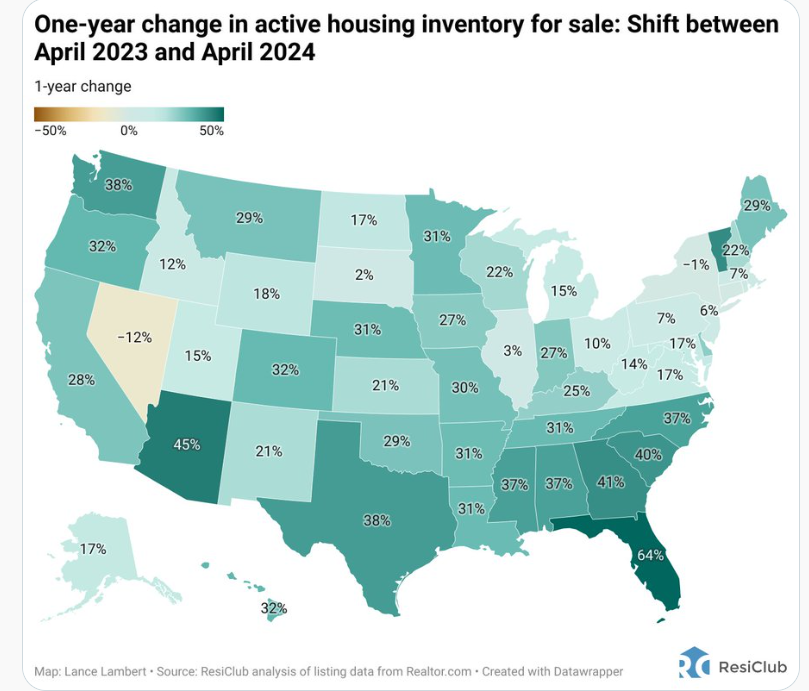
     Actually nationwide in the last one year inventory is rising albeit it doesn't indicate the drop of the price so far. This inventory eventually is slowing appreciation.

  • Real Estate Broker · Minneapolis, MN · Member since 2011 · 5k+ posts · 6k+ votes
    2y
    Quote from @Carlos Ptriawan:
    Quote from @James Hamling:
    Quote from @Carlos Ptriawan:

    This is for you James. Not all markes would react the same (in relevant) to interest rate and everything, some markets are much more sensitive.

    So theory all residential would go up in value in any condition may not be true, it's only up in certain market only.


    What I laid out is talking on economics, which is always an overall generalization. There will ALWAYS be specific deviation markets in any/all economies up, down, side to side. The US is over 300m people, thousands upon thousands upon thousands of cities, there will always by special case deviations but one should never operate systematically based upon those deviations UNLESS they are operating solely and specifically in those, right. 

    If the "binkie" statement all too many run to of "markets will always act uniquely" were true, riddle how I nailed forecasting with 97%+ accuracy since start of covid when I started PUBLICLY putting my ballz on the chopping block of making my forecasts public information. 

    And to date, not 1 of the naysayers and doompreachers has come onto BP to recant there "certainty" predictions that were SOOooo wrong. 

    I assure, rates will NOT significantly drop any time soon, as in years off. Appreciation is here to hold. Remember how '23' was supposed to drop? Then '24".... Nope. 

    Now, there will be those deviations given specific unique factors, say a steel town somewhere that 40% work at the plant and plant shut's down, oh-yeah, big time decline. But again, generalities, the "gravity" of things. 

    And i don't think speaking of a 3%-4% appreciation is some big crazy thing to expect. What is the argument vs, that inflation holds and real estate paces 0..... that is, again, an oxymoron. 

    Remember, inflation is NOT things getting more expensive, it's your dollar being worth LESS, the erosion of purchasing power. hence why EVERYTHING "costs more".     it was not a conspiracy of every business in US to simultaneously raise prices was it? No. It's a reflection of the dollar, buying LESS. And with that, real estate will.... cost MORE, right. 

    Ok, schools out, I gotta get the kids pizza....


     Actually nationwide in the last one year inventory is rising albeit it doesn't indicate the drop of the price so far. This inventory eventually is slowing appreciation.


    Come on Carlos, I thought you so much better then this. 

    This is HEAVILY skewed data. As it states 1yr, ONE year, change in ACTIVE inventory. Yeah, so active inventory went up from the all time EPIC zero/no inventory level.... Coming from that insane epic LOW, yup, even huge shortage of inventory will be a "big increase" of inventory from all but 0 level. 

    To put things in context, below is the FULL picture of inventory standing in MN market. That's the FULL-picture of yr-over-yr inventory in MN. 

    MN is still at lowest levels of inventory in 30 years!!!! But, from your HEAVILY skewed chart, on would think "holly-cow, 30%+ increase in inventory, wow, looks like a flood of inventory coming on" and reality is NOPE, it's just easy to look like big increase coming from all but 0. 

    MN is a 1.1 months inventory. Shortage is at 3 months.... So inventory would have to quadruple just to get into "normal" range. 

    I'd love to see full picture context of inventory in other markets like I have here, I bet ya it's a common theme....

  • Member since 2019 · 7k+ posts · 4k+ votes
    2y

    haha lol you are using your own city only :) I dont know but every region has different trajectory right now. It's all over the place.

  • Real Estate Broker · Minneapolis, MN · Member since 2011 · 5k+ posts · 6k+ votes
    2y
    Quote from @James Hamling:
    Quote from @Carlos Ptriawan:
    Quote from @James Hamling:
    Quote from @Carlos Ptriawan:

    This is for you James. Not all markes would react the same (in relevant) to interest rate and everything, some markets are much more sensitive.

    So theory all residential would go up in value in any condition may not be true, it's only up in certain market only.


    What I laid out is talking on economics, which is always an overall generalization. There will ALWAYS be specific deviation markets in any/all economies up, down, side to side. The US is over 300m people, thousands upon thousands upon thousands of cities, there will always by special case deviations but one should never operate systematically based upon those deviations UNLESS they are operating solely and specifically in those, right. 

    If the "binkie" statement all too many run to of "markets will always act uniquely" were true, riddle how I nailed forecasting with 97%+ accuracy since start of covid when I started PUBLICLY putting my ballz on the chopping block of making my forecasts public information. 

    And to date, not 1 of the naysayers and doompreachers has come onto BP to recant there "certainty" predictions that were SOOooo wrong. 

    I assure, rates will NOT significantly drop any time soon, as in years off. Appreciation is here to hold. Remember how '23' was supposed to drop? Then '24".... Nope. 

    Now, there will be those deviations given specific unique factors, say a steel town somewhere that 40% work at the plant and plant shut's down, oh-yeah, big time decline. But again, generalities, the "gravity" of things. 

    And i don't think speaking of a 3%-4% appreciation is some big crazy thing to expect. What is the argument vs, that inflation holds and real estate paces 0..... that is, again, an oxymoron. 

    Remember, inflation is NOT things getting more expensive, it's your dollar being worth LESS, the erosion of purchasing power. hence why EVERYTHING "costs more".     it was not a conspiracy of every business in US to simultaneously raise prices was it? No. It's a reflection of the dollar, buying LESS. And with that, real estate will.... cost MORE, right. 

    Ok, schools out, I gotta get the kids pizza....


     Actually nationwide in the last one year inventory is rising albeit it doesn't indicate the drop of the price so far. This inventory eventually is slowing appreciation.


    Come on Carlos, I thought you so much better then this. 

    This is HEAVILY skewed data. As it states 1yr, ONE year, change in ACTIVE inventory. Yeah, so active inventory went up from the all time EPIC zero/no inventory level.... Coming from that insane epic LOW, yup, even huge shortage of inventory will be a "big increase" of inventory from all but 0 level. 

    To put things in context, below is the FULL picture of inventory standing in MN market. That's the FULL-picture of yr-over-yr inventory in MN. 

    MN is still at lowest levels of inventory in 30 years!!!! But, from your HEAVILY skewed chart, on would think "holly-cow, 30%+ increase in inventory, wow, looks like a flood of inventory coming on" and reality is NOPE, it's just easy to look like big increase coming from all but 0. 

    MN is a 1.1 months inventory. Shortage is at 3 months.... So inventory would have to quadruple just to get into "normal" range. 

    I'd love to see full picture context of inventory in other markets like I have here, I bet ya it's a common theme....


    For some added context and clarity, below is what the #'s show when I add new-con into it, we get to 1.3mnths inventory....

    Expanding things even wider to add condo's condo-townhomes, any/EVERY residence type under the sun.... We finally get to 1.6 months inventory, so just need to DOUBLE entire current inventory to get too "normal"....

    I was able to find 1 way to skew the data to read 3.1mnths inventory.... By adding in all property types, new con, pre existing, condos etc etc, and keep it segmented to JUST Luxury real estate $ levels. So it looks like if your shopping at a multiplier of median home prices, yup, that inventory is finally not below the threshold for shortage.... by 0.2mnths supply.... But as you can see, context speaks volumes. Luxury generally moves a LOT slower than standard inventory, so 3.1mnths supply IS "shortage" in all context of historical norms. 

  • Real Estate Broker · Minneapolis, MN · Member since 2011 · 5k+ posts · 6k+ votes
    2y
    Quote from @Carlos Ptriawan:

    haha lol you are using your own city only :) I dont know but every region has different trajectory right now. It's all over the place.

    I don't have MLS feed for EVERY market in US, come on man be real.

    As said, I'd love to see others add the data for there markets. We have more then enough licensed people on BP from across the nation to see the full data from each. Ask. 

    And I note you completely skip the mountain sized hole I blew straight thru your premise. Your chart shows MN at 30%+ inventory increase but the FULL data shows it's 1.1 mnths vs 0.8mnths inventory that is the change. 

  • Real Estate Broker · Minneapolis, MN · Member since 2011 · 5k+ posts · 6k+ votes
    2y
    Quote from @James Hamling:
    Quote from @James Hamling:
    Quote from @Carlos Ptriawan:
    Quote from @James Hamling:
    Quote from @Carlos Ptriawan:

    This is for you James. Not all markes would react the same (in relevant) to interest rate and everything, some markets are much more sensitive.

    So theory all residential would go up in value in any condition may not be true, it's only up in certain market only.


    What I laid out is talking on economics, which is always an overall generalization. There will ALWAYS be specific deviation markets in any/all economies up, down, side to side. The US is over 300m people, thousands upon thousands upon thousands of cities, there will always by special case deviations but one should never operate systematically based upon those deviations UNLESS they are operating solely and specifically in those, right. 

    If the "binkie" statement all too many run to of "markets will always act uniquely" were true, riddle how I nailed forecasting with 97%+ accuracy since start of covid when I started PUBLICLY putting my ballz on the chopping block of making my forecasts public information. 

    And to date, not 1 of the naysayers and doompreachers has come onto BP to recant there "certainty" predictions that were SOOooo wrong. 

    I assure, rates will NOT significantly drop any time soon, as in years off. Appreciation is here to hold. Remember how '23' was supposed to drop? Then '24".... Nope. 

    Now, there will be those deviations given specific unique factors, say a steel town somewhere that 40% work at the plant and plant shut's down, oh-yeah, big time decline. But again, generalities, the "gravity" of things. 

    And i don't think speaking of a 3%-4% appreciation is some big crazy thing to expect. What is the argument vs, that inflation holds and real estate paces 0..... that is, again, an oxymoron. 

    Remember, inflation is NOT things getting more expensive, it's your dollar being worth LESS, the erosion of purchasing power. hence why EVERYTHING "costs more".     it was not a conspiracy of every business in US to simultaneously raise prices was it? No. It's a reflection of the dollar, buying LESS. And with that, real estate will.... cost MORE, right. 

    Ok, schools out, I gotta get the kids pizza....


     Actually nationwide in the last one year inventory is rising albeit it doesn't indicate the drop of the price so far. This inventory eventually is slowing appreciation.


    Come on Carlos, I thought you so much better then this. 

    This is HEAVILY skewed data. As it states 1yr, ONE year, change in ACTIVE inventory. Yeah, so active inventory went up from the all time EPIC zero/no inventory level.... Coming from that insane epic LOW, yup, even huge shortage of inventory will be a "big increase" of inventory from all but 0 level. 

    To put things in context, below is the FULL picture of inventory standing in MN market. That's the FULL-picture of yr-over-yr inventory in MN. 

    MN is still at lowest levels of inventory in 30 years!!!! But, from your HEAVILY skewed chart, on would think "holly-cow, 30%+ increase in inventory, wow, looks like a flood of inventory coming on" and reality is NOPE, it's just easy to look like big increase coming from all but 0. 

    MN is a 1.1 months inventory. Shortage is at 3 months.... So inventory would have to quadruple just to get into "normal" range. 

    I'd love to see full picture context of inventory in other markets like I have here, I bet ya it's a common theme....


    For some added context and clarity, below is what the #'s show when I add new-con into it, we get to 1.3mnths inventory....

    Expanding things even wider to add condo's condo-townhomes, any/EVERY residence type under the sun.... We finally get to 1.6 months inventory, so just need to DOUBLE entire current inventory to get too "normal"....

    I was able to find 1 way to skew the data to read 3.1mnths inventory.... By adding in all property types, new con, pre existing, condos etc etc, and keep it segmented to JUST Luxury real estate $ levels. So it looks like if your shopping at a multiplier of median home prices, yup, that inventory is finally not below the threshold for shortage.... by 0.2mnths supply.... But as you can see, context speaks volumes. Luxury generally moves a LOT slower than standard inventory, so 3.1mnths supply IS "shortage" in all context of historical norms. 


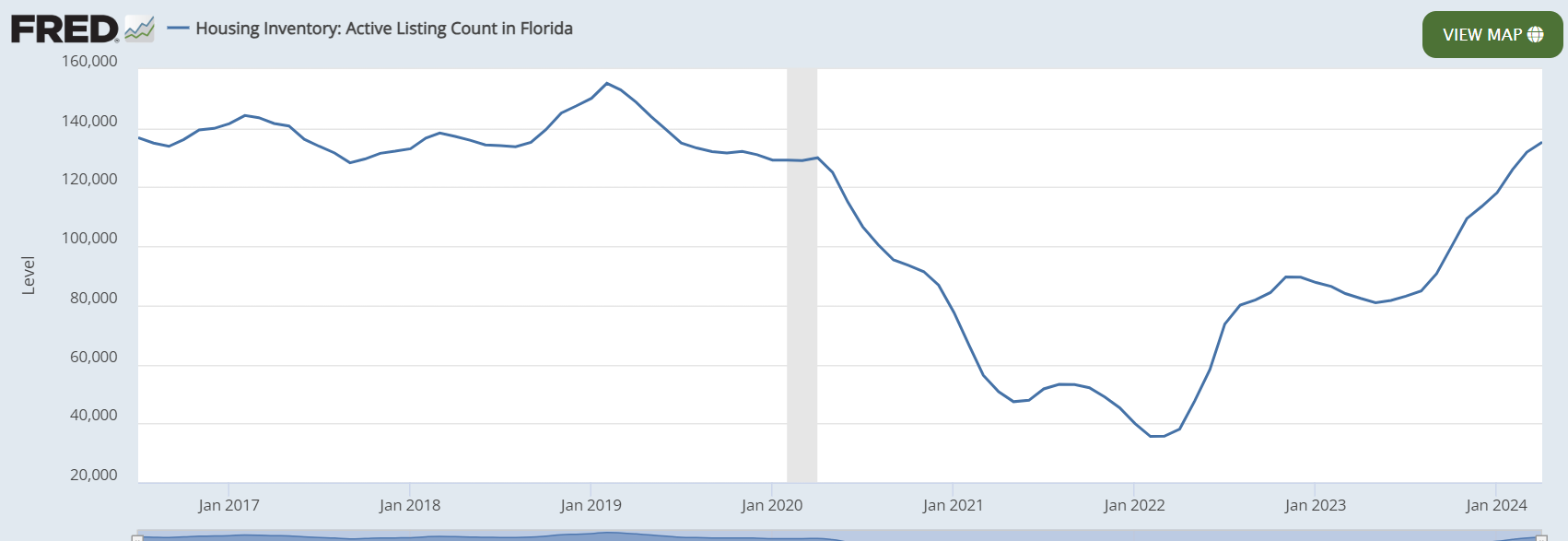
    Florida is made to look the worst in this chart, so I just started there to see what I could find.... 

    It looks like inventory is, well, more normal.... I suppose that doesn't make a good news headline though "FL housing, almost normal inventory level...." 

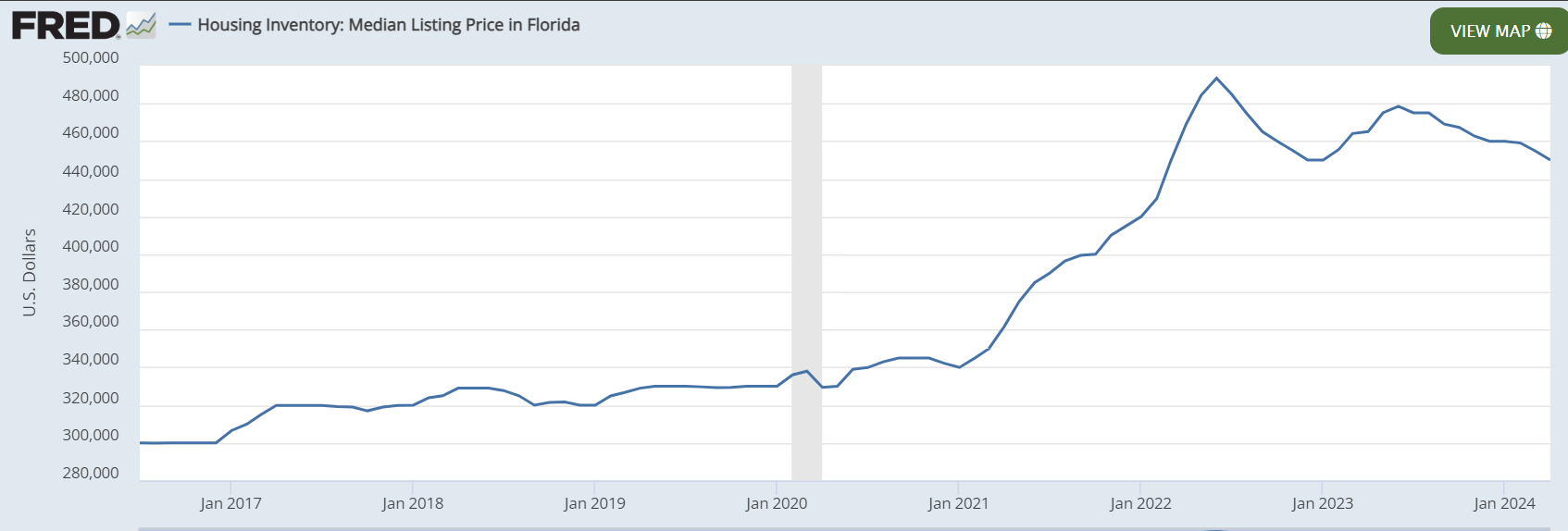
    But then I dig for better context, and HOLY-COW, when I look at median list price, wowzers, yeah inventory is almost normal but that sure as heck isnt. 

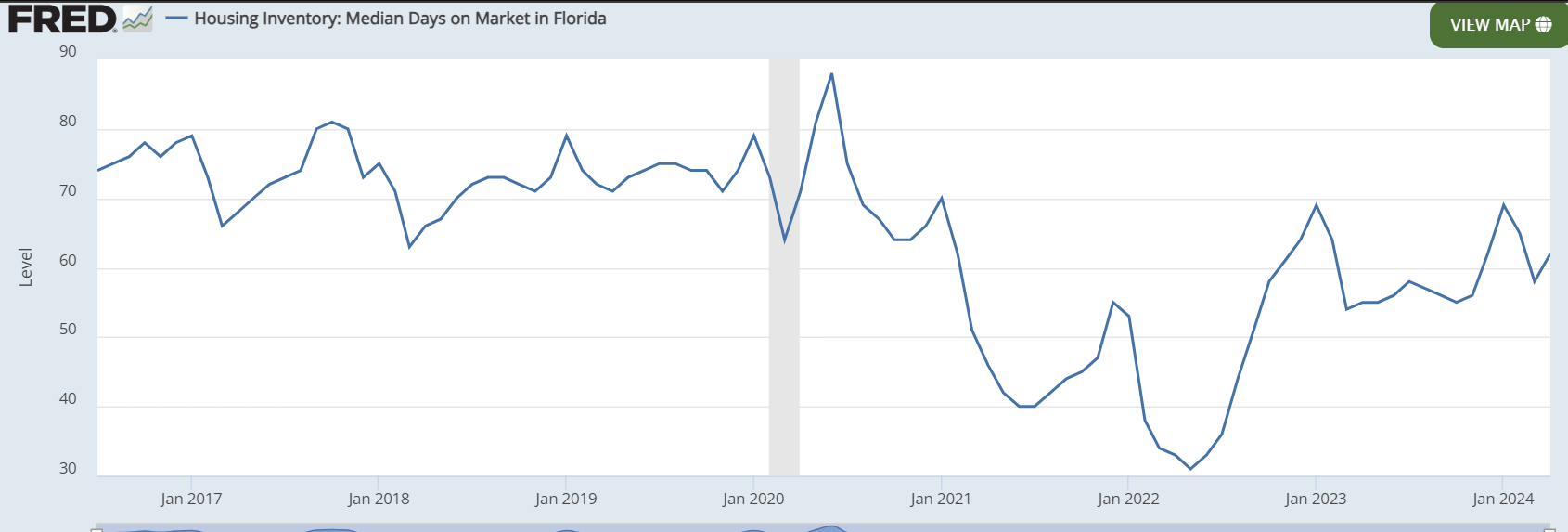
    So ok, again, I want better context to know what it all means. So, I go to days on market, that will tell us if these are actually selling because inventory nearing normal, prices WAY-way up from what were, surely there not selling like this, surely DOM is getting up there.... NOPE! Homes are a-selling in FL BIG time! 

    So it turns out your graph Carlos was complete PROPOGANDA.... Taking a shred of truth and spinning it to induce an assumption that is not even close to the reality. Because the increase in inventory on that chart, it makes on feel FL is crashing, right. NOPE, not crashing at all. "Normal" if anything, but at a whole different world of pricing it appears. 

    So yeah.... not gonna waste any more time on some spin-story. 

    Ya gotta be a lot more careful on vetting your data Carlos. I refuse to believe you knew this FULL context when posted it. Media.... WTF right, I mean seriously W-T-F, can't trust a damn thing one sees in any article anymore. 

  • Member since 2019 · 7k+ posts · 4k+ votes
    2y
    Quote from @James Hamling:
    Quote from @James Hamling:
    Quote from @James Hamling:
    Quote from @Carlos Ptriawan:
    Quote from @James Hamling:
    Quote from @Carlos Ptriawan:

    This is for you James. Not all markes would react the same (in relevant) to interest rate and everything, some markets are much more sensitive.

    So theory all residential would go up in value in any condition may not be true, it's only up in certain market only.


    What I laid out is talking on economics, which is always an overall generalization. There will ALWAYS be specific deviation markets in any/all economies up, down, side to side. The US is over 300m people, thousands upon thousands upon thousands of cities, there will always by special case deviations but one should never operate systematically based upon those deviations UNLESS they are operating solely and specifically in those, right. 

    If the "binkie" statement all too many run to of "markets will always act uniquely" were true, riddle how I nailed forecasting with 97%+ accuracy since start of covid when I started PUBLICLY putting my ballz on the chopping block of making my forecasts public information. 

    And to date, not 1 of the naysayers and doompreachers has come onto BP to recant there "certainty" predictions that were SOOooo wrong. 

    I assure, rates will NOT significantly drop any time soon, as in years off. Appreciation is here to hold. Remember how '23' was supposed to drop? Then '24".... Nope. 

    Now, there will be those deviations given specific unique factors, say a steel town somewhere that 40% work at the plant and plant shut's down, oh-yeah, big time decline. But again, generalities, the "gravity" of things. 

    And i don't think speaking of a 3%-4% appreciation is some big crazy thing to expect. What is the argument vs, that inflation holds and real estate paces 0..... that is, again, an oxymoron. 

    Remember, inflation is NOT things getting more expensive, it's your dollar being worth LESS, the erosion of purchasing power. hence why EVERYTHING "costs more".     it was not a conspiracy of every business in US to simultaneously raise prices was it? No. It's a reflection of the dollar, buying LESS. And with that, real estate will.... cost MORE, right. 

    Ok, schools out, I gotta get the kids pizza....


     Actually nationwide in the last one year inventory is rising albeit it doesn't indicate the drop of the price so far. This inventory eventually is slowing appreciation.


    Come on Carlos, I thought you so much better then this. 

    This is HEAVILY skewed data. As it states 1yr, ONE year, change in ACTIVE inventory. Yeah, so active inventory went up from the all time EPIC zero/no inventory level.... Coming from that insane epic LOW, yup, even huge shortage of inventory will be a "big increase" of inventory from all but 0 level. 

    To put things in context, below is the FULL picture of inventory standing in MN market. That's the FULL-picture of yr-over-yr inventory in MN. 

    MN is still at lowest levels of inventory in 30 years!!!! But, from your HEAVILY skewed chart, on would think "holly-cow, 30%+ increase in inventory, wow, looks like a flood of inventory coming on" and reality is NOPE, it's just easy to look like big increase coming from all but 0. 

    MN is a 1.1 months inventory. Shortage is at 3 months.... So inventory would have to quadruple just to get into "normal" range. 

    I'd love to see full picture context of inventory in other markets like I have here, I bet ya it's a common theme....


    For some added context and clarity, below is what the #'s show when I add new-con into it, we get to 1.3mnths inventory....

    Expanding things even wider to add condo's condo-townhomes, any/EVERY residence type under the sun.... We finally get to 1.6 months inventory, so just need to DOUBLE entire current inventory to get too "normal"....

    I was able to find 1 way to skew the data to read 3.1mnths inventory.... By adding in all property types, new con, pre existing, condos etc etc, and keep it segmented to JUST Luxury real estate $ levels. So it looks like if your shopping at a multiplier of median home prices, yup, that inventory is finally not below the threshold for shortage.... by 0.2mnths supply.... But as you can see, context speaks volumes. Luxury generally moves a LOT slower than standard inventory, so 3.1mnths supply IS "shortage" in all context of historical norms. 


    Florida is made to look the worst in this chart, so I just started there to see what I could find.... 

    It looks like inventory is, well, more normal.... I suppose that doesn't make a good news headline though "FL housing, almost normal inventory level...." 

    But then I dig for better context, and HOLY-COW, when I look at median list price, wowzers, yeah inventory is almost normal but that sure as heck isnt. 

    So ok, again, I want better context to know what it all means. So, I go to days on market, that will tell us if these are actually selling because inventory nearing normal, prices WAY-way up from what were, surely there not selling like this, surely DOM is getting up there.... NOPE! Homes are a-selling in FL BIG time! 

    So it turns out your graph Carlos was complete PROPOGANDA.... Taking a shred of truth and spinning it to induce an assumption that is not even close to the reality. Because the increase in inventory on that chart, it makes on feel FL is crashing, right. NOPE, not crashing at all. "Normal" if anything, but at a whole different world of pricing it appears. 

    So yeah.... not gonna waste any more time on some spin-story. 

    Ya gotta be a lot more careful on vetting your data Carlos. I refuse to believe you knew this FULL context when posted it. Media.... WTF right, I mean seriously W-T-F, can't trust a damn thing one sees in any article anymore. 


    lol btw what is interesting James, is that, the number of purchaser using all cash is up by 50-75% in every metro, so lot of region has 50% cash buyer while in bay area it was 15% cash buyer only two years ago but in 2024 cash buyers are 25%. Also found out that the number of mortgage demand is actually equal between 2023 to 2024. I bet these cash buyers are actually the one that's holding the price. About 50% purchasers are still FTHB btw.

Join the conversationCreate a free account to reply, vote on answers and follow this thread.