I built a system to scan 3,900 KC listings for hidden risk — here's what it caught
TL;DR: One listing added an entire bathroom that doesn't exist in county records. One flip turned a deck 'unsafe to walk on' into 'perfect for entertaining.' And one 'safe' Johnson County ranch sits one block from a federal Superfund site, yet that one might actually be the best deal of the three. 3 cases, 91 zip codes, 1 metro-wide breakdown.
After I posted about my Indianapolis experience, a few of the DMs I got were about Kansas City. One stuck with me: 'I just closed on a property in KC. Now I'm reading your post and wondering what I missed.'
That question kept bothering me. Not because of that one person, but because I realized I'd been asking myself the same thing every time I looked at a new listing. What am I NOT seeing?
So I decided to find out. Not for one property. For the entire Kansas City metro. I built a system that cross-references listing data against county records, tax trajectories, insurance markets, environmental databases, and and economic signals that don't show up on any listing page.
Here are 3 real properties from the scan. Two had problems. One was clean. The difference is worth paying attention to.
CASE 1: THE PHANTOM SQUARE FOOTAGE
East side, under $200K
The listing says 4 bed / 2 bath, over 2,500 sqft. County records say 3 bed / 1 bath, around 1,500 sqft. That's a thousand square feet and an entire bathroom that doesn't exist in any public record. No permits. No recorded additions.
The property sold for under $25K a few years ago. It's been through multiple listing cycles since, with repeated price drops and a pending sale that fell apart. The market keeps saying no.
If you're underwriting from out of state using the listing numbers, your price per sqft, rent estimate, and appraisal are all built on a fiction. Pull the county record and compare. Takes 30 seconds.
CASE 2: THE NORTHLAND FLIP
Northland, listed in the mid-$300s
Top school district. Newer construction. Professional photos. "Recently renovated to feel like new." The listing invites you to relax on the multi-level deck.
But the previous listing for the same property, different brokerage, about 18 months earlier at a fraction of the current ask, told a very different story: cash buyers only, deck unsafe to walk on, lower level gutted with flooring removed and drywall damage.
It sat for months. No one bought it. Then an investment LLC picked it up and relisted it at a significant markup.
The deck that was 'unsafe to walk on' is now 'perfect for entertaining.' The listed square footage jumped significantly from every prior record, because that gutted lower level now counts as finished space. And the listing shows a tax bill based on a relief program tied to the prior owner. It doesn't transfer. The actual liability after closing is several times higher.
Good schools. Newer construction. Northland. If it looks like this here, imagine what's hiding in the zip codes no one's checking.
CASE 3: THE THING YOU'D NEVER GOOGLE
Johnson County, under $300K
This is the one that's supposed to work.
2 bed / 1 bath ranch in Olathe. Johnson County. The zip code BP investors point to when they want "safe" Kansas City exposure. Verified permits for a new HVAC, electrical upgrade, re-roof. No price drops. No failed pendings. No "investor special" language. Clean listing, spacious backyard.
Standard checks come back clean. 9/10 high school. Violent crime below the national average. Vacancy under 3%. Major tech employer nearby with 2,000+ employees. Large-scale downtown redevelopment underway half a mile out.
One block from the front door sits a federal Superfund site. A former chemical storage operation with historical groundwater contamination. Vapor intrusion mitigation required on surrounding homes. On the EPA National Priorities List for years.
It doesn't show up in any standard real estate due diligence workflow. Not MLS, not Zillow, not a standard home inspection. This information lives in a completely different data universe from where most investors do their research.
The scan flagged it, then kept digging. EPA remediation records show the site has since been fully cleaned up. Groundwater monitoring ongoing, contamination addressed. The permit history confirms real, code-compliant upgrades. Zip-level fundamentals remain among the strongest in the dataset.
Cases 1 and 2, the data said run. Case 3, the data said the flag is real, but the risk is resolved, and everything underneath is solid. A thorough investor could eventually catch the first two.
Case 3 is different. That information lives in a database most investors don't know exists. No amount of Googling the address or reading the disclosure surfaces it. Every property has risk. The question is whether you found it before closing, understood what it actually meant, and decided it was yours to take. What you do with it is still your call.
HOW THE SCAN WORKED
The system I built covers 47 risk dimensions across 7 categories, pulling from 15+ public data sources per property. It's not perfect, and I'm still refining it. But even an imperfect screen catches things a listing page never will.
For KC, that meant:
• 3,900 active listings ingested
• 91 zip codes profiled (safety, economic stability, tax & insurance, rental market, environmental)
• 137 properties selected for individual deep-dives
• Every finding sourced from public records: federal, state, and county databases, plus cross-referencing listing data across multiple platforms.
THE KC-WIDE PICTURE
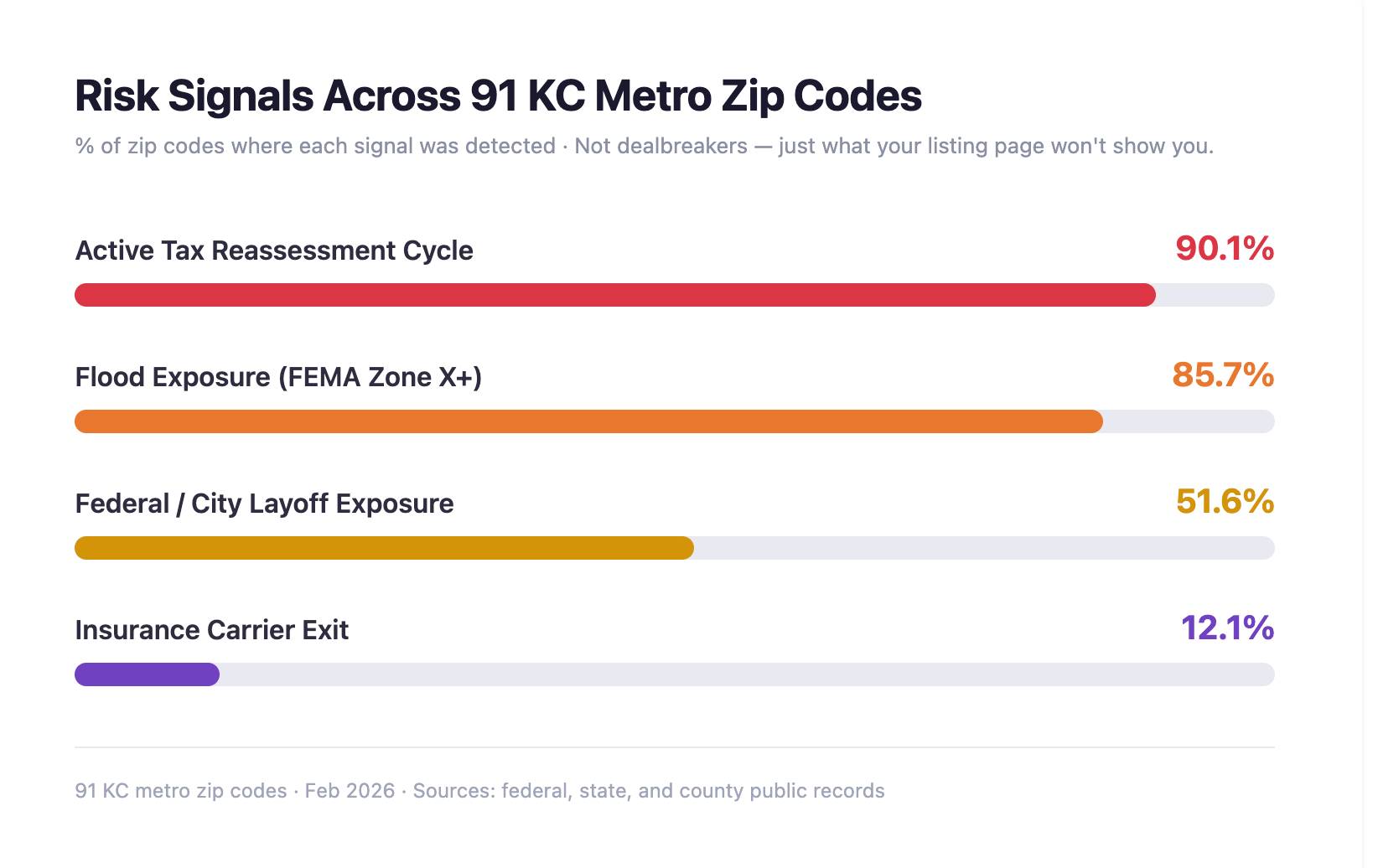
When I zoomed out to all 91 zip codes, certain patterns emerged. Not to say KC is risky, but to show where the risk concentrates and what kind of risk it is.
Over 90% of KC zip codes are in an active tax reassessment cycle. That's not unusual for a growing metro, but the reassessment disputes in Johnson and Jackson County are producing materially different outcomes. Know which side your zip falls on before you underwrite.
Nearly 86% have some level of flood exposure under FEMA mapping. Most of this is Zone X, minimal risk, not the kind that requires flood insurance. But it's worth knowing whether your specific property sits in a higher-risk pocket within that zip.
About half show exposure to federal or city employer concentration, meaning a single layoff announcement could shift vacancy and rent dynamics in that zip.
And 12% had an insurance carrier exit the state in 2024 or 2025. That one actually moves the needle on holding costs.
None of these mean don't invest in KC. KC's fundamentals are strong. Job growth, population trends, and affordability all point in the right direction. The risk isn't the market. It's going in without knowing which zip codes carry which signals, and pricing accordingly. The difference between a great KC deal and a costly mistake often comes down to one zip code over.
ONE MORE THING
After I ran the scan, I shared several of these findings with a KC-based investor-friendly agent to gut-check the results. Their response was basically: "Yeah, that tracks. But most of my out-of-state clients never ask about any of this."
That landed. The data doesn't replace a good local agent. It gives you better questions to ask them. I'd rather show up to that conversation already knowing what to look for, and let the local expert fill in what the data can't capture: neighborhood feel, tenant quality, contractor availability, which streets to avoid.
Showing up prepared is the first half of that equation. A good local team wins the second half.
WHAT'S NEXT
I'm going to keep scanning. KC is the second market after Indianapolis, and I'm already getting asked about Columbus, Memphis, and a few others.
If you've found hidden risks in your own deals that weren't on the listing page, drop it in the comments. Real examples help more than hypotheticals, and it helps everyone here calibrate what to actually look for.