Investing Guidance for a New Guy

Investing Guidance for a New Guy

Member since 2026 · 3 posts · 5 votes

Alright, I'll get straight to it. I am  married with children and would like to get started in real estate investing. Im looking to buy my first property and would like to know how I should go about it while keeping the family good. Im interested in multi-family, single family, commercial and also land sounds interesting to me as well. Any and all tips, resources, and advice welcome. How should I structure my first deal as a lead in to other deals?

4Reply
161 views

Most Popular Reply

Real Estate Broker · Northeast PA · Member since 2017 · 2k+ posts · 2k+ votes
5mo

@Jordan Hale

You’re asking the right questions—but you’re trying to solve too many things at once. You mentioned single-family, multi-family, commercial, land…

That’s where most people go sideways right out of the gate. You don’t need the “best” investment.

You need a safe, understandable first one. Something that rents easily, doesn’t need a lot of work, is in a decent, stable area, and is close enough that you can get to it without a project plan.

Boring is good on the first deal.

Protect the family first: You said something important—“keeping the family good.”

That’s the priority. So-- don’t stretch your finances, keep solid reserves (more than you think you need), avoid anything that has to go right to work. Your first deal should not create stress at home..

Don’t chase everything: Multi-family, commercial, land… those all have their place.

But for a first deal? Stay simple. A clean single-family or small multi (2–3 units) is usually the right place to start. Learn the game before you try to play every position.

How to think about the deal--Don’t start with “Is this a good property?”

Start with: “Do the numbers make sense after everything?”  That means rent, vacancy, maintenance, repairs, and reserves.

If it only works on paper—or if you’re “hoping” it works—walk away.

How to Structure your first deal:

Keep it straightforward:

  • Long-term hold
  • Fixed-rate financing
  • Conservative numbers
  • Positive or near break-even cash flow

This is your foundation deal, not your home run.

What matters most is you’re not trying to get rich on the first property. You’re trying to learn how to evaluate deals, learn how to manage a property, and build confidence.

The second deal is easier. The third one is easier than that.

The biggest mistake I see? Good people wait until they feel completely ready. That day doesn’t come. But there is a right way to start—slow, steady, and structured.

Good Luck!

See this reply in the discussion

11 Replies

Jump to latestLatest
  • Real Estate Broker · Northeast PA · Member since 2017 · 2k+ posts · 2k+ votes
    5mo

    @Jordan Hale

    You’re asking the right questions—but you’re trying to solve too many things at once. You mentioned single-family, multi-family, commercial, land…

    That’s where most people go sideways right out of the gate. You don’t need the “best” investment.

    You need a safe, understandable first one. Something that rents easily, doesn’t need a lot of work, is in a decent, stable area, and is close enough that you can get to it without a project plan.

    Boring is good on the first deal.

    Protect the family first: You said something important—“keeping the family good.”

    That’s the priority. So-- don’t stretch your finances, keep solid reserves (more than you think you need), avoid anything that has to go right to work. Your first deal should not create stress at home..

    Don’t chase everything: Multi-family, commercial, land… those all have their place.

    But for a first deal? Stay simple. A clean single-family or small multi (2–3 units) is usually the right place to start. Learn the game before you try to play every position.

    How to think about the deal--Don’t start with “Is this a good property?”

    Start with: “Do the numbers make sense after everything?”  That means rent, vacancy, maintenance, repairs, and reserves.

    If it only works on paper—or if you’re “hoping” it works—walk away.

    How to Structure your first deal:

    Keep it straightforward:

    • Long-term hold
    • Fixed-rate financing
    • Conservative numbers
    • Positive or near break-even cash flow

    This is your foundation deal, not your home run.

    What matters most is you’re not trying to get rich on the first property. You’re trying to learn how to evaluate deals, learn how to manage a property, and build confidence.

    The second deal is easier. The third one is easier than that.

    The biggest mistake I see? Good people wait until they feel completely ready. That day doesn’t come. But there is a right way to start—slow, steady, and structured.

    Good Luck!

  • Arman AhmedPro Member
    Real Estate Agent · Columbus Cleveland Dayton, OH · Member since 2024 · 2k+ posts · 915 votes
    5mo
    Quote from @Jordan Hale:

    Alright, I'll get straight to it. I am  married with children and would like to get started in real estate investing. Im looking to buy my first property and would like to know how I should go about it while keeping the family good. Im interested in multi-family, single family, commercial and also land sounds interesting to me as well. Any and all tips, resources, and advice welcome. How should I structure my first deal as a lead in to other deals?


    You’re approaching it the right way. The first deal should be about stability for your family, not trying to hit a home run on everything at once. Most new investors do best starting with a simple cash-flowing rental or small multifamily where the numbers are easy to understand, and the risk is controlled. If your local market feels too tight, a lot of families in your position end up going out-of-state to Midwest areas, where entry prices are lower, and you can actually get positive cash flow from day one. The key is keeping your first deal conservative, building systems, and then scaling from there once you understand how everything runs.
  • Min ZhangBusiness Member
    Real Estate Agent · Member since 2022 · 1k+ posts · 1k+ votes
    5mo

    If this will be your first investment property, I recommend starting 1-4 units. It sets a solid foundation before moving into commercial deals. Also, hiring a property manager can help you keep your family life stable by taking care of tenants, maintenance, and operations so you can stay focused on what matters at home. Hope this helps and best of luck on your investing journey

  • Jimmy LieuBusiness Member
    Real Estate Agent · Columbus, OH · Member since 2019 · 3k+ posts · 2k+ votes
    5mo
    Quote from @Jordan Hale:

    Alright, I'll get straight to it. I am  married with children and would like to get started in real estate investing. Im looking to buy my first property and would like to know how I should go about it while keeping the family good. Im interested in multi-family, single family, commercial and also land sounds interesting to me as well. Any and all tips, resources, and advice welcome. How should I structure my first deal as a lead in to other deals?

    Hey Tyler, Jordan pretty much nailed it—most of the time the brokerage split and any fees get taken off the top first, and then whatever is left gets applied toward anything like closing cost credits. Every brokerage and team can structure it a little differently though, so the key thing is what your agreement actually says. If it’s not super clear, it’s completely reasonable to ask your broker or team lead to walk you through a sample deal so you can see exactly how the commission flows from start to finish and avoid surprises at closing.


  • Wholesaler · Charleston WV · Member since 2026 · 225 posts · 121 votes
    5mo

     The goal of your first deal is not to hit a home run but to learn safely, build confidence, and create a foundation for future deals. Look for something that still works if you have a vacancy or an unexpected repair, because real estate always tests you at some point. Keep it conservative, make sure the numbers make sense, and treat the first property as your training ground that leads to the second, third, and fourth deal over time.

  • G. Brian DavisPro Member
    Investor · Hatboro, PA · Member since 2016 · 2k+ posts · 850 votes
    5mo

    The smartest move is to keep your first deal simple and stable. Something like a small multifamily or house hack where you can live in one unit and offset your expenses is usually the best entry point. It lowers risk, builds experience, and keeps your personal finances strong.

    Focus on one clear path that works with your current income and time. Make sure the deal works with today’s numbers, it’s about learning, staying stable, and setting up the next one.

  • Eric FernwoodBusiness Member
    Realtor · Las Vegas, NV · Member since 2014 · 992 posts · 1k+ votes
    5mo

    Hello @Jordan Hale,

    My advice is to start with the types of tenants you want in your properties, not the types of properties you desire. Focusing on the tenant segment is critical because no property has ever paid rent. Tenants do.

    The process we use is borrowed from how successful national retail chains select markets, define their target customers, and tailor their offerings to match demand.

    The steps are illustrated below.
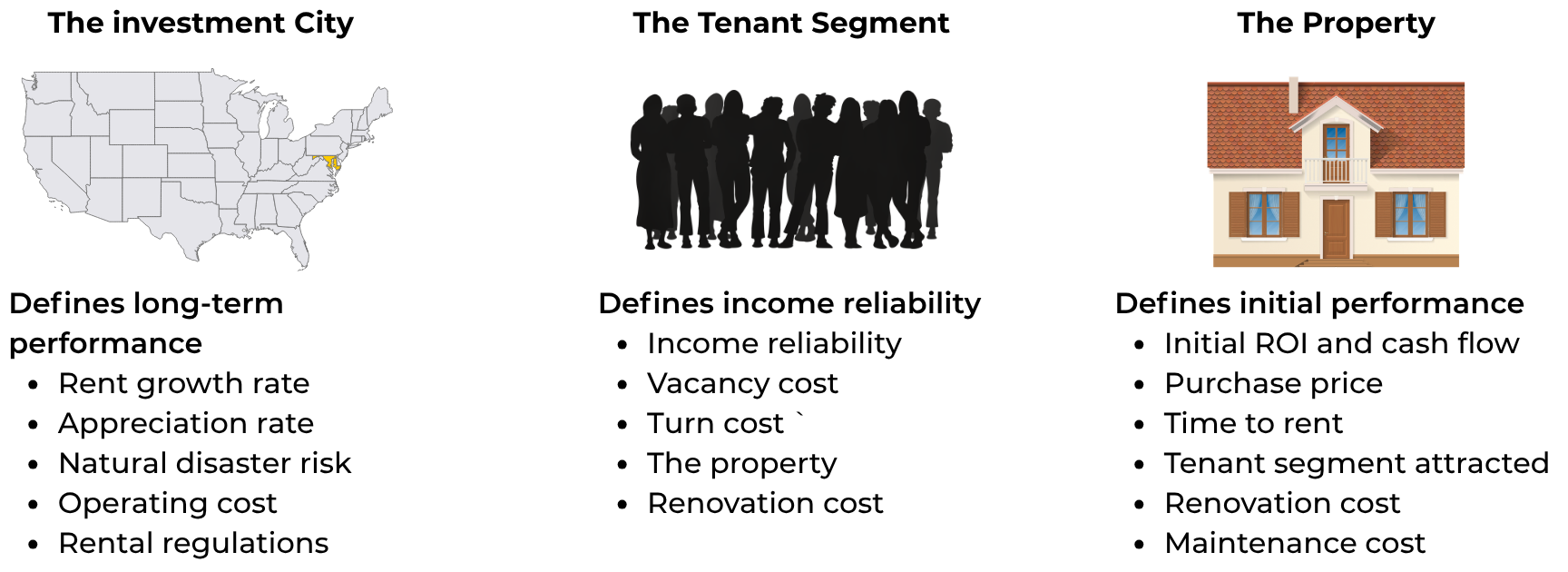
    Our process is straightforward:

    1. Define your long-term goals.

      For most of our clients, the goal is long-term financial independence and building generational wealth. Every investment decision should align with that goal.

    2. Select the right investment city.

      Live where you like, invest where you can achieve your goals. Focus on cities with significant and sustained population growth, job creation, rising personal incomes, low crime, and low operating costs. In most cases, this requires investing out of state with an experienced local investment team.

    3. Select a reliable tenant segment.

      A reliable tenant stays for years, pays on time, and takes care of the property. No property has ever paid rent. The tenant does. Your financial results depend on consistently having a reliable tenant in your property.

    4. Select properties that fit your tenant.

      Let your target tenant define the property. Focus on what they already rent and where they choose to live. Do not rely on opinions or trends.

    We have delivered over 600 investment properties to more than 170 clients worldwide. Most of our clients purchase three or more properties with us because they continue to see consistent rent growth and appreciation. This is due to our tenant-centric vs property centric investing framework.

    If you would like to go deeper on any of those steps, let me know.

    FERNWOOD Team, KW VIP Realty520 Reviews
  • Real Estate Broker · New York, NY · Member since 2020 · 2k+ posts · 1k+ votes
    5mo

    What really matters with your first deal is that it’s stable, something that cash flows in a way that doesn’t stress your household, and something you can realistically manage without it taking over your life.

    For most people in your position, a small multifamily or a solid single-family home in a good rental area tends to be the easiest way in. Not because it’s the flashiest or highest returning on paper, but because it’s more straightforward to finance, easier to understand, and easier to sell or pivot out of if you ever need to. Commercial and land can definitely work, but they usually make more sense once you’ve already owned and managed something simpler first.

    One thing you can do right now that helps a lot is start talking to lenders. Get a feel for what you actually qualify for, what your monthly payments would look like, and how much cash you’d really need for down payment and reserves. That kind of clarity makes everything else easier because you’re no longer guessing or falling in love with properties that don’t fit your numbers.

  • James WachobBusiness Member
    Real Estate Broker · Memphis, TN · Member since 2015 · 1k+ posts · 887 votes
    5mo

    Hey @Jordan Hale

    Great question, and the fact you’re thinking about your family while getting started is exactly the right mindset. Your first deal shouldn’t just be about making money, it should be about building a stable foundation you can safely grow from.

    For most people in your position, the best move is to keep the first deal simple and low risk. That usually means either:

    - A single-family rental, or
    - A small multifamily (duplex) if the numbers make sense

    These are easier to finance, manage, and exit if needed. Commercial and land can be great later, but they come with more complexity and risk. Not ideal for deal #1.

    When structuring your first deal, think of it as a “launchpad”:

    - Make sure it cash flows (even modestly) after all expenses
    - Keep reserves in place so your family isn’t financially stressed
    - Buy in an area with solid rental demand
    - Avoid heavy rehabs unless you have strong experience and time

    The goal isn’t to hit a home run. It’s to survive and learn, then use that experience to scale into deal #2, #3, and beyond.

    A lot of families also consider house hacking if it fits their lifestyle, but if that’s not realistic, a straightforward long-term rental is a great start.

    I’m a real estate agent based in Memphis and work with out-of-state investors building rental portfolios. Many investors choose markets like Memphis because the lower price points and strong rental demand make it easier to find stable, cash-flowing first deals — which is exactly what you want starting out.

    You’re thinking about this the right way. Protect your downside, keep it simple, and build from there. If you ever want to look at example deals or talk through what a “safe” first investment looks like, I’d be happy to connect and help.

  • Terrance HillPro Member
    Realtor · Memphis, TN · Member since 2010 · 425 posts · 117 votes
    4mo

    Hey Jordan welcome. With a family involved, the biggest thing is usually making sure the first deal puts you in a stronger position instead of stretching you too thin. A lot of investors start with something simpler and manageable first, then scale once they understand financing, reserves, repairs, and tenant management a little better.

    I’m open to connecting

  • Garrett CrosbyPro Member
    Real Estate Agent · Los Angeles, United States · Member since 2021 · 392 posts · 162 votes
    3mo

    Marc nailed it. When you have a family depending on you, the first deal's job is to not hurt you — not to make you rich. The home run comes later.

    My background is 20+ years in education, so I relate to the "learn by doing" phase. I'd add one thing to what's been said: wherever you are geographically, start by truly understanding your local market. Even if you eventually invest out of state, knowing one market's comps, rents, and neighborhoods deeply is a skill that transfers. You'll catch bad deals faster and good ones too. Don't skip that foundation step by jumping straight into the analysis of markets you've never been to.

    Start simple. Build from there. Happy to DM if you have questions along the way.

Join the conversationCreate a free account to reply, vote on answers and follow this thread.