Using AI to analyze your portfolio, and track important metrics

Using AI to analyze your portfolio, and track important metrics

Justin R.Pro Member
Rental Property Investor · San Anselmo · Member since 2015 · 659 posts · 599 votes

I’ve been experimenting with using AI alongside QuickBooks Online to improve my annual property reviews.

My current process is:

  • Run a property-level P&L by class in QBO
  • Separate true NOI from interest, principal, depreciation, and CapEx
  • Calculate economic occupancy, cap rate, LTV, DSCR, and actual cash flow
  • Compare property performance over multiple years
  • Identify unusual expenses, accounting errors, and cash-basis timing issues
  • Create a standardized one-page annual report for every property

I started a few years ago with Chap GPT, then moved to Claude, and currently back with Chat GPT. 

AI has been especially useful for turning basic accounting reports into something much more powerful from an owner/investor perspective. More powerful and faster, but not more simple.

I’m curious how others are using AI:

  • What reports do you run monthly or annually?
  • Do you use ChatGPT, Claude, Gemini, Copilot, or another system?
  • Are you uploading QBO reports, rent rolls, loan statements, or property-management reports?
  • What metrics or problems has AI helped you identify?
  • Have you built any repeatable templates, dashboards, or automated workflows?

I’d love to hear what is actually working for other owners

1Reply
346 views

Most Popular Reply

Englewood, NJ · Member since 2018 · 464 posts · 89 votes
3w

All of these are great post-acquisition workflows. The AI use case I've found most valuable is on the pre-acquisition side — specifically for tax deed auction underwriting, where the analysis problem is fundamentally different from portfolio management.

At a county tax deed auction, you might have 16 properties to evaluate simultaneously. You can't inspect any of them inside. You have the assessed value, the minimum bid, and public records — that's it. The margin for error is huge because you're buying sight-unseen with 100% cash.

Here's how AI changes the auction analysis:

1. Batch comparable screening: Feed the AI the full auction property list with assessed values and parcel details. Have it pull comparable sales within 0.5 miles for each property simultaneously. What would take a analyst days becomes a structured comparison table in minutes. For Broward County's upcoming Auction #113, I'm ranking all 16 properties by spread (assessed value vs. expected bid range) and flagging which ones have the thickest equity cushion.

2. Public data extraction: County appraiser records give you land value vs. building value, year built, square footage, zoning, and ownership history. AI can parse those records across multiple parcels and build a standardized underwriting sheet — something that would require manually pulling data from 16 different property appraiser pages.

3. Risk scoring: Aaron's point about T12 variance analysis applies even more at auction. Since you can't see inside the property, AI can flag risk factors from public data — properties with code enforcement liens, environmental overlays, flood zones, or title clouds that the clerk's database reveals. It's not a replacement for a title search, but it helps you decide which properties deserve deeper due diligence before bidding.

4. Rehab estimation from exterior data: This is where AI is still rough but improving. Street view images, property age, and neighborhood comparable conditions can give you a rehab range — not a precise estimate, but enough to know whether the spread justifies the risk.

The key difference from Justin's QBO workflow: you're not analyzing historical performance. You're predicting forward returns on properties where the data is incomplete and the acquisition is irreversible. Alison's point about treating AI like a fast junior analyst is exactly right — but at auction, that junior analyst is working with half the information and the stakes are higher because there's no inspection contingency.

For anyone doing tax deed auctions, the AI edge isn't in the reporting — it's in the speed of initial screening. You need to know within 48 hours of the auction which 4-5 properties deserve your full attention and which 11 you should pass on. That's where batch AI analysis pays for itself.

See this reply in the discussion

8 Replies

Jump to latestLatest
  • J CastroBusiness Member
    Lender · Florida · Member since 2025 · 673 posts · 240 votes
    1mo
    Quote from @Justin R.:

    I’ve been experimenting with using AI alongside QuickBooks Online to improve my annual property reviews.

    My current process is:

    • Run a property-level P&L by class in QBO
    • Separate true NOI from interest, principal, depreciation, and CapEx
    • Calculate economic occupancy, cap rate, LTV, DSCR, and actual cash flow
    • Compare property performance over multiple years
    • Identify unusual expenses, accounting errors, and cash-basis timing issues
    • Create a standardized one-page annual report for every property

    I started a few years ago with Chap GPT, then moved to Claude, and currently back with Chat GPT. 

    AI has been especially useful for turning basic accounting reports into something much more powerful from an owner/investor perspective. More powerful and faster, but not more simple.

    I’m curious how others are using AI:

    • What reports do you run monthly or annually?
    • Do you use ChatGPT, Claude, Gemini, Copilot, or another system?
    • Are you uploading QBO reports, rent rolls, loan statements, or property-management reports?
    • What metrics or problems has AI helped you identify?
    • Have you built any repeatable templates, dashboards, or automated workflows?

    I’d love to hear what is actually working for other owners


    This is a great use of AI, especially because you’re using it to interpret the numbers rather than simply generate a prettier report.

    One area I think has a lot of potential is using AI to compare property performance against the original investment assumptions. For example:

    • Actual vs. projected NOI
    • Actual vs. projected rehab/CapEx
    • Rent growth vs. underwriting assumptions
    • DSCR and debt-service changes
    • Cash-on-cash return over time
    • Property-level expense trends
    • Current equity vs. original invested capital

    The year-over-year comparison can be especially valuable because a property can look profitable on the surface while quietly becoming less efficient due to rising insurance, taxes, maintenance, utilities, or financing costs.

    I also like the idea of creating a standardized one-page report for every property. That makes it much easier to look at the portfolio as a business rather than managing each property in isolation.

    The key, as you pointed out, is that AI makes the analysis faster—but the investor still needs to understand what the numbers actually mean and verify the underlying data.

    I’d be interested in seeing your one-page annual report template. That sounds like something many investors could adapt to their own portfolios.

    JCREIG Capital Funding
  • Justin R.Pro Member
    OP
    Rental Property Investor · San Anselmo · Member since 2015 · 659 posts · 599 votes
    1mo
    • J CastroBusiness Member
      Lender · Florida · Member since 2025 · 673 posts · 240 votes
      1mo
      Quote from @Justin R.:

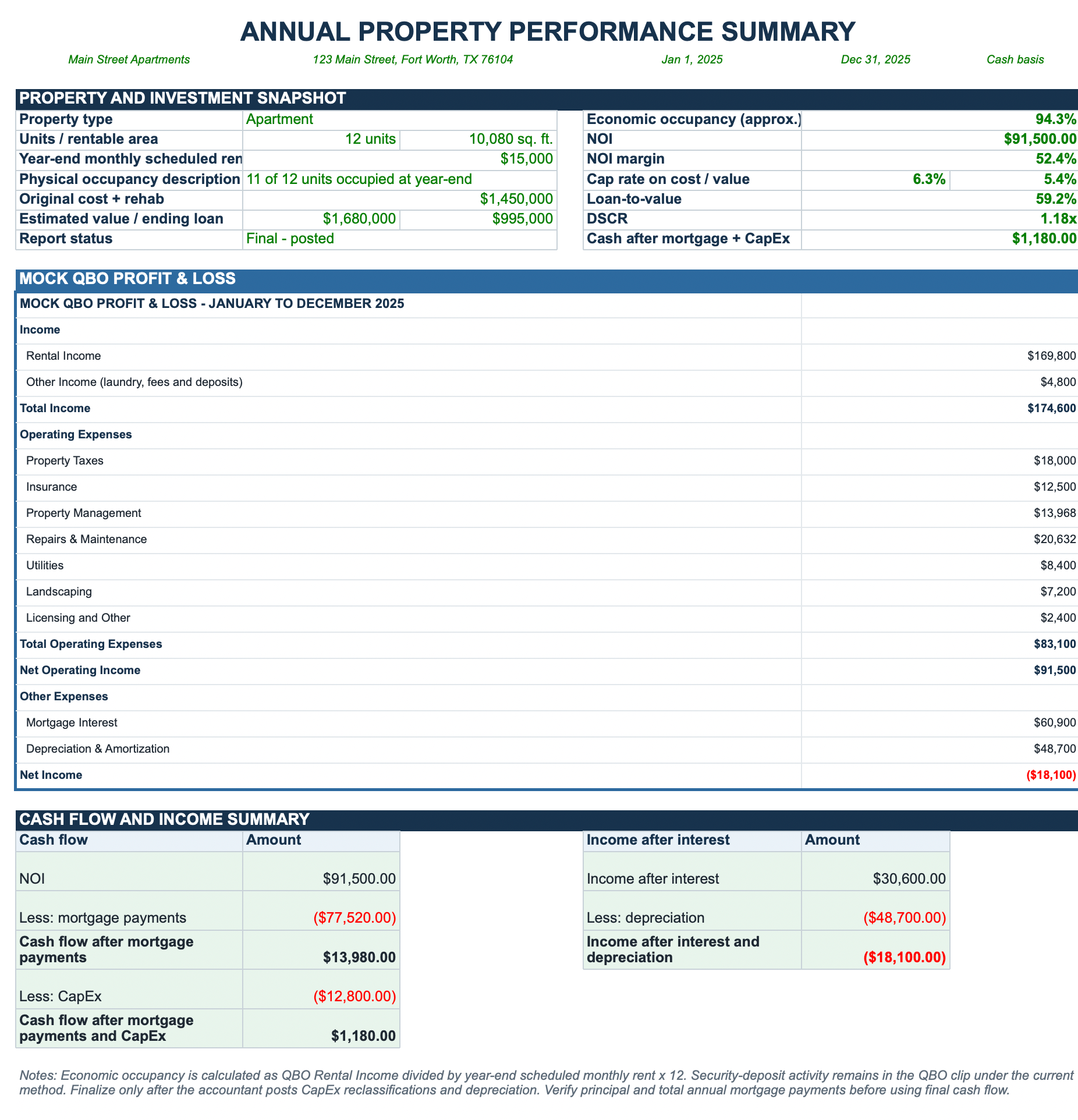
      @Justin R., this is exactly the kind of one-page reporting framework I was hoping you’d share. Thanks for posting it.

      Looking at this from a lender’s perspective, I really like that the report separates NOI, debt service, CapEx, and accounting items instead of treating “net income” as the same thing as property cash flow.

      A few things immediately stand out in this example:

      • 94.3% economic occupancy — strong, but there is still some vacancy exposure.
      • $91,500 NOI on $174,600 of total income gives a 52.4% NOI margin, which provides a useful view of operating efficiency.
      • 59.2% LTV provides a meaningful equity cushion from a collateral perspective.
      • 1.18 DSCR, however, tells a different story from the LTV. The property has substantial equity but relatively limited debt-service coverage.
      • Most importantly, the property generates approximately $13,980 after mortgage payments, but only $1,180 after CapEx. That distinction is extremely important when evaluating the property's true economic performance.

      That last point is one I think investors sometimes overlook. A property can technically be cash-flow positive after debt service while having very little actual cash available once realistic CapEx is accounted for.

      From a lending standpoint, I’d probably want to take this analysis one step further by adding a few items to the annual review:

      1. Debt maturity/refinance risk — What happens to DSCR if the loan has to be refinanced at a higher rate?

      2. Sensitivity analysis — What does cash flow look like at 90%, 85%, or 80% occupancy?

      3. Insurance and tax trend — Are those expenses increasing faster than rents?

      4. Debt yield — NOI divided by the outstanding loan balance can provide another useful lender-oriented metric.

      5. Stabilized value vs. loan balance — Particularly important when evaluating a future refinance or cash-out strategy.

      6. CapEx reserve adequacy — Is the annual CapEx number based on actual historical spending, a replacement reserve assumption, or both?

      I also like the separation of cap rate on cost vs. cap rate on current value. That can tell an investor something very different about how the original investment is performing versus what the current equity is earning.

      This is a great example of your point that AI makes the analysis more powerful and faster, but not necessarily simpler. The value isn't just generating the report—the real value is asking the right questions after the report is generated.

      As a lender, this type of standardized annual property review would make it much easier to have a productive conversation with an investor about leverage, refinance capacity, DSCR, equity, and the property's ability to support additional debt.

      Really well done. This is a template I could see being useful not only for owners, but also for investors preparing for their next acquisition or refinance.

      JCREIG Capital Funding
  • Rental Property Investor · Joliet, IL · Member since 2013 · 98 posts · 47 votes
    1mo

    Justin, I’m using AI as an operating and decision-support system for the portfolio.

    A few of the recurring uses that have been most valuable for me:

    • - Monthly review of property-management reports, rent collection, unusual expenses, and maintenance activity
    • - Property-level cash flow and multi-year expense analysis
    • - Rent benchmarking against current market listings
    • - Tracking rent drift and identifying properties that are materially below market
    • - Capital project analysis, including expected rent impact, financing capacity, and cash-flow effects
    • - Reviewing insurance coverage and comparing renewal options
    • - Property tax analysis and appeal support
    • - Standardized inspection and major-system tracking
    • One lesson I’ve learned is that the real power comes when the analysis becomes repeatable. A one-time AI conversation is useful. A defined process with consistent inputs, rules, and historical data is much more powerful.

    For example, I’ve built a small rental market intelligence process that collects comparable listings and helps establish a market-rent range before I make renewal decisions. I also use a rent target below full market rather than automatically pushing every tenant to the maximum.

    The biggest limitation has been data discipline. AI can find patterns very quickly, but if the source data changes format, accounting classifications are inconsistent, or you don't clearly define what belongs in NOI versus CapEx, it can produce a very polished wrong answer.

    So I’ve moved toward treating AI more like a very fast junior analyst: give it structured data, define the rules, let it do the repetitive analysis, and then challenge the conclusions.

    Your comment that it becomes “more powerful and faster, but not more simple” matches my experience almost exactly.

  • Aaron WeikleBusiness Member
    Member since 2026 · 76 posts · 23 votes
    3w

    Your workflow is solid. The class-based P&L separation is the right foundation but everything else falls apart if interest, principal, depreciation, and CapEx are mixed into operating expenses. A few things I've added that changed how useful the AI output actually is that I upload a trailing-12 alongside the annual P&L. When you give the model two periods at once and ask it to flag line items where variance exceeds 15%, it catches things a single year report buries which is a repair category that quietly doubled, or a utility expense that's been creeping because of a leak nobody flagged. Loan amortization schedules pasted directly into the chat let the AI calculate actual DSCR at the property level rather than using the stated payment. Lenders don't always structure IO periods cleanly in QBO, so the model doing that math from the schedule itself is more reliable. For cost segregation work, I've had good results feeding the AI a depreciation schedule from Form 4562 and asking it to identify assets still on 27.5 year MACRS that would likely qualify for 5 or 15 year reclassification. It won't replace an actual cost segregation study, but it's a useful pre-screen before you pay for one. The repeatable template piece is where I'd push you. Build a master prompt that specifies every metric you want calculated, the exact format for the one-pager, and how you want anomalies flagged. Once that's dialed in, the review time per property drops considerably and the outputs are actually comparable year over year.

    RealBooks
  • Englewood, NJ · Member since 2018 · 464 posts · 89 votes
    3w

    All of these are great post-acquisition workflows. The AI use case I've found most valuable is on the pre-acquisition side — specifically for tax deed auction underwriting, where the analysis problem is fundamentally different from portfolio management.

    At a county tax deed auction, you might have 16 properties to evaluate simultaneously. You can't inspect any of them inside. You have the assessed value, the minimum bid, and public records — that's it. The margin for error is huge because you're buying sight-unseen with 100% cash.

    Here's how AI changes the auction analysis:

    1. Batch comparable screening: Feed the AI the full auction property list with assessed values and parcel details. Have it pull comparable sales within 0.5 miles for each property simultaneously. What would take a analyst days becomes a structured comparison table in minutes. For Broward County's upcoming Auction #113, I'm ranking all 16 properties by spread (assessed value vs. expected bid range) and flagging which ones have the thickest equity cushion.

    2. Public data extraction: County appraiser records give you land value vs. building value, year built, square footage, zoning, and ownership history. AI can parse those records across multiple parcels and build a standardized underwriting sheet — something that would require manually pulling data from 16 different property appraiser pages.

    3. Risk scoring: Aaron's point about T12 variance analysis applies even more at auction. Since you can't see inside the property, AI can flag risk factors from public data — properties with code enforcement liens, environmental overlays, flood zones, or title clouds that the clerk's database reveals. It's not a replacement for a title search, but it helps you decide which properties deserve deeper due diligence before bidding.

    4. Rehab estimation from exterior data: This is where AI is still rough but improving. Street view images, property age, and neighborhood comparable conditions can give you a rehab range — not a precise estimate, but enough to know whether the spread justifies the risk.

    The key difference from Justin's QBO workflow: you're not analyzing historical performance. You're predicting forward returns on properties where the data is incomplete and the acquisition is irreversible. Alison's point about treating AI like a fast junior analyst is exactly right — but at auction, that junior analyst is working with half the information and the stakes are higher because there's no inspection contingency.

    For anyone doing tax deed auctions, the AI edge isn't in the reporting — it's in the speed of initial screening. You need to know within 48 hours of the auction which 4-5 properties deserve your full attention and which 11 you should pass on. That's where batch AI analysis pays for itself.

    • Rental Property Investor · Joliet, IL · Member since 2013 · 98 posts · 47 votes
      3w

      Taking 16 property records, standardizing the data, identifying obvious risks, and narrowing the list to the 4–5 properties worth deeper investigation is a very practical AI use.

      That is similar to how I’ve been thinking about AI in rental operations: collect and organize more evidence than I could reasonably process manually, then use the output to focus my own attention and judgment.

      The “fast junior analyst” comparison fits especially well here because speed and consistency are relatively low-risk fits for AI. I also find the analytical and intelligence components hugely valuable, as long as they expand and build on your own decision-making rather than replace due diligence.

Join the conversationCreate a free account to reply, vote on answers and follow this thread.