Landlords Are Taking Over the U.S. Housing Market

Landlords Are Taking Over the U.S. Housing Market

Professional · Batavia, IL · Member since 2016 · 104 posts · 39 votes

Here is an interesting article that was posted on Bloomberg.com today:

As Wall Street backs off of buying rental homes, small investors are picking up the slack.

‎February‎ ‎23‎, ‎2017‎ ‎4‎:‎00‎ ‎AM

As rising home prices, slow new home construction, and , the U.S. is increasingly a country of renters—and landlords.

Last year, 37 percent of homes sold were acquired by buyers who didn’t live in them, according to tax-assessment data compiled in a published by Attom Data Solutions and ClearCapital.com Inc.

That number may include second homes, or properties acquired by investors who seek to fix up old homes and resell them at a profit. But it’s also a strong indication that landlords are playing a larger role in the U.S. housing market.
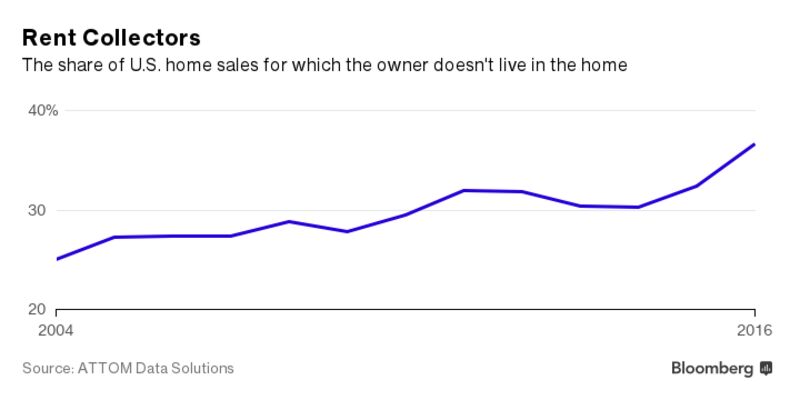
 

In the years following the foreclosure crisis, Wall Street drove a rise in the share of homes purchased by landlords, as bought thousands of cheap homes. In 2012, institutional investors accounted for 7.8 percent of home sales, according to the report.

Rising home prices led big investors to curtail their purchases, and the share of homes acquired by institutional investors fell to 2.9 percent last year. But as Wall Street backed off, smaller investors picked up the slack, aided by tools developed to help big investors find, finance, and manage rental properties.

Smaller investors—particularly those who have already paid off their mortgages on the homes they live in—see rental properties as an attractive way to .

To some extent, they’re focusing their resources on cheaper markets, because the profit margins are better at lower price points, said Daren Blomquist, senior vice president at Attom Data Solutions.
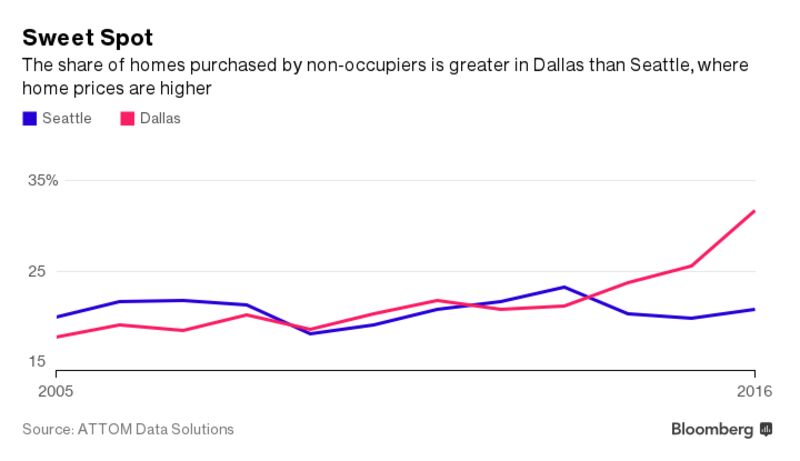
 

In Seattle, where the median home price was $414,000 at the end of last year, the annual share of sales to non-occupiers peaked in 2013, at 23 percent. But in cheaper Dallas, where the median home price was $201,000, the share of homes sold to people who don’t live in them nearly doubled over the last 12 years.

Whether the rise of the rental landlord is a positive development is an open question, said Blomquist. "On one hand, landlords are filling a need that exists because of the low homeownership rates. They may also be crowding out folks that want to be homeowners but can’t compete with investors.”

Thoughts??

2Reply
7 views

3 Replies

Jump to latestLatest
  • Seattle, WA · Member since 2015 · 500 posts · 243 votes
    9y

    "They may also be crowding out folks that want to be homeowners but can’t compete with investors."

    The above line is a load of baloney in my opinion. Investors are (presumably) looking to buy properties that retail buyers are not interested in, usually because the home needs a lot of work or because it is a multi-unit property. In this case, the investor is serving a purpose by taking this otherwise static inventory, and making it useful again. And an investor that is buying finished, move-in ready homes at or above market rate will likely not be an investor for very long unless they have a very specific gameplan.

    Also, there is no way an investor can compete with the homebuyer who sees a beautiful porch and thinks to themselves, "oh that is a lovely feature, let's up my offer by $10K because it's so pretty." Typically, it'll be the homebuyers crowding out the investors, not the other way around.

  • Richard AndersonPro Member
    OP
    Professional · Batavia, IL · Member since 2016 · 104 posts · 39 votes
    9y

    @Alex Chin, I agree. Especially in a "hot market." I imagine you see that taking place in Seattle all the time.

  • Investor · Zürich, Zürich · Member since 2016 · 292 posts · 115 votes
    9y

    @Richard Anderson thanks for posting. While it's somewhat interesting to read I don't actually consider this to contain any interesting information, frankly. If at all, it tells us that the professionals are slowing down their investing and the lemmings are picking up that inventory. Not a good sign, but very typical for a toppish environment (generally speaking). You can see this in the stock market every time as well.

    Irrespective of that, it's something I have said and seen for a long time: more and more people need to rent (vs being able to buy themselves), for a variety of resons. Someone will need to be their landlord. This entails to have a property that one can be a landlord for. Therefore someone needs to buy this property. This person is then called landlord. What a surprise.

    And I totally agree with @Alex Chin's post here. Investors taking away properties from (first time) owner-occupying owners? Yeah right. That would be a rare exception. And if so: it's called competition. ;-)

Join the conversationCreate a free account to reply, vote on answers and follow this thread.