Does Velocity Banking work????
Member since 2019 · 187 posts · 74 votes
Hey everyone ive been hearing about and researching VELOCITY BANKING alot lately. Seems too good to be true. Any of you experts have experience in this field and can confirm or deny? Thanks everyone!
Nick
Paying off a low interest mortgage instead of acquiring profitable assets is counter intuitive to creating wealth. It's a distraction, it's just creating a fancy name "Velocity Banking" and treating it like a magic wand without testing the financial math behind the whole philosophy. It's a gimmick
You are in no danger of me taking any of your advice about velocity banking, especially since you don't even recognize the time value of money formula.
We get it, you never specifically said "Fixed term conventional mortgages can be called for no reason", you just implied it with your statement "Your first lien will likely get called first." Since the vast majority of people who will use velocity banking will have first liens that are fixed term conventional mortgages. Technically you are not wrong about this, Kudos for using equivocation and definitional retreat to always "be right".
Lets circle back to the important question: which can get frozen a conventional mortgage or a HELOC?
"you don't even recognize the time value of money formula"
Excuse me? Where did that come from? ... or is that YOUR latest attempt to "be right", which you seem to desperately need.
So, go ahead - be right: it's all BS, and all those people saving thousands in interest using VB to pay off their loans early are just a bunch of losers doing stuff that doesn't work because it's all mumbo-jumbo and nonsense.
You're right - 100% correct! Have a Great life!
You are excused. It came from this very thread David:
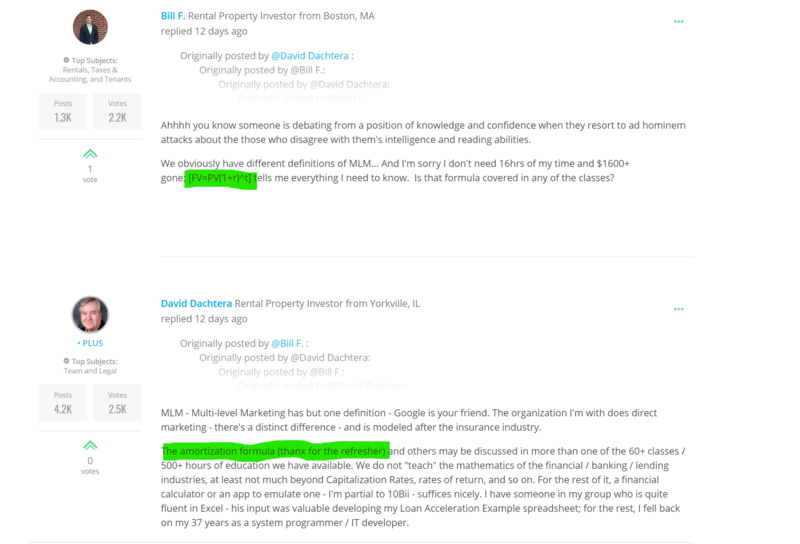
The formula I posted, [FV=PV*(1+r)^n)] is the time value of money equation, the the foundation of all modern finance. No big deal.
The amortization formula AKA the Equated Monthly Installment formula is
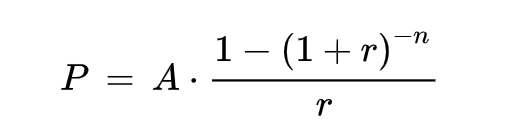
The former is how you do everything from calculate interest to figure out NPV and IRR. The latter is how you figure out a mortgage payment. Slightly different.
I've never argued that those who use Velocity Banking don't save money on interest. What I have argued is that it isn't velocity banking that saves them money, it is the principle repayment.
Thank you for finally admitting that position is correct. I appreciate you saw the error in your ways and have turned toward the light. I can only hope that this is your Road to Damascus moment and that from now on you will forsake the evil ways of Velocity Banking for the good news of simple, pure, principle repayment.
You are in no danger of me taking any of your advice about velocity banking, especially since you don't even recognize the time value of money formula.
We get it, you never specifically said "Fixed term conventional mortgages can be called for no reason", you just implied it with your statement "Your first lien will likely get called first." Since the vast majority of people who will use velocity banking will have first liens that are fixed term conventional mortgages. Technically you are not wrong about this, Kudos for using equivocation and definitional retreat to always "be right".
Lets circle back to the important question: which can get frozen a conventional mortgage or a HELOC?
"you don't even recognize the time value of money formula"
Excuse me? Where did that come from? ... or is that YOUR latest attempt to "be right", which you seem to desperately need.
So, go ahead - be right: it's all BS, and all those people saving thousands in interest using VB to pay off their loans early are just a bunch of losers doing stuff that doesn't work because it's all mumbo-jumbo and nonsense.
You're right - 100% correct! Have a Great life!
You are excused. It came from this very thread David:
The formula I posted, [FV=PV*(1+r)^n)] is the time value of money equation, the the foundation of all modern finance. No big deal.
The amortization formula AKA the Equated Monthly Installment formula is
The former is how you do everything from calculate interest to figure out NPV and IRR. The latter is how you figure out a mortgage payment. Slightly different.
I've never argued that those who use Velocity Banking don't save money on interest. What I have argued is that it isn't velocity banking that saves them money, it is the principle repayment.
Thank you for finally admitting that position is correct. I appreciate you saw the error in your ways and have turned toward the light. I can only hope that this is your Road to Damascus moment and that from now on you will forsake the evil ways of Velocity Banking for the good news of simple, pure, principle repayment.
Exactly, this is boiled down to one simple concept. Saving money and paying off loans faster only happens through principal repayment. It can be mathematically proven.
... and NO ONE has said otherwise.
We've already seen at least two mistaken impressions of what Velocity Banking is thought to be.
I'd be curious to know what others think it is and what your level of experience with it is, as well.
Did You Know ...
Yes, saving on interest and accelerating payoffs happens through applying additional principal. What we here in the U.S. call "Velocity Banking" is taught as part of basic Personal Financial Management education in multiple countries around the world. It's a methodology for planning and managing debt repayment and acceleration to help people make the best use of their discretionary income to achieve those goals taking their entire financial picture into account. There's no "magic" to it, no "smoke and mirrors", no "guru" nonsense or any of that. Just simple, proven methods for managing personal cash flow to achieve debt repayment and acceleration goals.
If that was a revelation to you, please share your thoughts on what you thought it is.
@Wayne Brooks. Thanks WAYNE. Is it actually paying more or just shifting the debt to a different type of interest?
These guys turned your thread into a mess, but I can explain this pretty simply for you. By putting a small ($5-$10K) portion of your mortgage on a HELOC / PLOC and treating it essentially like a checking account you are able to put ALL of your extra "checking" funds against your mortgage at all times. The money you DON'T use toward bills permanently brings your total mortgage balance down and the money you DO use toward bills temporarily holds the balance down sort of "leaning" on your mortgage balance until you need it. You can't do all that just by "paying extra principal" each month.
But here's the thing people never get about this. The average person pays around $20K in interest in order to pay down $10K worth of principal on the mortgage, because when paying by the amortization schedule you are paying interest on the entire loan. When you put the same $10K on your HELOC you're paying almost all principal instead of paying $20K in interest. That's the main difference. Now these guys are right that you can "just pay extra principal without the HELOC", but here's the question - do you have $10K to do that every six months or so? I think most people will say a big fat hell no to that. THAT'S THE POINT OF USING THE HELOC TO DO IT. You're using the HELOC to set up a portion of your mortgage that you can attack by 99% principal and around the clock every day of the month, not just when you realize you have some extra money lying around. These are all massive differences.
I can tell you for a fact that it works, because I use it. My original mortgage docs say that my mortgage balance should be $290K this month, but it's actually $236.5K. I've been able to put $53.5K extra toward my mortgage over 2 years with this strategy. Not skipping lattes or scraping money together every month to do it, just automatically through this strategy. You were asking about a debit card and all that. I don't think that's available, but you should be using a cash back credit card for all of your spending, anyway, not a debit card. Then you pay off the credit card once a month just like your other bills. It's not the easiest thing ever to manage, but I'm saving so much interest (I think in the range of $100K when I worked it out one time before) and shaving like 20 years off my mortgage, so I'll make the effort. Good luck!
I can tell you for a fact that it works, because I use it. My original mortgage docs say that my mortgage balance should be $290K this month, but it's actually $236.5K. I've been able to put $53.5K extra toward my mortgage over 2 years with this strategy.
And your HELOC balance is currently at $0?
Nobody is disputing the fact that this "strategy" works. We're disputing the perceived advantages over simply paying more principal every month (or however frequently you want to).
No, that's a fair point, I still have a balance on the HELOC - maybe $12K or so, but I don't really count that. If/when I don't have my mortgage payment I can pay that off in no time.
Well, everyone likes to talk about opportunity costs on this site, so from that standpoint alone, yes, this strategy has advantages over saving all month long (or for a few months or whatever) AND THEN putting money on the mortgage. I mean, think about the differences. In one scenario you're twiddling your thumbs waiting for money to pile up so you can pay some extra principal toward the mortgage. In the other scenario I've isolated a portion of my mortgage where I can attack the principal with everything that's in my checking account and all my income all month long. I understand why people compare the two, because it's EASIER to say that they'll just throw some extra money on their mortgage, but there's really no comparison, tbh. I move $10-$15K over to my HELOC saving myself around $20K off of the mortgage, pay the HELOC down over time which costs about $1000, and then I do it again. Paying $500-$1000 extra here or there when it's comfortable is technically doing the same thing, but it's like the difference between throwing a bullet and shooting one.
of course it feels nice to be able to throw tens of thousands on your principal and feel good about it, but it's not free money, not even close. here's a great file you can use to run various scenarios and see for yourself what, if any, velocity you're getting (devoid of emotion): https://www.biggerpockets.com/...
Sorry, Victor, but whatever you do with your money is a waste, because there are always better investments out there. You don't own the Yankees or 100% of Coca-Cola or Wal-Mart, so whatever you throw your tens of thousands on is a waste. Definitely not free money. I mean, look at all the money you're leaving on the table by not owning 5 NBA teams. Geez, buddy, time to rethink your strategy, huh?
Now if you want to keep comparing "investments", then you can obviously see that you lose. But if you want to discuss the best way to pay off your mortgage with money that's just sitting in your checking account ROTTING AWAY AND NOT INVESTED IN ANYTHING RIGHT NOW, then let me know. Later.

@Victor S. The original question that was posted was "Does Velocity Banking Work?". It was not asking for an opinion on the merits of paying down equity on a home. I find that when people are losing an argument, they like to change the subject. @Joshua S. did a great job explaining the strategy and proving that "velocity banking" does, in fact, work. Though I know that the debate will continue ;)
Whether or not it makes sense to pay down the equity has been beat to death in other threads.
except for there is no gained velocity vs simply adding extra pmts to your principal, as demonstrated in the spreadsheet i've linked in my post above. second post in this thread by @Wayne Brooks had succinctly summarized this whole debate into once sentence.
Maybe I'm missing it, but where is the spot in the spreadsheet about your income holding your mortgage balance down for part of the month until you need the money for bills? The HELOC / velocity strategy is to put all of your income on your mortgage, which brings down your average daily balance (and saves you on interest) until you need it.
I'm going to stop here and break that down step by step, because people either don't understand it or aren't listening or something.
Let's say you make your first payment from the HELOC to the mortgage and now your HELOC balance is $10K.
Now you get a paycheck and you put the whole thing on the $10K and your new balance is $7K.
Couple weeks go by and you get another paycheck and your new balance is $4K.
Now bills start coming in - pay the mortgage, pay the car, pay the cell, etc. - now your balance ends up at $9K for the month.
All total you took $1K off of the balance of the HELOC for the month (that's your disposable income), BUT you only pay interest on the average daily balance. That would be $7.5K NOT $9-$10K like someone who's making a lump sum payment to principal.
So, you're concerned with the differences vs just paying extra principal.
Difference #1: My money is on my mortgage balance all month long while you make a lump sum payments. Time is in my favor. The faster you pay off the principal the more you save.
Difference #2: I'm paying interest on a smaller balance than you are, so I'm saving more vs making lump sum payments. The amount is in my favor. You're paying interest on your entire balance and I'm using my income to hold the balance down, so I will pay less interest.
Difference #3: Because I'm paying less interest and paying principal faster, I'm also able to put MORE toward principal than you are over time. For example, in the first month because of my advantages I'm now ahead of you in the following month - let's say it's a small amount like $25 or something - that means my balance is $25 lower than yours. Obviously, since my balance is lower I'm paying even less interest than you are and able to put even more toward principal faster the following month and my advantage grows like that every month.
Where is any of this information in the spreadsheet? Am I missing it or is it just a part of the strategy you don't understand and haven't accounted for?
@Victor S. The original question that was posted was "Does Velocity Banking Work?". It was not asking for an opinion on the merits of paying down equity on a home. I find that when people are losing an argument, they like to change the subject. @Joshua S. did a great job explaining the strategy and proving that "velocity banking" does, in fact, work. Though I know that the debate will continue ;)
Whether or not it makes sense to pay down the equity has been beat to death in other threads.
except for there is no gained velocity vs simply adding extra pmts to your principal, as demonstrated in the spreadsheet i've linked in my post above. second post in this thread by @Wayne Brooks had succinctly summarized this whole debate into once sentence.
To clarify my last post, because my HELOC average daily balance is $7.5K, my total mortgage balance would be $97,500 that month.
Your balance would be $100K (or $99K if you want to suppose that you know what your disposable income is and pay it up front every month).
At 4%, I would pay $325 that month and you would pay $330-$333. A smaller difference than I had guessed, but it grows each month because I'm always paying less and less interest and more and more principal, which accelerates my results vs paying lump sum payments. Any of this accounted for?
the model, as presented in that spreadsheet, does not account for average daily balance. The stipulation was: "This simulates a person depositing their Monthly Income into the line of credit at the beginning of the month, paying Monthly Non-PI Expenses via a credit card, then using the line of credit to pay off the credit card AND the Monthly Loan Payment at the end of the month." The difference between heloc interest on $7.5k and $10k at 4% is a little over $8. Typically helocs carry a higher interest rate than your morgage and are variable in nature. What we're experiencing right now isn't a typical environment (my heloc rate is 3.75% currently). How would you model for interest rates that increase in the future? (not saying they will, but it is a possibility) Or how would you model for having more expenses for months where you daily average balance grows quite a bit? Obviously, an Excel model can't account for all these variables (or can it? throwing a challenge out there).
In your example, you say "At 4%, I would pay $325 that month and you would pay $330-$333." Does that include your heloc interest due on your balance and what heloc % are you using? I also don't know what principal amount you're basing those numbers on, as your typical mortgage payment stays fixed for the entire duration.
I might take a crack at doing a model with the average daily balance, but we'd have to make some of our assumption static (like heloc interest rates, not ever having an emergency, etc.). Again, I'm not saying this "strategy" doesn't work, but it shouldn't be this hard to show its alleged benefits vs simply paying more towards your mortgage monthly (maybe even daily, even you want to get this nuanced).
You'll have to correct me if I'm wrong, but here's how I see it working out. Let's say you and I have $200K @ 4% loans that started today. We both have the same $1K disposable income - in fact we have the same job and bills and everything. We're twin brothers, but I'm doing the velocity thing and you're paying extra principal via lump sum.
My balances are $190K and $10K. Yours is $200K.
We get a paycheck today. Mine brings me down to $190K and $7K. Yours goes into your checking account.
We get a paycheck in two weeks. Mine brings me down to $190K and $4K. Yours goes into your checking account.
Bills start to come in - mortgage, car, cell, electricity, etc. - my balances go up to $190K and $9K. Your checking account is $1K higher vs last month and you use it to make an extra principal payment.
My average daily balance on the HELOC (which is at 5%, btw) is $6.66K (part of the month at $7K / $4K / $9K divided by 3) and I get charged $27.77 ($6.66 ADB x .05 / 12) for that month. My mortgage interest on the $190K is $633.33 so I have a total of $661.10 in interest charges for the month. Your interest charges on the $200K are $666.66.
So, obviously, that's not a lot, but in one month I've saved $5 more than you've saved, but we are both supposedly doing the same thing - "paying extra principal".
Your month 2 balance is $198,711.84 ($199,711.84 minus the extra $1K you put on principal). You'll pay $663.37 in interest.
My month 2 balance is $189,706.84. Same as yours except $9K lighter, obviously, and minus the $5 I saved on the first month's interest, because that goes to my principal. I will pay $632.35 on my 4% loan and the average daily balance on the 5% HELOC is $5.66K (same as before except $1K less, obviously). That's $23.60 in interest. With my $632.35 that's a total of $655.95. This month I beat you by $7.42. Again, not a lot, but that's also 48% more than just one month ago.
So, after just a month or two I'm saving a little bit more than you because I have a lower average daily balance. I'm also not factoring in the idea that you still have $5K in your checking account, for example, but my $5K can go on my mortgage, because I don't really need a checking account anymore. We each have emergency funds and investments, but my checking account balance can go on my mortgage and yours is waiting around to pay bills.
I'm no math wizard, so when you work out this average daily balance math I will be interested to see if my savings increases by 48% relative to yours every month. If that's the case after 6 months I'm paying $52 less to interest than you are ($5 from the first month x 1.48 x 6 months) and the advantage is exponential. That jibes with my early post where I explained that over two years I've put an extra $50K on my mortgage just by changing the way I'm paying it. People always say, "Big deal, you saved $5", but It's not the $5, it's the fact that money I save on interest goes on my balance and then I'm paying EVEN LESS INTEREST and so on. It's a snowball effect from having a smaller and smaller balance relative to the other guy who's just "paying extra principal". In other words, ANY ADVANTAGE I have is amplified, because whatever I save by having a lower average daily balance and emptying my checking account onto the mortgage means that everything I save on interest is going to principal and I'm that much further ahead next month. There's no way to compete with that just by paying extra principal.
Thought this horse was dead....
my conclusion after researching this quite a bit..... LOTS more work and discipline to make this work, and the questionable benefit over just paying extra principle is minimal at best and not even close to being worth it....hard pass...
@Victor S. The original question that was posted was "Does Velocity Banking Work?". It was not asking for an opinion on the merits of paying down equity on a home. I find that when people are losing an argument, they like to change the subject. @Joshua S. did a great job explaining the strategy and proving that "velocity banking" does, in fact, work. Though I know that the debate will continue ;)
Whether or not it makes sense to pay down the equity has been beat to death in other threads.
except for there is no gained velocity vs simply adding extra pmts to your principal, as demonstrated in the spreadsheet i've linked in my post above. second post in this thread by @Wayne Brooks had succinctly summarized this whole debate into once sentence.
Maybe I'm missing it, but where is the spot in the spreadsheet about your income holding your mortgage balance down for part of the month until you need the money for bills? The HELOC / velocity strategy is to put all of your income on your mortgage, which brings down your average daily balance (and saves you on interest) until you need it.
I'm going to stop here and break that down step by step, because people either don't understand it or aren't listening or something.
Let's say you make your first payment from the HELOC to the mortgage and now your HELOC balance is $10K.
Now you get a paycheck and you put the whole thing on the $10K and your new balance is $7K.
Couple weeks go by and you get another paycheck and your new balance is $4K.
Now bills start coming in - pay the mortgage, pay the car, pay the cell, etc. - now your balance ends up at $9K for the month.
All total you took $1K off of the balance of the HELOC for the month (that's your disposable income), BUT you only pay interest on the average daily balance. That would be $7.5K NOT $9-$10K like someone who's making a lump sum payment to principal.
So, you're concerned with the differences vs just paying extra principal.
Difference #1: My money is on my mortgage balance all month long while you make a lump sum payments. Time is in my favor. The faster you pay off the principal the more you save.
Difference #2: I'm paying interest on a smaller balance than you are, so I'm saving more vs making lump sum payments. The amount is in my favor. You're paying interest on your entire balance and I'm using my income to hold the balance down, so I will pay less interest.
Difference #3: Because I'm paying less interest and paying principal faster, I'm also able to put MORE toward principal than you are over time. For example, in the first month because of my advantages I'm now ahead of you in the following month - let's say it's a small amount like $25 or something - that means my balance is $25 lower than yours. Obviously, since my balance is lower I'm paying even less interest than you are and able to put even more toward principal faster the following month and my advantage grows like that every month.
Where is any of this information in the spreadsheet? Am I missing it or is it just a part of the strategy you don't understand and haven't accounted for?
Your explanation reveals a misunderstanding of how interest is calculated. Using your numbers, let's do the math on interest on $7500 in a HELOC versus $9000 on a mortgage. Let's assume the interest rate is 3% on both the HELOC and your primary mortgage:
Here is one months interest calculation for both:
$7,500 @ 3% for one month is $18.75
$9,000 @ 3% for one month is $22.75
Monthly savings in this scenario is $4. You are not going to pay your mortgage off years earlier by paying an extra $4 per month. Where the fast pay down occurs is through extra principal. It is the extra cash you throw towards your HELOC (or primary mortgage) that accelerates the mortgage.
The true advantage of this method is you "trick" yourself into paying extra principal by running a negative balance and continually trying to pay it off. If an individual has good self discipline, you could just pay an extra $500 or whatever per month and pay it off just as fast. The problem is people don't have self discipline. They see a positive balance in their bank account and want to spend it.
So yes it does work, but not in the way people claim it works. It can also work out worse if the interest rate on the HELOC is higher than your primary mortgage. Even with daily calculated balances, you could end up paying more if the HELOC interest rate is higher.
$7,500 @ 4% for one month is $25
$9,000 @ 3% for one month is $22.75
Changing the rate to 1% higher on the HELOC causes the interest go to be higher, even though the balance carried is lower. In this example, you pay more interest every month.
Hi, Joe. Hopefully this will help us get on the same page, because I'm not sure what we're missing. We both have $1K disposable income to pay extra to principal.
On a $200K mortgage @ 4% your interest on the first month is $666.67.
On a $190K balance @ 4% my interest on the first month is $633.33.
On a $7.5K balance @ 5% my interest on the first month is $31.25.
$633.33 plus $31.25 is $664.58. So, I've saved $2 vs your strategy in the first month even though the HELOC rate is slightly higher.
LOL at $2, right?
Second Month
Your new balance is $198,711.84 - just lifting this off of bankrate's amo calculator and subtracting $1K extra principal payment. Interest $662.37 this month.
My new balance is $189,709.84. Interest is $632.37.
My new HELOC ADB is of course $6.5K ($1K less than last month). Interest at 5% this month is $27.08.
$632.37 plus $27.08 is $659.45 total interest this month. Around $3 saved vs your strategy.
Third Month
Your new balance is $197,419.38. Interest this month is $658.06.
My new balance is $189,386.38 - notice, my tiny $2-$3 savings is coming off of my principal. It's small in the beginning, but that can add up over time. Interest this month $631.29.
My new HELOC ADB is of course $5.5K. Interest is $22.92.
$631.29 plus $22.92 is $654.21. Saved about $4 this month vs your strategy.
So, I think we can agree I'm saving a dollar more than you each month that goes by unless I'm doing something wrong with my math - let me know. So, 3 years in, for example, I'm saving $37/month (the first $2 plus a dollar for every month) more than you on interest and that's also being applied to my principal. Again, $37 is not going to buy you a car or anything, but it's still an advantage vs just paying extra principal. Actually, if you plug in $37/month extra principal into bankrate your savings is a little over $11K, so it kinda does buy you a car. I'm not starting that calculation 3 years in, but I don't think it needs to be exact for you to see my point. :)
The thing is, the spirit of this strategy is that you're supposed to be able to do it if money is tight and disposable income is at a minimum, so comparing it to someone who has an extra $1K to put on the mortgage every month is out of bounds, in my opinion, but I'm humoring you, because you don't seem to be able to see any difference. Anyway, even when comparing to paying the equivalent amount of extra principal this strategy has advantages. I'm also not factoring in the idea that if we both have $5K in our checking accounts, for example, mine goes straight on my principal which gives me a boost / head start and yours is in your checking account waiting to pay bills. I left that out so we could compare apples to apples, but it's still an important advantage you can't account for. That's not money I'm taking out of savings or investments or something, it's just coming out of my checking / spending money.
So, think about it this way. Your strategy is always going to net you X amount of savings, which is limited by your income minus your bills.
My strategy is going to net me X + Y + Z savings - my disposable income PLUS my savings from the strategy itself (that is also applied to the balance and will amplify the effect) PLUS whatever is in my checking account that gives me a head start. Of course I'm going to come out ahead - my few dollars of savings comes off of my principal and makes my strategy MORE EFFECTIVE as time goes on. You are left paying X amount every month. Anyway, I'm guessing you'll move the goalposts and say that the $1K/month would do better in an index fund or something, but hopefully I'm wrong and you'll admit that there are advantages that have nothing to do with magic or tricks or anything. It's the simple mechanism of saving a little and putting that toward the balance, subsequently saving MORE, and so on until it snowballs into a tangible result.
Just like politics nowadays.... you aren’t going to change anyone’s mind.... the math is the math. and you can dance around it and rationalize yourself to believe some form of alternate math as much as you want..... if YOU believe it works, then fine... run with it.... knock yourself out.....
As Joe pointed out.... the math between the 2 strategies is very close.... but the effort, discipline and logistics don't make it worth it.... all it takes is a small bump in the interest rate on the HELOC.... or the bank to call or freeze the HELOC (you know the bank can do that at any time right?) and it falls apart... tons of variables and effort doesn't justify its use..... but obviously NO ONE will convince your otherwise... so have at it
@Joshua S. Josh, looks like the biggest portion of your argument hinges on the average monthly balance, which is something I can't either prove or disprove. However, if you do go back to that model I've posted and plug $200k for loan amount, 4% interest, 30 year term. $5k monthly income, $3045.17 monthly non-mortgage expenses (leaves $1k disposable). Heloc at 5% with 10k to transfer and paycheck parking option as "yes". Also, adjust cell AA38 to $1k as your initial payment. According to the model, you will save $99,077 with the heloc option and $99,249 with the extra $1k of principal pmts monthly. 10.5 yrs to payoff with either scenario.
"
On a $200K mortgage @ 4% your interest on the first month is $666.67.
On a $190K balance @ 4% my interest on the first month is $633.33.
On a $7.5K balance @ 5% my interest on the first month is $31.25.
$633.33 plus $31.25 is $664.58. So, I've saved $2 vs your strategy in the first month even though the HELOC rate is slightly higher.
LOL at $2, right?
Second Month
Your new balance is $198,711.84 - just lifting this off of bankrate's amo calculator and subtracting $1K extra principal payment. Interest $662.37 this month.
My new balance is $189,709.84. Interest is $632.37.
My new HELOC ADB is of course $6.5K ($1K less than last month). Interest at 5% this month is $27.08.
$632.37 plus $27.08 is $659.45 total interest this month. Around $3 saved vs your strategy."
Actually, if you were to apply your savings ($1k) as your initial payment (since you're counting $10k from heloc as your baseline), your first month's interest would've been $663.33 (calced off $199k) and second month's $659.03, so slightly better than your heloc example. You can plug this into the model in the far right table. The model was setup to take into account your disposable income ($1k) + the initial payment, but i've kept only the $1k in row 38 as a starting point.
Again, we're pinching pennies here.
Sorry, Victor, but that's not honest. I didn't make a $10K payment out of my income at the word go, I simply moved the debt from one vehicle to another. That's not a head start, it's just the beginning of the strategy. Your strategy is to go all month doing nothing and then putting your disposable income on the mortgage, so own it. If you need to move the goalposts like that maybe it's a sign that your strategy isn't as good as mine. We both know that anyone who pays extra principal doesn't calculate how much they'll have down the road and do it up front, they do so WHEN THEY HAVE THE EXTRA MONEY AFTER EXPENSES.
Unfortunately, this is the kind of disingenuous goalpost moving that always happens in these conversations. It's crazy to me that people can't just say, "Wow, I guess you're right, I never thought about it that way". Mind boggling, actually. Later.
i mean if your strategy is threatened by $1k up-front payment from an alternative "strategy", i don't know...
"We both know that anyone who pays extra principal doesn't calculate how much they'll have down the road and do it up front, they do so WHEN THEY HAVE THE EXTRA MONEY AFTER EXPENSES."
but somebody using a heloc would simply load it up with those expenses, right? your heloc gets paid down with the left-over cash, so you're simply dragging the eventual payoff out into the future.
again, if you feel like this strategy lets you get ahead, great. i'm simply arguing there is really no tangible benefit in using a heloc vs simply adding extra payments to your principal, as demonstrated in this thread. good luck.
"i mean if your strategy is threatened by $1k up-front payment from an alternative "strategy", i don't know..."
You want to compare apples to apples and when I do that and prove the strategy has advantages you say you can't prove or disprove it (code for the fact that I'm right and you don't know what to say). Now you're saying, "No, no, in this example I make my payment UP FRONT... Yeah, that's what I meant!" You're inventing changes to the comparison to benefit your side of the argument. You might as well say that Spider-Man swings in and knocks me over so you can make your payment first. Have some respect for logic, for christ sake. How about I get laid off from my job as a giraffe semen collector the minute I make the first HELOC payment and you win because I have no income? Or how about you time travel and save the Titanic and use your presidential medal of honor to blind me and I accidentally send my payment to the north pole? You could at least be more creative / entertaining if you're just going to throw in random changes to cheat logic and try to save face.
"i'm simply arguing there is really no tangible benefit in using a heloc vs simply adding extra payments to your principal, as demonstrated in this thread."
You're simply arguing a point that I proved wrong and you are unwilling to admit it. Fixed it for you.
Me: "4 + 4 = 8"
You: "Well, I added one in ahead of time, so actually, 4 + 4 = 9"
Have a good one.
I'm not sure who you're trying to be all cute for with your stream of consciousness, but it ain't working on me. If you can drop $10k from your heloc as your first payment, why can't I do the same with my "strategy"? You haven't provided a compelling argument that your "velocity" strategy is even marginally better that simply paying additional principal payments.
"...you say you can't prove or disprove it (code for the fact that I'm right and you don't know what to say)..."
Do you work for CNN, by chance? The only thing I said I can't prove/disprove was your daily average balance that gets charged interest. C'mon, man!