Does Velocity Banking work????
Member since 2019 · 187 posts · 74 votes
Hey everyone ive been hearing about and researching VELOCITY BANKING alot lately. Seems too good to be true. Any of you experts have experience in this field and can confirm or deny? Thanks everyone!
Nick
Paying off a low interest mortgage instead of acquiring profitable assets is counter intuitive to creating wealth. It's a distraction, it's just creating a fancy name "Velocity Banking" and treating it like a magic wand without testing the financial math behind the whole philosophy. It's a gimmick
i was gonna say, how will this tie into covid situation... it's all gravy until that heloc gets called by the bank.
Your first lien will likely get called first.
To clarify, you are saying that if you have a first position mortgage and a HELOC on a property, the mortgage is more likely to get called first with the HELOC remaining unfrozen?
... and the answer is, as always, "It depends". Contact your lender about your own financial situation.
David, you said "Your first lien will likely get called first."
Did you mean by that statement that if you have a mortgage and a HELOC, on the whole, the mortgage is more likely to get called?
I am trying to clarify your position since your statement was unclear.
Why would it?
That's between you and your lender.
@NIcholas Hamel great question. I've learned quite a bit myself from following this thread.
Something to be careful about with whole life policies ...
"Level Premium" policies, especially, can be confusing. They're designed such that the cash value build up early in the policy term is expected to pay the deficit between the policy premium and the actual cost of insurance which rises as the insured ages. Check with your agent / broker if there are any concerns about using a whole life policy's cash value as a source of funding.
i was gonna say, how will this tie into covid situation... it's all gravy until that heloc gets called by the bank.
Your first lien will likely get called first.
To clarify, you are saying that if you have a first position mortgage and a HELOC on a property, the mortgage is more likely to get called first with the HELOC remaining unfrozen?
... and the answer is, as always, "It depends". Contact your lender about your own financial situation.
David, you said "Your first lien will likely get called first."
Did you mean by that statement that if you have a mortgage and a HELOC, on the whole, the mortgage is more likely to get called?
I am trying to clarify your position since your statement was unclear.
Why would it?
That's between you and your lender.
I don't know David, that's why I am asking you, the person who made the statement: "Your first lien will likely get called first."
So are you going to answer the question or continue to evade?
I don't know where you heard that but it is incorrect. The cash value in a policy is literally the policy owner saving up the death benefit for the insured over the course of their natural life expectancy. Taking that a little further, the rate of growth they use in their planning is a worst case assumption that is also known as "the Guaranteed Rate". Each year, the insurance company takes a little bit from the premium (or the cash value) and puts it into a pool to cover the expected mortality that year.
Yes, the cost of insurance rises as you get older. But the amount at risk to the insurance company is simultaneously decreasing.
This is what a minimally-funded, level death benefit policy looks like over time...
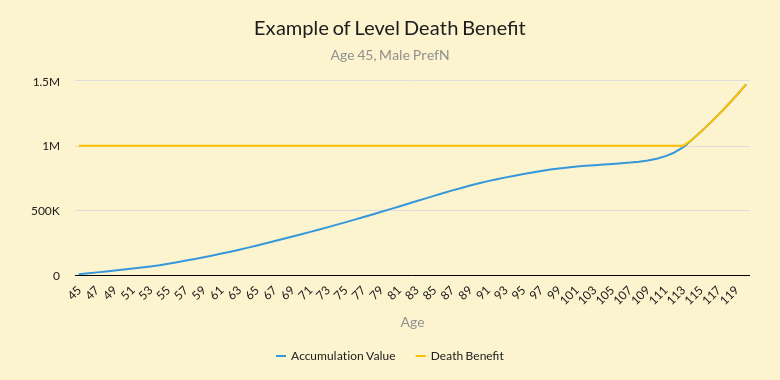
This is what your typical whole life or Guaranteed universal life policy looks like. it provides the maximum death benefit for the amount of Premium paid. Notice how the death benefit is pushed up when the cash value reaches it. The insurance company has an incentive for the cash value to perform as well as possible.
Real estate investors need a Maximum Over-funded policy with an increasing death benefit. That looks like this...
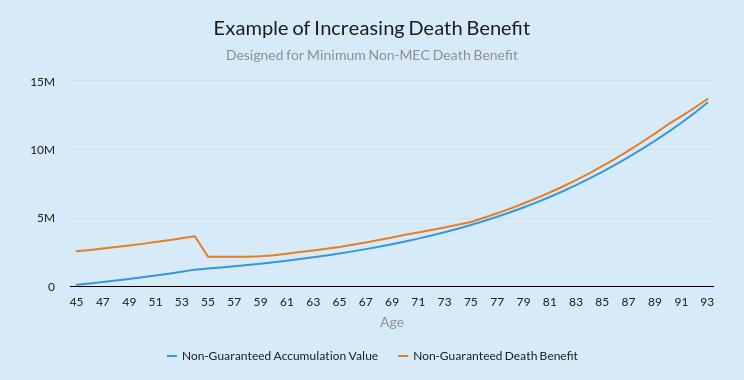
In this example, the policy is funded with 10 annual premiums of $100,000 per year. At the end of 10 years, the death benefit is reduced (to preserve the cash value and drive out mortality cost).
That tiny little sliver of risk between the cash value and the death benefit costs less than 0.25% of your cash value to maintain. At any age. Yes, the mortality cost is rising, but the net amount at risk to the insurance company is held to an absolute minimum.
Maximum over-funded policies are very efficient places to store wealth. When people talk about policies lapsing due to rising mortality costs, they are referring to minimally-funded policies, not the cash value monsters that real estate investors need to utilize.
Like I said Im not trying to get off topic. But @Thomas Rutkowski what do you mean where I heard what? I am using a Maximum Over-funded policy. I contribute for 11 years up to the MEC limit. I can borrow against the cash value to do whatever I like in this case to purchase more cash flow real estate deals. Since this is a private contract with you and your insurance carrier there is no public record, no DTI, no qualification, no showing up on your credit profile. I can pay the loan back on my schedule I set the terms. This is why I said I like infinite banking a bit more than velocity banking. For anyone that would like to learn more about this here is a link https://www.amazon.com/Becomin...
@Dirk Jackson - you mis-described how "level premium" policies work.
If you are using an infinite banking policy design, it is unlikely that it is a maximum over-funded policy design. They usually add in more death benefit than is necessary to leave room for you to add paid up additions later "paying yourself interest".
If you are leveraging the cash value for real estate investing, you want the policy stuffed full of paid up additions right from the start. More cash value = bigger bank. More dollars working in two places at one time.
You'll know if it was maximum over-funded by looking at your illustration. If the cash value to premium ratio isn't about 85%, its not designed for minimum non-MEC.
i was gonna say, how will this tie into covid situation... it's all gravy until that heloc gets called by the bank.
Your first lien will likely get called first.
To clarify, you are saying that if you have a first position mortgage and a HELOC on a property, the mortgage is more likely to get called first with the HELOC remaining unfrozen?
... and the answer is, as always, "It depends". Contact your lender about your own financial situation.
David, you said "Your first lien will likely get called first."
Did you mean by that statement that if you have a mortgage and a HELOC, on the whole, the mortgage is more likely to get called?
I am trying to clarify your position since your statement was unclear.
Why would it?
That's between you and your lender.
I don't know David, that's why I am asking you, the person who made the statement: "Your first lien will likely get called first."
So are you going to answer the question or continue to evade?
Did you read my answer (posted earlier)?
@Dirk Jackson - you mis-described how "level premium" policies work.
If you are using an infinite banking policy design, it is unlikely that it is a maximum over-funded policy design. They usually add in more death benefit than is necessary to leave room for you to add paid up additions later "paying yourself interest".
If you are leveraging the cash value for real estate investing, you want the policy stuffed full of paid up additions right from the start. More cash value = bigger bank. More dollars working in two places at one time.
You'll know if it was maximum over-funded by looking at your illustration. If the cash value to premium ratio isn't about 85%, its not designed for minimum non-MEC.
That was my description.
Be careful not to confuse level premium with level benefit.
Note also, that polices may differ between insurers.
i was gonna say, how will this tie into covid situation... it's all gravy until that heloc gets called by the bank.
Your first lien will likely get called first.
To clarify, you are saying that if you have a first position mortgage and a HELOC on a property, the mortgage is more likely to get called first with the HELOC remaining unfrozen?
... and the answer is, as always, "It depends". Contact your lender about your own financial situation.
David, you said "Your first lien will likely get called first."
Did you mean by that statement that if you have a mortgage and a HELOC, on the whole, the mortgage is more likely to get called?
I am trying to clarify your position since your statement was unclear.
Why would it?
That's between you and your lender.
I don't know David, that's why I am asking you, the person who made the statement: "Your first lien will likely get called first."
So are you going to answer the question or continue to evade?
Did you read my answer (posted earlier)?
Lets assume that I am a cretin who needs things explained to me Barney style and didn't comprehend the "answer" you posted earlier.
Can you please explain and elaborate to me/the greater BP community your statement "Your first lien will likely get called first."
FYI, I work from home now and things are slow, so I have all the time in the world. We can either get to the bottom of this quickly or I'll keep this up, with my cretin (which is what people who don't buy into Velocity Banking are, right?) like persistence, this charade for weeks. You pick.
Sorry @Victor S for blowing up your notifications.
@Wayne Brooks use the heloc as your first lien on your property so it replaces your mortgage.
i was gonna say, how will this tie into covid situation... it's all gravy until that heloc gets called by the bank.
Your first lien will likely get called first.
To clarify, you are saying that if you have a first position mortgage and a HELOC on a property, the mortgage is more likely to get called first with the HELOC remaining unfrozen?
... and the answer is, as always, "It depends". Contact your lender about your own financial situation.
David, you said "Your first lien will likely get called first."
Did you mean by that statement that if you have a mortgage and a HELOC, on the whole, the mortgage is more likely to get called?
I am trying to clarify your position since your statement was unclear.
Why would it?
That's between you and your lender.
I don't know David, that's why I am asking you, the person who made the statement: "Your first lien will likely get called first."
So are you going to answer the question or continue to evade?
Did you read my answer (posted earlier)?
Lets assume that I am a cretin who needs things explained to me Barney style and didn't comprehend the "answer" you posted earlier.
Can you please explain and elaborate to me/the greater BP community your statement "Your first lien will likely get called first."
FYI, I work from home now and things are slow, so I have all the time in the world. We can either get to the bottom of this quickly or I'll keep this up, with my cretin (which is what people who don't buy into Velocity Banking are, right?) like persistence, this charade for weeks. You pick.
Sorry @Victor S for blowing up your notifications.
Ok. Here's the earlier response again. Tell me which part you don't understand ...
(Repost)
... and the answer is, as always, "It depends". Contact your lender about your own financial situation.
(Edit)
Let me expand on that a bit, since you don't understand Velocity Banking ...
If your first position lien goes into default, it may very well be that your velocity account ((HE)LOC, etc.) is still receiving your payroll or other direct deposits and so is either still current or less behind than an inflexible first with a fixed payment amount.
So, yes - the first lien is more likely to be called than the second.
Hope that helps ...
(End Repost)
What part of that do you need help with?
@NIcholas Hamel the thing about a heloc is that you can use the extra money for emergency funds where as if you pour extra money into a mortgage the money is gone to the bank and you can’t get back. If you put $2000 extra on your heloc you can still have that available if needed for emergencies or assets. this is not the case with a mortgage.
@NIcholas Hamel the thing about a heloc is that you can use the extra money for emergency funds where as if you pour extra money into a mortgage the money is gone to the bank and you can’t get back. If you put $2000 extra on your heloc you can still have that available if needed for emergencies or assets. this is not the case with a mortgage.
A HELOC is a line of credit, so whey you say "if you put $2000 extra on your heloc you can still have it available", how is that any different than paying $2000 down on your mortgage and just using a HELOC, credit card, overdraft or any other line of credit as available funds? Once you make a payment towards your mortgage, from your HELOC, that money becomes locked up in the property. So whether you make a direct cash payment to the mortgage or it flows through the HELOC, makes no difference.
A line of credit is not an emergency fund. It is a line of credit. It is debt. An emergency fund is cash in a secure account, generally recommended to have 6 months expenses in an FDIC accounts.
The risk with HELOC is the bank can reduce your credit limit, freeze or close your account. This happened after the great recession and is likely to happen in the coming months. If you have no cash emergency fund, you would be in big trouble.
You DO understand the difference between a loan and a line of credit, right?
When you apply extra money to a loan, can you take that money back out when you need it?
Cash in reserve produces little or no return. Cash that you put to work, especially if you arbitrage, can produce a greater return than the cost of funds.
You may need to re-check the definition of "emergency". In that kind of a situation, do you REALLY care where the money comes from?
Nothing is without risk. Yes, if the economic situation goes far enough south (and it probably will), banks may return to cutting credit lines. Until then, you still have the available balance of that line in reserve.
Use the situation you have. Plan for the situation you may have.
i was gonna say, how will this tie into covid situation... it's all gravy until that heloc gets called by the bank.
Your first lien will likely get called first.
To clarify, you are saying that if you have a first position mortgage and a HELOC on a property, the mortgage is more likely to get called first with the HELOC remaining unfrozen?
... and the answer is, as always, "It depends". Contact your lender about your own financial situation.
David, you said "Your first lien will likely get called first."
Did you mean by that statement that if you have a mortgage and a HELOC, on the whole, the mortgage is more likely to get called?
I am trying to clarify your position since your statement was unclear.
Why would it?
That's between you and your lender.
I don't know David, that's why I am asking you, the person who made the statement: "Your first lien will likely get called first."
So are you going to answer the question or continue to evade?
Did you read my answer (posted earlier)?
Lets assume that I am a cretin who needs things explained to me Barney style and didn't comprehend the "answer" you posted earlier.
Can you please explain and elaborate to me/the greater BP community your statement "Your first lien will likely get called first."
FYI, I work from home now and things are slow, so I have all the time in the world. We can either get to the bottom of this quickly or I'll keep this up, with my cretin (which is what people who don't buy into Velocity Banking are, right?) like persistence, this charade for weeks. You pick.
Sorry @Victor S for blowing up your notifications.
Ok. Here's the earlier response again. Tell me which part you don't understand ...
(Repost)
... and the answer is, as always, "It depends". Contact your lender about your own financial situation.
(Edit)
Let me expand on that a bit, since you don't understand Velocity Banking ...
If your first position lien goes into default, it may very well be that your velocity account ((HE)LOC, etc.) is still receiving your payroll or other direct deposits and so is either still current or less behind than an inflexible first with a fixed payment amount.
So, yes - the first lien is more likely to be called than the second.
Hope that helps ...
(End Repost)
What part of that do you need help with?
Thank you for clarifying your position.
What is the mechanism of the bank calling a GSE conforming product? Resi mortgages can't, to the best of my knowledge, be called like commercial loans. So the statement "the first lien is more likely to be called than the second." Is incorrect.
Am I missing something here or does Velocity Banking require you to have a special mortgage that they only tell you about in the 16 hr class?
Now you can go into default on your first, but that will most likely allow the banks to call the HELOC, or at least freeze it.
That is the real worry with HELOCs that people brush aside; Banks can and will freeze HELOCs when it is in their best interest, unless you take certain specific steps, above and beyond, having the product active.
@NIcholas Hamel the thing about a heloc is that you can use the extra money for emergency funds where as if you pour extra money into a mortgage the money is gone to the bank and you can’t get back. If you put $2000 extra on your heloc you can still have that available if needed for emergencies or assets. this is not the case with a mortgage.
A HELOC is a line of credit, so whey you say "if you put $2000 extra on your heloc you can still have it available", how is that any different than paying $2000 down on your mortgage and just using a HELOC, credit card, overdraft or any other line of credit as available funds? Once you make a payment towards your mortgage, from your HELOC, that money becomes locked up in the property. So whether you make a direct cash payment to the mortgage or it flows through the HELOC, makes no difference.
A line of credit is not an emergency fund. It is a line of credit. It is debt. An emergency fund is cash in a secure account, generally recommended to have 6 months expenses in an FDIC accounts.
The risk with HELOC is the bank can reduce your credit limit, freeze or close your account. This happened after the great recession and is likely to happen in the coming months. If you have no cash emergency fund, you would be in big trouble.
You DO understand the difference between a loan and a line of credit, right?
When you apply extra money to a loan, can you take that money back out when you need it?
Cash in reserve produces little or no return. Cash that you put to work, especially if you arbitrage, can produce a greater return than the cost of funds.
You may need to re-check the definition of "emergency". In that kind of a situation, do you REALLY care where the money comes from?
Nothing is without risk. Yes, if the economic situation goes far enough south (and it probably will), banks may return to cutting credit lines. Until then, you still have the available balance of that line in reserve.
Use the situation you have. Plan for the situation you may have.
What a ridiculous response. Of course I understand the difference. Do you understand that in this scenario, whether the money flows through the HELOC or direct to the mortgage, the money can't be taken out of the mortgage?
Option 1:
$100,000 mortgage balance
$10,000 HELOC available credit, start with $0 balance
Pay $10,000 from HELOC to mortgage, resulting in $90,000 mortgage balance and $10,000 HELOC balance
Option 2:
$100,000 mortgage balance
$10,000 HELOC available credit, start with $0 balance
Pay $10,000 cash to mortgage, resulting in $90,000 mortgage balance and $0 HELOC balance
In BOTH situations, the money is trapped in mortgage pay down. Do you understand that? The only difference is that in Option 2, you have $10,000 available credit, versus Option 1 you have $0 credit and $10,000 cash. Total amount of equity trapped in mortgage is the same in either situation.
There is a major difference between cash and credit. Credit lines can be reduced or taken away. It happens in turbulent financial times - like we are in right now. If you have no income or are unemployed, companies will not give you credit and if you have no cash reserves, you are in trouble.
You say, "If the situation goes far enough south" - do you not understand the gravity of the current situation? Banks are already doing risk mitigation. It is going south quickly. I am not sure why you can't see what is happening.
i was gonna say, how will this tie into covid situation... it's all gravy until that heloc gets called by the bank.
Your first lien will likely get called first.
To clarify, you are saying that if you have a first position mortgage and a HELOC on a property, the mortgage is more likely to get called first with the HELOC remaining unfrozen?
... and the answer is, as always, "It depends". Contact your lender about your own financial situation.
David, you said "Your first lien will likely get called first."
Did you mean by that statement that if you have a mortgage and a HELOC, on the whole, the mortgage is more likely to get called?
I am trying to clarify your position since your statement was unclear.
Why would it?
That's between you and your lender.
I don't know David, that's why I am asking you, the person who made the statement: "Your first lien will likely get called first."
So are you going to answer the question or continue to evade?
Did you read my answer (posted earlier)?
Lets assume that I am a cretin who needs things explained to me Barney style and didn't comprehend the "answer" you posted earlier.
Can you please explain and elaborate to me/the greater BP community your statement "Your first lien will likely get called first."
FYI, I work from home now and things are slow, so I have all the time in the world. We can either get to the bottom of this quickly or I'll keep this up, with my cretin (which is what people who don't buy into Velocity Banking are, right?) like persistence, this charade for weeks. You pick.
Sorry @Victor S for blowing up your notifications.
Ok. Here's the earlier response again. Tell me which part you don't understand ...
(Repost)
... and the answer is, as always, "It depends". Contact your lender about your own financial situation.
(Edit)
Let me expand on that a bit, since you don't understand Velocity Banking ...
If your first position lien goes into default, it may very well be that your velocity account ((HE)LOC, etc.) is still receiving your payroll or other direct deposits and so is either still current or less behind than an inflexible first with a fixed payment amount.
So, yes - the first lien is more likely to be called than the second.
Hope that helps ...
(End Repost)
What part of that do you need help with?
Thank you for clarifying your position.
What is the mechanism of the bank calling a GSE conforming product? Resi mortgages can't, to the best of my knowledge, be called like commercial loans. So the statement "the first lien is more likely to be called than the second." Is incorrect.
Am I missing something here or does Velocity Banking require you to have a special mortgage that they only tell you about in the 16 hr class?
Now you can go into default on your first, but that will most likely allow the banks to call the HELOC, or at least freeze it.
That is the real worry with HELOCs that people brush aside; Banks can and will freeze HELOCs when it is in their best interest, unless you take certain specific steps, above and beyond, having the product active.
No, there is no "special mortgage". Learn about Velocity Banking or keep arguing from a place of not knowing. The choice is yours.
A loan can be "called" (get pedantic about definitions at your own peril) for a number of reasons, not the least of which would include Lis Pendens / Notice of Default, Due on Sale, failure to maintain insurance, universal default, ... Check your loan documents - never mind "what Dachtera said".
"Do you understand that in this scenario, whether the money flows through the HELOC or direct to the mortgage, the money can't be taken out of the mortgage?"
1. Show me where I said otherwise
2. Money doesn't "flow through" a (HE)LOC in this scenario.
I'll give you the same advice I gave Bill F. : "Learn about Velocity Banking or keep arguing from a place of not knowing. The choice is yours."
... and yes, I DO understand the gravity of our situation. I'm keeping the horse in front of the cart, where it belongs, for now.
i was gonna say, how will this tie into covid situation... it's all gravy until that heloc gets called by the bank.
Your first lien will likely get called first.
To clarify, you are saying that if you have a first position mortgage and a HELOC on a property, the mortgage is more likely to get called first with the HELOC remaining unfrozen?
... and the answer is, as always, "It depends". Contact your lender about your own financial situation.
David, you said "Your first lien will likely get called first."
Did you mean by that statement that if you have a mortgage and a HELOC, on the whole, the mortgage is more likely to get called?
I am trying to clarify your position since your statement was unclear.
Why would it?
That's between you and your lender.
I don't know David, that's why I am asking you, the person who made the statement: "Your first lien will likely get called first."
So are you going to answer the question or continue to evade?
Did you read my answer (posted earlier)?
Lets assume that I am a cretin who needs things explained to me Barney style and didn't comprehend the "answer" you posted earlier.
Can you please explain and elaborate to me/the greater BP community your statement "Your first lien will likely get called first."
FYI, I work from home now and things are slow, so I have all the time in the world. We can either get to the bottom of this quickly or I'll keep this up, with my cretin (which is what people who don't buy into Velocity Banking are, right?) like persistence, this charade for weeks. You pick.
Sorry @Victor S for blowing up your notifications.
Ok. Here's the earlier response again. Tell me which part you don't understand ...
(Repost)
... and the answer is, as always, "It depends". Contact your lender about your own financial situation.
(Edit)
Let me expand on that a bit, since you don't understand Velocity Banking ...
If your first position lien goes into default, it may very well be that your velocity account ((HE)LOC, etc.) is still receiving your payroll or other direct deposits and so is either still current or less behind than an inflexible first with a fixed payment amount.
So, yes - the first lien is more likely to be called than the second.
Hope that helps ...
(End Repost)
What part of that do you need help with?
Thank you for clarifying your position.
What is the mechanism of the bank calling a GSE conforming product? Resi mortgages can't, to the best of my knowledge, be called like commercial loans. So the statement "the first lien is more likely to be called than the second." Is incorrect.
Am I missing something here or does Velocity Banking require you to have a special mortgage that they only tell you about in the 16 hr class?
Now you can go into default on your first, but that will most likely allow the banks to call the HELOC, or at least freeze it.
That is the real worry with HELOCs that people brush aside; Banks can and will freeze HELOCs when it is in their best interest, unless you take certain specific steps, above and beyond, having the product active.
No, there is no "special mortgage". Learn about Velocity Banking or keep arguing from a place of not knowing. The choice is yours.
A loan can be "called" (get pedantic about definitions at your own peril) for a number of reasons, not the least of which would include Lis Pendens / Notice of Default, Due on Sale, failure to maintain insurance, universal default, ... Check your loan documents - never mind "what Dachtera said".
Words mean things David. Deal with it. Resi loans can't be called at the bank's discretion.
Due on Sale/Insurance are contractual obligation for a failure to perform and it does not automatically result in full repayment of a loan being due. Ready Fannie and Freedie's overlays. ( keep doing down this rabbit hole at your own peril; you could show the whole world how little you actually know about RE)
All of this missed the main point: the banks CAN and DO freeze and/or call HELOCs whenever they want. I know that because I have read those loan docs too. So how does velocity of banking deal with that?
I'll say what I've said before: check your loan documents. Never mind "what Dachtera said".
Economic situations resulting in banks taking adverse actions is outside the scope of Velocity Banking. If you'd learned about it, you would know that.
I'll say what I've said before: check your loan documents. Never mind "what Dachtera said".
Economic situations resulting in banks taking adverse actions is outside the scope of Velocity Banking. If you'd learned about it, you would know that.
Fixed term conventional mortgages cannot be called for no reason. Pretty much any HELOC can be modified to reduce limits or even close a line of credit. Even if a borrower is current and employed. Banks do it as an offensive action to reduce risk. It happened to many during the great recession.
The reason this pertains to velocity banking is someone could be using a HELOC for living expenses. That is what Velocity Banking is all about, instead of having cash reserves, using a line of credit to live off of. You (and others) have promoted the idea that a line of credit is identical to cash reserves. It is not the same. Please stop telling us to go to your two day seminar to learn all about it. We don't understand what you are saying because it doesn't make sense, not because of our comprehension skills.
NO ONE ever said Fixed term conventional mortgages can be called for no reason. Sorry. Actions banks may take are DEfensive, not OFfensive (regardless how WE may feel about them). Sorry.
NO! "Using a line of credit to live off of" is NOT what velocity banking is. Sorry.
NO ONE ever even intimated "that a line of credit is identical to cash reserves". Sorry.
EVERYTHING you don't understand "doesn't make sense" until you learn about it. Again, the choice is yours: continue to argue from a position of ignorance or learn what you need to know to make an intelligent comment / argument.
You are in no danger of me taking any of your advice about velocity banking, especially since you don't even recognize the time value of money formula.
We get it, you never specifically said "Fixed term conventional mortgages can be called for no reason", you just implied it with your statement "Your first lien will likely get called first." Since the vast majority of people who will use velocity banking will have first liens that are fixed term conventional mortgages. Technically you are not wrong about this, Kudos for using equivocation and definitional retreat to always "be right".
Lets circle back to the important question: which can get frozen a conventional mortgage or a HELOC?
"you don't even recognize the time value of money formula"
Excuse me? Where did that come from? ... or is that YOUR latest attempt to "be right", which you seem to desperately need.
So, go ahead - be right: it's all BS, and all those people saving thousands in interest using VB to pay off their loans early are just a bunch of losers doing stuff that doesn't work because it's all mumbo-jumbo and nonsense.
You're right - 100% correct! Have a Great life!