? Re depreciation length on STR roof replacement

? Re depreciation length on STR roof replacement

Jared CooperPro Member
Rental Property Investor · Scottsdale, AZ · Member since 2020 · 24 posts · 8 votes

Hi! I recently had a new roof replacement on my short-term rental (average stay under 30 days) and I would like to know the depreciation period for the roof? Is it 27.5 years or 39 yrs? I also had a recent cost segregation study performed and they had the roof components prior to the replacement at all 39 years. 

Also, if you can you please cite the correct source document and or IRS section that supports the 27 1/2 or the 39 year depreciation length? Thank you! 

1Reply
220 views

Most Popular Reply

Michael PlaksPro Member
Tax Accountant / Enrolled Agent · Houston, TX · Member since 2014 · 5k+ posts · 6k+ votes
7mo
Quote from @Jared Cooper:

Hi! I recently had a new roof replacement on my short-term rental (average stay under 30 days) and I would like to know the depreciation period for the roof? Is it 27.5 years or 39 yrs? I also had a recent cost segregation study performed and they had the roof components prior to the replacement at all 39 years. 

Also, if you can you please cite the correct source document and or IRS section that supports the 27 1/2 or the 39 year depreciation length? Thank you! 

Normal STRs require 7 days or less average stay. Under 30 but more than 7 require providing hotel-like services like daily cleaning. Otherwise you won't be able to apply your losses against your other income, and your entire cost seg game becomes almost pointless.

That said, roofs on STRs are 39 years, however eligible for an instant Sec 179 write-off. It's convoluted, so there is no simple code reference. Search this forum, the issue has been discussed in depth several times.

See this reply in the discussion

17 Replies

Jump to latestLatest
  • Michael PlaksPro Member
    Tax Accountant / Enrolled Agent · Houston, TX · Member since 2014 · 5k+ posts · 6k+ votes
    7mo
    Quote from @Jared Cooper:

    Hi! I recently had a new roof replacement on my short-term rental (average stay under 30 days) and I would like to know the depreciation period for the roof? Is it 27.5 years or 39 yrs? I also had a recent cost segregation study performed and they had the roof components prior to the replacement at all 39 years. 

    Also, if you can you please cite the correct source document and or IRS section that supports the 27 1/2 or the 39 year depreciation length? Thank you! 

    Normal STRs require 7 days or less average stay. Under 30 but more than 7 require providing hotel-like services like daily cleaning. Otherwise you won't be able to apply your losses against your other income, and your entire cost seg game becomes almost pointless.

    That said, roofs on STRs are 39 years, however eligible for an instant Sec 179 write-off. It's convoluted, so there is no simple code reference. Search this forum, the issue has been discussed in depth several times.

  • Jared CooperPro Member
    OP
    Rental Property Investor · Scottsdale, AZ · Member since 2020 · 24 posts · 8 votes
    7mo

    Thanks Mike that's what I also thought too (39 yrs.)

    I did finally come across the IRS pubs that seem to address the issue. 

    IRS Pub. 527
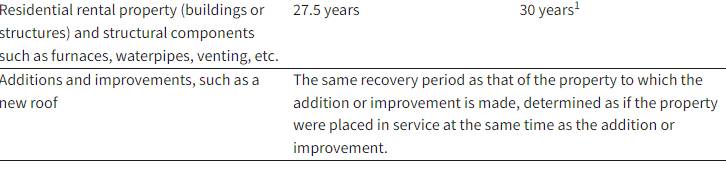

    IRS Pub. 946
    Residential rental property. This is any building or structure, such as a rental home (including a mobile home), if 80% or more of its gross rental income for the tax year is from dwelling units. A dwelling unit is a house or apartment used to provide living accommodations in a building or structure. It does not include a unit in a hotel, motel, or other establishment where more than half the units are used on a transient basis. (< than 30 days). 

  • Ashish AcharyaBusiness Member
    CPA, CFP®, PFS · FL · Member since 2017 · 5k+ posts · 3k+ votes
    7mo

    Hey Jared, I see you got this answered, but also wanted to mention that technically to be considered a short-term rental the average stay must be 7 days or less and the depreciation life depends on how the property is classified, not the stay length.

    If the property is treated as a short-term rental, then the roof is generally a capital improvement to rental property and depreciated over 39 years. If the property is long-term or mid-term (which it kind of sounds like what you might have if the average stay is over 7 days), then its 27.5, but if you truly have a short-term and you've already been depreciating it at this rate then it will probably stay at the rate you've been using.

    You can also look into Modified Accelerated Cost Recovery System MACRS (IRC §168), it’s the method the IRS allows businesses to depreciate tangible property over time.

    Best of luck with your investments and happy to connect!

    INVESTOR FRIENDLY CPA®5240 Reviews
    TaxMD® | Tax Planning Software
  • Jared CooperPro Member
    OP
    Rental Property Investor · Scottsdale, AZ · Member since 2020 · 24 posts · 8 votes
    6mo

    Thanks Ashish for your feedback. Yes we settled on 39 years for depreciation. 

  • Hinton, WV · Member since 2026 · 4 posts · 1 vote
    6mo

    @Jared Cooper 

    Michael makes a great point about the 7-day average stay requirement for non-passive treatment. If the average stay is between 7–30 days, you generally need to provide significant personal services (eg, cleaning) to avoid passive classification .

    On the depreciation point, it’s more nuanced than a simple 27.5 v 39 year. Under IRC 168(e)(2)(A), residential rental property generally requires that at least 80% of gross rental income is from dwelling units. There’s also a rule excluding units in establishments where more than half the units are used on a transient basis, but that test is most relevant in multi-unit contexts (eg hotels).

    For a single-unit STR, the key issue is typically whether the property is being operated as residential rental property or more like a lodging business. If it's more like a hotel that can support a 39 year classification. Otherwise, many STRs are still treated as residential rental property with a 27.5-year recovery period.

    That’s why the classification question matters so much. it affects the roof, the cost seg study, and the overall depreciation strategy. Definitely worth confirming with your CPA how the property is being treated on the return.

    A lot of cost segregation companies don't apply this level of nuance for STRs but I'm trying to model this carefully and specifically for STRs. 

    See more here: https://www.law.cornell.edu/uscode/text/26/168

  • CPA| New Clients Welcome| 50 States · Member since 2016 · 440 posts · 94 votes
    6mo

    @Jared Cooper, hi. Depreciation depends on classification: 27.5 years if treated as residential rental, 39 years if nonresidential. The key is how the STR is classified based on use. Supported by IRC §168(c) and IRS Pub 946. Worth reviewing your cost seg to confirm.


  • Jared CooperPro Member
    OP
    Rental Property Investor · Scottsdale, AZ · Member since 2020 · 24 posts · 8 votes
    6mo

    Thank you @Fulton Abraham Sanchez and "account closed" for your feedback. Yes, our guests stay on average < 7 night and we provide cleaning services and any additional cleaning request, or other personal requests. It seems like there was some confusion initially but I think we resolved it for now. 

  • Jason MalabuteBusiness Member
    Accountant · Los Angeles, CA · Member since 2016 · 2k+ posts · 907 votes
    6mo
    Hey Jared — lot of back and forth in this thread so let me try to simplify it. Since your average guest stay is under 7 days and you're providing cleaning services, your STR is treated as a lodging activity (basically like a hotel), which means the building and roof are classified as nonresidential real property with a 39-year life under IRC §168(e) — your cost seg company got that right. But here's the good news: because it's nonresidential, that roof replacement is eligible for a Section 179 deduction, meaning you can potentially expense the entire cost in the year you placed it in service instead of spreading it over 39 years. And if you're materially participating in the STR (which most hands-on operators with sub-7-day stays are), those losses aren't passive — so that Section 179 write-off on the roof could offset your W-2 or other active income directly. Talk to your CPA about running the numbers because the current-year savings could be significant.
    Malabute & Company CPAs525 Reviews
  • Accountant · Austin, TX · Member since 2016 · 72 posts · 72 votes
    6mo

    One important nuance to clarify here, the 27.5 years or 39 years depreciation class is determined based on whether the property has an average stay of 30 days or less, not 7 days or less.

    The 7-day rule to define a short-term rental (or 30 days with significant personal services) is a definition that is specific to section 469 (and you don't need to provide cleaning services if it's under 7 days average, that's a whole different subject).  But that same rules isn't used to determine whether the property qualifies for 27.5 or 39 year depreciation.  Tax code §168(e)(2)(A)(ii) specifies that the 27.5 residential rental property schedule doesn't apply to property that is used on a "transient basis". While section 168 does not clearly define transient basis, the tax courts have upheld that the tax code generally defines transient basis as an average stay of 30 days or less, including section 1.48-1(h)(2)(ii). This stance is also backed by the IRS in a Private Letter Ruling PLR-139827-07.

    Michael brought up a good point about the roof also qualifying for section 179 if it's a short-term rental, which is often overlooked. 

    David Orr
    Tax Modern

    • Michael PlaksPro Member
      Tax Accountant / Enrolled Agent · Houston, TX · Member since 2014 · 5k+ posts · 6k+ votes
      6mo
      Quote from @David Orr:

      One important nuance to clarify here, the 27.5 years or 39 years depreciation class is determined based on whether the property has an average stay of 30 days or less, not 7 days or less.

      The 7-day rule to define a short-term rental (or 30 days with significant personal services) is a definition that is specific to section 469 (and you don't need to provide cleaning services if it's under 7 days average, that's a whole different subject).  But that same rules isn't used to determine whether the property qualifies for 27.5 or 39 year depreciation.  Tax code §168(e)(2)(A)(ii) specifies that the 27.5 residential rental property schedule doesn't apply to property that is used on a "transient basis". While section 168 does not clearly define transient basis, the tax courts have upheld that the tax code generally defines transient basis as an average stay of 30 days or less, including section 1.48-1(h)(2)(ii). This stance is also backed by the IRS in a Private Letter Ruling PLR-139827-07.

      Michael brought up a good point about the roof also qualifying for section 179 if it's a short-term rental, which is often overlooked. 

      David Orr
      Tax Modern

      Actually, there is even more nuance and room for debate, although I do believe 39 yrs is the right answer.

      David quoted:
      ...doesn't apply to property that is used on a "transient basis"...


      Yes, but the phrase does not stop there. It continues:
      ...by a hotel, motel, inn, or other similar establishment.

      Whether a house used as an STR - and NOT providing hotel-like services - falls under this "similar establishment" definition could be debated. But not today. :)

  • JD, CCIM , Real Estate Broker · Tuscaloosa, AL · Member since 2014 · 1k+ posts · 1k+ votes
    6mo

    Did I misunderstand something? I thought all residential was 27.5 years. Which means roof is 27.5 years but also not eligible for cost seg or Section 179 write-off because structural. It is eligible for remaining life write-off in current year if partially replaced. Has something changed?

    • Accountant · Austin, TX · Member since 2016 · 72 posts · 72 votes
      6mo
      Quote from @Denise Evans:

      Did I misunderstand something? I thought all residential was 27.5 years. Which means roof is 27.5 years but also not eligible for cost seg or Section 179 write-off because structural. It is eligible for remaining life write-off in current year if partially replaced. Has something changed?

      Short-term rentals are considered non-residential, different depreciation classes apply to them.

      But if you haven't come across this before, that's not at all surprising. There are a lot of things about rentals and especially short-term rentals that unfortunately most tax pros don't know how to handle correctly. From what I've seen, I would say that at least 90% of tax pros don't know that short-term rental buildings are supposed to be depreciated over 39 years instead of 27.5. And probably 98% of tax pros don't know that Section 179 can be used for a roof for a short-term rental. When I review tax returns from other tax pros, I almost never see an STR with 39-year depreciation, and I don't think I've ever seen Section 179 used for a roof on someone else's tax return. I've never seen partial asset disposition of the old roof on someone else's tax return. It's also extremely rare to see a tax return with amortized loan costs from the purchase of the property. And it's pretty common to see short-term rentals on Schedule C that should be on Schedule E. And often STRs that qualify to be non-passive have losses reported as passive instead.

      There are a quite a few tax pros in this BiggerPockets forum that have experience with real estate and know all of these things, and most tax pros who specialize in real estate are also familiar with these things.  But most generalist tax pros who do most of the tax returns in the US have no idea how to do these things correctly, unfortunately. 

      David Orr

      Tax Modern

    • Michael PlaksPro Member
      Tax Accountant / Enrolled Agent · Houston, TX · Member since 2014 · 5k+ posts · 6k+ votes
      6mo
      Quote from @Denise Evans:

      Did I misunderstand something? I thought all residential was 27.5 years. Which means roof is 27.5 years but also not eligible for cost seg or Section 179 write-off because structural. It is eligible for remaining life write-off in current year if partially replaced. Has something changed?


       Short-term rentals have different rules

  • JD, CCIM , Real Estate Broker · Tuscaloosa, AL · Member since 2014 · 1k+ posts · 1k+ votes
    6mo

    Thanks, @David Orr, I absolutely did not know that. I appreciate the correction and explanation. And for the other items. I knew most of them already, but just never thought about packaging them together as a litmus test for accounting professionals to guide real estate investors. Please PM me with more information about yourself. People ask me for knowledgeable real estate accountants and I just don't have anybody I can recommend comfortably.

  • JD, CCIM , Real Estate Broker · Tuscaloosa, AL · Member since 2014 · 1k+ posts · 1k+ votes
    6mo

    Thanks. I get it. Short term rentals are like hotels, not residential. Makes perfect sense. I just never heard it or thought it through.

  • Basit SiddiqiBusiness Member
    Accountant · New York, NY · Member since 2015 · 8k+ posts · 3k+ votes
    5mo

    You may want to see if you can fully dispose of the old roof that was calculated by the old cost segregation study.

    Best of luck!

Join the conversationCreate a free account to reply, vote on answers and follow this thread.