Money in whole life insurance
Most Popular Reply
Scranton, PA · Member since 2017 · 168 posts · 137 votes
6yOriginally posted by @Brian G.:
@Shaun R. be careful, whole life is 15-20x more expensive than term for the same pay out upon death (ie death benefit) but they are usually structured so the *Insurance Company Keeps* the savings component of the policy upon your death that you’ve been paying extra to build up. It’s not an efficient financial product imo especially when you can borrow against better performing investments (ie retirement accounts, taxable brokerage accounts, etc.) Buy term insurance, save the difference and invest in something else with a better return. 4%? No thanks. Is there anyone who recommends whole life insurance policies besides insurance salesmen? Maybe a Financial Planner on BP can weigh in? I’ve heard they can serve a purpose for a very small % of very wealthy individuals but can’t remember how exactly.
Hey Brian, here’s a little clarity on some of the things you brought up:
1) fair warning I am a degenerate life insurance agent.
2) Whole Life is more expensive than term (albeit not generally 15-20 times - usually more like 4 times) for 2 reasons:
- It is guaranteed to pay out. Traditional term policies don’t get issued out past the age of 85 for a reason. That’s when the average person passes away. Over 95% term policies will never pay out. It is not the most cost effective way to get lifetime protection. There is a product called a GUL that offers the long term protection with reduced cash values for a savings in cost.
- Building cash value. Cash value is beneficial. Why buy stocks when options are less expensive? They’re different products for different purposes. There’s value in the extra money a stock brings.
3) Is it really more expensive? I’ve done the math before. The average life insurance client takes out 7 life insurance policies over the course of their lives. Comparing the cost of one 20 year term policy to one whole life policy isn’t honest. If you insure yourself from age 20-80 that’s 4 20 year policies. Before you say you’ll be self insured, my average clients age 60 and that person is most often looking for another 10-20 year term policy (most are surprised they can’t get an off the shelf 30 year).
If you’re healthy and young you can get $500k for around $30/month. You can’t if you’re 60. Someone age 60 looking for a term policy in average health will pay $380/month (it can cost much more depending on health). If you average that cost over the course of 60 years it works out to around $147,600. That is just cost. For something over 95% of people will never see a return on.
4) 4% guaranteed interest for a dividend earning WL policy is the minimum amount a policy will pay. WL companies with dividends find ways to pay competitive ones.
5) Life insurance is not primarily an investment. I didn’t liquidate my rentals to buy more WL. I promise, I’m here for more than just following around Joe Splitrock. I’m here because I’m an active real estate investor. Permanent life insurance is a hedge. What if I die? What if I get sick? What if I need supplemental income when I retire? You can take out as many IRAs and brokerage accounts as you want. They won’t pay a death benefit. You die tomorrow and your family only has what’s in the account- hopefully it’s not a bad year. Hopefully I had enough money to feed it. If I have partners hopefully my wife can afford to pay them off if she doesn’t want to work with them.
6) Most financial planners collect a commission. Their commission (unlike an insurance agent) is based on your assets managed. They make way more off investment accounts than they do life insurance. I had another agent tell me that a financial planner hired him to find out how to liquidate a clients life insurance policy. The agent explained it wasn’t in the best interest of the client, the financial planner told him he didn’t care - he just wanted the funds under management. They have just as much bias as an insurance agent if not more (unless they’re fee only - they’re still just sales people). Keep in mind during your CFP there are no classes on real estate. If an agent properly structures your policy for cash value accumulation they’re actually taking a significant discount on commissions.
Which begs another question- who learns the ins and outs of the life insurance business for free? I’ve read a lot of articles and listened to a lot of podcasts about life insurance by people who are not agents and every single one has had factual errors.
Yes, life insurance agents as well as financial planners, auto mechanics, lawyers, bartenders, real estate agents, property managers, doctors, and the guy at Best Buy are all sales people. These are people that are compensated for being experts at what they do. We’re no different. It takes a lot of work to be good at what I do. You can’t buy a life insurance policy without someone earning a commission. If I get arrested I’m not going to google a legal blog, I’m going to hire a lawyer. We are legally responsible for our recommendations that we make.
7) I don’t recommend WL to all of my clients. This might be surprising. When a client comes to me with a need my recommendation is based on the best interest of the client, not my commission. Strangely Enough people talk about the commissions on WL policies. I make way more money from term policies. Term insurance is a cash cow for insurance companies because it rarely gets used. The profits from that go to paying WL dividends. For clients that do get WL policies we maximize them for growing cash value A WL policy off the shelf doesn’t do that.
8) Life insurance companies steal your cash value - not completely true. A WL policy has two parts. Cash value and an insurance component. The policy is designed for the insurance component to pay the difference between your cash value amount and the death benefit. The policy would be more expensive if you wanted both. Like I said before, if you simply want a death benefit until age 121, there’s cheaper ways to do it.
9) You didn’t ask about taxes, but you invoked rich people and retirement accounts. Retirement accounts and specifically RMDs (especially for beneficiaries after a death) can cause real tax problems- God forbid you have a kid trying to find college when you pass and they have to take RMDs. The tax-free nature of life insurance policies. Wealthy people- life insurance is an easy way to transfer wealth.
10) I almost forgot- borrowing from retirement accounts and brokerage accounts. Assuming you're not trying to suggest someone can borrow from an IRA- the process is much easier from a life insurance policy, no required payment schedules, and you don't have the 50% borrowing limit. Borrowing from IULs can be incredibly inexpensive as well. Suggesting that IULs or WL policies have low growth is just not true. Lower returns than market investing? Sometimes, not all the time. WL and IULs don't lose money. Once you get paid a dividend the company can't take it back because they had a bad year the following year. Speaking of 4% guaranteed- where else can you get that kind of interest (assuming you forget about the additional dividend payments) guaranteed?
Hope that was helpful despite the fact I’m a good-for-nothing sales person. 😉
73 Replies
- 6yThomas RutkowskiPro MemberFinancial Advisor · Boynton Beach, FL · Member since 2015 · 834 posts · 798 votes
Originally posted by @Brian G.:
Originally posted by @John Perrings:
Originally posted by @Brian G.:
@Shaun R. be careful, whole life is 15-20x more expensive than term for the same pay out upon death (ie death benefit) but they are usually structured so the *Insurance Company Keeps* the savings component of the policy upon your death that you’ve been paying extra to build up. It’s not an efficient financial product imo especially when you can borrow against better performing investments (ie retirement accounts, taxable brokerage accounts, etc.) Buy term insurance, save the difference and invest in something else with a better return. 4%? No thanks. Is there anyone who recommends whole life insurance policies besides insurance salesmen? Maybe a Financial Planner on BP can weigh in? I’ve heard they can serve a purpose for a very small % of very wealthy individuals but can’t remember how exactly.
To add on to the good info Zachary posted.
If a 45 yr old makes payments of $290/mo for 20yrs on a $1M 20yr term policy and your cost of money is 4%, unless you die in that 20 yr term, the net compound cost of that term policy is $107,772 or -4%. It is a pure cost.
If a 45 yr old makes payments of $1,465/mo for 20yrs on a $1M whole life policy, and your cost of money is 4%, the 20yr compound cost of those payments is $544,439. But you will have $480,131 in cash value at the end of those 20yrs. The 20yr *net* compound cost is $64,308.
The payment is 5x higher (not 15-20x), but it was a 40% reduction in cost. All because this person had a permanent, guaranteed death benefit.
If someone takes $1 from their checking account and puts that $1 in their savings account, is that an expensive transaction? The same thing is happening with cash value life insurance. It's just that this particular "savings account" earns upwards of 40x over that of a bank, has creditor protection, is tax-deferred, and comes with death and disability protection baked-in.
Payment ≠ Cost
Hmmm...just pulled up a free quote from Zander Insurance on a 20 Year Term Life Insurance of $1M for a male age 45 and have multiple quotes for under $100/mo. Not sure why you used $290.
Pretty sure a simple investing calculator would tell me if I invested the difference of $1,365/mo ($1,465-$100 = $1,365) at a very reasonable rate of return I would have way more than $480k at the end of 20 years.
Setting that aside, I have a couple questions:
1) Is it true that whole life insurance policies are structured so that upon one's death, the death benefit is paid out but the cash value, ie "savings account" portion of the policy is forfeited by the deceased (kept by the insurance company)?
2) Are there other investing vehicles that also provide protection from creditors, are tax deferred and that you can borrow from/against?
3) Is this a product that you sell/recommend to all of your clients or just some of them and why?
Thanks for weighing in!
Brian - The cash value is quite literally the policy owner saving up the death benefit for the insured over their expected lifetime. So as the cash value increases over time, the net amount at risk to the insurance company goes down. To a certain extent, the insurance company is buying term and investing the difference. Only they can do it more efficiently than you can. They need to cover the delta between the cash value and the death benefit.
When the death benefit is paid, it is the sum of the cash value and the additional coverage provided by the company. If you have borrowed against you policy, the insurance company will pay off that loan from the death benefit and your beneficiary gets the remainder. The insurance company does not keep the cash value. That is a myth perpetuated by people who don't understand life insurance.
- Investor · HI · Member since 2017 · 328 posts · 124 votes6y
@Thomas Rutkowski I'm utilizing the WL strategy for REI. Wouldn't mind networking with others. All the best. Mike
- Realtor · Los Angeles, CA · Member since 2018 · 952 posts · 1k+ votes6y
Shaun, I'd be very skeptical of whole life insurance.
I did a deep, deep dive into whole life insurance (including index universal life) about two years ago when my father-in-law insisted I get a whole life policy. My father-in-law is very protective of his daughter, so I figured I had to -- and if not, I had to have danged good reasons why. So, I spent the better part of eight months talking to a wide variety of insurance salesmen, from the small-town old-timers to the "infinite banking" gurus, and here are a few of the things I learned:
- A lot of money goes to the salesperson's commission and the cost of the underlying product, the life insurance. So you might put $50K into your policy over the first few years, but your account will only be credited $40K or so. Sure, that $40K might earn a 4% return, but you invested $50K. The real return, in this hypothetical, is actually 3.2%. My father-in-law bragged about his $200K policy that was earning 7% a year, every year, but he's actually put a lot more money into that account than $200K.
- Insurance companies also pay a dividend, but how they derive it is totally opaque. A 6% dividend doesn't mean you earn a 6% return on your money; it means the insurance company earned/is paying out 6% of its investment account -- but no company discloses how big its investment account is. The insurance companies are basically saying, "This year, we had some amount of money that made 6%. We're not going to tell you how much money or how we made that return. But we'll disperse it, and it's up to you, if you're astute enough, to actually track how much money you've sent us, how much money is in your account, and what that return looks like." The insurance companies are correct that most people don't do the math.
- Whole-life policies are complicated instruments, and that complication allows for a lot of fees. There are fees all over the place. In short, you mail a check for $XXX every year, and some amount less than $XXX ends up in your account. Then the insurance company decides what return that less-than-$XXX will earn. There's no transparency.
- Whole life salesmen advertise these amazing advantages of whole life insurance as though they don't exist in any other vehicle. For example, salesmen tout the guaranteed return. As pointed out earlier, the guaranteed return is lower than advertised. More importantly, you can get a guaranteed return by buying an annuity. The annuity will be cheaper because it doesn't also include overpriced life insurance. If you want a modest guaranteed return, buy an annuity!
- Similarly, a big deal is made of the fact that you can access your policy via a loan. Firstly, if you want equity that you can access via a loan, you're better off putting a down payment into a home. You can borrow against the value of a home just as you can borrow against the value of a whole life policy; there's effectively no difference. It's no miracle of finance (it's certainly not "infinite banking") that you can borrow against equity with a whole life policy. Furthermore, the insurance company is going to charge you an interest rate of their choosing. You can't shop around for this loan because your only lender is the insurance company. So your money is still "at work," as they say, earning that 4%, but now you're paying 3.5% for the privilege of using it. In this hypothetical, your money's only earning 0.5%, and a lot of it has disappeared to commissions and fees.
- Another funny thing: my father-in-law would praise the insurance companies as being bedrocks of our economic system because they own huge buildings. "You know who owns the such-and-such building in Chicago? MetLife does. That's why I trust them with my money." Oh, boy... If you want the stability that comes with owning A+ real estate, buy shares of a REIT. You can own the Empire State Building by buying shares of the Empire State Realty Trust -- and you won't also be paying for life insurance!
Two points to close:
Whole life salesmen will show you a thirty-year projection of how much money you'll earn if you reinvest all of your dividends. It looks AMAZING -- but only a small fraction of that yield is guaranteed (about equivalent to keeping your money in an online savings account), and an index fund will perform better over thirty years. It will. And you can even borrow against an investment portfolio, too.
And, most importantly, don't fall for the baloney that this is what rich people do, that this is rich people's secret, that this makes you the bank. It doesn't. If you want guaranteed income, but an annuity. If you want to build equity, buy a house. If you want a safe and strong return, but an index fund. If you want life insurance to protect your spouse and kids, buy 25-year term insurance. If you want to overpay for a mediocre return from a vehicle that ties up your resources for years -- for the rest of your life, really -- buy a whole life policy.
Good luck!
- 6yThomas RutkowskiPro MemberFinancial Advisor · Boynton Beach, FL · Member since 2015 · 834 posts · 798 votes
Originally posted by @Jon Schwartz:
Shaun, I'd be very skeptical of whole life insurance.
I did a deep, deep dive into whole life insurance (including index universal life) about two years ago when my father-in-law insisted I get a whole life policy. My father-in-law is very protective of his daughter, so I figured I had to -- and if not, I had to have danged good reasons why. So, I spent the better part of eight months talking to a wide variety of insurance salesmen, from the small-town old-timers to the "infinite banking" gurus, and here are a few of the things I learned:
- A lot of money goes to the salesperson's commission and the cost of the underlying product, the life insurance. So you might put $50K into your policy over the first few years, but your account will only be credited $40K or so. Sure, that $40K might earn a 4% return, but you invested $50K. The real return, in this hypothetical, is actually 3.2%. My father-in-law bragged about his $200K policy that was earning 7% a year, every year, but he's actually put a lot more money into that account than $200K.
- Insurance companies also pay a dividend, but how they derive it is totally opaque. A 6% dividend doesn't mean you earn a 6% return on your money; it means the insurance company earned/is paying out 6% of its investment account -- but no company discloses how big its investment account is. The insurance companies are basically saying, "This year, we had some amount of money that made 6%. We're not going to tell you how much money or how we made that return. But we'll disperse it, and it's up to you, if you're astute enough, to actually track how much money you've sent us, how much money is in your account, and what that return looks like." The insurance companies are correct that most people don't do the math.
- Whole-life policies are complicated instruments, and that complication allows for a lot of fees. There are fees all over the place. In short, you mail a check for $XXX every year, and some amount less than $XXX ends up in your account. Then the insurance company decides what return that less-than-$XXX will earn. There's no transparency.
- Whole life salesmen advertise these amazing advantages of whole life insurance as though they don't exist in any other vehicle. For example, salesmen tout the guaranteed return. As pointed out earlier, the guaranteed return is lower than advertised. More importantly, you can get a guaranteed return by buying an annuity. The annuity will be cheaper because it doesn't also include overpriced life insurance. If you want a modest guaranteed return, buy an annuity!
- Similarly, a big deal is made of the fact that you can access your policy via a loan. Firstly, if you want equity that you can access via a loan, you're better off putting a down payment into a home. You can borrow against the value of a home just as you can borrow against the value of a whole life policy; there's effectively no difference. It's no miracle of finance (it's certainly not "infinite banking") that you can borrow against equity with a whole life policy. Furthermore, the insurance company is going to charge you an interest rate of their choosing. You can't shop around for this loan because your only lender is the insurance company. So your money is still "at work," as they say, earning that 4%, but now you're paying 3.5% for the privilege of using it. In this hypothetical, your money's only earning 0.5%, and a lot of it has disappeared to commissions and fees.
- Another funny thing: my father-in-law would praise the insurance companies as being bedrocks of our economic system because they own huge buildings. "You know who owns the such-and-such building in Chicago? MetLife does. That's why I trust them with my money." Oh, boy... If you want the stability that comes with owning A+ real estate, buy shares of a REIT. You can own the Empire State Building by buying shares of the Empire State Realty Trust -- and you won't also be paying for life insurance!
Two points to close:
Whole life salesmen will show you a thirty-year projection of how much money you'll earn if you reinvest all of your dividends. It looks AMAZING -- but only a small fraction of that yield is guaranteed (about equivalent to keeping your money in an online savings account), and an index fund will perform better over thirty years. It will. And you can even borrow against an investment portfolio, too.
And, most importantly, don't fall for the baloney that this is what rich people do, that this is rich people's secret, that this makes you the bank. It doesn't. If you want guaranteed income, but an annuity. If you want to build equity, buy a house. If you want a safe and strong return, but an index fund. If you want life insurance to protect your spouse and kids, buy 25-year term insurance. If you want to overpay for a mediocre return from a vehicle that ties up your resources for years -- for the rest of your life, really -- buy a whole life policy.
Good luck!
So using your own math:
If $50K went into premium, and we get $40,000 of cash value, we now have access to a line of credit of $40,000. 4% is the guaranteed rate, not the rate that the companies actually pay. Several companies are still paying over a 6% dividend. IULs can easily earn 6% annualized. This is the growth on the cash value and it can be clearly seen on your policy statements... at least for IULs. WL is more of a black box.
So let's say I can invest in a 12 month notes earning 10%. If I use my cash value line of credit to fund a $40,000 purchase and my loan rate is 5%, I am going to finish the year with $4000, right? I can deduct the interest, so my taxable income is $2000. If I'm paying a marginal tax rate of 40%, I'm paying $800 to the IRS and I'm left with a net gain of $1,200. If you combine the "side fund" gain with the dividend gain inside the policy, you have a total of $3600 of gain.
If you took your $50,000 and invested directly in the same notes, you would finish the year with $5000. At 40% tax, you would write a check to the IRS for $2000 leaving you with a net after tax income of $3000.
Do you see the difference?
Do you understand the power of compounding interest?
Would you rather have $50,000 growing at a net of 6%? or $40,000 growing at a net of 9%
I think its a no-brainer.
You made the case for life insurance all by yourself.
- 6yThomas RutkowskiPro MemberFinancial Advisor · Boynton Beach, FL · Member since 2015 · 834 posts · 798 votes
Originally posted by @Jon Schwartz:
Shaun, I'd be very skeptical of whole life insurance.
I did a deep, deep dive into whole life insurance (including index universal life) about two years ago when my father-in-law insisted I get a whole life policy. My father-in-law is very protective of his daughter, so I figured I had to -- and if not, I had to have danged good reasons why. So, I spent the better part of eight months talking to a wide variety of insurance salesmen, from the small-town old-timers to the "infinite banking" gurus, and here are a few of the things I learned:
- A lot of money goes to the salesperson's commission and the cost of the underlying product, the life insurance. So you might put $50K into your policy over the first few years, but your account will only be credited $40K or so. Sure, that $40K might earn a 4% return, but you invested $50K. The real return, in this hypothetical, is actually 3.2%. My father-in-law bragged about his $200K policy that was earning 7% a year, every year, but he's actually put a lot more money into that account than $200K.
- Insurance companies also pay a dividend, but how they derive it is totally opaque. A 6% dividend doesn't mean you earn a 6% return on your money; it means the insurance company earned/is paying out 6% of its investment account -- but no company discloses how big its investment account is. The insurance companies are basically saying, "This year, we had some amount of money that made 6%. We're not going to tell you how much money or how we made that return. But we'll disperse it, and it's up to you, if you're astute enough, to actually track how much money you've sent us, how much money is in your account, and what that return looks like." The insurance companies are correct that most people don't do the math.
- Whole-life policies are complicated instruments, and that complication allows for a lot of fees. There are fees all over the place. In short, you mail a check for $XXX every year, and some amount less than $XXX ends up in your account. Then the insurance company decides what return that less-than-$XXX will earn. There's no transparency.
- Whole life salesmen advertise these amazing advantages of whole life insurance as though they don't exist in any other vehicle. For example, salesmen tout the guaranteed return. As pointed out earlier, the guaranteed return is lower than advertised. More importantly, you can get a guaranteed return by buying an annuity. The annuity will be cheaper because it doesn't also include overpriced life insurance. If you want a modest guaranteed return, buy an annuity!
- Similarly, a big deal is made of the fact that you can access your policy via a loan. Firstly, if you want equity that you can access via a loan, you're better off putting a down payment into a home. You can borrow against the value of a home just as you can borrow against the value of a whole life policy; there's effectively no difference. It's no miracle of finance (it's certainly not "infinite banking") that you can borrow against equity with a whole life policy. Furthermore, the insurance company is going to charge you an interest rate of their choosing. You can't shop around for this loan because your only lender is the insurance company. So your money is still "at work," as they say, earning that 4%, but now you're paying 3.5% for the privilege of using it. In this hypothetical, your money's only earning 0.5%, and a lot of it has disappeared to commissions and fees.
- Another funny thing: my father-in-law would praise the insurance companies as being bedrocks of our economic system because they own huge buildings. "You know who owns the such-and-such building in Chicago? MetLife does. That's why I trust them with my money." Oh, boy... If you want the stability that comes with owning A+ real estate, buy shares of a REIT. You can own the Empire State Building by buying shares of the Empire State Realty Trust -- and you won't also be paying for life insurance!
Two points to close:
Whole life salesmen will show you a thirty-year projection of how much money you'll earn if you reinvest all of your dividends. It looks AMAZING -- but only a small fraction of that yield is guaranteed (about equivalent to keeping your money in an online savings account), and an index fund will perform better over thirty years. It will. And you can even borrow against an investment portfolio, too.
And, most importantly, don't fall for the baloney that this is what rich people do, that this is rich people's secret, that this makes you the bank. It doesn't. If you want guaranteed income, but an annuity. If you want to build equity, buy a house. If you want a safe and strong return, but an index fund. If you want life insurance to protect your spouse and kids, buy 25-year term insurance. If you want to overpay for a mediocre return from a vehicle that ties up your resources for years -- for the rest of your life, really -- buy a whole life policy.
Good luck!
So using your own math:
If $50K went into premium, and we get $40,000 of cash value, we now have access to a line of credit of $40,000. 4% is the guaranteed rate, not the rate that the companies actually pay. Several companies are still paying over a 6% dividend. IULs can easily earn 6% annualized. This is the growth on the cash value and it can be clearly seen on your policy statements... at least for IULs. WL is more of a black box.
So let's say I can invest in a 12 month notes earning 10%. If I use my cash value line of credit to fund a $40,000 purchase and my loan rate is 5%, I am going to finish the year with $4000, right? I can deduct the interest, so my taxable income is $2000. If I'm paying a marginal tax rate of 40%, I'm paying $800 to the IRS and I'm left with a net gain of $1,200. If you combine the "side fund" gain with the dividend gain inside the policy, you have a total of $3600 of gain.
If you took your $50,000 and invested directly in the same notes, you would finish the year with $5000. At 40% tax, you would write a check to the IRS for $2000 leaving you with a net after tax income of $3000.
Do you see the difference?
Do you understand the power of compounding interest?
Would you rather have $50,000 growing at a net of 6%? or $40,000 growing at a net of 9%
I think its a no-brainer.
You made the case for life insurance all by yourself.
@Thomas Rutkowski perhaps I’m misinformed. Are you saying when an individual dies with a Whole Life policy in place the beneficiary receives *both the total face value of the death benefit and the Cash Value* that has built up in the policy?
I was under the impression that the insured can *either* surrender their policy while alive and receive the Cash Value *or* their beneficiary can receive the Death Benefit after their passing. Is that not the case?
- Scranton, PA · Member since 2017 · 168 posts · 137 votes6y
Originally posted by @Jon Schwartz:
Shaun, I'd be very skeptical of whole life insurance.
I did a deep, deep dive into whole life insurance (including index universal life) about two years ago when my father-in-law insisted I get a whole life policy. My father-in-law is very protective of his daughter, so I figured I had to -- and if not, I had to have danged good reasons why. So, I spent the better part of eight months talking to a wide variety of insurance salesmen, from the small-town old-timers to the "infinite banking" gurus, and here are a few of the things I learned:
- A lot of money goes to the salesperson's commission and the cost of the underlying product, the life insurance. So you might put $50K into your policy over the first few years, but your account will only be credited $40K or so. Sure, that $40K might earn a 4% return, but you invested $50K. The real return, in this hypothetical, is actually 3.2%. My father-in-law bragged about his $200K policy that was earning 7% a year, every year, but he's actually put a lot more money into that account than $200K.
- Insurance companies also pay a dividend, but how they derive it is totally opaque. A 6% dividend doesn't mean you earn a 6% return on your money; it means the insurance company earned/is paying out 6% of its investment account -- but no company discloses how big its investment account is. The insurance companies are basically saying, "This year, we had some amount of money that made 6%. We're not going to tell you how much money or how we made that return. But we'll disperse it, and it's up to you, if you're astute enough, to actually track how much money you've sent us, how much money is in your account, and what that return looks like." The insurance companies are correct that most people don't do the math.
- Whole-life policies are complicated instruments, and that complication allows for a lot of fees. There are fees all over the place. In short, you mail a check for $XXX every year, and some amount less than $XXX ends up in your account. Then the insurance company decides what return that less-than-$XXX will earn. There's no transparency.
- Whole life salesmen advertise these amazing advantages of whole life insurance as though they don't exist in any other vehicle. For example, salesmen tout the guaranteed return. As pointed out earlier, the guaranteed return is lower than advertised. More importantly, you can get a guaranteed return by buying an annuity. The annuity will be cheaper because it doesn't also include overpriced life insurance. If you want a modest guaranteed return, buy an annuity!
- Similarly, a big deal is made of the fact that you can access your policy via a loan. Firstly, if you want equity that you can access via a loan, you're better off putting a down payment into a home. You can borrow against the value of a home just as you can borrow against the value of a whole life policy; there's effectively no difference. It's no miracle of finance (it's certainly not "infinite banking") that you can borrow against equity with a whole life policy. Furthermore, the insurance company is going to charge you an interest rate of their choosing. You can't shop around for this loan because your only lender is the insurance company. So your money is still "at work," as they say, earning that 4%, but now you're paying 3.5% for the privilege of using it. In this hypothetical, your money's only earning 0.5%, and a lot of it has disappeared to commissions and fees.
- Another funny thing: my father-in-law would praise the insurance companies as being bedrocks of our economic system because they own huge buildings. "You know who owns the such-and-such building in Chicago? MetLife does. That's why I trust them with my money." Oh, boy... If you want the stability that comes with owning A+ real estate, buy shares of a REIT. You can own the Empire State Building by buying shares of the Empire State Realty Trust -- and you won't also be paying for life insurance!
Two points to close:
Whole life salesmen will show you a thirty-year projection of how much money you'll earn if you reinvest all of your dividends. It looks AMAZING -- but only a small fraction of that yield is guaranteed (about equivalent to keeping your money in an online savings account), and an index fund will perform better over thirty years. It will. And you can even borrow against an investment portfolio, too.
And, most importantly, don't fall for the baloney that this is what rich people do, that this is rich people's secret, that this makes you the bank. It doesn't. If you want guaranteed income, but an annuity. If you want to build equity, buy a house. If you want a safe and strong return, but an index fund. If you want life insurance to protect your spouse and kids, buy 25-year term insurance. If you want to overpay for a mediocre return from a vehicle that ties up your resources for years -- for the rest of your life, really -- buy a whole life policy.
Good luck!
Glad you outsmarted the old man! A few inaccuracies here:
- part of those fees is obviously cost of insurance. You might not think so, but that is worth something.
- the Guaranteed interest I’m seeing off WL companies right now is ranging from 2.5-4%. If you have a bank that’s paying 4%, let me know!
- Dividends aren’t guaranteed, but Mass Mutual has consistently paid one since the Civil War. Companies find a way to pay them.
- Annuities don’t pay close to what dividend earning WL does over time. You’re looking at two separate products for two separate intended purposes.
- Borrowing money from your house is much more difficult and expensive than borrowing from a WL policy. An equity loan will obviously have fees and you have to be approved. WL loans must be approved if there’s cash available and it’s a straight interest loan. As you pointed out, the policy grows even while you have a loan out.
- Guaranteed interest is a big deal. On years where the market, housing, and incomes go down - that money still gets deposited. You probably don’t have the experience of going the 2008 and seeing 40% of your retirement accounts disappearing overnight.
- You never considered the benefit of all of this happening tax free.
- I understand. When you don’t have money you’re not worried about insurance or reducing taxes, or the security of guaranteed interest. This kind of product isn’t for everyone- it may not be for you. It doesn’t mean no one should have it. Either your father-in-law is the financial moron you think he is, or he’s seen the real changes that come about from his policy. Did you ever review his policy to see if it actually did well? - 6yThomas RutkowskiPro MemberFinancial Advisor · Boynton Beach, FL · Member since 2015 · 834 posts · 798 votes
Originally posted by @Brian G.:
@Thomas Rutkowski perhaps I’m misinformed. Are you saying when an individual dies with a Whole Life policy in place the beneficiary receives *both the total face value of the death benefit and the Cash Value* that has built up in the policy?
I was under the impression that the insured can *either* surrender their policy while alive and receive the Cash Value *or* their beneficiary can receive the Death Benefit after their passing. Is that not the case?
Brian - That's not what I'm stating at all. The cash value is part of the death benefit. For example, if you have a $1M death benefit and $500,000 of cash value, your beneficiary is going to get $1M. The insurance company is not keeping the cash value, the cash value will make up the first $500,000 of the death benefit and the "mortality costs" pay for the other $500,000.
As the cash value accumulates over time, the net amount at risk to the insurance company steadily and predictably declines. If you are 40 years old, for example, the "mortality cost" represents the amount of money that must be pooled in order to pay all of the expected claims on all of their 40 year insureds. So while the cost of insurance increases each year, the net amount at risk to the insurance company is declining over time. [So the myth that IULs are going to lapse due to rising mortality costs is just that, a myth. The mortality costs stay relatively constant as a percentage of cash value. Whole life companies work off of the same mortality tables.]
This graph shows the cash value and death benefit over time. The delta between the death benefit and the cash value is the net amount at risk to the insurance company. This also illustrates why a company who's cash value grows at a faster rate (i.e. an IUL) will actually have lower cost of insurance, not higher. The gap will be smaller because the cash value will close the gap with the death benefit faster. (Note: This is a Minimally-funded policy. i.e. what most people think of when they think of "Whole Life") This is not an example of an maximum over-funded policy design that you would use for leveraging into real estate.]
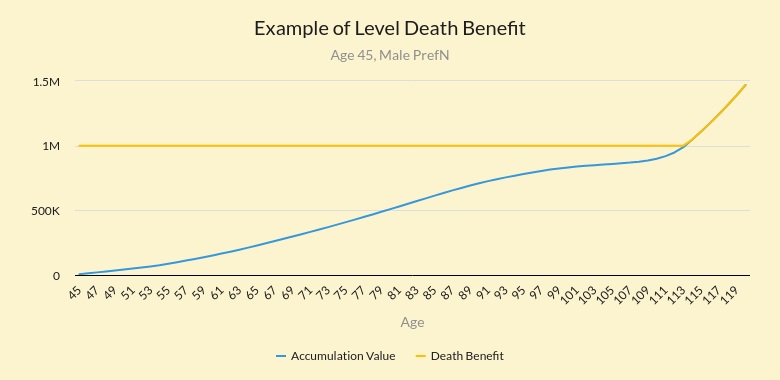
Given the same $1M policy, if you had taken out a policy loan for $500,000 on that $1M policy, your beneficiary would only receive $500,000. That's not because "the loans reduce the Death Benefit" as many people incorrectly state. The death benefit is still $1M ($500K of which is the cash value), but the loan must be satisfied. So the "net" death benefit received by the beneficiary is $500,000.
This is the proof that the insurance company does not keep the cash value, which is another popular myth constantly repeated by people who don't understand how life insurance works.
- Realtor · Los Angeles, CA · Member since 2018 · 952 posts · 1k+ votes6y
Originally posted by @Thomas Rutkowski:
Originally posted by @Jon Schwartz:
Shaun, I'd be very skeptical of whole life insurance.
I did a deep, deep dive into whole life insurance (including index universal life) about two years ago when my father-in-law insisted I get a whole life policy. My father-in-law is very protective of his daughter, so I figured I had to -- and if not, I had to have danged good reasons why. So, I spent the better part of eight months talking to a wide variety of insurance salesmen, from the small-town old-timers to the "infinite banking" gurus, and here are a few of the things I learned:
- A lot of money goes to the salesperson's commission and the cost of the underlying product, the life insurance. So you might put $50K into your policy over the first few years, but your account will only be credited $40K or so. Sure, that $40K might earn a 4% return, but you invested $50K. The real return, in this hypothetical, is actually 3.2%. My father-in-law bragged about his $200K policy that was earning 7% a year, every year, but he's actually put a lot more money into that account than $200K.
- Insurance companies also pay a dividend, but how they derive it is totally opaque. A 6% dividend doesn't mean you earn a 6% return on your money; it means the insurance company earned/is paying out 6% of its investment account -- but no company discloses how big its investment account is. The insurance companies are basically saying, "This year, we had some amount of money that made 6%. We're not going to tell you how much money or how we made that return. But we'll disperse it, and it's up to you, if you're astute enough, to actually track how much money you've sent us, how much money is in your account, and what that return looks like." The insurance companies are correct that most people don't do the math.
- Whole-life policies are complicated instruments, and that complication allows for a lot of fees. There are fees all over the place. In short, you mail a check for $XXX every year, and some amount less than $XXX ends up in your account. Then the insurance company decides what return that less-than-$XXX will earn. There's no transparency.
- Whole life salesmen advertise these amazing advantages of whole life insurance as though they don't exist in any other vehicle. For example, salesmen tout the guaranteed return. As pointed out earlier, the guaranteed return is lower than advertised. More importantly, you can get a guaranteed return by buying an annuity. The annuity will be cheaper because it doesn't also include overpriced life insurance. If you want a modest guaranteed return, buy an annuity!
- Similarly, a big deal is made of the fact that you can access your policy via a loan. Firstly, if you want equity that you can access via a loan, you're better off putting a down payment into a home. You can borrow against the value of a home just as you can borrow against the value of a whole life policy; there's effectively no difference. It's no miracle of finance (it's certainly not "infinite banking") that you can borrow against equity with a whole life policy. Furthermore, the insurance company is going to charge you an interest rate of their choosing. You can't shop around for this loan because your only lender is the insurance company. So your money is still "at work," as they say, earning that 4%, but now you're paying 3.5% for the privilege of using it. In this hypothetical, your money's only earning 0.5%, and a lot of it has disappeared to commissions and fees.
- Another funny thing: my father-in-law would praise the insurance companies as being bedrocks of our economic system because they own huge buildings. "You know who owns the such-and-such building in Chicago? MetLife does. That's why I trust them with my money." Oh, boy... If you want the stability that comes with owning A+ real estate, buy shares of a REIT. You can own the Empire State Building by buying shares of the Empire State Realty Trust -- and you won't also be paying for life insurance!
Two points to close:
Whole life salesmen will show you a thirty-year projection of how much money you'll earn if you reinvest all of your dividends. It looks AMAZING -- but only a small fraction of that yield is guaranteed (about equivalent to keeping your money in an online savings account), and an index fund will perform better over thirty years. It will. And you can even borrow against an investment portfolio, too.
And, most importantly, don't fall for the baloney that this is what rich people do, that this is rich people's secret, that this makes you the bank. It doesn't. If you want guaranteed income, but an annuity. If you want to build equity, buy a house. If you want a safe and strong return, but an index fund. If you want life insurance to protect your spouse and kids, buy 25-year term insurance. If you want to overpay for a mediocre return from a vehicle that ties up your resources for years -- for the rest of your life, really -- buy a whole life policy.
Good luck!
So using your own math:
If $50K went into premium, and we get $40,000 of cash value, we now have access to a line of credit of $40,000. 4% is the guaranteed rate, not the rate that the companies actually pay. Several companies are still paying over a 6% dividend. IULs can easily earn 6% annualized. This is the growth on the cash value and it can be clearly seen on your policy statements... at least for IULs. WL is more of a black box.
So let's say I can invest in a 12 month notes earning 10%. If I use my cash value line of credit to fund a $40,000 purchase and my loan rate is 5%, I am going to finish the year with $4000, right? I can deduct the interest, so my taxable income is $2000. If I'm paying a marginal tax rate of 40%, I'm paying $800 to the IRS and I'm left with a net gain of $1,200. If you combine the "side fund" gain with the dividend gain inside the policy, you have a total of $3600 of gain.
If you took your $50,000 and invested directly in the same notes, you would finish the year with $5000. At 40% tax, you would write a check to the IRS for $2000 leaving you with a net after tax income of $3000.
Do you see the difference?
Do you understand the power of compounding interest?
Would you rather have $50,000 growing at a net of 6%? or $40,000 growing at a net of 9%
I think its a no-brainer.
You made the case for life insurance all by yourself.
Thomas, you forgot to factor in that year's insurance premium. When you account for that, the annual totals are much closer.
- 6yThomas RutkowskiPro MemberFinancial Advisor · Boynton Beach, FL · Member since 2015 · 834 posts · 798 votes
Originally posted by @Jon Schwartz:
Originally posted by @Thomas Rutkowski:
Originally posted by @Jon Schwartz:
Shaun, I'd be very skeptical of whole life insurance.
I did a deep, deep dive into whole life insurance (including index universal life) about two years ago when my father-in-law insisted I get a whole life policy. My father-in-law is very protective of his daughter, so I figured I had to -- and if not, I had to have danged good reasons why. So, I spent the better part of eight months talking to a wide variety of insurance salesmen, from the small-town old-timers to the "infinite banking" gurus, and here are a few of the things I learned:
- A lot of money goes to the salesperson's commission and the cost of the underlying product, the life insurance. So you might put $50K into your policy over the first few years, but your account will only be credited $40K or so. Sure, that $40K might earn a 4% return, but you invested $50K. The real return, in this hypothetical, is actually 3.2%. My father-in-law bragged about his $200K policy that was earning 7% a year, every year, but he's actually put a lot more money into that account than $200K.
- Insurance companies also pay a dividend, but how they derive it is totally opaque. A 6% dividend doesn't mean you earn a 6% return on your money; it means the insurance company earned/is paying out 6% of its investment account -- but no company discloses how big its investment account is. The insurance companies are basically saying, "This year, we had some amount of money that made 6%. We're not going to tell you how much money or how we made that return. But we'll disperse it, and it's up to you, if you're astute enough, to actually track how much money you've sent us, how much money is in your account, and what that return looks like." The insurance companies are correct that most people don't do the math.
- Whole-life policies are complicated instruments, and that complication allows for a lot of fees. There are fees all over the place. In short, you mail a check for $XXX every year, and some amount less than $XXX ends up in your account. Then the insurance company decides what return that less-than-$XXX will earn. There's no transparency.
- Whole life salesmen advertise these amazing advantages of whole life insurance as though they don't exist in any other vehicle. For example, salesmen tout the guaranteed return. As pointed out earlier, the guaranteed return is lower than advertised. More importantly, you can get a guaranteed return by buying an annuity. The annuity will be cheaper because it doesn't also include overpriced life insurance. If you want a modest guaranteed return, buy an annuity!
- Similarly, a big deal is made of the fact that you can access your policy via a loan. Firstly, if you want equity that you can access via a loan, you're better off putting a down payment into a home. You can borrow against the value of a home just as you can borrow against the value of a whole life policy; there's effectively no difference. It's no miracle of finance (it's certainly not "infinite banking") that you can borrow against equity with a whole life policy. Furthermore, the insurance company is going to charge you an interest rate of their choosing. You can't shop around for this loan because your only lender is the insurance company. So your money is still "at work," as they say, earning that 4%, but now you're paying 3.5% for the privilege of using it. In this hypothetical, your money's only earning 0.5%, and a lot of it has disappeared to commissions and fees.
- Another funny thing: my father-in-law would praise the insurance companies as being bedrocks of our economic system because they own huge buildings. "You know who owns the such-and-such building in Chicago? MetLife does. That's why I trust them with my money." Oh, boy... If you want the stability that comes with owning A+ real estate, buy shares of a REIT. You can own the Empire State Building by buying shares of the Empire State Realty Trust -- and you won't also be paying for life insurance!
Two points to close:
Whole life salesmen will show you a thirty-year projection of how much money you'll earn if you reinvest all of your dividends. It looks AMAZING -- but only a small fraction of that yield is guaranteed (about equivalent to keeping your money in an online savings account), and an index fund will perform better over thirty years. It will. And you can even borrow against an investment portfolio, too.
And, most importantly, don't fall for the baloney that this is what rich people do, that this is rich people's secret, that this makes you the bank. It doesn't. If you want guaranteed income, but an annuity. If you want to build equity, buy a house. If you want a safe and strong return, but an index fund. If you want life insurance to protect your spouse and kids, buy 25-year term insurance. If you want to overpay for a mediocre return from a vehicle that ties up your resources for years -- for the rest of your life, really -- buy a whole life policy.
Good luck!
So using your own math:
If $50K went into premium, and we get $40,000 of cash value, we now have access to a line of credit of $40,000. 4% is the guaranteed rate, not the rate that the companies actually pay. Several companies are still paying over a 6% dividend. IULs can easily earn 6% annualized. This is the growth on the cash value and it can be clearly seen on your policy statements... at least for IULs. WL is more of a black box.
So let's say I can invest in a 12 month notes earning 10%. If I use my cash value line of credit to fund a $40,000 purchase and my loan rate is 5%, I am going to finish the year with $4000, right? I can deduct the interest, so my taxable income is $2000. If I'm paying a marginal tax rate of 40%, I'm paying $800 to the IRS and I'm left with a net gain of $1,200. If you combine the "side fund" gain with the dividend gain inside the policy, you have a total of $3600 of gain.
If you took your $50,000 and invested directly in the same notes, you would finish the year with $5000. At 40% tax, you would write a check to the IRS for $2000 leaving you with a net after tax income of $3000.
Do you see the difference?
Do you understand the power of compounding interest?
Would you rather have $50,000 growing at a net of 6%? or $40,000 growing at a net of 9%
I think its a no-brainer.
You made the case for life insurance all by yourself.
Thomas, you forgot to factor in that year's insurance premium. When you account for that, the annual totals are much closer.
I have no idea what you are talking about. Would you rather have $40,000 growing at 9% or $50,000 growing at 6%. That's what this all comes down to. The power of time and compounding interest.
I think its pretty simple and totally accounts for your $50,000 premium turning into $40,000 of cash value. Its not close at all. It will only take a few years for Life Insurance plus side fund value to cross over the alternative scenario.
Show me the numbers or where you think I'm wrong.
- Realtor · Los Angeles, CA · Member since 2018 · 952 posts · 1k+ votes6y
Zachary, I'm a glutton for pain for getting into forum arguments with insurance salesmen, but I wanted to respond to you points, quoted below in italics:
- part of those fees is obviously cost of insurance. You might not think so, but that is worth something.
Yes, but insurance is much more affordable if you're just buying the insurance -- ie, term life insurance.- the Guaranteed interest I’m seeing off WL companies right now is ranging from 2.5-4%. If you have a bank that’s paying 4%, let me know!
This is absolutely misleading. That percentage is not taking into account the cost of the insurance. I ran the numbers on an "infinite banking" policy that was generated for me and removed the dividend, so we were just looking at the guaranteed return. The actual IRR peaked at 2.32% in year 36. This was when Ally was offering 2.25% on its online savings account. Entirely comparable.
- Dividends aren’t guaranteed, but Mass Mutual has consistently paid one since the Civil War. Companies find a way to pay them.And I'm sure you're aware that dividends have been declining every year for well over a decade. Here's a screengrab from a 2018 report put out by The Insurance Pro Blog:

- Annuities don’t pay close to what dividend earning WL does over time. You’re looking at two separate products for two separate intended purposes.
They certainly do when you compare the actual costs. If you compare when an annuity costs and what it pays vs. what a whole life policy actually costs and what it guarantees, annuities are a preferable option.- Borrowing money from your house is much more difficult and expensive than borrowing from a WL policy. An equity loan will obviously have fees and you have to be approved. WL loans must be approved if there’s cash available and it’s a straight interest loan. As you pointed out, the policy grows even while you have a loan out.
This is a bunch of bunk, man. I got a $160K HELOC on my primary residence for a cost of $0. Yes, I had to be approved, but you argue that whole life policies are for people with money -- ie, the kind of people who don't have difficulty getting approved for a HELOC. And my home continues to appreciate even while I have the loan out, as I'm sure you're aware. Plus, when I decided I wanted that HELOC, I got to shop around for the rate and terms that benefited me most. On my specific HELOC, I have to pay interest and principle, but my rate is LIBOR -1%. I'm paying 2.24%! That's insane!
- Guaranteed interest is a big deal. On years where the market, housing, and incomes go down - that money still gets deposited. You probably don’t have the experience of going the 2008 and seeing 40% of your retirement accounts disappearing overnight.
I did. I was 26 years old and my retirement account was only $40K or so, but I watched my portfolio drop 40%. It was especially painful because I'd saved all of that money in the previous two years. But, as I'm sure you know, market volatility is fine early in a person's career. Are you suggesting somebody very near retirement would benefit from buying whole life insurance instead of an annuity?
- You never considered the benefit of all of this happening tax free.
The tax-free element is about all the whole life policy has going for it. I just don't think the juice is worth the squeeze.
- I understand. When you don’t have money you’re not worried about insurance or reducing taxes, or the security of guaranteed interest. This kind of product isn’t for everyone- it may not be for you. It doesn’t mean no one should have it. Either your father-in-law is the financial moron you think he is, or he’s seen the real changes that come about from his policy. Did you ever review his policy to see if it actually did well?
Firstly, to insure my family, my wife and I have term life policies totaling $5.5M ($2.5M for her and $3M for me as I earn a little more). Obviously, we'd never buy a whole life policy for this amount as the premium would be crushing.
Secondly, to reduce taxes, my wife and I both invest heavily in our SEP and Roth IRAs, mine through my C corp and hers through her LLC. I know these options aren't available to everybody, but to sell whole life insurance as the only tax mitigation strategy is baloney.
Thirdly, my father-in-law certainly isn't a financial moron, but I don't think he's right about whole life insurance. He did share the details of his policy when we discussed this in 2018 (as well as a screenshot of his policy page, which I won't share.) He opened a $50K convertible whole life policy in 1983. The annual premium is about $2500. The death benefit in 2018 was $340K, and the cash value was $115K. In 2018, the dividend was a little more than $7100. As my father-in-law put it, "The dividend is now more than $7100 which is a nice return on the $115,000 cash value." Those are his exact words from the email.
But I'm looking at the numbers and seeing that my father-in-law put $2500 into his policy for 25 years. If you put $2500 into an index fund earning, say, 7% annually, your portfolio would be worth $169,000 in year 25. "But the death benefit is $340K!," you'd say. Yes, you're right. Comparing apples and oranges for sure....
Anyway. Thanks!
- Realtor · Los Angeles, CA · Member since 2018 · 952 posts · 1k+ votes6y
Originally posted by @Thomas Rutkowski:
Originally posted by @Jon Schwartz:
Originally posted by @Thomas Rutkowski:
Originally posted by @Jon Schwartz:
Shaun, I'd be very skeptical of whole life insurance.
I did a deep, deep dive into whole life insurance (including index universal life) about two years ago when my father-in-law insisted I get a whole life policy. My father-in-law is very protective of his daughter, so I figured I had to -- and if not, I had to have danged good reasons why. So, I spent the better part of eight months talking to a wide variety of insurance salesmen, from the small-town old-timers to the "infinite banking" gurus, and here are a few of the things I learned:
- A lot of money goes to the salesperson's commission and the cost of the underlying product, the life insurance. So you might put $50K into your policy over the first few years, but your account will only be credited $40K or so. Sure, that $40K might earn a 4% return, but you invested $50K. The real return, in this hypothetical, is actually 3.2%. My father-in-law bragged about his $200K policy that was earning 7% a year, every year, but he's actually put a lot more money into that account than $200K.
- Insurance companies also pay a dividend, but how they derive it is totally opaque. A 6% dividend doesn't mean you earn a 6% return on your money; it means the insurance company earned/is paying out 6% of its investment account -- but no company discloses how big its investment account is. The insurance companies are basically saying, "This year, we had some amount of money that made 6%. We're not going to tell you how much money or how we made that return. But we'll disperse it, and it's up to you, if you're astute enough, to actually track how much money you've sent us, how much money is in your account, and what that return looks like." The insurance companies are correct that most people don't do the math.
- Whole-life policies are complicated instruments, and that complication allows for a lot of fees. There are fees all over the place. In short, you mail a check for $XXX every year, and some amount less than $XXX ends up in your account. Then the insurance company decides what return that less-than-$XXX will earn. There's no transparency.
- Whole life salesmen advertise these amazing advantages of whole life insurance as though they don't exist in any other vehicle. For example, salesmen tout the guaranteed return. As pointed out earlier, the guaranteed return is lower than advertised. More importantly, you can get a guaranteed return by buying an annuity. The annuity will be cheaper because it doesn't also include overpriced life insurance. If you want a modest guaranteed return, buy an annuity!
- Similarly, a big deal is made of the fact that you can access your policy via a loan. Firstly, if you want equity that you can access via a loan, you're better off putting a down payment into a home. You can borrow against the value of a home just as you can borrow against the value of a whole life policy; there's effectively no difference. It's no miracle of finance (it's certainly not "infinite banking") that you can borrow against equity with a whole life policy. Furthermore, the insurance company is going to charge you an interest rate of their choosing. You can't shop around for this loan because your only lender is the insurance company. So your money is still "at work," as they say, earning that 4%, but now you're paying 3.5% for the privilege of using it. In this hypothetical, your money's only earning 0.5%, and a lot of it has disappeared to commissions and fees.
- Another funny thing: my father-in-law would praise the insurance companies as being bedrocks of our economic system because they own huge buildings. "You know who owns the such-and-such building in Chicago? MetLife does. That's why I trust them with my money." Oh, boy... If you want the stability that comes with owning A+ real estate, buy shares of a REIT. You can own the Empire State Building by buying shares of the Empire State Realty Trust -- and you won't also be paying for life insurance!
Two points to close:
Whole life salesmen will show you a thirty-year projection of how much money you'll earn if you reinvest all of your dividends. It looks AMAZING -- but only a small fraction of that yield is guaranteed (about equivalent to keeping your money in an online savings account), and an index fund will perform better over thirty years. It will. And you can even borrow against an investment portfolio, too.
And, most importantly, don't fall for the baloney that this is what rich people do, that this is rich people's secret, that this makes you the bank. It doesn't. If you want guaranteed income, but an annuity. If you want to build equity, buy a house. If you want a safe and strong return, but an index fund. If you want life insurance to protect your spouse and kids, buy 25-year term insurance. If you want to overpay for a mediocre return from a vehicle that ties up your resources for years -- for the rest of your life, really -- buy a whole life policy.
Good luck!
So using your own math:
If $50K went into premium, and we get $40,000 of cash value, we now have access to a line of credit of $40,000. 4% is the guaranteed rate, not the rate that the companies actually pay. Several companies are still paying over a 6% dividend. IULs can easily earn 6% annualized. This is the growth on the cash value and it can be clearly seen on your policy statements... at least for IULs. WL is more of a black box.
So let's say I can invest in a 12 month notes earning 10%. If I use my cash value line of credit to fund a $40,000 purchase and my loan rate is 5%, I am going to finish the year with $4000, right? I can deduct the interest, so my taxable income is $2000. If I'm paying a marginal tax rate of 40%, I'm paying $800 to the IRS and I'm left with a net gain of $1,200. If you combine the "side fund" gain with the dividend gain inside the policy, you have a total of $3600 of gain.
If you took your $50,000 and invested directly in the same notes, you would finish the year with $5000. At 40% tax, you would write a check to the IRS for $2000 leaving you with a net after tax income of $3000.
Do you see the difference?
Do you understand the power of compounding interest?
Would you rather have $50,000 growing at a net of 6%? or $40,000 growing at a net of 9%
I think its a no-brainer.
You made the case for life insurance all by yourself.
Thomas, you forgot to factor in that year's insurance premium. When you account for that, the annual totals are much closer.
I have no idea what you are talking about. Would you rather have $40,000 growing at 9% or $50,000 growing at 6%. That's what this all comes down to. The power of time and compounding interest.
I think its pretty simple and totally accounts for your $50,000 premium turning into $40,000 of cash value. Its not close at all. It will only take a few years for Life Insurance plus side fund value to cross over the alternative scenario.
Show me the numbers or where you think I'm wrong.
Naw man, you're right. $40K at 9% is better than $50K at 6%. That's the only consideration, and I am sold.
My only advice for people that are considering a WL insurance policy, ask the agent to show where in the policy it's written of all the benefits. I had a NYLife WL policy and one of benefit the agent kept telling me year after year to convince me to keep my policy was that you can withdraw from the cash value tax free. I finally read the policy line by line and that was not the case. You can only borrow against the cash value and interest must be paid on that loan if you do not pay it back.
- Scranton, PA · Member since 2017 · 168 posts · 137 votes6y
Originally posted by @Jon Schwartz:
Zachary, I'm a glutton for pain for getting into forum arguments with insurance salesmen, but I wanted to respond to you points, quoted below in italics:
- part of those fees is obviously cost of insurance. You might not think so, but that is worth something.
Yes, but insurance is much more affordable if you're just buying the insurance -- ie, term life insurance.- the Guaranteed interest I’m seeing off WL companies right now is ranging from 2.5-4%. If you have a bank that’s paying 4%, let me know!
This is absolutely misleading. That percentage is not taking into account the cost of the insurance. I ran the numbers on an "infinite banking" policy that was generated for me and removed the dividend, so we were just looking at the guaranteed return. The actual IRR peaked at 2.32% in year 36. This was when Ally was offering 2.25% on its online savings account. Entirely comparable.
- Dividends aren’t guaranteed, but Mass Mutual has consistently paid one since the Civil War. Companies find a way to pay them.And I'm sure you're aware that dividends have been declining every year for well over a decade. Here's a screengrab from a 2018 report put out by The Insurance Pro Blog:
- Annuities don’t pay close to what dividend earning WL does over time. You’re looking at two separate products for two separate intended purposes.
They certainly do when you compare the actual costs. If you compare when an annuity costs and what it pays vs. what a whole life policy actually costs and what it guarantees, annuities are a preferable option.- Borrowing money from your house is much more difficult and expensive than borrowing from a WL policy. An equity loan will obviously have fees and you have to be approved. WL loans must be approved if there’s cash available and it’s a straight interest loan. As you pointed out, the policy grows even while you have a loan out.
This is a bunch of bunk, man. I got a $160K HELOC on my primary residence for a cost of $0. Yes, I had to be approved, but you argue that whole life policies are for people with money -- ie, the kind of people who don't have difficulty getting approved for a HELOC. And my home continues to appreciate even while I have the loan out, as I'm sure you're aware. Plus, when I decided I wanted that HELOC, I got to shop around for the rate and terms that benefited me most. On my specific HELOC, I have to pay interest and principle, but my rate is LIBOR -1%. I'm paying 2.24%! That's insane!
- Guaranteed interest is a big deal. On years where the market, housing, and incomes go down - that money still gets deposited. You probably don’t have the experience of going the 2008 and seeing 40% of your retirement accounts disappearing overnight.
I did. I was 26 years old and my retirement account was only $40K or so, but I watched my portfolio drop 40%. It was especially painful because I'd saved all of that money in the previous two years. But, as I'm sure you know, market volatility is fine early in a person's career. Are you suggesting somebody very near retirement would benefit from buying whole life insurance instead of an annuity?
- You never considered the benefit of all of this happening tax free.
The tax-free element is about all the whole life policy has going for it. I just don't think the juice is worth the squeeze.
- I understand. When you don’t have money you’re not worried about insurance or reducing taxes, or the security of guaranteed interest. This kind of product isn’t for everyone- it may not be for you. It doesn’t mean no one should have it. Either your father-in-law is the financial moron you think he is, or he’s seen the real changes that come about from his policy. Did you ever review his policy to see if it actually did well?
Firstly, to insure my family, my wife and I have term life policies totaling $5.5M ($2.5M for her and $3M for me as I earn a little more). Obviously, we'd never buy a whole life policy for this amount as the premium would be crushing.
Secondly, to reduce taxes, my wife and I both invest heavily in our SEP and Roth IRAs, mine through my C corp and hers through her LLC. I know these options aren't available to everybody, but to sell whole life insurance as the only tax mitigation strategy is baloney.
Thirdly, my father-in-law certainly isn't a financial moron, but I don't think he's right about whole life insurance. He did share the details of his policy when we discussed this in 2018 (as well as a screenshot of his policy page, which I won't share.) He opened a $50K convertible whole life policy in 1983. The annual premium is about $2500. The death benefit in 2018 was $340K, and the cash value was $115K. In 2018, the dividend was a little more than $7100. As my father-in-law put it, "The dividend is now more than $7100 which is a nice return on the $115,000 cash value." Those are his exact words from the email.
But I'm looking at the numbers and seeing that my father-in-law put $2500 into his policy for 25 years. If you put $2500 into an index fund earning, say, 7% annually, your portfolio would be worth $169,000 in year 25. "But the death benefit is $340K!," you'd say. Yes, you're right. Comparing apples and oranges for sure....
Anyway. Thanks!
I appreciate the thoughtful response. You're absolutely right. Dividends over the past 10 years have trended even or downward. Mostly because 2008 was a banner year for insurance companies. In 2008
Mass Mutual paid a dividend of 7.9
Guardian paid 7.25
NW Mutual paid 7.5
NYL paid 6.79
Pen Mutual and Ohio National paid 6.34, 6.65 respectively.
In 2019 they did drop a little.
Mass Mutual paid 6.4
Guardian paid 5.85
NW Mutual paid 5
NYL paid 6
Pen Mutual and Ohio National paid 6.1, 5.4 respectively.Still not terrible numbers.
I'll note too that the authors of the Insurance Pro Blog have not stopped writing whole life insurance policies for cash value. They're active agents still writing policies. Is it because they're despicable degenerates? Have they sold out? No. It's still a great product.
You must understand that Ally is no longer offering a 2.25% interest rate anymore (that has dropped by significantly more than 2.79%).
That said, I'm not trying to change your mind (as I said before, it's not for everyone - my primary business is selling multi-million dollar term policies. They're incredibly beneficial). I'm glad you're taking care of your family in the way you want to take care of them. There are plenty of people who this works well for. I'm just asking you to respect that WL is not a terrible product. It's a good product when it makes sense for the client.
I'm surprised you're making this argument if you've spent any amount of time on the insurance pro blog. I don't think I can post the link, but they have a great post on buying term and investing the difference. They just recently updated it too. The new post is called Buy Term and Invest The Difference is Still Broken. They really dive into the numbers on theI wish you the best!
- Scranton, PA · Member since 2017 · 168 posts · 137 votes6y
Originally posted by @Thomas N.:
My only advice for people that are considering a WL insurance policy, ask the agent to show where in the policy it's written of all the benefits. I had a NYLife WL policy and one of benefit the agent kept telling me year after year to convince me to keep my policy was that you can withdraw from the cash value tax free. I finally read the policy line by line and that was not the case. You can only borrow against the cash value and interest must be paid on that loan if you do not pay it back.
Great point and something to consider! WL policies are intended to be kept for life. If you withdraw more than you paid as premium (as a surrender option of the policy) in a form other than a loan it is taxable. Even a loan can be taxable if the policy is not set up right. Also note, most WL polices have surrender fees the first few years of the policy. That's worth noting.
- Insurance Agent · Orinda, CA · Member since 2016 · 77 posts · 113 votes6y
Originally posted by @Brian G.:
Originally posted by @John Perrings:
Originally posted by @Brian G.:
@Shaun R. be careful, whole life is 15-20x more expensive than term for the same pay out upon death (ie death benefit) but they are usually structured so the *Insurance Company Keeps* the savings component of the policy upon your death that you’ve been paying extra to build up. It’s not an efficient financial product imo especially when you can borrow against better performing investments (ie retirement accounts, taxable brokerage accounts, etc.) Buy term insurance, save the difference and invest in something else with a better return. 4%? No thanks. Is there anyone who recommends whole life insurance policies besides insurance salesmen? Maybe a Financial Planner on BP can weigh in? I’ve heard they can serve a purpose for a very small % of very wealthy individuals but can’t remember how exactly.
To add on to the good info Zachary posted.
If a 45 yr old makes payments of $290/mo for 20yrs on a $1M 20yr term policy and your cost of money is 4%, unless you die in that 20 yr term, the net compound cost of that term policy is $107,772 or -4%. It is a pure cost.
If a 45 yr old makes payments of $1,465/mo for 20yrs on a $1M whole life policy, and your cost of money is 4%, the 20yr compound cost of those payments is $544,439. But you will have $480,131 in cash value at the end of those 20yrs. The 20yr *net* compound cost is $64,308.
The payment is 5x higher (not 15-20x), but it was a 40% reduction in cost. All because this person had a permanent, guaranteed death benefit.
If someone takes $1 from their checking account and puts that $1 in their savings account, is that an expensive transaction? The same thing is happening with cash value life insurance. It's just that this particular "savings account" earns upwards of 40x over that of a bank, has creditor protection, is tax-deferred, and comes with death and disability protection baked-in.
Payment ≠ Cost
Hmmm...just pulled up a free quote from Zander Insurance on a 20 Year Term Life Insurance of $1M for a male age 45 and have multiple quotes for under $100/mo. Not sure why you used $290.
Pretty sure a simple investing calculator would tell me if I invested the difference of $1,365/mo ($1,465-$100 = $1,365) at a very reasonable rate of return I would have way more than $480k at the end of 20 years.
Setting that aside, I have a couple questions:
1) Is it true that whole life insurance policies are structured so that upon one's death, the death benefit is paid out but the cash value, ie "savings account" portion of the policy is forfeited by the deceased (kept by the insurance company)?
2) Are there other investing vehicles that also provide protection from creditors, are tax deferred and that you can borrow from/against?
3) Is this a product that you sell/recommend to all of your clients or just some of them and why?
Thanks for weighing in!
Regarding the $100/mo term insurance you found: I am doing an apples-to-apples comparison of two life insurance products that have equivalent benefits other than the length of term. Can't just pick some random product and assume you're making a fair comparison.
While it's not incorrect to analyze what could be done with the difference between the two premiums, the point of my post was to analyze the true cost between those two products.
Your argument that you could invest the difference is the standard Dave Ramsey "buy term invest the difference" argument. But you're not acknowledging (and neither does Ramsey) the fact that the cash value in whole life is liquid and can then be used to invest.
Additionally, the 4% cost of money for the premium outlay is different than what you think you can earn with the difference. The cost of money to determine the growth you are giving up when making an insurance premium payment. You can make the 4% cost of money whatever you want - my analysis still proves that, over a 20 yr period, the net compound cost (the true cost) is less than buying term with equal benefits.
Term insurance is a true cost - a LIABILITY
Whole life insurance is an ASSET that is liquid. tax-deferred, and produces an incomeHere is a question for you: Where do you store your cash?
- 6yThomas RutkowskiPro MemberFinancial Advisor · Boynton Beach, FL · Member since 2015 · 834 posts · 798 votes
Originally posted by @Thomas N.:
My only advice for people that are considering a WL insurance policy, ask the agent to show where in the policy it's written of all the benefits. I had a NYLife WL policy and one of benefit the agent kept telling me year after year to convince me to keep my policy was that you can withdraw from the cash value tax free. I finally read the policy line by line and that was not the case. You can only borrow against the cash value and interest must be paid on that loan if you do not pay it back.
Its incumbent upon the agent to make sure that their clients fully understand the product. There are 2 ways to access the cash value: policy loans and withdrawals. Many agents incorrectly use the term "take money out of the policy" when referring to policy loans. Many inexperienced agents don't understand that policy loans are the insurance company's money with the cash value serving as collateral.
Its incumbent upon the policy owner to do their own homework and find a good policy. If you're paying loan interest at 8% while your cash value is earning a 5% dividend, you're going backward and you might, as it sounds like you do, have a poor opinion of policy loans as a means to access the cash value. But, as in the case of Mass Mutual, for example, you can get a variable loan at 5% while your cash value is currently earning a 6% dividend. I trust you can see the advantage in that.
I've saved many people from this problem by showing them banks where they can refinance their high interest rate policy loan with a low interest rate 3d party loan. Banks love cash value as collateral because their loans are fully collateralized and they can get an assignment.
- RI · Member since 2018 · 48 posts · 13 votes6y
So wait if I'm reading this correctly the upside to a whole life insurance policy is that it's a guaranteed 4%? Isn't that like, half of what the s&p500 would return?
- 6yGreg O'BrienBusiness MemberAccountant · Boston, MA · Member since 2019 · 386 posts · 336 votes
@Jim Cellini no not at all. Its a banking strategy, not an investment strategy. The bigger point is the cash grows uninterrupted, tax advantaged even when you leverage the cash value to invest in RE, businesses, other assets. The dollar you leverage in the policy keeps growing (despite and S&P crashes) AND you put it to use outside the policy. I wouldn’t recommend anyone goes near the IB strategy until theyve spent hours studying it. Just my thoughts.
- 6yThomas RutkowskiPro MemberFinancial Advisor · Boynton Beach, FL · Member since 2015 · 834 posts · 798 votes
Originally posted by @Jim Cellini:
So wait if I'm reading this correctly the upside to a whole life insurance policy is that it's a guaranteed 4%? Isn't that like, half of what the s&p500 would return?
I've repeatedly stated throughout this thread that the Guarantee is just a worst case scenario. It is not what the insurance companies actually pay. The insurance companies invest their assets in bonds and mortgages. Their dividends are a function of what they make on those investments. You should never buy a life insurance policy based on just the guarantee. Its nice to know its there, but I would be very disappointed if my policy actually performed that poorly.
It is reasonable to expect the cash value of indexed universal life to earn between 6 - 8%. Returns are a function of the debt markets only to the extent that the interest from their fixed investments gives the insurance company's hedgers the budget they need to purchase options to capture index movement. If interest rates drop, they have less money for hedging and caps drop. If interest rates rise, they have more money for hedging and caps rise.
You can't compare traditional investments to life insurance. The cash value of life insurance can provide 2 to 3 times the INCOME in retirement as money in a brokerage account. Every heard of the 4%-Rule? Life insurance is more like 7-8%. Why? because you are not taking money out of the policy. You are borrowing against it. It keeps growing even while you are taking income.
This is why the Buy Term and Invest the Difference myth is so easy to bust. Mutual funds may outperform an IUL growing at only 6%, but unless you have 2 to 3 times the assets by the time you retire, the IUL will provide more after tax income. Account statements don't pay bills. Income pays bills.
- Investor · ND · Member since 2019 · 6 posts · 3 votes6y
I set up whole life policies for my four children. Each of them will have around $26,000 at age 23. Not much, but something to help them get started out in life. Only pay on them for 10 years and done. Went through New York Life.
- Investor · ND · Member since 2019 · 6 posts · 3 votes6y
I set up whole life policies for my four children. Each of them will have around $26,000 at age 23. Not much, but something to help them get started out in life. Only pay on them for 10 years and done. Went through New York Life.
- Rental Property Investor · CT · Member since 2017 · 24 posts · 17 votes6y
@Shaun R.
Its called IBC. Theres a few books about it. The most known one is called Becoming your own banker by R. Nelson Nash
- Rental Property Investor · CT · Member since 2017 · 24 posts · 17 votes6y
@Shaun R.
The book that introduced me to the concept was
What Would the Rockefellers Do?: How the Wealthy Get and Stay That Way, and How You Can Too
Join the conversationCreate a free account to reply, vote on answers and follow this thread.