Cash Accumulation life insurance
Real Estate Agent · Buffalo, NY · Member since 2018 · 4 posts · 4 votes
I have been working with a financial advisor for about a year now and he is strongly suggesting permanent life insurance. I am skeptical about it because I would rather save the money that I would put into the policy and instead put it towards a real estate investment. Also, I am only 21 so life insurance seems like a waste of money right now. He is pushing it because it is a guaranteed return of 5% and it is also tax free. Is permanent life insurance worth it?
@Peter York your financial adviser is actually an insurance salesman. The 5% return is nonsense. Ask him this question. If I pay $10,000 each year for the next 5 years, how much money can I withdraw at the end of year 5? Spoiler alert, it is not $50K pus 5% per year.
Why is he pushing this insurance? Because 30-70% of your first year premium goes to pay his commission. Top performers may even get as much as 100% of the first years premium. In other words, these policies are extremely lucrative to sell. You pay in for years and have nothing (besides life insurance).
Ask yourself how does the insurance company make their annual return? The answer is they invest your money in bonds, mortgages and the stock market. Nothing special and there is no magical way for them to get a better return. If you peel away the expenses, you are better investing all the money directly in those things yourself. Or better yet real estate!
You don't need life insurance if you are 21 with no family. Once you have a family, get a term policy that ends once the kids are out of college. Invest your other money in real estate.
If you are considering life insurance, ask your planner these questions:
Fair questions to ask, but good luck getting a straight answer.
@Account Closed you say start young, but that is mostly due to compounding interest. If you fund any investment at a young age, you are better off than starting later. Younger policy holders also pay less for the term portion due to low death risk, so it has the appearance that starting young is better.
When you get a whole life policy, you are basically paying for term and investment. The "term" portion of the payment covers death benefit unit the "investment" portion surpasses the death benefit. Or until a dividend can pay the premium.
Whole life policies cost as much as 10X the equivalent term policy. That is important to understand when comparing the two.
I would argue a 21 year old doesn't even need life insurance. That is due to very low risk of death and no survivors to care for. Although the "term" portion of your payment is smaller at a young age, it is because the risk is low, so also a waste of money.
You would be far better off investing that same payment into a low fee market fund that was diversified in bonds to reduce risk. Instead of paying the "term" portion, more money just goes to the investment, so your money would multiply faster. In the event you died young, you would still have money saved that could be used for funeral expenses.
Even at an older age, it is better to get a term policy and fund investments separately.
I am not sure why your term policy would be quoted at $1800 for $750K at your age. A 55 year old should be able to get 20 year / $500K term for around $150 per month. Non smoker in good health.
Bottom line is if you invest carefully in your 20's through 40's, there should be no reason for a term policy as you get older. I have a term policy that expires when my daughter is out of college. Basically the thinking is that she and my wife can support themselves at that point. My investments will produce enough passive income by that point that the $500K is not needed. Ultimately that money invested in real estate is getting a far higher return.
As a young man, you are probably at your healthiest now than you will be over the next 5-15 years when you will feel a greater need for life insurance. With that being said, it would be a great idea to go through the medical exam for $500K-$1M or more of term life insurance. Without any medical history or complications, it is reasonable to find term life insurnace for $50-$75 per month even for a 30 year term policy.
When looking for term life insurance, always ask for a "convertible" policy with "guaranteed insurability." This would allow you to convert the term life insurance policy to a permanent/whole life policy within a specified number of years (often as long as the term policy). The "guaranteed insurability" allows you to keep you same underwriting tier (rating basis) regardless of any medical history when you convert your policy in the given time frame.
This is great do to the low initial pricing due to your age, and if you have a serious medical condition within the "convertible" time-frame, you would be able to switch to a whole life policy without being penalized or declined for health history.
Regards,
Tommy Brown
CA DOI Lic #0K51144
A recurring objection to permanent insurance is the perceived "high cost" of the premiums as compared to the perceived "low cost" of term insurance.
Something to understand: Term insurance is a true cost. When you pay term insurance premiums, you will never see that money, nor the interest you could have earned on that money, ever again.
With permanent insurance, you still have access to the cash you put into the policy.
If you move money from your checking account to your savings account, is there a cost?
The same thing is happening with permanent insurance.
And since there are the additional features of a permanent death benefit and disability waiver, this "savings account" (insurance policy) self-completes all the deposits you would have made into it, over the course of your working life, in the event you die or become disabled. Does your bank or brokerage account do that?
A recurring objection to permanent insurance is the perceived "high cost" of the premiums as compared to the perceived "low cost" of term insurance.
Something to understand: Term insurance is a true cost. When you pay term insurance premiums, you will never see that money, nor the interest you could have earned on that money, ever again.
With permanent insurance, you still have access to the cash you put into the policy.
If you move money from your checking account to your savings account, is there a cost?
The same thing is happening with permanent insurance.
And since there are the additional features of a permanent death benefit and disability waiver, this "savings account" (insurance policy) self-completes all the deposits you would have made into it, over the course of your working life, in the event you die or become disabled. Does your bank or brokerage account do that?
Are you trying to say that permanent insurance has no "true cost" built into it? In other words, none of the money you pay goes towards a fund to cover death benefit? That is really hard to believe. I am fairly sure that for every 1000 permanent policies written, some percentage of people die prior to funding anywhere near the death premium. The money to pay those premiums comes from that risk pool of all 1000 people (just for example). So a portion (the term portion) of your permanent policy payment does not get invested. It goes towards the risk pool and insurance company profit/administration costs.
My point is a permanent policy has a term component. So what is the difference if you buy a term policy and then just invest the other money into a brokerage account? So instead of paying $1000 a month for a permanent life policy, I pay $50 term and invest the other $950 in my brokerage.
Everyone keeps saying you can purchase term insurance for less money and invest the difference in real estate or the stock market. Investing in any type of stock market, mutual funds, or whatever is super risky. You never know where the market will be when you need your money.
When term insurance expires before a person dies every penny spent was wasted. Not only that, he wasted many times more money because to start a new policy he will have to pay twice as much due to being older. Why would a person waste thousands of dollars when he could be putting a portion of his money at a young age toward a policy that would be paid off for life.
The problem with trying to buy a cheaper policy and invest the difference is super risky and reducing your risk the the very first thing that needs to be eliminated to be successful. Only a fool puts his money into the markets and crosses his fingers. Successful people reduce their risks and spend their money frugally.
You get what you pay for. Buy a cheap term policy, outlive the policy and you wasted every penny you paid. Buy a whole life policy, pay a little more and your heirs are set for life. Later, when you are more experienced with real estate, GUESS WHAT??? Your insurance policy(s) will be paid in full and then you can do your stock market gambling. Investing in the stock market is 100% pure gambling.
Life insurance should not be a vehicle to make money and I would never borrow against a policy. It is to protect your family so they are not burdened by your death and so they can continue to live the lifestyle you gave them. Don't be cheap when it comes to protecting your family!
A recurring objection to permanent insurance is the perceived "high cost" of the premiums as compared to the perceived "low cost" of term insurance.
Something to understand: Term insurance is a true cost. When you pay term insurance premiums, you will never see that money, nor the interest you could have earned on that money, ever again.
With permanent insurance, you still have access to the cash you put into the policy.
If you move money from your checking account to your savings account, is there a cost?
The same thing is happening with permanent insurance.
And since there are the additional features of a permanent death benefit and disability waiver, this "savings account" (insurance policy) self-completes all the deposits you would have made into it, over the course of your working life, in the event you die or become disabled. Does your bank or brokerage account do that?
Are you trying to say that permanent insurance has no "true cost" built into it? In other words, none of the money you pay goes towards a fund to cover death benefit? That is really hard to believe. I am fairly sure that for every 1000 permanent policies written, some percentage of people die prior to funding anywhere near the death premium. The money to pay those premiums comes from that risk pool of all 1000 people (just for example). So a portion (the term portion) of your permanent policy payment does not get invested. It goes towards the risk pool and insurance company profit/administration costs.
My point is a permanent policy has a term component. So what is the difference if you buy a term policy and then just invest the other money into a brokerage account? So instead of paying $1000 a month for a permanent life policy, I pay $50 term and invest the other $950 in my brokerage.
Hi Joe,
Yes, there is a cost for insurance. That cost is often paid in the first 1-3 years of the policy. During those first couple of years, you get less cash value per year than what you put into it.
After that, however, for every $1 in premium you pay, you end up with more than $1 in cash value for that year.
That is net of all costs, fees, etc.
At some point, say around 3-7 years, you will completely break even - meaning the total available cash value will be greater than or equal to every cumulative premium dollar you've paid into the policy.
If I put $1 in and my cash value is greater than or equal to $1, isn't that just like a savings account?
To use your example, if you paid $50/mo for term insurance for 20 years, that's $12,000 total cost. But it's $20,000 in lost opportunity cost if you would have put that $50 somewhere earning, say, 5% annually for 20 years. That's $20,000 you never earned and can never earn on in the future.
If you put the entire $1,000/mo in a permanent policy earning 5% for 20 years, that's $240,000 in total premium payments, but you'd have $400,000 in cash value, or a $700,000 death benefit. All tax free.
You have more tax-free money than what you put in. Was there a cost to you for this life insurance?
100% Control, Use, and Certainty
@John Perrings, that isn't a fair comparison.
A $50 a month 20 year level term policy for a non-smoking 30 year old should generally get about $1m in death benefit. The other $950, invested in a low turnover mutual fund would be worth $484k in 20 years at 7%, or $432k at 6%. Both those results assume taxes are paid on gains annually, which reduces the tax burden for cashing out significantly.
It also assumes that the person did not invest in the closest equivalent (a Roth retirement account). If the person invested in a traditional IRA/401k, the amount invested would have to be raised because it's before tax money-- which changes the equation as well. If the person is looking for certainty, they could invest in an A share variable annuity in their retirement account-- that would reduce the returns but can provide certainty at a much lower cost than a whole life product. They also have a transparent fee structure.
After 20 years, the need for term insurance is reduced, if not eliminated (assuming kids have moved out and the house is paid for). If the insured dies during the term, his/her dependents are better off with the higher death benefit relative to the whole life example you gave.
@John Perrings, that isn't a fair comparison.
A $50 a month 20 year level term policy for a non-smoking 30 year old should generally get about $1m in death benefit. The other $950, invested in a low turnover mutual fund would be worth $484k in 20 years at 7%, or $432k at 6%. Both those results assume taxes are paid on gains annually, which reduces the tax burden for cashing out significantly.
It also assumes that the person did not invest in the closest equivalent (a Roth retirement account). If the person invested in a traditional IRA/401k, the amount invested would have to be raised because it's before tax money-- which changes the equation as well. If the person is looking for certainty, they could invest in an A share variable annuity in their retirement account-- that would reduce the returns but can provide certainty at a much lower cost than a whole life product. They also have a transparent fee structure.
After 20 years, the need for term insurance is reduced, if not eliminated (assuming kids have moved out and the house is paid for). If the insured dies during the term, his/her dependents are better off with the higher death benefit relative to the whole life example you gave.
You changed the comparison. Read my previous post. I wasn’t comparing to “buy term and invest the difference.”
I was talking about the misconception of the “high costs” of permanent insurance.
Since you have use of the permanent insurance cash value, it’s like taking money from your checking account and putting it in your savings account. When you transfer $1,000 from your checking to your savings, was that a cost? Answer: No.
@John Perrings, that isn't a fair comparison.
A $50 a month 20 year level term policy for a non-smoking 30 year old should generally get about $1m in death benefit. The other $950, invested in a low turnover mutual fund would be worth $484k in 20 years at 7%, or $432k at 6%. Both those results assume taxes are paid on gains annually, which reduces the tax burden for cashing out significantly.
It also assumes that the person did not invest in the closest equivalent (a Roth retirement account). If the person invested in a traditional IRA/401k, the amount invested would have to be raised because it's before tax money-- which changes the equation as well. If the person is looking for certainty, they could invest in an A share variable annuity in their retirement account-- that would reduce the returns but can provide certainty at a much lower cost than a whole life product. They also have a transparent fee structure.
After 20 years, the need for term insurance is reduced, if not eliminated (assuming kids have moved out and the house is paid for). If the insured dies during the term, his/her dependents are better off with the higher death benefit relative to the whole life example you gave.
You changed the comparison. Read my previous post. I wasn’t comparing to “buy term and invest the difference.”
I was talking about the misconception of the “high costs” of permanent insurance.
Since you have use of the permanent insurance cash value, it’s like taking money from your checking account and putting it in your savings account. When you transfer $1,000 from your checking to your savings, was that a cost? Answer: No.
The question you asked was 'what is the cost of this insurance?' Opportunity cost is one of the biggest.
I don't hate permanent life insurance. There are situations where it is appropriate (like very messy family situations). However, the advent of Roth retirement accounts, newer types of variable annuities (which often have a life insurance component) and decreasing costs of trusts have limited them significantly.
@John Perrings, that isn't a fair comparison.
A $50 a month 20 year level term policy for a non-smoking 30 year old should generally get about $1m in death benefit. The other $950, invested in a low turnover mutual fund would be worth $484k in 20 years at 7%, or $432k at 6%. Both those results assume taxes are paid on gains annually, which reduces the tax burden for cashing out significantly.
It also assumes that the person did not invest in the closest equivalent (a Roth retirement account). If the person invested in a traditional IRA/401k, the amount invested would have to be raised because it's before tax money-- which changes the equation as well. If the person is looking for certainty, they could invest in an A share variable annuity in their retirement account-- that would reduce the returns but can provide certainty at a much lower cost than a whole life product. They also have a transparent fee structure.
After 20 years, the need for term insurance is reduced, if not eliminated (assuming kids have moved out and the house is paid for). If the insured dies during the term, his/her dependents are better off with the higher death benefit relative to the whole life example you gave.
You changed the comparison. Read my previous post. I wasn’t comparing to “buy term and invest the difference.”
I was talking about the misconception of the “high costs” of permanent insurance.
Since you have use of the permanent insurance cash value, it’s like taking money from your checking account and putting it in your savings account. When you transfer $1,000 from your checking to your savings, was that a cost? Answer: No.
The question you asked was 'what is the cost of this insurance?' Opportunity cost is one of the biggest.
I don't hate permanent life insurance. There are situations where it is appropriate (like very messy family situations). However, the advent of Roth retirement accounts, newer types of variable annuities (which often have a life insurance component) and decreasing costs of trusts have limited them significantly.
I agree, Mac. Opportunity cost is one of the biggest costs.
It goes back to my original response in this thread. You’re looking at opportunity cost by trying to compare the rates of return of one thing OR another. Leveraging life insurance cash value, I can earn a rate of return on one thing AND another.
In your original response to me, you mentioned that I was making an “unfair comparison.” You are trying to compare a gauranteed cash asset (life insurance) with investment vehicles that carry risk. THAT is an unfair comparison.
Although this is a thread about insurance, there are other options for a 21-year-old to create incredible long term wealth and provide for a family he doesn't have yet.
For instance, you could consider a self-directed Roth IRA. (Or, if you are a solo-entrepreneur, a Solo-401K with a Roth component can be even more powerful.)
Imagine annual contributions where the earnings grow completely tax-free – and imagine the ability to invest in high return assets such as real estate and notes.
When you die, it becomes a "Beneficiary IRA." Your heirs inherit what potentially has become an extremely valuable asset with great tax benefits.
Mat Sorensen's "Self Directed IRA Handbook" is a great resource on this topic.
Thank you for your contribution!
I can't think of a reason a self-directed IRA (Roth or otherwise) is preferential to a properly funded permanent life policy (especially for high wage earners and doubly if the point is to pass down the money). It will get even more complex if Washington gets rid of the ability to stretch. RMDs are the biggest liability with an IRA. They can be devastating especially if a parent dies as the child is trying to fund college.
The fees and difficulty around self-directed IRAs makes life Insurance preferential. Even if your investment stops earning a return a properly structured life insurance policy will continue earning money.
What is kinda crazy to me about where this post has gone is this simple fact: you do not have to choose between permanent life insurance and “investing the difference.” By law you have full right to borrow against any cash value in your policy. You can spend that money on anything your heart desires. Elvis lithographs if you want-anything.
If your policy has non-direct recognition loans, a low borrowing interest rate and a strong guaranteed interest/ divided - the policy will still grow more cash value even while you’ve borrowed against the cash value. The growth will outgrow the debt. Properly structured and the money the policy makes will be more than the interest you pay.
This makes 110% more sense than doing something like self-directing an IRA where you're not earning your money from two sources.
You can borrow the cash value and put it right in the stock market if you want. If you’re making more than the interest the policy charges it makes sense.
You can do this from the second the money hits the account. There’s no lost opportunity cost - nothing. The only bad thing that can happen is for Dave And Suzie to be disappointed. Even if your “invest the rest” plan falters, the money is still insured - if properly structured the plan will continue growing even though you’ve borrowed against it and your Elvis lithographs are worthless (I know Elvis lithographs being worthless is crazy town).
A recurring objection to permanent insurance is the perceived "high cost" of the premiums as compared to the perceived "low cost" of term insurance.
Something to understand: Term insurance is a true cost. When you pay term insurance premiums, you will never see that money, nor the interest you could have earned on that money, ever again.
With permanent insurance, you still have access to the cash you put into the policy.
If you move money from your checking account to your savings account, is there a cost?
The same thing is happening with permanent insurance.
And since there are the additional features of a permanent death benefit and disability waiver, this "savings account" (insurance policy) self-completes all the deposits you would have made into it, over the course of your working life, in the event you die or become disabled. Does your bank or brokerage account do that?
Are you trying to say that permanent insurance has no "true cost" built into it? In other words, none of the money you pay goes towards a fund to cover death benefit? That is really hard to believe. I am fairly sure that for every 1000 permanent policies written, some percentage of people die prior to funding anywhere near the death premium. The money to pay those premiums comes from that risk pool of all 1000 people (just for example). So a portion (the term portion) of your permanent policy payment does not get invested. It goes towards the risk pool and insurance company profit/administration costs.
My point is a permanent policy has a term component. So what is the difference if you buy a term policy and then just invest the other money into a brokerage account? So instead of paying $1000 a month for a permanent life policy, I pay $50 term and invest the other $950 in my brokerage.
Hi Joe,
Yes, there is a cost for insurance. That cost is often paid in the first 1-3 years of the policy. During those first couple of years, you get less cash value per year than what you put into it.
After that, however, for every $1 in premium you pay, you end up with more than $1 in cash value for that year.
That is net of all costs, fees, etc.
At some point, say around 3-7 years, you will completely break even - meaning the total available cash value will be greater than or equal to every cumulative premium dollar you've paid into the policy.
If I put $1 in and my cash value is greater than or equal to $1, isn't that just like a savings account?
To use your example, if you paid $50/mo for term insurance for 20 years, that's $12,000 total cost. But it's $20,000 in lost opportunity cost if you would have put that $50 somewhere earning, say, 5% annually for 20 years. That's $20,000 you never earned and can never earn on in the future.
If you put the entire $1,000/mo in a permanent policy earning 5% for 20 years, that's $240,000 in total premium payments, but you'd have $400,000 in cash value, or a $700,000 death benefit. All tax free.
You have more tax-free money than what you put in. Was there a cost to you for this life insurance?
100% Control, Use, and Certainty
This is not an accurate statement. You are conflating the crossover point where cash value exceeds the premiums as the point where expenses cease. That is not the case. There is no point where 100% of the premium goes straight to the cash value.
There are generally 3 groups of expenses in a life insurance policy: Premium charges, Policy Charges, and the Cost of Insurance. The insurance company takes a percentage of every dollar of premium every year for life. This is explicit in a Universal Life and buried in a Whole Life. The Policy Charges are related to the death benefit: the higher the death benefit, the higher the policy charges. This is where the savings occurs in overfunded policies designed with minimum death benefits. These charges are spread across the surrender charge period of the policy. They go away after 10-15 years.
The final charge is the cost of insurance. The insurance company needs to pool money in order to pay the expected claims. This cost is made explicit in a universal life and is simply buried in a whole life.
As I've written repeatedly throughout this thread, the cash value of a policy represents the policy owner saving up their own death benefit over their natural life expectancy. The cost of insurance is there every single year to cover the gap between the cash value and the death benefit.
Whether the policy is a whole life or universal life, these costs are there. We know they're virtually the same in both types of policies because both types of policies will have identical cash accumulation values when the same design assumptions are used.
A recurring objection to permanent insurance is the perceived "high cost" of the premiums as compared to the perceived "low cost" of term insurance.
Something to understand: Term insurance is a true cost. When you pay term insurance premiums, you will never see that money, nor the interest you could have earned on that money, ever again.
With permanent insurance, you still have access to the cash you put into the policy.
If you move money from your checking account to your savings account, is there a cost?
The same thing is happening with permanent insurance.
And since there are the additional features of a permanent death benefit and disability waiver, this "savings account" (insurance policy) self-completes all the deposits you would have made into it, over the course of your working life, in the event you die or become disabled. Does your bank or brokerage account do that?
Are you trying to say that permanent insurance has no "true cost" built into it? In other words, none of the money you pay goes towards a fund to cover death benefit? That is really hard to believe. I am fairly sure that for every 1000 permanent policies written, some percentage of people die prior to funding anywhere near the death premium. The money to pay those premiums comes from that risk pool of all 1000 people (just for example). So a portion (the term portion) of your permanent policy payment does not get invested. It goes towards the risk pool and insurance company profit/administration costs.
My point is a permanent policy has a term component. So what is the difference if you buy a term policy and then just invest the other money into a brokerage account? So instead of paying $1000 a month for a permanent life policy, I pay $50 term and invest the other $950 in my brokerage.
There are two huge differences between simply buying term and investing the difference and buying a permanent life insurance policy.
The first is the tax benefit of the cash value of the life insurance.
The second benefit, that no one here has mentioned, is that you can get about 2 to 3 times the after tax income from the cash value of a life insurance policy that you can get from a typical brokerage account or IRA/401(k).
Tax Benefit
While the permanent life insurance policy is certainly hit with high upfront charges, the cash value within the policy accumulates tax-free. And, as you'll see below, the increased income potential more than makes up for the fees. Money in a typical brokerage account will be hit with taxes on the interest and dividends as well as capital gains tax on the increases. Contributions to a Roth are already taxed as are the premium dollars used for the life insurance policy. It too grows tax free, but the contributions are limited whereas life insurance has no limits. And you won't get nearly as much income from the Roth as you will from the cash value.
Traditional IRA/401(k) will grow tax free, but you will pay ordinary income taxes on every dollar that is distributed.
Income Benefit
This is the beautiful thing about permanent insurance. And especially Indexed Universal Life. All 50 states in this country have language written into their statutes that requires that life insurance companies make loans to their policy owners that are secured by the cash value of the policy. It doesn't state that they can borrow their cash value. It states that they must make loans to the policy owner.
The way that a life insurance retirement plan works is this: you borrow against the policy to get tax free income. At the end of the year, when the interest is due, the insurance company, knowing that the collateral securing the loan also went up in value, loans you the money to pay themselves the interest and tacks it onto the loan balance. This continues year after year with the loan balance getting ever larger each year, but it is always secured by the cash value that is also growing every year.
When the policy owner dies, the death benefit (which includes the small term payout plus ALL of the cash value) first satisfies all of the policy loans and then the balance is paid to the beneficiary.
The magic is that the overall balance is not reduced as income is taken as it is with every other type of retirement savings. The full amount of cash value continues to earn interest/dividends and grow.
---------------------------------------------------------------------------
Look up the 4% Rule. Financial advisors recommend not taking any more than 4% of your retirement saving as income. This reduces the risk that you will run out of money before you die.
So...
If you have $1 Million in a traditional IRA or 401(k), you can reasonably expect to take annual distributions of $40,000. BUT, that money hasn't been taxed yet. In the 25% tax bracket, the US Treasury will get $10,000 of that and you will net only $30,000.
If you have $1 Million in a Roth IRA, congratulations! You don't have any taxes to pay. Your annual income will be $40,000 per year. (The 4%-Rule)
If you have $1 Million of Cash Value, you can safely take about $80,000 per year in loans against your policy's cash value. That is damn near 3X the income from the traditional IRA and 2X the income from the Roth.
SHOW ME HOW YOU CAN DO THAT WITH THE BUY TERM AND INVEST THE DIFFERENCE MODEL.
And do it without making outrageous assumptions about growth. This is simply nice, safe life insurance. Principal protected.
This chart is comparing the income projections for a 40 year old client saving $12,000/yr to age 65. The orange line is the income from the life insurance policy. The growth rate on the cash value is 6.38% which matches Penn or Mass Mutual Whole Life and is reasonable for any Indexed UL. The Blue line represents a market alternative and is based on a reasonable 9% growth assumption.
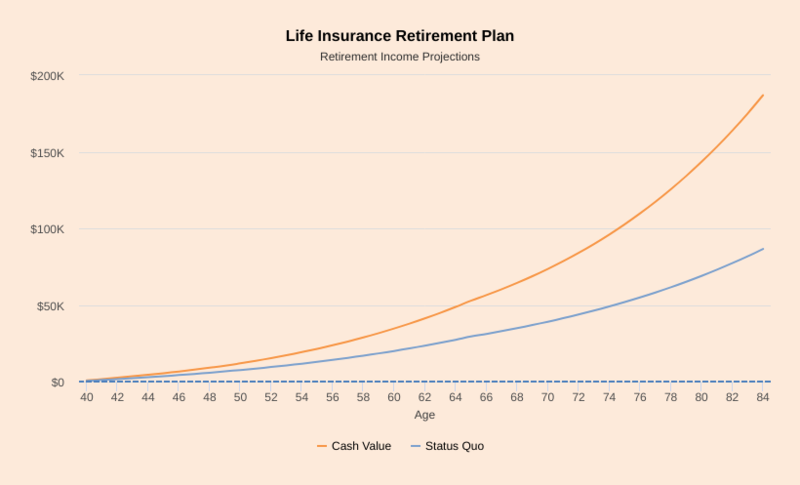
What this is showing is the income the client could take if the client retired at that age. Retirement at age 65, for example, would allow retirement income of around $52,000 per year TAX-FREE from the cash value versus maybe $30,000 of income from the brokerage account.
Here is what the accumulation looks like over time...

Yep. The brokerage account has more money in it at retirement age. So what? You can still get more Income from the life insurance policy. You can take your quarterly account statement from your broker to starbucks and it won't buy you a cup of coffee. Income is what matters.
I can show the math underlying these assumptions. Its not hard, simply build a spreadsheet and tally the loans and financed interest.
As a Fiduciary, I have no issues with recommending an overfunded life insurance policy. I know that my clients will pay less in fees and commissions and will receive greater income at retirement.
The haters here can think what they want. They are confusing a minimally-funded whole life policy with over-funded life insurance. These are two completely different animals.
A recurring objection to permanent insurance is the perceived "high cost" of the premiums as compared to the perceived "low cost" of term insurance.
Something to understand: Term insurance is a true cost. When you pay term insurance premiums, you will never see that money, nor the interest you could have earned on that money, ever again.
With permanent insurance, you still have access to the cash you put into the policy.
If you move money from your checking account to your savings account, is there a cost?
The same thing is happening with permanent insurance.
And since there are the additional features of a permanent death benefit and disability waiver, this "savings account" (insurance policy) self-completes all the deposits you would have made into it, over the course of your working life, in the event you die or become disabled. Does your bank or brokerage account do that?
Are you trying to say that permanent insurance has no "true cost" built into it? In other words, none of the money you pay goes towards a fund to cover death benefit? That is really hard to believe. I am fairly sure that for every 1000 permanent policies written, some percentage of people die prior to funding anywhere near the death premium. The money to pay those premiums comes from that risk pool of all 1000 people (just for example). So a portion (the term portion) of your permanent policy payment does not get invested. It goes towards the risk pool and insurance company profit/administration costs.
My point is a permanent policy has a term component. So what is the difference if you buy a term policy and then just invest the other money into a brokerage account? So instead of paying $1000 a month for a permanent life policy, I pay $50 term and invest the other $950 in my brokerage.
Hi Joe,
Yes, there is a cost for insurance. That cost is often paid in the first 1-3 years of the policy. During those first couple of years, you get less cash value per year than what you put into it.
After that, however, for every $1 in premium you pay, you end up with more than $1 in cash value for that year.
That is net of all costs, fees, etc.
At some point, say around 3-7 years, you will completely break even - meaning the total available cash value will be greater than or equal to every cumulative premium dollar you've paid into the policy.
If I put $1 in and my cash value is greater than or equal to $1, isn't that just like a savings account?
To use your example, if you paid $50/mo for term insurance for 20 years, that's $12,000 total cost. But it's $20,000 in lost opportunity cost if you would have put that $50 somewhere earning, say, 5% annually for 20 years. That's $20,000 you never earned and can never earn on in the future.
If you put the entire $1,000/mo in a permanent policy earning 5% for 20 years, that's $240,000 in total premium payments, but you'd have $400,000 in cash value, or a $700,000 death benefit. All tax free.
You have more tax-free money than what you put in. Was there a cost to you for this life insurance?
100% Control, Use, and Certainty
This is not an accurate statement. You are conflating the crossover point where cash value exceeds the premiums as the point where expenses cease. That is not the case. There is no point where 100% of the premium goes straight to the cash value.
There are generally 3 groups of expenses in a life insurance policy: Premium charges, Policy Charges, and the Cost of Insurance. The insurance company takes a percentage of every dollar of premium every year for life. This is explicit in a Universal Life and buried in a Whole Life. The Policy Charges are related to the death benefit: the higher the death benefit, the higher the policy charges. This is where the savings occurs in overfunded policies designed with minimum death benefits. These charges are spread across the surrender charge period of the policy. They go away after 10-15 years.
The final charge is the cost of insurance. The insurance company needs to pool money in order to pay the expected claims. This cost is made explicit in a universal life and is simply buried in a whole life.
As I've written repeatedly throughout this thread, the cash value of a policy represents the policy owner saving up their own death benefit over their natural life expectancy. The cost of insurance is there every single year to cover the gap between the cash value and the death benefit.
Whether the policy is a whole life or universal life, these costs are there. We know they're virtually the same in both types of policies because both types of policies will have identical cash accumulation values when the same design assumptions are used.
I am not saying that there are no costs inside the insurance policy.
I'm proposing a thought exercise for how to think about the costs of permanent insurance - to the policy owner - compared to term insurance (my original response).
I stand by my analogy.
Scenario 1: A bank depositor transfers a dollar from their checking account to their savings account (a guaranteed cash asset). -$1 in checking … +$1 in savings (net)
Scenario 2; A policy owner transfers a dollar from their checking account to their permanent life insurance policy (also a guaranteed cash asset). -$1 in checking … +$1 in cash value (net)
In both cases, they moved their dollar from one guaranteed cash account to another guaranteed cash account. In both cases, they have 100% control and use of that dollar after the move. One guaranteed cash account just so happens to also be tax-free and have the extra feature of a death benefit.
So did moving that dollar cost them anything?
Answer: No.
---
BTW, regarding internal insurance policy expenses -- I don't think we should care about it. Seriously, why should we?
The policy owner gets an illustration that tells them, in black and white, what the guarantees and non-guaranteed projections will be, *net of all costs*.
A person either likes the guaranteed, tax-free rate of *net* growth or they don't. Why get caught up in these unnecessary debates over internal costs, fees, commissions, etc? It really doesn't matter.
I, of course, agree with @Thomas Rutkowski explanation that you are saving up for your death benefit using permanent insurance. But since the net IRR of the death benefit is positive, even if it endows, there was still no cost to the policy owner, other than possible lost opportunity cost.
(A quick aside about commissions: I think it's passing strange when some real estate people on BP - who should be completely accustomed to transaction commissions - get all bent out of shape over an insurance agent making a commission on a life insurance policy lol)
Not all policies are created equal. At one end of the spectrum you have basic whole life and their Guaranteed UL equivelent. These are minimally-funded policies that offer the most death benefit protection for the money. This is what your typical "hater" is thinking about when they comment on these forum posts. To use your $1 analogy, its not moving $1 from checking to saving. A minimally-funded policy is trading $1 for "insurance" and maybe 25-cents of cash. If you survive the year, all you have is 25-cents.
The opposite end of the spectrum is an overfunded policy designed right up to the MEC limit. The fees, and death benefit, are held to a minimum. You also have the entire spectrum between these two extremes. Using your analogy again, an overfunded policy is trading $1 for less "insurance" and 85-cents of cash value. If you survive the year, you have is 85-cents. [but that 85-cents is capable of generating more retirement income than the full dollar in a traditional account]
If pure death benefit protection is your goal, then I agree with you: who cares about the costs. But if my goal is creating tax-free retirement income, the fees are a drag on the performance of the cash value. If the policy is not designed properly, the income will be lower. Moreover, when I'm leveraging my policy, I want to know that I am better off by leveraging it as opposed to simply investing directly in the alternative.
With a poorly designed IBC policy, the numbers will never work out, because the high fees mean you have less cash going to work for you. so I had better been after the death benefit protection. When the fees are low, the payback occurs much sooner.
You two guys really know your stuff! All I know is i purchased a few term insurance policies, they expired and I have nothing from them. I purchased a lot of whole life policies, they are paid in full and my familyis set for life. I find it to be annoying when people try to act like they are the world's smartest investors when comparing theses that seem trivial to me i.e. a little more or less interest earned by different products when most people don't bother to analyze investments that have a significant impact on their finances and people are 'penny-wise and pound-foolish'.
I will back up any insurance salesman and they are well-worth their commissions considering the knowledge they have to know. As stated before, my problem with dealing with any salesmen is due to my lack of education and knowledge and that caused me to not trust them because I cannot comprehend what they are telling me.
This was a great and educational thread.
Not all policies are created equal. At one end of the spectrum you have basic whole life and their Guaranteed UL equivelent. These are minimally-funded policies that offer the most death benefit protection for the money. This is what your typical "hater" is thinking about when they comment on these forum posts. To use your $1 analogy, its not moving $1 from checking to saving. A minimally-funded policy is trading $1 for "insurance" and maybe 25-cents of cash. If you survive the year, all you have is 25-cents.
The opposite end of the spectrum is an overfunded policy designed right up to the MEC limit. The fees, and death benefit, are held to a minimum. You also have the entire spectrum between these two extremes. Using your analogy again, an overfunded policy is trading $1 for less "insurance" and 85-cents of cash value. If you survive the year, you have is 85-cents. [but that 85-cents is capable of generating more retirement income than the full dollar in a traditional account]
If pure death benefit protection is your goal, then I agree with you: who cares about the costs. But if my goal is creating tax-free retirement income, the fees are a drag on the performance of the cash value. If the policy is not designed properly, the income will be lower. Moreover, when I'm leveraging my policy, I want to know that I am better off by leveraging it as opposed to simply investing directly in the alternative.
With a poorly designed IBC policy, the numbers will never work out, because the high fees mean you have less cash going to work for you. so I had better been after the death benefit protection. When the fees are low, the payback occurs much sooner.
Yes, I understand and agree with all of that, but maybe look at it a little differently.
Rather than say that a non-fully-over-funded policy has "higher fees," I would say, rather, that more of your dollars are going towards the initial death benefit. To me, it's a trade-off of higher cash value, early on vs. higher initial death benefit. The "higher fees" are paying for more death benefit, so it's not like we're just throwing money out the window when buying a policy that's not fully overfunded with cash.
What does the client need?
I don't think I'm saying anything you would disagree with here.
I should mention, however, that I do take professional exception to how you frequently refer to Infinite Banking in a negative light. I do not agree with how you characterize IBC as a marketing system or that the typical IBC policy is not fully overfunded to the MEC limit. It's simply not true.
As an authorized IBC practitioner, I can tell you that not one second of the training in the IBC authorization program was spent on marketing or sales.
And while I'm sure you've seen policies by IBC Practitioners with less-than-fully-overfunded cash value, that does not mean it is an "IBC Policy." That being said, however, there may be very valid reasons to not fully overfund a policy. For example, it may make sense to leave some "room" in one of your policies for later years, when you may not be insurable. It is perfectly reasonable to plan for the possibility of coming into some money and needing a place to put it where it will grow tax-free for the rest of your life.
Here is a podcast episode about this very topic.
I've written fully overfunded policies, I've written policies leaving "room" in them, and I've written policies with no Paid Up Additions rider at all - because in each case it was the best thing for my client - and in each case it still kept to the spirit of the IBC strategy.
IBC training is about understanding the macro-economy, the role banks and the govt played in the last two major recessions, and the benefits of creating your own sources of capital using dividend-paying, cash value whole life insurance. If you don't know how to capitalize, when you need cash, you must seek that cash from outside sources who do know how to capitalize.
From all of your great content here on BP, I know you feel the same way about the importance of capitalizing and leveraging that capital. :)
I agree with everything you have said. Life insurance is an infinitely customizable financial tool.
But, you have no idea how many people rely on me to take a second look at their IBC/BYOB proposals. Those clients, whose goal was specifically to get what they thought was a maximum-overfunded policy, instead were given policy illustrations that WERE NOT funded to the maximum. How would they know?
The vast majority are designed exactly the same. They leave room for the client to add premium later in the form of paid up additions under the guise of "paying yourself interest".
When I do see an illustration that is well-designed, I let them know that there is nothing I can do to improve it.
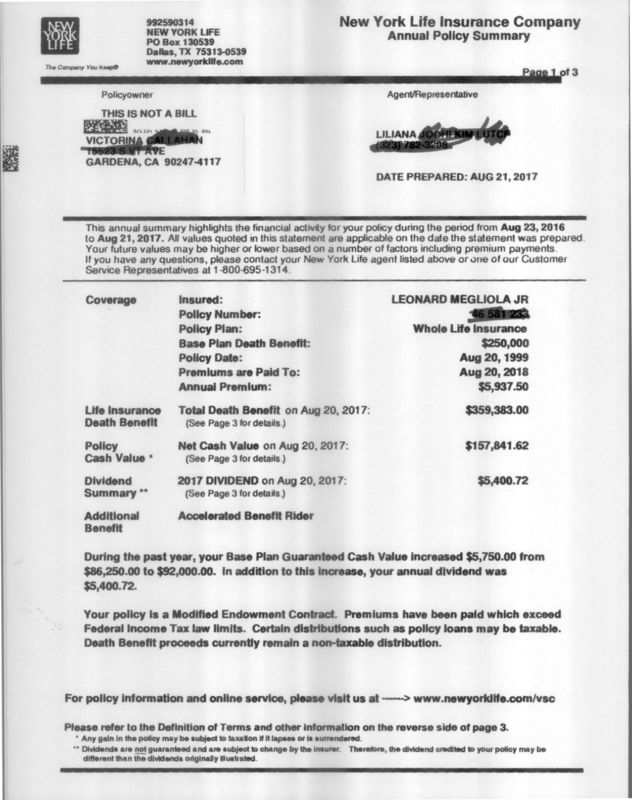
I think it is crazy to be a penny pincher. I can't find my policy that has more than $450k in cash value because I made it irrevocable in a living trust. I will get a copy in the next few days. But, having policies with this much cash value is a great feeling to know that it is safe, in one place and I did not lose this money by being cheap and dabbling in other markets. I am sure I did not pay as much for the policy as the $157k cash value that is in it.
Everyone keeps saying you can purchase term insurance for less money and invest the difference in real estate or the stock market. Investing in any type of stock market, mutual funds, or whatever is super risky. You never know where the market will be when you need your money.
When term insurance expires before a person dies every penny spent was wasted. Not only that, he wasted many times more money because to start a new policy he will have to pay twice as much due to being older. Why would a person waste thousands of dollars when he could be putting a portion of his money at a young age toward a policy that would be paid off for life.
The problem with trying to buy a cheaper policy and invest the difference is super risky and reducing your risk the the very first thing tha
needs to be eliminated to be successful. Only a fool puts his money into the markets and crosses his fingers. Successful people reduce their
risks and spend their money frugally.
You get what you pay for. Buy a cheap term policy, outlive the policy and you wasted every penny you paid. Buy a whole life policy, pay a little more and your heirs are set for life. Later, when you are more experienced with real estate, GUESS WHAT??? Your insurance policy(s) will be paid in full and then you can do your stock market gambling. Investing in the stock market is 100% pure gambling.
Life insurance should not be a vehicle to make money and I would never borrow against a policy. It is to protect your family so they are not burdened by your death and so they can continue to live the lifestyle you gave them. Don't be cheap when it comes to protecting your family!
Spoken like a true salesman. the stock market has all kinds of tools high risk Low risk take your pick. This risk talk is BS you pick a fund that that is a tool to use with money saved with buying term .I can find many index funds that will get nice gain with out big risk . a guaranteed whole life policy until age 99. It has a current death benefit of $1,551,262, with a current face value of $1,549,562. The monthly premium is $1,982.72. This reader has been paying his policy for 79 months – so he’s paid a total of $156,634 for this policy. Guess what the current cash value is in February 2019? Just $88,459. That’s almost a -40% return of the past 7 years… The argument of most insurance agents is “well, you’re getting more than life insurance! You’re getting an investment as well!” So, if you want to separate the two – he has $88,459 in “investments/cash value” and paid $68,175 for a $1,500,000 insurance policy. Any way you slice this it’s bad. If you wanted to get a $1.5 million term life policy, this reader would probably pay about $115/mo in a worst case. So, in the same 79 months he’s had the policy, he could have had the same insurance coverage for just $9,085. That’s a $59,090 difference! I’m also assuming that he got a 0% return on his investments – because if you start changing the math on the life insurance portion, the return goes negative quickly! Conclusion – Only Purchase Term Life Insurance The bottom line is that, for young adults, term life insurance makes the most financial sense. The purpose of insurance is to be a backstop against major financial loss in the case of an unexpected event – death. It’s not an investment vehicle. It’s not sexy. It’s not a retirement savings account. No matter how you paint it, insurance is designed to be insurance.
I agree with everything you have said. Life insurance is an infinitely customizable financial tool.
But, you have no idea how many people rely on me to take a second look at their IBC/BYOB proposals. Those clients, whose goal was specifically to get what they thought was a maximum-overfunded policy, instead were given policy illustrations that WERE NOT funded to the maximum. How would they know?
The vast majority are designed exactly the same. They leave room for the client to add premium later in the form of paid up additions under the guise of "paying yourself interest".
When I do see an illustration that is well-designed, I let them know that there is nothing I can do to improve it.
@Thomas Rutkowski - Regarding your experience of double-checking IBC policies - that's fair enough.
Can I ask - what is it about "leaving room" in the policy that you think is so detrimental? It obviously does push out the time it takes to "break even" on premiums paid vs cash value available in the policy. Less cash available early on. and it does lower the return on cash value somewhat. I get that side of the story, and it is important.
But I do think an argument could be made for leaving room. Especially for people here on BP.
Staying with the idea of trade-offs.
In a non-fully-over-funded policy, you pay the same cash in, you do have less cash value (say 60% of what you paid in 1st year premium), but you have a higher initial death benefit.
In a fully-over-funded policy, you pay the same cash in, you have a higher cash value ratio in that first year (use the 85% that you've mentioned), but you have a lower initial death benefit.
If an investor leverages cash value to buy an income producing asset. That asset generates a profit. What are their options for where to put that profit?
It doesn't seem wrong to me that you'd leave some "room" in at least one policy so that you have a place to put those profits. A place where the money will never be taxed again.
If you compare the long-term IRR of both policies, the non-fully-over-funded policy will also be similar. Maybe around a half a percent lower. I'm not saying that's not important - but it's not far off from a fully over-funded policy in the long term - and that's if you leave the policy alone.
If you are truly using it as a source of capital, buying other assets, and then funding PUAs from the profit, the difference would presumably be less. Admittedly, still less.
So I suppose I'm coming at this from the angle of certainty. We don't know what our insurability will be in the future. We may not be able to start another policy into which we can save profits. Having some room now, ensures we do have that place.
Interested to hear your thoughts!
It sounds to me like you are ok with sneaking the high death benefit - and the higher commission that goes along with it - into a policy and not telling the client about it because you think its in the client's best interest. If the client's stated goal is a maximum overfunded policy, that is what I am going to give them.
IRR is a useless calculation when comparing life insurance policies. It is looking at the return on the premium. The insurance fees are a loss. I care about the return on the cash value. When $1 of premium turns into 60-cents of cash value, the IRR is going to be much lower than when the cash value is 85-cents.
And talking about a place to store the profits generated...
First, 60-cents of leveraged cash value is not going to generate as much profit as 85-cents of cash value. All the people here standing on the sidelines watching this thread are trying to objectively determine whether or not it makes sense to put cash into a policy and leverage it to invest in "A" or simply invest in "A" directly.
That's what I wanted to see when I first figured this out. And I built a financial model to prove it to myself. And every client and prospective client who has reached out to me. Its a lot easier to accomplish when 85-cents of your premium dollar is going to work in two places at once rather than only 65-cents.
Second, there is nothing but future potential uninsurability stopping someone from increasing the death benefit of the policy or starting a new one to absorb the profits generated from the side fund.
I have no issue with sitting down with someone and explaining how life insurance can meet multiple needs. You have the extreme high DB/low CV on one end of the spectrum and Low DB/High CV on the other. Both can meet the client's needs. But when the emphasis is on CV, give them what they want.
And don't feed them the BS that putting more premium into their policy is "paying themselves interest". That is extremely dishonest. They aren't borrowing from their own bank and their not paying themselves interest. They are borrowing from the insurance company and anything on top of the interest paid to them is just more premium that could have been put into the policy on day 1.
It sounds to me like you are ok with sneaking the high death benefit - and the higher commission that goes along with it - into a policy and not telling the client about it because you think its in the client's best interest. If the client's stated goal is a maximum overfunded policy, that is what I am going to give them.
IRR is a useless calculation when comparing life insurance policies. It is looking at the return on the premium. The insurance fees are a loss. I care about the return on the cash value. When $1 of premium turns into 60-cents of cash value, the IRR is going to be much lower than when the cash value is 85-cents.
And talking about a place to store the profits generated...
First, 60-cents of leveraged cash value is not going to generate as much profit as 85-cents of cash value. All the people here standing on the sidelines watching this thread are trying to objectively determine whether or not it makes sense to put cash into a policy and leverage it to invest in "A" or simply invest in "A" directly.
That's what I wanted to see when I first figured this out. And I built a financial model to prove it to myself. And every client and prospective client who has reached out to me. Its a lot easier to accomplish when 85-cents of your premium dollar is going to work in two places at once rather than only 65-cents.
Second, there is nothing but future potential uninsurability stopping someone from increasing the death benefit of the policy or starting a new one to absorb the profits generated from the side fund.
I have no issue with sitting down with someone and explaining how life insurance can meet multiple needs. You have the extreme high DB/low CV on one end of the spectrum and Low DB/High CV on the other. Both can meet the client's needs. But when the emphasis is on CV, give them what they want.
And don't feed them the BS that putting more premium into their policy is "paying themselves interest". That is extremely dishonest. They aren't borrowing from their own bank and their not paying themselves interest. They are borrowing from the insurance company and anything on top of the interest paid to them is just more premium that could have been put into the policy on day 1.
Well, you’ve got some nerve I’ll give you that.
But unprofessional, uncalled for, and untrue accusations aside ...I have already *agreed with you* about the benefits of fully over funding a policy.
I was attempting to have a dialog about some situations when it may not be the best thing to do.
Having a life Insurance death benefit *does* have value. And many people want it. So then it’s just a matter of how you’ll provide it to your clients.
There is more than one way to look at this thing called life insurance. Just like most things in life.