Why do REI dislike or avoid life insurance?

Why do REI dislike or avoid life insurance?

Real Estate Agent · Harbor Springs, MI · Member since 2017 · 5 posts · 2 votes

As a real estate investor and financial advisor I usually understand the mindset of other investors. Individuals in real estate are usually more willing to take on risk which is often rewarded. I understand REI's usually deploy a large portion of their capital to advancing their real estate portfolio... but it seems like they dislike or do not understand life insurance. When I start to work with REI's I expect them to invest less of their income into traditional retirement accounts. I also expect them to find value in benefits like life insurance and disability, but that has not been my experience. Why is this?

I also understand disagreeing with the infinite banking concept Brandon has talked about with whole life insurance but it seems like the large majority avoid life insurance in general.

Those in the industry full time... help me understand! How can I better convey the idea to real estate investors? 

0Reply
192 views

Most Popular Reply

Rental Property Investor · East Wenatchee, WA · Member since 2014 · 10k+ posts · 16k+ votes
6y
Originally posted by @Brook Vosler:

I also expect them to find value in benefits like life insurance and disability, but that has not been my experience. Why is this?

I also understand disagreeing with the infinite banking concept Brandon has talked about with whole life insurance but it seems like the large majority avoid life insurance in general.

Most of us I would think have the best value insurances out there - term life, liability umbrella policies and liability hazard insurance per property.  

My wife and I are literally insured for $2.5M for less than $1000/yr with term life and umbrella insurance. Then there's the millions in property hazard liability coverage we get for tens of dollars per month per property. 

Disability insurance?   High cost for already having passive cf that more than covers my not 'working.'  Too hard to quantify something that's a % of a w2 a lot of us don't have anyway.  

Same with long--term care. High cost. If I go into a home, I'll own it most likely or buy it while there. We have a different mindset than employees.

And don't get me started on whole (hole) life.  The costs and fees are outrageous.  Why are producer commissions so high?  If I want to invest the difference in premium costs vs term, I'll invest it. My heirs will also get to benefit from the 'cash value' of those separate investments when I die.   

in summary, we're not anti-insurance.  We can do cost/benefit analysis and are anti high-cost/ low benefit. 

See this reply in the discussion

54 Replies

Jump to latestLatest
  • Financial Advisor · Boynton Beach, FL · Member since 2015 · 833 posts · 798 votes
    6y
    Originally posted by @Todd Goedeke:

    @Aaron K. I agree. To shed light on the subject of insurance commissions, there are two parts to commissions; target premium commission and the commission on the excess. The total of both can be around 10% of total deposit.

    Has yourself If life insurance is such a great investment why do you never hear from people saying how much money they made off their policy?

    Anybody can use software to produce a graph. Legally there is about 5-8 pages of disclosures that should accompany a graph. Also an insurance company name should be present to prevent insurance agents from printing misleading graphs and charts.

    Again, you don't understand the difference in policy designs. It's not 10% if the policy is properly designed.

    You don't get it: Its not the life insurance that is the investment. The life insurance is helping you build wealth in whatever you are investing in. The graphs are not showing life insurance returns, they are showing the combination of life insurance and real estate vs real estate alone. The charts aren't misleading, you just aren't interpreting the data properly.

    Do you think of your checking account as an investment? Its a place to store your liquid wealth.

  • Financial Advisor · Boynton Beach, FL · Member since 2015 · 833 posts · 798 votes
    6y
    Originally posted by @Tony Kim:
    Originally posted by @Thomas Rutkowski:

    @Tony Kim

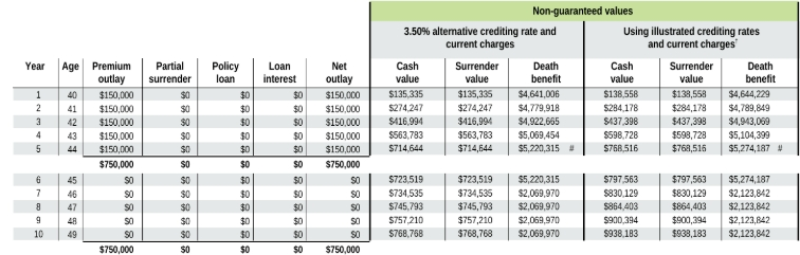
    I was presenting an illustration yesterday. He is a 40 year old, healthy, non-tobacco and his crossover around the end of the 4th year. Hey @Joe Splitrock - note that the cash value = the surrender value. Premium minus charges = cash value.

    That said, this crossover point is meaningless. The graph I posted above looks at the true opportunity cost. Its not about how long until you have your money back. Its about how long before you catch up to where your money would have been had you invested it all in real estate without the life insurance. THAT is what the earlier graph above is showing.

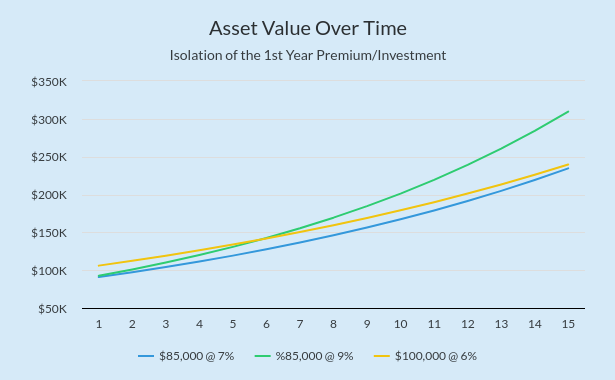
    This graph is from my webinar last week. It is examining one premium in isolation. The $85,000 represents the cash value from a properly-designed, maximum over-funded policy receiving the first premium of $100,000. 

    The numbers used in this analysis correspond to the simplistic assumptions in my example above (10% growth opportunity, 40% tax, 5% loan rate. The Green line represents getting a cash value line of credit at 5% and using the loan proceeds to invest at a 10% rate and paying 40% taxes. The Yellow line represents the alternative: simply taking $100,000 and making the same investment. The life insurance PLUS leverage for REI catches up before the 6th year.

    The blue line is for there to illustrate the same example without tax-deductible interest (as with a policy loan from the insurance company).

    Hi Thomas,

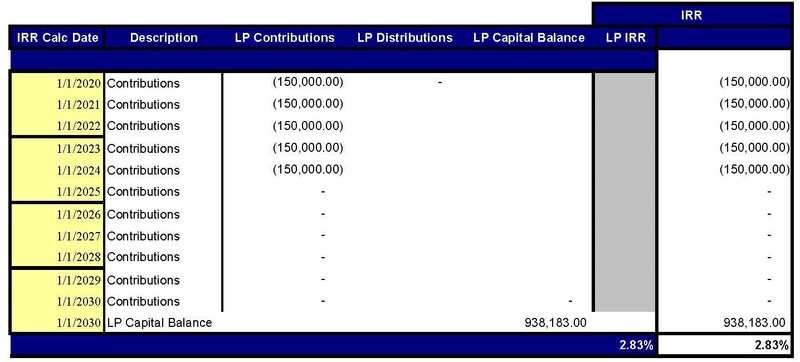
    Thank you for that information and providing me with a sample. So based on the spreadsheet that you posted, am I correct in assuming that if we pay 150K in premiums for the first 5 years and no longer have to pay additional premiums starting in year six, by the time we reach year ten, the cash value will be 938,183? Money going in is 750K, cash value of 938K over a period of ten years?

    I entered those numbers in my IRR spreadsheet and get an annualized return of 2.83%. Is there someplace in which my schedule is incorrectly configured?

     If you choose to focus on the life insurance alone, you are missing the whole point. I call it The Double Play for a reason.

    1.) As the charts clearly show, you will build more wealth by leveraging the cash value to do whatever you were going to do in the first place. Fees, commissions, and IRR on the premium don't have anything to do with this. After all the fees are taken out of the premium, you will be left with about 85% that goes to the cash value. THAT plus a line of credit against THAT allows you to put the money to work in two places at one time. You have less, but it will be growing at a faster rate and will eventually catch up to where you would have been had you done something else.

    2. We haven't discussed income from life insurance, but at risk of going down another rabbit hole, the remaining cash value (~85% of the premium) is capable of generating 2 to 3 times the after tax income of money held in traditional retirement assets. Think 4%-rule. Cash value is more like an 8%-Rule and its tax free.

    3. You are looking at the return on premium. This does not take policy design into consideration. A basic whole life is going to have much, much higher fees than a maximum over-funded whole life. The CASH VALUE in both will be growing at the same rate. But the policy design dictates how much cash value is left over after the fees are subtracted from the premium.

    My charts and the simple example, show a 6% growth ON THE CASH VALUE.
  • Jag C.Pro Member
    Rental Property Investor · Member since 2018 · 74 posts · 22 votes
    3y

    @Mark Welp

    Mark, I just saw this thread. I am looking at this presently and would love to know how you use whole life - do you use it to invest in notes, for downpayment, full amount of sales price? How do you pay yourself back? 

    I have found a lot of material on real estate investors using the policy for investment, but none that sure the nitty gritty/give a detailed overview of how e investors make it work. 

    Thank you. 

Join the conversationCreate a free account to reply, vote on answers and follow this thread.