Why do REI dislike or avoid life insurance?

Why do REI dislike or avoid life insurance?

Real Estate Agent · Harbor Springs, MI · Member since 2017 · 5 posts · 2 votes

As a real estate investor and financial advisor I usually understand the mindset of other investors. Individuals in real estate are usually more willing to take on risk which is often rewarded. I understand REI's usually deploy a large portion of their capital to advancing their real estate portfolio... but it seems like they dislike or do not understand life insurance. When I start to work with REI's I expect them to invest less of their income into traditional retirement accounts. I also expect them to find value in benefits like life insurance and disability, but that has not been my experience. Why is this?

I also understand disagreeing with the infinite banking concept Brandon has talked about with whole life insurance but it seems like the large majority avoid life insurance in general.

Those in the industry full time... help me understand! How can I better convey the idea to real estate investors? 

0Reply
255 views

Most Popular Reply

Rental Property Investor · East Wenatchee, WA · Member since 2014 · 10k+ posts · 16k+ votes
6y
Originally posted by @Brook Vosler:

I also expect them to find value in benefits like life insurance and disability, but that has not been my experience. Why is this?

I also understand disagreeing with the infinite banking concept Brandon has talked about with whole life insurance but it seems like the large majority avoid life insurance in general.

Most of us I would think have the best value insurances out there - term life, liability umbrella policies and liability hazard insurance per property.  

My wife and I are literally insured for $2.5M for less than $1000/yr with term life and umbrella insurance. Then there's the millions in property hazard liability coverage we get for tens of dollars per month per property. 

Disability insurance?   High cost for already having passive cf that more than covers my not 'working.'  Too hard to quantify something that's a % of a w2 a lot of us don't have anyway.  

Same with long--term care. High cost. If I go into a home, I'll own it most likely or buy it while there. We have a different mindset than employees.

And don't get me started on whole (hole) life.  The costs and fees are outrageous.  Why are producer commissions so high?  If I want to invest the difference in premium costs vs term, I'll invest it. My heirs will also get to benefit from the 'cash value' of those separate investments when I die.   

in summary, we're not anti-insurance.  We can do cost/benefit analysis and are anti high-cost/ low benefit. 

See this reply in the discussion

54 Replies

Jump to latestLatest
  • Financial Advisor · Indianapolis, IN · Member since 2018 · 294 posts · 165 votes
    6y

    @Thomas Rutkowski

    Your example factoring in taxes is overly simplistic. An investor in the 40% tax bracket is unlikely to pay 40% on investment income. Qualified dividend rates are capped at 20% and most investors are equally likely to only have unrealized gains and thus have zero taxes. 

    Your example is not without merit, but there are many assumptions built into your example that are unlikely to play out much of the time. 

    Its also worth noting that people can take a line of credit against many traditional brokerage accounts at comparable rates without having to be handcuffed to a policy or premiums for life. 

  • Rental Property Investor · Savannah, GA · Member since 2018 · 174 posts · 129 votes
    6y

    @Brook Vosler

    Somebody has probably already said this, but I think a big factor is the access to capital now. Even in the best of the best cash value whole life policies I’ve seen, that break even point where I’m positive compared to my contributions is 5 years away. Of course I could front load a whole lot, but then there’s the still the lack of access to the capital that makes sense until much further down the road.

    Another great point already made is being “self-insured” through your assets. If you have $1M in equity and a good emergency fund, do I really need more life insurance? No, probably not.

    But still think the biggest factor for most is access to their capital quickly and currently to see returns from day one.

    The people that are looking at whole life as a possible investment tool are probably also looking at how to set up their portfolio for a smooth transition after they pass away. But then again, I could be completely wrong.

  • Financial Advisor · Boynton Beach, FL · Member since 2015 · 834 posts · 798 votes
    6y

    @Daniel McNulty - As I stated, it is a simple example to illustrate the concept. There is no need to get into sophisticated modeling here. The concept works regardless of the tax rates. 

    A line of credit against a life insurance policy will be for nearly 100% of the cash value. A line of credit against a brokerage account will be a much lower LTV. Cash value is principal protected. Apples and oranges.

  • Financial Advisor · Boynton Beach, FL · Member since 2015 · 834 posts · 798 votes
    6y
    Originally posted by @Joe Splitrock:

    @Brook Vosler investors don't like life insurance because they are sophisticated and understand it is not a good deal. They understand that fees, including sales commissions are ridiculous. Of course that is why insurance agents and financial planners try to force it down your throat. 

    At the end of the day, insurance companies invest in bonds, mortgages and some in the stock market. So insurance companies have no special formula to reduce risk and increase return. They just add a fee layer and tie you into a product that is impossible to get out of, without loosing everything you put in.

    The "be your own bank" nonsense it just another angle to try to sell the insurance. You can only "be your own bank" after you have funded the policy with massive amounts of money. You would be better using that cash to invest in real estate, then pulling it out through long term financing. 

    @Thomas Rutkowski I have trouble with these "results not guaranteed" graphs that are just sales tools. How much more could someone have made if they reinvested everything into REI - way more that is the point.

     Look at the graph closely. It is showing the result if someone invested 100% of their money into real estate. Putting your money to work in two places at one time results in better wealth accumulation than putting your money to work in only one place at one time. Again: would you rather have 85% of your money earning 9% or 100% of your money earning 6%? Pretty simple math.

  • Joe SplitrockPro Member
    Moderator
    Rental Property Investor · Sioux Falls, SD · Member since 2015 · 9k+ posts · 18k+ votes
    6y
    Originally posted by @Thomas Rutkowski:
    Originally posted by @Joe Splitrock:

    @Brook Vosler investors don't like life insurance because they are sophisticated and understand it is not a good deal. They understand that fees, including sales commissions are ridiculous. Of course that is why insurance agents and financial planners try to force it down your throat. 

    At the end of the day, insurance companies invest in bonds, mortgages and some in the stock market. So insurance companies have no special formula to reduce risk and increase return. They just add a fee layer and tie you into a product that is impossible to get out of, without loosing everything you put in.

    The "be your own bank" nonsense it just another angle to try to sell the insurance. You can only "be your own bank" after you have funded the policy with massive amounts of money. You would be better using that cash to invest in real estate, then pulling it out through long term financing. 

    @Thomas Rutkowski I have trouble with these "results not guaranteed" graphs that are just sales tools. How much more could someone have made if they reinvested everything into REI - way more that is the point.

     Look at the graph closely. It is showing the result if someone invested 100% of their money into real estate. Putting your money to work in two places at one time results in better wealth accumulation than putting your money to work in only one place at one time. Again: would you rather have 85% of your money earning 9% or 100% of your money earning 6%? Pretty simple math.

     You are using a logic trap. Presenting two options, knowing one is more appealing, so it favors your desired outcome. The problem is there are not two options (there is many) and the favored option isn't even guaranteed. By controlling the options, you control the outcome. 

  • Investor · Singapore · Member since 2013 · 1k+ posts · 3k+ votes
    6y

    All I know is that the more complex the product, the less benefit to me and more to the seller. Few financial products are more complex than Whole Life Insurance. How many pages is your typical policy?

  • Financial Advisor · Indianapolis, IN · Member since 2018 · 294 posts · 165 votes
    6y

    @Thomas Rutkowski

    Suggesting it is simple math is misleading...Your model is completely based on the tax benefits and leverage. If you actually compare apples to apples as you say, leveraging 100% of your capital to 1.85X into almost anything else will nearly double your whole life policy returns WITHOUT the complexity and illiquidity. Factoring in a realistic tax on top of that blows whole life out of the water. 

  • Financial Advisor · Boynton Beach, FL · Member since 2015 · 834 posts · 798 votes
    6y

    @Daniel McNulty So if you can't win your argument, you just change the game? 

    All I'm saying is that if you were going to invest in "A", then you can do better by putting your money into a properly-designed, maximum over-funded policy and then leverage that cash value to invest in "A". Pretty simple.

    To both you and @Joe Splitrock, if you don't like it, don't do it. But neither of you can get past your dislike of life insurance to admit that it works. Logic trap? Give me a break. I built a model to compare doing this against not doing this so I could prove it to myself. If its too complicated for you, let it go. I know it works and my clients all know it works.

    "Suggesting it is simple math is misleading...Your model is completely based on the tax benefits and leverage." Duh. That's the point.

    Please tell me how a life insurance policy is illiquid if I can access 100% of the cash value at any time?

  • Anthony GaydenPro Member
    Rental Property Investor · Omaha, NE · Member since 2014 · 2k+ posts · 3k+ votes
    6y
    Originally posted by @Account Closed:

    All I know is that the more complex the product, the less benefit to me and more to the seller. Few financial products are more complex than Whole Life Insurance. How many pages is your typical policy?

     I completely agree. 

  • Investor · Philadelphia, PA · Member since 2015 · 3k+ posts · 3k+ votes
    6y

    @Brook Vosler

    Because we’re not dead yet. So who needs it?

  • Member since 2020 · 22 posts · 7 votes
    6y

    It could also be due to bad experience with insurance companies. For example, with the current crisis, some insurance companies are not paying out on their policies because the insurance policy actually has language for cases like a pandemic. So you'll have someone paying a premium for 20 years, they end up dying from the pandemic and then their beneficiaries won't get a payout. 

  • Rental Property Investor · Ithaca, NY · Member since 2015 · 1k+ posts · 1k+ votes
    6y

    @Brook Vosler

    Greater autonomy, if I die, should I rely on a company to pay my family out or should I rely on myself? Easy answer. Life insurance is kind of redundant if I have physical cash flowing assets. Now home and business insurance, that’s a whole different conversation.

  • Scranton, PA · Member since 2017 · 168 posts · 137 votes
    6y
    Originally posted by @CO Yilmaz:

    It could also be due to bad experience with insurance companies. For example, with the current crisis, some insurance companies are not paying out on their policies because the insurance policy actually has language for cases like a pandemic. So you'll have someone paying a premium for 20 years, they end up dying from the pandemic and then their beneficiaries won't get a payout. 

     If you have an example of this happening I’d like to know. I’m only aware of one specialty company that has policy language that won’t a pandemic. No major company excludes pandemics. 

    I have not heard of one case like that. 

  • Member since 2020 · 22 posts · 7 votes
    6y

    @Zachary Paschke SunLife in Canada - my wife works there as an actuary - they have clauses in case of pandemic and I recommend that people check their own policies as well.

  • Scranton, PA · Member since 2017 · 168 posts · 137 votes
    6y
    Originally posted by @CO Yilmaz:

    @Zachary Paschke SunLife in Canada - my wife works there as an actuary - they have clauses in case of pandemic and I recommend that people check their own policies as well.

     Hate to defend your wife’s company, but COVID-19 is covered by SunLife’s life insurance policies. They may not be issuing new policies to people with COVID or COVID symptoms, but that does not impact existing policies. It is common right now for companies to not issue new policies, but SunLife is covering COVID deaths. 

    Clauses in the policy and clauses in the application are to very different things. Not being able to apply and getting a declined claim after you’ve paid into it are two different things. 

    I just pulled a SunLife sample policy and there’s no exclusion for any Pandemic. Please don’t unnecessarily scare people. 

    The only policy I’ve seen so far (in my experience) that excludes pandemics is a specialty policy offered by one division of Loyds of London. It’s a highly specialized policy for a limited case use and people taking out the policy understand what they have. 

  • Member since 2020 · 22 posts · 7 votes
    6y
    Originally posted by @CO Yilmaz:

    @Zachary Paschke SunLife in Canada - my wife works there as an actuary - they have clauses in case of pandemic and I recommend that people check their own policies as well.

    My point is - there may have been situations in the past where people thought they had coverage but did not due to some condition in the agreement that they were not aware of so overall people do not have good feelings with insurance companies and do not trust them.

  • Rental Property Investor · Los Angeles · Member since 2018 · 844 posts · 1k+ votes
    6y
    Originally posted by @Thomas Rutkowski:

    @Daniel McNulty So if you can't win your argument, you just change the game? 

    All I'm saying is that if you were going to invest in "A", then you can do better by putting your money into a properly-designed, maximum over-funded policy and then leverage that cash value to invest in "A". Pretty simple.

    To both you and @Joe Splitrock, if you don't like it, don't do it. But neither of you can get past your dislike of life insurance to admit that it works. Logic trap? Give me a break. I built a model to compare doing this against not doing this so I could prove it to myself. If its too complicated for you, let it go. I know it works and my clients all know it works.

    "Suggesting it is simple math is misleading...Your model is completely based on the tax benefits and leverage." Duh. That's the point.

    Please tell me how a life insurance policy is illiquid if I can access 100% of the cash value at any time?

    How long does it take for a policy's liquidity or cash value to match the total dollar amount of premiums paid?

    Can you provide an example via a spreadsheet? All this talk is much more meaningful when backed up with actual numbers.

  • Joe SplitrockPro Member
    Moderator
    Rental Property Investor · Sioux Falls, SD · Member since 2015 · 9k+ posts · 18k+ votes
    6y
    Originally posted by @Tony Kim:
    Originally posted by @Thomas Rutkowski:

    @Daniel McNulty So if you can't win your argument, you just change the game? 

    All I'm saying is that if you were going to invest in "A", then you can do better by putting your money into a properly-designed, maximum over-funded policy and then leverage that cash value to invest in "A". Pretty simple.

    To both you and @Joe Splitrock, if you don't like it, don't do it. But neither of you can get past your dislike of life insurance to admit that it works. Logic trap? Give me a break. I built a model to compare doing this against not doing this so I could prove it to myself. If its too complicated for you, let it go. I know it works and my clients all know it works.

    "Suggesting it is simple math is misleading...Your model is completely based on the tax benefits and leverage." Duh. That's the point.

    Please tell me how a life insurance policy is illiquid if I can access 100% of the cash value at any time?

    How long does it take for a policy's liquidity or cash value to match the total dollar amount of premiums paid?

    Can you provide an example via a spreadsheet? All this talk is much more meaningful when backed up with actual numbers.

     You would want to see the total amount paid in (including death premium and fees) and have it charted against surrender cash value. The key is surrender value, because that includes fees that are charged for cashing out your policy. 

  • Financial Advisor · Boynton Beach, FL · Member since 2015 · 834 posts · 798 votes
    6y

    @Tony Kim

    I was presenting an illustration yesterday. He is a 40 year old, healthy, non-tobacco and his crossover around the end of the 4th year. Hey @Joe Splitrock - note that the cash value = the surrender value. Premium minus charges = cash value.
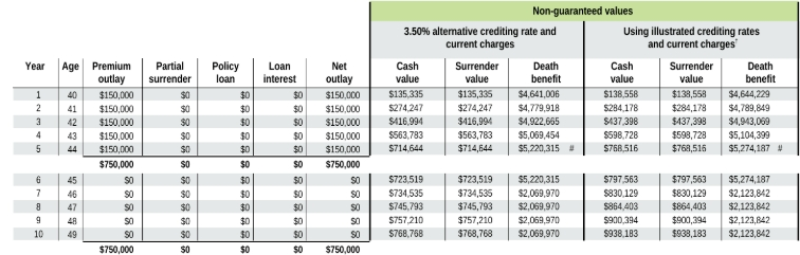
    That said, this crossover point is meaningless. The graph I posted above looks at the true opportunity cost. Its not about how long until you have your money back. Its about how long before you catch up to where your money would have been had you invested it all in real estate without the life insurance. THAT is what the earlier graph above is showing.

    This graph is from my webinar last week. It is examining one premium in isolation. The $85,000 represents the cash value from a properly-designed, maximum over-funded policy receiving the first premium of $100,000. 
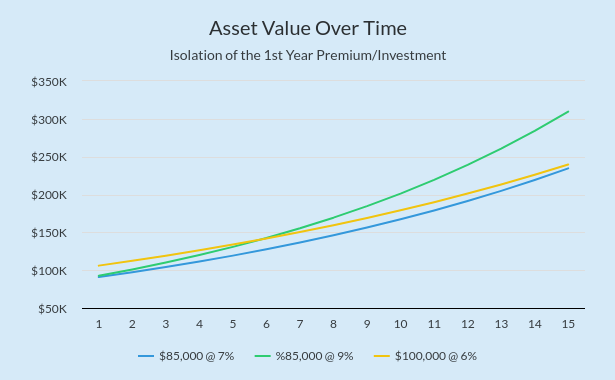
    The numbers used in this analysis correspond to the simplistic assumptions in my example above (10% growth opportunity, 40% tax, 5% loan rate. The Green line represents getting a cash value line of credit at 5% and using the loan proceeds to invest at a 10% rate and paying 40% taxes. The Yellow line represents the alternative: simply taking $100,000 and making the same investment. The life insurance PLUS leverage for REI catches up before the 6th year.

    The blue line is for there to illustrate the same example without tax-deductible interest (as with a policy loan from the insurance company).

  • Specialist · Easton, PA · Member since 2018 · 1k+ posts · 2k+ votes
    6y

    @Brook Vosler

    The minute we bought our first rental property, my wife had me get life insurance.

  • Investor/Agent/CPA · Columbus, OH · Member since 2015 · 249 posts · 207 votes
    6y

    @Brook Vosler

    If people understood how overfunded whole life insurance worked and the access to capital they can have, they would jump all over it.

    I fund all my real estate with my whole life policies.

    People on BP need capital. If they understood it or took time to understand it, they would change their mind.

  • Contractor · Sheboygan, WI · Member since 2016 · 921 posts · 266 votes
    6y

    @Aaron K. I agree. To shed light on the subject of insurance commissions, there are two parts to commissions; target premium commission and the commission on the excess. The total of both can be around 10% of total deposit.

    Has yourself If life insurance is such a great investment why do you never hear from people saying how much money they made off their policy?

    Anybody can use software to produce a graph. Legally there is about 5-8 pages of disclosures that should accompany a graph. Also an insurance company name should be present to prevent insurance agents from printing misleading graphs and charts.

  • Rental Property Investor · Los Angeles · Member since 2018 · 844 posts · 1k+ votes
    6y
    Originally posted by @Thomas Rutkowski:

    @Tony Kim

    I was presenting an illustration yesterday. He is a 40 year old, healthy, non-tobacco and his crossover around the end of the 4th year. Hey @Joe Splitrock - note that the cash value = the surrender value. Premium minus charges = cash value.

    That said, this crossover point is meaningless. The graph I posted above looks at the true opportunity cost. Its not about how long until you have your money back. Its about how long before you catch up to where your money would have been had you invested it all in real estate without the life insurance. THAT is what the earlier graph above is showing.

    This graph is from my webinar last week. It is examining one premium in isolation. The $85,000 represents the cash value from a properly-designed, maximum over-funded policy receiving the first premium of $100,000. 

    The numbers used in this analysis correspond to the simplistic assumptions in my example above (10% growth opportunity, 40% tax, 5% loan rate. The Green line represents getting a cash value line of credit at 5% and using the loan proceeds to invest at a 10% rate and paying 40% taxes. The Yellow line represents the alternative: simply taking $100,000 and making the same investment. The life insurance PLUS leverage for REI catches up before the 6th year.

    The blue line is for there to illustrate the same example without tax-deductible interest (as with a policy loan from the insurance company).

    Hi Thomas,

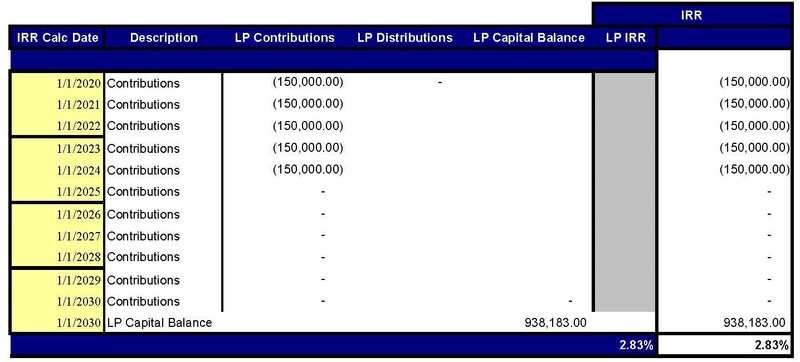
    Thank you for that information and providing me with a sample. So based on the spreadsheet that you posted, am I correct in assuming that if we pay 150K in premiums for the first 5 years and no longer have to pay additional premiums starting in year six, by the time we reach year ten, the cash value will be 938,183? Money going in is 750K, cash value of 938K over a period of ten years?

    I entered those numbers in my IRR spreadsheet and get an annualized return of 2.83%. Is there someplace in which my schedule is incorrectly configured?
  • Investor · Saint Paul, MN · Member since 2015 · 663 posts · 512 votes
    6y

    @Brook Vosler

    Simple answer get $1 million life insurance term policy when you’re done. No big deal. Very cheap if you’re healthy.  

  • Scranton, PA · Member since 2017 · 168 posts · 137 votes
    6y
    Originally posted by @Todd Goedeke:

    @Aaron K. I agree. To shed light on the subject of insurance commissions, there are two parts to commissions; target premium commission and the commission on the excess. The total of both can be around 10% of total deposit.

    Has yourself If life insurance is such a great investment why do you never hear from people saying how much money they made off their policy?

    Anybody can use software to produce a graph. Legally there is about 5-8 pages of disclosures that should accompany a graph. Also an insurance company name should be present to prevent insurance agents from printing misleading graphs and charts.

    Just a heads up from someone who gets paid commissions on life insurance policies. “Target premiums” or the premium paid into the underlying policy have the highest commissions and what you call “excess” is the least commissioned money that goes into a policy. There’s no 10% average. The more money an agent is able to write into your policy on top of the target (or base) premium- the bigger commission and fee discount you get on the policies. 

    Good agents that now how to structure cash into a policy for clients earn less than people who write basic 100 year payment whole life policies. It may not seem like a big deal, but I do it on EVERY permanent policy I write. Even children’s policies. I take a hit on commissions so my clients can build more cash value quicker with fewer fees (as long as it’s a feasible option and often it is). 

    Commissions are not that different on term policies and permanent policy target premiums.  

Join the conversationCreate a free account to reply, vote on answers and follow this thread.