Real Estate Agent · Harbor Springs, MI · Member since 2017 · 5 posts · 2 votes
As a real estate investor and financial advisor I usually understand the mindset of other investors. Individuals in real estate are usually more willing to take on risk which is often rewarded. I understand REI's usually deploy a large portion of their capital to advancing their real estate portfolio... but it seems like they dislike or do not understand life insurance. When I start to work with REI's I expect them to invest less of their income into traditional retirement accounts. I also expect them to find value in benefits like life insurance and disability, but that has not been my experience. Why is this?
I also understand disagreeing with the infinite banking concept Brandon has talked about with whole life insurance but it seems like the large majority avoid life insurance in general.
Those in the industry full time... help me understand! How can I better convey the idea to real estate investors?
I also expect them to find value in benefits like life insurance and disability, but that has not been my experience. Why is this?
I also understand disagreeing with the infinite banking concept Brandon has talked about with whole life insurance but it seems like the large majority avoid life insurance in general.
Most of us I would think have the best value insurances out there - term life, liability umbrella policies and liability hazard insurance per property.
My wife and I are literally insured for $2.5M for less than $1000/yr with term life and umbrella insurance. Then there's the millions in property hazard liability coverage we get for tens of dollars per month per property.
Disability insurance? High cost for already having passive cf that more than covers my not 'working.' Too hard to quantify something that's a % of a w2 a lot of us don't have anyway.
Same with long--term care. High cost. If I go into a home, I'll own it most likely or buy it while there. We have a different mindset than employees.
And don't get me started on whole (hole) life. The costs and fees are outrageous. Why are producer commissions so high? If I want to invest the difference in premium costs vs term, I'll invest it. My heirs will also get to benefit from the 'cash value' of those separate investments when I die.
in summary, we're not anti-insurance. We can do cost/benefit analysis and are anti high-cost/ low benefit.
@Brook Vosler I'd say real estate investors aren't as big on life insurance as the general public because it is seen as unnecessary, if you've set up your portfolio of rentals well, it doesn't need one specific person to be run properly, the benefit to their family would be the portfolio they leave behind.
@Aaron K. There are certainly things you can do to simplify the process of passing on a portfolio, but in my experience that is never a seamless process.
I may be underestimating the average investor, but I question whether most people set up their portfolio in a way that an inexperienced family member could be set up for success.
@Brook Vosler doesn't matter, perception is reality. If an investor has a portfolio worth 100s of thousands or millions they think that even if their heirs are total screw ups they still have tons of assets they could sell if needed.
The reality is whole life policies in general are overly expensive, terrible investments and unnecessary for almost anyone but the ultra wealthy who may actually benefit from the tax benefits because their wealth is greater than the estate tax exemptions in place these days.
Its not just real estate investors, its everyone, myself included who are not huge fans of those instruments. Buy a term policy for pennies on the dollar. Save the difference yourself. It gives you more flexibility and better return potential.
I also expect them to find value in benefits like life insurance and disability, but that has not been my experience. Why is this?
I also understand disagreeing with the infinite banking concept Brandon has talked about with whole life insurance but it seems like the large majority avoid life insurance in general.
Most of us I would think have the best value insurances out there - term life, liability umbrella policies and liability hazard insurance per property.
My wife and I are literally insured for $2.5M for less than $1000/yr with term life and umbrella insurance. Then there's the millions in property hazard liability coverage we get for tens of dollars per month per property.
Disability insurance? High cost for already having passive cf that more than covers my not 'working.' Too hard to quantify something that's a % of a w2 a lot of us don't have anyway.
Same with long--term care. High cost. If I go into a home, I'll own it most likely or buy it while there. We have a different mindset than employees.
And don't get me started on whole (hole) life. The costs and fees are outrageous. Why are producer commissions so high? If I want to invest the difference in premium costs vs term, I'll invest it. My heirs will also get to benefit from the 'cash value' of those separate investments when I die.
in summary, we're not anti-insurance. We can do cost/benefit analysis and are anti high-cost/ low benefit.
@Brook Vosler yea kind of a straw man question...whole life went way of the dodo for most when 401ks etc started.
We have plenty of term insurance as business partner, spouse etc. crazy not to and so I guess the answer is 1) you are dealing with idiots and/or 2) they don’t want what YOU are selling
Perception is reality is completely true. My wife and I just hired a financial advisor (her idea) last year to set up IRA and college funds for the kids. He is a great guy and help us with cleaning up the unnecessary insurance coverage we had from other years. He has saved us some money and given my wife piece of mind as we now have "safety measures" in place. He is not a real estate investor and tries to steer me away from REI. He perceives it a too risky. He is not going to change my mind and be versa. So we agree to disagree. My wife's happy, so I'm back to looking for the next deal.😀
I didn't realize that was a thing among real estate investors but I'm guessing it's because average Americans have very little savings and they want the peace of mind knowing their family will be taken care of when they're gone. If you're a successful real estate investor with good cashflow and equity.... THAT'S your "life insurance". I got a 20 year term policy about 15 years ago because 15 years ago I had very little net worth. When my term is up I will review my finances and decide whether it's worth doing another term. It will also be more expensive this time around than when I was a young buck so that will factor in. If I had to guess, I won't get it again.
@Brook Vosler I like REI and dislike while life because I understand math. I'm a huge fan of term life, own-occ disability, and umbrella insurance for the same reason.
I think you can set aside a small portion of your funds to deal with it. After all, the proceed from life insurance is tax free. I mean people buy gold, silver, lego, rolex too, it's just another way to diversify.
Family men and women who die without life insurance don't just die. They abscond with the funds. Term life insurance is so dirt cheap that it's criminal not to have it.
@Brook Vosler I’m a big fan of term life insurance and have it in place shortly past when all our kids are grown. Inexpensive and worth the money. I decided not to buy too much since I’m married, otherwise I’d have to sleep with one eye open!
Many insurance companies struggle insuring REI's without a W2 for the same reason they don't want the coverage. If a REI dies, their income doesn't go away.
Every REI should have a term living benefit policy while building up the portfolio. By the time you have a large working portfolio and steady cash coming in, you're already self-insured. The income replaces retirement funds and income for kids.
To build something that really is a retirement/ life insurance replacement - it needs to be self sufficient. Property management or at least the plan to be able to transition to that. If the plan is to have your spouse/ kids sell the properties you’ll need a chunk of cash to hand down as well. Good planning can help negate the need for life insurance- there’s just rarely good planing.
The average Multi-property REI at age 70 is not looking for $30k under a rock to cover burial expenses. The person who planned on getting there, but only has 2 houses later in life and little cash might struggle.
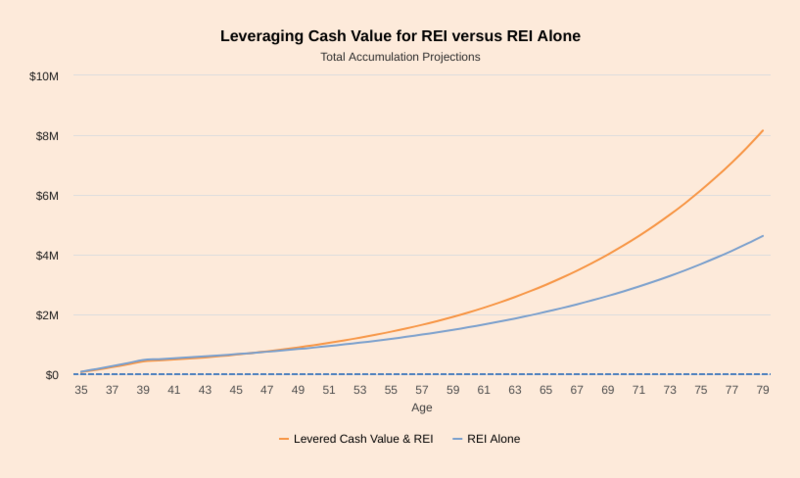
Whether you like life insurance or not, you can build more wealth by leveraging the cash value of a maximum over-funded life insurance policy to invest in real estate. You're putting your money to work in two places at one time.
Not sure what this graph is. But your position is a combination of whole life policy and RealEstate investing is better than (that same monthly spend apples to apples in month dollars invested) term life and RealEstate? Hmmmm?
Correct. The model used to generate the output used in the graph is an A vs B comparison using apples-to-apples inputs. Its hard to tell by the scale, but the sum of life insurance cash value and real estate starts off at a disadvantage due to the charges in a life insurance policy. But since your money is working in two places at one time and earning a higher rate of return, the power of compounding interest eventually takes over.
Would you rather have 85% of your money growing at 9% or 100% of your money growing at 6%?
@Anthony Gayden why do you have a life insurance policy on a 10 month old child? Life insurance is not an investment for college. Was the policy your idea or the life insurance agent?
@Thomas Rutkowski are you a licensed insurance agent? If so would you reveal what your commission is on a whole life policy?
I was a licensed agent years ago and know all about how insurance companies come up with convenient stories that try to explain why people should buy insurance as an investment.Explain how insurance companies and their executives get rich by siphoning off huge fees with insurance policies.
@Anthony Gayden why do you have a life insurance policy on a 10 month old child? Life insurance is not an investment for college. Was the policy your idea or the life insurance agent?
Todd, I am an insurance agent. I’d like to comment on this. You’re right. You do not take a life insurance policy out on a child for the purposes of college. You take it out on yourself. That way, if you pass, the insurance company will cover the full amount of the death benefit. You don’t need to pay for college when a child dies. I do unfortunately know what you have to pay for when a child dies. You realize how fragile life is.
My daughter has a sizable whole life policy. One another agent makes a commission on! Every life insurance product pays a commission. I took it out mostly, because if she gets sick or decides a career path that is uninsurable - she won’t have to worry about it. The policy will be worth several times what I paid for it. Most of my practice is selling insurance to people over the age of 60. Occasionally it’s for tax planning, but mostly it’s because they lived their lives underinsured and they either have a business endeavor that requires it or they’re coming to terms with mortality and haven’t saved enough. My daughter will never have to worry about her kids paying to cover her final expenses.
@Todd Goedeke You may have been an agent at one time, but you don't know the difference between a minimally-funded and a maximum over-funded policy. If you did, you wouldn't ask such a ridiculous question. Not all life insurance policy designs are the same.
The graph I showed includes the commissions and the strategy still works. So if you're making more money, who cares what the agent is making?
@Thomas Rutkowski it is still nice to know where your insurance salesman's incentives are aligned, pretty much everyone here knows an RE agent makes 3% or less on a transaction. I'm sure people getting ripped off by "financial advisors" selling mutual funds would like to know their commissions. I'd like to know what a commission looks like for this part of the insurance industry, as I'm sure would many others.
I'm of the same mindset regarding whole life insurance and the cash value which can be leveraged and deployed into new RE investments while still maintaining the insurance benefits. Whole life policies can get expensive...
@Aaron K. My incentives are aligned to help my clients make money. Maximum over-funded policies have as little death benefit and commission as you can legally get in an insurance contract. This is what an investor needs for this type of strategy to work. Unfortunately, these forums are filled with people who see insurance as a one size fits all and lump all agents and life insurance into the same category. The math works.
Commissions on a maximum over-funded policy are less than 5% of the premium. As I stated in my original post above, the premium to cash value ratio in a maximum over-funded policy should be about 85%. When its not, that means that the death benefit is higher than it needs to be and so are the fees and expenses of the policy.
The Double Play math is simple. Imagine if your first premium was $100,000. Think big. $15,000 of that is lost to the policy charges. You are starting with $85,000 of cash value. Premium minus expenses equals cash value. You can get a line of credit against that cash value at prime, but let's just say 5% to keep the math simple and be conservative. If you can take the proceeds of that credit line and invest it at 10%, you'll make $8,500 the first year. Your interest is a business expense, so you end up with $4,250 of taxable income.
If you're in a 40% tax bracket, you'll write a check to the IRS for $1700, leaving you with a net of $2,550. The cash value of the policy also earns a dividend during that same period, so assuming that is 6%, your cash value grows by $5100. The total growth is $7,650.
Compare this with investing $100,000 of your own cash directly in the same investment earning 10%. This time all $10,000 is subject to income taxes, so your net after tax is $6,000.
As I stated in my first post: would you rather have 85% of your money making 9% or 100% of your money making 6%? The graph clearly shows the benefit of this planning approach over time.
This is just a simple example. Depreciation in real estate requires a little more sophisticated modeling, but it still works. And you can see that a poorly designed policy with less than 85% cash value would negatively impact the results.
@Brook Vosler investors don't like life insurance because they are sophisticated and understand it is not a good deal. They understand that fees, including sales commissions are ridiculous. Of course that is why insurance agents and financial planners try to force it down your throat.
At the end of the day, insurance companies invest in bonds, mortgages and some in the stock market. So insurance companies have no special formula to reduce risk and increase return. They just add a fee layer and tie you into a product that is impossible to get out of, without loosing everything you put in.
The "be your own bank" nonsense it just another angle to try to sell the insurance. You can only "be your own bank" after you have funded the policy with massive amounts of money. You would be better using that cash to invest in real estate, then pulling it out through long term financing.
@Thomas Rutkowski I have trouble with these "results not guaranteed" graphs that are just sales tools. How much more could someone have made if they reinvested everything into REI - way more that is the point.