It's normal for the market to slow down in winter, especially right around Thanksgiving and Christmas. This year feels different, and I'm hearing many landlords complain they can't find renters. My market is humming right along, except for the higher-priced single-family homes.
The linked article provides some good information.
What are you seeing? Has it slowed? Reversed? Stayed the same?
@Nathan Gesner Don't believe everything you read, especially on the web. Most of our properties are in the fastest growing county in the state. Lots of building going on, and lots of jobs. The number one employer is the state government, because the capital is next door, and the number two employer is the federal government, both are not cyclical and don't fluctuate, if anything their job base increases. Other large employers are health, education, as well as transportation and warehousing. There are drops in other areas including big cities and rural areas and areas that are losing population. Pittsburgh's current population is 302,000 (US census estimates 2024) whereas in 1950 it was 676,000. Philadelphia's current population is 1,600,000 versus 2,071,000 in 1950. Pennsylvania is still the fifth largest state after CA, TX, FL and NY and covers a large area with different sub-economies. I've looked at the fastest growing areas in other states and while I think you can profit from real estate everywhere, perhaps with a different strategy, investing in the fastest growing areas in the state seems to me to give an edge or a push in the right direction.
I had five rentals up for clients in the past few months, and only three got rented. A fourth got four accepted clients, and during the lease signing, they all bailed and the client smartly pivoted to MTR. Things are definitely moving slower in the higher price points. I have a $5,500 rental going up soon for 1/1 occupancy (the front unit is rented for $6,100) so I will be able to judge a little off that, but winter months are always slower here.
In my main area, fair priced units usually last under 15 days on the market long. Typically there are only a few available at a time. Right now there are definitely more units available than average, but they aren't staying on the market for extremely long. Instead of under 15 days, they seem to be renting in the 15-30 day range.
Prices appear solid. Mid-range units have held firm in pricing. If anything, there appears to be a condensing of the price range. I'm not seeing many units at the lower or higher end of the typical price range. Pricing seems to be centering around the 50-80 percentile.
The units that used to aim high on pricing have dried up. Those are the ones that would stay on the market for 90+ days. I'm not seeing many of those.
I can't imagine rent going down too much. In my area the supply is always going to be limited. Few people would buy to turn into a rental. At current price/rent levels they'd be negative cash flowing a minimum $1000 a month and likely much more. With the new rent control policies, there is zero incentive to lower rent as it may take years before you could recoup that with the minimal increases they allow.
We have not experienced any rent decline and rents are continuing to increase. Some rents have gone up as much as 22% this year and 40-50% or more since Covid. The last rental we filled this month was vacant for about 2 weeks, then filled at a higher rnet than the previous renter at that location by 18%. Costs have escalated sharply, water up 25%, electric up 30% and natural gas up 33%, and at one property insurance went up 400%. People are staying more, moving less since COVID, which means less rental inventory, increased demand and higher prices particularily in the lower and medium priced markets. Have seen some price reductions from asking rents or higher priced segment of the market. We try to keep good tenants for long term, an dhave several 30 year tenants and a 24 year tenant and average 12.5 years over the portfolio of existing properties. I can't remember the last time we lowered any rent might have been in 2008 or earlier.
Why are your rents increasing so much right now? Everything I've read shows PA peaked in 2022 and has dropped 5-6% since then. Are your long-term renters just now catching up with the market?
@Nathan Gesner Don't believe everything you read, especially on the web. Most of our properties are in the fastest growing county in the state. Lots of building going on, and lots of jobs. The number one employer is the state government, because the capital is next door, and the number two employer is the federal government, both are not cyclical and don't fluctuate, if anything their job base increases. Other large employers are health, education, as well as transportation and warehousing. There are drops in other areas including big cities and rural areas and areas that are losing population. Pittsburgh's current population is 302,000 (US census estimates 2024) whereas in 1950 it was 676,000. Philadelphia's current population is 1,600,000 versus 2,071,000 in 1950. Pennsylvania is still the fifth largest state after CA, TX, FL and NY and covers a large area with different sub-economies. I've looked at the fastest growing areas in other states and while I think you can profit from real estate everywhere, perhaps with a different strategy, investing in the fastest growing areas in the state seems to me to give an edge or a push in the right direction.
Seasonality always comes into play! Some areas are seeing declines while others are holding steady. I always remind myself that nothing can be as bad as the rent decline in 2020-2021 in major cities such as SF..
I just rented a SFR here in the greater Seattle area. It took a little longer but the rental prices are remaining the same. There are some areas nearby still seeing increases.
It's normal for the market to slow down in winter, especially right around Thanksgiving and Christmas. This year feels different, and I'm hearing many landlords complain they can't find renters. My market is humming right along, except for the higher-priced single-family homes.
The linked article provides some good information.
What are you seeing? Has it slowed? Reversed? Stayed the same?
Yes, it was a slower summer than normal. Rental inventory is up and rates declined in a lot of areas of Orlando / Central Florida. With that said, the properties that were prepped and in good condition still rented quickly and on the higher end of the market range. Conversely, those who just wanted to relist without any repairs, or continued to try to increase rent despite the market shift are struggling to find tenants. With that said, we have seen an uptick this month of applications and our DOM has fallen 8 days in November.
It's normal for the market to slow down in winter, especially right around Thanksgiving and Christmas. This year feels different, and I'm hearing many landlords complain they can't find renters. My market is humming right along, except for the higher-priced single-family homes.
The linked article provides some good information.
What are you seeing? Has it slowed? Reversed? Stayed the same?
Jacksonville, FL has seen rents drop in many areas due to a ton of new supply coming into the market. We're seeing historically insulated submarkets to new construction get effected because of how much there has been as a percentage of existing stock. It does seem to have plateaued in the last 12 months or so, but units are taking longer to lease then they did 2-3 years ago for sure.
Very location-specific. Interesting that your market is slowing, but Chris's market is doing well around Orlando.
Jacksonville hasn’t been building as many total units as Orlando, but Jacksonville has been top 10 in the nation for building new housing units as a percentage of current stock. So percentage wise Jacksonville has seen a crazy amount of new supply being delivered which has affected rents.
We also manage a portfolio of new construction homes in Palm Coast and Palm Bay and rents for those homes have dropped $25-75 depending upon floorplan and submarket and they’re taking longer to lease up compared to 2 years ago.
A lot of Florida is having similar issues of stagnating or dropping rent, but it definitely depends on market, submarket, asset type, etc.
Our rents haven't been decreasing - but they haven't been going up either. Still have a few people thinking it's 2021 and trying to charge 2-300 more than the market - those are sitting. Fairly priced units will sit for 2 weeks or so.
I would say things have slowed or even decreased very slightly.
The crazy thing is - insurance costs have increased significantly here and property taxes just went up as well. It does make the local area not as "hot' for investing as it used to be.
New construction is up, a couple luxury neighborhoods (500k+) and a couple new mid sized apartment complexes (1000+ f/ 1 bedroom). And there's a 147 unit section 8 apt complex being developed as well - in an "affordable" area.
DOM for selling is up to ~80 days. I actually have a house on the market that has been listed for about 60 days - still gets interest and a couple offers, but nothing worth entertaining (if it doesn't sell, I'll just rent it out again). Solid house and a good location, so a little surprising to me. But with the election and the time of year, it makes sense.
Very location-specific. Interesting that your market is slowing, but Chris's market is doing well around Orlando.
Jacksonville hasn’t been building as many total units as Orlando, but Jacksonville has been top 10 in the nation for building new housing units as a percentage of current stock. So percentage wise Jacksonville has seen a crazy amount of new supply being delivered which has affected rents.
We also manage a portfolio of new construction homes in Palm Coast and Palm Bay and rents for those homes have dropped $25-75 depending upon floorplan and submarket and they’re taking longer to lease up compared to 2 years ago.
A lot of Florida is having similar issues of stagnating or dropping rent, but it definitely depends on market, submarket, asset type, etc.
Wouldn't jacksonville total unit build be high in if the percentage in relation to current stock is high? Given that Jacksonville has one of the largest populations in the country. Just curious.
@Basit Siddiqi Jacksonville is the 38th largest MSA by population just going off Wikipedia list from July 2023. Orlando is 21st in the list.
Truthfully I haven't compiled a list of the list of the number of total units being built for all cities, but when I would see the lists of the top 10 that Jacksonville was on as a percentage, many of the other cities had higher unit counts as well, like Nashville, Phoneix, Austin, etc.
I don't remember seeing Orlando being on those same lists, so I couldn't compare directly the total number of units being built for Jacksonville vs Orlando. Often the data companies put out the lists and you have to pay to access the data that would allow me to get more specific like this, so I can't do so.
Jacksonville probably is building more total units than some other larger markets, but I just don't have access to that information. So I may have misrepresented this a little, but that wasn't purposeful. My main point is that regardless of its size percentage wise its very high which has impacted Jacksonville a ton.
@Chris Grenzig The chart on Wikipedia is interesting, its showing the population gains/losses from 2020 to 2023. For each of the SMA you can see which areas are growing and which areas are declining. Within each MSA there are pockets of increases and decreases, which are counter to the overall growth or decline. But for me I'd rather be in a growth area than a declining area, but thats just me.
@David Krulac that's for sure, I wasn't really talking about population growth, talking about the amount of new supply being built which impacted the overall supply and demand. But you bring up a good point that supply could be at record levels if demand is matching that same pace. Unfortunately for us in Jacksonville, demand was outpaced by supply because of the low cost of capital, and a huge surge in rent growth from 2020-2022 so the feasibility of everyone's projects looked great. Jacksonville still seems to have continued job and population growth, but without actual hard data, it seems apparent the supply far outstripped the short-term demand. I think it will meet long-term demand since new construction starts in the past 1-3 years have dropped off a cliff, so new supply coming onto the market from 2025-2028 will be significantly lower and allow for absorption of everything and most likely we'll start to see organic rent growth again in the 2-8% range as we saw in 2016-2020.
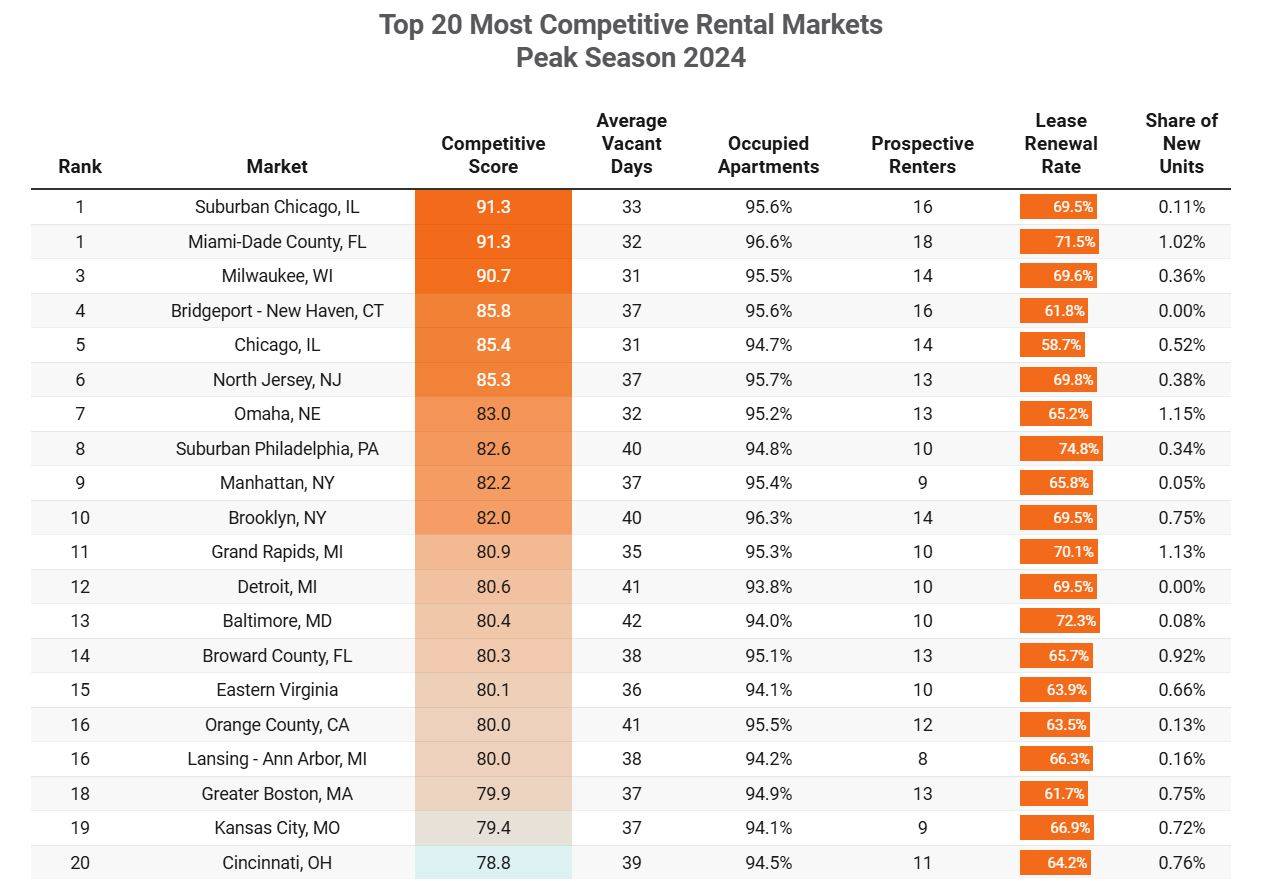
Milwaukee rents continue to go up, we are now the 3rd most competitive market in the US, ahead of NY and LA.. And only 0.36% of the supply is new units - meaning very little is going to change.
It's normal for the market to slow down in winter, especially right around Thanksgiving and Christmas. This year feels different, and I'm hearing many landlords complain they can't find renters. My market is humming right along, except for the higher-priced single-family homes.
The linked article provides some good information.
What are you seeing? Has it slowed? Reversed? Stayed the same?
During this time, many renters drop out of the rental pool (looking for properties). Holding out for a strong or higher rent during this time can cost you money. (months on the market) I sometime offer an incentive like 1/2 off first month's rent to stand out. Alot of new renters have a tough time coming up with sec dep and rent during this time of season especially with xmas. Maybe run a black friday special :)
One with rents continuing to increase and 0%-1% vacancy rate. Always full, fat, and happy in this market.
Other with rents continuing to increase, but with 10% vacancy rate. This market was decent until a month ago, where everything slowed down. Expecting a pick-up for January 1st lease expirations.
We are feeling it's slower. Have had some big remodeled units that unfortunately came up late in the year. Some unexpected vacancies. There's a lot to be said about this but having process in place to mitigate turns going bad helps. Example mentioned already of shifting the leases to term out in the summer. May- July is good. Side note I have one landlord friend who actually has his renew in the middle of winter so they can't find another place. Another pro tip. Start communication about 2 months prior to the lease ending sending out renewal emails and following up with a text or a phone call to confirm. In addition to doing regular inspections as soon as someone gives notice due and immediate inspection to determine if the unit is being kept up decent or if you need to plan on some repairs before it is turned. Perhaps they are things that could be done while the other tenant is still there?
Just increased rents as I do every year. More demand than supply. I buy where people want to live, not where property is cheap due to low demand.
True similar to the real estate market. In fact, our market is approx. 3 months of supply vs 6 months being a balanced market. Based on Absorbtion rate.