Service Animals & Emotional support- Is animal restriction dead?
Real Estate Broker · Watertown, NY · Member since 2016 · 1k+ posts · 1k+ votes
Hey guys,
Is anyone noticing a huge uptick in the amount of people applying for apartments who have service and emotional support animals? In just the last 3 months, I swear 7/10 people have had one of the two. I even had one applicant tell me they had 4 service dogs! Literally a small gang of dogs surrounding them at all times.
I have no issues with people who have these, but it feels like it's getting to the point where EVERYONE has one. We even have to disregard our insurance companies strict breed restrictions and risk being canceled if there's ever a claim.
What's everyone doing to offset the risks that are being forced upon us with this new phenomenon? Obviously animal proofing during the rehab is one, but what else?
@Jennifer J. you can't charge a deposit, no pet rent, nothing.
I've studied this issue for almost ten years and it's definitely getting worse and the government is doing nothing to help. Some states have instituted penalties for anyone falsely claiming an emotional support animal or service animal but they provide no guidance on how to file a complaint.
The easiest solution is to hand this over to www.PetScreening.com and let them deal with it. Their service is 100% free to the Landlord so why not let them do the work? They are experts in the law and will at least weed out most of the fraudsters, which takes care of about 60% of them. The remainder may make it past the screening but at least you'll have their animal information on file and can ensure it's kept current.
Virtually anyone can "prescribe" an emotional support animal. Psychologist, family doctor, family counselor, marriage counselor, and even a pastor. It needn't be a licensed medical practitioner and they're not required to have any medical training that qualifies them to identify the emotional "disability" that the individual suffers from. You feel sad? Get a dog! Things going poorly at work? Get a dog! You heard someone died in the war zone 27 miles from your location? Get a dog!
The most interesting part is that these people suffering from disabling emotional problems are usually not seeking any form of treatment. They see a doctor or counselor once, get a dog prescription, and then never go back. Why? Because they don't actually have a disability and they're not actually trying to heal anything. They just want their pet.
Even though the animal is essentially considered a medical device in the eyes of the law, they still have to meet basic responsibilities like keeping it leashed, not allowing it to damage the property, cleaning up after it, keeping it quiet, not letting it threaten others, etc. I recently kicked someone out because their ESA lunged and snapped at two different people on two different occasions. If the animal does not abide by the rules, you can absolutely require them to remove it.

Dan, how would you deal with this situation in a multi-family setting? Wouldnt raising rent in only one of the units be perceived as discrimination?
Dan, how would you deal with this situation in a multi-family setting? Wouldnt raising rent in only one of the units be perceived as discrimination?
Thanks for your reply @Dan H.!
Lets say you have a quad (I am looking at quads right now as a possibility), all units rent for the same amount. One of the tenants pulls an ESA card but has no other issues. It seems to me that in this scenario, if the rent is raised, it could be concluded that due to lack of any other infractions - the rent raise was caused by attainment of ESA. Would that be considered illegal?
Thank you for all your help man!
Edit: The rent was raised above the rent of other identical units in the quad.
As others have stated, ADA and ACAA are not relevant in this context. ADAs have rules for libraries, hotels, restaurants etc...and ACAA (Air Carrier Access Act) governs the airlines and forced the airlines to allow passengers to fly with their pets (cough cough ESAs). FHA is what governs prohibited acts by landlords.
Service Animals and ESAs are indeed different, but are lumped together due to these confusion, and because many people buy these $20 SA vests and put them on their pets, and start to walk them into libraries, restaurants, stores, clinics etc...and it's totally unfair to those who have a legit need since we as Landlords are so sick and tired of these ESA scammers.
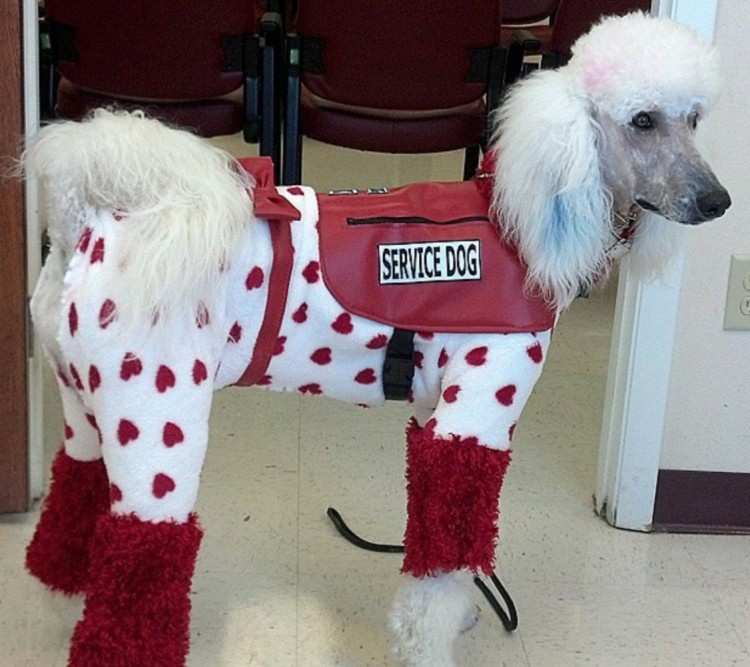
I also have an uptick of faked ESAs in the past year.
Usually people who themselves have no clear understanding of the laws.
Applicant: "I have two dogs and two cats, all emotional animals, so they cannot be denied".
Me: "What are emotional animals? Are your animals emotional or you emotional"?
During the application I explicitly ask them to fill in my ANIMAL section. It asked about type, breed, age, color, weight, mature height, mature weight, name etc etc etc...It stated that the animal section covers pets, service animals, emotional support animals, working animals, therapy dogs. ALL INCLUSIVE. I also state that the application is going to be binded with the lease agreement so anything falsified will be grounds for termination of lease. Any animals added after lease signing must be cleared and written permission obtained from landlord and information must be provided to landlord prior to occupancy so that landlord may verify and consult with property insurer. If they pull the I've got an ESA a month into occupancy I will absolutely kick them out not for having an ESA but for not obtaining prior written permission.
Having said that you can refuse ESA under FHA there are a number of exceptions such as if causes financial burden on you, if you have less than 3 properties, if you are living in one of the building apartments, I don't have the full list and wording but look it up.
I also ask for verification from their doctors, but I can't insist. Florida just had a bill (1128) a few months ago that looked like it was going to pass by requiring ESA to have their primary doctor endorsement then suddenly the bill died. Sad...
I also would make sure their faked ESA letters are active and current. If inactive force them to pay again to get a new one. Ask for vaccination records, ask for bite history, your insurer most likely need that.
OK, so a lot of people are wondering, what does it take to get these online ESA endorsement letters? HOW LOW IS THE BAR? ARE THEY LEGIT?
So I actually went ahead to one of those (there are MANY websites) and they do not even pretending because their websites says
"AVOID PAYING ANY PET FEES"
and "FLY WITH YOUR PET WITHOUT HASSLE"
and "5 MINUTES TO TURN A PET INTO AN EMOTIONAL SUPPORT ANIMAL GURANTEED!!!"
So bear with me a bit as I take you through the steps on what it takes.
First, you are asked to enter some basic information, your name, age, gender, email address and whether you have a pet at this moment, what kind of pet and it's name.
Next, you have to fill out a fairly long list of bogus questionnaire, basically to establish that you have some sort of "anxiety". Here is such a questionnaire below. Answers are Yes/No or scale from 1 to 5.
Describe your feelings in the last 30 days
In the past 7 days
Additional Question 1: Describe your happiness
Additional Question 2: Describe your confidence level
Additional Question 3:Describe your sleeping patterns
Additional Question 4: Describe your social skills
Additional Question 5: Describe your activity levels
Additional Question 6: For Travel Letters - How will your pet be traveling with you?
Once these questions are answered, you are asked one more question.
Describe the reasons why you need an Emotional Support Animal AND what specific symptoms you are hoping to alleviate by having your ESA with you.
Get this, my answer to this question was "I want to avoid pet fees when moving to a new apartment and it would be great to go to restaurants with my pet". I wasn't kidding, that's what I entered.
I hit NEXT, then it tells me I do qualify for ESA letter and asked me to pick a package and price.
YUP, it's THAT easy. Basically you self diagnosed and say you needed one, then you get a letter rubber stamped by a professional.
Also, the reason ESA and true service animals are often lumped together in rental contexts is because HUD lumped them together as "assistance animals".
The United States Department of Housing and Urban Development (HUD) uses the term "assistance animal" to cover any animal that works, provides assistance, or performs tasks for the benefit of a person with a disability, or provides emotional support that alleviates one or more identified symptoms or effects of a person's disability. (FHEO Notice: FHEO-2013-01 at page 2). An emotional support animal is one type of assistance animal allowed as a reasonable accommodation to a residence with a "no pets" rule.
Whats relevant here is HUD's FHA reasonable accomodations. Not ADA or ACAA.
A follow up question to my last post, in terms of how HUD has grouped service animals and ESA together and just put both under the umbrella of "assistance animals". Does that mean as far as HUD's fair housing is concerned, there is no distinction in their policies and guidelines on how SA and ESA owners are to be treated/screened/verified by landlords?
I find that many applicants - most likely because they are not legit SA/ESA, use many terms interchangeably.
"I have a support animal".
"I have a service dog providing emotional support".
"I have 2 dogs and 2 cats, all providing support and services".
In these cases where you are not even sure what type it is, how far can a landlord inquire about the animal and what it does to the applicant without crossing any lines.
I have often heard that for a service animal, the only questions one can ask are limited to (a) whether it's needed due to a disability and (b) what task is the animal been trained to perform. That's it, and those two questions can only be asked when the disability or need is not obvious. The rules are explicit, you "cannot ask about the person’s disability, require medical documentation, require a special identification card or training documentation for the dog, or ask that the dog demonstrate its ability to perform the work or task". This is directly from the ADA web site. But this is ADA, which covers public facilities like hotels, restaurants, libraries, stadiums etc...it doesn't govern rental properties.
Yet HUD grouped SA and ESA into one class and does not seem to address the fact that SA and ESA are very different - a seeing eye dog is a true need and is trained to provide such service, an ESA is untrained and 99% of the time is a stun to get into pet free housing. Do we as landlords need to treat the two groups of animals differently because HUD doesn't?
Specifically. do you adhere to the ADA's service animal guidelines because HUD doesn't have one - as far as what you can and cannot ask just to be on the safe side?
I see many landlords ask for ESA documentation such as a verifiable actively licensed MHCP's prescription for the ESA, myself included. I kept wondering if this is allowed by HUD for all assistance animals, does it mean we are allowed to ask for medical documentation if an applicant claim to have a service dog and it's not obvious to us why, and would like to see documentation?
I do believe that, at most, they can only request an accommodation for one animal per person. So, one person with four pets is right out.
Not necessarily. While I think 99% of the ESA claims are total BS, I cannot deny more than one animal out right.
You can certainly have a service animal and an emotional animal. A person that's blind needing a seeing eye dog and also some sort of anxiety disorder needing an ESA, and are two different animals.
While this is unlikely, I did have several inquiries recently from potential applicants saying they have multiple service animals. The main issue here is they don't even know the different between service animals and ESA, they are mostly likely repeating what their friends told them "just say you have service animals and they will back off". So when I told them I gladly accept service animals and emotional support animals, then went on to tell them their respective definitions and how I just need to have them provide a doctor's letter for me to call and verify, they never bother to follow through with the application.
But going back to whether multiple ESAs are legal, I did a search and there doesn't seem to be specific clauses on HUD about whether multiple assistance animals are OK, but I found this:
Michigan State College Of Law Animal Legal and Historical Center FAQ on ESA
At least this is the interpretation from a legal profession and on item #14 of the FAQ:
While there do not seem to be any cases dealing with the issue of multiple emotional support animals, the basic requirements for this reasonable accommodation would still be the same. In other words, if a person were claiming the need for multiple emotional support animals, then he or she would need documentation supporting this need from his or her physician or medical professional. The practitioner would need to provide documentation that each support animal alleviated some symptom of the disability.
So I guess technically one person can have multiple ESAs as long as the doctor treating the patient prescribe that.
One other thing I found while reading through this FAQ is the following.
HUD does not cover this issue specifically in its notice to housing providers. However, the underlying purpose of the FHA is provide an equal opportunity to use and enjoy housing regardless of disability. If a tenant cannot have a particular guest over who uses a service or assistance animal, then the tenant may be deprived of the ability to use and enjoy his or her dwelling based on the presence of a disability. There do not yet appear any published legal cases that have reviewed this issue. In 2011, the United States District Court for the District of Nevada entered a consent decree (a settlement of a lawsuit where a party agrees to take an action without admitting liability) on a this issue. The complaint in the underlying case alleged that the defendants declined to allow a friend of their tenants who uses a service animal to visit the tenants' apartment. The defendants then evicted the tenants based on the service animal's presence in the apartment. As plaintiff, the United States alleged that this denied the tenants the "full enjoyment of their apartment at Defendants' apartment building." See U.S. v. DeAngeli, Case No. 3:11-CV-00796-RCJ-WGC (July 8. 2013), available at http://www.justice.gov/sites/default/files/crt/legacy/2013/10/30/deangelisettle.pdf. As part of the agreement, the defendants had to agree to comply with the Fair Housing Act, create a policy for assistance animals in their apartment building, undergo education and training on the issue, and abide by other requirements of the consent decree.
I am more worried about a guest's ESA. You can't screen a guest. So if your lease allows a guest to stay for say 7 days a month, technically you have to allow that guest who has an ESA to visit with an ESA without your having an opportunity to verify. As a matter of fact, your tenant may have a dozen close friends all having ESAs who visit from time to time. How would any Landlord do? There is really no defense against such abuse because there is no clause you can put in the lease to prevent that and there is no verification possible to guard against it.