First Flip in DFW — Seeking Advice on Buy Boxes, Pricing, and Profits

First Flip in DFW — Seeking Advice on Buy Boxes, Pricing, and Profits

Member since 2023 · 6 posts · 6 votes

Hey BP Community,

I’m gearing up for my first flip in the Dallas–Fort Worth area, and I’d love some guidance from investors who have been active in this market. I’ve been a long-term investor in DFW for about four years, but this will be my first value-add / non–move-in-ready property.

My goal for this project is to either flip and immediately sell or BRRRR, ideally pulling most (or all) of my cash back out while still breaking even on monthly cash flow. I’d love to find a property where both exit options are viable depending on final numbers.

Here’s what I already have in place:

• Team: Realtor, DSCR lender, flip lender, and a GC contractor

• Timeline: Planning to start looking seriously in early December

What I’m Looking for Insight On:

1. Best Purchase Prices to Target for a First Flip

For beginners in DFW, what price ranges have you found to be the most predictable and forgiving?

(Ex: ARVs in the $180–$260K range vs. $250–$350K entry points)

2. Recommended Buy Boxes

For those flipping consistently in DFW:

• What price points and ARV ranges are you targeting right now for beginner-friendly flips?

• Are cosmetic-only flips still viable or do most deals require deeper rehab?

• What rehab budgets or scopes (cosmetic vs. major systems) feel the most predictable in this market? (I am ideally looking for mostly cosmetic if viable)

• Do you prefer newer builds (1980s+) or are 1950s–1970s homes still worth it for flips?

• What property features do you avoid in your buy box (foundation issues, roof, cast iron plumbing, septic, etc.)?

• What spreads do you personally look for between purchase → rehab → ARV?

• What’s your minimum projected profit before you greenlight a deal?

• What’s your expected DOM for common ARV ranges in DFW?

3. Average Profit Margins in DFW

I know this varies widely but I’d love to hear what people are realistically netting:

• What’s a typical profit range for newer flippers?

• Any recent examples you're open to sharing (purchase / rehab / ARV / net)?

• Best and worst outcomes you’ve seen?

4. Best Areas for New Flippers

Which DFW submarkets have:

• Reliable comps for this type of investing 

• Strong buyer demand

• Manageable rehab scope

• Less competition from institutional buyers

Examples: Dallas proper, Plano, Arlington, Mesquite, Garland, West Fort Worth, - I’m open to all feedback.

Also: any submarkets to avoid for a first timer?

5. Additional Advice for a First-Time Flipper / BRRR Hybrid

Anything you wish you had known before your first value-add project?

• Red flags when evaluating a house or contractor

• What kills deals most often

• Tips for keeping holding costs under control

• Things you wish you had budgeted more (or less) for

Appreciate any insight, war stories, numbers, or guidance you’re willing to share. Thanks in advance!

3Reply
182 views

Most Popular Reply

Real Estate Broker · Coppell, TX · Member since 2011 · 5k+ posts · 4k+ votes
9mo

Sorry...way way too many questions for me.

Every situation different.

Probably not enough spread in most cosmetic flips....probably need the full meal deal.

Also that cuts out much of your competition if you can handle more.

Older and cheaper probably better depending on where you buy.

Be ready to act quick, be conservative on your ARV and plan on about double whatever you think your time on market will be. LOTS of experienced flippers busting their hard money loans, so that will kill your profits quickly if you pay another origination fee and all your holding costs.

See this reply in the discussion

8 Replies

Jump to latestLatest
  • Real Estate Broker · Coppell, TX · Member since 2011 · 5k+ posts · 4k+ votes
    9mo

    Sorry...way way too many questions for me.

    Every situation different.

    Probably not enough spread in most cosmetic flips....probably need the full meal deal.

    Also that cuts out much of your competition if you can handle more.

    Older and cheaper probably better depending on where you buy.

    Be ready to act quick, be conservative on your ARV and plan on about double whatever you think your time on market will be. LOTS of experienced flippers busting their hard money loans, so that will kill your profits quickly if you pay another origination fee and all your holding costs.

  • Diego AlvaradoBusiness Member
    Real Estate Agent · Flower Mound, TX · Member since 2016 · 294 posts · 139 votes
    9mo

    Hi @Juliette Holm

    James give you a very details inside, this is what I would like to add on his response.

    Property Selection Caveats (1970s Homes)
    While the general decade recommendation is sound, remember that every property needs close inspection:
    Plumbing Systems
    : Be extremely cautious with houses built in the 1970s. Many homes from this era have very poor original plumbing systems (e.g., polybutylene pipe), which can be a costly, project-killing surprise. For your first flip, you must fully understand and budget for this potential issue.

    Red Flags Checklist

    For the General Contractor (GC)
    :
    Delayed Quotes
    : Significant or repeated delays in providing you with bids and quotes.
    Poor Communication
    : Lack of responsiveness or reliable communication.
    Unreliable References
    : References that are difficult to contact, overly vague, or seem fabricated.

    Contractor & Project Management

    Pre-Vetted GCs
    : Have a small list of multiple General Contractors ready to go before you need them.
    Active Oversight
    : Commit to visiting the property frequently—at least once a day, if necessary—to monitor progress and preempt issues.

    Financial & Deal Focus

    The Deal-Killer
    : Be aware that the biggest hurdle in acquiring a property is often the seller's unrealistic price expectation.
    Conservative Estimation
    : You must be very conservative with your repair and renovation estimates.
    Don't Solely Rely on Othe
    rs: Do not rely only on your contractor's estimates.
    Collaborate and Verify
    : Collect as much information as possible from your entire team to form your own final, conservative budget.
    Realtor Expertise
    : Your realtor should be a key part of your team, and they must be knowledgeable about the house-flipping business and local construction costs, (hands-on experience).

    Next Steps

    The comment you made at the end of your original note is important and likely requires its own, separate discussion thread to give it the attention it deserves!
  • 🎉 Director of Events at BiggerPockets · Denver, CO · Member since 2016 · 424 posts · 436 votes
    9mo

    Hey all!

    The BiggerPockets team will be on the road in TX in January! Join Dave Meyer, Henry Washington, Garrett Brown, and more January 12-17 for our Texas Cash Flow Roadshow. We'll be stopping in Austin, Houston, and DFW and are planning community networking events, a strategy workshop, a live podcast, and an intimate supper club gathering.

    The live BiggerPockets podcast with Dave and Henry is just north of Dallas!

    Learn more and register at biggerpockets.com/texas

    I hope to see you there!

    BiggerPockets
  • Member since 2025 · 12 posts · 3 votes
    9mo

    Hey Juliette! 

    Not too many questions for me, I enjoy it... and get it too! 

    I'm from Texas, born and raised in Houston, and well.. we just have a lot to say! :)

    As I mentioned, I am in Texas and I work heavily on the lending + deal-analysis side (DSCR + flip funding), so I see a TON of first-timer projects come across my desk in the DFW market. Here's what I consistently see working for new flippers right now:

    • Purchase Range: Most first-time investors do best picking up houses in the $150–$230K range. Underwriting stays predictable and holding costs don’t snowball.

    • Target ARVs: The safest lane in DFW right now is $250–$350K ARV. Strong retail buyer pool, faster DOM, and cleaner comps                                                                            

    Buy Box (Beginner Friendly                            1965–1985 builds                                   Mostly cosmetic rehab           No cast iron plumbing                                        Minimal foundation movement                                                 Roof/HVAC functional or newer

    This combo helps keep surprises (and margins) under control.

    • Rehab Budget: Newer flippers succeed most often with $25–$45K cosmetic scopes. Once you hit $60K+ or major systems, the margin for error shrinks fast.


    • Expected Profit: Realistic net margins I’m seeing on first flips are $20–$35K, depending on discipline with the buy price + timeline.

    • DFW Submarkets That Are Still Beginner-Friendly:

    – Garland

    – Mesquite

    – Arlington

    – HEB / Mid-Cities

    – Some pockets of Grand Prairie & West Fort Worth

    These areas have strong comps and retail demand, which makes underwriting a lot smoother.

    If you want, I’m happy to run sample numbers or help stress-test your buy box from a lender’s perspective. I connect with multiple lenders in the Texas market and can point you toward options that fit your strategy. Just let me know — always happy to help another investor get started the right way.

    -Sheridan

    • Gilbert, AZ · Member since 2024 · 21 posts · 5 votes
      9mo

      @Sheridan Skrobanek this is very helpful even though DFW is not my market. Anyone from PHX area can share a similar insights? Thanks in advance.

  • Member since 2025 · 12 posts · 3 votes
    9mo

    Hey Vincent, Thanks. I really appreciate that. I'm glad it helped even outside the DFW market.

    A lot of these principles apply nationally, especially for beginners looking to scale with predictable numbers

    PHX has its own quirks though... tighter spreads, faster DOM in certain pockets, and a bit more volatility depending on build year. If you share your target price points or buy box, I'll do my best to give a general guidance from the lending/analysis side, if you want. 

  • Andrew PostellPro Member
    Lender · Fort Worth, TX · Member since 2016 · 8k+ posts · 6k+ votes
    9mo

    @Juliette Holm I will answer most of these questions here...but I do have some alarms going off in my head.  It is a little unusual for your team to not know these answers.  Maybe you didn't ask them?  But I would highly recommend for you to work with people who have experience in this space.  That way, you aren't going on the internet asking strangers for answers.  Your team should be definitive in their directions for you and provide sound reasons why.  We work with people that come recommended and have experience for a reason.  That's why alarms are going off for me.  Please be careful.  Here's your answers:

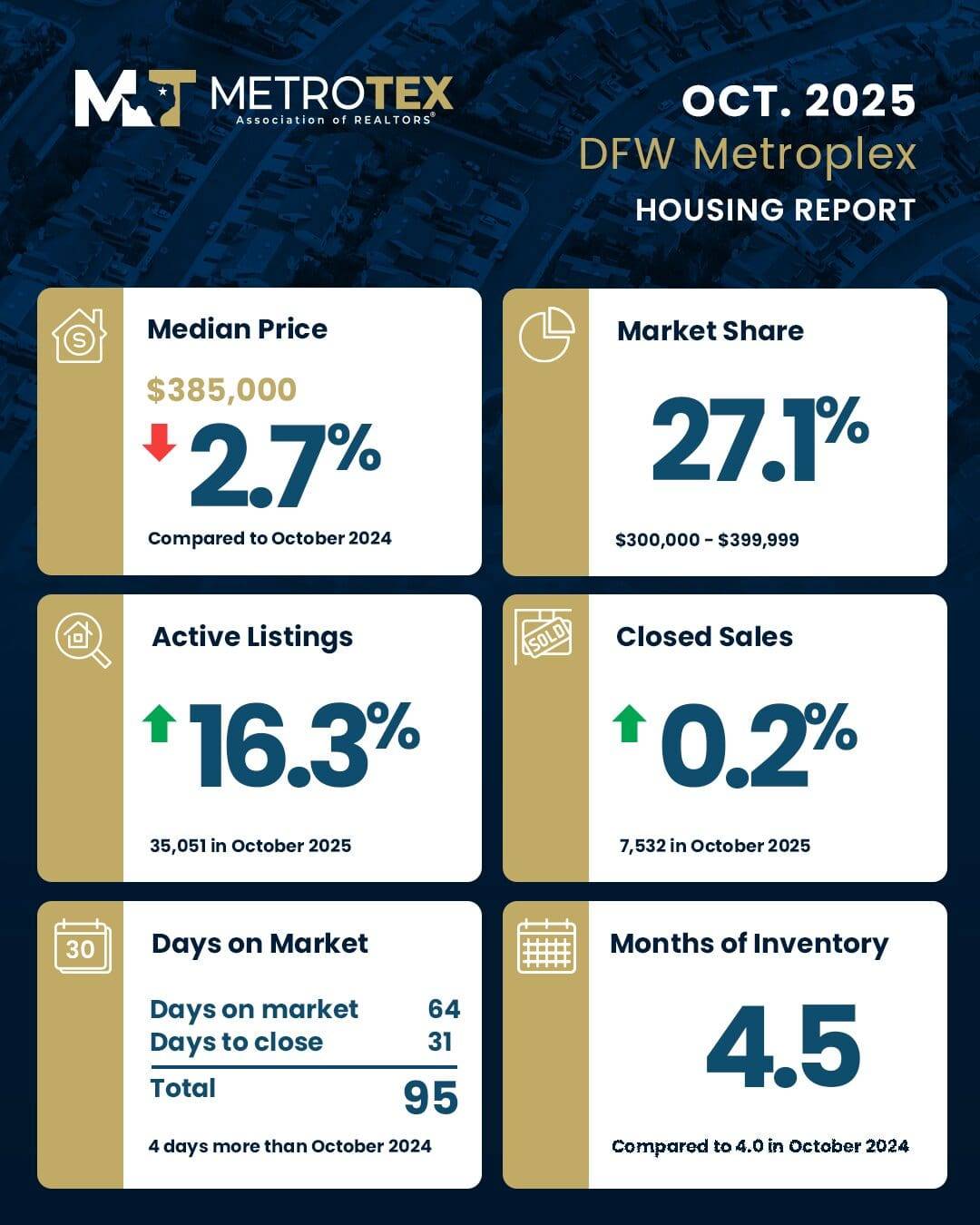
    Below is a graphic that comes from the Texas A&M Real Estate Center.  It's the definitive source of information for real estate figures in Texas.  MetroTex (the Dallas side of town) Association of Realtors compiles this information and puts it out for everyone to see. This has our "average days on market", what the largest "price point" in sales is, and has our median home price as well.  Every real estate agent has access to this information (that's why the alarms are going off - they should know this stuff).

    So, if I am flipping...I need to expect that many days to sell my home. If I am flipping, I would target an ARV of the largest "price point" to ensure that I am marketing a home that has the most views. Could I do something different than what the numbers say? Of course! But we target these things for a reason. It's what gives us the highest chance of success.

    If I am doing the BRRRR Method, I would target homes BELOW the median price point. That's where renters live. Anything $300,000 and below on the ARV would be a great rental property. If this is your first time doing this, I would target anything after 1976 (since no lead paint after that date), 3 BR, 2BA homes. Garages are not necessary. Again, you can always do something different...but these give us the highest odds of success. Also, if I am flipping or doing the BRRRR Method my highest chances of success come from off market homes. I do not use a realtor on those.

    The numbers I use are based on my prequalification numbers from my lenders. Meaning, if my "flip lender" will lend me 75% of the ARV....then I need to target homes that have a purchase price and rehab of 75% of the ARV. That will help me to be successful and limit my out of pocket costs. If I am doing the BRRRR Method and my DSCR lender states that I will only cash flow at 70% ARV, then I need to buy and rehab at 65% of ARV....or else be ok with bringing more money to close or not cashflowing.

    The submarkets to avoid are the same submarkets that every real estate agent should know about - 76105,76104, 75210, 75215, 75223...there are some different ones if you plan on BRRRR'ing a property.

    Anyway, I hope this helps some.  Thanks for the post!

Join the conversationCreate a free account to reply, vote on answers and follow this thread.