Ask me your electrical questions!

Ask me your electrical questions!

Electrician · Bothell, WA · Member since 2014 · 241 posts · 96 votes

I've been an electrician in Washington (the real one..) for 10 years, residential, commercial, and industrial. I've learned a ton from BP so this is me trying to give back with knowledge of something I know very well. Hit me up anytime.. even if you're reading this a year from now..

31Reply
1,138 views

Most Popular Reply

Property Manager · Livonia, MI · Member since 2011 · 4k+ posts · 1k+ votes
11y
Originally posted by @Shawn Thom:

Sometimes I look at older homes that have old break boxes or have brands that are known to be bad.  I ask my electrician about changing out the breaker box and he gives me a price.  That part I get.   Then he talks about changing out the service as well.  What all does changing out the service include?

 it means everything from the riser, the rain head, the cam, the meter, the wire from the meter to the pane.. 

look at this pic... it's from the "weatherproof fittings" to the "Service wire holder".

See this reply in the discussion

211 Replies

Jump to latestLatest
  • Investor · Simpsonville, SC · Member since 2016 · 135 posts · 73 votes
    9y

    Loren, Is romex okay in a crawlspace?  Stapled to the joists (not lying on the ground like it is now). 

  • Electrician · Bothell, WA · Member since 2014 · 241 posts · 96 votes
    9y

    Yep. Stapled within 12" of a box and then every 4.5'.

  • Investor · Simpsonville, SC · Member since 2016 · 135 posts · 73 votes
    9y

    Thank you, Sir.

  • Rental Property Investor · Sumter, SC · Member since 2015 · 334 posts · 531 votes
    8y

    Question: my current rehab has aluminum wiring and I'm replacing all the outlets and switches (painted over, broken, etc.). I bought the correct - and much more expensive! - replacements for Al wire. Do I need to use Noalox on the connections also? 

  • Electrician · Bothell, WA · Member since 2014 · 241 posts · 96 votes
    8y

    Yes, if you are connecting dissimilar metals to each other.

    Alternatively you could buy the wire nuts that have deox in them (they're purple), and pigtail copper wires to the existing aluminum wiring. That way you can use standard cheap outlets.

  • Tonawanda, NY · Member since 2016 · 28 posts · 3 votes
    7y

    I would like an electrician to do a walk-through through this house that I am buying, and to please tell me if anything is wrong or needs to be repaired.  Problem is, I have not closed on the house yet, and the power is off.  Does the power need to be on for the electrician to know if something is wrong?

  • Rental Property Investor · Douglas County, MO · Member since 2014 · 1k+ posts · 1k+ votes
    7y

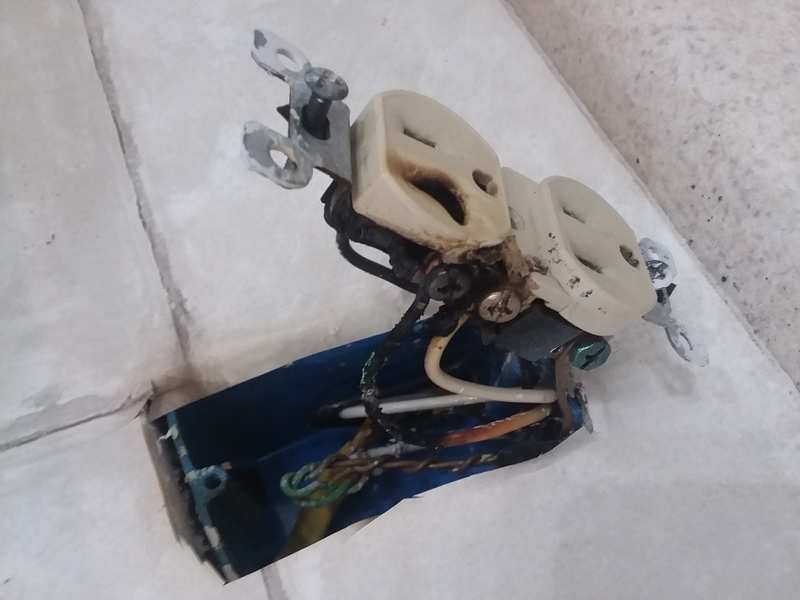
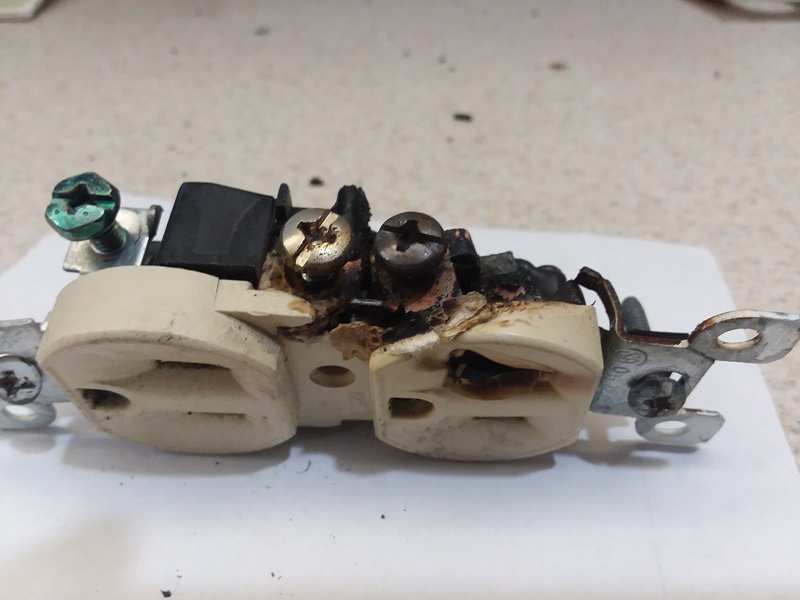
    I had some electrical "fun" in my kitchen yesterday.

    I turned on the toaster oven (different receptacle on the same circuit) and I noticed sparks shooting out of this receptacle. !!!
    I'm not positive, but I think there was a nick in the insulation on the neutral wire on the load side of the receptacle.

    My question is, why didn't the breaker trip?

  • Electrician · Bothell, WA · Member since 2014 · 241 posts · 96 votes
    7y

    Hard to say. If it was in your kitchen, it should have been GFCI protected and tripped there. Perhaps there wasn't enough of a DIRECT short to tell the breaker to trip (think welder) or maybe the breaker is old or malfunctioning.

  • Rental Property Investor · Douglas County, MO · Member since 2014 · 1k+ posts · 1k+ votes
    7y
    Originally posted by @Loren Thomas:

    Hard to say. If it was in your kitchen, it should have been GFCI protected and tripped there. Perhaps there wasn't enough of a DIRECT short to tell the breaker to trip (think welder) or maybe the breaker is old or malfunctioning.

    Yes, it's in the kitchen, but not near any water source - about 8 ft from the sink, which is on an island - so it is not GFCI protected. The house was built in 2003, so the breaker is 16 years old. It's a 20 amp breaker.

  • Rental Property Investor · Upstate, NY · Member since 2012 · 3k+ posts · 3k+ votes
    7y

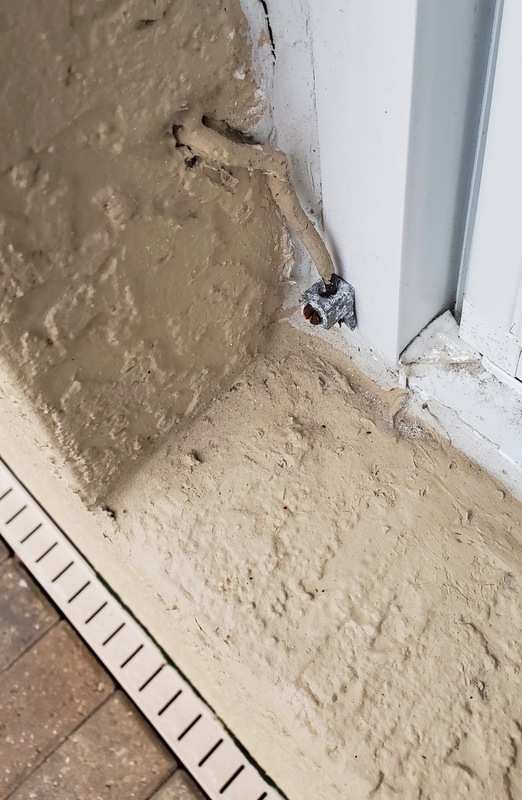
    This one intrigued me. I have done a lot of electrical in my day & can't understand this (corroded) grounding.

    It's in a 2005 built home on Marco Island (last sold for $1.5million). This is attached to the vinyl framing of a ground floor master bedroom window that faces onto the pool decking (decking drainage below). There are no circuits on the inside wall that would/could need such a ground??

  • Electrician · Bothell, WA · Member since 2014 · 241 posts · 96 votes
    7y

    Sorta hard to tell from the picture, could be a ground for cable or phone. But if it's only attached to vinyl... it's not doing anything!

  • Rental Property Investor · Upstate, NY · Member since 2012 · 3k+ posts · 3k+ votes
    7y
    Originally posted by @Loren Thomas:

    Sorta hard to tell from the picture, could be a ground for cable or phone. But if it's only attached to vinyl... it's not doing anything!

    Your correct. There are no phone lines in the home, the spa circuitry was via remote WiFi from the kitchen area & all other electronics, 2 a/c units, pool/spa ancillary pumps/heaters also 30 feet away. The only time I ever saw something like it was to cheat on the grounding of a remote afterthought outlet when it was too difficult to run a ground to the panel. These homes are solid cement brick outer walls so who knows where it goes.

    thanks

  • Blue Springs, MO · Member since 2015 · 481 posts · 313 votes
    7y
    Originally posted by @Sylvia B.:
    My question is, why didn't the breaker trip?

    Disclaimer: I am not a professional electrician.

    You had a loose connection at that receptacle, probably at the terminal screw for the badly charred white wire (the top screw in the first picture, the right screw in the second picture).  It might have also been at the small brass tab that links the two screws on that side of the receptacle - if it was damaged at some point, like somebody started to twist the tab off but then decided not to, it could also cause this problem.

    The receptacle that you plugged the toaster oven into was "downstream" of this burned one.  One set of white and black wires at the burned one came from the breaker panel, and the other set of wires went to the receptacle where the toaster oven was plugged in.

    When the heavy load of the toaster oven (probably 15 to 20 amps) was put on the circuit, that loose connection heated up, and caused the melting and charring.  The loose connection also limited the current that the toaster oven was drawing, which is probably why the breaker didn't trip.

    If you had plugged in a small load (like a phone charger, or a table lamp, or similar - much less than 1 amp), instead of the toaster oven, you probably wouldn't have had this problem.

    A GFCI probably wouldn't have helped you here, either.  All the GFCI cares about is that all the juice that goes out on the black wire comes back in on the white wire.  If any of the juice going out on the black wire goes somewhere else - like, through a nick in the wire insulation either inside the outlet or on the cord of an appliance, or into the water if you accidentally drop an appliance in the sink - then a GFCI will trip.

    Some electricians like to "pigtail" the outlets.  Instead of using both screws to feed power to the rest of the outlets "through" this outlet, they will run the wire from the breaker panel, the wire to the rest of the outlets, and a short wire into a wire nut.  The other end of the short wire connects to one of the screws on this outlet. You can still have the same problem if the wire nut is loose (applying a load downstream will melt the wire nut), and you can have a problem at the pigtailed outlet if the screw for the short wire is loose - but only if you plug something into the pigtailed outlet.

    Some home inspectors have a plug-in gadget made by Ideal or Fluke that allows them to find things like this.  This gadget measures the voltage at an outlet, applies a heavy load for a short time, measures the (lower) voltage under load, and calculates the percent voltage drop.  You can watch the measured voltage drop go up as they test outlets that are further along in the string from the breaker panel.

    You can DIY this test with a voltmeter and either a small space heater or a hair dryer. The voltmeter can be any digital voltmeter that will read 120 V AC. It helps to get a 2-prong plug with some cord on it (cut it off of a dead appliance), strip the ends of each wire a half-inch or so, wrap each wire around one test prod, and then tape it up really good with electrical tape - that way you don't need three hands for the next part. Or, if your meter leads unplug at both ends, get a replacement set of leads, cut off the test prods, and wire the red and black wires directly to a 2-prong plug. If you like gadgets, get a "Kill-a-watt" or similar plug-in meter online, or at some hardware stores, for about $30 to $40.

    Go to an outlet, plug in your meter, and write down the reading. It's normal for it not to be exactly 120.0 V AC, and it's normal for it to bounce around a few tenths of a volt while you watch it. If it's consistently way low (below maybe 110.0 V) or way high (above maybe 125.0 V), you may want to seek help from an electrician before proceeding. Now, plug in the space heater or hair dryer, and crank it up to high. Watch the  voltmeter while you do this. It is totally normal for the voltage to drop down when the heater/dryer kicks in, but let the heater/dryer run for a couple of minutes and write down the lowest voltage you see. Then, turn the heater/dryer off and do some math. If the voltage dropped 5% or less (like, it was 120.0 V with the heater off, and 114.0 V at its lowest with the heater on), then the circuit from the breaker panel to that outlet is in pretty good shape. If it's between 5% and maybe 8%, that's not as good, but it might be OK. If it's over 10%, then you should investigate further, or have an electrician investigate - you've got a loose connection somewhere between that outlet and the breaker box, which is potentially dissipating a lot of heat inside the wall somewhere. Back-stabbed connections, loose wire nuts, and terminal screws that aren't tightened all the way down on receptacles and switches can cause this problem.

    Is that way more than you wanted to know about it?  :D
  • Blue Springs, MO · Member since 2015 · 481 posts · 313 votes
    7y

    @Pat L. Is it possible that the meter or service drop used to be there - maybe before the pool was installed, if the house didn't always have a pool?  Although for $1.5mil and built in 2005, maybe it always had a pool.

    Usually there's a ground coming out of the meter to a ground rod pretty close to the meter.  If the meter got moved for some reason, I could see somebody wondering what to do with the now-unused ground wire, and deciding that making it "look attached" was better than letting it hang free or cutting it off.

    Another idea - maybe the previous owner had some kind of antenna wire (TV, shortwave, ham radio) coming through this window, and this was a ground connection for that?  You could loosen the screw, slip another wire under the screw, and tighten it up to make a "good enough" connection for most radio purposes.  This assumes that the wire that disappears into the wall goes to ground, somewhere.

  • Rental Property Investor · Douglas County, MO · Member since 2014 · 1k+ posts · 1k+ votes
    7y
    Originally posted by @Matt R.:

    Is that way more than you wanted to know about it?  :D
     Actually, no. That was lots of useful information. All screws on the receptacle were very firmly tightened, so that wasn't the issue.

  • Rental Property Investor · Upstate, NY · Member since 2012 · 3k+ posts · 3k+ votes
    7y

    @Sylvia B. Just a quick question. Was the shorted outlet installed in an old metal outlet box??

    Over the years I have found many shorted out due to the narrow metal boxes coming in contact or arcing with the outlet screws. Back in my days of electrical eng courses we studied the concept of arcing/creepage caused by mediums such as humidity &/or surface dust/corrosion. I have always wrapped our outlets with electrical tape.

  • Rental Property Investor · Douglas County, MO · Member since 2014 · 1k+ posts · 1k+ votes
    7y
    Originally posted by @Pat L.:

    @Sylvia B. Just a quick question. Was the shorted outlet installed in an old metal outlet box??

    Over the years I have found many shorted out due to the narrow metal boxes coming in contact or arcing with the outlet screws. Back in my days of electrical eng courses we studied the concept of arcing/creepage caused by mediums such as humidity &/or surface dust/corrosion. I have always wrapped our outlets with electrical tape.

    No,  it's in a plastic box. I also cover the screws with tape when dealing with a metal box. (Hate those!)

  • Member since 2019 · 9 posts · 0 votes
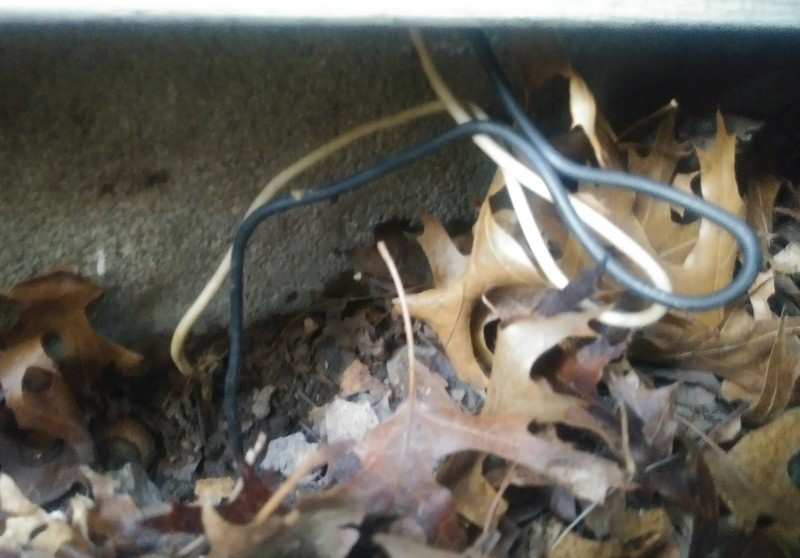
    6y

    Hi,

    I found a black wire and a white wire coming out of the ground and into my house. What are they? Should I cover them for protection?

  • Electrician · Bothell, WA · Member since 2014 · 241 posts · 96 votes
    6y

    That's interesting! Could be a lot of things, none of them too good. If you can test them for power with a hot stick do that, then if theres no power just cut em out. But they appear to be 120v wires for an outlet or light or something? Do you know where they go or come from?

  • Rental Property Investor · Upstate, NY · Member since 2012 · 3k+ posts · 3k+ votes
    6y

    saw an interesting hook-up.

    Duplex has an electric on-demand HW system that required wiring to 2 separate double pole 50amp 240v breakers.

    Because the the panels for each unit were only 100amp the heater was hooked up to a 50amp double pole breaker in each of the electrical panels.

    I can't imagine it being an issue given the split of the electrical draw when it fires up to heat the water. Plus it certainly eliminates having to upgrade one of the electrical panels to 200amps. Possibly splits the electrical bill as well.

    Do you see any risks with this configuration ???

  • Electrician · Bothell, WA · Member since 2014 · 241 posts · 96 votes
    6y

    You're saying an appliance is fed from (2) 50A breakers, each in a separate electrical panel?

    I really doubt that's a legal configuration. I cant say for sure though. At the very least it's not industry standard. 

    What sort of property was this?

  • Jason TougasPro Member
    Rental Property Investor · San Antonio, TX · Member since 2019 · 50 posts · 24 votes
    6y

    @Robert Cummings

    The easiest way to determine what is wrong with your outlet is to purchase a outlet tester. These are $20 at Home Depot or Amazon and will tell you exactly what is going on electrically. (Open neutral, ungrounded, open hot etc.)

  • Blue Springs, MO · Member since 2015 · 481 posts · 313 votes
    6y
    Originally posted by @Pat L.:
    Because the the panels for each unit were only 100amp the heater was hooked up to a 50amp double pole breaker in each of the electrical panels.

    Disclaimer: I am not a professional electrician.

    I can think of a couple of possible problems:

    1: If somebody wants to work on the heater, they will probably go to whichever panel is closest, and turn off the 50 amp breaker marked "water heater".  They will then open up the heater and get shocked, because there is still power to it from the other panel.  Same thing applies if the water heater is obviously screwing up in some way, and the tenant wants to shut off power to it... it won't be obvious that both tenants need to turn off a breaker to shut it down completely.

    You could fix this by installing a disconnect switch next to the heater, but if the heater works like I think it does, it would have to be a fairly unusual type of switch - a 4PST (four-pole) switch, rather than the common 2PST (two-pole) switch.

    2: Depending on how the heater is wired internally, a failure *might* cause it to connect the two separate feeds together inside.  This leads to a dangerous situation: somebody wants to do work or just shut off the power to side A, so they turn off the main breaker in side A's panel.  However, the failure in the heater will allow power from side B's panel (which is still on) to flow into side A's panel, energizing everything in side A.  Someone working on side A of the house could get shocked, even though they turned the main breaker off.

  • Member since 2020 · 9 posts · 5 votes
    6y

    Loren.  I am looking for a little reinforcement/information for some ideas I have for a wiring project I have on an investment property.  Are you still answering electrical questions?  Thanks! Sean

  • Rental Property Investor · Jacksonville, FL · Member since 2019 · 32 posts · 15 votes
    6y

    @Loren Thomas I am doing some upgrades to my duplex and would like to add a washer/dryer outlet. The unit has 3 NEMA 6-20 (winky face outlet) outlets for the AC window units from the past and these 3 have double breakers in the breaker box. Can I swap out the  NEMA 6-20 outlet  for a 3 or 4 prong Dryer outlet? Below is a picture of my  breaker box, it doesn't have a main breaker and things are labeled kind of weird. Do you have any insight on what the Lights/Rec might be? 

Join the conversationCreate a free account to reply, vote on answers and follow this thread.