AI Is Great for Real Estate Research. I Still Don’t Trust It for Underwriting Math.

AI Is Great for Real Estate Research. I Still Don’t Trust It for Underwriting Math.

Specialist · Greeley, CO · Member since 2026 · 36 posts · 18 votes

I’m a software engineer and real estate investor, and one thing I keep coming back to is that AI and underwriting software solve two very different problems.

AI is great at pulling information out of messy inputs. OM packages, leases, rent rolls, contractor bids, lender quotes, market reports. That part of the workflow is full of unstructured data, and AI can save a lot of time there.

But once I’m deciding whether to buy, refinance, or walk away, I don’t want “pretty good.” I want deterministic math. Same inputs, same outputs. No guessing, no drift, no black box.

The bigger problem for me wasn’t just underwriting, though. It was the gap between systems.

Underwriting in one spreadsheet.
Portfolio tracking somewhere else.
Tenant info in another place.
Project and contractor work in another tool.
A bunch of copy/paste and re-entering the same assumptions over and over.

None of those tools were individually terrible. The problem was the handoff points between them. That’s where the drag really showed up.

So I ended up building a system for myself around one idea:
AI for extraction and intake.
Deterministic logic for the math and decision-making.
A single workflow instead of five disconnected ones.

That said, I still think old-school work wins where it matters most. Walking the property and talking to local operators will catch things no software ever will.

I’m at the point where I’d actually benefit from a small number of serious power users who already have a real workflow and are willing to be brutally honest about what’s clunky, what’s missing, and where the assumptions break.

Not looking for casual signups. More interested in 3 to 5 people who are actively underwriting or operating and want to pressure-test something built around reproducible math and a more consolidated workflow.

Curious where other people draw that line:
Where are you comfortable using AI in your investing workflow, and where do you still want rigid systems or manual review?

If this sounds like your workflow, feel free to reply or DM me.

0Reply
705 views

Most Popular Reply

Member since 2021 · 82 posts · 79 votes
7mo

You nailed it — the tools aren't the problem, the handoffs between them are. That's where numbers drift and hours disappear.

Two things I've learned the hard way:

Extraction needs guardrails. Letting AI interpret lease terms freely is asking for trouble. Structured fields with validation rules. Flag outliers, don't guess.

Sensitivity analysis is the real filter. Nobody runs 200 scenarios manually in a spreadsheet. Automating that kills bad deals before you waste a site visit.

Agreed on boots on the ground. No software replaces walking the property. But software can tell you which ones are worth the drive.

See this reply in the discussion

30 Replies

Jump to latestLatest
  • Member since 2021 · 82 posts · 79 votes
    7mo

    You nailed it — the tools aren't the problem, the handoffs between them are. That's where numbers drift and hours disappear.

    Two things I've learned the hard way:

    Extraction needs guardrails. Letting AI interpret lease terms freely is asking for trouble. Structured fields with validation rules. Flag outliers, don't guess.

    Sensitivity analysis is the real filter. Nobody runs 200 scenarios manually in a spreadsheet. Automating that kills bad deals before you waste a site visit.

    Agreed on boots on the ground. No software replaces walking the property. But software can tell you which ones are worth the drive.

    • Specialist · Greeley, CO · Member since 2026 · 36 posts · 18 votes
      7mo
      Quote from @Nicholas Cokas:

      You nailed it — the tools aren't the problem, the handoffs between them are. That's where numbers drift and hours disappear.

      Two things I've learned the hard way:

      Extraction needs guardrails. Letting AI interpret lease terms freely is asking for trouble. Structured fields with validation rules. Flag outliers, don't guess.

      Sensitivity analysis is the real filter. Nobody runs 200 scenarios manually in a spreadsheet. Automating that kills bad deals before you waste a site visit.

      Agreed on boots on the ground. No software replaces walking the property. But software can tell you which ones are worth the drive.


      Nicholas — really solid points, especially on the extraction guardrails. That was one of the first things I ran into. Letting AI free-form interpret lease terms or expense categories creates more cleanup work than it saves. The approach I landed on was structured field mapping with validation at the boundary — AI handles the messy parsing, but every value gets slotted into a typed field with range checks before it touches any calculation. Outliers get flagged, not silently passed through.

      On sensitivity analysis — 100% agree that's where the leverage is. Running 200 scenarios manually is a non-starter. That's actually one of the areas where I think the "deterministic math + automation" approach really shines. You define the bounds, let the system sweep through them, and focus your time on the scenarios that actually change the decision. Kills bad deals fast and gives you conviction on the good ones.

      And yeah — software tells you which properties are worth the drive. The site visit tells you which ones are worth the wire transfer.

      Appreciate the thoughtful reply.


  • Realtor · Boulder, CO · Member since 2016 · 3k+ posts · 5k+ votes
    7mo

    Completely agree. Underwriting is ultimately a bit of a mix of art and science. AI can help with the science part but lacks the "artistry"/ experience-based/ common sense part. I actually think AI is leading a lot of people into making bad buying decisions right now. 

  • Specialist · Greeley, CO · Member since 2026 · 36 posts · 18 votes
    7mo

    100% — and I think the danger is specifically that AI makes people feel confident without earning it. ChatGPT can spit out a 10-year proforma in 30 seconds, but if you don't know what a reasonable cap rate spread looks like for that submarket, or why a 95% occupancy assumption on a value-add deal is fantasy, you'll just get a really professional-looking bad decision.

    The "art" side is knowing which assumptions to stress test. Like if someone tells me they're underwriting 3% rent growth for 10 years straight on a secondary market office building right now — that's not a math problem, that's a judgment problem. No model fixes that.

    Where I land on it: AI is genuinely useful for the grunt work (pulling comps, reading rent rolls, extracting data from OMs). But the actual underwriting — choosing assumptions, stress testing scenarios, understanding what the numbers mean — that still needs someone who's looked at enough deals to know when something smells off.

    • Investor · Member since 2019 · 17 posts · 7 votes
      6mo
      Quote from @Eric Davis:

      Where I land on it: AI is genuinely useful for the grunt work (pulling comps, reading rent rolls, extracting data from OMs). But the actual underwriting — choosing assumptions, stress testing scenarios, understanding what the numbers mean — that still needs someone who's looked at enough deals to know when something smells off.

      This is exactly right. I use software to analyze deals every day across multiple markets out of state (my local market is too expensive to get in), and the line I've drawn is the same one you're describing. Though I went a step further to let AI do the underwriting for me based on my financial scenario and stress test. 

      Let the machine scan 1,000 listings and flag which 15 hit your filters. Let it pull tax history, comp the rents, estimate rehab. That's grunt work at scale.

      But the moment you're calculating cash-on-cash or stress-testing a rate jump from 7% to 8.5% — that math needs to be deterministic, not a guess by AI. Your assumptions, your financing, your numbers. Two investors analyzing the same duplex should get different answers.

      The tools that get this wrong let AI pick the assumptions for you. The ones that get it right let AI do the sourcing and extraction, then hand you a calculator with your inputs locked in, let you run different scenarios with your own finance assumptions.

      At the end of the day, AI should be treated like an assistance for you to farm out the grunt work, you are still the one making the actual decisions based on the (hopefully very organized information) presented to you by whatever system you are using.
  • Member since 2021 · 82 posts · 79 votes
    7mo

    Eric, Steve — this thread is one of the better conversations on AI in RE investing I've seen on BP. Want to add a few things from the operations side that might be useful.

    The "judgment problem" Eric described is really an assumptions problem — and most investors don't stress-test the right ones.

    Everyone stress-tests purchase price and rent. Almost nobody stress-tests insurance, property tax reassessment, or capex timing — and those are the three that actually blow up deals in 2026.

    Quick example. A 40-unit value-add in Birmingham. The proforma looks great at a 7% cap. But if you're underwriting insurance at $800/unit because that's what the seller's been paying on a grandfathered policy, and your post-acquisition quote comes back at $1,400/unit — that's $24,000/year in NOI you just lost. On a 7 cap, that's $342,000 in value that evaporated before you even painted a unit.

    No AI catches that. No spreadsheet catches that. An operator who's been through a few insurance renewals catches it in 30 seconds.

    Where I actually think AI creates the most danger right now:

    1. Comp selection. AI pulls comps by proximity and recency. An experienced underwriter pulls comps by relevance — construction type, unit mix, vintage, tenant profile. A 2005 CBS building and a 1972 wood-frame three blocks apart are not comps. AI doesn't know that unless you tell it.

    2. Expense ratio assumptions. ChatGPT defaults to the "50% rule" or whatever's in its training data. Actual expense ratios vary wildly — 35-45% for well-maintained SFR, 45-55% for older multifamily, 55%+ for properties with deferred maintenance. The number depends on the property, not the model.

    3. Exit cap rate assumptions. This is the biggest one. I've seen AI-generated proformas assume the same cap rate at exit as at entry. In a rising rate environment, that's not conservative underwriting — it's fiction. Underwriting a 50-75 basis point expansion on exit is the minimum right now.

    Where AI genuinely saves time (and I use it daily):

    - Parsing OMs and rent rolls into structured data. A 40-page offering memorandum becomes a clean data table in minutes instead of hours.

    - Market research — pulling demographic trends, employment data, permit activity, insurance rate filings across multiple markets simultaneously.

    - Scenario sweeps. Define your base case, set the bounds on 6-8 variables, and let it run 200 combinations. You're not looking at 200 outputs — you're looking for the 3-4 scenarios where the decision changes. That's where your time goes.

    The line I draw: AI handles everything before the decision. Extraction, organization, scenario generation, research. The decision itself — buy, pass, renegotiate — stays human. Not because AI can't do math, but because the math is only as good as the assumptions, and choosing assumptions requires pattern recognition from deals you've actually done.

    Eric's framework of "AI for extraction, deterministic logic for math, single workflow" is the right architecture. The missing piece for most investors is the feedback loop — tracking what you assumed on a deal vs. what actually happened 12 months later. That's how you calibrate assumptions over time instead of guessing the same way on every deal.

    • Specialist · Greeley, CO · Member since 2026 · 36 posts · 18 votes
      7mo
      Quote from @Nicholas Cokas:

      Eric, Steve — this thread is one of the better conversations on AI in RE investing I've seen on BP. Want to add a few things from the operations side that might be useful.

      The "judgment problem" Eric described is really an assumptions problem — and most investors don't stress-test the right ones.

      Everyone stress-tests purchase price and rent. Almost nobody stress-tests insurance, property tax reassessment, or capex timing — and those are the three that actually blow up deals in 2026.

      Quick example. A 40-unit value-add in Birmingham. The proforma looks great at a 7% cap. But if you're underwriting insurance at $800/unit because that's what the seller's been paying on a grandfathered policy, and your post-acquisition quote comes back at $1,400/unit — that's $24,000/year in NOI you just lost. On a 7 cap, that's $342,000 in value that evaporated before you even painted a unit.

      No AI catches that. No spreadsheet catches that. An operator who's been through a few insurance renewals catches it in 30 seconds.

      Where I actually think AI creates the most danger right now:

      1. Comp selection. AI pulls comps by proximity and recency. An experienced underwriter pulls comps by relevance — construction type, unit mix, vintage, tenant profile. A 2005 CBS building and a 1972 wood-frame three blocks apart are not comps. AI doesn't know that unless you tell it.

      2. Expense ratio assumptions. ChatGPT defaults to the "50% rule" or whatever's in its training data. Actual expense ratios vary wildly — 35-45% for well-maintained SFR, 45-55% for older multifamily, 55%+ for properties with deferred maintenance. The number depends on the property, not the model.

      3. Exit cap rate assumptions. This is the biggest one. I've seen AI-generated proformas assume the same cap rate at exit as at entry. In a rising rate environment, that's not conservative underwriting — it's fiction. Underwriting a 50-75 basis point expansion on exit is the minimum right now.

      Where AI genuinely saves time (and I use it daily):

      - Parsing OMs and rent rolls into structured data. A 40-page offering memorandum becomes a clean data table in minutes instead of hours.

      - Market research — pulling demographic trends, employment data, permit activity, insurance rate filings across multiple markets simultaneously.

      - Scenario sweeps. Define your base case, set the bounds on 6-8 variables, and let it run 200 combinations. You're not looking at 200 outputs — you're looking for the 3-4 scenarios where the decision changes. That's where your time goes.

      The line I draw: AI handles everything before the decision. Extraction, organization, scenario generation, research. The decision itself — buy, pass, renegotiate — stays human. Not because AI can't do math, but because the math is only as good as the assumptions, and choosing assumptions requires pattern recognition from deals you've actually done.

      Eric's framework of "AI for extraction, deterministic logic for math, single workflow" is the right architecture. The missing piece for most investors is the feedback loop — tracking what you assumed on a deal vs. what actually happened 12 months later. That's how you calibrate assumptions over time instead of guessing the same way on every deal.


      Nicholas, the insurance example is spot-on. I'd add property tax reassessment to that same bucket — especially in states with uncapped reassessment. You close a value-add at $2.5M, the county reassesses from the seller's $1.6M basis, and your "taxes growing 2%/year" proforma just took a step function hit on day one. Same invisible gap, same category of thing that no model catches but any experienced operator flags immediately.


      Your comp selection point is underrated too. The proximity/recency bias in AI-pulled comps is dangerous precisely because it looks rigorous. Nice table, addresses, dates — feels like analysis. But a 2005 CBS and a 1972 wood-frame aren't just different comps, they have fundamentally different insurance profiles, maintenance curves, and tenant demographics.

      The feedback loop is where I'd push back slightly — not on the idea but on framing it as "missing." The data exists. Every operator has their actual P&L twelve months later. The problem is nobody reconciles it against their original underwriting in a structured way. Insurance assumed $800/unit, actual came back $1,400? That observation should inform your next Birmingham multifamily underwriting automatically, not just live in your head as "remember to bump insurance." That's the architecture problem I keep coming back to — storing assumptions and actuals as structured data so you can calibrate over time instead of guessing the same way every deal.


  • Member since 2021 · 82 posts · 79 votes
    7mo

    Eric — your pushback on the feedback loop framing is actually the more precise version of what I was getting at. You're right that the data exists. The P&L is sitting there 12 months later. The gap isn't information — it's architecture.

    Most investors treat underwriting as a point-in-time event. You model the deal, you close the deal, the spreadsheet goes in a folder. Twelve months later you're underwriting the next deal and pulling assumptions from memory instead of from structured actuals.

    Your point on property tax reassessment is the same mechanic. It's not "remember to adjust taxes." It's "states with uncapped reassessment + value-add acquisition strategy = step function on day one." Once you encode that as a rule rather than a memory, every future underwriting gets it right automatically.

    That's where the real leverage is — not storing one data point, but recognizing the structural pattern across deals so the calibration compounds.

  • Chris SeveneyBusiness Member
    Moderator
    Investor · VA · Member since 2015 · 21k+ posts · 19k+ votes
    7mo

    I am another person who agrees with this. The key to any underwriting is garbage in, equals garbage out. If what you're putting into a model, whether it's an AI model, an Excel model, or a napkin, is not accurate data, it does not matter.

    The other important component to understand and realize as part of a model is the sensitivity analysis of what can cause variations in your numbers and other things that cannot be picked up by AI, which is:

    - understanding what is going on in the community

    - what is going on in that area

    - what is a tenant mix

    - the tenant base

    There's a lot that goes into underwriting that is more than just numbers. 

    7e investments53 Reviews
  • Investor · Portland, OR · Member since 2026 · 67 posts · 35 votes
    7mo

    @Chris Seveney nailed it — garbage in, garbage out regardless of how sophisticated the model is. And the qualitative stuff he listed — community dynamics, tenant base, what's actually happening on the ground — is exactly what separates operators who've done deals from people who've built spreadsheets.

    @Nicholas Cokas insurance example is a perfect case. No model flags a grandfathered policy. An operator who's been through a few renewals catches it immediately. That pattern recognition from real deals is the one thing you can't automate.

    The feedback loop discussion is where it gets interesting though. The data to calibrate your assumptions is sitting in your P&L twelve months later — but most of us never reconcile it against what we originally underwrote. I've been guilty of that too. Having a system that forces that comparison is what's actually tightened my underwriting over time, more than any AI feature.

  • Property Manager · Calabasas, CA · Member since 2026 · 141 posts · 67 votes
    7mo

    Good thread. I'll add the commercial angle since most of the examples here are multifamily or SFR.

    On the NNN/commercial side, the assumptions that kill deals aren't cap rates or rent growth — they're the ones buried in the lease structure itself. Things like: what's the CAM cap (or is there one), how are controllable vs uncontrollable expenses defined, is there a gross-up clause on base year expenses, does the PM/PM software even track these correctly.

    I had an AI tool pull a rent roll from an OM on a retail strip I was looking at. It nailed the base rent numbers. Missed entirely that three of the leases had CAM caps at 5% annual increases — which meant the landlord was absorbing everything above that. On a property where insurance costs jumped 40% in one year (which they did in SoCal), that's not a rounding error, that's the whole deal thesis falling apart.

    The feedback loop point Nicholas made is exactly right, and it's even more pronounced in commercial because lease-level assumptions compound over 10-year terms. The delta between what you underwrote in year 1 and what actually reconciled at year-end CAM tells you more than any model. But you have to track it at the lease level, not just the property level.

    For what it's worth, the place where I've found AI most genuinely useful in CRE ops is reading and summarizing estoppel certificates and SNDA agreements — stuff that's dense, repetitive, and doesn't require judgment. The judgment part stays with the operator.

  • Investor · Portland, OR · Member since 2026 · 67 posts · 35 votes
    7mo

    @Ryan Stomel I can't agree more with Ryan that AI is genuinely useful in reading, highlighting, summarizing large text rather than making operator level judgment. That's literally what LLM was designed for. My past decade career was developing these AI systems for some of the largest tech companies. But when it comes to my persnal investment judgement, I never let AI (statistical models) touch my numbers. AI helps me remove lots of tedious repetitive work from my workflow, but it will never make decision on my behalf.

  • Property Manager · Calabasas, CA · Member since 2026 · 141 posts · 67 votes
    7mo

    Appreciate the kind words, Ryan — and your background is exactly the right lens for this conversation. A decade building these systems at the infrastructure level gives you a cleaner view of what LLMs actually are vs. what the marketing suggests they are.

    The framing you used is precise: they're designed for reading, highlighting, and summarizing unstructured text. That's the capability. The gap between "can parse a document" and "should make a capital allocation decision" is enormous, and people conflate them constantly.

    On the commercial side, the estoppel/SNDA example is a good test case because it's one of the few places where the use case is almost purely extraction with minimal judgment required — find the estoppel provisions, flag any deviations from the standard form, summarize for attorney review. AI handles that well. The moment you start asking it to interpret whether a particular provision creates material risk in a specific deal context, you're outside the capability boundary.

    The personal investment judgment point is the one I'd underline. The output of an LLM is a probability distribution over tokens. Real estate decisions are binary — you either wire the money or you don't. Those aren't the same kind of problem, and the architecture reflects that.

  • Investor · Portland, OR · Member since 2026 · 67 posts · 35 votes
    7mo

    @Ryan Stomel well said. Its easy to vibe code something that parses numbers and call it a proptech platform until real money is on the line. I've never met a serious investor who lets AI make decisions for them. But plenty use it to outsource the grunt work — condensing 9,000 leads down to 20 qualified ones, that kind of thing.

    I made a mistake last year that cost me my entire flip margin. Prices dropped 5-10% in my submarket after two major tech employers announced layoffs. On a flip thats everything. What bothered me more than the loss was I couldn't trace back why I made the assumptions I did. No record of what I was looking at when I pulled the trigger. So I built an audit layer in my tech stack — every assumption timestamped with reasoning, similar to how financial institutions reconcile decisions. Now I can tell the difference between a bad process and an unpredictable market. One I fix, the other I have to accept.

    My team uses software to fast-filter garbage deals out of my pipeline. But deals that pass the filter still get a lot of manual time — poking assumptions, running scenarios, always more than one exit strategy. AI doesnot catch that nuance yet and I'm fine doing it the hard way.

  • Property Manager · Calabasas, CA · Member since 2026 · 141 posts · 67 votes
    7mo

    The audit layer idea is genuinely underrated and I don't think enough people build it until they get burned.

    The distinction you're drawing — bad process vs. unpredictable market — is exactly the right frame. The layoff announcement was unknowable. The fact that you couldn't trace your reasoning after the fact is fixable. Those are two completely different problems and they require different responses.

    I've seen the same thing on the commercial side. A deal that doesn't work out because a tenant didn't renew is one thing. A deal that doesn't work out because you never stress-tested the scenario where they don't renew is a different thing entirely. The first you have to accept. The second you can correct.

    The timestamped reasoning piece is something more investors should be doing. Not just "I underwrote this at a 7 cap" but "here's what I believed about the market at the time, here's the comps I was looking at, here's the assumption I made about absorption." When you revisit 12 months later you can actually separate "my reasoning was sound and the market moved" from "I was optimistic from the start and I knew it."

    The harder version of this is building that discipline before you lose money on a deal. Most people build it after. But at least they build it.

  • Member since 2021 · 82 posts · 79 votes
    7mo

    Ryan D. — the audit layer is the most underrated thing in this thread. Most operators build it after they lose money. The fact that you built it means you won't make the same mistake twice. That's the real edge — not better models, better memory.

    One thing I'd add: track the jumps, not the drifts. Rent drifts 2-3% a year — your spreadsheet handles that fine. Insurance, taxes post-acquisition, capex timing — those jump. And the jump is where deals actually die. If your audit layer flags every time an actual comes in 15%+ off your assumption, you'll start seeing structural patterns across deals, not just one-off misses.

    Good thread. The people in this room actually operate.

  • Investor · Portland, OR · Member since 2026 · 67 posts · 35 votes
    7mo

    @Nicholas Cokas appreciate that. "Track the jumps not the drifts" is a great way to frame it. The insurance (CA and FL) and tax reassessment hits are exactly what's killed margins on deals I've seen hundreds of times.

    I've only done residential (would love to learn retail/industrial) for my investing career and still own a mid-size portfolio across LTRs, STRs and active flips. Having those different operations/teams running downstream actually helps absorb some of the shifts — if a flip market softens I can pivot to STR and wait for better summer pricing to offload inventory rather than panic selling. Not ideal but better than sitting collecting dust and panicking.

    Thats actually why I hand coded multiple exit scenario analysis into my system. Every deal gets modeled with more than one way out with/without 1031 strategy and cross state-line tax scenarios considered (I invest across state lines). Best expected outcome is great but the real question is always whats the floor if things go sideways as they always go sideways 100%. Real estate is racing against a set of time-series assumptions and shooting at a moving target simultaneously.

    Building tools that keep up with that takes a lot of mistakes and expensive lessons. The software gets better over time but it'll never replace the judgment you get from actually operating in field. Thats the part no AI can shortcut.

  • Member since 2017 · 1 post · 0 votes
    7mo

    @Eric Davis Really well put. The distinction between AI for extraction vs. deterministic math for decisions is exactly the right framing. I've been building a platform along these same lines: AI handles the messy data intake (comps, rental estimates, condition assessment), but scoring is fully deterministic across five strategies (Buy & Hold, BRRRR, Flip, Wholesale, House Hack). Same inputs, same scores every time, and users can override any part of the AI analysis to build the complete picture.

    Would love to connect and get your feedback if you're open to it (or anyone else who is interested).

    • Specialist · Greeley, CO · Member since 2026 · 36 posts · 18 votes
      7mo
      Quote from @Carl Fagerlin:

      @Eric Davis Really well put. The distinction between AI for extraction vs. deterministic math for decisions is exactly the right framing. I've been building a platform along these same lines: AI handles the messy data intake (comps, rental estimates, condition assessment), but scoring is fully deterministic across five strategies (Buy & Hold, BRRRR, Flip, Wholesale, House Hack). Same inputs, same scores every time, and users can override any part of the AI analysis to build the complete picture.

      Would love to connect and get your feedback if you're open to it (or anyone else who is interested).


      Appreciate that. That is exactly how I think about it too. AI can be useful on the intake side, but once a deal decision is on the line, I want deterministic outputs and a workflow I can audit.

      The override point is important too. If users cannot inspect and correct the system, it is hard to trust it in a real underwriting process.

      Sounds like you are thinking about the problem the right way.


  • Eric FernwoodBusiness Member
    Realtor · Las Vegas, NV · Member since 2014 · 1k+ posts · 1k+ votes
    6mo

    Hello @Eric Davis,

    Your phrase "deterministic math" resonated with me. I am an engineer and I want the same answer every time I ask an AI the same question — but that's not how it works. In my experience, AI is genuinely useful if you understand its limitations.

    Where AI Excels

    Here are a few recent requests where AI delivered real value. Two reminders: always validate important responses, and be prepared to ask follow-up questions to get what you actually need.

    • Find a chart showing the U.S. inflation rate from 2000 to today.
    • Find a chart showing personal income growth in Clark County, Nevada over the last 20 years.
    • What is IRR, and how is it used to evaluate a real estate investment?
    • I'm writing an article on 1031 exchanges. Based on common search questions, what topics should I include?

    Where AI Falls Short

    While AI is helpful for organizing your thinking and identifying what to consider, it struggles with subjective questions — the kind where the right answer depends on context, judgment, or local knowledge.

    Example 1 — Estimating rent: What rent should I charge for 123 Any St? AI performs no better than Zillow, Rentometer, or Redfin. These tools estimate rent by calculating the average $/sq ft from "comparable" properties and multiplying this by the subject property's square footage. Rentometer, for example, stated $1,900–$2,200/mo for the property below. None of these tools (including AI) can account for the property's actual condition. The bigger problem: instead of saying "I don't know," AI gives a confident-sounding answer anyway.

    Example 2 — Refinance decisions: Should I refinance my property? Too many variables , including financial, situational, after refinance cash flow, and emotional factors are key factors in a refinance decision. No AI can give a valid answer.

    Example 3 — Renovation decisions: What should I renovate in this property? The right answer depends on the tenant segment the property attracts, the current competition in the market, demand volume, and the available budget. You only want to spend enough to bring the property to market-ready condition, as illustrated below. Only a skilled property manager can provide the insight you need.

    The pattern: whenever a question is subjective, AI will almost always fall short.

    AI adds value for some types of questions and provides invalid answers for others. Your job is to know what to ask and to validate the provided answer.

    FERNWOOD Team, KW VIP Realty520 Reviews
  • Specialist · Greeley, CO · Member since 2026 · 36 posts · 18 votes
    6mo

    @Eric Fernwood, this is exactly the kind of breakdown I was hoping this post would surface. The rent estimation example especially — that's one of the clearest illustrations of the confidence problem with AI.

    It'll give you $1,900–$2,200 with the same tone it uses to explain what IRR is. One of those answers is verifiable. The other one requires walking the unit, knowing the submarket, and understanding what the tenant pool actually responds to. AI treats both questions the same way and that's where people get burned.

    Your renovation example hits the same nerve. "What should I renovate" is a question that lives entirely in local context — tenant segment, competing inventory, what moves the needle for that specific submarket. That's operator knowledge, not something you can prompt-engineer your way into.

    The framework I keep coming back to is: AI is a research assistant, not a decision engine. It's great at "find me this data" and "organize this mess." It's dangerous when people treat the output as a conclusion instead of an input.

    The deterministic piece matters most to me on the underwriting side specifically because of what you said — you want the same answer every time. If I change one assumption in a 10-year hold model, I need to see exactly what moved and why. That's not an AI problem. That's an engineering problem.

    Sounds like you've built a solid filter for what to delegate vs. what to keep manual. Curious — on the refinance side, when you're running those scenarios, are you mostly working in spreadsheets or do you have a system you've built around it?

    • Eric FernwoodBusiness Member
      Realtor · Las Vegas, NV · Member since 2014 · 1k+ posts · 1k+ votes
      6mo
      Quote from @Eric Davis:

      @Eric Fernwood, this is exactly the kind of breakdown I was hoping this post would surface. The rent estimation example especially — that's one of the clearest illustrations of the confidence problem with AI.

      It'll give you $1,900–$2,200 with the same tone it uses to explain what IRR is. One of those answers is verifiable. The other one requires walking the unit, knowing the submarket, and understanding what the tenant pool actually responds to. AI treats both questions the same way and that's where people get burned.

      Your renovation example hits the same nerve. "What should I renovate" is a question that lives entirely in local context — tenant segment, competing inventory, what moves the needle for that specific submarket. That's operator knowledge, not something you can prompt-engineer your way into.

      The framework I keep coming back to is: AI is a research assistant, not a decision engine. It's great at "find me this data" and "organize this mess." It's dangerous when people treat the output as a conclusion instead of an input.

      The deterministic piece matters most to me on the underwriting side specifically because of what you said — you want the same answer every time. If I change one assumption in a 10-year hold model, I need to see exactly what moved and why. That's not an AI problem. That's an engineering problem.

      Sounds like you've built a solid filter for what to delegate vs. what to keep manual. Curious — on the refinance side, when you're running those scenarios, are you mostly working in spreadsheets or do you have a system you've built around it?

      Hello Eric,

      Thanks for kind words. You asked about financing.

      The problem with financing is that it has both subjective and objective elements. For example, suppose you are considering buying a $400,000 property and, based on your analysis, you realize you must put 30% down to be cash-flow neutral. With rents increasing about 5% per year, it will be two years before there is measurable positive cash flow. Three clients choose different options.

      • A client who is a financial analyst decided to put 20% down and accept negative cash flow. The logic was: If I put 20% down, I save $40,000 compared to putting 30% down. With negative cash flow of about $300/Mo, and with rents rising and interest rates declining, I expect this to last 2 to 3 years. 3 years x 12 Months/Year x $300/Month is $10,000, which is a much lower cost, especially with tax benefits.
      • A client who is an engineer decided to put 25% down and accept a negative $150/mo cash flow, anticipating refinancing in 2 to 3 years, with continued rent growth.
      • A client who “stays awake” if she has any debt, paid cash.

      The decision on financing is based on many things other than just the numbers. AI is of no value in subjective situations. We model the options with a spreadsheet and discuss it with the client. They make the final decision.

      Do not expect AI to do what requires a knowledgable human.

      FERNWOOD Team, KW VIP Realty520 Reviews
  • Michael LapsleyPro Member
    Boston, MA · Member since 2014 · 3 posts · 5 votes
    6mo

    @Eric Fernwood Eric, with respect, I think you've mischaracterized what Rentometer does — and this isn't the first time this framing has come up.

    Rentometer doesn't prescriptively price individual units. We survey the rental market. That's a fundamentally different tool for a fundamentally different purpose.

    Take that dilapidated property. A sophisticated investor doesn't look at it and ask "what does this rent for?" They ask: "what does this market support in rent once it's brought to condition — and does that make the deal pencil?"

    That's exactly where Rentometer's market data earns its keep. If comparable units in that market rent for $1,800/month, an investor now has the anchor they need to work backwards: factor in purchase price, make-ready costs, and target return — and you arrive at a maximum offer price. The dilapidated condition isn't a problem for Rentometer. It's actually the opportunity the data helps you quantify.

    AI alone can't give you that market survey — it has no access to current, address-specific comp data. But give AI a structured Rentometer report and suddenly it becomes a genuinely useful tool for stress-testing that investment thesis.

    The data layer is what makes the analysis possible. That's the point.  

    • Eric FernwoodBusiness Member
      Realtor · Las Vegas, NV · Member since 2014 · 1k+ posts · 1k+ votes
      6mo
      Quote from @Michael Lapsley:

      @Eric Fernwood Eric, with respect, I think you've mischaracterized what Rentometer does — and this isn't the first time this framing has come up.

      Rentometer doesn't prescriptively price individual units. We survey the rental market. That's a fundamentally different tool for a fundamentally different purpose.

      Take that dilapidated property. A sophisticated investor doesn't look at it and ask "what does this rent for?" They ask: "what does this market support in rent once it's brought to condition — and does that make the deal pencil?"

      That's exactly where Rentometer's market data earns its keep. If comparable units in that market rent for $1,800/month, an investor now has the anchor they need to work backwards: factor in purchase price, make-ready costs, and target return — and you arrive at a maximum offer price. The dilapidated condition isn't a problem for Rentometer. It's actually the opportunity the data helps you quantify.

      AI alone can't give you that market survey — it has no access to current, address-specific comp data. But give AI a structured Rentometer report and suddenly it becomes a genuinely useful tool for stress-testing that investment thesis.

      The data layer is what makes the analysis possible. That's the point.  

      Hello Michael,

      I agree with you if all you want is an area average, Rentometer (et. al.) is fine. Where this falls down is when people make investment decisions based on Rentometer estimates. Below are examples where Rentometer failed.

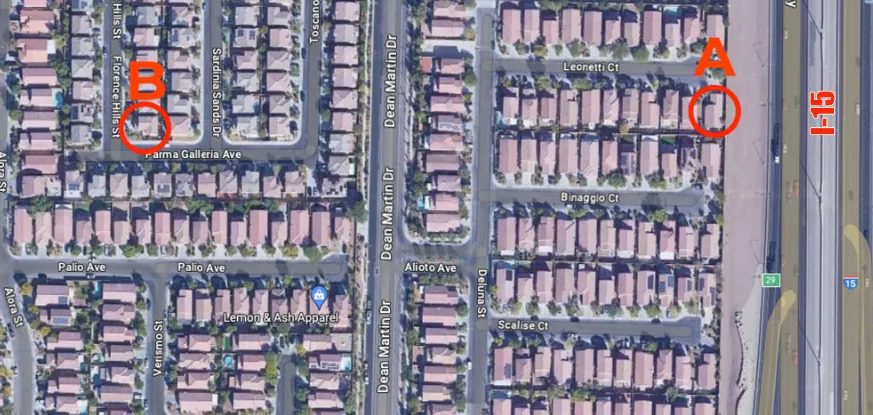
      Proximity to nuisances – Rentometer showed the same rent for both properties. However, Property A, located next to Interstate 15, will rent for less than Property B even if the physical attributes are the same. This is due to the noise from I-15. I was in Property A several years ago. The noise was so loud that my client and I had to shout to hear each other. Because of the noise, this property is practically unrentable.

      Age – These two properties have similar sizes and the same number of beds and baths. Rentometer says they will rent for approximately the same amount, which is not accurate.

      Using AI

      AI will do no better, if not worse, than Rentometer because it suffers from the same problem: it cannot determine the current condition of a property. And, it does not know the “styles” people in a location prefer.

      How We Estimate Rents

      All investment calculations are based on the rental rate. So “good enough” is not acceptable for investment decisions. We use a four-step process to determine an accurate estimate, as illustrated below.

      Software and AI Fail

      The reason software and AI estimates do not work is that potential renters evaluate a property as a place to live. People are not software. They do not follow an algorithm. People make housing decisions based on emotions, not logic.

      FERNWOOD Team, KW VIP Realty520 Reviews
  • Member since 2021 · 82 posts · 79 votes
    6mo

    Eric's framing is right. Ryan D.'s audit layer is right. "Track the jumps not the drifts" is right.

    But all of that is still audit — what I assumed vs. what happened. Reactive. Twelve months after close.

    The layer above is verification at intake. The system refuses to let an unverified claim become an assumption.

    Insurance line in an OM says "$800/unit." Audit layer flags it 12 months later at $1,400. Deal already closed. Verification layer flags it at intake: grandfathered policy, doesn't transfer at sale, current submarket quotes are $1,300–$1,500. The $800 doesn't enter your underwriting unless you override it, and the override is logged.

    Comps work the same way. Two wood-frame 1972s pulled against a CBS 2005 aren't comps. The system says so before they hit your model.

    Same for tax reassessment, CAM caps, exit caps. Every claim carries its source, the logic that produced it, and the rules that would invalidate it. Not confidence scores. Provenance.

    That's the gap between a proforma generator and something a CFO will wire money against. Audit tells you why a deal failed. Verification keeps it from entering your pipeline as a deal.

    Regulated industries are already there — insurance appeals, financial planning, legal. Real estate lands in the same place 18–24 months later.

  • Member since 2021 · 82 posts · 79 votes
    6mo

    @Chris Lin — you're directionally right. AI for sourcing and filtering, human for the decision. That framework is sound.

    One thing I'd push on though — you said "I went a step further to let AI do the underwriting for me based on my financial scenario and stress test." Then two paragraphs later you said "that math needs to be deterministic, not a guess by AI."

    Those two statements are in tension. And the gap between them is where deals actually break. If AI is selecting your comps, estimating rehab, and pulling tax history across multiple out-of-state markets — that's not grunt work anymore. That's assumption generation. And assumptions are the underwriting. The math downstream is just arithmetic.

    The question isn't whether your calculator is deterministic. It's whether the inputs feeding that calculator were validated by someone who knows the submarket. Eric Fernwood made this point earlier in the thread — Rentometer shows the same rent for a property next to I-15 and one three blocks away in a quiet neighborhood. The data looks clean. The number is wrong. No software catches that without local context.

    Out-of-state across multiple markets compounds that risk. You're trusting the extraction layer to get the inputs right in markets where you don't have the pattern recognition to know when something smells off. That works great when the market is forgiving. It gets expensive fast when it's not.

    None of that means what you're doing is wrong — filtering 1,000 listings down to 15 is real leverage. But the further you are from the asset, the more the verification layer matters. Ryan D. learned that the hard way on a flip when his submarket shifted under him. The audit layer he built after that loss is what separates "I use software" from "I have a system."

    The people in this thread who've been through a few cycles all landed in the same place: let AI do the work before the decision. Keep the decision human. And build the feedback loop so your assumptions get better over time, not just faster.

  • AJ WongBusiness Member
    Real Estate Broker · Oregon & California Coast · Member since 2022 · 834 posts · 696 votes
    6mo

    AI is terrible and inaccurate. 

    Sesemi | STR Brokers powered by Fathom Realty 518 Reviews
  • Fayetteville Arkansas · Member since 2026 · 44 posts · 12 votes
    6mo

    You can build skills with functions and reference files to make it accurate. Harnessing AI is the key. 

  • Member since 2021 · 82 posts · 79 votes
    6mo

    @AJ Wong — "AI is terrible and inaccurate" is a design problem, not a technology problem. If you ask ChatGPT for a cap rate and it hallucinates a number - yes, that's terrible. That's also not what anyone in this thread is talking about.

    What Eric built (and what I run): deterministic math with validated inputs. AI extracts data from messy documents. The math is the same spreadsheet logic you'd write yourself. Same inputs, same outputs, every time. The AI doesn't underwrite — it reads the rent roll so you don't have to retype it.

    Dismissing the entire category because bad implementations exist is like refusing to use spreadsheets because someone once typed the wrong formula.

    @Iliya — "harnessing AI is the key" is directionally right but too vague to help anyone. The specifics matter: structured extraction with validation rules, every number cited back to a source document, sensitivity analysis at 200 scenarios instead of 3, and a feedback loop so assumptions improve after each close.

    None of this replaces walking the property. Eric said it, I said it earlier in this thread, and every experienced operator here agrees. But the handoff problem Eric described — five disconnected tools, copy-paste between them, assumptions drifting — that's a real workflow problem with a real solution. The people dismissing it without engaging the substance aren't adding to the conversation.

Join the conversationCreate a free account to reply, vote on answers and follow this thread.