Is debt the new asset?
Rental Property Investor · Nashville, TN · Member since 2018 · 9 posts · 15 votes
Was listening to podcast by George Gammon and Robert Kiyosaki recently. They made the comment that with high market valuations for most RE right now, and record low interest rates, that the debt is now the asset, and the property is now the liability. I think I get what they were trying to say, but can anyone expand in that comment?
I don't quite "get" what they're saying....will have to listen to the podcast.
I know Kyosaki is good at one thing: using high-level, pie-in-the-sky analysis and cherry picking data to sell books and courses. He's pop culture REI. In his world of trite clichés (don't work for money; let money work for you....buy low, sell high....work for yourself, not someone else; own assets, not liabilities, etc), there is always a story from a person who has a first name and a last initial whom you and I could never contact to verify that A) said story actually happened and B) how hard they had to work on their own to make it happen.
So, I would not trust him with anything unless I personally vetted the details IN DETAIL. He even admit on several occasions that most of his writings in the "Rich Dad" series are fictionalized accounts designed to teach concepts. In other words, he gives a theory.....that sometimes works out in practice with a whole lot of elbow grease on your part.
If someone won't show me their balance sheet, I take everything they say with a grain of salt. Especially if they say real estate is not an asset. I guarantee you, it is. If you disagree, then please send Quit Claim deeds to all your non-assety real estate naming me as the Grantee. Thanks in advance.
The moment the dollar was untethered from an asset to mark its value (gold), debt became the asset so what Gammon and Kiyosaki are saying is nothing new, but it is highlighted in a market like ours. The moment the government chose to stimulate the economy through the pandemic it created a plow through recession, which isn't to say we'll never see recessions any more, but when the government prints money to save everyone, the only thing that is valuable is debt.
Would I be correct to state that using the house to secure a mortgage at say 4%, and inflation is running at 8%, you could theoretically say inflation is eating the dollar denominated value of the mortgage by 4%, thus adding 4% to your rate of return? Is that the right way to look at it?
I don't quite "get" what they're saying....will have to listen to the podcast.
I know Kyosaki is good at one thing: using high-level, pie-in-the-sky analysis and cherry picking data to sell books and courses. He's pop culture REI. In his world of trite clichés (don't work for money; let money work for you....buy low, sell high....work for yourself, not someone else; own assets, not liabilities, etc), there is always a story from a person who has a first name and a last initial whom you and I could never contact to verify that A) said story actually happened and B) how hard they had to work on their own to make it happen.
So, I would not trust him with anything unless I personally vetted the details IN DETAIL. He even admit on several occasions that most of his writings in the "Rich Dad" series are fictionalized accounts designed to teach concepts. In other words, he gives a theory.....that sometimes works out in practice with a whole lot of elbow grease on your part.
If someone won't show me their balance sheet, I take everything they say with a grain of salt. Especially if they say real estate is not an asset. I guarantee you, it is. If you disagree, then please send Quit Claim deeds to all your non-assety real estate naming me as the Grantee. Thanks in advance.
Yeah, I read Rich Dad Poor Dad years ago, but he was a guest on Gammon's show, and he wasn't selling anything. George Gammon mentioned the concept, and I've heard it before, but still trying to wrap my mind around exactly what they mean "debt is the asset, the property is the liability". I think they basically meant with rates so low, and higher inflation likely coming, inflation will eat away the debt.
Was listening to podcast by George Gammon and Robert Kiyosaki recently. They made the comment that with high market valuations for most RE right now, and record low interest rates, that the debt is now the asset, and the property is now the liability. I think I get what they were trying to say, but can anyone expand in that comment?
I think they just generally mean that debt is cheap now so from the financial angle it is a good moment to get indebted or apply for mortgages.
However, they do not say that when interest rates are low generally prices are high, so what you are saving on the debt side of a deal is included on the sell price as a mark up.
Actually Kristalina Georgieva, head of the IMF, has recently reminded economic agents that debts have to be repaid in full and even if interest rates are low, borrowers still need to be able to generate enough income to meet montly repayments of principal and interest. She is reminding banks and economic agents of the dangers associated with excessive debt.
"War is Peace. Freedom is Slavery. Ignorance is Strength" George Orwell
Debt is an Asset: R. Kiosaki
Sterling I think you answered your own question pretty correctly . I’m debt obsessed currently . 2% interest rates are to die for .. not literally . For once I think rich dad poor dad works for “newer “ Investors in real estate
Debt will never BE the asset, but it's used to acquire assets which provide returns great than the debt interest rate.
Maybe an oversimplification of what they're saying in the podcast, but if you could refi your house at 3%, and then throw that money right into a general stock market ETF aiming for 8%, then you can conceivably consider debt the asset yielding you a 5% return.
If someone were to offer you $1m today at 3% would you take it? It'd be hard to turn that down given the greater returns you can get in so many different areas.
Just try to avoid thinking debt used to buy a vacation or a new sports car is an asset!
@Sterling Wyatt
Man this thread is gold. I’m gonna be not the smartest dude here, but I can say I agree with a related but inverse principle of his:
“savers are losers.”
I meet a lot of tired or failed landlords who wanna throw in the towel because, in part, they limited themselves to hard work, savings, and only buying within traditional means. Aka living in a house, getting a bigger one then renting out the old one.
Nothing wrong with that.
But my observation is that on the other hand the investors who understand how to get a lot of debt (and the assets that debt allows them to control) within safe constructs are 9/10 times happier and closer to a place of true investing.
@Sterling Wyatt
Man this thread is gold. I’m gonna be not the smartest dude here, but I can say I agree with a related but inverse principle of his:
“savers are losers.”
I meet a lot of tired or failed landlords who wanna throw in the towel because, in part, they limited themselves to hard work, savings, and only buying within traditional means. Aka living in a house, getting a bigger one then renting out the old one.
Nothing wrong with that.
But my observation is that on the other hand the investors who understand how to get a lot of debt (and the assets that debt allows them to control) within safe constructs are 9/10 times happier and closer to a place of true investing.
Oh man, this is an excellent point right here. I feel the lack of creativity, whether intentional or not, for those stuck in the tunnel vision of "traditional" ways as you expanded on is their downfall. Especially now. Leading your investment route in one way will give you one result. Acknowledging and discovering the many wonderful flavors of REI will keep you "happier and closer to a place of true investing" more times than not.
My take on the OP's thread and not having listened to it myself yet is this, I think it may be alluding to the Note game. Which is a topic I just recently started studying up on and I am intrigued. Holding a performing Note in this perceived shifts in market atmosphere seem (to me) to be the new asset. Great post so far!
Sterling you're exactly right. Inflation eats the debt. In a high inflation environment creditors are losers. Say you have 3% fixed rate debt but in 5 years the market rate on that same loan is 6% interest, well the creditor is still only getting 3% on the money they loaned you when they could be getting 6%. This is why ARMs exist. In the meantime, inflation is pushing up the nominal value of your asset and the cashflow the asset yields, but your payment remains fixed. So the return on your initial investment gets better and better as inflation pushes up asset values and yield. But it gets worse and worse for the creditor as interest rates go up as they still have hundreds of thousands of dollars tied up yielding only 3%.
@Sterling Wyatt The only logical explanation I have is that both the host and RK have no idea about basic financial concepts and are further willing to debase themselves to sell whatever it is they are hawking this week. As Upton Sinclair said: “It is difficult to get a man to understand something, when his salary depends on his not understanding it.”
@Nate Sanow You mentioned 'your observations. How long have you been observing things? Last time I checked, those folks who had excess amounts of leverage in the GFC didn't 'win', unless you consider not getting foreclosed on 'losing'. The choice about how much debt to take on is a function of how much risk the individual is willing to bear. In the vast majority of cases, more debt= more risk. more debt= higher return is also usually true, until it isn't. If one wants to lower their chance of permanent loss of capital to near zero, having no debt is the obvious first step. granted, it caps your upside, but the same holds true for the downside.
@Sterling Wyatt can you take out a loan on any existing equity you have? It is a good time to cash out with a low rate and scale to other properties. I like how @Brandon Turner talks about how to look at debt when explaining ROI in the book of rental property investing. Keeping your money in the deal low while maximizing loans.
I am really enjoying reading this thread,
I think his best book is Fake. It is really out of the box and gives a cynical overview of our economic system. I personally have built my properties through grinding hard and am not sure most people could pull off being financially secure by not working our asses off while we build. Some can and god bless them but even the most talented will need some luck. I do think Robert K. and too many other people are gimmicky in that regard.
That being said I do agree with much of how Robert would describe "the system works." Rich people use debt to by assets. Poor and middle class (as they teach us in school) use debt to stuff (crap if you will). Because the people who make the rules are rich they will not create solutions going forward that would harm them. He like me believes this is morally wrong (and it pisses him off) however it is the real world and bitching about it doesn't help anybody. Because of the overwhelming debt in the world governments will need to inflate or drop the value of debt. Assuming that is how this plays out buying income real estate with debt will make people wealthy. And I am putting my money where my mouth is.
I forget the exact number but something like 95% of the income real estate that was foreclosed in the Great Recession could have been held if the owner could have made up or handled a 15% decrease in revenues. So underwrite your properties so if your rent revenue went down 20% you still could pay all your bills. Looking at history it is hard to imagine a scenario where you get killed if you abide by that rule. And if I am right and take giant amounts of debt you will create a ton of wealth for yourself. If you think rental property is expensive now wait until the dollar has a significant decline.
@Sterling Wyatt
Thats exactly the point. US printing money will create inflation. Whoever have debt will make money... IF the allocation is in Real assets that will gain with inflation. House might not follow exactly inflation, but tends to get at least big part of it. Rentals tends to increase as well...
About RE being Liability, i think he tries to explain the rat race, people buying big houses with current salary, ending up paying larger installments. The big house became a liability cause all expenses grows ( maintenance, taxes, etc). He never considere that your own house reduces rent payments on his example. But thats to make it clear, to increase rental, would make the explanation more sophisticated.
I didnt listen specifically, but i believe that his liability is related to each one house.
@Sterling Wyatt
Thats exactly the point. US printing money will create inflation. Whoever have debt will make money... IF the allocation is in Real assets that will gain with inflation. House might not follow exactly inflation, but tends to get at least big part of it. Rentals tends to increase as well...
About RE being Liability, i think he tries to explain the rat race, people buying big houses with current salary, ending up paying larger installments. The big house became a liability cause all expenses grows ( maintenance, taxes, etc). He never considere that your own house reduces rent payments on his example. But thats to make it clear, to increase rental, would make the explanation more sophisticated.
I didnt listen specifically, but i believe that his liability is related to each one house.
If printing money causes inflation then how come when the Fed expanded their balance sheet from 2008-2014 inflation stayed pretty much constant?
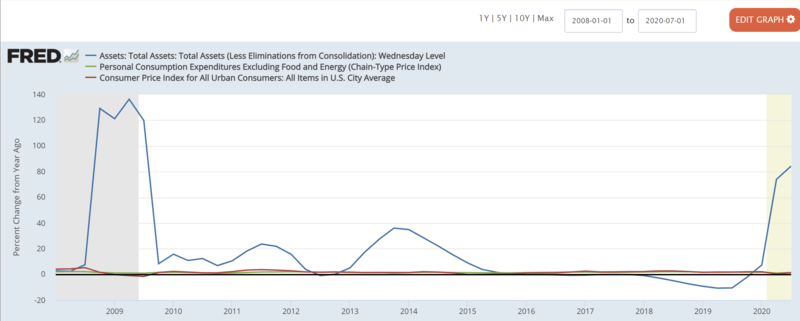
My understanding on why the Fed has printed so much $ and there hasn't been a huge rise in inflation, is that most of that money has gone to banks to shore up their balance sheets and cash reserves and hasn't made it to main street yet. Once it does inflation will increase, but it also depends how you define inflation-what's included. Houses have certainly gone up in most areas, cost of college, and a lot of food costs. The Fed would love for us to spend more I'm sure. I just saw where Australia's latest Treasury auction offered negative rates. Might happen here in the not too distant future maybe? I appreciate everyone's comments on this thread, and what I've gathered is it sounds like they were trying to say to take on as much low rate fixed debt as your comfortable with (with some emergency cash reserves available), and as we get rising inflation, the value of the rents and RE will increase at a higher pace than in the past, thus eating away the % of your $ required to pay your mortgages, and the creditors will be the ones on the short end of the stick?
@Bill F.
The answer to your late question is quite simple. Although FED was printing money, due to the deleverage from financial system, we actually faced a huge monetary contraction. So the act of printing money was not enough to offset the contraction caused by deleveraging.
The situation is not the same now, as a consequence printing money is making expansion.
Kiyosaki makes controversial statements to provoke thought and get attention. Probably more to get attention these days. He is famous for saying in Rich Dad Poor Dad that your personal home is not an asset. That statement is as factually incorrect, as is saying that "debt is an asset". It may make strategic sense to hold more debt, but that hardly makes it an asset.
What he is really trying to say is that based on current lending rates, taking on debt makes more sense than holding more equity. Inflation erodes the value of the dollar over time. That means the dollars you pay back on a loan in the future are worth less than the dollars you borrowed.
I am not sure this is anything new, other than the fact that the gap between expected inflation and interest rates is much closer than it has been for a long time.
Just remember that debt has an inverse relationship with interest rates. The moment interest rates go up, even just a little bit, the underlying value of debt (generally) will fall.
The longer dated the debt, the more sensitive it will be to interest rate shocks.
I would not recommend getting overexposed to debt unless the returns are truly astounding.
Kiyosaki makes controversial statements to provoke thought and get attention. Probably more to get attention these days. He is famous for saying in Rich Dad Poor Dad that your personal home is not an asset. That statement is as factually incorrect as saying that "debt is an asset". It may make strategic sense to hold more debt, but that hardly makes it an asset.
What he is really trying to say is that based on current lending rates, taking on debt makes more sense than holding more equity. Inflation erodes the value of the dollar over time. That means the dollars you pay back on a loan in the future are worth less than the dollars you borrowed.
I am not sure this is anything new, other than the fact that the gap between expected inflation and interest rates is much closer than it has been for a long time.
Thank you, Joe, for offering the levelheaded response so needed in this thread. Focus less on the words with Kiyosaki, more on the ideas. It says "bestselling author" on his books, not "bestwriting author." And yes, I filched that joke straight from him.
"Focus less on the words with Kiyosaki, more on the ideas."
Words are meant to convey ideas, and when someone plays fast and loose with words and makes up flashy statements that twist reality to put more money in their pocket....we call those kinds of people con artists. It is not only poor writing, it is poor teaching, and since Kyosaki stylizes himself as a financial "educator" I call Baloney Slice on that kind "material."
I reiterate: he is a pop culture real estate investor who doesn't really invest, last I checked....maybe that has changed. He sells books--lot of them--by making outrageous claims as if they were some secrete insight that he came up with, but what it amounts to is the same old shyster trick: telling people what they want to hear. Saying things like "Debt is an asset" is designed to spark controversy so he can sell more books. It isn't to teach anyone anything particularly new, useful, interesting, or important...nor is it factually correct. Debt is a liability, but telling people that doesn't sell books.
Taking real estate advice from Kyosaki's "ideas" is like taking marriage advice from Zsa Zsa Gabor.
Kiyosaki makes controversial statements to provoke thought and get attention. Probably more to get attention these days. He is famous for saying in Rich Dad Poor Dad that your personal home is not an asset. That statement is as factually incorrect as saying that "debt is an asset". It may make strategic sense to hold more debt, but that hardly makes it an asset.
What he is really trying to say is that based on current lending rates, taking on debt makes more sense than holding more equity. Inflation erodes the value of the dollar over time. That means the dollars you pay back on a loan in the future are worth less than the dollars you borrowed.
I am not sure this is anything new, other than the fact that the gap between expected inflation and interest rates is much closer than it has been for a long time.
Thank you, Joe, for offering the levelheaded response so needed in this thread. Focus less on the words with Kiyosaki, more on the ideas. It says "bestselling author" on his books, not "bestwriting author." And yes, I filched that joke straight from him.
Forget about Kiyosaki, not promoting or debating him, just the thought concept that was brought up in the conversation.
"Focus less on the words with Kiyosaki, more on the ideas."
Words are meant to convey ideas, and when someone plays fast and loose with words and makes up flashy statements that twist reality to put more money in their pocket....we call those kinds of people con artists. It is not only poor writing, it is poor teaching, and since Kyosaki stylizes himself as a financial "educator" I call Baloney Slice on that kind "material."
I reiterate: he is a pop culture real estate investor who doesn't really invest, last I checked....maybe that has changed. He sells books--lot of them--by making outrageous claims as if they were some secrete insight that he came up with, but what it amounts to is the same old shyster trick: telling people what they want to hear. Saying things like "Debt is an asset" is designed to spark controversy so he can sell more books. It isn't to teach anyone anything particularly new, useful, interesting, or important...nor is it factually correct. Debt is a liability, but telling people that doesn't sell books.
Taking real estate advice from Kyosaki's "ideas" is like taking marriage advice from Zsa Zsa Gabor.
Sorry, Erik, got better things to do than get drawn into exactly the kind of pretzel-logic Kiyosaki debate that makes the old man so much of his money. By all means, the book is worthless, the investment advice is worthless, the ideas are flimflam, and you have impressed me greatly with your deep sagacity in so many ways in these forums.
Is debt an asset? Yes, to banks and lenders
I've been happily punching their assets in the face when commercial or with rates at 6%+.
Will be holding another mortgage burning party (virtual of course) February 5th. Commercial-like private lender mortgage at 6%.
All things are an asset to somebody.