Zillow ads climate risk insights, but too many people are ignoring the data

Zillow ads climate risk insights, but too many people are ignoring the data

Denver · Member since 2024 · 29 posts · 17 votes

A sign of the times. Zillow is adding climate risk scores powered by First Street for every for-sale listing on its platform.

Another Zillow survey published in September 2023 found that 83% of home shoppers considered climate risks when looking at homes – but far too many are ignoring the warnings.

The 2023 US Census Bureau’s state-to-state migration data shows Florida and Texas ranked #1 and #2 for new move-ins with 1.25m people migrating to those two states combined.

Now let’s pair this with climate risk...

Policygenius ranked the 48 contiguous states for climate risk based on drought, extreme heat, wildfires, flooding, and climate change preparedness.

Guess which state has the highest climate risk? Florida. And Texas is 4th worst.

Here are the top 10 states where people moved in 2023 along with their climate risk ranking. Arizona, Georgia and North Carolina are unfortunately at very high risk as well.
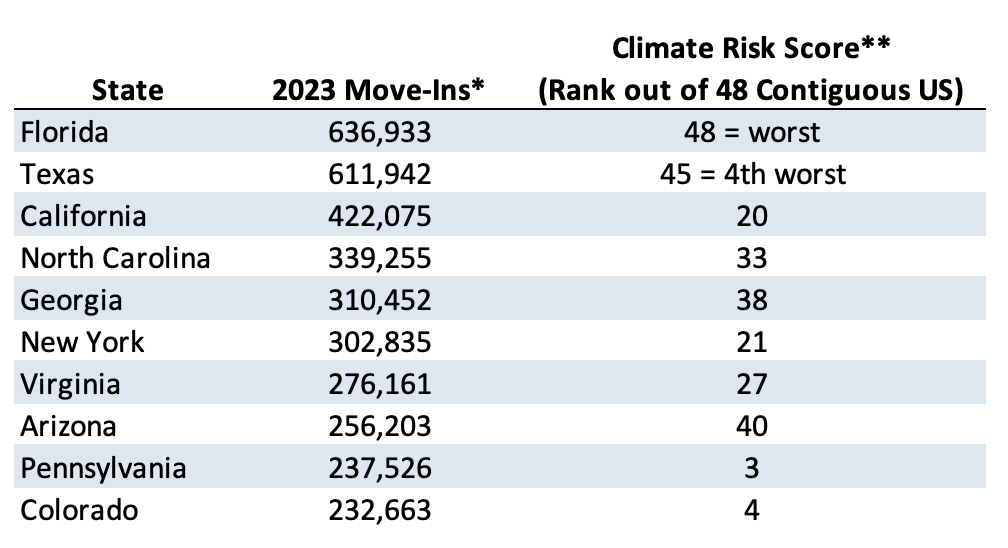


I think we’ll see large swaths of climate refugees moving to the midwest, upper midwest and mountain west. This is where land and home values will increase the most, and where they’re currently less expensive in many cases. Development will start to happen at higher rates as more people move. Jobs will be most in demand as the populations in these states grow.

What does this mean for the future of homeownership, rental property investing, home values, insurance, and migration?

How long will this take to happen?

How do you feel about it personally especially if you’ve migrated to / from a risky state in the last 2-3 years?

Climate rankings for all 48 states from Policygenius**:
https://infogram.com/best-and-worst-states-for-climate-change-1hd12yx3orgyx6k

Census Bureau migration data*:
https://www.census.gov/data/tables/time-series/demo/geographic-mobility/state-to-state-migration.html

Zillow press release on adding climate data:
https://zillow.mediaroom.com/2024-09-26-Zillow-introduces-First-Streets-comprehensive-climate-risk-data-on-for-sale-listings-across-the-US

3Reply
281 views

Most Popular Reply

Bruce WoodruffPro Member
Contractor/Investor/Consultant · San Diego / Phoenix · Member since 2021 · 12k+ posts · 15k+ votes
2y

Much of this climate paranoia is usally driven by false ...or more accurately -  'incompletely (or incorrectly) analyzed' data.

For example, I see that you list Arizona as a State that is 'in danger' because of dwindling water supplies....yet you fail to manetion that they get much less of their % water from the Colorado, instead having rivers and underground sources to rely upon. Unlike So Cal, that gets a larger % or their water from the Colorado.

If the environmentalists in Cali would go away and we could get desalination going, Cali would be fine. And so would the rest of the Soutwest, which could then claim it's higher (and rightful) claims to the Colorado supply.

Basically so many moving parts and ways to deal with the climate issues, both those that are real and those that are imagined. ANd then for all we know, the planet coiuld be on the verge of entering a new Wet-Age or Ice-Age. Moot point then.

But in response to your original question, no, I would not even consider climate in my choices for where to buy rentals or investment properties. It's all about the $$$$. Does it make sense and will it make money? I.E. Florida....some 'Chicken Little' investors are selling and running about now. Can you say Opportunity Awaits?

See this reply in the discussion

54 Replies

Jump to latestLatest
  • Investor · Denver Metro, CO · Member since 2021 · 12 posts · 5 votes
    2y

    Thanks for sharing the data and links – I've been thinking about this for years, and have adjusted how and where I buy as a result. It's great to see that Zillow is surfacing the data as well.

  • Denver · Member since 2024 · 29 posts · 17 votes
    2y

    @Laura Nelson Interesting, where are you investing? I'm seeing some large institutional SFR/BTR investors looking in very different markets too.

  • Rental Property Investor · Manteno, IL · Member since 2009 · 2k+ posts · 2k+ votes
    2y

    Why does arizona have a climate risk? Lack of water?   If anything that might restrict building but I don't see them running out of water for existing homes so wouldn't that mean home values going up because supply would be restricted.

    What kind of climate risk could occur there? Flooding no. hurricane obviously not. Tornadoes not really.  Heating temp increasing? Is that really a climate risk for the homes themselves? Are they going to catch on fire?

    I just don't see that at all.  And how is texas fourth worst? Houston could be hit by a hurricane but they have a lot of population in other areas that would not be in danger.  Unlike florida, where the entire state can pretty much be clobbered. 

    And how is california not higher with the increasing number of forest fires?

  • Denver · Member since 2024 · 29 posts · 17 votes
    2y

    @Mike H. I've listed the criteria from the analysis I used from Policygenious (and here's the full article:

    https://www.policygenius.com/homeowners-insurance/best-and-w...)

    Drought is the biggest concern for AZ, along with high heat. Arizona's water supply from the Colorado river is being depleted faster than it can be replenished. Here a bit more on that: https://www.fox10phoenix.com/news/arizonas-water-crisis-colo...

    --------

    The factors that went into this analysis were grouped into the following five categories. We then ranked states from best to worst for each category.
    • Drought: The likelihood of negative economic impacts as a result of drought, the number of people and fresh water sources exposed, and the state's ability to recover or adapt to a future with drought
    • Extreme heat: Projected number of dangerously hot days by 2050 and the percentage of people vulnerable to dangerously high temperatures
    • Wildfires: Fraction of housing units directly or indirectly exposed to wildfire, as well as wildfire likelihood and home susceptibility
    • Flooding: Percentage of people living in 100 and 500-year floodplains, projected 30-year increase in number of properties with flood risk, and the percentage of the population living in a 100-year coastal floodplain
    • Climate change preparedness: How well each state is responding to current and future climate change threats
  • Investor · Denver Metro, CO · Member since 2021 · 12 posts · 5 votes
    2y
    Quote from @Brett Jurgens:

    @Laura Nelson Interesting, where are you investing? I'm seeing some large institutional SFR/BTR investors looking in very different markets too.


     My investments are currently in Colorado, but I'm going to expand into the Midwest (where I grew up and am familiar with some markets).  

  • Denver · Member since 2024 · 29 posts · 17 votes
    2y
    Quote from @Laura Nelson:
    Quote from @Brett Jurgens:

    @Laura Nelson Interesting, where are you investing? I'm seeing some large institutional SFR/BTR investors looking in very different markets too.


     My investments are currently in Colorado, but I'm going to expand into the Midwest (where I grew up and am familiar with some markets).  


    Got it and makes sense. I live in Denver and have one here and one in the mountains. Thinking about other markets too but don't know much about opportunities outside of CO. 

  • Bradley BuxtonBusiness Member
    Real Estate Agent · NV · Member since 2023 · 1k+ posts · 720 votes
    2y

    @Brett Jurgens

    It seems like climate risks can be mitigated with human technology, better buildings, desalinization, improved infrastructure.  In the short term until the technology improves an investor climate risk will be the insurance costs associated with owning real estate. This will be a relatively unknow factor when calculating returns. Buying in TX or CA will likely have ever increasing insurance costs. 

  • Denver · Member since 2024 · 29 posts · 17 votes
    2y

    @Bradley Buxton definitely things being done to make homes more sustainable re: natural disasters. Code in FL, for example, has increased hurricane wind strength from 145mph to 175mph in some areas I know about.

    And agree, it's all "insurance" weather a policy or not. 

    And actually being able to insure, and properly insure, in some of these areas is an entirely separate can of worms!

  • Bruce WoodruffPro Member
    Contractor/Investor/Consultant · San Diego / Phoenix · Member since 2021 · 12k+ posts · 15k+ votes
    2y

    Much of this climate paranoia is usally driven by false ...or more accurately -  'incompletely (or incorrectly) analyzed' data.

    For example, I see that you list Arizona as a State that is 'in danger' because of dwindling water supplies....yet you fail to manetion that they get much less of their % water from the Colorado, instead having rivers and underground sources to rely upon. Unlike So Cal, that gets a larger % or their water from the Colorado.

    If the environmentalists in Cali would go away and we could get desalination going, Cali would be fine. And so would the rest of the Soutwest, which could then claim it's higher (and rightful) claims to the Colorado supply.

    Basically so many moving parts and ways to deal with the climate issues, both those that are real and those that are imagined. ANd then for all we know, the planet coiuld be on the verge of entering a new Wet-Age or Ice-Age. Moot point then.

    But in response to your original question, no, I would not even consider climate in my choices for where to buy rentals or investment properties. It's all about the $$$$. Does it make sense and will it make money? I.E. Florida....some 'Chicken Little' investors are selling and running about now. Can you say Opportunity Awaits?

  • Rental Property Investor · Round Rock, TX · Member since 2016 · 1k+ posts · 971 votes
    2y

    So, you need Zillow to tell you it's hot in TX and FL gets hurricanes? And that like it's something new, not going on for millennia?

    Take it with a big grain of salt - I saw a property tagged with HIGH RISK of HEAT due to a 200% increase of days over 100F in the next 10 years....going from ONE per year to ...drum roll...TWO days per year.

  • Bruce WoodruffPro Member
    Contractor/Investor/Consultant · San Diego / Phoenix · Member since 2021 · 12k+ posts · 15k+ votes
    2y
    Quote from @Costin I.:

    So, you need Zillow to tell you it's hot in TX and FL gets hurricanes? And that like it's something new, not going on for millennia?

    Take it with a big grain of salt - I saw a property tagged with HIGH RISK of HEAT due to a 200% increase of days over 100F in the next 10 years....going from ONE per year to ...drum roll...TWO days per year.


    Exactly ^^^

    I've noticed that they are now calling the wildest temps as 'Heat Advisory'....For example: Last summer in Phoenix, they had a period with 105ish temps declared as 'Heat Advisory'. I checked over in San Diego (because I have lots of friends/family there) and they had temps in the 80s-90s described as 'Heat Advisory'.....Huh?

    I firmly believe that the media/internet/powers that be are just spinning the crap out of this whole weather thing. Why? Money. Power.

    Having said that, we should all be aware of the ever-changing weather/climate and how it might affect our investing and more importantly, our lives and health. But it really has not perceptively changed much in my lifetime....

  • Denver · Member since 2024 · 29 posts · 17 votes
    2y

    I think it’s fantastic that Zillow is highlighting risks and opportunities of properties more broadly.

    Data like this helps buyers ask better questions about potentially higher insurance costs (or insurability risk), higher maintenance costs, etc.

    We all know AZ is hot. That’s not the point.

    Not all of us know migration patterns. That’s why I thought the pairing of millions of people moving to some of the riskiest, and potentially more expensive future real estate markets, was interesting to explore.

    @Costin I. how much have insurance costs increased in TX the last 3-4 years?

    Adding insurance cost increases and insurability to this may be a good v2.

  • Rental Property Investor · Round Rock, TX · Member since 2016 · 1k+ posts · 971 votes
    2y

    @Brett Jurgens if data is non-partisan, yes, it could be helpful if one can access it and knows how to interpret it. If it's used to promote an agenda or to scare you into doing something, then I take it very cautiously (like the jobs numbers, that were adjusted 340% retroactively...do you still place value on that reporting, after repeated significant adjustments?). IMHO, if something is based on fear, there is an agenda behind it. And a lack of solid arguments, otherwise the fear factor would not be necessary.  

    Insurance in TX increased substantially in the last years, on average 10% per year, in some cases even experienced 30% annual increase.  

    I agree, seeing migration patterns coupled with insurance costs and insurability might be a good macro-economic indicator. Not easy to do, not in a heavily regulated environment. I think a free market would sort this kind of thing in a very efficient manner. 

  • Bruce WoodruffPro Member
    Contractor/Investor/Consultant · San Diego / Phoenix · Member since 2021 · 12k+ posts · 15k+ votes
    2y

    @Brett Jurgens No one (certainly not I) is bashing your concept here. It is important (and a huge advantage) to be able to anticipate interstate migration patterns before they happen :-)

    I am just opposed to the 'sky is falling' approach....not even saying you were going there.....but lots of people do just that.

    Other than that, interesting topic....

  • Dan H.Pro Member
    Investor · Poway, CA · Member since 2015 · 7k+ posts · 8k+ votes
    2y

    I am not stating this because I am against it; I have mixed feelings.  I am stating it to provide something to ponder and an explanation why it may appear people are ignoring the data.

    If owners of property impacted by climate events are heavily bailed out by FEMA and other sources, then what is the risk?

    The latest that I am aware of occurred this past Monday, Rancho Palos Verdes. ~70 years ago a landslide took out over 100 homes in the area. The road is built on top of a previous landslide. Was it hard to predict future issues? FEMA & Ca provided a $42m buyout program for the worst impacted.
    https://timesofsandiego.com/politics/2024/10/29/residents-of...

    It seems the owners should have known the risk, but let’s assume they did know the risk but also knew the precedence of assistance for climate related impacts.  Is it unreasonable that they would expect aid for a climate related impact?

    Same logic can be applied to anyone impacted by the recent hurricanes.

    So what is the risk?

    By the way I am looking at properties in a high fire risk area.  It will require Ca Fair Plan insurance which is not cheap but is likely cheaper than a free market would dictate.  What is my risk?  I know the state has CA fair plan insurance for high risk properties and I know its cost.  if it burns down, I will have insurance.  Even though climate risk (fire) is high, my risk does not seem high. 

    So it appears I am one ignoring the data, but I believe I have a good grasp of the risk and a plan to mitigate the risk.  

    Best wishes

  • Denver · Member since 2024 · 29 posts · 17 votes
    2y
    Quote from @Bruce Woodruff:

    @Brett Jurgens No one (certainly not I) is bashing your concept here. It is important (and a huge advantage) to be able to anticipate interstate migration patterns before they happen :-)

    I am just opposed to the 'sky is falling' approach....not even saying you were going there.....but lots of people do just that.

    Other than that, interesting topic....

    100% and appreciate that @Bruce Woodruff. Don't worry, I didn't feel bashed! All good points being made about being careful with, and critical of, data. Love the discourse here. 

    I think tracking turn costs, vacancy rates, insurance costs, etc. in connection with a lot of this data could all be helpful iterations. I find myself and other real estate investors are often locally focused to the markets we all know. And often a smart strategy. This along with high home prices in some markets like mine in Denver are making me take a broader look.

  • Denver · Member since 2024 · 29 posts · 17 votes
    2y
    Quote from @Dan H.:

    I am not stating this because I am against it; I have mixed feelings.  I am stating it to provide something to ponder and an explanation why it may appear people are ignoring the data.

    If owners of property impacted by climate events are heavily bailed out by FEMA and other sources, then what is the risk?

    The latest that I am aware of occurred this past Monday, Rancho Palos Verdes. ~70 years ago a landslide took out over 100 homes in the area. The road is built on top of a previous landslide. Was it hard to predict future issues? FEMA & Ca provided a $42m buyout program for the worst impacted.
    https://timesofsandiego.com/politics/2024/10/29/residents-of...

    It seems the owners should have known the risk, but let’s assume they did know the risk but also knew the precedence of assistance for climate related impacts.  Is it unreasonable that they would expect aid for a climate related impact?

    Same logic can be applied to anyone impacted by the recent hurricanes.

    So what is the risk?

    By the way I am looking at properties in a high fire risk area.  It will require Ca Fair Plan insurance which is not cheap but is likely cheaper than a free market would dictate.  What is my risk?  I know the state has CA fair plan insurance for high risk properties and I know its cost.  if it burns down, I will have insurance.  Even though climate risk (fire) is high, my risk does not seem high. 

    So it appears I am one ignoring the data, but I believe I have a good grasp of the risk and a plan to mitigate the risk.  

    Best wishes


     Sounds like you're not ignoring the data at all to me! You're informed, understand the cost of insurance, and have analyzed the risk / reward. 

    Interesting point about bailouts and government support. Not sure how often that happens and to the extent it does, how much individuals are receiving.

    Trying my best not to politicize this, but have to add that massive bailouts are going to continue to get harder to afford with the high federal debt we have today.

  • Investor · Milwaukee - Mequon, WI · Member since 2010 · 5k+ posts · 7k+ votes
    2y

    As an investor I consider myself lucky to be on the Great Lakes. My team works with a lot of relocation clients and we always ask: why are you moving to Milwaukee? About 50% of the answers have to do with family or job. The other half is related to personal experience with too much/not enough water, excessive heat or smoke from fires.

    Migration trends seem to be generational and move/change at a glacial pace. A lot of young people move to FL, because their parents where always talking about that some day they would - and never did. 

    Money is ultimately going to be the driver, foremost the cost of insurance. FL is now basically going socialist by offering state-sponsored tax-funded insurance to replace the private insurance carriers who don't want to loose money any more.

    Home prices are also interesting: when the first row of houses gets washed out by a storm surge, you have for sale signs pop up in the second. But who is going to look at this and say, yeah I am going to make a full-price offer? And as soon as prices start to slip YoY and people start to expect that it becomes a self-fulfilling prophecy.

    I had a client who moved from a new subdivision is AZ, because they ran out of water. For two years they were bringing in water with tanker trucks. Home values go pretty much to zero, if you don't have water.

    It's like Earnest Hemingway said about how it happened: first gradually, then suddenly. I think we are still in "gradually", in 10 years things may look a little different. 

    Trends are always hard to spot at the beginning. And for some reason as a society which is rapidly getting technologically more advanced some of us come to the conclusion that scientists can not be trusted.. make it make sense.

  • Investor · Denver Metro, CO · Member since 2021 · 12 posts · 5 votes
    2y
    Quote from @Marcus Auerbach:

    As an investor I consider myself lucky to be on the Great Lakes. My team works with a lot of relocation clients and we always ask: why are you moving to Milwaukee? About 50% of the answers have to do with family or job. The other half is related to personal experience with too much/not enough water, excessive heat or smoke from fires.

    Migration trends seem to be generational and move/change at a glacial pace. A lot of young people move to FL, because their parents where always talking about that some day they would - and never did. 

    Money is ultimately going to be the driver, foremost the cost of insurance. FL is now basically going socialist by offering state-sponsored tax-funded insurance to replace the private insurance carriers who don't want to loose money any more.

    Home prices are also interesting: when the first row of houses gets washed out by a storm surge, you have for sale signs pop up in the second. But who is going to look at this and say, yeah I am going to make a full-price offer? And as soon as prices start to slip YoY and people start to expect that it becomes a self-fulfilling prophecy.

    I had a client who moved from a new subdivision is AZ, because they ran out of water. For two years they were bringing in water with tanker trucks. Home values go pretty much to zero, if you don't have water.

    It's like Earnest Hemingway said about how it happened: first gradually, then suddenly. I think we are still in "gradually", in 10 years things may look a little different. 

    Trends are always hard to spot at the beginning. And for some reason as a society which is rapidly getting technologically more advanced some of us come to the conclusion that scientists can not be trusted.. make it make sense.


     Thanks for sharing your insights and experiences here! Would be curious to learn about the Milwaukee market sometime. 

  • Denver · Member since 2024 · 29 posts · 17 votes
    2y
    Quote from @Marcus Auerbach:

    As an investor I consider myself lucky to be on the Great Lakes. My team works with a lot of relocation clients and we always ask: why are you moving to Milwaukee? About 50% of the answers have to do with family or job. The other half is related to personal experience with too much/not enough water, excessive heat or smoke from fires.

    Migration trends seem to be generational and move/change at a glacial pace. A lot of young people move to FL, because their parents where always talking about that some day they would - and never did. 

    Money is ultimately going to be the driver, foremost the cost of insurance. FL is now basically going socialist by offering state-sponsored tax-funded insurance to replace the private insurance carriers who don't want to loose money any more.

    Home prices are also interesting: when the first row of houses gets washed out by a storm surge, you have for sale signs pop up in the second. But who is going to look at this and say, yeah I am going to make a full-price offer? And as soon as prices start to slip YoY and people start to expect that it becomes a self-fulfilling prophecy.

    I had a client who moved from a new subdivision is AZ, because they ran out of water. For two years they were bringing in water with tanker trucks. Home values go pretty much to zero, if you don't have water.

    It's like Earnest Hemingway said about how it happened: first gradually, then suddenly. I think we are still in "gradually", in 10 years things may look a little different. 

    Trends are always hard to spot at the beginning. And for some reason as a society which is rapidly getting technologically more advanced some of us come to the conclusion that scientists can not be trusted.. make it make sense.


     Thanks Marcus, interesting stuff. I've heard of some developments in Vegas that don't have water rights. Crazy!

    Would also be curious about the markets you're in too. I'm in Denver, good place to be, but pricey right now. 

  • V.G JasonPro Member
    Investor · Member since 2022 · 3k+ posts · 3k+ votes
    2y

    Climate risk is definitely present. I'm just going to tell you it's not where we think it is, it'll surprise people where it really is. 

    The main programs that study this show a far different look than the appropriate (private & costly) programs. The latter of which has been significantly more accurate in the last 20 years. Look at this year's storms in Asheville, perfect example. 

    Water is short-term issue, it won't be a material one. It'll require technology and different inter-state policies in regarding the agreements of sourcing. Coastal, sea levels, pollution, etc., those one's are going to be more prevalent and likely inappropriately evaluated. I'll tell you this coastal Texas is going to see a completely different flood zone, as are parts of NC, GA, etc.. Yet we sat here working off the previous notion? Don't buy the same scam twice, really think about how these investments are placed.

    The more drastic issue will be energy procurement and energy grids. This is something most folks need to be ready for. Winterization and peak summer heat is something your soil, HVAC, etc., need to be equipped.

    I'm short two houses in Asheville, 0/10 on flood map, and both are about 80% decimated. I am speaking from direct experience, other programs show such a vast different view on how storms come across. They don't just touch the coast, it's how they wrap around.

  • Investor · Milwaukee - Mequon, WI · Member since 2010 · 5k+ posts · 7k+ votes
    2y
    Quote from @Laura Nelson:
    Quote from @Marcus Auerbach:

    As an investor I consider myself lucky to be on the Great Lakes. My team works with a lot of relocation clients and we always ask: why are you moving to Milwaukee? About 50% of the answers have to do with family or job. The other half is related to personal experience with too much/not enough water, excessive heat or smoke from fires.

    Migration trends seem to be generational and move/change at a glacial pace. A lot of young people move to FL, because their parents where always talking about that some day they would - and never did. 

    Money is ultimately going to be the driver, foremost the cost of insurance. FL is now basically going socialist by offering state-sponsored tax-funded insurance to replace the private insurance carriers who don't want to loose money any more.

    Home prices are also interesting: when the first row of houses gets washed out by a storm surge, you have for sale signs pop up in the second. But who is going to look at this and say, yeah I am going to make a full-price offer? And as soon as prices start to slip YoY and people start to expect that it becomes a self-fulfilling prophecy.

    I had a client who moved from a new subdivision is AZ, because they ran out of water. For two years they were bringing in water with tanker trucks. Home values go pretty much to zero, if you don't have water.

    It's like Earnest Hemingway said about how it happened: first gradually, then suddenly. I think we are still in "gradually", in 10 years things may look a little different. 

    Trends are always hard to spot at the beginning. And for some reason as a society which is rapidly getting technologically more advanced some of us come to the conclusion that scientists can not be trusted.. make it make sense.


     Thanks for sharing your insights and experiences here! Would be curious to learn about the Milwaukee market sometime. 

    You can find a lot of information about Milwaukee neighborhoods and market updates on YouTube. The growth is mostly in the surrounding suburbs, but we also have a chronic housing shortage both for sale and for rent. A recent study from Rentcafe found that Milwaukee is the third most competitive market for renters in the US, ahead of NY. On average 14 renters per unit offered. But competition is also fierce among investors. 

    @Brett Jurgens

  • Denver · Member since 2024 · 29 posts · 17 votes
    2y
  • Rental Property Investor · Round Rock, TX · Member since 2016 · 1k+ posts · 971 votes
    2y

    This is how the same area shows in 3 different flood map systems:

    This is for a suburb of San Antonio, not a coastal region.
    The first is the one used now by Zillow and Realtor, feeding from First Street - the house and whole neighborhood is not marked currently in a flood zone, but it's deemed a MAJOR risk with 30% chance of flooding in the next 30 years.
    The second one is from SARA, and has some portion of the neighborhood in flood plain.
    The third one is from FEMA and it shows some portions in 100y floodplain, and the whole neighborhood in a 500y floodplain.
    So, which one should you believe?  

    I guess, it depends on who you ask - there might be an "expert source" where this neighborhood is already a marina. Question is then, for an investor, should you consider a price premium for "water view"?

  • Jay HinrichsBusiness Member
    Real Estate Consultant · Summerlin, NV · Member since 2014 · 45k+ posts · 66k+ votes
    2y
    Quote from @Mike H.:

    Why does arizona have a climate risk? Lack of water?   If anything that might restrict building but I don't see them running out of water for existing homes so wouldn't that mean home values going up because supply would be restricted.

    What kind of climate risk could occur there? Flooding no. hurricane obviously not. Tornadoes not really.  Heating temp increasing? Is that really a climate risk for the homes themselves? Are they going to catch on fire?

    I just don't see that at all.  And how is texas fourth worst? Houston could be hit by a hurricane but they have a lot of population in other areas that would not be in danger.  Unlike florida, where the entire state can pretty much be clobbered. 

    And how is california not higher with the increasing number of forest fires?


    I think Texas probably ranks up there because of wind and hail .. and really bad soils that wreck foundations..

    CA i dont get at all.. VERY few people live in the forests.. Granted there have been some bad fires I have lived through them But to affect the whole state no way.. I bet no more than 5% of the population is in high fire risk areas.   Maybe they are adding in Earthquakes that would change things a lot.. And if AZ is on the list then NV would need to be to as Vegas has the exact same issues.  Its hard to find a perfect spot anywhere in this country. as long as folks move to where the jobs are or where tax treatment is better I think they kind of over look the adverse weather.
Join the conversationCreate a free account to reply, vote on answers and follow this thread.