Austin Market Report - October 2026
October brought further evidence of weakening prices in the Austin-area housing market. Buyer activity remains subdued, and all four major price measures declined year over year. At the same time, new listings fell, limiting the growth of available inventory.
Here's the October snapshot for the 5-county Austin metro:
Closed sales: 2,277 (-4.8% year over year)
Pending sales: 2,191 (-8.2%)
New listings: 3,393 (-9.7%)
Median sold price: $405,000 (-6.9%)
Average sold price: $566,381 (-3.4%)
Median sold price per square foot: $207 (-3.7%)
Months of inventory: 5.6 (up from 5.5 a year ago)
Average days on market: 91 (up from 89)
Prices Continue to Soften
October's price data add to the evidence of a softening market.
The median sold price fell 6.9% year over year to $405,000, while the average declined 3.4% to $566,381. Average and median sold prices per square foot also fell, by 3.5% and 3.7%, respectively.
Average and median prices can fluctuate with the mix of properties sold. Price per square foot has similar limitations, but declines across all four measures are consistent with broader pricing weakness rather than simply a shift toward lower-priced transactions.
Some seasonal softening is expected as the market moves into winter. The year-over-year declines, however, suggest that the weakness extends beyond normal seasonal fluctuations.
Buyer Demand Remains Subdued
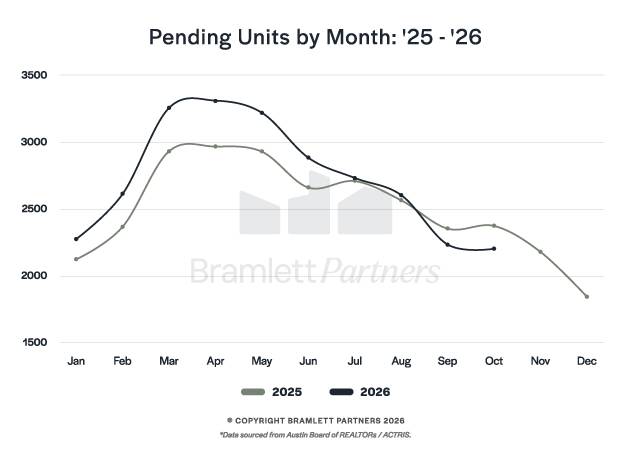
Pending sales declined 8.2% year over year to 2,191, following September's 5.9% decline. This marks the second consecutive month of pending activity falling below 2025 levels.
Closed sales also fell 4.8%, while total dollar sales volume declined 8.1%. Weaker pending activity points toward continued pressure on closings as the year winds down.
New Listings Pull Back
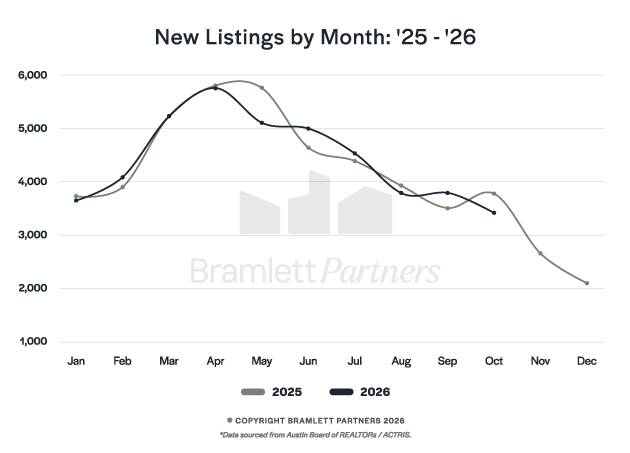
New listings fell 9.7% year over year to 3,393, reversing September's 7.9% increase.
The month-to-month comparison is particularly interesting. New listings increased between September and October in 2025, but declined approximately 10% over the same period this year.
Despite fewer new listings, months of inventory increased from 5.3 in September to 5.6 in October.
However, that remains only slightly above the 5.5 months recorded a year ago.
The combination of weaker demand and reduced listing activity has left inventory relatively stable year over year, even as prices continue to soften.
Mortgage Rates Remain a Challenge
According to Freddie Mac, the national average 30-year fixed mortgage rate declined from 7.40% in mid-October to 7.18% on November 5.
That modest retreat does little to offset the broader affordability problem. Rates remain nearly a full percentage point higher than the 6.22% recorded a year earlier.
These averages reflect conventional financing for well-qualified owner-occupants. Investors financing non-owner-occupied properties generally face higher borrowing costs.
The Takeaway
October adds to the evidence that Austin's housing market remains under downward pricing pressure. Buyer demand is weaker than a year ago, and both sale prices and prices per square foot are showing year-over-year declines
Nevertheless, inventory has changed relatively little year over year, and fewer new listings are entering the market. The data point toward continued weakness, but don't establish how much further prices may adjust.
For buyers, slower activity and longer marketing times continue to create negotiating opportunities, particularly on properties that have struggled to attract offers.
For sellers, realistic pricing remains essential. Homes are competing for a smaller pool of active buyers, and pricing based on earlier market conditions can lead to extended marketing times.
For investors, lower acquisition prices may create opportunities, but financing costs remain a significant constraint. Rental income, operating expenses, and realistic financing assumptions need to support the purchase without relying on future appreciation or refinancing.
The central development in October is that weaker demand is now accompanied by broader evidence of pricing softness, while new supply has also pulled back. How those forces develop over the coming months will be important in determining the market's direction heading into 2027.
As always, real estate is hyperlocal. Questions about a particular Austin-area neighborhood, property, or investment are welcome.
Source: Bramlett Partners' October 2026 First Look analysis of Austin Board of REALTORS/ACTRIS data. Figures are preliminary and may differ from subsequently published market reports.
