Ashcroft capital - Paused Distributions
Member since 2020 · 9 posts · 8 votes
Anyone else getting notified this morning of paused Ashcroft distributions due to refinancing issues?
We have been working on refinancing the asset in order to access the equity and create liquidity to earnestly restart the renovations. The new lender we initially signed up with for the refinance notified us that they would not be able to provide the new loan at the agreed upon terms due to current market volatility.
We continue to pursue alternative refinancing options and anticipate having a new loan closed within the next six months. To remain conservative with liquidity and continue increasing NOI through unit renovations, we are pausing distributions beginning this month. Your preferred return will continue to accrue and will be paid at the next capital event, or when cash flow allows.
While distributions are on pause, we are not collecting its asset management fee and Birchstone Residential is collecting a reduced property management fee.
I guess there are about 20 suckers born every minute. Every one of you in this is an accredited investor, right? A two-second glance at their materials reveals that when they distribute funds from a property sale one of the categories is: unpaid distributions. This has been the plan since the start.
Investing in real estate is not that hard. I can't imagine what would make anyone put their money into one of these things. Pure laziness I guess. TBills are paying over 5% if you need lazy guys. No need for this nonsense.
Experience matters 100% in syndications. There’s a reason why many sponsors have never given back a property to a lender or lost a dollar of investor capital. Sure market risk is real but that’s where experience comes into play. Everyone can make money in an up market but through experience, sponsors can mitigate risk in a downmarket and still provide reasonable returns.
I think it comes down to the WHY you are doing something.
I can give example of Chick Fil A. Their restaurants average about 5 million minimum in sales and some do 10 million annually which is staggering as it compares to a dine in Cheesecake factory with much larger tickets per person.
They give employee chance from within to partially own and operate ONE store. The employee see it as a chance of a lifetime to make 300k,400k,500k a year with share of the profits. They want to run the location to perfection.
On the flip side the private equity companies tend to just want to hit a number kind of like the fund managers.
So it's an approach of only buy when the syndicator feels really awesome about a property OR they just keep scaling and hoping some work out.
Experience matters 100% in syndications. There’s a reason why many sponsors have never given back a property to a lender or lost a dollar of investor capital. Sure market risk is real but that’s where experience comes into play. Everyone can make money in an up market but through experience, sponsors can mitigate risk in a downmarket and still provide reasonable returns.
let me tell you one example okay....
I have to anonymize this otherwise the GP fund would sue me, this is illustration
so this is large GP fund that has 100% good exit full cycle track record from 2010-2020 era, but their current running portfolio is the following.
Apt A current DSCR 1.0; stopped distribution, buy at cap 5 fixed-debt
Apt B current DSCR 0.9 ; stopped distribution buy floating debt 60%LTV.
Apt C issue capital call to buy rate cap, buy cap 3 floating debt 70% LTV. current DSCR 0.8
Apt D , on target NOI, DSCR 1.3
Apt E, on target NOI, DSCR 1.2
At the end, experience doesn't matter because every few deals need to examine individually with its own cycle and financial model. If you as LP invest at bad market time in good sponsor, the probabily of losing money is still 70%, if you don't invest at bad market time, your chance of losing money is zero percent.
This is why at the end of the day, investing at public stock index or REIT would be better to customer as stock price is reflecting the actual condition due to its financial transparency. Not so much with GP.
Investing at GP is sometimes similar to investing at drug dealership with all these hidden private transaction LOL
this GP guy capture my message accurately :
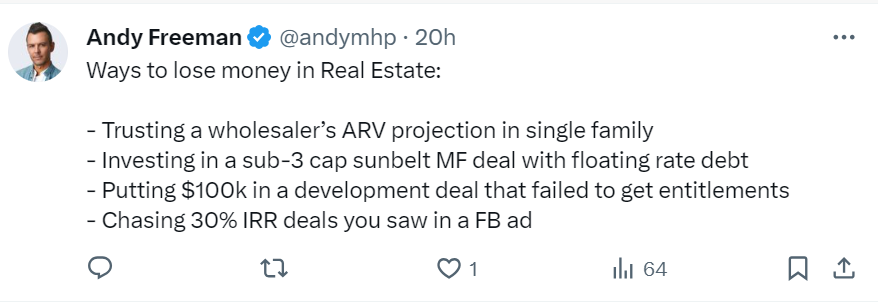
@Carlos Ptriawan
We’re talking about different levels of experience. A 2010-2020 track record has zero experience in a recession or a down market. And sure, you can find outliers but at the end of the day REITs are totally different investments and more correlated to equities than they are real estate. Over the past 24 years, REITs have averaged a 10.9% return while a private placement strategy utilizing longer term fixed rate debt would have averaged 20% to 30%.
The problem is the sponsor/strategy selection, not investment vehicle. LPs should stop chasing the high leverage, short flip sponsors.
@Carlos Ptriawan
We’re talking about different levels of experience. A 2010-2020 track record has zero experience in a recession or a down market. And sure, you can find outliers but at the end of the day REITs are totally different investments and more correlated to equities than they are real estate. Over the past 24 years, REITs have averaged a 10.9% return while a private placement strategy utilizing longer term fixed rate debt would have averaged 20% to 30%.
The problem is the sponsor/strategy selection, not investment vehicle. LPs should stop chasing the high leverage, short flip sponsors.
yep but my message is examining each individual deals is much more important.
The problem with most LP is they are all very naive, they think investing in 2023 environment is same as 2015 as everything should just work with so called experienced sponsor. Market condition overrules everything. Many times, do nothing is the best. Almost nobody teaches the LP how to do proper DD. The GP world education just attrac them to think syndication is the easy route.
Yes REIT investment is lower, but their capital preservation is better than syndication during bad times.
Even you guys GP, the way you marketing yourself is telling the other GP as the bad boys LOL, there's no real "unbiased financial analyst" (like in stock market) in syndication world that tell this sponsor A is good guy or sponsor B is good guy LOL
All because no transparency in this investing scheme
@Carlos Ptriawan I’m more aligned with your pov. The key issue, in my mind, is that syndications are motivated to *transact deals*, in good and in less good markets. Why are so many decent, seasoned syndicators in trouble now? What they should have done is not brought low cap deals in 2021-2022. Some are even losing money on their 2020 purchases.
I’d like someone to show me syndicators that said, “nope we’re not buying more deals because we don’t think we can make a decent return for our investors.” It’s more like most just keep going and going. But, I don’t fully blame syndicators. I also blame naive LP’s providing the money for these late cycle deals. There is a codependency at play, so this is not just a rant against syndicators. At least not in my mind.
A friend of mine who works at Nuvo was quoted here, it is worth a read. https://therealdeal.com/national/2023/11/02/multifamily-firm...
It's unfortunate that so many have been burned by this down market. I would just say that in the future, put more emphasis on sponsors and strategy. I, too, wish there were more regulation in the private placement space when it comes to sponsors and reporting. With a good sponsor, you won't even have to review each deal. You'll just know the box that they invest in and each deal will fit the parameters that they focus on.
Second, make sure you understand the product quality that you're investing in. REITs invest in Core and Core Plus assets with low leverage and these previous comments are speaking mostly about sponsors that were focused on highly leveraged 1970s and 1980s value add. It's an apples and oranges comparison. If you like the stability and lower returns of REITs, find a sponsor that also invests in Core and Core Plus properties. They're out there and they will still beat the returns of REITs. I know many great sponsors that have never lost a dollar of investor capital.
Third, to @Amit M.'s point, understand the alignment of interest created by compensation. Too much back end compensation will lead to risk taking. Too much upfront and non-performance based recurring comp and there's no incentive to perform well (ie REITs).
Fourth, avoid the new age internet marketing sponsors promising the highest returns. As with ANY investment, higher returns typically come with higher risks. There are many great sponsors out there (happy to provide a few) that have a long track records, have never lost a property, and know when to dial up or back leverage/purchases while still being able to provide 20-30% annual returns over the past 20 years and multiple cycles.
REITs are a great investment but primarily due to liquidity. The other concerns that you have voiced are very much valid but they can be mitigated with the right sponsor.
I make millions annually transacting as a principal broker and owner of my company with clients.
I also run a lean operation with employees extracting the most performance per worker.
Many big companies tend to hire the crap out of every position having 30,40,50 people in the hopes they keep scaling. When markets change they have a massive nut to pay and start bleeding cash to stay afloat.
I see this with large commercial brokerages when cycle sales is hot the champagne is flowing and companies can't hire on people fast enough then downturn happens and they have to merge with other companies to survive or go out of business all together.
I do think anyone would say they were shocked rates went up 300 basis points so fast.
My clients when we were buying NNN and rates in 3's was only 15 basis points difference between 5 year fixed and 10 and I mentioned to them 10 is worth it because you often have full cycle low fixed rate for paydown and more options to exit and trade up than 3 to 5 years fixed debt. They are sitting pretty awesome now with those 10 year loans. If you make millions per year and have a 4 million property you owe 2.2 million on fixed for 10 years then pretty, pretty good especially with investment grade tenants.
Heavily consider investing with GP's that tend to like the money but do not NEED the money to survive or keep some business model alive.
Some of my friends did massive exits with multifamily and sitting on tens of millions or more in cash with pencils down on that asset class unless they can buy quality at say 6 cap and assume a loan with 5 to 7 years remaining in the 3's fixed with 25 to 30 year amortization schedule. They do not want to buy anything that is a headache because again they do not need the money. The ones with larger companies tend to scratch their heads saying ( How can we keep doing deals in this environment to pay staff and make money ?)
I could retire today but I would be very bored. Instead I live my ideal life and work when I want and choose which clients I want. 20 years in I can do that. People ask why if people have tons of money they still buy real estate? It's the hunt and the art of the deal. I love looking at thousands of properties to find the true diamond that catches my eye.
Anyone else getting notified this morning of paused Ashcroft distributions due to refinancing issues?
We have been working on refinancing the asset in order to access the equity and create liquidity to earnestly restart the renovations. The new lender we initially signed up with for the refinance notified us that they would not be able to provide the new loan at the agreed upon terms due to current market volatility.
We continue to pursue alternative refinancing options and anticipate having a new loan closed within the next six months. To remain conservative with liquidity and continue increasing NOI through unit renovations, we are pausing distributions beginning this month. Your preferred return will continue to accrue and will be paid at the next capital event, or when cash flow allows.
While distributions are on pause, we are not collecting its asset management fee and Birchstone Residential is collecting a reduced property management fee.
70/80% of syndications are in trouble in 2024. Especially if they have multiple portfolio in asset structure.
You would lose money 100% for sure. What we don't know whether you lose 50% or lose 100%.
actually you can lose MORE THAN 100% if they took accelerated depreciation, you may end up owing more than your investment. That happened I believe on those houston deals.
Another way they are doing it is by creating next series of fund , like ponzi, the next fund investor is subsidizing the asset of previous fund.
or the most brutal way is basically bankrupt the current LP, and buy again the same asset from the lender with new cap with the new lp
Considering the current real estate environment and the frothy stock market, I’m considering taking a fairly large position in a diversified debt fund (notes) like offerings by PPR Capital (10% dividend, 1 year hold) https://pprcapitalmgmt.com/strategy/
and would like opinions on comparing risk for something like this vs syndications and other alt investments. To me the notes seem far less risky with the pretty large geographically diverse holdings, but am I wrong about that? What is the black swan event to worry about? How can I lose my money?
@Sebastian Bennett I'm interested in the answer to this as well!
I’d like someone to show me syndicators that said, “nope we’re not buying more deals because we don’t think we can make a decent return for our investors.”
I’d like someone to show me syndicators that said, “nope we’re not buying more deals because we don’t think we can make a decent return for our investors.”
Kudos to Praxis Capital for doing that. I also know a couple of other syndicators who haven’t transacted in 1.5 years because the deals at sub 4 cap did not make sense
I feel bad for the LOs that lost money in this cycle where we're counting on the continued cash flows for living expenses. Hopefully everything works out and they can get their distributions at the exit.
This seems like a prime buying environment though over the next few years as these loans reach maturity.
I feel bad for the LOs that lost money in this cycle where we're counting on the continued cash flows for living expenses. Hopefully everything works out and they can get their distributions at the exit.
This seems like a prime buying environment though over the next few years as these loans reach maturity.
Recommend people start new threads on topics as most of the posts no longer talking about the original post

I’d like someone to show me syndicators that said, “nope we’re not buying more deals because we don’t think we can make a decent return for our investors.”
now this is solid answer from a GP !!
Rather than keep saying experienced GP would make it even during tsunami of foreclosure with cap three environment ! we know that's a straight lie.
I feel bad for the LOs that lost money in this cycle where we're counting on the continued cash flows for living expenses. Hopefully everything works out and they can get their distributions at the exit.
This seems like a prime buying environment though over the next few years as these loans reach maturity.
I always trade bond in the background , so I am short and long term bond, I keep position for weeks or month. When the Fed position is to short the bond, it's equal to short the commercial/residential sector. But the impact would be higher in commercial because they have short term financing.
For us that can always purchase residential anytime and the return at many times is almost always higher than a commercial, I question myself why I should invest at these and that.
One thing that's very irritating for me especially when dealing with value-add multifamily in specific, is these GP are keep buying and selling so quick to make the return very fast, but this practice when being done so quick would create doom-loop situation where the next GP would have less probability of reaching their target. Lets say same asset bougth with cap 9 , two years later another GP bought at cap 7, then 4 year later at cap 5 , then 3 years later another GP buy at cap 3, the guy that purchase with cap 3 would be the unlucky one and would be wiped out when there's volatility in bond and interest rate, we're in this cycle, so based on this forward yield curve, the cap 3 market would become cap 6 market and thats where the game is stopped temporarily before it's restarted some time later in the future.
These combination of "doom loop" situation only happened in rentonomic sector like in syndication because profitability could only be achieved through market rent.
Lets comparing syndication and other sector during interest rate changes :
In tech sector, although we're sensitive to rate changes that creating less demand to the product, but because we have much less number of employee but we have lot of cash (FCF and higher margin than any other industry) and we can raise price , tech can survive during interest rate changes.
Banking sector could make profit too during high interest changes because of the spread between Fed and deposit would make huge profit.
These are reason why rentonomics in commercial asset risk/reward are the worst during rate changes.
so what we see today is not really a GP issue but more into structural interest rate spread issue that can't be fixed/repaired as there's no alternative. This condition is actually more favourable for us LP to invest in debt capital stack rather than equity as the risk is lesser and well defined.
I'd be weary of any of these companies. Sh!t is going to come down like timber.. Watch out and say far away from these funds. I will add Cardone and any other syndicator as well. They are/were operating off of cheap money. Now, that the cheap money is gone and they have to refinance; sh!t is going to hit the fan. 3-4% easy money. 8-10%; whole different ballgame people.
@Carlos Ptriawan
We’re talking about different levels of experience. A 2010-2020 track record has zero experience in a recession or a down market. And sure, you can find outliers but at the end of the day REITs are totally different investments and more correlated to equities than they are real estate. Over the past 24 years, REITs have averaged a 10.9% return while a private placement strategy utilizing longer term fixed rate debt would have averaged 20% to 30%.
The problem is the sponsor/strategy selection, not investment vehicle. LPs should stop chasing the high leverage, short flip sponsors.
Can you share the data to support the 20%-30% average returns? Also, are these gross returns are returns net to the LP, after the GP's fees and split? In anycase, it would be great if you can share the source of this information.
It's unfortunate that so many have been burned by this down market. I would just say that in the future, put more emphasis on sponsors and strategy. I, too, wish there were more regulation in the private placement space when it comes to sponsors and reporting. With a good sponsor, you won't even have to review each deal. You'll just know the box that they invest in and each deal will fit the parameters that they focus on.
Second, make sure you understand the product quality that you're investing in. REITs invest in Core and Core Plus assets with low leverage and these previous comments are speaking mostly about sponsors that were focused on highly leveraged 1970s and 1980s value add. It's an apples and oranges comparison. If you like the stability and lower returns of REITs, find a sponsor that also invests in Core and Core Plus properties. They're out there and they will still beat the returns of REITs. I know many great sponsors that have never lost a dollar of investor capital.
Third, to @Amit M.'s point, understand the alignment of interest created by compensation. Too much back end compensation will lead to risk taking. Too much upfront and non-performance based recurring comp and there's no incentive to perform well (ie REITs).
Fourth, avoid the new age internet marketing sponsors promising the highest returns. As with ANY investment, higher returns typically come with higher risks. There are many great sponsors out there (happy to provide a few) that have a long track records, have never lost a property, and know when to dial up or back leverage/purchases while still being able to provide 20-30% annual returns over the past 20 years and multiple cycles.
REITs are a great investment but primarily due to liquidity. The other concerns that you have voiced are very much valid but they can be mitigated with the right sponsor.
Can you please share the names of these "many great sponsors out there (happy to provide a few) that have a long track records, have never lost a property, and know when to dial up or back leverage/purchases while still being able to provide 20-30% annual returns over the past 20 years and multiple cycles."?
The industry is dependent upon the lenders and the lenders are skittish now a days. Ashcroft is doing the right thing by pausing and finding another lender. I like that they are not taking an asset management fee as well. I'm pushing a lot of my financing over to life insurance companies because the banks are hard to deal with and there seems to be less renewal risk with insurance companies.
The industry is dependent upon the lenders and the lenders are skittish now a days. Ashcroft is doing the right thing by pausing and finding another lender. I like that they are not taking an asset management fee as well. I'm pushing a lot of my financing over to life insurance companies because the banks are hard to deal with and there seems to be less renewal risk with insurance companies.
lender is the one that would go bankrupt if they continue financing while asset valuation going down ( an increase of 1% cap rate is equal to asset valuation lowered by 8-12%). The problem with lender is they can't anticipate market risk volatility, almost as similar as subprime mortgage lender; lot of these lenders are just assuming "favourable market condition" would continue without end. Now when the Fed made radical U-turn, they're all the one that's holding the bag. But inherently in this syndication dog-eat-dog world, at the end of the cycle someone would be wiped out.
