Sell 1 SFH and buy 2 more, or hold?
Most Popular Reply
Member since 2026 · 16 posts · 8 votes
3wI think the first question I'd ask is:
What do you ultimately want to do with the equity from this property?
That answer may make the decision much clearer.
If you're planning to sell because you want to take some of your wealth out of real estate and use the money for other purposes, then I'd absolutely have your CPA look closely at whether selling now allows you to take advantage of the Section 121 exclusion while you're still eligible.
If you're going to sell anyway, capturing an available tax benefit can certainly make sense.
But if the primary reason you're considering selling is simply to get the equity out so you can buy more investment property, I'm not sure I'd be so quick to give up this particular asset.
You have two things working in your favor:
A 3.25% first mortgage and only about a 45% LTV.
That means you have roughly 55% equity in the property while carrying exceptionally inexpensive first-mortgage debt.
If the property is cash-flowing properly, I'd investigate accessing some of that equity through an investment-property HELOC or fixed second mortgage while leaving that 3.25% first mortgage completely untouched.
And here's something many investors don't realize: there are second-position investment-property programs that can use DSCR underwriting.
DSCR—Debt Service Coverage Ratio—essentially looks at the property's rental income relative to its housing/debt obligation. Depending on the particular program, that can allow an investor to access equity based primarily on the property's cash flow rather than qualifying in the traditional manner using personal employment income.
That could create an entirely different strategy:
Keep the existing property and its 3.25% first mortgage.
Access a portion of the 55% equity in second position.
Use that capital toward another acquisition.
Finance the new investment separately, potentially with another DSCR loan.
Now instead of selling one property to buy another, you may be able to keep the existing property and add another property to the portfolio.
Obviously, leverage isn't free money.
I'd want to know what the existing property cash-flows today, what the new second-position payment does to that cash flow, how much equity you're actually pulling out, and what return that capital can generate in the next acquisition.
I'd calculate:
1. What return am I currently earning on the equity in this property?
2. How much equity can I safely access without destroying its cash flow?
3. What's the cost of that second-position capital?
4. What return can I reasonably generate by deploying it into another property?
5. What reserves will I have after doing it?
There's also an important distinction regarding the $40K tax number.
You don't owe capital-gains tax today simply because the property has appreciated. Generally, selling is what realizes the gain and creates the taxable event. Your Section 121 concern is really whether you have an opportunity today to exclude qualifying gain that could be reduced or lost if you wait too long to sell.
That's a CPA conversation, particularly because depreciation taken during the rental period can affect the tax calculation.
So I'd bring the decision back to your objective:
If you want to take capital out of real estate, selling and taking advantage of Section 121 may make sense.
If your objective is to grow the portfolio, I'd first investigate whether you can use DSCR-based second-position financing to put some of that 55% equity to work without selling a good cash-flowing property carrying 3.25% debt.
You may not have to sell one investment to buy the next one.
29 Replies
- Member since 2026 · 16 posts · 8 votes3w
I think the first question I'd ask is:
What do you ultimately want to do with the equity from this property?
That answer may make the decision much clearer.
If you're planning to sell because you want to take some of your wealth out of real estate and use the money for other purposes, then I'd absolutely have your CPA look closely at whether selling now allows you to take advantage of the Section 121 exclusion while you're still eligible.
If you're going to sell anyway, capturing an available tax benefit can certainly make sense.
But if the primary reason you're considering selling is simply to get the equity out so you can buy more investment property, I'm not sure I'd be so quick to give up this particular asset.
You have two things working in your favor:
A 3.25% first mortgage and only about a 45% LTV.
That means you have roughly 55% equity in the property while carrying exceptionally inexpensive first-mortgage debt.
If the property is cash-flowing properly, I'd investigate accessing some of that equity through an investment-property HELOC or fixed second mortgage while leaving that 3.25% first mortgage completely untouched.
And here's something many investors don't realize: there are second-position investment-property programs that can use DSCR underwriting.
DSCR—Debt Service Coverage Ratio—essentially looks at the property's rental income relative to its housing/debt obligation. Depending on the particular program, that can allow an investor to access equity based primarily on the property's cash flow rather than qualifying in the traditional manner using personal employment income.
That could create an entirely different strategy:
Keep the existing property and its 3.25% first mortgage.
Access a portion of the 55% equity in second position.
Use that capital toward another acquisition.
Finance the new investment separately, potentially with another DSCR loan.Now instead of selling one property to buy another, you may be able to keep the existing property and add another property to the portfolio.
Obviously, leverage isn't free money.
I'd want to know what the existing property cash-flows today, what the new second-position payment does to that cash flow, how much equity you're actually pulling out, and what return that capital can generate in the next acquisition.
I'd calculate:
1. What return am I currently earning on the equity in this property?
2. How much equity can I safely access without destroying its cash flow?
3. What's the cost of that second-position capital?
4. What return can I reasonably generate by deploying it into another property?
5. What reserves will I have after doing it?
There's also an important distinction regarding the $40K tax number.
You don't owe capital-gains tax today simply because the property has appreciated. Generally, selling is what realizes the gain and creates the taxable event. Your Section 121 concern is really whether you have an opportunity today to exclude qualifying gain that could be reduced or lost if you wait too long to sell.
That's a CPA conversation, particularly because depreciation taken during the rental period can affect the tax calculation.
So I'd bring the decision back to your objective:
If you want to take capital out of real estate, selling and taking advantage of Section 121 may make sense.
If your objective is to grow the portfolio, I'd first investigate whether you can use DSCR-based second-position financing to put some of that 55% equity to work without selling a good cash-flowing property carrying 3.25% debt.
You may not have to sell one investment to buy the next one.
- Investor · Naples, FL · Member since 2026 · 11 posts · 4 votes3w
Hi Clay. Thanks for the detailed response.
1. This SFH is valued at apprx $750k and I have $420k in equity and it will qualify for the Section 121 Rule as per my CPA. Cap Rate is 4% and net cashflow after all expenses is $30k per year. ROE is apprx 7.8%.
2. Taking a $150k 2nd mortgage would bring my cashflow to $0
3. Assuming assuming 7% interest rate on the 2nd
4. Market in S. Florida is tough and it's difficult to get cashflow unless you put a large down payment. I think the Cap Rate would be in the 3s as far as %
5. The reserve will not be an issue as fortunately I have some cash available.
My Retirement Planner (I just retired in November) suggested I sell all my rental properties (1 duplex and 2 SFHs) since real estate rich but cash poor and thinks I should put more into the stock market as it provides a higher cash flow than the properties (although there's an argument that the properties perform better as a total return). I sold one SFH already which did not have a mortgage and paid off my primary residence. I am looking to sell the other SFH, however keeping the duplex for a few more years, or maybe much longer (bought it in 1995) because it is in an area being gentrified and property values should move higher once we see real estate have a good appreciation period.
Thanks,
Robert
- Member since 2026 · 16 posts · 8 votes3w
Congratulations on your retirement. I am in Delray Beach.
Thanks. Those numbers help considerably, and they actually change my thinking somewhat.
The number that jumps out at me is this:
If you borrow $150K against the property in second position, your current $30K annual cash flow essentially goes to zero.
That makes me much less enthusiastic about leveraging this particular property simply for the sake of keeping it.
Right now you have approximately $420K of equity producing $30K per year in net cash flow, plus you're sitting on an exceptionally attractive 3.25% first mortgage.
The question isn't whether you can access the equity.
You probably can.
The question is whether accessing it actually improves your financial position.
If taking $150K out at approximately 7% eliminates the property's cash flow, you're effectively converting a property producing $30K annually into a break-even investment so you can redeploy $150K into another South Florida property where you're telling me cap rates may only be in the 3% range.
I'm not sure that's a good trade.
This is where I think your Section 121 opportunity becomes much more relevant.
Your CPA has already confirmed that the property qualifies. So now I'd have the CPA calculate exactly what your after-tax proceeds would be if you sold today and used the Section 121 exclusion.
Then compare two strategies:
KEEP AND LEVERAGE
Keep the 3.25% first mortgage.
Borrow $150K in second position.
Existing property's cash flow falls from approximately $30K to $0.
Deploy $150K into another investment.
Determine what the combined portfolio actually earns.Versus:
SELL AND REDEPLOY
Sell the $750K property.
Pay off the existing mortgage.
Use the Section 121 exclusion while you're eligible.
Walk away with a substantially larger pool of equity to redeploy.
Use that equity to acquire one or potentially multiple properties with lower leverage.The second strategy may actually put you in a stronger position, particularly if South Florida properties require substantial equity today to produce meaningful cash flow.
There's also a third option I'd keep on the table:
Do nothing.
Sometimes that's the option investors forget.
You have a property producing approximately $30K annually with very inexpensive 3.25% debt.
There's nothing wrong with continuing to collect the cash flow while waiting for either property values, rents, interest rates or acquisition opportunities to create a better reinvestment environment.
So with the additional information you've given me, I wouldn't automatically recommend taking the second mortgage.
I'd compare:
1. Keep it exactly as it is and collect the $30K.
2. Leverage it and determine the return on the entire combined portfolio after the additional debt.
3. Sell while the Section 121 opportunity is available and determine what your after-tax equity could earn if redeployed elsewhere.
And I wouldn't limit the third calculation to South Florida.
If your objective is building an investment portfolio and South Florida is producing 3%-range cap rates, there's another question worth asking:
Does the next dollar of my investment capital have to stay in South Florida?
That's really the decision you're making.
Your 3.25% mortgage is valuable, but cheap debt by itself isn't a reason to keep an asset.
The asset still has to compete with what that $420K of equity could potentially earn somewhere else.
With the numbers you've given me, I'd spend some serious time modeling the sell-and-redeploy scenario before the Section 121 window closes.
- 3wMarvin ChapmanPro MemberRental Property Investor · Atlanta, GA · Member since 2025 · 18 posts · 7 votes
Robert, you should not sell the SFH. You have an asset in which you have 55% equity with low debt service because of the 3.25 % interest rate. You will not see that interest rate again in future transactions. Because of the 45 % LTV and low debt service, your cash flow should be very strong. Additionally, your 55 % equity provides you with an opportunity to extract capital to make future purchases or engage in capital expenditures with a HELOC or home equity loan.
On the other hand, the acquisition of two properties would require taking on debt service with interest rates from the 6.5 % to 6.8 % The result is that you will see diminished cash flow because of the higher cost of capital. Additionally, you will take on other costs in the form of agent commissions, title insurance, loan origination fees, and transfer taxes. The cost of these will end up consuming 8 % to 10 % of the two properties’ value. The dollar amount lost through these costs may be more than the $ 40,000 capital gains tax that you are trying to avoid.
A 3.25% mortgage in today’s market is an irreplaceable wealth-builder. Keep the asset, protect your cash flow, and deploy secondary equity strategies to acquire more properties.
- Real Estate Consultant · Melbourne, FL · Member since 2019 · 185 posts · 107 votes3w
I would have a hard time giving up 3.25% debt just to buy two more properties. Especially with a $40k tax bill attached. Run hold, sell and second position options after every cost. Two doors is not automatically better than one good door.
- 3wAaron ZimmermanBusiness MemberAccountant · Chicago, IL · Member since 2018 · 2k+ posts · 1k+ votes
How much gain is there on the sfh overall?
 Brick House CPAs53 Reviews
 - 3wShiloh LundahlPro MemberRental Property Investor · Gilbert, AZ · Member since 2016 · 3k+ posts · 4k+ votes
@Robert C. people are sharing with you what they would do according to their value system which is fine. There is a correct answer here but it depends on what your goal is. It's like asking the quickest way to get from point A to point B. There is a correct answer but it depends on where point A is and where point B is and it depends on what time of day it is and if you are traveling alone or if you have another passenger with you so you can use the HOV lane, etc.
So you would need to give us some more info for us to give you a better answer.
Having a low interest rate is fantastic if your goal is to keep the property and live off of the cash flow. Usually properties valued at $750,000 don't cash flow well as a traditional rental unless the interest rate is very low or if the loan amount is very low - like in your situation. So you could very well ride it out for as long as possible and take advantage of the low rate. However, if your goal is to build wealth and cash flow isn't your primary need right now, then you may get a little more creative.
Here is an option that I would consider, I would approach the tenant and I would ask them if they would like to buy the property from you at a 5% discount. 3% would go to them in concessions and 2% as just a discount. This would save you money because it would cut out the vacancy, and it would save in realtor fees and a lot of buyers are asking for concessions anyway (I don't know about your area though). If they say yes, then I would spend some time looking for a more inexpensive market, maybe the triad area of North Carolina, I like that market.
Once I get settled on the specific market, I would connect with investors in that market to get to know the area really well to get familiar with where to buy and where not to buy. Then I would connect with wholesalers in that market and I would start to analyze deals. Maybe I would even buy 1 or 2 properties over a 3 to 6 month period so I really get to know the market and I get a team on the ground to help me fix up and manage my properties. Then I would go back to the tenant in Florida and I would help them buy the property. And now that I have deal flow, I should be able to do a 1031 exchange into 5 to 10 properties at a much lower price point because I am buying them at a significant discount. Then once I fix them up and stabilize the new portfolio, I should be able to cash flow much better on the new portfolio than I was with the single family home (even with a new, higher interest rate) and I should have been able to double my equity through the process.
Interest rates are great for certain strategies like buy and hold until I die. But a good interest rate may keep someone locked into a deal for a much longer period because of fear of loss. As long as the overall gain is much better than the benefit from the current interest rate, I would say not to allow the interest rate to keep you stuck.
But, like everyone else, I am just sharing what I would do and I don't have enough context to share what may work better in your particular situation with your particular goals and personality.
Good luck to you. Let us know how it goes.
- Investor · Naples, FL · Member since 2026 · 11 posts · 4 votes3w
Thank you all for your responses and advice. Seems everyone is in favor not selling the SFH with a 3.5% interest even if it means having to pay the $40k in capital gains by not selling in the next 6 months (I'd still have to pay the 25% of the depreciation taken so far), plus closing costs, RE commissions, etc.
Maybe I look at trying to 1031 the duplex into a triplex or quadruplex and leave the SFH alone. However it may be tough to find something that cashflows the same or better, even with a large down payment (40%-50%).
I will run the numbers on selling the duplex and see what the numbers show and at the same time look at what’s available in the market in small multi-family in the Miami or Naples market.
Thank you all again, I appreciate the advice.
Robert
- 3wDan HandfordPro MemberInvestor · Lexington, SC · Member since 2018 · 779 posts · 501 votes
Robert, I would compare the two choices using after-tax cash and future flexibility rather than the number of doors. The 3.25% debt has real value, while selling creates transaction costs and a known tax expense. For the replacement properties, underwrite today's rates, reserves, repairs, and realistic cash flow, then compare that result with holding the current home and paying the eventual tax. I would also have a tax professional verify the Section 121 timing and basis. What specific advantage would the two new properties need to provide before giving up the existing financing?
- Investor · Naples, FL · Member since 2026 · 11 posts · 4 votes3w
Shiloh, thanks for tour thoughts on the different approach. At this point in my life (recently retired in November), I am looking to simplify things as much as possible so don’t think investing out of state would be a good fit for me. I already have a Realtor and PM (does both) that manages my current rentals in Miami and she has done a good job over many years so things are “simple” as far as the management.
I guess I am looking for cashflow, but am young enough (errr 63, so not SO young) that I am also thinking about creating more equity over the next 10-12 years. Maybe I need to define this first, but after reading all the advice, it may make more sense to try to 1031 the duplex into a larger property (3 or 4-plex) and that it provides the same or more cashflow and I get to participate in the appreciation of a larger asset over the years.
Thanks for your feedback
- 3wJimmy LieuBusiness MemberReal Estate Agent · Columbus, OH · Member since 2019 · 3k+ posts · 2k+ votes
Quote from @Robert C.:
Hi BP community. I have a question about selling and buying.
I owned 1 duplex and 2 SFHs in Miami, Fl, but recently sold 1 SFH and looking to sell another SFH due to Section 121 rules (to avoid capital gains). Not thrilled with selling this SFH since it has a 3.25% mortgage. The property has a 45% LTV.
So my question is, given today’s R.E. environment, should I sell the property and buy 2 additional properties, or should I just I just hold on to the property although I would have to pay capital gains on the property (a $40k capital gain tax).
I would appreciate advice from the experienced BP community.
Great question and welcome! Personally, I'd have a hard time giving up a 3.25% mortgage without first looking closely at the numbers. With 45% LTV, you have a lot of equity tied up in the property, so I'd compare the return on that equity today versus what that same equity could produce if you sold and bought two properties. If the current SFH still cash flows well and has solid long-term fundamentals, paying $40K in taxes later may be less painful than giving up cheap debt and taking on two new loans at much higher rates. On the other hand, if the equity isn't producing much of a return and two new properties would meaningfully improve your total cash flow and growth potential even after transaction costs and financing, selling could make sense. I'd also run the tax situation by a CPA before making the decision because Section 121 has specific ownership/use requirements, and rental use and depreciation can affect how much gain is actually excluded. I'd make this an ROI decision rather than a tax-only decision.
 Jimmy Lieu, Red 1 Realty4.9119 Reviews
 - Real Estate Agent · Chicago, IL · Member since 2017 · 2k+ posts · 2k+ votes3w
Will you be able to find single families that cash flow with today’s rates? Unlikely as most do not. Maybe sell it to buy a larger 4 unit, etc. I would not sell with a 3 rate.
- Real Estate Broker · Chicago, IL · Member since 2014 · 2k+ posts · 1k+ votes3w
Quote from @Robert C.:
Hi BP community. I have a question about selling and buying.
I owned 1 duplex and 2 SFHs in Miami, Fl, but recently sold 1 SFH and looking to sell another SFH due to Section 121 rules (to avoid capital gains). Not thrilled with selling this SFH since it has a 3.25% mortgage. The property has a 45% LTV.
So my question is, given today’s R.E. environment, should I sell the property and buy 2 additional properties, or should I just I just hold on to the property although I would have to pay capital gains on the property (a $40k capital gain tax).
I would appreciate advice from the experienced BP community.
Can you clarify for me how a section 121 applies to investment properties. I thought it only applied to your primary residence.
- Investor · Naples, FL · Member since 2026 · 11 posts · 4 votes3w
Hi Crystal,
It’s a Section 121 because it was my primary residence in 2019, which then became a rental in 2024 when we moved to Naples and purchased a home here (primary). So since we lived in it 2 of the last 5 years, we can use the rule to exclude $500k of capital gains (married, filing jointly).
Hope this answers your question, but let me know if it doesn’t or see something incorrect on the above.
Thanks
- 3wAshish AcharyaBusiness MemberCPA, CFP®, PFS · FL · Member since 2017 · 5k+ posts · 3k+ votes
Robert, with a 3.25% mortgage and only about 45% LTV, I would not look at this as simply "sell one property to buy two more." I'd compare the after-tax return on the equity you already have against what that same equity could realistically earn in the next two deals.
I’m from Florida as well, so I’m well aware of the insurance, property tax, and real estate challenges investors here face. In Miami especially, that can materially change the hold-versus-sell math even when the existing debt is attractive.
On the tax side, selling a rental can trigger capital gain and depreciation recapture, so I’d model that before giving up a low-rate loan. If the goal is to stay invested in real estate, a 1031 exchange may be worth evaluating because it could let you defer some or all of the current gain and recapture while moving the equity into replacement properties, assuming the exchange is structured correctly and the replacement properties qualify.
I’d also look at whether the property still has any suspended passive losses attached to it, because a fully taxable disposition can sometimes free those up, depending on the facts.
The real question for me would be: after taxes, transaction costs, and the loss of that 3.25% debt, do the two replacement properties produce a meaningfully better return on equity than the one you already own?
Happy to connect and share some of our resources that might be helpful!
 INVESTOR FRIENDLY CPA®5241 Reviews
 - Investor · Naples, FL · Member since 2026 · 11 posts · 4 votes3w
Thank you all for providing your feedback and perspective. I appreciate the advice from much more experienced RE investors as I acquired RE over many years, little by little, but without ever making RE a real “business” and have lots to learn.
- 3wGregory AcsPro MemberLender · MD · Member since 2025 · 133 posts · 52 votes
I think one of the biggest mistakes with BRRRRs is assuming you’ll get all of your capital back on the refinance. In some markets, conservative appraisals can make that difficult even if the rehab is well executed. I’d underwrite every deal assuming the appraisal could come in lower than expected, so the refinance becomes an upside rather than something the deal absolutely depends on.
I’d also compare refinance options before you reach that stage. Different lenders can have different loan structures and appraisal approaches, so understanding those differences early can give you more flexibility if the first appraisal doesn’t come in where you hoped.
- 2wJason MalabuteBusiness MemberAccountant · Los Angeles, CA · Member since 2016 · 2k+ posts · 897 votes
With a 3.25% loan sitting at 45% LTV, I'd treat this as a return on equity question rather than a sell versus hold one: what is that equity earning where it sits right now, and what would the same equity realistically earn in the next two deals after taxes and closing costs come out. I'd also pressure test the $40k before you decide, because the primary residence exclusion doesn't cover the piece of gain tied to depreciation you claimed while it was a rental, so that portion stays taxable even when the rest is excluded, and the two out of five test looks backward from your closing date, so what matters is how many days of qualifying use still land inside that window. If the plan is to stay invested in real estate either way, a 1031 is worth pricing out, and there is a path where both the exclusion and an exchange apply to the same sale when the property is genuinely held for investment at closing. Worth checking whether the property is carrying suspended passive losses too, since a fully taxable sale can release those depending on the facts, and Florida insurance and property tax pressure can move the hold math on its own. This is all very fact specific, so have your own CPA run the after tax comparison before you list anything.
 Malabute & Company CPAs525 Reviews
 - Lender · Washington DC · Member since 2026 · 61 posts · 15 votes2w
Quote from @Robert C.:
Hi BP community. I have a question about selling and buying.
I owned 1 duplex and 2 SFHs in Miami, Fl, but recently sold 1 SFH and looking to sell another SFH due to Section 121 rules (to avoid capital gains). Not thrilled with selling this SFH since it has a 3.25% mortgage. The property has a 45% LTV.
So my question is, given today’s R.E. environment, should I sell the property and buy 2 additional properties, or should I just I just hold on to the property although I would have to pay capital gains on the property (a $40k capital gain tax).
I would appreciate advice from the experienced BP community.
Your situation makes sense, especially with a 3.25% mortgage and only 45% LTV. I'd be hesitant to give up that financing without looking at the numbers carefully. that said, if you're already leaning toward selling because of the Section 121 timing, I'd be interested in taking a look at the property myself. I'm actively looking to acquire SFHs in the Miami market, and if the numbers make sense, I'd be open to purchasing it directly rather than having you go through a traditional listing. if you're open to it, send me the property details (address, asking price, current mortgage balance/payment, rent if it's rented, and any major repairs needed). I can take a look at the numbers and let you know if I can make an offer.
- 2wEric FernwoodBusiness MemberRealtor · Las Vegas, NV · Member since 2014 · 991 posts · 1k+ votes
Hello Robert,
Whether or not to do a 1031 exchange is one of the most common questions I receive. We’ve completed more than 90 exchanges, many of them one-to-many. In fact, we recently completed a 1-to-6 exchange.
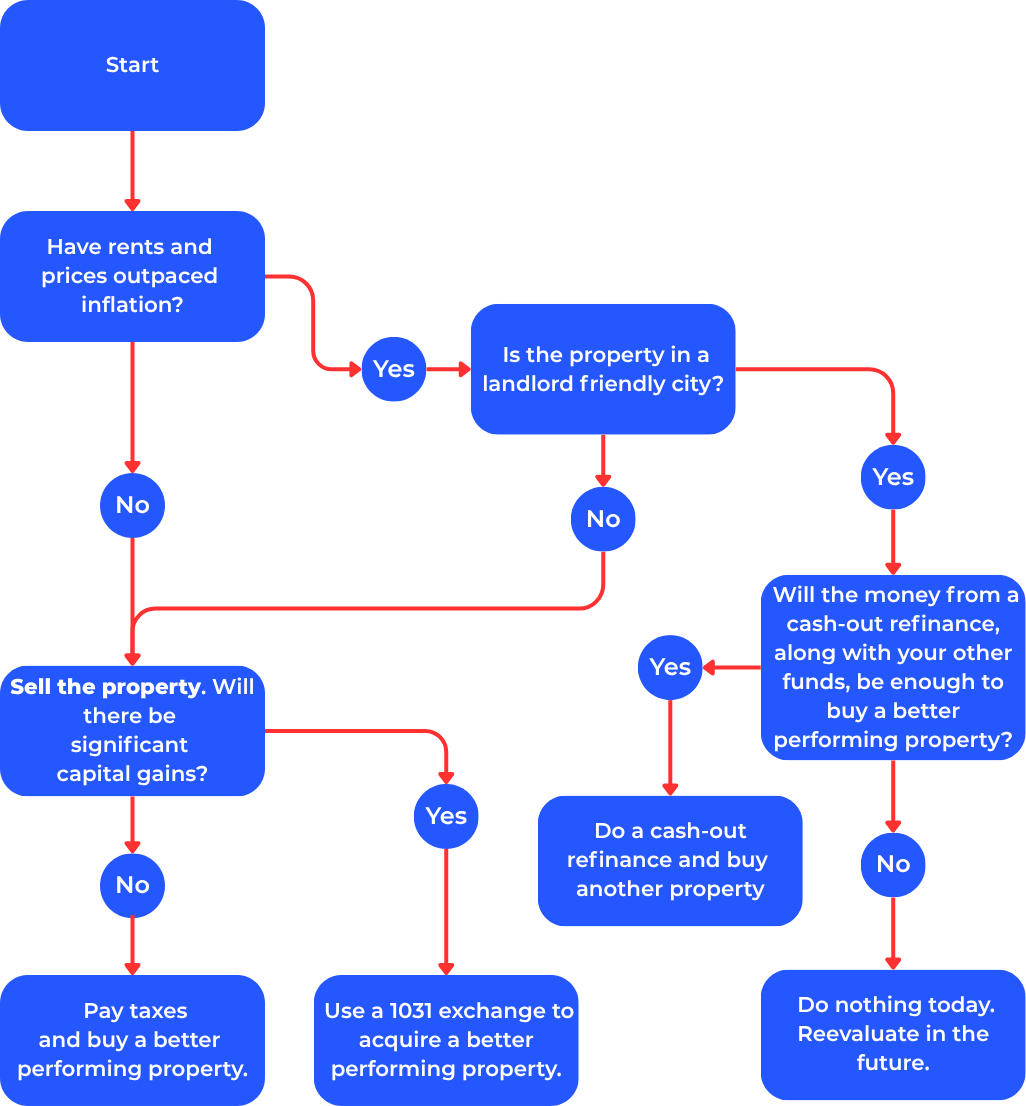
However, a 1031 exchange is only one of four options:
Hold the property and reconsider later.
Complete a cash-out refinance and use the proceeds to buy another property.
Complete a 1031 exchange.
Sell the property and pay the taxes.
The best choice depends on your goals, how your current property and market have performed, and how much equity you would preserve by completing an exchange.
The decision diagram below summarizes the process we use to help investors determine which option best fits their situation.
I hope this helps.
 FERNWOOD Team, KW VIP Realty520 Reviews
 - 2wDave FosterBusiness MemberQualified Intermediary for 1031 Exchanges · St. Petersburg, FL · Member since 2013 · 9k+ posts · 9k+ votes
@Robert C. Giving up a good property isn't an easy decision, especially with a great interest rate. Even with the 121 exclusion, you want it to align with your goals as a RE investor. Since this is also an investment property, why not hold on to it? As a real estate investor, you will be able to sell later and still not pay tax by doing a 1031 exchange. You can exchange into any type of investment property in any state or do what we call a diversification exchange into multiple investment properties, as you mentioned doing. And the tax will stay deferred indefinitely. You're going to reinvest in real estate anyway. So why sell a good property now just to avoid tax you can avoid in other ways and accomplish exactly what you want?
 The 1031 Investor5134 Reviews
 - 2wTyler MccleanPro MemberInvestor · Nassau County, NY · Member since 2022 · 69 posts · 19 votes
Yes there are helocs that close in as little as 5 days with no appraisal required specifically designed for investment properties. Shoot me a dm.
- Banker · MA · Member since 2026 · 120 posts · 31 votes2w
The thing worth flagging here is that second-position DSCR programs on investment properties typically go up to around 75-80% CLTV, so with a 45% LTV first mortgage there's real room to pull equity without touching that rate. That equity comes out as cash, no taxable event, no 1031 clock, no giving up the cheapest debt you'll probably ever carry on that asset. You could theoretically fund a down payment on a second property and finance the third acquisition with its own DSCR loan, ending up with three doors instead of two. The math on keeping a 3.25% first usually wins unless the property is genuinely underperforming on cash flow.
James Driscoll
- 1dJacob CamhiBusiness MemberHinton, WV · Member since 2026 · 131 posts · 40 votes
losing that 3.25% mortgage is a really big deal, probably bigger than the $40,000 capital gains tax, especially when thinking about buying two new properties at today's rates. that low rate is practically free money.
i'd run the numbers on what two new properties would actually cost you in debt service compared to what this one is currently bringing in, even with the $40,000 tax hit. the cash flow on two properties bought today might not offset the loss of that incredible rate, particularly in a market like miami.
sometimes holding a gem, even with a tax payment, makes more financial sense than expanding your portfolio with expensive new debt. have you really projected the cash flow for those two new hypothetical properties, including today's financing costs?
- Investor · Naples, FL · Member since 2026 · 11 posts · 4 votes1d
Thanks for your insight Jacob. I don't see real estate getting back to a place where the cashflow works, even with a larger down payment, anytime soon. So I have decided to just the sell this property and sit back for a while (maybe even 2-3 years) to take a look at opportunities, unless something arises where I can buy one property for cash, or almost all cash. I still have another rental (a duplex in Miami) and that one is paid for and has a decent cashflow of $2,450/month (net of all expenses).
Thanks again

Join the conversationCreate a free account to reply, vote on answers and follow this thread.