Which fix & flip mistake have you seen hurt a project the most?

Which fix & flip mistake have you seen hurt a project the most?

Charles WalkerBusiness Member
Real Estate Consultant · Member since 2025 · 15 posts · 1 vote

A lot of flips do not get into trouble because of one catastrophic event. The margin often gets chipped away by several smaller misses that compound.

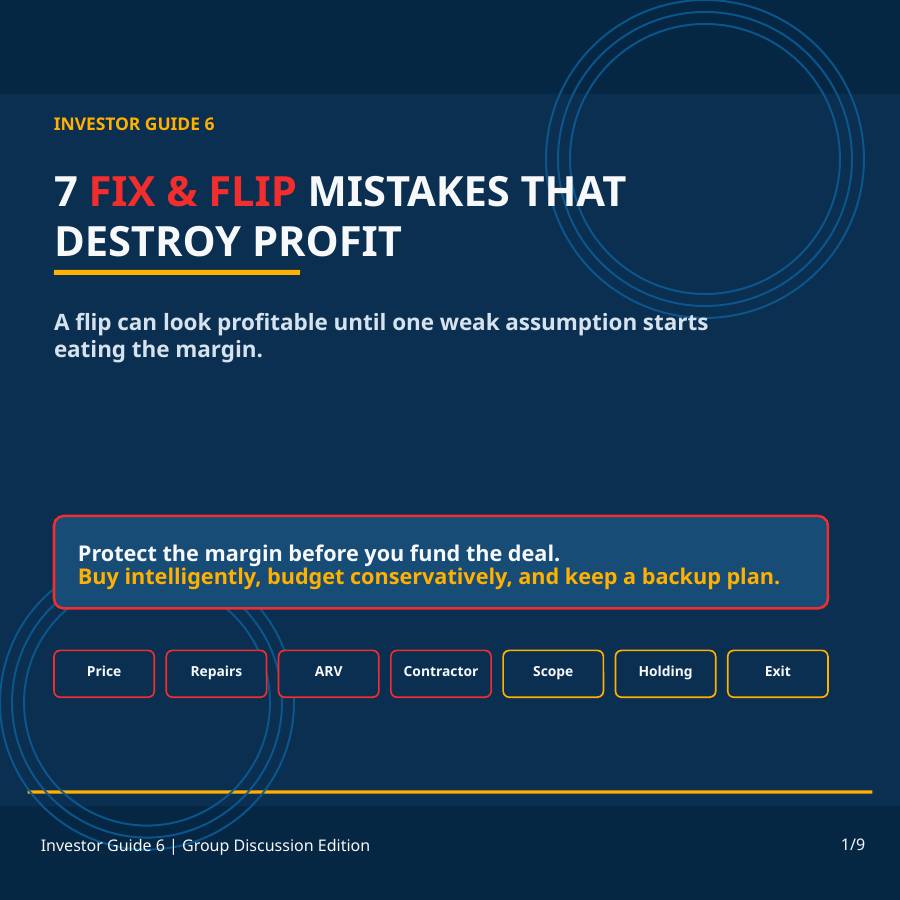
Seven areas I think are worth stress-testing before moving forward with a project:

·   Acquisition price: Did you leave enough room for the project to absorb normal variability?

·   Repair budget: Is the scope complete, and is there enough contingency for items that show up after demolition?

· ARV: Are you using relevant comparable sales, or the value the deal needs in order to work?

·   Contractor: Have you vetted workmanship, references, scheduling, licensing or insurance where applicable, and the ability to finish?

·   Renovation level: Are the finishes appropriate for the neighborhood, price point, and target buyer?

·   Holding costs: What happens if the project takes two, three, or four months longer than planned?

·   Exit strategy: If the resale plan changes, is there a realistic Plan B?

For example, if a $60,000 rehab turns into $78,000, $18,000 of the projected margin is gone before considering any other changes. If an expected $400,000 resale becomes $375,000, that creates another $25,000 difference. The point is not the specific numbers; it is how quickly several modest misses can stack up.

Which of these has caused the most trouble in your projects, and what process do you use to catch it before closing?
0Reply
447 views

6 Replies

Jump to latestLatest
  • Real Estate Agent · Kansas City · Member since 2018 · 4k+ posts · 3k+ votes
    3d

    Not scoping the sewer. Always do that

    • Charles WalkerBusiness Member
      OP
      Real Estate Consultant · Member since 2025 · 15 posts · 1 vote
      3d

      Good point, Caleb.

      A sewer camera inspection belongs on the due diligence checklist. An unexpected sewer line repair can hit both the rehab budget and the timeline, cutting into the projected profit.

      One of my sons is a plumber. He was just telling me about a simple repair that should have cost about $250 turned into a minimum $3,000 repair because of issues that could not be seen initially.

      Have you had a project where a missed sewer issue became a major expense?

  • James JonesPro Member
    Investor · Collierville, TN 38017 · Member since 2017 · 635 posts · 463 votes
    1d

    The two that have hurt me most across 236 properties:

    1. Under-scoping the rehab, especially missing conversion costs. I convert 2/1s to 3/1s and 3/1s to 4/2s, usually adding 400-650 sq ft or turning a carport or garage into a master bed and bath. That's where the margin lives, but you have to scope it fully upfront, permits included. The $60K-to-$78K drift you described is exactly how a deal dies - by inches, not by one catastrophe.

    2. Buying the wrong ARV. I buy under $100K in Memphis ZIPs like 38109 and 38114 with ARV $180K-$265K. The ARV has to come from real sold comps, not the number the deal needs to work. If I can't prove ARV on comps, I pass.

    The fix for both is the same: a ruthless buy box. 3BR+, 1% rule, Section 8 rents $1,395-$1,950. If the deal doesn't fit the box, no amount of optimism fixes it.

    • Charles WalkerBusiness Member
      OP
      Real Estate Consultant · Member since 2025 · 15 posts · 1 vote
      1d

      James, "the ARV has to come from real sold comps, not the number the deal needs to work" is a point worth emphasizing.

      Your conversion examples also show why the rehab scope needs to account for the finished layout and permit requirements upfront. Adding a bedroom or bath changes more than the square footage.

      A clearly defined buy box gives you a reason to pass before optimism starts rewriting the numbers.

      With your Memphis conversions, which cost is most often overlooked when investors prepare their initial rehab budget?

  • Crystal SmithPro Member
    Moderator
    Real Estate Broker · Chicago, IL · Member since 2014 · 2k+ posts · 1k+ votes
    15h

    Total reliance on recently sold properties within the past 6 months to determine ARV and not monitoring the contingent or pending that will eventually become the comparables for selling the property once the property goes on the market later.

    • Charles WalkerBusiness Member
      OP
      Real Estate Consultant · Member since 2025 · 15 posts · 1 vote
      14h

      Good point Crystal. Closed sales show where the market has been, while pending and contingent listings can help indicate where it is heading—although the final sale price is not confirmed until closing.

      That makes monitoring the market throughout the rehab just as important as establishing the initial ARV. A project can stay on budget and still lose margin if buyer demand or pricing shifts.
      If it is a REHAB that takes longer than expected the difference may be even greater.

      What signals do you watch most closely—price reductions, days on market, or how quickly comparable properties go under contract?

Join the conversationCreate a free account to reply, vote on answers and follow this thread.