My name is Matan, I'm a physician currently in fellowship in CA (2 more years until I'm an attending making a decent salary). I recently became interested in REI after I found out one of my bosses at work has been doing long distance investing in multi family homes. I've read Rich Dad/Poor Dad and Rental Property Investing by Brandon Turner. I see how hard a lot of my colleagues work, even in their 60s, and I want to start investing soon, so I don't have to work grueling overnight shifts when my body won't have as much strength in 20-30 years like it does now. I currently have about $50k saved up, and my fiancee has about another $50k. We are both interested in REI, and plan on pooling our money together to invest.
My main issue is that I don't have a ton of time to travel to desired markets (thinking of places like Phoenix, North Carolina, Reno/Vegas, Ohio) to look at properties, network, meet potential team members, etc. Also, after reading RPI by Brandon Turner, I'm aware of multiple strategies, but since I've never actually invested or bought a property yet, I feel like I'm overwhelemd by all the options, and find it hard to get started. For example, I'm not too sure about how to actually find good deals/distressed properties, and how to actually find appropriate property managers, CPAs, lawyers, etc.
I think once I get started and inertia starts to build up, things will make more sense, but it's that first step that I'm finding difficult. I would appreciate any general/specific advice that you all may have. Thank you everyone!
Rental Property Investor · Member since 2018 · 826 posts · 809 votes
2y
@Matan Paret I really don’t think you should start investing now. You can’t buy much with $50k, at least not the asset class you’ll want with your future income potential. For your specific situation I’d wait until you get $200k+ saved up and buy better asset classes…even if you have to wait 5 years.
There’s higher risk that you burn out with more difficult tenants (even if you use a PM), than you missing out on good investments. Future you will thank current you for having patience if you wait. If you have FOMO and pull the trigger now, I suspect future you will be upset.
Rental Property Investor · Member since 2018 · 826 posts · 809 votes
2y
@Matan Paret I really don’t think you should start investing now. You can’t buy much with $50k, at least not the asset class you’ll want with your future income potential. For your specific situation I’d wait until you get $200k+ saved up and buy better asset classes…even if you have to wait 5 years.
There’s higher risk that you burn out with more difficult tenants (even if you use a PM), than you missing out on good investments. Future you will thank current you for having patience if you wait. If you have FOMO and pull the trigger now, I suspect future you will be upset.
Attorney · Philadelphia · Member since 2018 · 2k+ posts · 3k+ votes
2y
@Matan Paret There are a few ways to appoach the start of your real estate investing journey and it is highly dependent on career path. For someone who is going to be a hands own operator and rely on real estate as their full time employment in lieu of a W2 job, or foresees that transition at some point, buying the entry level low barrier assets can serve a useful function. Most investors buy in this space because it aligns with capabilities and are chasing the paper returns that appear better than more stable neghborhoods but its truthfully very difficult to realize gains in this space, especially passively. It is usually not the return on investment but instead the ability to learn and relationships that are formualed from lenders to contractors etc. that can be leaned on as that individual advances in their real estate career that make these entry acquisitions worthwhile.
Meanwhile, with the person who foresees themselves mantaining their W2 job, this entry step is not necessary and truthfully should be avoided. In your post you even alluded to the lack of time you have, and suspect as a physician you won't be changing careers and availability will continue to be an isuse.
In your case, if you have $100,000 on the sideline I don't know if I would necessarily invest all of the capital unless it is in at least a B neighborhood and play the long game, rather than invest in the more volatile markets and swing for the fences. You can also ask your co-workers where they are investing passively as they may have already screened syndicators or JV operators you can lean on.
Real Estate Consultant · Madison, NJ · Member since 2016 · 6k+ posts · 7k+ votes
2y
You feel overwhelmed because you don't have the time to focus so you are looking for a way in without a lot of input from you - this can be a recipe for disaster. As mentioned above, syndications may be your best bet for truly passive income, but you are absolutely ripe to make a bad decision on that because you don't have the time and will not be able to property vet the operator. Read The Hands-Off Investor by @Brian Burke in your free time before doing anything. This might help you get started. Many doctors who develop enough extra income to invest, start in syndications until residency is over and practice is going.
Real Estate Agent · Columbus & Cleveland, OH · Member since 2023 · 1k+ posts · 1k+ votes
2y
Hey Matan, if you work with a solid investment focused agent, they can source you deals and connect you with the right team to be successful.
You should read this article about the core-4. Having a team in place is essential to long-distance investing. the core-4 consists of a realtor, contractor, property manager, and a lender. Once you have this team in place, you should have the foundation to invest in any market confidently while not being there physically.
My name is Matan, I'm a physician currently in fellowship in CA (2 more years until I'm an attending making a decent salary). I recently became interested in REI after I found out one of my bosses at work has been doing long distance investing in multi family homes. I've read Rich Dad/Poor Dad and Rental Property Investing by Brandon Turner. I see how hard a lot of my colleagues work, even in their 60s, and I want to start investing soon, so I don't have to work grueling overnight shifts when my body won't have as much strength in 20-30 years like it does now. I currently have about $50k saved up, and my fiancee has about another $50k. We are both interested in REI, and plan on pooling our money together to invest.
My main issue is that I don't have a ton of time to travel to desired markets (thinking of places like Phoenix, North Carolina, Reno/Vegas, Ohio) to look at properties, network, meet potential team members, etc. Also, after reading RPI by Brandon Turner, I'm aware of multiple strategies, but since I've never actually invested or bought a property yet, I feel like I'm overwhelemd by all the options, and find it hard to get started. For example, I'm not too sure about how to actually find good deals/distressed properties, and how to actually find appropriate property managers, CPAs, lawyers, etc.
I think once I get started and inertia starts to build up, things will make more sense, but it's that first step that I'm finding difficult. I would appreciate any general/specific advice that you all may have. Thank you everyone!
Hey Matan, I am a physician too. I am finishing up this year. I think for you to invest in real estate it will be better to finish up the fellowship first b/c I know how grueling medical training is and I do not think you will want to spend your " golden weekends" getting on a plane to go look at properties.
If your fiancee is not currently in training maybe she could spend more time looking for deals and the rest. The truth is you have to decide what type of homes you want to invest and what investment strategy going to look like. During the next 2 years, you can continue listening to the Bigger Pockets podcast and Real Estate Rookie podcast. There are also a ton of books you can read. I'm quite sure you will be in a great place to start investing when you sign that attending cheque with an enormous sign-on bonus.
Technically, I am a newbie just like you but what I have gathered, for you to succeed in long-distance investing, you need a good realtor, property manager, lender, and contractors. Your boss might be able to help with the contacts of his team members, and maybe they might be of help to you in the future. When you are ready to start investing and which markets(cities) you are going to be targeting, you can try to form a team by reaching out to realtors and property managers on the bigger pockets forum. I'm guessing as you work with them, you can then decide if they are trustworthy or people you want to work with. Best of Luck.
Investing takes time, energy, and money. Depending on other aspects of your life you can only dedicate so much time to each one. Time with family, health, career, hobbies will take resources to put into investing. Having a good partner with good communication will be key if you want to get started sooner than later. Keep your goal and why you want to invest as a guide.
Real Estate Consultant · Dallas TX · Member since 2021 · 59 posts · 38 votes
2y
If I were in your position , I would partner with another operator , or possibly fund fix and flips as a PML. You can also invest in some smaller multifamily or multifamily funds.
Hi Matan, great you are thinking about investing at this early stage of your career, you are ahead of 90% of doctors, who historically are not the savviest of investors. Read the "Four pillars of Investing" by Dr William Bernstein, retired Neurologist or listen to it, will give a great overall framework to plug in your investing journey/plan.
Why private Real Estate? Is it that you want direct control? did Bob Kiyosaki open your eyes, OU, to assets - things that cash flow, and liabilities - things that don't
Investing in single family fix/flips, or long-term rentals is quite challenging even if in your neighborhood but especially long distance. Many people don't make a profit, obviously odds of success get better with experience/good team, etc.
consider until you have more time to commit to instead look at buying publicly traded equity REITs, not mortgage REITS, they are tricky
get subscription to Seeking Alpha and follow Brad Thomas, Jussi Askola and many others research/writing to start with
REITS have beaten the SP500 last 50 yrs, by a lot, 13% to 11% just in last 20 yrs too, and they have taken a temporary beating due to sudden rise in 10 yr rates and hence CAP rates, but their underlying rent roles have only gone up. Many REITs now 20-40% below their NAV, Net Asset Value. So, buying good quality REITs now is like buying MAG 7 stocks in March 2020 or March 2009. The purchase decision only requires online thorough research, then try to buy in a 401k/ira so you don't have to pay taxes on the Dividends which can be large. Trail each purchase w a 10% downside stop loss limit order if you're not confident in the REIT, then continue your research on private real estate, and when you have the capital/team in place/knowledge of the local real estate market put it to work then, no rush.
Be very careful w private real estate syndications, some great ones, some really not great ones, and takes years of investing experience/understanding debt/property management/taxation rules etc before you should safely go that route, but then they can be awesome as they give high yields w passivity, the Holy Grail of RE investing :)
you are on the right path, and RE far less complicated than the Krebs Cycle too :)
house hack. not sure why no one else proposed this. and if you takes you months or longer to find a high quality small multi that you can afford, so be it.
agree that something passive might be good for OP but i would argue he's years away from something like a syndication. i view syndications as a diversification strategy once you're in a strong financial position and have a good network. thoughts? if they were just savings accounts returning 15% then we'd all invest in them =)
Real Estate Consultant · Madison, NJ · Member since 2016 · 6k+ posts · 7k+ votes
2y
@Nicholas L. no, I disagree. Syndications aren't for seasoned investors only, they are for people who have money and limited time. There are ones for qualified and new investors, but they require due diligence also. He might need a bit more money and time to do the research, but having limited time as a new dr. is a scale for putting money into something where you think it's passive (out of state flipping, landlording) and realize you can't keep up or manage anything and you should have just invested in index funds.
fair, but isn't it tough to find the right one when you're a brand new investor - brand new to RE and maybe also investing in general? i'm genuinely asking.
Real Estate Agent · Memphis, TN · Member since 2019 · 365 posts · 264 votes
2y
@Matan Paret welcome to the forums and congrats on the first post! It all depends on how much time and effort you want to spend as to which way I'd advise you to go. I work with hundreds of out of state investors and quite a few physicians and most of them prefer to invest passively through a turnkey provider since their calendars are quite full. But if you have the time to spend and don't mind putting in the effort going the active route will be more lucrative but again that's more time invested. Like others have mentioned it's all about having the right team in place from an investor friendly agent, to a PM and contractors.
Feel free to reach out if you have any questions. Best of luck!
My name is Matan, I'm a physician currently in fellowship in CA (2 more years until I'm an attending making a decent salary). I recently became interested in REI after I found out one of my bosses at work has been doing long distance investing in multi family homes. I've read Rich Dad/Poor Dad and Rental Property Investing by Brandon Turner. I see how hard a lot of my colleagues work, even in their 60s, and I want to start investing soon, so I don't have to work grueling overnight shifts when my body won't have as much strength in 20-30 years like it does now. I currently have about $50k saved up, and my fiancee has about another $50k. We are both interested in REI, and plan on pooling our money together to invest.
My main issue is that I don't have a ton of time to travel to desired markets (thinking of places like Phoenix, North Carolina, Reno/Vegas, Ohio) to look at properties, network, meet potential team members, etc. Also, after reading RPI by Brandon Turner, I'm aware of multiple strategies, but since I've never actually invested or bought a property yet, I feel like I'm overwhelemd by all the options, and find it hard to get started. For example, I'm not too sure about how to actually find good deals/distressed properties, and how to actually find appropriate property managers, CPAs, lawyers, etc.
I think once I get started and inertia starts to build up, things will make more sense, but it's that first step that I'm finding difficult. I would appreciate any general/specific advice that you all may have. Thank you everyone!
That's great, Matan; you're almost done! Have you thought about house hacking in your local market? It's a great way to get started that doesn't require much time or capital. If that's not an option, I can say Ohio is a great market for cash flow.
Real Estate Agent · Metro Detroit · Member since 2023 · 4k+ posts · 3k+ votes
2y
@Matan Paret having fun trying to sort through all the advice here?
Let's look at your situation LOGICALLY:)
OPTION #1 With your combined $100k for a down payment, you could buy a $1M+ SFR home in California. BUT, could you afford the monthly mortgage payment (PITI)? You could try house hacking and renting out rooms to help cover part of your PITI. Roommates can be challenging and it's unlikely they will cover 100% of your PITI, but you should get decent appreciation. When you sell in 2 years, you'll also get $250k/$500k tax free from the sale proceeds.
OPTION #2 Try to buy a 2-4 unit in California. Live in one unit, rent the rest. You can use rental income from other units to qualify for a bigger loan amount => higher purchase price. Hard to find in decent areas, so you'll be tempted to buy in Class C or even D areas. While Class C could work out if you research and find a gentrifying area, we do NOT recommend Class D areas due to high crime - NEWSFLASH: young doctor killed by tenant over parking dispute:(
OPTION #3 Buy rental out of state Your $100k will get you about a $400k rental property. Challenge is understanding Property Classes and what each means for ROI.
Recommend you first figure out the property Class you want to invest in, THEN figure out the corresponding location to invest in.
If you apply Class A assumptions to a Class B or C purchase, your expectations won’t be met and it may be a financial disaster.
So, when investing in areas they don’t really know, investors should research the different property Class submarkets.
Here’s our OPINION for the Metro Detroit market (use as a template for your target area!) that we’ve learned in our 24 years, managing almost 700 doors across the Metro Detroit area, including almost 100 S8 leases.:
Class A Properties: Cashflow vs Appreciation: Typically, 3-5 years for positive cashflow, but you get highest relative rent & value appreciation. Vacancy Est: Historically 10%, 5% the more recent norm. Tenant Pool: Majority will have FICO scores of 680+, zero evictions in last 7 years.
Class B Properties: Cashflow vs Appreciation: Typically, decent amount of relative rent & value appreciation. Vacancy Est: Historically 10%, 5% should be applied only if proper research done to support. Tenant Pool: Majority will have FICO scores of 620-680, some blemishes, but should have no evictions in last 5 years
Class CProperties: Cashflow vs Appreciation: Typically, high cashflow and at the lower end of relative rent & value appreciation. Can try to reposition to Class B, but neighborhood may impede these efforts. Vacancy Est: Historically 10%, but 15-20% should be used to also cover tenant nonpayment, eviction costs & damages. Tenant Pool: majority will have FICO scores of 560-620, many blemishes, but should have no evictions in last 2 years. Verifying last 2 years of rental history very important! Also, focus on 2 years of job/income stability.
Class DProperties: Cashflow vs Appreciation: Typically, all cashflow with zero or negative relative rent & value appreciation Vacancy Est: 20%+ should be used to cover nonpayment, evictions & damages. Tenant Pool: majority will have FICO scores under 560, little to no good tradelines, lots of collections & chargeoffs, recent evictions. Verifying last 2 years of rental history and income extremely important to find the “best of the worst”.
Make sure you understand the Class of properties you are looking at and the corresponding results to expect.
Often times investing as an LP in a syndication makes sense for demanding careers / people with limited time and high-income earners.
Investing out of state on your own is certainly a strategy but will take a lot of time to build the management systems and find a deal worthy of investing.
The main question to ask yourself is do you want to build an active or passive investment portfolio?
Property Manager · California Washington North Carolina South Carolina, Georgia and Alabama · Member since 2020 · 71 posts · 27 votes
2y
Hello Matan,
I am with a property management firm that is nation wide operating in 30 different states and 60+ different markets. I myself support CA, WA, NC, SC, GA & AL. If you have any questions or need support in these markets for information of rent analysis, local market real estate agents, networks, other details please don't hesitate to reach out. We manage typically single family homes and smaller apartments.
Thank you everyone! Your responses have been helpful, and much appreciated.
I think at this time, while I focus on my fellowship, I will continue to read, engage on the forums, and educate myself regarding REI and the opportunities that are available out there.
I think right now I only have time for passive investing (syndications), but once I become an attending, my fiancee and I should have more time, and I'd like to use my solid income as a physician to purhcase some properties (single fam or multi fam, or possibly in partnerships). I'll try to connect with those of you who reached out and replied, thank you all again!
As a fellow physician and real estate investor I was in your shoes 10+ years ago. First thing i will say, take your time, and be patient. Next you should at this juncture be focusing on big picture things like paying off any high-interest debt, credit cards, student loans, saving for a down payment eventual home purchase and focus on your family. Once you have all of the above which typically occur somewhere in the 5 to 7 years post residency, then my suggestion would be considered passive investing through syndications. Unless you intend to someday transition out of your physician job many physicians find that password investing via syndications is a more hands-off way to diversify your income, and tax in a favored way. However, you need to focus on your education and proper vetting of the syndication deals in order to know what you're investing in. This education requires time and dedication although you can certainly do it and there are many websites out there and help provide resources for it. I'm happy to help anyway I can please feel free to reach out.
Real Estate Consultant · Ann Arbor, MI · Member since 2022 · 460 posts · 250 votes
2y
Hi Matan-
Great question.
I work with many physicians in California.
The thing to do is find an investor friendly Realtor in the area you wish to invest.
I am based in Ann Arbor, Michigan. Many understand the value of investing in a college town like Ann Arbor. However, there are other great markets to invest for cashflow or short terms rentals including Ann Arbor.
The investor friendly Realtor will help you identify properties to invest, help you position the property for its highest and best use as an income property, be able to recommend property managers so you know your tenants/guests will be taken care of and your property, and recommend other valuable team members like local property inspectors, local insurance specialists and investor friendly lenders.
Rental Property Investor · Brandon, SD · Member since 2015 · 1k+ posts · 1k+ votes
2y
Hi Matan,
Another fellow physician investor here. I was in residency 16 years ago and thinking about real estate investing as a way to hedge and prepare for burnout. I'm still working the ED, but also building a portfolio. I agree with many comments on here that investing in RE might be a challenge for you now as you need to focus on your fellowship. If you do start investing, get a full-service property manager or do something passive. @Antonio Na, @Duke Giordano it's great to see some other physician investors on BP! Best of luck to all of you.
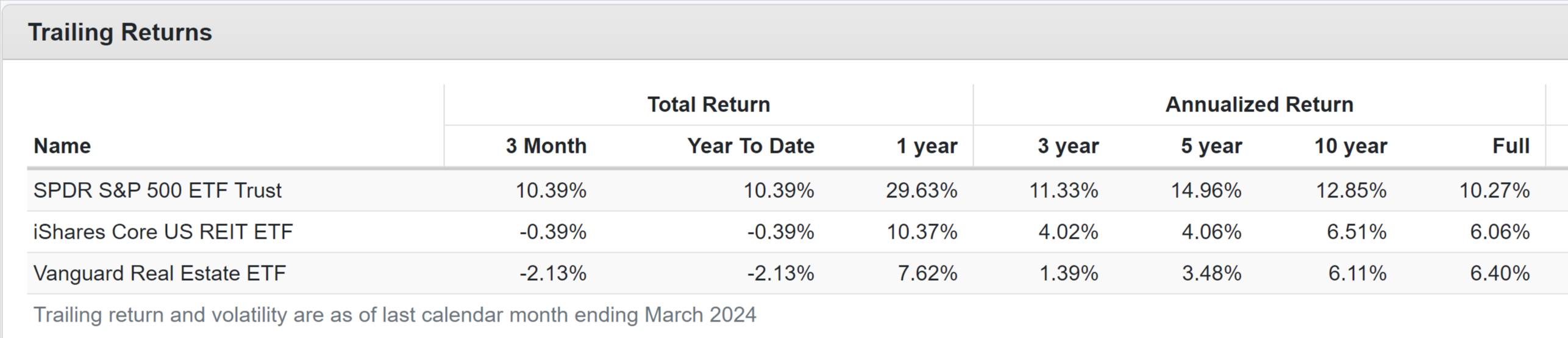
REITS have beaten the SP500 last 50 yrs, by a lot, 13% to 11% just in last 20 yrs too
This is simply/verifiably not true. This is a graph of aggregate (dividend reinvested) for Vanguard REIT Index vs SPY for as long as there's data (since Dec 2004).
REITS have beaten the SP500 last 50 yrs, by a lot, 13% to 11% just in last 20 yrs too
This is simply/verifiably not true. This is a graph of aggregate (dividend reinvested) for Vanguard REIT Index vs SPY for as long as there's data (since Dec 2004).
sorry if I offended you but there is quite a lot more data than since 2004, and as I said in my post REITs have outperformed for 20/25/ and even 50 yrs of data, but you are correct not in the most recent 5/10/15 yrs only MAG 7 run-up. US stock market, aka MAG-7, have outperformed 12% to 9.5% with REITs in last 10 yrs and even more strongly in last 5 years at 15.7% to 10.3%, perhaps this will continue but the sp500 currently with a 34.4 Shiller PE, which is much higher than in October of 1929, and that wasn't the best time to start investing, please read the following 1 article and then the graphs/tables, There are also multiple academic studies at the European real estate research site EPRA
This is study from NAREIT all equity index not the more limited VNQ vanguard which tracks the MSCI 25/50 index which only hold 160 positions at a time, not the 270 US and nearly 400 global
This chart is from EPRA and a European academic study with data from 1977-2010
Not saying REITs are better than Matan buying single family rentals or multi-family etc, just given that he has 2 more years of Fellowship (often work 100-132 hrs a week), trying to provide him with another option that he can wet his Beak so to speak in Real Estate, in different sectors as well, start learning about the industry, then when he graduates, he will have to only work 80-90 hrs a week and will have the time to devote to more active ReaL Estate. I have hundreds of friends and family (as all Indians do :) who are busy doctors and when I have sat down and discussed their forays into private real estate, they have usually not done as well as they intended to, and they have almost always miscalculated their returns significantly as well. It's human nature not to factor in their time, nor large episodic real estate expenses etc.
almost forgot this table chart from Mary Callahan Erdoes , she is the head of JP morgan asset management which has hundreds of thousands of high net worth investors, They are quite stringent when comparing their own investor's returns to other Asset classes
@Paul Azad Thanks for the detailed explanation of which of the REIT indices you meant. I tried replicating the results in an investible way and failed. The only ETF I found tracking the index (USRT) started trading in late 2007. Admittedly, all of these depend on the start and stop dates of comparison and the more recent run in SPY does make many of these older charts look different but this is what I found for USRT vs SPY (which has outperformed USRT by 10.78 % in 2024 YTD)
VNQ + VNQI would get you part way with 812 individual REITs going forward, in a low expense fee Vanguard format, but I don't know of any market maker yet with a total REIT index as an ETF or mutual fund yet?
for some reason REITs have never been a sexy asset class, older investors look at REITs as a weird-bond and wonder why own something with 4-5% dividend when they can own Investment Grade corporates at 5-6% or even recently US treasuries at 5%, and young investors don't even know what they are.
yet they acquire class A real estate, the kind you and I can't due to price, the kind that has the best capital appreciation in great areas long term, and they have access to credit at lower rates than us, or they can just print shares and get new capital for free that way, to buy more great properties, They can pay for the best management, they don't ever pay brokerage fees either in or out (have everything in -house), and they generally have much lower risk as most of their portfolios are leveraged at only about 30-40% LTV, and we have zero personal liability when owning them as opposed to the litigation headaches we get with direct RE, and right now they collectively are on sale about 25-50% below their NAVs at lowest valuation since 2008, as opposed to SP500 at all time highs. But hey WTF do I know :) good luck Amir
Investor · Vermont and New York · Member since 2023 · 308 posts · 309 votes
2y
It may be a cliche, but I do know of a few anecdotal instances of doctors and dentists who invest through a partnership. Typically there will be a partner who handles the deal flow and logistics and the folks who went to med school are usually LPs/"silent" partners.