Given continued negative cash flow and the fact that I don’t want to be a long-term landlord, what is the most rational next step:
Sell one or both now and stop the bleed?
Hold and restructure in a way that meaningfully improves cash flow?
Or something else I’m missing?
I’m focused on minimizing further damage and making a clean, forward-looking decision.
I'm sure there are many financial avenues you could take....but I am for simple and easy.
Since you admittedly dislike the RE business, I would just sell and mark it up as a bad experience. You're losing $20k per year, and that's a lot regardless of your 'high income'. If you want to throw away $20k a year, give it to charity....
Sell.
Why did you buy them if you didn’t want to be a landlord?
Selling will costs you 7-10% on average, how many years can you lose $1,700/months before it’s higher than losing all that day one?
Can you refinance?
The $1,700/mo negative cashflow a you say should be a minor inconvenience for a high income earner. But it also means it will make almost zero difference in your life if it suddenly goes $200/mo positive. So you might as well sell and go to bank CDs if you’ve decided real estate isn’t for you.
Good luck.
I appreciate your response. I bought my first property at 26, and it felt a lot like starting a new job I was excited about, only to discover later that I really disliked it. I assumed managing a rental wouldn’t be an issue, but I quickly realized it wasn’t for me. My frontal lobe wasn't fully developed haha
With interest rates now higher, refinancing doesn’t make sense. Based on your advice, I think the most practical move is to cut my losses and shift into CDs instead.
I think selling makes the most sense if refinancing is not an option. Chat with local agents and have them provide a net estimated proceeds sheet. Bleeding $1,700 a month is quite a bit
Given continued negative cash flow and the fact that I don’t want to be a long-term landlord, what is the most rational next step:
Sell one or both now and stop the bleed?
Hold and restructure in a way that meaningfully improves cash flow?
Or something else I’m missing?
I’m focused on minimizing further damage and making a clean, forward-looking decision.
Consider sunk cost fallacy. And regardless of what you do come up with a financial plan that includes asset allocation. Unless you are holding cash for a planned purchase or attempting to mitigate SORR heavy in CDs is likely not optimal for long term growth. Low cost TSM index funds are a major player in my passive income portfolio.
As others have said, losing $1700 a month is not a small amount. Sometimes we don’t know we don’t want to be a landlord until we are one. It’s not for everyone.
I would try to sell these properties to get out from under this. I’m sure it is very stressful. You should discuss your numbers with an experienced investor. Is there a way to make the properties profitable or were they just bought wrong.
Talking to a real estate agent will help with what the market value of the properties are. You need help from experienced folks not just anyone.
I'm sure there are many financial avenues you could take....but I am for simple and easy.
Since you admittedly dislike the RE business, I would just sell and mark it up as a bad experience. You're losing $20k per year, and that's a lot regardless of your 'high income'. If you want to throw away $20k a year, give it to charity....
Sell.
OP what is your personal housing or rental
Situation? Compare that versus moving into one of these units.
OP what is your personal housing or rental
Situation? Compare that versus moving into one of these units.
That is a very good point. Thank you for sharing that POV. but that is not a good option for me as I travel a lot and It will significantly decrease the quality of my life to live the burbs of texas.
If you invested that much there should be some positive equity. At least in my market prices are 20% or so higher then 3 years ago so you would of had to really screw up to be negative equity, maybe have 2 or 3 local brokers give you valuation estimate?
In terms of cashflow -$1700 is huge, what kind of properties were these? If thats the true loss you need to sell these. Did you raise the rents after you rehabbed, could not get higher?
Real estate honestly is not for everyone. You need to really know what doing to make money off this stuff, have good contacts, etc. Just dump the money in SP500 and take 4 to 5% withdrawals it is the pretty fool proof way unless you panic and sell at bottom or something during a crash haha. If do choose to buy property again get an investor friendly realtor or someone experienced locally who knows what they are doing to run all your numbers and confirm them in advance.
Given continued negative cash flow and the fact that I don’t want to be a long-term landlord, what is the most rational next step:
Sell one or both now and stop the bleed?
Hold and restructure in a way that meaningfully improves cash flow?
Or something else I’m missing?
I’m focused on minimizing further damage and making a clean, forward-looking decision.
Can you provide a few basic details? What you describe does not compute, with that much down you should be at least break even. Your ROE should be about a grand a month. Assume you bought two 300k-ish single family homes, $2000 payment each, how do you manage to loose money??
Given continued negative cash flow and the fact that I don’t want to be a long-term landlord, what is the most rational next step:
Sell one or both now and stop the bleed?
Hold and restructure in a way that meaningfully improves cash flow?
Or something else I’m missing?
I’m focused on minimizing further damage and making a clean, forward-looking decision.
Can you provide a few basic details? What you describe does not compute, with that much down you should be at least break even. Your ROE should be about a grand a month. Assume you bought two 300k-ish single family homes, $2000 payment each, how do you manage to loose money?
I’ve put about $159K into these two properties so far, but it’s not like all of that went straight into equity or some massive down payment. A big chunk of it was renovation money especially for the first house in the burbs of texas, which was basically a fixer‑upper from day one. That place needed work before it could even function as a rental. Between the upfront cash $85K on Property 1 and $34K on Property 2 plus the $40K I’ve lost in negative cash flow in the last couple of years, a lot of what I’ve spent wasn’t “investment” in the traditional sense. It was me patching things, upgrading things, and covering monthly losses just to keep these properties afloat.
Right now, Property 1has an estimated value of $375K, and the loan balance is about $315K, so there’s roughly $59K in equity before selling costs. Property 2 in Celina is valued at $475K, with a loan balance of $409K, which gives me around $66K in equity. So across both properties, I’m sitting on about $125K in equity, but that’s just the raw number it doesn’t include agent fees, closing costs, or any final prep work. let me know if I am messing up any numbers
I didn't do the comps myself , I worked with an agent to get a number that would make sense if I want to sell and not have the houses for daysss on the market.
Okay, that helps to paint the picture. So your PITI is about $5,000 combined for both. Are you saying your rent is only $1650 per unit, or how do you arrive at that neg cash flow. PM?
Where I am going with this: real estate is not like a stock that you buy today and sell tomorrow. If you own proeprty in a good location, even if you screwed up when you bought them, it is almost impossible to not be profitable after some time.
I'll speak for myself when I say that in my 20's my planning horizon was measured in weeks and months, so I did not even have the patience to ride out bumps in the stock market. Let alone real estate, which moves at a glacial pace.
Almost everyone who ever sold rental properties regrets it 10 years later. So don't judge yourself too soon. What you should ask is: how will these properties look like in 10 years and - HOW do I get to a break even asap?
I’m renting Property 1 for $2,300, but the mortgage is $3,000, so that one loses about $700 every month. Property 2 rents for $3,000, but the mortgage is $4,000 ( A lot of corporations bought houses in that area for cash and are renting for cheap making it hard to rent it for higher), so that’s another $1,000 loss and the taxes on that property are about to jump by thousands of dollars, which will push the monthly loss even higher (context -I pay for taxes and insurance every month through my escrow account). Altogether, I’m losing around $1,700 every month, not including repair costs, and the first property is older so something breaks every couple of months. Rent is market price. I see a lot of houses not rented for months because they priced it 100-200$ more than market value. so increasing rent isn't an optio. All in all in one year I am losing around 20k out of pocket. I am a 30 year old single girl just for context so this is all coming out of just my pocket
I’m already fighting the taxes and I’ve shopped for the best insurance available, but even with all that, the break‑even point is extremely far out. If there’s something I’m not seeing in these numbers, I’m open to it , do you see anything that I am not seeing? another route aside from selling?
@Haset A. I'm sorry to hear about your bad investment. Even the best investors have some absolute stinkers.
With the limited information you've provided I would cut my losses. You'll take a big hit, but it will stop the bleeding and give you piece of mind to focus on more productive things.
If you want to do a deeper analysis, I would build an annual financial model projecting the future cash flows of the property. This should take into consideration the future rent/expense increases, the amortization of principal, and the expected appreciation. Ultimately these are investments so calculating the prospective return on investment is more useful than ruminating on whatever sunk costs you have. if you run the numbers and it doesn't pencil out then it the answer to your question becomes easier.
Given continued negative cash flow and the fact that I don’t want to be a long-term landlord, what is the most rational next step:
Sell one or both now and stop the bleed?
Hold and restructure in a way that meaningfully improves cash flow?
Or something else I’m missing?
I’m focused on minimizing further damage and making a clean, forward-looking decision.
Can you provide a few basic details? What you describe does not compute, with that much down you should be at least break even. Your ROE should be about a grand a month. Assume you bought two 300k-ish single family homes, $2000 payment each, how do you manage to loose money?
I’ve put about $159K into these two properties so far, but it’s not like all of that went straight into equity or some massive down payment. A big chunk of it was renovation money especially for the first house in the burbs of texas, which was basically a fixer‑upper from day one. That place needed work before it could even function as a rental. Between the upfront cash $85K on Property 1 and $34K on Property 2 plus the $40K I’ve lost in negative cash flow in the last couple of years, a lot of what I’ve spent wasn’t “investment” in the traditional sense. It was me patching things, upgrading things, and covering monthly losses just to keep these properties afloat.
Right now, Property 1has an estimated value of $375K, and the loan balance is about $315K, so there’s roughly $59K in equity before selling costs. Property 2 in Celina is valued at $475K, with a loan balance of $409K, which gives me around $66K in equity. So across both properties, I’m sitting on about $125K in equity, but that’s just the raw number it doesn’t include agent fees, closing costs, or any final prep work. let me know if I am messing up any numbers
I didn't do the comps myself , I worked with an agent to get a number that would make sense if I want to sell and not have the houses for daysss on the market.
The past is irrelevent.
You know what the value of the investment is now + what return you can get on other investments.
What is your expected return(Cash flow + Appreciation) on your two properties?
If your expected return is negative into the forseable future, it is time to sell the property.
Think about selling using a 1031, and put those proceeds into a Delaware Trust (DST), which is a REIT that qualifies for a 1031 tax-free exchange. About as passive, hands-off as one can get, yet still open for a decent return over time.
Given continued negative cash flow and the fact that I don’t want to be a long-term landlord, what is the most rational next step:
Sell one or both now and stop the bleed?
Hold and restructure in a way that meaningfully improves cash flow?
Or something else I’m missing?
I’m focused on minimizing further damage and making a clean, forward-looking decision.
I hear you — that sounds incredibly stressful, and anyone in your situation would feel the weight of holding onto under-performing properties.
From what you’ve shared, it sounds like your main goal is to stop the financial and emotional bleed while making a clean, forward-looking decision. Sometimes the most rational move is the one that reduces stress and preserves your energy for future opportunities.
Ultimately, the “best” decision is the one that balances your financial goals with your peace of mind. Protecting your mental and emotional health is just as important as protecting your finances.
You’re not alone — plenty of investors have been in this position and come out stronger by making a clear, rational choice to stop the losses and reset.
Given continued negative cash flow and the fact that I don’t want to be a long-term landlord, what is the most rational next step:
Sell one or both now and stop the bleed?
Hold and restructure in a way that meaningfully improves cash flow?
Or something else I’m missing?
I’m focused on minimizing further damage and making a clean, forward-looking decision.
If you can break even or only lose a bit it may make sense to sell.
@Haset A., First, I just want to say good for you for taking the shot. And don't worry, every investment, whether it is bad or good, is a learning experience. So it'll be worth it no matter what. You’re right, a lot of high-income W-2 earners invest in real estate specifically to offset taxes, create long-term savings, and build wealth. The key, though, is making sure the strategy is set up correctly.
Taking the current losses out of the equation for now... I know you mentioned that you don’t really want to be a landlord and that the management side has been stressful. Like others have said, if it truly feels like too much, there’s nothing wrong with selling and reallocating that capital into something else that better fits your lifestyle. That said, since you’re posting here, it sounds like you may still be open to making it work, and if that’s the case, the strategy matters a lot. If your original reason for investing was tax savings as a high-income earner, you’ll want to understand the difference between passive vs. non-passive income. Most people think they are investing in real estate for passive income, but many high-income earners don’t invest in real estate just for passive cash flow, they actively participate so they can convert losses into non-passive losses that can offset their W-2 income.
Most often, that’s done through the short-term rental rules, which are typically easier to qualify for. Have you considered converting one or both of these properties into short-term rentals and seeing how that interacts with your income? In many cases, higher rents plus the tax benefits can completely change the math and make the properties far more worthwhile.
Anther option, if you are considering staying in real estate but move away from the current properties, could be a 1031 exchange (like someone mentioned above) and into something better aligned with your goals.
Either way, I’d strongly recommend continuing to weigh your options with an experienced real estate investor and your tax professional.
You want to fully understand what keeping or selling the properties means for your tax situation and make sure you’re doing the most with what you already have before walking away from it. Take a deep breath, it will all be okay! Think of it as a learning experience. Good luck & happy to connect!
There's really 2 options here - sell, cut your losses. Forget CDs, invest in the stock market. There will be lots of opportunities this coming year. AI CapEx is going to be even higher than this year, interest rates coming down (so expect small caps to do better) and the Trump admin will ensure the market does well at any cost.
Second option - 1031 exchange into a STR. An STR is an "active" investment so you can deduct from your W2.
I plan to do that this year with my LTRs - sell them all and dump into an STR
Hey Haset, I just sent you a private message. I own some rental properties and would liek to review to see if they would be a good addition to my portfolio :)
Hello Haset,
Definitely have a lot of empathy for your situation. Given the information you shared, I would sell those properties. There is a lot of hype around real estate and it would have been hard to foresee that a bunch of corporate buys would have affected your rents. I had a condo in DC that I would have been losing $400-500 a month if I had kept and rented. I lost a lot selling even after 12 years because I bought in 2006, the market crashed in 2008, and I had very little equity in the property. If I had held onto it a few more years as a rental I could have sold it for a profit, but again impossible to predict and overall glad I sold it and got it off my plate since I wasn't intentionally planning to be in real estate at the time. These 2 books were really helpful in giving me clarity on investing and personal finance.
Amazon.com: Money: Master the Game: 7 Simple Steps to Financial Freedom (Audible Audio Edition): Tony Robbins, Tony Robbins, Jeremy Bobb, Simon & Schuster Audio: Audible Books & Originals
Amazon.com: The Simple Path to Wealth: Your Road Map to Financial Independence and a Rich, Free Life (Audible Audio Edition): JL Collins, JL Collins, Peter Adeney, Audible Studios: Audible Books & Originals
@Haset A. A., It all depends on what your tax situation really is with those properties. You are probably selling at some sort of gain (even with the large capital expenses). And if you've held these for a few years, there will be depreciation recapture to contend with. If you were to just sell and move into equities.
A 1031 exchange of those properties into a more passive opportunity would let you avoid that tax (do some math and see how long it would take you investing in equities to = the amount of tax you'll pay immediately if you sell without the 1031). There are real estate types like NNN or a few syndications out there that qualify for 1031 treatment. A lot of our clients will go with DSTs (Delaware statutory trusts). Which defers all taxes and solves any debt/finance issues.
Hello @Haset A.
Losing $1,700/Mo is an ugly pill to swallow. If you still have some hope in RE (which it seems you do), perhaps it’s time to review your RE strategy.
If your goal is long-term financial independence, your rental income must meet specific requirements, which are determined by the city you invest in and the tenant segment that occupies your property.
The city where you invest defines all long-term goals, including:
The tenant segment you target determines income reliability:
We've worked with over 170 clients pursuing long-term financial independence. Many were facing the same type of decision you're facing now. I created the following decision tree to simplify the process.
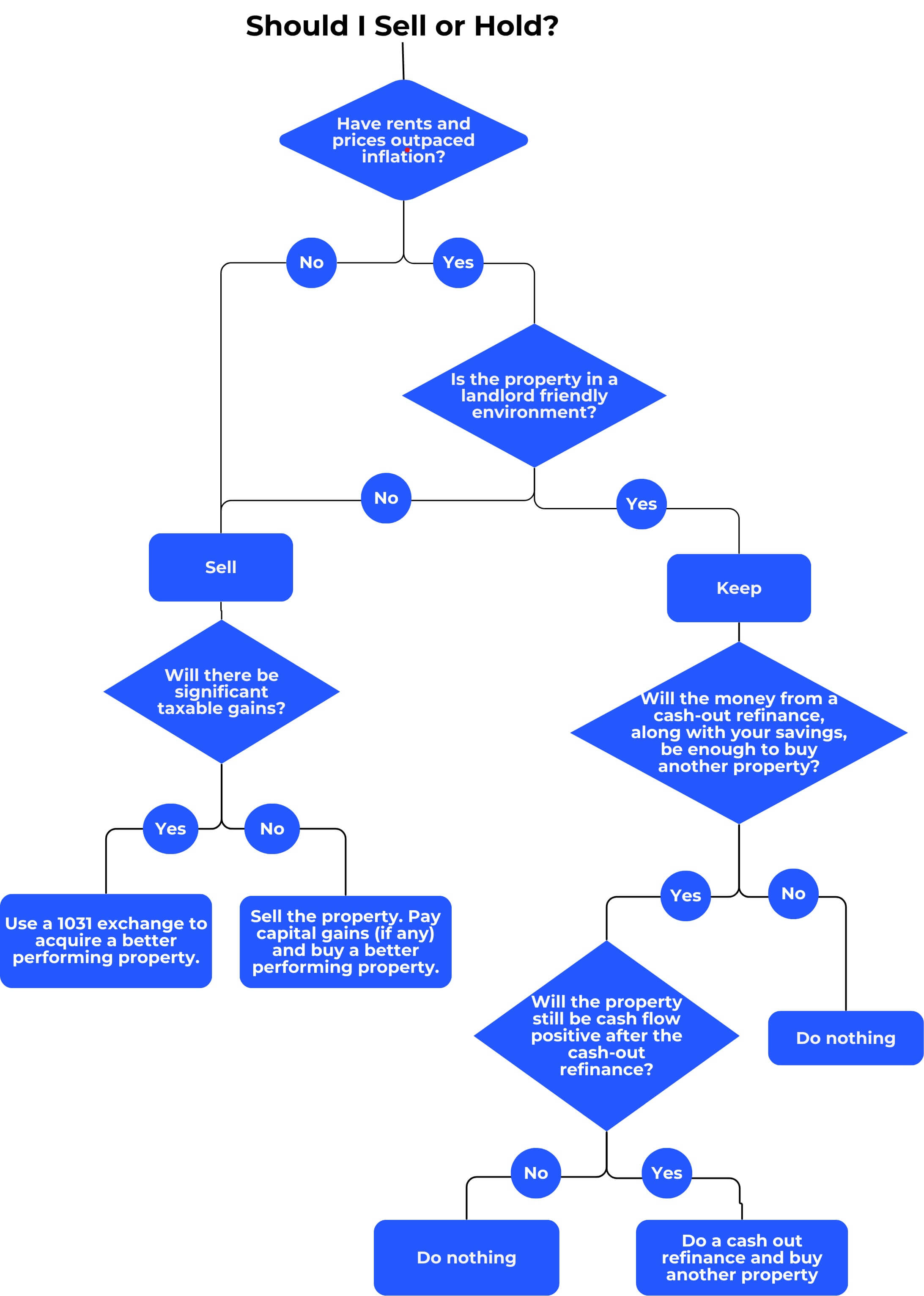
Achieving long-term financial independence requires investing in the right city and buying properties that attract tenants who stay for many years and pay rent on schedule.