I am in the Cleveland, OH market, and own a few SFH that I rent out. The market is great for CoC return as well as some appreciation. Looking for thoughts and feedback as I debate continuing on the SFH path or entering the MFH market (2-4 units). The appreciation here on those seems minuscule so would hope the CoC makes up for it. The goal is income and hold long term. What are the criteria I should look for when researching and identifying a 'good MFH investment': I heard $300/unit profit is ideal as well as total rent being at least 1% of purchase price. Are there any hidden risks to consider with MFH's? Thank you in advance!
Real Estate Agent · Charlotte, NC · Member since 2019 · 111 posts · 58 votes
8mo
@Daniela Schaal I'm in Cleveland as well, with SFH and multifamily homes. I personally like SFH or small multi's more because they are more liquid. With bigger multi's, you have additional costs as well, like cleaning, landscaping etc. if you buy at the right price, multi's' can be good, but it's hard to get a good on them because they are glamorous to many just because they are multi's. Regardless, if you'd need help with off market deals or private lending, let me know
Property Manager · Cleveland, OH · Member since 2020 · 312 posts · 265 votes
8mo
MFH in Cleveland is definitely viable. If you're expecting $300 a month per unit, you're definitely slumming it or going section 8.
Some notes on MFH
1. Water is included in Rent, you cannot legally bill it back to tenants unless it's submetered. Same deal with landscaping.
2. 3/4 bedroom units take much longer than average to rent out. Tenants would rather pay the extra money for a house at that point. Go with 2 bedroom units. 3. Get separate washers/ dryers. Multi family tenants fight over driveways/shared washer dryer units. 4. Don't allow pets. If one tenant can't handle the responsibility of a pet, you can lose the other good tenant.
Lender · Miami, FL · Member since 2025 · 125 posts · 35 votes
8mo
Hi Daniela,
Ohio is a great rental market but I agree appreciation is not what it's known for. That doesn't mean you can only enjoy cash flow in Ohio. I think your strategy moving forward is appropriate. In lieu of strong appreciation, you could accelerate debt pay down by moving from SFH to multifamily. Taking on a larger loan and having multiple tenants help pay it down. This also helps you diversify your vacancy risk considering turnover on a SFH means 100% of the revenue stops.
Now regarding the criteria, $300/unit/month sounds reasonable. Just make sure that you deduct reserves (repairs, turnover) from what you consider profit otherwise the day you have to make a repair or have turnover you will have to come out of pocket.
I am in the Cleveland, OH market, and own a few SFH that I rent out. The market is great for CoC return as well as some appreciation. Looking for thoughts and feedback as I debate continuing on the SFH path or entering the MFH market (2-4 units). The appreciation here on those seems minuscule so would hope the CoC makes up for it. The goal is income and hold long term. What are the criteria I should look for when researching and identifying a 'good MFH investment': I heard $300/unit profit is ideal as well as total rent being at least 1% of purchase price. Are there any hidden risks to consider with MFH's? Thank you in advance!
Hey Daniela, welcome to BP! If your goal is long-term income, moving into small MFH properties can definitely make sense because you’re getting multiple streams of rent in one building, which can help stabilize cash flow and offset vacancies, but there are a few things to keep in mind. That $300/unit profit and the 1% rule are good starting points, but you also want to look at location, tenant turnover, and maintenance costs since repairs can add up quickly with multiple units, and managing more tenants can take more time or require a property manager. Make sure to check local ordinances, parking, and potential HOA or zoning issues that could affect rentability. In markets like Cleveland, MFH can still cash flow really well, but appreciation may be slower compared to SFH, so you’re mostly banking on cash flow. Also consider financing differences—sometimes small MFHs have slightly higher rates or different underwriting requirements. Many investors in nearby Columbus, Ohio have successfully scaled 2-4 unit buildings while hitting the 1% rule and positive cash flow, benefiting from strong population and job growth, which helps long-term hold strategies. Happy to connect and answer any questions you have!
Real Estate Agent · Charlotte, NC · Member since 2019 · 111 posts · 58 votes
8mo
@Daniela Schaal I'm in Cleveland as well, with SFH and multifamily homes. I personally like SFH or small multi's more because they are more liquid. With bigger multi's, you have additional costs as well, like cleaning, landscaping etc. if you buy at the right price, multi's' can be good, but it's hard to get a good on them because they are glamorous to many just because they are multi's. Regardless, if you'd need help with off market deals or private lending, let me know
Recommend becoming familiar with specific areas to know the "Not worth the headache" streets/areas vs. "this will do" areas.
If you find potentials, use Google street view to get an idea of the area. There are several multi family homes in Cleveland as it was an industrial city.
Do not concern yourself with the age of the homes. Most will be hovering around 100 yrs old and, yes, some repairs will be necessary but they are more solid and durable than the newer, cheaper built homes.
"Are there any hidden risks to consider with MFH's?" Everyone has given good feedback (i.e., different washer / drier). Also verify if it is a legal MFH as some just converted them but not correctly.
Yes, you could get more net cash flow but you could get more in-fighting depending on the tenants (e.g., driveway debates, company coming over while the other has to sleep nights). Most importantly, some experts say stick with SFH as the turnovers are less. I disagree with avoiding +3 BR homes as room for the kids is highly desirable. Also, they are much less likely to leave.
Pets? It depends. If you aren't getting offers (which you shouldn't be the case), feel free to allow it but prep the hardwood floors and don't be surprised on a carpet replacement.
In Cleveland, 2–4 unit MFHs usually win on cash flow and vacancy protection, not appreciation. One empty unit won’t sink the deal, and financing is still favorable. Instead of hard rules like $300/unit or the 1% rule, focus on true cash flow after all expenses, condition of big-ticket items, and tenant quality. The biggest risks are older systems, inherited tenants, and underestimated capex—but if you underwrite conservatively, MFHs can be a strong long-term income play.
Property Manager · Cleveland · Member since 2025 · 52 posts · 28 votes
8mo
Hey! Great to see another local investor in the Cleveland SFH space.
Regarding the jump to 2-4 units, the 1% rule and $300/door are solid benchmarks, but in this market, the 'hidden' risks are usually in the utility splits and older mechanicals—especially if you're looking at older Cleveland doubles.
My name is Mario and I work with a local property management team here. We actually have an inside sales team that specializes in exactly what you're doing—analyzing the transition from SFH to MFH. About 50% of the deals they source for our clients are off-market, so they have a really good pulse on what a 'good' multifamily deal actually looks like right now.
Happy to have them take a look at your criteria or provide some feedback on any specific MFH deals you're debating. It's a different beast than SFH, but the cash flow can definitely be worth it if the numbers are right!
Realtor · Columbus, OH · Member since 2023 · 1k+ posts · 1k+ votes
8mo
I’d only jump from SFHs to 2–4 units if it still cash-flows after you budget real vacancy, repairs/capex, and turnover. The hidden risk is that older buildings' roof/sewer/electrical and shared utilities can blow up expenses fast, so if it doesn’t work with conservative numbers, I’d pass.
I am in the Cleveland, OH market, and own a few SFH that I rent out. The market is great for CoC return as well as some appreciation. Looking for thoughts and feedback as I debate continuing on the SFH path or entering the MFH market (2-4 units). The appreciation here on those seems minuscule so would hope the CoC makes up for it. The goal is income and hold long term. What are the criteria I should look for when researching and identifying a 'good MFH investment': I heard $300/unit profit is ideal as well as total rent being at least 1% of purchase price. Are there any hidden risks to consider with MFH's? Thank you in advance!
You want to be careful with, "what you hear"!
There are several challenges somewhat unique to 2-4 unit, small MFR.
1) Tenants want you to be their mediator with other tenants. - "They are too noisy" - "They are parking in "my spot" (when there is no assigned parking, just entitlement) - "They smoke outside too close to my open window" This happens less as the number of units increases.
2) Water is a common utility owner has to absorb cost of, but there may also only be one boiler/furnace and/or shared electrical panels - so, more costs for owner to absorb.
3) Parking can be an issue
4) Mailboxes can also be a problem
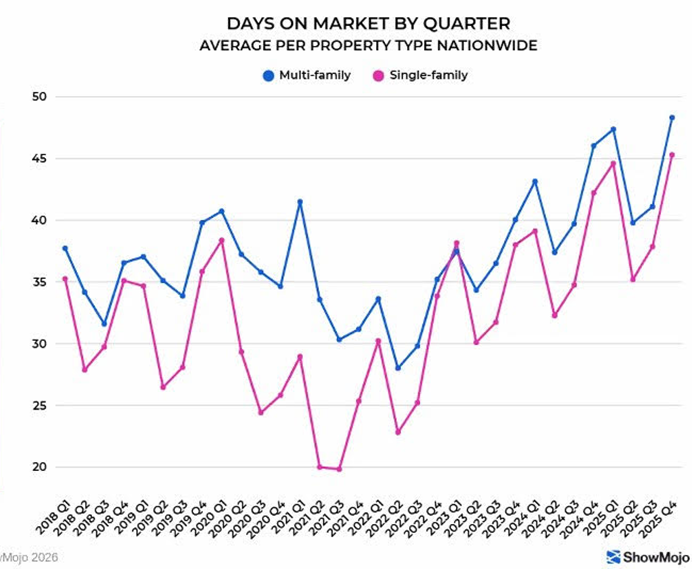
Also, multi-family units typically take longer to rent, per graph below:
Real Estate Agent · Cedar Rapids IA · Member since 2022 · 26 posts · 16 votes
8mo
If you're looking for long term hold and income definitely do MFH try to do no less than 2 bedroom units at least for the majority. They're easier to rent out than one bedroom units. Multiple units to me means security that the property will always produce income even if you run in to a bad tenant at some point you still have 3/4 units paying. Where in the SFH market you're sunk until you get that tenant out and a new tenant in place.
Since your goal is long-term income, I’d treat MFH underwriting less as hitting fixed rules (like $300/unit or 1%) and more as a full-picture comparison against your SFHs.
When I look at small MF, I focus on whether the incremental complexity (shared systems, higher repair volatility, management) is actually compensated with better stabilized cash flow and downside protection. In markets like Cleveland, where appreciation may be modest, that usually means being extra conservative on expenses and vacancy.
I’ve found it helpful to underwrite a few 2–4 unit deals side-by-side with SFHs using the same assumptions and see which truly produces stronger, more resilient income rather than relying on per-unit rules of thumb.