I have 100,000 and i dont know where to put it...
New to Real Estate · Hong Kong · Member since 2020 · 14 posts · 19 votes
If money was not an issue and i had 100,000 USD on the side to put for down payments, would investing in expensive cities like los angeles be a good idea because of the rental occupancy rate there, or would it be wiser to invest it in somewhere that has a lower occupancy rate but i can buy more with 100,000 in down payments.
If money was not an issue and i had 100,000 USD on the side to put for down payments, would investing in expensive cities like los angeles be a good idea because of the rental occupancy rate there, or would it be wiser to invest it in somewhere that has a lower occupancy rate but i can buy more with 100,000 in down payments.
Etienne, I'd invest for appreciation in a market like Los Angeles. If money's not an issue at present, and you want your money put to best use, invest in a place like LA (and I vote specifically for LA).
Let's just do some quick math:
Let's say $100K is going to be 25% down payment on one or several properties. In your appreciation market, you'll receive no cashflow, but the building will appreciate 5% per year. In the cashflow market, you'll earn a fantastic 15% cash-on-cash return but no appreciation. All financing terms are identical. Let's remove costs associated by buying and selling. To further simplify, let's say there's no principal paydown (since it will be equivalent in both examples).
What's your investment horizon? Let's say seven years...
In seven years, in your appreciation market, you'll own a property worth $562,840. You borrowed $300k to buy it, so you profit in year 7 is $262,840.
In the cashflow market, after seven years, you will have made $105,000 in cashflow. You'll have no profit in the sale of the building because it didn't appreciate.
Now, cashflow-lovers are going to make the following argument: cashflow is money-in-hand whereas appreciation is speculative.
They would be right that cashflow is money-in-hand in that you get it regularly, not as a big lump sum at the end. This makes the early cashflow payments more valuable than the later appreciation harvesting. However, if money is not a current concern, as is the case in this example, the actual value of those earlier payments is lower. To be really nerdy and mathy about it, you can use a much lower discount rate when analyzing the value of future earnings.
However, is appreciation speculative? In the Midwest, yes. In cities that have populations under 1M and might or might not be ascendant, absolutely. But in an international gateway city with a longterm average appreciation rate of 6.7% going back to 1975 -- meaning this longterm average incorporates the five recessions that have occurred since? Appreciation is far less speculative than Midwestern investors make it out to be, and to the extent that it is more speculative, the reward is much greater.
So, buy LA, my friend!
Best,
Jon
If you have 100k to invest, you need to stop wasting your time w houses and move up to Multifamily.
@Jon Schwartz regarding California I would be more concerned about businesses moving out, terrible policies, high taxation and an (almost?) bankrupt state, relying on foreign cash for real estate appreciation. What are your thoughts about these?
I think your fears are overblown.
Some business is moving out, but Silicon Valley isn't going anywhere. The farms of California aren't going anywhere. Netflix (which has its largest footprint now in Hollywood) isn't going anywhere. You have to keep in mind that 1 in 8 Americans lives in California. To put things in perspective: California's GDP is almost twice Texas's GDP. So when a company moves from California to Texas, it has twice as much impact on Texas as it does on California.
What terrible policies are you referring to?
High taxation is a buzzkill, no question. I think a lot of us see it as the price to pay for sound environmental policies and worker protections and all the other things that all this tax money pays for.
Is California bankrupt? I did some quick googling and found that, at least currently, California's public debt as a percentage of its GDP ranks ahead of Kentucky, New York, Illinois, Connecticut, Rhode Island, Nevada, Hawaii, Alaska, Alabama, Colorado, Massachusetts, New Mexico, Pennsylvania, North Dakota, West Virginia, Texas, Washington, and New Jersey (source: https://www.usgovernmentspendi...). I'm sure California's finances are in the stinker right now, but what state has a pristine balance sheet at the moment?
Does California's real estate rely on foreign cash for appreciation? Chinese buyers are a serious power here -- so much so that catering to Chinese buyers is covered in agent education. But I think the biggest driver of appreciation is the vast undersupply of houses (source: https://www.ppic.org/wp-conten...). In markets like mine, Los Angeles, you also have physical barriers to expansion -- namely, the ocean and the mountains. So I think your take is off the mark.
Best,
Jon
How long are people going to hold on to that false narrative about California being bankrupt? Yes, it was almost bankrupt a long time ago back on the Terminator was our governor and he tried to turn things around unsuccessfully. but under Brown, California really turned things around and prior to Covid, had a very large surplus. But then people don't know about that because it doesn't make the news, does it? All they remember are the large battles Arnold Schwarzenegger had with the unions in trying to eliminate their defined-benefit pensions.
@Jon Schwartz regarding California I would be more concerned about businesses moving out, terrible policies, high taxation and an (almost?) bankrupt state, relying on foreign cash for real estate appreciation. What are your thoughts about these?
I think your fears are overblown.
Some business is moving out, but Silicon Valley isn't going anywhere. The farms of California aren't going anywhere. Netflix (which has its largest footprint now in Hollywood) isn't going anywhere. You have to keep in mind that 1 in 8 Americans lives in California. To put things in perspective: California's GDP is almost twice Texas's GDP. So when a company moves from California to Texas, it has twice as much impact on Texas as it does on California.
What terrible policies are you referring to?
High taxation is a buzzkill, no question. I think a lot of us see it as the price to pay for sound environmental policies and worker protections and all the other things that all this tax money pays for.
Is California bankrupt? I did some quick googling and found that, at least currently, California's public debt as a percentage of its GDP ranks ahead of Kentucky, New York, Illinois, Connecticut, Rhode Island, Nevada, Hawaii, Alaska, Alabama, Colorado, Massachusetts, New Mexico, Pennsylvania, North Dakota, West Virginia, Texas, Washington, and New Jersey (source: https://www.usgovernmentspendi...). I'm sure California's finances are in the stinker right now, but what state has a pristine balance sheet at the moment?
Does California's real estate rely on foreign cash for appreciation? Chinese buyers are a serious power here -- so much so that catering to Chinese buyers is covered in agent education. But I think the biggest driver of appreciation is the vast undersupply of houses (source: https://www.ppic.org/wp-conten...). In markets like mine, Los Angeles, you also have physical barriers to expansion -- namely, the ocean and the mountains. So I think your take is off the mark.
Best,
Jon
How long are people going to hold on to that false narrative about California being bankrupt? Yes, it was almost bankrupt a long time ago back on the Terminator was our governor and he tried to turn things around unsuccessfully. but under Brown, California really turned things around and prior to Covid, had a very large surplus. But then people don't know about that because it doesn't make the news, does it? All they remember are the large battles Arnold Schwarzenegger had with the unions in trying to eliminate their defined-benefit pensions.
Tony,
I can tell you first hand that the state isn’t in a good place financially and has not been in a good place since the Great Recession. It’s all a shell game, a house of cards. CalPers alone has a $1 trillion dollar unfunded liability.
Open your eyes people! Don’t get me wrong, I was born and raised in this state and I wouldn’t want to be anywhere else in terms of location but don’t let that cloud your vision. This state is crushing the middle class. There are two classes of people who do well in this state, the extremely poor and the extremely wealthy, everything in the middle gets decimated.
This state is full of pipe dreams and guess who gets to foot the bill for all of this idiocracy? That’s right the middle class tax paying citizens. That’s who. Those of you in SF, LA and SD need to take a look at the rest of the state and realize we do not feel the same way that you do about the state of the state.
I think ur spot on .
I compare the investment to california to a high growth stock like tesla or apple and cash flow investment to divident play . as long as california produces the googles of the world appreciation would trump cash flow . some people do want steady flow of income so cash flow is preferred but if one is comparing strictly ROI then california would better . However i would say bay area real estate is better poised then LA just because of the fact that I believe technology( software) would drive future innovation in any field from medicine to cars and silicon valley continues to be the leader in software . last 10 years has proven that as well .
@Sid Naik @Jon Schwartz it seems like you guys enjoy the platform we are all using today for this conversation. I came across a guy on Instagram today you might have heard of? His name was @Brandon Turner! Just happened to post about lying cash flow and true cash flow, lol! He talked about what cash flow he looks for. I would imagine he might steer some of us towards finding properties that cash flow and appreciate together. Wealth is not created by using a single lane pony! Being creative and using multiple strategies to be the best you will build wealth! And guess what.....it’s ok to have Google stock while buying real estate that cash flows lol
If money was not an issue and i had 100,000 USD on the side to put for down payments, would investing in expensive cities like los angeles be a good idea because of the rental occupancy rate there, or would it be wiser to invest it in somewhere that has a lower occupancy rate but i can buy more with 100,000 in down payments.
Etienne, I'd invest for appreciation in a market like Los Angeles. If money's not an issue at present, and you want your money put to best use, invest in a place like LA (and I vote specifically for LA).
Let's just do some quick math:
Let's say $100K is going to be 25% down payment on one or several properties. In your appreciation market, you'll receive no cashflow, but the building will appreciate 5% per year. In the cashflow market, you'll earn a fantastic 15% cash-on-cash return but no appreciation. All financing terms are identical. Let's remove costs associated by buying and selling. To further simplify, let's say there's no principal paydown (since it will be equivalent in both examples).
What's your investment horizon? Let's say seven years...
In seven years, in your appreciation market, you'll own a property worth $562,840. You borrowed $300k to buy it, so you profit in year 7 is $262,840.
In the cashflow market, after seven years, you will have made $105,000 in cashflow. You'll have no profit in the sale of the building because it didn't appreciate.
Now, cashflow-lovers are going to make the following argument: cashflow is money-in-hand whereas appreciation is speculative.
They would be right that cashflow is money-in-hand in that you get it regularly, not as a big lump sum at the end. This makes the early cashflow payments more valuable than the later appreciation harvesting. However, if money is not a current concern, as is the case in this example, the actual value of those earlier payments is lower. To be really nerdy and mathy about it, you can use a much lower discount rate when analyzing the value of future earnings.
However, is appreciation speculative? In the Midwest, yes. In cities that have populations under 1M and might or might not be ascendant, absolutely. But in an international gateway city with a longterm average appreciation rate of 6.7% going back to 1975 -- meaning this longterm average incorporates the five recessions that have occurred since? Appreciation is far less speculative than Midwestern investors make it out to be, and to the extent that it is more speculative, the reward is much greater.
So, buy LA, my friend!
Best,
Jon
You're not taking into account mortgage paydown on the non-speculative, non-LA property. That adds to the ROI. Also where is one getting a 400k rental property in LA that is neutral cash flow after all expenses (10% management, 5% Capex, 5% maintence, 5% vacancy, 2%+ insurance (eq insurance is necessary, HOA fees since 400k definitely won't buy a house). So if you can find a $400k condo with 25% down and rent it for $2k/mo, you'd get crushed.
300k mortgage at 3.25% would be $1306/mo, leaving you $694/mo for expenses. Well, expenses would be:
HOA: about $400 (maybe more)
Management: $200
Capex: $100
Maint: $100
Insurance+eq insurance: $ 150/mo
Vacancy: $100
So $1050 in expenses.
So cash flow would be about $400 negative a month, and I think these numbers are ambitious. Anyone investing in LA needs to be making enough to cover thousands in negative cash per year. It may be worth it for appreciation, but remember back in 2006 when LA real estate was a sport, but then dropped 30%? That could be a killer if you can't hold on for a long time.
Just my two cents...
@Isaura Orellana Yes, rep your city! I too am from the Midwest. However, I have since moved. Do you have a suggestion on how to enter the market in Detroit being an OOS investor? I've seen many affordable properties listed, any particular neighborhood you suggest? And what advice would you offer? Thanks!
@Isaura Orellana Yes, rep your city! I too am from the Midwest. However, I have since moved. Do you have a suggestion on how to enter the market in Detroit being an OOS investor? I've seen many affordable properties listed, any particular neighborhood you suggest? And what advice would you offer? Thanks!
If money was not an issue and i had 100,000 USD on the side to put for down payments, would investing in expensive cities like los angeles be a good idea because of the rental occupancy rate there, or would it be wiser to invest it in somewhere that has a lower occupancy rate but i can buy more with 100,000 in down payments.
Etienne, I'd invest for appreciation in a market like Los Angeles. If money's not an issue at present, and you want your money put to best use, invest in a place like LA (and I vote specifically for LA).
Let's just do some quick math:
Let's say $100K is going to be 25% down payment on one or several properties. In your appreciation market, you'll receive no cashflow, but the building will appreciate 5% per year. In the cashflow market, you'll earn a fantastic 15% cash-on-cash return but no appreciation. All financing terms are identical. Let's remove costs associated by buying and selling. To further simplify, let's say there's no principal paydown (since it will be equivalent in both examples).
What's your investment horizon? Let's say seven years...
In seven years, in your appreciation market, you'll own a property worth $562,840. You borrowed $300k to buy it, so you profit in year 7 is $262,840.
In the cashflow market, after seven years, you will have made $105,000 in cashflow. You'll have no profit in the sale of the building because it didn't appreciate.
Now, cashflow-lovers are going to make the following argument: cashflow is money-in-hand whereas appreciation is speculative.
They would be right that cashflow is money-in-hand in that you get it regularly, not as a big lump sum at the end. This makes the early cashflow payments more valuable than the later appreciation harvesting. However, if money is not a current concern, as is the case in this example, the actual value of those earlier payments is lower. To be really nerdy and mathy about it, you can use a much lower discount rate when analyzing the value of future earnings.
However, is appreciation speculative? In the Midwest, yes. In cities that have populations under 1M and might or might not be ascendant, absolutely. But in an international gateway city with a longterm average appreciation rate of 6.7% going back to 1975 -- meaning this longterm average incorporates the five recessions that have occurred since? Appreciation is far less speculative than Midwestern investors make it out to be, and to the extent that it is more speculative, the reward is much greater.
So, buy LA, my friend!
Best,
Jon
You're not taking into account mortgage paydown on the non-speculative, non-LA property. That adds to the ROI. Also where is one getting a 400k rental property in LA that is neutral cash flow after all expenses (10% management, 5% Capex, 5% maintence, 5% vacancy, 2%+ insurance (eq insurance is necessary, HOA fees since 400k definitely won't buy a house). So if you can find a $400k condo with 25% down and rent it for $2k/mo, you'd get crushed.
300k mortgage at 3.25% would be $1306/mo, leaving you $694/mo for expenses. Well, expenses would be:
HOA: about $400 (maybe more)
Management: $200
Capex: $100
Maint: $100
Insurance+eq insurance: $ 150/mo
Vacancy: $100
So $1050 in expenses.
So cash flow would be about $400 negative a month, and I think these numbers are ambitious. Anyone investing in LA needs to be making enough to cover thousands in negative cash per year. It may be worth it for appreciation, but remember back in 2006 when LA real estate was a sport, but then dropped 30%? That could be a killer if you can't hold on for a long time.
Just my two cents...
This is a little over $400K, but it cashflows:
https://www.redfin.com/CA/Los-...
Scroll up and find the post with all the maps. That's me explaining why this triplex is a good buy.
Best,
Jon
I would still rather invest outside Cali.....moving vans are heading East and that cannot be good for real estate out there if trends continue. For the last 5-6 yrs Nashville has had 120/day moving here. I bet Cali would kill for those numbers!
@Jonathan Anderson
Ok. well since your entire argument, and the profitability of your plan, is based on one HUGE if.. which is if the owner of the property can rent the place for enough to cover ALL of the costs of ownership including, but not limited to
a 300k mortgage payment,
property taxes
scheduled maintenance
property management fees (as you stated)
misc repair costs
a quick check of the median listed price of a 2 bed condo in LA is, wouldn't you know 389,000.
So after 100k down, and the loan origination fees, looks like 400k total purchase is a great figure to go off of....
leaving us with roughly a 300k loan.
So, at 4% on a 30yr fixed = $1432.00/mo
property taxes escrow = $392/mo (random property listed at $379k)
property management = $100/mo (conservatively...)
scheduled maintenance = $100/mo (conservatively...)
1 repair per year ($480/yr) = $40/mo
Now, let's look at 2br SFR for rent. Im going to, for argument's sake, allow our 2br condo to be compared against 2br houses in terms of rental price, partially because it will still illustrate my point, and also, I did not feel like hunting through 1000 listings for apartment complex owned and managed studio-3br listings to find an example. We do have to count out apartment complex listings however, single unit privately owned condos, are in need of updating, and do not have the amenities that apartment complexes do for our 400k purchase price, unless there is a $200/mo HOA fee. Infact 400k +/- purchase price is the lowest anything is listed for in L.A.
So..while I would love to just assume avg median rent / avg media price, We can not. While the lowest we can find a condo for is 350k+, the avg median sales price is over 700k. So basically, at 400k, were looking at the low side of what is out there.
And just a quick glance at realtor.com, and we can see how this will play out...Keep in mind we are looking at 2br condos to purchase. And sure enough 2br houses are listed for rent all the way down to $1300/mo and 17 listed for less than $2k/mo.
So, did you do the math from above? our total (conservative) estimate for monthly costs came to $2064.00. Just to be safe, I repeated the search for rentals 2br+ in Los Angeles, SFR or Condos on zillow, and there are at least 30 listings for under $2k per month.
To be fair, I repeated the search for homes for sale for less than 400k on LA. I think we can both agree that mobile/manufactured housing should be removed as they are a depreciating asset which would invalidate the appreciation aspect of your argument. Zillow does have listings down to 320k. which would mean a lower monthly mortgage payment.
All in all, I'm still not seeing it actually work out. Looks to me like you can rent a place for less than the cost of ownership. (which is generally speaking the rule.... otherwise no one would ever rent.) which means that There is most likely going to be at least a little negative cash flow at 100k down.
But let's say we break even. Every day that property sits empty adds to negative cash flow.
I do not believe that investing in property is a bad idea at all. Your suggestion lumps in all of the possible rewards and disregards any risk. I believe that attempting to invest with the same monetary plan as one would purchase a primary residence is not investing at all. It is simply buying another liability that someone else is going to live in.
You want a great return on 100k. Buy a 100k house. Rent it for $500/mo. Let it appreciate 2% per year. Pay your property taxes, do your scheduled maintenance, and repairs, and walk with 5% per year, with almost no risk.
Or buy a house in LA....maybe break even on cash flow... and at the end of 7 years... maybe..maybe break even on house value.
Oh... forgot to mention forbes reported in december 2019 on L.A. awwww...no appreciation in 2019 for LA homes...
https://www.forbes.com/sites/johnwake/2020/12/31/no-house-price-appreciation-in-new-york-los-angeles-chicago-or-san-francisco/#cffec8f1af84
If you invested in L.A. with the 100k down strategy in 2019.... there goes that whole year of profit.
Gavin, Gavin, Gavin...
First, to quickly address your counter example: A $100K house bought in cash and rented for $500/month is going to generate $6000/year in cashflow max. You're talking about a 5% return with almost no risk. You're saying that this $100K house has "almost no risk" of incurring more than $1000/year in maintenance and vacancy. Sure!
Now on to your gripping takedown of investing in LA:
Firstly, you don't make money in LA buying a condo. Secondly, you don't make money in LA by doing ten minutes of research and buying anything anywhere. The Los Angeles MSA has over twice the population of your entire state. A little more effort is required to invest here.
Let's take this listing as an example:
https://www.redfin.com/CA/Los-...
I know, the purchase price is $459K, which puts us over the $400K limit. My original post was demonstrating simple math between appreciation and cashflow, and this price point is in the ballpark of a $100K down payment, so let's proceed.
What numbers do you run on this listing? Here's what I get:
Rental Income: $2865
PITI (at 4% interest): $2206
Maint & Capex (10%): $287
Prop Mgmt (5%): $143
Vacancy (4%): $115
CASHFLOW: $114
PITI includes property taxes (1.27% annually in LA) and insurance. We don't mess around with escrowed taxes or insurance when we put 25% down, my friend.
So this inexpensive LA property cashflows. But we're not buying for cashflow, right? We're buying for appreciation. This property is just below downtown LA, an area which was been massively gentrified over the last decade. Nowhere in LA is growing faster (and becoming expensive faster) than downtown LA. (Obviously, yes, COVID will put a slowdown on that growth, but I think we'll be back in track in 12-18 months.)
Let's look at some maps!
All of the below maps were made with Census Bureau data, which you can download yourself at data.census.gov. I use Tableau to make my maps. The most recent annual data from the Census Bureau reflects 2018's data collection, so the range we're looking at is 2013-2018 (numbers reflecting 2019 will be published in October, and I can't wait to update these maps!). All of these maps represent census tracts in Los Angeles; census tracts are the smaller geographically area that the Census Bureau tracks.
Here's household formation 2013-2018:
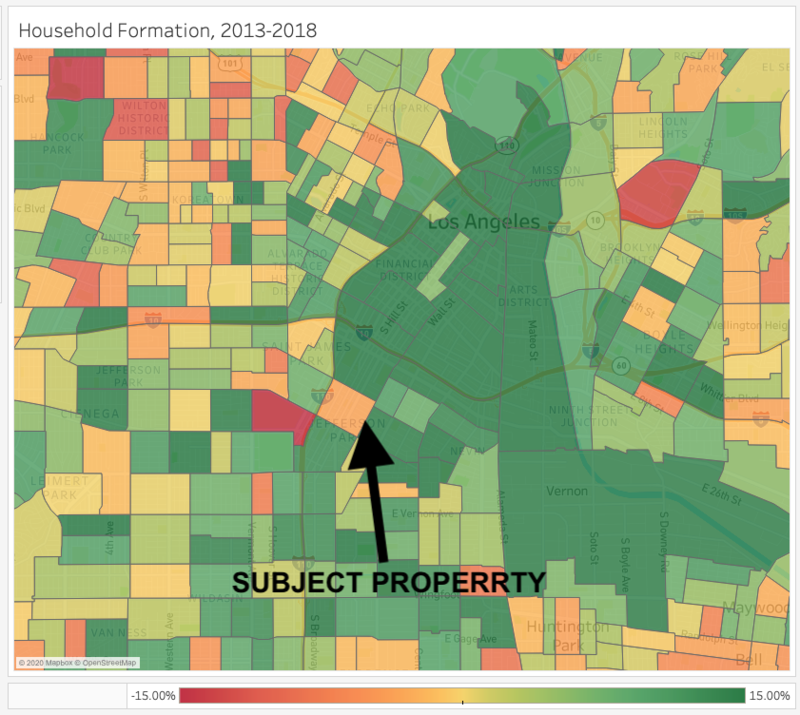
The bright green areas to the north of the subject property are downtown LA. Lots of people moving in! The subject property's census tract is a spot of orange surrounded by green. That's a good thing! Because look at this map of renters who have moved in within the last one year:
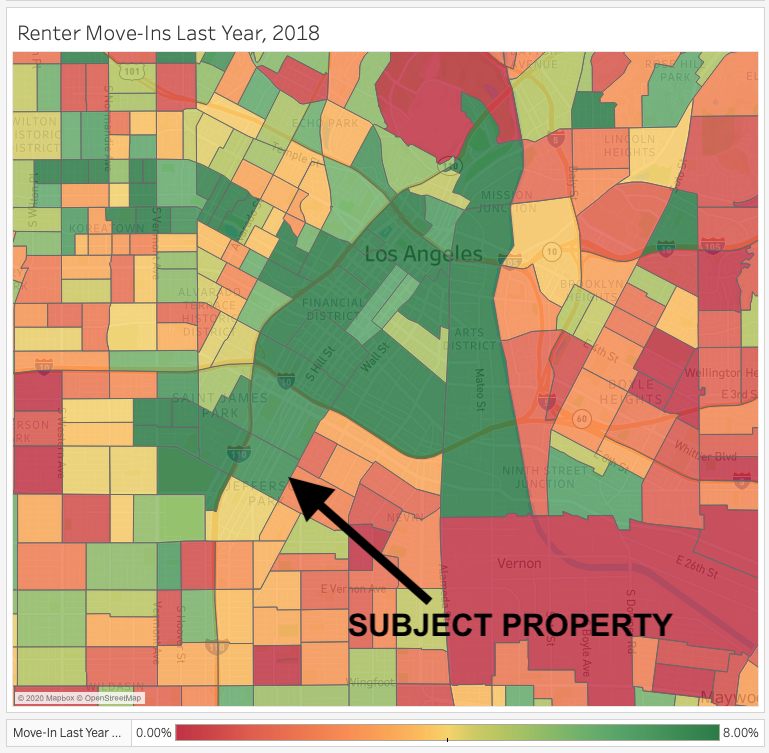
As you can see, now the green area extends down to our subject property. New renter households abound! And this is what we want -- more renters moving in means more demand means higher rents means more expensive buildings.
What's interesting, though, is that prices are lagging move-ins. Here's median home price growth, 2013-2018:

As you can see, at the very top of the map, the northern area of downtown LA has already seen robust home price appreciation. Our little census tract and the areas around it have not. Fantastic! We've identified the cusp, the edge of the path of progress. We're right on target!
That's the kind of analysis required to make money in LA real estate, and it's this kind of analysis that mitigates the risk such that one is not playing roulette.
@Todd Pultz, gotta ask, is this still speculation at best?
Thanks guys!
All the best,
Jon
Curious how you came to 2200ish with insurance and taxes at 4%. That's not right. The p+I would be about 1900 alone. A 500k house would have about 6000 in taxes per year (500/mo). Insurance is easily $1500/yr ($125/mo) and probably more since you need eq insurance.
So just loan, insurance and taxes are much more like $2500.
Also a 500k condo would be garbage in LA. A SFV house would be in a D neighborhood. I don't disagree with you on the potential appreciation, but if this guy has $100k to invest, he better be prepared to take on $6k+ of negative cash flow annually. This isn't necessarily a bad bet, it's just one that inherently involves risk. Now, if I knew I had a guaranteed income of $200k year at my regular job, then I'd definitely take a $6k hit/yr and bet on LA long term appreciation. But you have to be able to hold for a long time to increase the odds of getting the appreciation you cite.
I am a strong believer that a mix of cashflow+appreciation is the most profitible route for real estate investing. I would put it in B class 2-4 units in major cities which are seeing growth but not on the west coast or any of the very low negative cashflow markets. There are many areas that provide a solid mix of the two.
@Etienne Dubois
Actually you do not even need the full $100,000. You can do the strategy I will share below with no downside risk and a huge upside that can increase you net-worth instantly, provide you with secured cash flow for years. Please forgive the length of my reply, I just wanted to give you the details since it involves commercial and not residential real estate and most people on BiggerPockets do residential and multifamily:
1. You need to take a training with a Fund Manager who specializes in commercial single tenant retail. (The reason I say a fund manager is because this is not someone with a syndication where the capital is deployed in one building like an apartment building and that’s it. A Fund Manager usually has lots of cash to be deployed constantly into various properties. It is like having several syndications grouped together in one structure and there is cash reserves and various transactions by location etc
2. The training should be focused on single tenant commercial properties because their values have everything to do with who rents them and nothing to do with comparable sales like residential real estate. Also if no one is renting a single tenant commercial building, it can be priced much lower because most owners don’t know how to procure a national commercial tenant and most brokers prefer to list the property for sale (to make a bigger commission) than try to locate a big tenant who would then rent the property for 10 to 15 years. It is a huge opportunity gap in many markets in the US and very few know how to make it happen. In today’s market with Covid-19 quick service restaurants are actively growing
3. After the training you can work and communicate directly with the fund manager by doing the following:
a) Find a vacant single tenant commercial building with the specific criteria the Fund Manager has asked you to identify (there are 15 criteria such as heavy traffic, with a building that used to be occupied by a food operator, so all would be set up for another fast food business as they are essential businesses and it also important to have great national tenants nearby etc)
b) your will know how to contact the listing broker and will use the script given to you by the Fund Manager
c) you will make an offer to purchase the property and can even send a proof of fund given to you by the fund manager showing that capital is sitting cash in the fund’s bank account. This way the listing broker will take you seriously and will send you the purchase contract to sign
d) You will sign the purchase contract in your name and/or the RE Fund name and the property will then be under contract usually for approximately 45 days for due diligence (to inspect the property) with no obligation to purchase it and an additional 15 days to close
e) You will need only $5,000 for the Earnest Money Deposit that's refundable. This is placed in an escrow account. Remember you showed the Proof of Funds letter from the bank account of the RE fund and your small deposit is refundable anyway (even if the listing broker wants to see more money, you can probably put $10k but they will only usually ask for the increased deposit once the due diligence contingency period expires)
f) Now that you have the property under contract you will prepare a package to present to national tenants just like you were trained by the fund manager who will review the package and you will be able to offer the location with attractive lease terms etc to national tenants
g) You will then start contacting the national tenants based on the list and data given to you by the fund manager and will use a specific script when leaving voice mail messages and then you will follow up by email (as a fund manager I have created a list of over 4000 national tenants with very specific information regarding who to contact, the size of space they like, who they like to be next to etc)
h) You just need one tenant to communicate back, expressing interest to expand in that location. Tenant reply by email and they request a conference call to discuss and negotiate the lease terms that will be suitable for them if they like the location
i) You will connect the national tenant with the Fund Manager for everyone to get on a conference call or a zoom video to negotiate the term details such as how many months free rent, tenant improvement allowance, if they can go dark, any exclusives etc etc (You should not worry about that part because the Fund Manager will handle all those details)
j) after that a Letter of Intent to lease will be signed by the parties reflecting the National Tenant's intent to lease and the proposed commitment details to lease the space for 10 or 15 years with a NNN lease (NNN means: Tenant pays the lease plus taxes, insurance and maintenance) and a corporate guarantee (lease is guaranteed by the national tenant for the duration of the 10 or 15 years lease and it is backed by their entire company and their financing bank like Wells Fargo) and it will also reflect any other terms such as escalation of rent over time, renewal option for the lease if any etc
k) The National tenant usually sends a designer or representative to take a walk through the property and then they are ready to sign the lease agreement
l) It is then that you will assign the deal over to the Fund Manager who will pay all cash and your friend will get an assignment fee (usually between $40k and $150k)
Here is how the numbers will work:
Property vacant under contract say $600k and now with a national tenant lined up to pay say only $5k a month NNN (meaning a base tent of $60k a year and the tenant pays taxes, insurance and maintenance and the lease again has a corporate guarantee) the property will then be valued easily at over $1,000,000 (6% cap)
The upside instant increase in value is $400,000 and usually the assignment fee that your friend gets will be 10% of that upside which is $40k all done within 60 days the 45 day due diligence and 15 additional days to close (assignment fee could be 25% of the upside increase in value if Tenant commits to 15 years and in this example it would be $100k (25% of $400k upside increase)
Please note that:
- No real estate license is needed
- No additional cash is needed on your part
- No rehab process is needed (all is negotiated as a discount to Tenant to do improvements the way they want and up to their standards because Subway has different needs than Starbucks or Fat Burger Etc based on their style and standards)
- No due diligence or inspections are needed on your part, it is all done by the Tenant’s Representative
- There is No Down side risk because if no tenant responds during the 45 days due diligence, you can simply cancel the contract and get your $5,000 refunded (or whatever amount you put in as earnest money deposit)
- This can be done wherever you live in the US
- Almost all is done by internet and phone except for a couple of visits to the property
The fund manager gives the training, the Proof of Fund, the process, the script the support, the tenant list, the negotiations, and the cash to close because the property eventually gets assigned to the the real estate fund
This will not happen every 60 days but you have no downside, a huge upside and if done just 3 times in an entire year you will easily have over $120k in assignment fees’ income, plus experience (which btw achieves a goal of $10k per month which is most people’s income goal)
Here is the best part, you can remove the fund manager and just do the deal yourself and use the $100k you have as a downpayment or a tenant improvement credit for the national tenant coming in and buy the property at $600k with an instant increase in value to $1Million Dollars
You can put a small downpayment that you can cash out after the tenant is in the location and you can repeat the process each time increasing your passive income till you get to a net $10,000 per month passively (this would be 4 or 5 single tenant buildings that you will hold for passive income with full debt on each) and none of your own money since you will refinance each deal (banks love the corporate guarantees and interest rates today are very low)
Getting $10k/mo income and increasing your net worth into the millions is only hard if you use conventional ways to buy commercial properties or try to do rehab or wholesale in residential real estate which are very tedious, slow, competitive and exhausting methods
Fastest growing tenants right now during COVID-19 are Quick Service Restaurants and btw the last deal I did with someone like this was in July the single tenant vacant property was under contract at $900,000 and now with a national tenant in it with the NNN 10 year lease and corporate guarantee and escalations etc it appraised at over $1,500,000
The assignment fee paid to the person with whom we did a joint venture because he lined up the deal was $60k for less than 20 hours of work on their part by phone
Again it does not happen on every property but it happens often enough with less hassles and more upside than any other strategy I have experienced and I have been in the business as an investor, a fund manager and an educator for over 30 years
@Etienne Dubois
Actually you do not even need the full $100,000. You can do the strategy I will share below with no downside risk and a huge upside that can increase you net-worth instantly, provide you with secured cash flow for years. Please forgive the length of my reply, I just wanted to give you the details since it involves commercial and not residential real estate and most people on BiggerPockets do residential and multifamily:
1. You need to take a training with a Fund Manager who specializes in commercial single tenant retail. (The reason I say a fund manager is because this is not someone with a syndication where the capital is deployed in one building like an apartment building and that’s it. A Fund Manager usually has lots of cash to be deployed constantly into various properties. It is like having several syndications grouped together in one structure and there is cash reserves and various transactions by location etc
2. The training should be focused on single tenant commercial properties because their values have everything to do with who rents them and nothing to do with comparable sales like residential real estate. Also if no one is renting a single tenant commercial building, it can be priced much lower because most owners don’t know how to procure a national commercial tenant and most brokers prefer to list the property for sale (to make a bigger commission) than try to locate a big tenant who would then rent the property for 10 to 15 years. It is a huge opportunity gap in many markets in the US and very few know how to make it happen. In today’s market with Covid-19 quick service restaurants are actively growing
3. After the training you can work and communicate directly with the fund manager by doing the following:
a) Find a vacant single tenant commercial building with the specific criteria the Fund Manager has asked you to identify (there are 15 criteria such as heavy traffic, with a building that used to be occupied by a food operator, so all would be set up for another fast food business as they are essential businesses and it also important to have great national tenants nearby etc)
b) your will know how to contact the listing broker and will use the script given to you by the Fund Manager
c) you will make an offer to purchase the property and can even send a proof of fund given to you by the fund manager showing that capital is sitting cash in the fund’s bank account. This way the listing broker will take you seriously and will send you the purchase contract to sign
d) You will sign the purchase contract in your name and/or the RE Fund name and the property will then be under contract usually for approximately 45 days for due diligence (to inspect the property) with no obligation to purchase it and an additional 15 days to close
e) You will need only $5,000 for the Earnest Money Deposit that's refundable. This is placed in an escrow account. Remember you showed the Proof of Funds letter from the bank account of the RE fund and your small deposit is refundable anyway (even if the listing broker wants to see more money, you can probably put $10k but they will only usually ask for the increased deposit once the due diligence contingency period expires)
f) Now that you have the property under contract you will prepare a package to present to national tenants just like you were trained by the fund manager who will review the package and you will be able to offer the location with attractive lease terms etc to national tenants
g) You will then start contacting the national tenants based on the list and data given to you by the fund manager and will use a specific script when leaving voice mail messages and then you will follow up by email (as a fund manager I have created a list of over 4000 national tenants with very specific information regarding who to contact, the size of space they like, who they like to be next to etc)
h) You just need one tenant to communicate back, expressing interest to expand in that location. Tenant reply by email and they request a conference call to discuss and negotiate the lease terms that will be suitable for them if they like the location
i) You will connect the national tenant with the Fund Manager for everyone to get on a conference call or a zoom video to negotiate the term details such as how many months free rent, tenant improvement allowance, if they can go dark, any exclusives etc etc (You should not worry about that part because the Fund Manager will handle all those details)
j) after that a Letter of Intent to lease will be signed by the parties reflecting the National Tenant's intent to lease and the proposed commitment details to lease the space for 10 or 15 years with a NNN lease (NNN means: Tenant pays the lease plus taxes, insurance and maintenance) and a corporate guarantee (lease is guaranteed by the national tenant for the duration of the 10 or 15 years lease and it is backed by their entire company and their financing bank like Wells Fargo) and it will also reflect any other terms such as escalation of rent over time, renewal option for the lease if any etc
k) The National tenant usually sends a designer or representative to take a walk through the property and then they are ready to sign the lease agreement
l) It is then that you will assign the deal over to the Fund Manager who will pay all cash and your friend will get an assignment fee (usually between $40k and $150k)
Here is how the numbers will work:
Property vacant under contract say $600k and now with a national tenant lined up to pay say only $5k a month NNN (meaning a base tent of $60k a year and the tenant pays taxes, insurance and maintenance and the lease again has a corporate guarantee) the property will then be valued easily at over $1,000,000 (6% cap)
The upside instant increase in value is $400,000 and usually the assignment fee that your friend gets will be 10% of that upside which is $40k all done within 60 days the 45 day due diligence and 15 additional days to close (assignment fee could be 25% of the upside increase in value if Tenant commits to 15 years and in this example it would be $100k (25% of $400k upside increase)
Please note that:
- No real estate license is needed
- No additional cash is needed on your part
- No rehab process is needed (all is negotiated as a discount to Tenant to do improvements the way they want and up to their standards because Subway has different needs than Starbucks or Fat Burger Etc based on their style and standards)
- No due diligence or inspections are needed on your part, it is all done by the Tenant’s Representative
- There is No Down side risk because if no tenant responds during the 45 days due diligence, you can simply cancel the contract and get your $5,000 refunded (or whatever amount you put in as earnest money deposit)
- This can be done wherever you live in the US
- Almost all is done by internet and phone except for a couple of visits to the property
The fund manager gives the training, the Proof of Fund, the process, the script the support, the tenant list, the negotiations, and the cash to close because the property eventually gets assigned to the the real estate fund
This will not happen every 60 days but you have no downside, a huge upside and if done just 3 times in an entire year you will easily have over $120k in assignment fees’ income, plus experience (which btw achieves a goal of $10k per month which is most people’s income goal)
Here is the best part, you can remove the fund manager and just do the deal yourself and use the $100k you have as a downpayment or a tenant improvement credit for the national tenant coming in and buy the property at $600k with an instant increase in value to $1Million Dollars
You can put a small downpayment that you can cash out after the tenant is in the location and you can repeat the process each time increasing your passive income till you get to a net $10,000 per month passively (this would be 4 or 5 single tenant buildings that you will hold for passive income with full debt on each) and none of your own money since you will refinance each deal (banks love the corporate guarantees and interest rates today are very low)
Getting $10k/mo income and increasing your net worth into the millions is only hard if you use conventional ways to buy commercial properties or try to do rehab or wholesale in residential real estate which are very tedious, slow, competitive and exhausting methods
Fastest growing tenants right now during COVID-19 are Quick Service Restaurants and btw the last deal I did with someone like this was in July the single tenant vacant property was under contract at $900,000 and now with a national tenant in it with the NNN 10 year lease and corporate guarantee and escalations etc it appraised at over $1,500,000
The assignment fee paid to the person with whom we did a joint venture because he lined up the deal was $60k for less than 20 hours of work on their part by phone
Again it does not happen on every property but it happens often enough with less hassles and more upside than any other strategy I have experienced and I have been in the business as an investor, a fund manager and an educator for over 30 years
So, in other words, wholesale NNN properties in the US using Fund Managers as your funding source while living in HK?
Wholesaling has much to do with getting properties at below market value, but we make offers at market value or very close to it based on a very specific formula and we go through licensed brokers who are listing the properties 9 out of 10 times on the MLS.
Also it is not a "funding source" because for instance, when I do this with people in a joint venture, I provide the training, the POF, the process, the script etc and make myself available for the conference calls with the national tenants then they assign the deal to my real estate fund.
I am not a "funding source", I am the buyer. JV partners are under no obligation to assign to me after the training and even after using all the resources. If they need a money to buy on their own, they can do so directly with a local commercial bank anywhere in the US. Many actually just do it for themselves and they get a loan easily if they have the credit and capital for downpayment if they show the LOI from the national tenant to occupy the building with the terms we negotiate.
Most people who get trained to do this work their own backyard within 3 to 10 miles. Although I do have a few who do it from a distance including an American JV Partner who lives in Sweden of all places!
@Jon Schwartz regarding California I would be more concerned about businesses moving out, terrible policies, high taxation and an (almost?) bankrupt state, relying on foreign cash for real estate appreciation. What are your thoughts about these?
I think your fears are overblown.
Some business is moving out, but Silicon Valley isn't going anywhere. The farms of California aren't going anywhere. Netflix (which has its largest footprint now in Hollywood) isn't going anywhere. You have to keep in mind that 1 in 8 Americans lives in California. To put things in perspective: California's GDP is almost twice Texas's GDP. So when a company moves from California to Texas, it has twice as much impact on Texas as it does on California.
What terrible policies are you referring to?
High taxation is a buzzkill, no question. I think a lot of us see it as the price to pay for sound environmental policies and worker protections and all the other things that all this tax money pays for.
Is California bankrupt? I did some quick googling and found that, at least currently, California's public debt as a percentage of its GDP ranks ahead of Kentucky, New York, Illinois, Connecticut, Rhode Island, Nevada, Hawaii, Alaska, Alabama, Colorado, Massachusetts, New Mexico, Pennsylvania, North Dakota, West Virginia, Texas, Washington, and New Jersey (source: https://www.usgovernmentspendi...). I'm sure California's finances are in the stinker right now, but what state has a pristine balance sheet at the moment?
Does California's real estate rely on foreign cash for appreciation? Chinese buyers are a serious power here -- so much so that catering to Chinese buyers is covered in agent education. But I think the biggest driver of appreciation is the vast undersupply of houses (source: https://www.ppic.org/wp-conten...). In markets like mine, Los Angeles, you also have physical barriers to expansion -- namely, the ocean and the mountains. So I think your take is off the mark.
Best,
Jon
How long are people going to hold on to that false narrative about California being bankrupt? Yes, it was almost bankrupt a long time ago back on the Terminator was our governor and he tried to turn things around unsuccessfully. but under Brown, California really turned things around and prior to Covid, had a very large surplus. But then people don't know about that because it doesn't make the news, does it? All they remember are the large battles Arnold Schwarzenegger had with the unions in trying to eliminate their defined-benefit pensions.
Tony,
I can tell you first hand that the state isn’t in a good place financially and has not been in a good place since the Great Recession. It’s all a shell game, a house of cards. CalPers alone has a $1 trillion dollar unfunded liability.
Open your eyes people! Don’t get me wrong, I was born and raised in this state and I wouldn’t want to be anywhere else in terms of location but don’t let that cloud your vision. This state is crushing the middle class. There are two classes of people who do well in this state, the extremely poor and the extremely wealthy, everything in the middle gets decimated.
This state is full of pipe dreams and guess who gets to foot the bill for all of this idiocracy? That’s right the middle class tax paying citizens. That’s who. Those of you in SF, LA and SD need to take a look at the rest of the state and realize we do not feel the same way that you do about the state of the state.
I agree that unfunded liabilities of the various pensions are an issue, I was referring to how the stigma of bankruptcy in general for California which began a long time ago never seems to go away. Prior to Covid, CA had one of the largest surpluses in the nation. Of course, they're not totally unrelated, and I don't have strong opinions about where CA is headed...but I have no interest in arguing tangential stuff that comes about from me trying to correct something that I consider false.
Incidentally, I worked as an accountant for two months at a public pension in California (Not Calpers). My goodness, trying to motive union office workers to do anything, lol. Not fun. I realized that I didn't belong in an environment where people would be standing at the elevator at 5 PM sharp regardless of what they were in the middle of. So I helped finish the CAFR and got the heck out of there and went back to the private side.
Wholesaling has much to do with getting properties at below market value, but we make offers at market value or very close to it based on a very specific formula and we go through licensed brokers who are listing the properties 9 out of 10 times on the MLS.
Also it is not a "funding source" because for instance, when I do this with people in a joint venture, I provide the training, the POF, the process, the script etc and make myself available for the conference calls with the national tenants then they assign the deal to my real estate fund.
I am not a "funding source", I am the buyer. JV partners are under no obligation to assign to me after the training and even after using all the resources. If they need a money to buy on their own, they can do so directly with a local commercial bank anywhere in the US. Many actually just do it for themselves and they get a loan easily if they have the credit and capital for downpayment if they show the LOI from the national tenant to occupy the building with the terms we negotiate.
Most people who get trained to do this work their own backyard within 3 to 10 miles. Although I do have a few who do it from a distance including an American JV Partner who lives in Sweden of all places!
But you're still 'assigning' a contract to buy, no?
Interesting though.... the assignment fee hinges on working with the manager on getting the property leased...which is slightly different than what a traditional wholesaler would do, which is to just take a bite of the meat and pass it on to the real buyer. And it also hinges on having a list of corporate tenants that you can successfully place.
This might be interesting, considering there are going to be a lot of vacant properties in the immediate future.
@Account Closed
Hi David, actually the return is often much better than that. Look at the numbers I explained in the previous post:
"Property vacant under contract say $600k and now with a national tenant lined up to pay say only $5k a month NNN (meaning a base tent of $60k a year and the tenant pays taxes, insurance and maintenance and the lease again has a corporate guarantee) the property will then be valued easily at over $1,000,000 (6% cap)"
My fund buys the property all cash at $600K and we usually offer the national tenant about $50K for tenant allowance toward tenant improvement cost. Once tenant is in, I go to the bank and refinance all or most of the capital to be cashed and the fund often gets back the full $650K.
Payment is $4,290 on the $650K loan (I get a 20 year amortization at 5% interest) and with an income of $5,000 net per month we end up with a $610 a month in positive cash flow that we keep for reserves in the fund, and that's now with no money out of the fund. (remember the tenant pays property tax, insurance, maintenance etc)
We repeat the process. Got over 2000 success stories on YouTube.
I have done this for millions of dollars in properties for many years and for my own account I choose mixed use properties like retail downstairs and office or residential upstairs.
If you still end up having to put a down payment and get a loan the numbers will be 15 to 20% cash on cash depending on the loan terms
David A
Sorry I was not clear but you can do this anywhere in the US where you have a vacant single tenant building. You need to put it under contract if you have proof of funds (commercial real estate brokers will ask for that), then you have 45 to 60 days of due diligence during which you should prepare a package and call tenants and send them the info about the property and the location etc.
All you need is one national tenant to contact you back so you can negotiate 9 specific items for their LOI such as amount of TI and free months, as well as corporate guarantee etc. If no one does call you, then you cancel your contract and get your earnest money back.
Please review what I wrote above now and it will make more sense. I realize this is a different type of commercial property than BiggerPockets members are used to and that's why I tried to write a set by step process for it as best as I could.
I have many videos on YouTube for free explaining how anyone can do it. Just put in the search: "How and why I personally train and partner with new commercial real estate investors". btw you can to do it on your own if you have the money as proof of funds and can gather some contracts for big tenants and their contacts and you know how to negotiate these deals etc.
All the best
If money was not an issue and i had 100,000 USD on the side to put for down payments, would investing in expensive cities like los angeles be a good idea because of the rental occupancy rate there, or would it be wiser to invest it in somewhere that has a lower occupancy rate but i can buy more with 100,000 in down payments.
Etienne, I'd invest for appreciation in a market like Los Angeles. If money's not an issue at present, and you want your money put to best use, invest in a place like LA (and I vote specifically for LA).
Let's just do some quick math:
Let's say $100K is going to be 25% down payment on one or several properties. In your appreciation market, you'll receive no cashflow, but the building will appreciate 5% per year. In the cashflow market, you'll earn a fantastic 15% cash-on-cash return but no appreciation. All financing terms are identical. Let's remove costs associated by buying and selling. To further simplify, let's say there's no principal paydown (since it will be equivalent in both examples).
What's your investment horizon? Let's say seven years...
In seven years, in your appreciation market, you'll own a property worth $562,840. You borrowed $300k to buy it, so you profit in year 7 is $262,840.
In the cashflow market, after seven years, you will have made $105,000 in cashflow. You'll have no profit in the sale of the building because it didn't appreciate.
Now, cashflow-lovers are going to make the following argument: cashflow is money-in-hand whereas appreciation is speculative.
They would be right that cashflow is money-in-hand in that you get it regularly, not as a big lump sum at the end. This makes the early cashflow payments more valuable than the later appreciation harvesting. However, if money is not a current concern, as is the case in this example, the actual value of those earlier payments is lower. To be really nerdy and mathy about it, you can use a much lower discount rate when analyzing the value of future earnings.
However, is appreciation speculative? In the Midwest, yes. In cities that have populations under 1M and might or might not be ascendant, absolutely. But in an international gateway city with a longterm average appreciation rate of 6.7% going back to 1975 -- meaning this longterm average incorporates the five recessions that have occurred since? Appreciation is far less speculative than Midwestern investors make it out to be, and to the extent that it is more speculative, the reward is much greater.
So, buy LA, my friend!
Best,
Jon
"In the cashflow market, you'll earn a fantastic 15% cash-on-cash return but no appreciation."
Can you tell me where this 15% market is, here in 2020?
I can't! I was using exaggerated numbers to make my point.
@Account Closed
I did not mean to discourage anyone. As a matter of fact, my strategy above is perfect for a non-professional who wants to get started in commercial real estate or REI in general, but does not want to risk any of his/her money, does not know what to do step by step, needs someone completely aligned with them to assign to without any further negotiations and someone who will negotiate with the tenants since they get one interested.
Mind you although we deal directly with the licensed brokers who listed the properties, these licensed professionals usually do not like to call on the national tenants to offer the properties for lease (it is not as profitable for them as getting a commission). There is a real gap in the market for these type of deals and you do not need to be a builder or licensed or anything other than know the step by step of what needs to be done and follow through.
@Account Closed
David, that's the easy part. You can see these type of properties when you drive around and yes on Loopnet.com and all commercial websites
It's hard to say what you should do with it. Everyone is different and has different types of risk and mindsets as well as skills. I know day traders that can turn $100k into $300k in 4 months. I know investors that can turn $100k into a $3 million portfolio in just a few years.
Ideally, I'd put it towards down payments on rentals with a goal to make at least 20% COC return, in a market where values can rise 4-6% annually.
If money was not an issue and i had 100,000 USD on the side to put for down payments, would investing in expensive cities like los angeles be a good idea because of the rental occupancy rate there, or would it be wiser to invest it in somewhere that has a lower occupancy rate but i can buy more with 100,000 in down payments.
Etienne, I'd invest for appreciation in a market like Los Angeles. If money's not an issue at present, and you want your money put to best use, invest in a place like LA (and I vote specifically for LA).
Let's just do some quick math:
Let's say $100K is going to be 25% down payment on one or several properties. In your appreciation market, you'll receive no cashflow, but the building will appreciate 5% per year. In the cashflow market, you'll earn a fantastic 15% cash-on-cash return but no appreciation. All financing terms are identical. Let's remove costs associated by buying and selling. To further simplify, let's say there's no principal paydown (since it will be equivalent in both examples).
What's your investment horizon? Let's say seven years...
In seven years, in your appreciation market, you'll own a property worth $562,840. You borrowed $300k to buy it, so you profit in year 7 is $262,840.
In the cashflow market, after seven years, you will have made $105,000 in cashflow. You'll have no profit in the sale of the building because it didn't appreciate.
Now, cashflow-lovers are going to make the following argument: cashflow is money-in-hand whereas appreciation is speculative.
They would be right that cashflow is money-in-hand in that you get it regularly, not as a big lump sum at the end. This makes the early cashflow payments more valuable than the later appreciation harvesting. However, if money is not a current concern, as is the case in this example, the actual value of those earlier payments is lower. To be really nerdy and mathy about it, you can use a much lower discount rate when analyzing the value of future earnings.
However, is appreciation speculative? In the Midwest, yes. In cities that have populations under 1M and might or might not be ascendant, absolutely. But in an international gateway city with a longterm average appreciation rate of 6.7% going back to 1975 -- meaning this longterm average incorporates the five recessions that have occurred since? Appreciation is far less speculative than Midwestern investors make it out to be, and to the extent that it is more speculative, the reward is much greater.
So, buy LA, my friend!
Best,
Jon
"In the cashflow market, you'll earn a fantastic 15% cash-on-cash return but no appreciation."
Can you tell me where this 15% market is, here in 2020?
I can't! I was using exaggerated numbers to make my point.
I'm coming more and more to the conclusion that REI is great for professionals like builders/developers/rehabbers, and middlemen like agents/brokers/lenders- but for non-professional individual investors, it's only great in the right market conditions.
Interesting...
You're probably right if you're trying to go from 0 to 60 using real estate as your primary income.
I think REI works best if you already have an income and has a long time horizon. It's like that saying that people overestimate what they can achieve in a year and underestimate what they can achieve in a decade. If you have income and educate yourself about what separates a solid buy from an average (not to mention stupid) buy, you get really change the trajectory of your life and be somewhere you didn't expect in ten years.
I've also come across portfolios where successful investors are getting 35% COC... that would be awesome to put $100k into properties and collect $3k/month in net, but it doesn't happen often. Ideally, from the investors I associate with, 15-20% and sometimes 25% is logical.