Hi I have question that I can't decipher, lets say there're similar asset class type of MF in one zip code. All of them purchase at cap 3.5 ; all making same rent same gross income. The difference is , the 4 of them uses floating debt without caps, while one is using fixed debt of 4.5% (for example). Imagine all of them is having the loan to the same bank.
Now assume the 5 year baloon is due, and Market cap in the greater region is at cap 6.0x , since 4 uses floating, they are all going into foreclosure as DSCR is 0.8x; they're all having the same Income before debt. But since one of the fixed-rate MF has fixed rate, lets say they are able to sustain the DSCR into 1.05x in the last year for example so the LP/GP is at least able to return the equity.
My question is, it is easy to understand the floating-rate GP MF would be under foreclosure with valuation of cap 6.0 ; but what happen to fixed-rate-GP ? are they able to sell it with market cap between 4 to 5 while other MF comp is at 6 ? Also who really wants to buy that fixed-rate asset giving all comps is at cap 6 ? what happen if there's no buyer ? what do I miss here ?
Hi I have question that I can't decipher, lets say there're similar asset class type of MF in one zip code. All of them purchase at cap 3.5 ; all making same rent same gross income. The difference is , the 4 of them uses floating debt without caps, while one is using fixed debt of 4.5% (for example). Imagine all of them is having the loan to the same bank.
Now assume the 5 year baloon is due, and Market cap in the greater region is at cap 6.0x , since 4 uses floating, they are all going into foreclosure as DSCR is 0.8x; they're all having the same Income before debt. But since one of the fixed-rate MF has fixed rate, lets say they are able to sustain the DSCR into 1.05x in the last year for example so the LP/GP is at least able to return the equity.
My question is, it is easy to understand the floating-rate GP MF would be under foreclosure with valuation of cap 6.0 ; but what happen to fixed-rate-GP ? are they able to sell it with market cap between 4 to 5 while other MF comp is at 6 ? Also who really wants to buy that fixed-rate asset giving all comps is at cap 6 ? what happen if there's no buyer ? what do I miss here ?
To answer the question, NO. They would not be able to sell at the lower cap because the appraisals will come in based on those other assets. This is one of the problems people are not talking about, which is just because you have fixed debt, it does not matter in the evaluations. Typically, MF trades around 1-2% above the borrowing rate, which each point being about 15% of value. So even though you are still above a 1 DSCR, most of the profits typically come from the exit on the MF asset, which hopefully the rent increases have allowed the NOI to increase to offset some of the cap rate compression. But if the NOI has not changed, your value is significantly less. If you are invested in one of these offerings, again while debt is fixed, I would plan on it not exiting when it was supposed too.
Hi I have question that I can't decipher, lets say there're similar asset class type of MF in one zip code. All of them purchase at cap 3.5 ; all making same rent same gross income. The difference is , the 4 of them uses floating debt without caps, while one is using fixed debt of 4.5% (for example). Imagine all of them is having the loan to the same bank.
Now assume the 5 year baloon is due, and Market cap in the greater region is at cap 6.0x , since 4 uses floating, they are all going into foreclosure as DSCR is 0.8x; they're all having the same Income before debt. But since one of the fixed-rate MF has fixed rate, lets say they are able to sustain the DSCR into 1.05x in the last year for example so the LP/GP is at least able to return the equity.
My question is, it is easy to understand the floating-rate GP MF would be under foreclosure with valuation of cap 6.0 ; but what happen to fixed-rate-GP ? are they able to sell it with market cap between 4 to 5 while other MF comp is at 6 ? Also who really wants to buy that fixed-rate asset giving all comps is at cap 6 ? what happen if there's no buyer ? what do I miss here ?
To answer the question, NO. They would not be able to sell at the lower cap because the appraisals will come in based on those other assets. This is one of the problems people are not talking about, which is just because you have fixed debt, it does not matter in the evaluations. Typically, MF trades around 1-2% above the borrowing rate, which each point being about 15% of value. So even though you are still above a 1 DSCR, most of the profits typically come from the exit on the MF asset, which hopefully the rent increases have allowed the NOI to increase to offset some of the cap rate compression. But if the NOI has not changed, your value is significantly less. If you are invested in one of these offerings, again while debt is fixed, I would plan on it not exiting when it was supposed too.
Hi I have question that I can't decipher, lets say there're similar asset class type of MF in one zip code. All of them purchase at cap 3.5 ; all making same rent same gross income. The difference is , the 4 of them uses floating debt without caps, while one is using fixed debt of 4.5% (for example). Imagine all of them is having the loan to the same bank.
Now assume the 5 year baloon is due, and Market cap in the greater region is at cap 6.0x , since 4 uses floating, they are all going into foreclosure as DSCR is 0.8x; they're all having the same Income before debt. But since one of the fixed-rate MF has fixed rate, lets say they are able to sustain the DSCR into 1.05x in the last year for example so the LP/GP is at least able to return the equity.
My question is, it is easy to understand the floating-rate GP MF would be under foreclosure with valuation of cap 6.0 ; but what happen to fixed-rate-GP ? are they able to sell it with market cap between 4 to 5 while other MF comp is at 6 ? Also who really wants to buy that fixed-rate asset giving all comps is at cap 6 ? what happen if there's no buyer ? what do I miss here ?
To answer the question, NO. They would not be able to sell at the lower cap because the appraisals will come in based on those other assets. This is one of the problems people are not talking about, which is just because you have fixed debt, it does not matter in the evaluations. Typically, MF trades around 1-2% above the borrowing rate, which each point being about 15% of value. So even though you are still above a 1 DSCR, most of the profits typically come from the exit on the MF asset, which hopefully the rent increases have allowed the NOI to increase to offset some of the cap rate compression. But if the NOI has not changed, your value is significantly less. If you are invested in one of these offerings, again while debt is fixed, I would plan on it not exiting when it was supposed too.
That’s what I am thinking too , so at the end it doesn’t really master how the operator perform since everything goes back to comps…..
Developer · Member since 2020 · 4k+ posts · 4k+ votes
2y
As far as foreclosure you need to bring in the equity part of the discussion. Market value may be low, but if you have enough equity you have options.
Plus it’s a learning exercise. Longterm debt for Longterm assets. Even with commercial 5 year balloon. Potential options were to move from 5 to 7 year earlier in the cycle.
Or risk reward analysis. We took a 1% point hit by refinancing about 1.5 years early on our 5 year balloon. Went from 4.5% to 5.5% and 5 to a 7 year balloon. This was to avoid the interest rate change exposure. By the time our term comes up we will have more equity in the analysis. Plus the business cycle would have moved on. Or we would refi downward and extend the amort period to reduce the PI monthly for cashflow.
Risk reward. We gave up 1% point for 1.5 years for 7 years of security.
Even now people should consider refinancing at these higher rates to lock in security if they think interest rates will stay at higher levels and their balloons are coming due in the next 1 to 2 years. Or if their cap rates have negatively shifted, impacting their valuation.
As far as foreclosure you need to bring in the equity part of the discussion. Market value may be low, but if you have enough equity you have options.
Plus it’s a learning exercise. Longterm debt for Longterm assets. Even with commercial 5 year balloon. Potential options were to move from 5 to 7 year earlier in the cycle.
Or risk reward analysis. We took a 1% point hit by refinancing about 1.5 years early on our 5 year balloon. Went from 4.5% to 5.5% and 5 to a 7 year balloon. This was to avoid the interest rate change exposure. By the time our term comes up we will have more equity in the analysis. Plus the business cycle would have moved on. Or we would refi downward and extend the amort period to reduce the PI monthly for cashflow.
Risk reward. We gave up 1% point for 1.5 years for 7 years of security.
Even now people should consider refinancing at these higher rates to lock in security if they think interest rates will stay at higher levels and their balloons are coming due in the next 1 to 2 years. Or if their cap rates have negatively shifted, impacting their valuation.
so as long as DSCR is above 1.0 at year 5 , the bank is willing to refi and not foreclosure ; is that key assumption ?
Developer · Member since 2020 · 4k+ posts · 4k+ votes
2y
Yes. But my thought is more about equity. Not the DCSR calc by itself.
You could have a bad DCSR but if you have enough equity versus your debt load or cashflow you have room to wiggle with the bank.
You could possibly refi your PI down to favorably impact your DCSR calc.
Or the bank is in a more favorable debt to equity position that they will refi even with an unfavorable DCSR value. They really don't want to own REI. . To me the key point is to refi before your balloon date to give you time if needed. Versus keeping the lower interest rate. The investor is more in control than the lender. If the lender waits till say 3 months out from the balloon term then they have very little bargaining power.
To me there should be no one with an ARM or balloon terms of less than 1 year at this time.
We are in Commercial so maybe different. But to me it is still about risk reward.
Our investments can easily take 1% point negative impact to gain 5 or 7 years of stable PI. .
Our current issue is more about cost to purchase or build than interest rates.
Yes. But my thought is more about equity. Not the DCSR calc by itself.
You could have a bad DCSR but if you have enough equity versus your debt load or cashflow you have room to wiggle with the bank.
You could possibly refi your PI down to favorably impact your DCSR calc.
Or the bank is in a more favorable debt to equity position that they will refi even with an unfavorable DCSR value. They really don't want to own REI. . To me the key point is to refi before your balloon date to give you time if needed. Versus keeping the lower interest rate. The investor is more in control than the lender. If the lender waits till say 3 months out from the balloon term then they have very little bargaining power.
To me there should be no one with an ARM or balloon terms of less than 1 year at this time.
We are in Commercial so maybe different. But to me it is still about risk reward.
Our investments can easily take 1% point negative impact to gain 5 or 7 years of stable PI. .
Our current issue is more about cost to purchase or build than interest rates.
- This is fabulous answer Clark. This is where I see there're two different mindsets, first is those that's doing this from long term entrepreneurship perspective so you are carefully crafted this financial transaction with your own money, doesn't involve public money, with the purpose of long term gain. On other hand we see these GP syndication that their purpose is to just flip a business very quickly to buy and to sell with other people money
- So my question to you, why don't you just buy Agency loan with 10 year debt just to avoid financing risk ?
- For GP or long term enterpreneur like yourself, do you always need to sell your asset at the end of the day considering you have such sizeable equity ? why not just continue the business even to the event that you have to refi every 5 years ? I guess that would be more financial savvy rather than keep acquiring and selling proprty every 3 years. Am I correct or not ?
- But in other scenario, lets say you purchase at cap 3 , your debt is fixed at 4%, at year 5 your DSCR is 1.0x, your equity this is very tricky because comp is reduced 200bps, and you have negative equity even if DSCR is higher than 0, what would you do ?
Realtor · Dallas - Fort Worth Metroplex, TX · Member since 2016 · 1k+ posts · 925 votes
2y
@Chris Seveney I like the comment typically MF sells 1-2% higher than debt. But right now and for most of 2023 that has not been the case. And I don’t understand the buyers who are closing right now even if they are cash or 1031, they are still, for the most part, buying properties that are overpriced in the market.
@Chris Seveney I like the comment typically MF sells 1-2% higher than debt. But right now and for most of 2023 that has not been the case. And I don’t understand the buyers who are closing right now even if they are cash or 1031, they are still, for the most part, buying properties that are overpriced in the market.
Just my opinion and would value your thoughts.
I'm amazed by Chris answer. So logically any CRE would just need to be refi-ed with holding long term even though they have fixed debt.
in other word, if there's contraction in market cap rate, then it doesn't even make sense to sell. FOR EVERYONE.
So in markt cap rate going higher (eg: from cap 3 to cap 6) then the only solution is to refi because viable exit is not just possible except to accept to lose money ?
So in markt cap rate going higher (eg: from cap 3 to cap 6) then the only solution is to refi because viable exit is not just possible except to accept to lose money ?
It is tough to say if that is true or not true. Two factors at play here - NOI and cap rate (cap rate of course is not end all be all as a cap of 5% that needs $5M in repairs is different than a cap of 6% with no repairs...) But assuming we are going off those two factors:
Lets use real numbers, lets say your NOI is $1M a year, at a 3% cap that property is worth $33,333,333. But your DSCR of 1.25% lets you borrower$17,000,000 at 4% and you have the balance in equity from investors.
If your NOI did not increase and your cap rate went to 6%, your value is only $16,666,666. If cap rates went to 6% lending is probably around 5% which means bank will only give you $15M. You have a $2M shortfall. In this instance you would just stay status quo until you pray you can have rent growth to bump up the NOI which would hopefully let you refinance BUT that just covers the bank loan - investor equity is destroyed.
This is what I think people are completely missing right now, even the fixed rate debt, your cap rate has gone up, so hopefully that sponsor considered selling at a higher cap rate otherwise even though they could be cash flowing - their valuations are blown.
@Chris Seveney I like the comment typically MF sells 1-2% higher than debt. But right now and for most of 2023 that has not been the case. And I don’t understand the buyers who are closing right now even if they are cash or 1031, they are still, for the most part, buying properties that are overpriced in the market.
Just my opinion and would value your thoughts.
When I refer to multifamily I am talking 5+ units and typically larger transactions. Those have slowed significantly. Also depends on who is buying, when the large REIT's buy in their cost of capital is low as they may have insurance money or pension funds that can pay 3-4% so different ball game. The syndicators who are buying most likely have cash burning a hole in their pocket. As simple math will tell you if you are taking on leverage, it makes almost no sense to buy at a 4% cap when your cost of borrowing is 6%.
To put it in simple terms, would you take a HELOC against your house at 6% to invest it in a 4% CD?
Now they may think there is value add that they can increase NOI but still should have bought at a discount.
Another reason why is there is more distressed MF loans now that office I recently saw. Lets say you own a MF property in an area and its doing ok. But the two next to it are distressed. If those sell at a 20% discount and an increased cap rate, what happens to your asset - it will not appraise and will adjust to the comps.
@Chris Seveney I like the comment typically MF sells 1-2% higher than debt. But right now and for most of 2023 that has not been the case. And I don’t understand the buyers who are closing right now even if they are cash or 1031, they are still, for the most part, buying properties that are overpriced in the market.
Just my opinion and would value your thoughts.
When I refer to multifamily I am talking 5+ units and typically larger transactions. Those have slowed significantly. Also depends on who is buying, when the large REIT's buy in their cost of capital is low as they may have insurance money or pension funds that can pay 3-4% so different ball game. The syndicators who are buying most likely have cash burning a hole in their pocket. As simple math will tell you if you are taking on leverage, it makes almost no sense to buy at a 4% cap when your cost of borrowing is 6%.
To put it in simple terms, would you take a HELOC against your house at 6% to invest it in a 4% CD?
Now they may think there is value add that they can increase NOI but still should have bought at a discount.
Another reason why is there is more distressed MF loans now that office I recently saw. Lets say you own a MF property in an area and its doing ok. But the two next to it are distressed. If those sell at a 20% discount and an increased cap rate, what happens to your asset - it will not appraise and will adjust to the comps.
Yes, I too was referring to larger MF, and in Texas the mainstream brokers are still closing deals where the CAP is less than the current commercial interest rates.
@Chris Seveney I like the comment typically MF sells 1-2% higher than debt. But right now and for most of 2023 that has not been the case. And I don’t understand the buyers who are closing right now even if they are cash or 1031, they are still, for the most part, buying properties that are overpriced in the market.
Just my opinion and would value your thoughts.
When I refer to multifamily I am talking 5+ units and typically larger transactions. Those have slowed significantly. Also depends on who is buying, when the large REIT's buy in their cost of capital is low as they may have insurance money or pension funds that can pay 3-4% so different ball game. The syndicators who are buying most likely have cash burning a hole in their pocket. As simple math will tell you if you are taking on leverage, it makes almost no sense to buy at a 4% cap when your cost of borrowing is 6%.
To put it in simple terms, would you take a HELOC against your house at 6% to invest it in a 4% CD?
Now they may think there is value add that they can increase NOI but still should have bought at a discount.
Another reason why is there is more distressed MF loans now that office I recently saw. Lets say you own a MF property in an area and its doing ok. But the two next to it are distressed. If those sell at a 20% discount and an increased cap rate, what happens to your asset - it will not appraise and will adjust to the comps.
Dang !!!!!!!!!!
it is comps that matter !!!!!!!!!!
Geez this point is so freaking important, thank you Chris you save my life !
@Chris Seveney I like the comment typically MF sells 1-2% higher than debt. But right now and for most of 2023 that has not been the case. And I don’t understand the buyers who are closing right now even if they are cash or 1031, they are still, for the most part, buying properties that are overpriced in the market.
Just my opinion and would value your thoughts.
When I refer to multifamily I am talking 5+ units and typically larger transactions. Those have slowed significantly. Also depends on who is buying, when the large REIT's buy in their cost of capital is low as they may have insurance money or pension funds that can pay 3-4% so different ball game. The syndicators who are buying most likely have cash burning a hole in their pocket. As simple math will tell you if you are taking on leverage, it makes almost no sense to buy at a 4% cap when your cost of borrowing is 6%.
To put it in simple terms, would you take a HELOC against your house at 6% to invest it in a 4% CD?
Now they may think there is value add that they can increase NOI but still should have bought at a discount.
Another reason why is there is more distressed MF loans now that office I recently saw. Lets say you own a MF property in an area and its doing ok. But the two next to it are distressed. If those sell at a 20% discount and an increased cap rate, what happens to your asset - it will not appraise and will adjust to the comps.
Yes, I too was referring to larger MF, and in Texas the mainstream brokers are still closing deals where the CAP is less than the current commercial interest rates.
Developer · Member since 2020 · 4k+ posts · 4k+ votes
2y
Your correct two different investment approaches. Two different risk reward time frames.
We are not a syndication who has an investment with an exit plan and a 5 year timeframe. Plus an investor group tied to that plan.
When we analyze a deal we are looking for a payback potential in 8 to 12 years. 13 or 14 years if a value add play.
If it’s a cash deal like our country subdivisions we are looking for 100% profit. $1mm cost selling at $2mm.
We want to address our risk management up front.
One of the risk items is financing terms. We look for a Longterm debt amort period of 20 to 25. With a payback of 8 to 12; all cash flow to 20 to 25 is extra. Also if our deal goes south to some degree we have cushion.
10 year financing is good. But with our current 7 year balloon or 25 year SBA fixed we are covered. Another thing we do is stick with our lenders. Thus we can cross collateralize between current and future deals. We don’t have to refinance or sale.
Our deal analysis upfront just has to play out. Once everything is in play and our financing is set, and we are positive at 60% occupancy we can turn on to cruise control and see the world.
Your correct two different investment approaches. Two different risk reward time frames.
We are not a syndication who has an investment with an exit plan and a 5 year timeframe. Plus an investor group tied to that plan.
When we analyze a deal we are looking for a payback potential in 8 to 12 years. 13 or 14 years if a value add play.
If it’s a cash deal like our country subdivisions we are looking for 100% profit. $1mm cost selling at $2mm.
We want to address our risk management up front.
One of the risk items is financing terms. We look for a Longterm debt amort period of 20 to 25. With a payback of 8 to 12; all cash flow to 20 to 25 is extra. Also if our deal goes south to some degree we have cushion.
10 year financing is good. But with our current 7 year balloon or 25 year SBA fixed we are covered. Another thing we do is stick with our lenders. Thus we can cross collateralize between current and future deals. We don’t have to refinance or sale.
Our deal analysis upfront just has to play out. Once everything is in play and our financing is set, and we are positive at 60% occupancy we can turn on to cruise control and see the world.
Henry what’s the longest financing that’s available in your asset class ?
I wish every operator just like you that have long term view of business financing and not just buy and sell quick.
Los Angeles, CA · Member since 2021 · 584 posts · 738 votes
2y
I'm still in the learning phase of Commercial MF, but based on my experience thus far, another factor may have been glazed over. Commercial loans include prepay penalties that must be factored into the cost analysis. Additionally, the lender regularly audits.
However, on appraisers/comps and CAP rates, the lender will factor in the current equity, as already mentioned. They usually remain aware of the trend by conducting their annual audits on your property/loan, assuming the PnL you provide is accurate. This leads to the more important aspect of running the business, which is risk mitigation. By tracking your PnL closely and making adjustments to your operation costs/revenue, you should continue to increase the NOI at a similar pace to the rising rate, thus maintaining your DCR. A PITI term also helps a bit better than a I/O loan.
When it comes to the original loan itself, investors should avoid deviating too far from the standard 1.2 to 1.3 DCR. I know there are lenders out there that will loan on 1.1 or even less. That can be fine if the original purchase was at a sizeable discount. If not, then you run the risk of what we are discussing on this thread.
Finally, I think that banking relationships can also play a huge factor in mitigating the risk. Lenders often favor those with good history and their review board can make concessions and adjustments to help everyone involved get over the hump at the end of each term. On more than one occasion, my Lender has surprised me with their willingness to adjust terms in the middle, or even days before escrow closing. I have had 5% reductions twice on down payments that were way off their standards for a given market, from two separate institutions. On separate occasions, the lenders have reduced rates by as much as 30 basis points, without additional fees, to get a loan to work in my favor and to keep me from shopping with another lender when the interest rate was still trending across the board.
Back to the OP, I think the ultimate responsibility falls on the asset holder/investor. Your actions regarding operating the business, cost cutting to increase NOI, keeping good relationships with the Lender, and ensuring that the asset was not overleveraged, to begin with, are the keys to surviving untimely interest and CAP rate fluctuations.
Chris and Henry already laid out what some probably did not consider. I would immediately trade a point to relock into longer debt before it's too late. I may even take a 2 point hit depending on the situation. At the same time, I would monitor my NOI closely and keep a pulse on the market trends to get a better guess as to what an appraiser would evaluate my properties at. Frequent trades are great for growth and you can use shorter-term debt if you can guarantee you have the energy. But during these times, I would not use debt that is shorter than 5 years. Time to make moves is the key, or else you better have a large portfolio or reserves to cover the difference.
Investor · Fremont, CA · Member since 2015 · 211 posts · 125 votes
2y
Very educational thread.
I agree with Chris that at steady state - CAP rates should be 1-2% higher than borrowing rates. Currently everyone is assuming higher borrowing rates are temporary and will revert to 2-3% and hence CAP rates will revert to 4-5%. In my opinion this is a big risk. MF and even SFR will need years of adjustment (no appreciation and rapid rent increases) if rates do not fall below 4% in next 2 years.
Inflation will remain higher in this case, keeping rates up.
If on other hand rates do fall to 2-3% range. Things will get interesting.
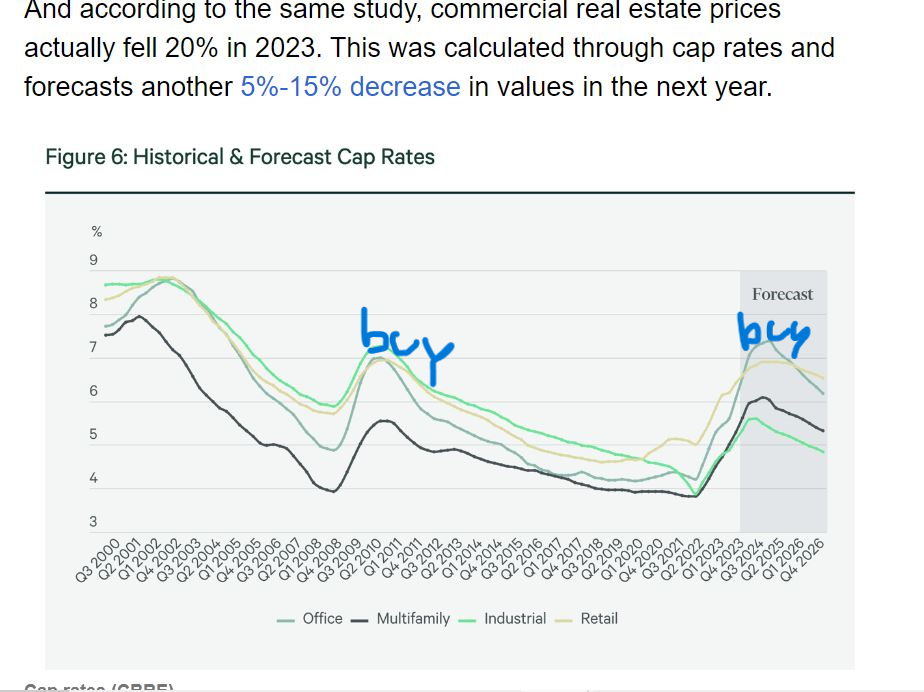
the cap doesn't really matter but the slope of the cap that matters.
when we chase CRE basically we are trading the spread between 5Y bond and cap rate.
This is same like buying stock, buying at 40 or 300 doesn't matter if we don't know the context, so in stock going up is better; with CRE what matter is the width spread between SOFR/5Y and fair cap rate.
for example is folks buy in that inverse U slope in 2013 and later 2025, your reward/risk is higher than those who purchase at 2019.
Also, CRE long cycle boom/bust cycle is every 14-15 years so this is pretty predictable. First is 1992 ; followed by 2008 and then 2022/2023.
What's very dumb in my opinion is that some CRE guru like Shumrock (read it at the real deal com) is instructing their student to buy using floating than fixed debt while rate is near zero but CPE is increasing. When M2 is being added in massive and CPE increases it would just means inflation 12 months ahed, so rather than buy fix or hedge the floating with swap, this guy is just buying with floating, hence massive foreclosure today.
the cap doesn't really matter but the slope of the cap that matters.
when we chase CRE basically we are trading the spread between 5Y bond and cap rate.
This is same like buying stock, buying at 40 or 300 doesn't matter if we don't know the context, so in stock going up is better; with CRE what matter is the width spread between SOFR/5Y and fair cap rate.
Yes that's my point. This difference should be 1-2%. However, if the 5y bond rate increases over time, then additional income will be required to compensate. Its instantaneous analysis vs projecting changes over time of holding.
One extreme case to consider is if 5yr rates go to 10% and stay there for 10 years. Will you be able to hold. If yes, that's great, that's what one wants.
the cap doesn't really matter but the slope of the cap that matters.
when we chase CRE basically we are trading the spread between 5Y bond and cap rate.
This is same like buying stock, buying at 40 or 300 doesn't matter if we don't know the context, so in stock going up is better; with CRE what matter is the width spread between SOFR/5Y and fair cap rate.
Yes that's my point. This difference should be 1-2%. However, if the 5y bond rate increases over time, then additional income will be required to compensate. Its instantaneous analysis vs projecting changes over time of holding.
One extreme case to consider is if 5yr rates go to 10% and stay there for 10 years. Will you be able to hold. If yes, that's great, that's what one wants.
yea....
additional income doesn't really matter, napkin calculator: value add apartment biz can only add value maximum 0.50 bps so only add from 4 to 3.5 cap........ I laugh at these point to my GP teacher telling them man my duplex in alabama could perform way better than your 1k multifamily unit lol
so basically from the info of Chris/Henry above : different model doesn't really matter, if market cap move by 100 bps they are all dead LOL because only refi is possible, this is my just buy duplex is wayyyyyyyyyyyyyyyyyy better than investing at CRE as LP.
rates going to 3.5 in April 2025, but most loan would be matured in 2024.
Now question: if you are bridge note holder, do you want to foreclosure or extend ? i would say foreclosure would be better for note holder as they can purchase asset for cheap LOL, 2024 would be fun.