How are you actually timing rent increases in value-add deals?

How are you actually timing rent increases in value-add deals?

Investor · Lansing, MI · Member since 2021 · 55 posts · 22 votes

Something I’ve been thinking about while underwriting deals:

A lot of proformas assume rents jump to stabilized levels pretty quickly, but in reality you’re renovating units over time.

So rent growth is really driven by:

- How fast you can turn units

- How many you can handle at once

For initial underwriting, I’ve been testing a simple ramp from current to post-renovation rents over a stabilization period instead of assuming instant bumps.

For example, if you have 100 units and a 4-year stabilization, you’re effectively assuming ~25% of units are renovated each year, and GPR ramps based on the blended mix of renovated vs unrenovated units over time. The longer the stabilization period, the slower the ramp up is and vice versa. 

It’s a small tweak, but it noticeably changed returns on a deal I looked at.

Curious how others handle this:

- Are you modeling unit turns or just using a ramp up?

- How many units/month do you underwrite?

- Equity or debt for renovations?

0Reply
124 views

Most Popular Reply

G. Brian DavisPro Member
Investor · Hatboro, PA · Member since 2016 · 3k+ posts · 866 votes
5mo

We’ve seen a lot of deals miss because they assume smooth, fast turns that don’t match actual execution. Modeling the ramp based on unit turns and capacity usually brings returns down to something more honest.

What matters most is matching the pace to the operator’s track record and the property’s constraints. Stress test, stress test, stress test!!!

See this reply in the discussion

9 Replies

Jump to latestLatest
  • Real Estate Coach · Salt Lake City, UT · Member since 2017 · 273 posts · 414 votes
    5mo

    We try to get the renovations done in an 18-month period no matter how big the property... In fact, we have one more unit left on a property we purchased last March. 

    Usually, all of your tenants are on 12-month leases and you do the renovations when their leases end. Generally, we wait for a few people to choose to leave, then renovate their units, offer the newly renovated units to the remaining good existing tenants, and keep going.

    As far as modeling... We plan on no renovations the first two months, then 1 month vacancy on each unit. If we have a rent roll, we can kinda predict how many units we'll renovate each month based on lease dates... normally higher numbers in the summer and lower in the winter months (especially if you're in colder climates). If you're good at spreadsheeting, you can model that out.

    If you're not good at spreadsheeting, just plan on realizing about 1/3 of your income in the year you renovate and 100% after that. So if you plan on renovating 12 units in the first year, plan on the full higher rents on 4. That accounts for the fact that some will be renovated early in the year and some late. In the second year, all 12 will have the higher rents. 

    Of course, while you're doing the actual renovations, the unit will be vacant, so you have to increase your vacancy rate. Again, if you're renovating 12 units, plan on an extra 12 months of vacancy (or 1 unit the entire year).

    • Investor · Lansing, MI · Member since 2021 · 55 posts · 22 votes
      5mo
      Quote from @Brian Briscoe:

      We try to get the renovations done in an 18-month period no matter how big the property... In fact, we have one more unit left on a property we purchased last March. 

      Usually, all of your tenants are on 12-month leases and you do the renovations when their leases end. Generally, we wait for a few people to choose to leave, then renovate their units, offer the newly renovated units to the remaining good existing tenants, and keep going.

      As far as modeling... We plan on no renovations the first two months, then 1 month vacancy on each unit. If we have a rent roll, we can kinda predict how many units we'll renovate each month based on lease dates... normally higher numbers in the summer and lower in the winter months (especially if you're in colder climates). If you're good at spreadsheeting, you can model that out.

      If you're not good at spreadsheeting, just plan on realizing about 1/3 of your income in the year you renovate and 100% after that. So if you plan on renovating 12 units in the first year, plan on the full higher rents on 4. That accounts for the fact that some will be renovated early in the year and some late. In the second year, all 12 will have the higher rents. 

      Of course, while you're doing the actual renovations, the unit will be vacant, so you have to increase your vacancy rate. Again, if you're renovating 12 units, plan on an extra 12 months of vacancy (or 1 unit the entire year).


      That’s super helpful, Brian. I appreciate you laying that out.

      I like the way you’re tying it directly to lease expirations and factoring in the 1 month downtime. That’s probably the most realistic way to do it.

      The 1/3 income assumption in the renovation year is interesting too. That’s pretty much what I’m trying to approximate with the ramp approach, just in a more simplified way for initial underwriting before getting into lease-by-lease detail.

      On my end I’ve been using a higher vacancy assumption in Year 1 and then dropping to stabilized vacancy after that, applied to the ramped GPR. So more of a blended approach rather than modeling downtime per unit.

      I’m actually planning to implement a more detailed ramp up method like you described to better tie it to lease expirations and unit turns

    • Real Estate Coach · Salt Lake City, UT · Member since 2017 · 273 posts · 414 votes
      5mo
      Quote from @Gabe Goudreau:
      Quote from @Brian Briscoe:

      We try to get the renovations done in an 18-month period no matter how big the property... In fact, we have one more unit left on a property we purchased last March. 

      Usually, all of your tenants are on 12-month leases and you do the renovations when their leases end. Generally, we wait for a few people to choose to leave, then renovate their units, offer the newly renovated units to the remaining good existing tenants, and keep going.

      As far as modeling... We plan on no renovations the first two months, then 1 month vacancy on each unit. If we have a rent roll, we can kinda predict how many units we'll renovate each month based on lease dates... normally higher numbers in the summer and lower in the winter months (especially if you're in colder climates). If you're good at spreadsheeting, you can model that out.

      If you're not good at spreadsheeting, just plan on realizing about 1/3 of your income in the year you renovate and 100% after that. So if you plan on renovating 12 units in the first year, plan on the full higher rents on 4. That accounts for the fact that some will be renovated early in the year and some late. In the second year, all 12 will have the higher rents. 

      Of course, while you're doing the actual renovations, the unit will be vacant, so you have to increase your vacancy rate. Again, if you're renovating 12 units, plan on an extra 12 months of vacancy (or 1 unit the entire year).


      That’s super helpful, Brian. I appreciate you laying that out.

      I like the way you’re tying it directly to lease expirations and factoring in the 1 month downtime. That’s probably the most realistic way to do it.

      The 1/3 income assumption in the renovation year is interesting too. That’s pretty much what I’m trying to approximate with the ramp approach, just in a more simplified way for initial underwriting before getting into lease-by-lease detail.

      On my end I’ve been using a higher vacancy assumption in Year 1 and then dropping to stabilized vacancy after that, applied to the ramped GPR. So more of a blended approach rather than modeling downtime per unit.

      I’m actually planning to implement a more detailed ramp up method like you described to better tie it to lease expirations and unit turns


       You kinda have to use the blended approach if you don't have detailed data. Even if you have a rent roll during underwriting, you never know what month you'll close and start the process.

      When blending, think in terms of geometry if that helps. If you're bad at geometry, skip to the bottom. If you assume you'll have 10 renovated units for an entire 12 months period, that's a rectangle if you graph it (10 high and 12 long). Area of a rectangle (or rental income) is 10 x 12.

      If you ramp it up, you have a triangle with the pointy end on the left, base of the triangle is 12, and height on the right hand side is 10. Area under the triangle (or rental income) is 1/2*b*h or 1/2 the area of the full rectangle... In general, you can count on about half of the projected rent increases from renovations in a year -- assuming you're constantly renovating.

      Of course, you never start the day you close (maybe 2 month delay with scheduling, contracts, material purchasing, mobilization, etc.), so I usually drop projected rent increases from the planned year 1 renovations to ~1/3 in initial underwriting to account for delays in the timeline. 

  • G. Brian DavisPro Member
    Investor · Hatboro, PA · Member since 2016 · 3k+ posts · 866 votes
    5mo

    We’ve seen a lot of deals miss because they assume smooth, fast turns that don’t match actual execution. Modeling the ramp based on unit turns and capacity usually brings returns down to something more honest.

    What matters most is matching the pace to the operator’s track record and the property’s constraints. Stress test, stress test, stress test!!!

    • Investor · Lansing, MI · Member since 2021 · 55 posts · 22 votes
      5mo
      Quote from @G. Brian Davis:

      We’ve seen a lot of deals miss because they assume smooth, fast turns that don’t match actual execution. Modeling the ramp based on unit turns and capacity usually brings returns down to something more honest.

      What matters most is matching the pace to the operator’s track record and the property’s constraints. Stress test, stress test, stress test!!!


       I like that mantra! Better safe than sorry. 

  • Specialist · Greeley, CO · Member since 2026 · 36 posts · 18 votes
    5mo

    Gabe — this is one of the more thoughtful underwriting questions I've seen on here. The "instant stabilization" assumption in most proformas is probably the single biggest source of overstated returns in value-add deals.

    Your blended ramp approach is solid and honestly closer to reality than what a lot of institutional shops use. The 100 units over 4 years = 25/year linear ramp is a reasonable starting point, but one thing worth pressure-testing is whether that ramp is actually linear. In practice, the first year of renovations is usually slower (you're figuring out contractors, scope, supply chain), years 2-3 are your peak throughput, and year 4 often slows down because you're left with the occupied units where you're waiting on natural turnover to get access.

    That S-curve pattern changes returns more than you'd expect because your highest renovation spend is front-loaded (mobilization, materials bulk orders) but your rent lift is back-loaded. So your actual cash-on-cash in years 1-2 can look meaningfully worse than a linear ramp assumes.

    On your specific questions:

    Unit turns vs. ramp — I think modeling individual unit turns is overkill for initial underwriting. The ramp approach is the right level of abstraction. Where it matters to get more granular is when you're comparing renovation scopes — light cosmetic ($3-5K/unit) vs. full gut ($15-25K/unit) — because the turn time per unit is completely different, which changes how many you can push through per month.

    Units/month — Depends heavily on the scope and whether units are occupied. For light cosmetic turns on vacants, 8-12/month is realistic with a decent crew. Full guts, you're probably looking at 3-5/month. The constraint is usually not labor — it's vacancy. You can only renovate what's empty, and if retention is decent, you're waiting on natural turnover for a chunk of your units.

    Equity vs. debt for renovations — Most value-add deals I've seen structure renovation budgets into the loan as a holdback or a separate capex facility that gets drawn as work is completed. The advantage is leverage on the renovation spend, but the catch is that your lender's draw schedule adds another constraint on your renovation pace. If draws take 3-4 weeks to process, that's working capital you need to float.

    What kind of asset are you looking at — workforce housing cosmetic refresh, or more of a full repositioning play?


    Side note — I've actually been building an underwriting tool that models this exact problem. Here's what a lease rollover timeline looks like when you project out renewals, vacancy periods, and rent escalations per unit:
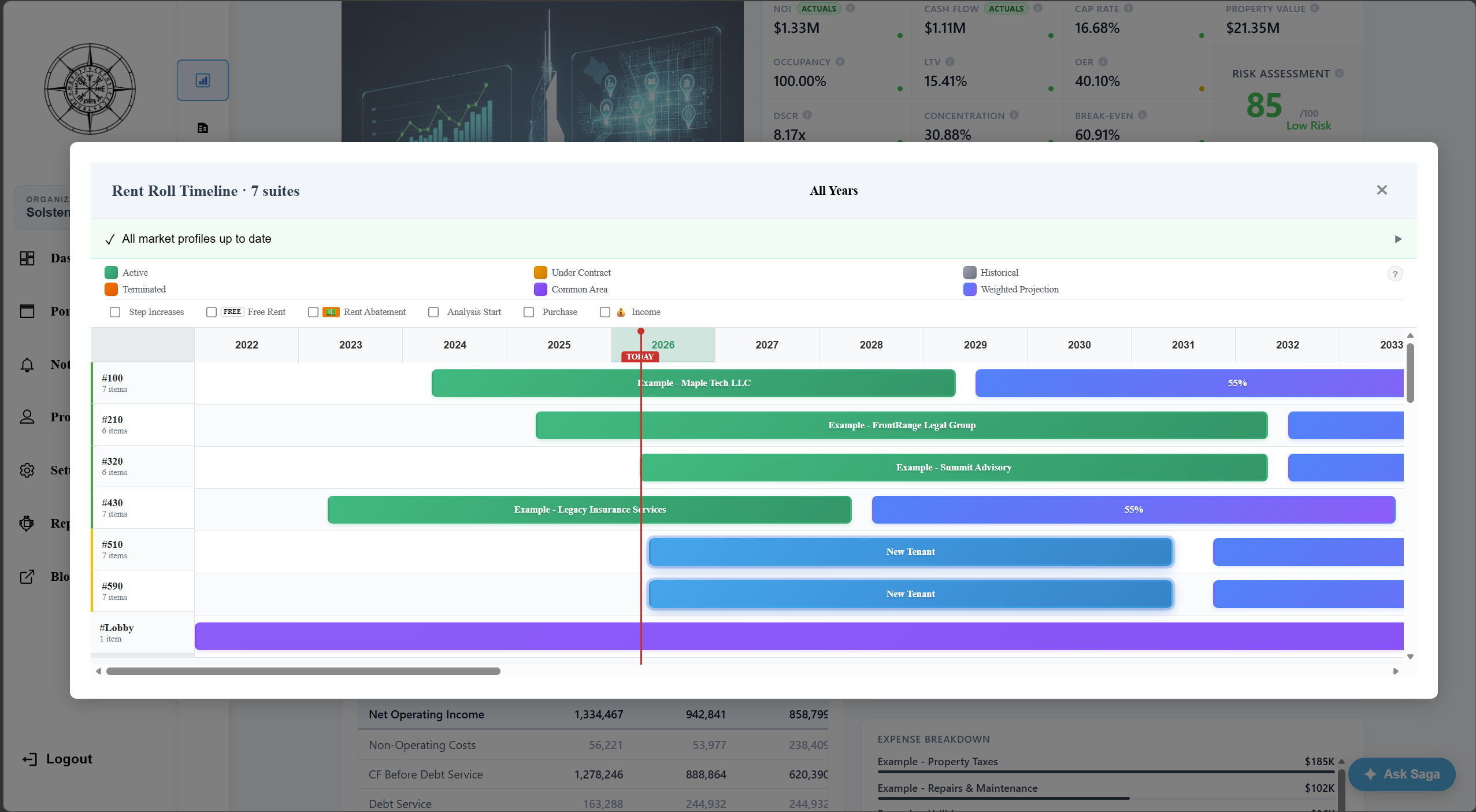


    Each bar is a lease term with step increases, the gaps are projected vacancy (sized by market vacancy assumptions), and the new leases come in at inflated market rates. It's basically the unit-level version of the ramp you're describing — but instead of assuming a linear blend, it builds up from individual lease events. Happy to walk through how the modeling works if you're interested.

    • Real Estate Coach · Salt Lake City, UT · Member since 2017 · 273 posts · 414 votes
      5mo
      Quote from @Eric Davis:

      Gabe — this is one of the more thoughtful underwriting questions I've seen on here. The "instant stabilization" assumption in most proformas is probably the single biggest source of overstated returns in value-add deals.

      Your blended ramp approach is solid and honestly closer to reality than what a lot of institutional shops use. The 100 units over 4 years = 25/year linear ramp is a reasonable starting point, but one thing worth pressure-testing is whether that ramp is actually linear. In practice, the first year of renovations is usually slower (you're figuring out contractors, scope, supply chain), years 2-3 are your peak throughput, and year 4 often slows down because you're left with the occupied units where you're waiting on natural turnover to get access.

      That S-curve pattern changes returns more than you'd expect because your highest renovation spend is front-loaded (mobilization, materials bulk orders) but your rent lift is back-loaded. So your actual cash-on-cash in years 1-2 can look meaningfully worse than a linear ramp assumes.

      On your specific questions:

      Unit turns vs. ramp — I think modeling individual unit turns is overkill for initial underwriting. The ramp approach is the right level of abstraction. Where it matters to get more granular is when you're comparing renovation scopes — light cosmetic ($3-5K/unit) vs. full gut ($15-25K/unit) — because the turn time per unit is completely different, which changes how many you can push through per month.

      Units/month — Depends heavily on the scope and whether units are occupied. For light cosmetic turns on vacants, 8-12/month is realistic with a decent crew. Full guts, you're probably looking at 3-5/month. The constraint is usually not labor — it's vacancy. You can only renovate what's empty, and if retention is decent, you're waiting on natural turnover for a chunk of your units.

      Equity vs. debt for renovations — Most value-add deals I've seen structure renovation budgets into the loan as a holdback or a separate capex facility that gets drawn as work is completed. The advantage is leverage on the renovation spend, but the catch is that your lender's draw schedule adds another constraint on your renovation pace. If draws take 3-4 weeks to process, that's working capital you need to float.

      What kind of asset are you looking at — workforce housing cosmetic refresh, or more of a full repositioning play?


      Side note — I've actually been building an underwriting tool that models this exact problem. Here's what a lease rollover timeline looks like when you project out renewals, vacancy periods, and rent escalations per unit:


      Each bar is a lease term with step increases, the gaps are projected vacancy (sized by market vacancy assumptions), and the new leases come in at inflated market rates. It's basically the unit-level version of the ramp you're describing — but instead of assuming a linear blend, it builds up from individual lease events. Happy to walk through how the modeling works if you're interested.

       @Gabe Goudreau -- I definitely agree with @Eric Davis -- S-shape is much more accurate for modeling because it is slow on the front and back end. There are lots of models that incorporate S-shape renovations (look at A-CRE for example).

      The model we use uses linear progression -- we state how many units per month and when we start, and it builds it in. We do have the ability to overwrite each individual month when we have better data to actually input.

    • Investor · Lansing, MI · Member since 2021 · 55 posts · 22 votes
      5mo
      Quote from @Eric Davis:

      Gabe — this is one of the more thoughtful underwriting questions I've seen on here. The "instant stabilization" assumption in most proformas is probably the single biggest source of overstated returns in value-add deals.

      Your blended ramp approach is solid and honestly closer to reality than what a lot of institutional shops use. The 100 units over 4 years = 25/year linear ramp is a reasonable starting point, but one thing worth pressure-testing is whether that ramp is actually linear. In practice, the first year of renovations is usually slower (you're figuring out contractors, scope, supply chain), years 2-3 are your peak throughput, and year 4 often slows down because you're left with the occupied units where you're waiting on natural turnover to get access.

      That S-curve pattern changes returns more than you'd expect because your highest renovation spend is front-loaded (mobilization, materials bulk orders) but your rent lift is back-loaded. So your actual cash-on-cash in years 1-2 can look meaningfully worse than a linear ramp assumes.

      On your specific questions:

      Unit turns vs. ramp — I think modeling individual unit turns is overkill for initial underwriting. The ramp approach is the right level of abstraction. Where it matters to get more granular is when you're comparing renovation scopes — light cosmetic ($3-5K/unit) vs. full gut ($15-25K/unit) — because the turn time per unit is completely different, which changes how many you can push through per month.

      Units/month — Depends heavily on the scope and whether units are occupied. For light cosmetic turns on vacants, 8-12/month is realistic with a decent crew. Full guts, you're probably looking at 3-5/month. The constraint is usually not labor — it's vacancy. You can only renovate what's empty, and if retention is decent, you're waiting on natural turnover for a chunk of your units.

      Equity vs. debt for renovations — Most value-add deals I've seen structure renovation budgets into the loan as a holdback or a separate capex facility that gets drawn as work is completed. The advantage is leverage on the renovation spend, but the catch is that your lender's draw schedule adds another constraint on your renovation pace. If draws take 3-4 weeks to process, that's working capital you need to float.

      What kind of asset are you looking at — workforce housing cosmetic refresh, or more of a full repositioning play?


      Side note — I've actually been building an underwriting tool that models this exact problem. Here's what a lease rollover timeline looks like when you project out renewals, vacancy periods, and rent escalations per unit:


      Each bar is a lease term with step increases, the gaps are projected vacancy (sized by market vacancy assumptions), and the new leases come in at inflated market rates. It's basically the unit-level version of the ramp you're describing — but instead of assuming a linear blend, it builds up from individual lease events. Happy to walk through how the modeling works if you're interested.


      Eric, really appreciate the thoughtful response - this is great.

      The S-curve point is a great callout. I’ve been assuming a linear ramp for simplicity, but what you’re describing makes a lot of sense operationally, especially with the slower start and back-end drag from occupied units. I can see how that would push more of the rent lift later and impact early cash flow more than a linear assumption shows.

      Also agree on vacancy being the real constraint. It’s easy to think in terms of “units per month,” but in practice you’re limited by turnover unless you’re pushing people out, which changes the whole business plan.

      On my end I’ve been keeping things more simplified for initial underwriting using a ramp plus a higher Year 1 vacancy assumption, but I’m planning to look more into incorporating this S-curve dynamic.

      Really interesting point on renovation scope too. That’s something I haven’t explicitly tied into pacing yet, but it probably should be since it directly impacts turn time and throughput.

      I’ve been looking at both strategies you mentioned, lighter cosmetic value-add and more full repositioning plays, and also some ground-up multifamily development which is more my background.

      Curious, when you’re underwriting upfront, are you explicitly shaping that S-curve in your assumptions, or is that something that comes in later once you’re deeper into the deal? Or does your tool do both?

    • Specialist · Greeley, CO · Member since 2026 · 36 posts · 18 votes
      5mo
      Quote from @Gabe Goudreau:
      Quote from @Eric Davis:

      Gabe — this is one of the more thoughtful underwriting questions I've seen on here. The "instant stabilization" assumption in most proformas is probably the single biggest source of overstated returns in value-add deals.

      Your blended ramp approach is solid and honestly closer to reality than what a lot of institutional shops use. The 100 units over 4 years = 25/year linear ramp is a reasonable starting point, but one thing worth pressure-testing is whether that ramp is actually linear. In practice, the first year of renovations is usually slower (you're figuring out contractors, scope, supply chain), years 2-3 are your peak throughput, and year 4 often slows down because you're left with the occupied units where you're waiting on natural turnover to get access.

      That S-curve pattern changes returns more than you'd expect because your highest renovation spend is front-loaded (mobilization, materials bulk orders) but your rent lift is back-loaded. So your actual cash-on-cash in years 1-2 can look meaningfully worse than a linear ramp assumes.

      On your specific questions:

      Unit turns vs. ramp — I think modeling individual unit turns is overkill for initial underwriting. The ramp approach is the right level of abstraction. Where it matters to get more granular is when you're comparing renovation scopes — light cosmetic ($3-5K/unit) vs. full gut ($15-25K/unit) — because the turn time per unit is completely different, which changes how many you can push through per month.

      Units/month — Depends heavily on the scope and whether units are occupied. For light cosmetic turns on vacants, 8-12/month is realistic with a decent crew. Full guts, you're probably looking at 3-5/month. The constraint is usually not labor — it's vacancy. You can only renovate what's empty, and if retention is decent, you're waiting on natural turnover for a chunk of your units.

      Equity vs. debt for renovations — Most value-add deals I've seen structure renovation budgets into the loan as a holdback or a separate capex facility that gets drawn as work is completed. The advantage is leverage on the renovation spend, but the catch is that your lender's draw schedule adds another constraint on your renovation pace. If draws take 3-4 weeks to process, that's working capital you need to float.

      What kind of asset are you looking at — workforce housing cosmetic refresh, or more of a full repositioning play?


      Side note — I've actually been building an underwriting tool that models this exact problem. Here's what a lease rollover timeline looks like when you project out renewals, vacancy periods, and rent escalations per unit:


      Each bar is a lease term with step increases, the gaps are projected vacancy (sized by market vacancy assumptions), and the new leases come in at inflated market rates. It's basically the unit-level version of the ramp you're describing — but instead of assuming a linear blend, it builds up from individual lease events. Happy to walk through how the modeling works if you're interested.


      Eric, really appreciate the thoughtful response - this is great.

      The S-curve point is a great callout. I’ve been assuming a linear ramp for simplicity, but what you’re describing makes a lot of sense operationally, especially with the slower start and back-end drag from occupied units. I can see how that would push more of the rent lift later and impact early cash flow more than a linear assumption shows.

      Also agree on vacancy being the real constraint. It’s easy to think in terms of “units per month,” but in practice you’re limited by turnover unless you’re pushing people out, which changes the whole business plan.

      On my end I’ve been keeping things more simplified for initial underwriting using a ramp plus a higher Year 1 vacancy assumption, but I’m planning to look more into incorporating this S-curve dynamic.

      Really interesting point on renovation scope too. That’s something I haven’t explicitly tied into pacing yet, but it probably should be since it directly impacts turn time and throughput.

      I’ve been looking at both strategies you mentioned, lighter cosmetic value-add and more full repositioning plays, and also some ground-up multifamily development which is more my background.

      Curious, when you’re underwriting upfront, are you explicitly shaping that S-curve in your assumptions, or is that something that comes in later once you’re deeper into the deal? Or does your tool do both?

      Gabe — good questions, and the fact that you're thinking about this at the initial underwriting stage puts you ahead of most.

      To answer directly: I shape the S-curve upfront in initial underwriting, not later. The reason is that if you model a linear ramp and the deal pencils at a 15% IRR, then you go back and apply a more realistic renovation pace and it drops to 11% — you just wasted weeks of due diligence on a deal that doesn't work. Better to stress-test early and kill bad deals fast.

      In practice, I don't literally draw an S-curve. I model it through lease-level events — each unit has a lease expiration, a projected vacancy period (sized by market), and then a new lease at the renovated rate. The "ramp" emerges naturally from the timing of those events rather than being an assumption you plug in. That's what the timeline in those screenshots is doing — it's building up from individual unit outcomes rather than top-down blended averages.

      The advantage is that when you change one assumption — say renovation scope goes from light cosmetic to full gut — the turn time per unit changes, which shifts the vacancy periods, which reshapes the ramp automatically. You don't have to manually re-derive the blend.

      On ground-up vs. value-add — that's a completely different absorption problem. Value-add is constrained by turnover of existing tenants. Ground-up is constrained by lease-up velocity against a market with a known pipeline. The modeling is different but the principle is the same: don't assume instant stabilization, build up from the unit-level timing.

      Your approach of a ramp plus higher Year 1 vacancy is solid for quick screening. The question is just how much deal-specific refinement you want before you go hard on due diligence. If you're looking at enough deals that the extra precision matters, happy to walk you through how I've set up the modeling — might save you some Excel time. No pressure either way.

      What market are you focused on for the ground-up side?


Join the conversationCreate a free account to reply, vote on answers and follow this thread.