From single family to multi family

From single family to multi family

Investor · Saint Joseph, MO · Member since 2016 · 69 posts · 23 votes

Hello BP friends I am looking for advice. We have 3 single family investment properties. While we have been successful in cashing in the equity (brrrr), the monthly cash flow isn’t where we want it to be. I am considering multi family- apartment complexes but the idea is somewhat intimidating.

Any opinions on whether multi family is better or worse? What is the financing process like, do you need a business plan if going through a bank? Any advice would be greatly appreciated!

0Reply
106 views

Most Popular Reply

Real Estate Syndicator · Phoenix, AZ · Member since 2018 · 903 posts · 1k+ votes
6y

@Tiffany Smith As suggested, education is great. Here are some recommendations for some great books on commercial real estate of course:  Crushing it Commercial Real Estate, Brian Murray ; Confessions of a Real Estate Entrepreneur by James Randel. Best Ever Apartment Syndication Book by Joe Fairless covers quite a bit on the Commercial Real Estate acquisition process even if targeted more towards people interested in syndication. Due Diligence Handbook for Commercial Real Estate by Brian Hennessy is also a recommendation.

However getting on in there and experiencing will always be the best. Start with a Duplex if needed, however really these seem to be just like a Single Family Home. Slightly less risk as now you have two tenants, yet very much same cashflow, renovations, bank requirements etc.

Until you get over 4 units, you will be getting residential appraisals(comps approach....), residential financing, etc. There are still benefits to having a quad over a single family however, the argument to economies of scale with 1 roof, more tenants to cover vacancies, etc comes into play the more units of course.

Also, for multifamily or commercial loans, helps to have a business plan yes. Also helps having other properties with equity as proof of net worth or collateral. Chances are you will be a signing as a personal guarantor on any commercial loan in early stages but as long as the deal makes sense and its a local bank(national banks sometimes tedious) willing to see the business plan or value-add strategy(usually best), the loan will be easy to come by. Having some cash reserves to show will also make it a smooth process. I find commercial financing is easier then residential. Working with people who understand investing always makes it easier. Hope that helps!

See this reply in the discussion

28 Replies

Jump to latestLatest
  • Cory CarlsonBusiness Member
    Real Estate Broker · OR · Member since 2018 · 311 posts · 226 votes
    6y
    Originally posted by @Tiffany Smith:

    @Cory Carlson you make some good points! I have considered selling but based on comps that I have seen I don’t think I could make much money. I should do a more thorough analysis though. On top of this I would have to pay capital gains unless I was able to sell and reinvest relatively quickly. Another thing I like about the homes we have is while they don’t cash flow as well as an apartment complex, we have long term renters paying down the debt and increasing our equity. In theory, we could have one or all of these properties pay for themselves and other investments if we continue using refis but this takes a long time. All in all if I knew I could make enough money I would sell, I just don’t think it would be worth it right now.

    It is not necessarily about "making much money" after selling. Thats only one piece of the puzzle. Its about recognizing the opportunity (if there is one) with your equity seeing higher returns elsewhere. All of this due diligence can be done prior to making any decisions. 

    Check out this analysis for a client I am working with right now. Its a lot to follow but this is just one example of selling both properties and recognizing the opportunity of the equity elsewhere. Also know my analysis below is going to be a little out of context as its tailored towards this clients needs. I also deleted some names, addresses and content to maintain my clients privacy (who has given me permission to use this example for illustrations): 

    __________________
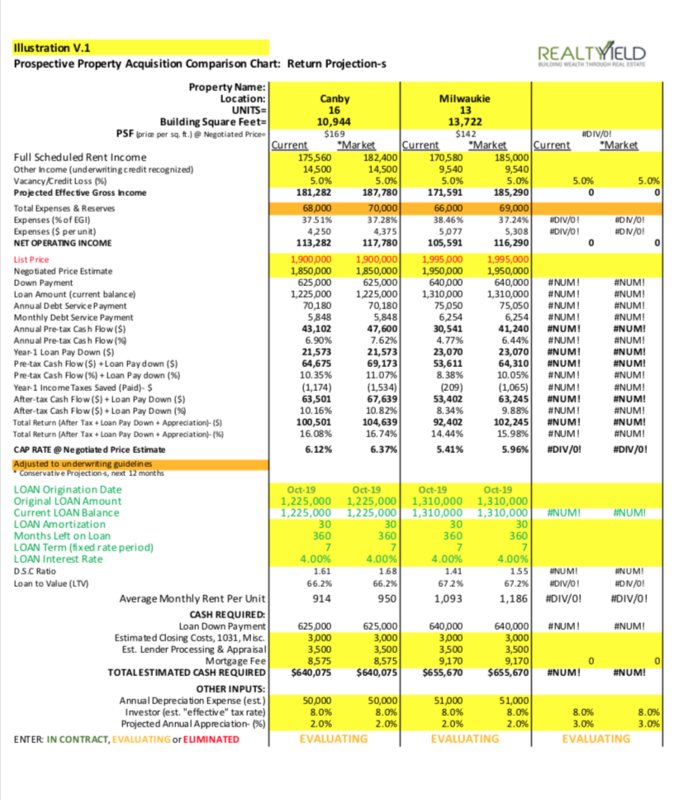
    Thanks for getting the property information to me quickly. I have attached a PROSPECTIVE PROPERTY ACQUISITION COMPARISON CHART below showing the projected returns on both your Vancouver properties as well as a cumulative column. In both cases, I’ve used CURRENT rents and adjusted/stabilized the expense load to reflect your normal provided operating expenses. I also outline moderate rent increases in the Market columns to look at projected returns after utilizing any potential upside. My additional notes and comments on each are as follows:
    Single Family Home 1

    • Current Value of $270,000 and equity position of approximately ~$219,000 as provided.
    • Full scheduled rental income of $16,800 and 5% vacancy shows an effective gross income of $15,960, which is very close to your stated actual.
    • Year 1 returns are as follows: Pre-tax Cashflow $646 (0.30%), After-tax Cashflow $726 (0.33%), After-tax Return + Pay down on principle $1,942 (0.89%), Total Return (After-tax + pay down + appreciation-2%) $7,342 (3.35%).
    • What first stuck out to me are the operating expenses seem high at 75.6% of EGI?

    Single Family Home 2

    • Current Value of $415,000 and equity position of approximately ~$272,717 as provided.
    • Full scheduled rental income of $21,000 and 6% vacancy shows an effective gross income of $19,740.
    • Year 1 returns are as follows: Pre-tax Cashflow -$3,469 (-1.27%), After-tax cashflow $3,171 (-1.16%), After-tax + principle pay down $969 (0.36%) and Total Return $9,269 (3.40%).

    You have a breakeven and a negative cash flowing investment showing a cumulative position that involves feeding your investments annually. With today’s prices of single family homes and small plex’s its common the investor has to give up cashflow for pay down or vise versa. Generally we see it is not until the investor has approximately $400,000+ of capital equity where you start to see returns that show BOTH healthy cashflow, principle pay down and a significantly improved total return. So, how much equity could you move? With a portfolio value of approximately ~$715,000 subtract fees (5% commissions + 1.5% closing/exchange costs + 1.5% excise tax) minus your loan amount provides approximately $500,000 cash available to reinvest.

    The next PROSPECTIVE PROPERTY ACQUISITION COMPARISON CHART shows apartment complexes in varying market types and the projected year 1 returns to serve as illustrations using actual opportunities available today in the market place. Depending on what markets you are interested in as well as building class could see very different projections as shown. I assumed again an investor effective tax rate of 8% and conservative annual appreciation of 2% for this analysis purpose. I also attached the offering memorandums for reference.

    Canby - 16 Unit Multifamily

    • Purchase price of $1,850,000 with moderate leverage (66.2% loan-to-value) with an estimated ~$640,075 cash required to close.
    • Current scheduled average monthly rent of ~$914/ per unit.
    • Current scheduled CAP rate of 6.12% based off my estimated projections.
    • Year 1 returns are as follows: Pre-tax cash flow $43,102 (6.90%), After-tax cash flow $41,928 (6.71%), After-tax + principle pay down $63,501 (10.16%) and Total Return (After-tax + pay down + appreciation-2%) $100,501 (16.08%).
    • This nearly 5X's your current position but may need to have operating expenses adjusted after a walk through and running this through underwriting.

    Milwaukie - 13 Unit Multifamily

    • Projected purchase price of $1,950,000 and moderate leverage with 67.2% Loan-to-value.
    • Current schedule average monthly rent of ~$1,093/ per unit with current CAP of 5.41%
    • Projected year 1 returns are as follows: Pre-tax cash flow $30,541 (4.77%), after-tax cash flow $30,322 (4.73%) after-tax cash flow + principle pay down $53,402 (8.34%), and Total Return $92,402 (14.44%).
    • I like the Milwaukie/Oregon City market, they are the next to see large development in the expanding Portland markets, similarly to Lake Oswego.

    Let me know your questions and concerns? These analysis do represent actual opportunities in the market place but again are really to serve as an illustration to show with your current equity position you could significantly improve your position. Perhaps Oregon is not your market of choice, but inventory exists and it represents how far your current capital equity could go.

    Constant Commercial Real Estate Inc543 Reviews
  • Real Estate Agent · Oklahoma City, OK · Member since 2019 · 956 posts · 600 votes
    6y

    @Arlan Potter I think a great PM could handle a 24 plex, but maybe that doesn't exist in your area? That said, I like that you're setting expectations appropriately with cash flowing less on multi. Multi is in such demand in OK that it does bring numbers down!

  • Investor · Saint Joseph, MO · Member since 2016 · 69 posts · 23 votes
    6y

    @Thomas Dunleavy yes I believe 25% is accurate based on what I have seen.  You should check out crushing it in Apartments and commercial real estate, it gave me a lot of ideas about funding deals.  If you don’t have 25% you could partner with someone or see if the seller will finance part of the down payment.  There are many ways to fund deals, you just need to be creative and think outside the box!

Join the conversationCreate a free account to reply, vote on answers and follow this thread.