Hi, total newbie here so apologies if this is answered elsewhere. Briefly, 35F, married to 33M, both ER physicians. Currently, living in Houston but planning to move back to California in 2-3 years. We are well compensated but will take a pay cut moving back, I’d guess a combined income of $500k/yr. My student loans will be paid off and his will hopefully be forgiven after 10 years of public service. I would really like to live in the South Bay but don’t want to be house poor. Wondering if it is at all advisable to buy a multi family property in a less expensive neighborhood and then hopefully purchase a “forever home” a few years later. Or should we just save the down payment, buy the forever house and invest in stock rather than trying to invest in LA real estate hoping for passive income later? Hope that makes sense and thanks for reading!
See the agents BiggerPockets members work with in Los Angeles, CA.
See agentsHi, total newbie here so apologies if this is answered elsewhere. Briefly, 35F, married to 33M, both ER physicians. Currently, living in Houston but planning to move back to California in 2-3 years. We are well compensated but will take a pay cut moving back, I’d guess a combined income of $500k/yr. My student loans will be paid off and his will hopefully be forgiven after 10 years of public service. I would really like to live in the South Bay but don’t want to be house poor. Wondering if it is at all advisable to buy a multi family property in a less expensive neighborhood and then hopefully purchase a “forever home” a few years later. Or should we just save the down payment, buy the forever house and invest in stock rather than trying to invest in LA real estate hoping for passive income later? Hope that makes sense and thanks for reading!
Veronica,
LA investor and house-hacker here.
Are you talking about buying and living in the multifamily? That's what I'm doing: house-hacking a duplex for a couple of years before moving into the forever home. I'm in a similar situation, similar joint income, similar aspiration for a forever home that would basically bankrupt us!
If your timeline is at least 2-3 years before buying the forever home, I think it's a great idea. In that time, market rents will grow faster than expenses, so your property is likely to cashflow when yo move out. You can then keep the property and open a HELOC for additional down-payment funds on the forever home, or sell the property when you move. Because of rent control, multifamily properties with vacant units sell for more here. You'll get top dollar for a duplex with one unit as near-market rent and the other unit vacant.
Plus, the cost of living in LA is so high, that if you rent or buy a starter home, your housing cost will be in the thousands. You'll save money in the meantime by house-hacking a duplex, triplex, or fourplex.
Good luck!
Best,
Jon
Hi, total newbie here so apologies if this is answered elsewhere. Briefly, 35F, married to 33M, both ER physicians. Currently, living in Houston but planning to move back to California in 2-3 years. We are well compensated but will take a pay cut moving back, I’d guess a combined income of $500k/yr. My student loans will be paid off and his will hopefully be forgiven after 10 years of public service. I would really like to live in the South Bay but don’t want to be house poor. Wondering if it is at all advisable to buy a multi family property in a less expensive neighborhood and then hopefully purchase a “forever home” a few years later. Or should we just save the down payment, buy the forever house and invest in stock rather than trying to invest in LA real estate hoping for passive income later? Hope that makes sense and thanks for reading!
Veronica,
LA investor and house-hacker here.
Are you talking about buying and living in the multifamily? That's what I'm doing: house-hacking a duplex for a couple of years before moving into the forever home. I'm in a similar situation, similar joint income, similar aspiration for a forever home that would basically bankrupt us!
If your timeline is at least 2-3 years before buying the forever home, I think it's a great idea. In that time, market rents will grow faster than expenses, so your property is likely to cashflow when yo move out. You can then keep the property and open a HELOC for additional down-payment funds on the forever home, or sell the property when you move. Because of rent control, multifamily properties with vacant units sell for more here. You'll get top dollar for a duplex with one unit as near-market rent and the other unit vacant.
Plus, the cost of living in LA is so high, that if you rent or buy a starter home, your housing cost will be in the thousands. You'll save money in the meantime by house-hacking a duplex, triplex, or fourplex.
Good luck!
Best,
Jon
@Veronica Solorio I like to look at the data. Now, I don't invest in California however, there is a trend at present according to data where people are moving out of urban city into the surrounding suburban or distant cities. Mainly this has to do with a shift to remote working options, Covid and the need for more sq footage in the home.
You can always look at the data from such sources as uhual or hireahelper. I can send the links if necessary, but most likely will be taken down here. In any case, Los Angeles has seen a 70% increase in people moving out of the city since the pandemic started according to HireaHelper data.
I only mention this because, as people move away, and purchase housing in nearby cities, prices will fall. Why? Two reasons mainly.
Reason 1 : Many will sell their inner city homes to buy the new home. This will cause an increase in supply and typically cause a decrease in prices.
Reason 2 : Many will be unable to pay two mortgages as rates change, forbearance terms end or a recessionary period occurs. This will cause an increase in supply and a decrease in prices.
Now, a lot of assumptions here and nobody has a crystal ball on timing. However, my point is, in the next year, I expect many big Urban Cities will have opportunity for buying real estate due to the above. Los Angeles is just one of them. Others on the list are San Francisco, New York, Sacramento and more.
So I would say if you can buy the forever home in a year or two, you will be in a good spot. Buy an investment now if the investment makes sense by the numbers or logically, then buy your forever home later when prices fall.
Happy to share the data with anyone as well, just send me a message.
Thanks Jon and Chris! Yes we planned on living in one of the units of a duplex and then moving on to the forever house later. I’d love to buy a duplex or something in the South Bay but prices seem insane. We’d basically be doing this hoping for passive income later when doctoring has gotten too exhausting. From very basic research it seems like rental units are more successful in a better neighborhood but those are super expensive. We’d prefer Redondo Beach but not sure that would leave us with enough for a second down payment. Any recommendations on middle of the road neighborhoods that will still rent well? I was thinking Harbor City, San Pedro, Lomita or maybe Torrance? Thanks so much!
Hi Veronica, I agree with Jon on all his points. I live in Redondo but have a fourplex in Long Beach where numbers are more favorable to investors (as are rent control laws). I would say you can find a more attractive investment in San Pedro, Lomita and Long Beach especially if your willing to buy a distressed property. Torrance and Redondo are nearly impossible to make lucrative. I think Jon’s idea of house hacking and later moving into your forever home is a great strategy. Good luck!
I work in the health care field as well and was looking into a similar strategy. I was living in Torrance and wanted to house hack. I agree with Tammy that the numbers are much more favorable in Long Beach than the other beach cities. I ended up buying a rental property and renting. The numbers worked out better for me with this strategy. Mostly because the only properties that I could afford, I didn't feel comfortable with my fiance living there.
@Veronica Solorio I like to look at the data. Now, I don't invest in California however, there is a trend at present according to data where people are moving out of urban city into the surrounding suburban or distant cities. Mainly this has to do with a shift to remote working options, Covid and the need for more sq footage in the home.
You can always look at the data from such sources as uhual or hireahelper. I can send the links if necessary, but most likely will be taken down here. In any case, Los Angeles has seen a 70% increase in people moving out of the city since the pandemic started according to HireaHelper data.
I only mention this because, as people move away, and purchase housing in nearby cities, prices will fall. Why? Two reasons mainly.
Reason 1 : Many will sell their inner city homes to buy the new home. This will cause an increase in supply and typically cause a decrease in prices.
Reason 2 : Many will be unable to pay two mortgages as rates change, forbearance terms end or a recessionary period occurs. This will cause an increase in supply and a decrease in prices.
Now, a lot of assumptions here and nobody has a crystal ball on timing. However, my point is, in the next year, I expect many big Urban Cities will have opportunity for buying real estate due to the above. Los Angeles is just one of them. Others on the list are San Francisco, New York, Sacramento and more.
So I would say if you can buy the forever home in a year or two, you will be in a good spot. Buy an investment now if the investment makes sense by the numbers or logically, then buy your forever home later when prices fall.
Happy to share the data with anyone as well, just send me a message.
Chris,
I'd love to see that data! Please share links!
I do invest in California, and I feel like the data that most out-of-staters reference isn't viewed in the context of California's incredibly large population.
For example, Californians make up 11.9% of the US population. In contrast, Arizonians make up 2.2% of the US population. So even if there was no population change whatsoever amongst the states, you'd expect about 5.5x more one-way trips out of CA than AZ, and you'd expect U-Haul to price them about 5.5x more expensively.
Additionally, a 70% uptick in move-outs from Los Angeles might not mean much. Los Angeles is surrounded by other (relatively large) cities, and the population of LA County is just over 10,000,000. LA County has 38% more people than the entire state of Arizona. Everybody I know who's moving out of LA isn't going far; they're moving to Pasadena mostly, as well as Malibu, Glendale, the beach cities -- a myriad of places that aren't LA proper and aren't as crowded, but are literally just over the municipal border. As you can imagine, all of this resettling in other parts of the county is creating a ton of property tax revenue.
Fun bonus fact: most people moving from there home in CA are moving to a new home in CA! The minority of CA movers move to another state.
All the best,
Jon
Thanks Jon and Chris! Yes we planned on living in one of the units of a duplex and then moving on to the forever house later. I’d love to buy a duplex or something in the South Bay but prices seem insane. We’d basically be doing this hoping for passive income later when doctoring has gotten too exhausting. From very basic research it seems like rental units are more successful in a better neighborhood but those are super expensive. We’d prefer Redondo Beach but not sure that would leave us with enough for a second down payment. Any recommendations on middle of the road neighborhoods that will still rent well? I was thinking Harbor City, San Pedro, Lomita or maybe Torrance? Thanks so much!
Veronica,
I'd investigate Torrance listings first; Torrance has a nice old downtown that's adorable.
Harbor City isn't much to look at, though there is a Whole Foods there now!
Multifamilies in San Pedro might be a touch dicey, but it's an excellent long-term investment. Everybody is waiting for San Pedro to get expensive. It's the last piece of California coast left.
Overall, though, all of the neighborhoods you mention are just fine for rentals, are "middle of the road" at worst! If you head north and get near the 105, or head inland and get near the 110 -- that's where you'll find neighborhoods in such ill shape that you're exposing yourself to a potentially difficult tenant base.
Good luck!
Jon
There are still great multifamily deals to be had in Sacramento. Primarily due to long time landlords not increasing rents to market rate. You have to turn over a property but it is possible to get proforma numbers that approach the 1% rule in desirable areas.
@Veronica Solorio
Why would you buy an investment in Ca if your main goal is passive income? From your initial post after the pay cut you are making over $500,000. If you budgeted yourself and saved money you can buy apartment complexes out of CA making the passive income you want. It also won't count against you when go to buy your "forever home" because you should buy the apartment complex through an LLC. If you buy residential (under 4 units) that will lower your buying power for your forever home. Also the policies and numbers are not favorable in Ca. In CA you are basically losing money monthly waiting for the rents and appreciation of the property. That is stupid. If you can't cash flow you are going to put yourself in a bad position.
@Veronica Solorio
Why would you buy an investment in Ca if your main goal is passive income? From your initial post after the pay cut you are making over $500,000. If you budgeted yourself and saved money you can buy apartment complexes out of CA making the passive income you want. It also won't count against you when go to buy your "forever home" because you should buy the apartment complex through an LLC. If you buy residential (under 4 units) that will lower your buying power for your forever home. Also the policies and numbers are not favorable in Ca. In CA you are basically losing money monthly waiting for the rents and appreciation of the property. That is stupid. If you can't cash flow you are going to put yourself in a bad position.
Nick,
I have to disagree with you on a couple of points!
Firstly, Veronica never said her main goal is passive cashflow. But even if it is, she clearly doesn't need it now while she and her husband are earning $500K/year as doctors. So the better strategy for her is to first focus on building equity in CA investments.
Thanks to CA's high appreciation rates and outsized gains from forced equity, a person in Veronica's position will benefit more from investing in CA for the foreseeable future, building a sizable portfolio, then trading her CA portfolio for cashflowing assets in other states when its time to retire from medicine.
In other words, instead of investing $1M in St. Louis and seeing a 10% cash-on-cash return, she could invest $1M in LA County and see no cash-on-cash return while than $1M grows to $4M. At that point, she can 1031 into $4M of apartment buildings in St. Louis and cashflow like mad.
Policies and numbers are tougher in CA, but I find cashflowing properties in LA County. What's more, I find house hack opportunities that lower one's cost of living while they live in the house hack, then cashflow when they move out. Because of the timeline, house hacks are more forgiving in the numbers.
And don't forget that if Veronica bought an apartment complex in a cheaper Midwest market, she'd have to put down at least 25% and would need to secure a commercial loan. This would require refinancing every 5-10 years. With an LA house hack, she can put a considerable amount of money into a residential property, put down less than 20%, and secure a super low owner-occupant interest rate. No refinancing required ever.
A residential mortgage will lower one's buying power, but after seasoning, the income from the property will offset the mortgage costs -- not completely, but significantly.
@Jon Schwartz
Jon,
Your right rereading the original post she said should they just save and buy their "forever home" and then invest in the stock market instead of hoping for the LA real estate to have passive income. When you're saying that the $1m property in La county appreciates to $4m how long are you anticipating on that taking? Since 2000 all of La county has gone up about 5.88% (https://www.neighborhoodscout....) I believe that would take about 24-25 years to do that. Chances are she would have to put down a good size down payment to break even on a million dollar duplex.
Current listing 3192 Pine Ave #2, Long Beach, CA 90807 $950,000. Rent for one side, est. using BP Insights for a 3/2, $2,400 so thats $4,800 total when both sides are being rented. If we say 20% should be for maintenance and CapEx, which is probably on the low side, that means she needs the mortgage at $3,840 to break even. To get that, Veronica would need to put down about 44.5% which is $422,750. Obviously this is not house hacking, rents will rise so if they live there for a couple of years they could put down less and wait until rents go up before moving on to their "forever home". Rents will go up but how fast they will go up is an assumption. Considering the past 3 elections they have fought for rent control, and trying to break down prop 13, we will see how that plays out.
Actual example is a 8-unit I purchased in PHX, AZ, which is still an appreciating market, I bought for about the same down payment. The big difference for me is I don't have to live in the property, I have a property manager, and I make cash every month. So, right now I make 5.6% CoCr--based on the last few months it looks like I may start getting closer to 7%. Over the last year, I have had 8 brokers try to get me to sell for $250-300k over what I bought it for in Sept of 2019. Obviously low inventory and low interest rates are a big factor in this. The major advantage to units is the scaling factor. An example of that is the rent increase in PHX has been very similar to LA because of the influx of people and business, according to Marcus & Millichap 2020 report. If rents go up $50/mo in this Long Beach duplex that is an extra $100/mo, but for the 8-unit thats $400/mo. So over a 25yr period that $300/mo difference is significant, especially when you factor in that commercial property is based off of the income it produces.
In terms of buying power, being a real estate agent and from your response, you are aware that your buying power will go down. However, if she does put the 44.5% down from the earlier example the mortgage is $3,840/mo. To make the duplex, at this mortgage, not negatively effect her buying power at all the total rental income needs to be $12,190/mo.
$12,190 (rent from both units)
$ 9,142 (Can count 75% towards your income)
x 42% (max DTI is 42%)
$3,840 Mortgage
It will take awhile to raise the rents to that value. Of course they not wait that long to buy their forever home. If you speculate refinancing and doing 1031 exchanges that makes the analysis more complicated. The more what if's you throw into analysis makes it more complicated and unclear.
For my way of thinking you should be investing in cash flowing assets and buying the most units possible. Just because you want to live in CA does not mean you have to invest there. There are plenty of markets that are seeing positive migration and business moving there that have pro-landlord laws. Examples being AZ, TX, FL. It is highly unlikely that she will see the rent increase she needs in "a few years" time frame to have that duplex making positive cash flow.
@Jon Schwartz
Jon,
Your right rereading the original post she said should they just save and buy their "forever home" and then invest in the stock market instead of hoping for the LA real estate to have passive income. When you're saying that the $1m property in La county appreciates to $4m how long are you anticipating on that taking? Since 2000 all of La county has gone up about 5.88% (https://www.neighborhoodscout....) I believe that would take about 24-25 years to do that. Chances are she would have to put down a good size down payment to break even on a million dollar duplex.
Current listing 3192 Pine Ave #2, Long Beach, CA 90807 $950,000. Rent for one side, est. using BP Insights for a 3/2, $2,400 so thats $4,800 total when both sides are being rented. If we say 20% should be for maintenance and CapEx, which is probably on the low side, that means she needs the mortgage at $3,840 to break even. To get that, Veronica would need to put down about 44.5% which is $422,750. Obviously this is not house hacking, rents will rise so if they live there for a couple of years they could put down less and wait until rents go up before moving on to their "forever home". Rents will go up but how fast they will go up is an assumption. Considering the past 3 elections they have fought for rent control, and trying to break down prop 13, we will see how that plays out.
Actual example is a 8-unit I purchased in PHX, AZ, which is still an appreciating market, I bought for about the same down payment. The big difference for me is I don't have to live in the property, I have a property manager, and I make cash every month. So, right now I make 5.6% CoCr--based on the last few months it looks like I may start getting closer to 7%. Over the last year, I have had 8 brokers try to get me to sell for $250-300k over what I bought it for in Sept of 2019. Obviously low inventory and low interest rates are a big factor in this. The major advantage to units is the scaling factor. An example of that is the rent increase in PHX has been very similar to LA because of the influx of people and business, according to Marcus & Millichap 2020 report. If rents go up $50/mo in this Long Beach duplex that is an extra $100/mo, but for the 8-unit thats $400/mo. So over a 25yr period that $300/mo difference is significant, especially when you factor in that commercial property is based off of the income it produces.
In terms of buying power, being a real estate agent and from your response, you are aware that your buying power will go down. However, if she does put the 44.5% down from the earlier example the mortgage is $3,840/mo. To make the duplex, at this mortgage, not negatively effect her buying power at all the total rental income needs to be $12,190/mo.
$12,190 (rent from both units)
$ 9,142 (Can count 75% towards your income)
x 42% (max DTI is 42%)
$3,840 Mortgage
It will take awhile to raise the rents to that value. Of course they not wait that long to buy their forever home. If you speculate refinancing and doing 1031 exchanges that makes the analysis more complicated. The more what if's you throw into analysis makes it more complicated and unclear.
For my way of thinking you should be investing in cash flowing assets and buying the most units possible. Just because you want to live in CA does not mean you have to invest there. There are plenty of markets that are seeing positive migration and business moving there that have pro-landlord laws. Examples being AZ, TX, FL. It is highly unlikely that she will see the rent increase she needs in "a few years" time frame to have that duplex making positive cash flow.
Chris,
Thanks for the feedback! It sounds like your Phoenix investment is going well -- congrats!
A couple answers to your inquiries:
In talking about $1M growing to $4M, I do mean that one must be more active than buying a single property and waiting for natural appreciation. You're right that this entails risk and complication. My point is merely: if you have the luxury of a high-paying job in the meantime, you're better off by pursuing a strategy that prioritizes equity growth over cashflow. You're better off starting with a $1M LA duplex and pursuing a $4M LA portfolio that's cashflow neutral than starting with a $1M out-of-state cashflowing property. The former serves you better in the long run.
Thanks for the Long Beach example! It's not bad, though I wish I could say the same for your underwriting! I built a spreadsheet that allows for a quick and in-depth house hack analysis. For the Long Beach example, it looks like this:
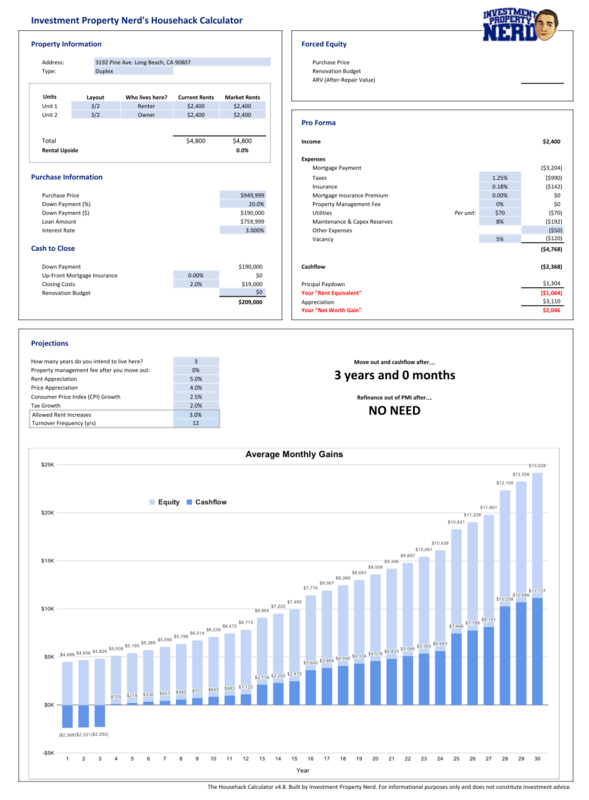
My analysis assumes a 20% down payment at 3% interest. I'm also assuming 5% annual rent increases and 4% annual appreciation, both well below the longterm averages in LA.
While living in one of the units, net monthly cost after income and expenses is $2368. Of that, $1304 is recouped through principal paydown. So house hacking this property would be like finding a 3/2 apartment in Long Beach for $1064/month. Lemme tell you something: you will not find a 3/2 apartment in Long Beach for $1064/month! These 3/2 apartments in Long Beach costs $2400/month.
Down payment plus closing costs on this property would be $209K. If Veronica bought this property instead of renting a 3/2 in Long Beach, she'd save $16,032 in house costs annually. That's a 7.6% return on the money she ties up before factoring in appreciation. It's savings instead of cashflow, but as mentioned above, if you have the luxury of a high-paying job, savings and cashflow are equivalent (except that savings isn't taxed).
This property wouldn't cashflow on day one, but by my projection, it will cashflow after three years. This appears to work with Veronica's timeline. The property won't cashflow much in year one, just $105/month, but with all of the development happening in Long Beach, I'd very happily own a cashflow-neutral property there and watch it gain in value over the next decade.
Plus, this listing has my FAVORITE feature in a Socal building: a garage built under living space!
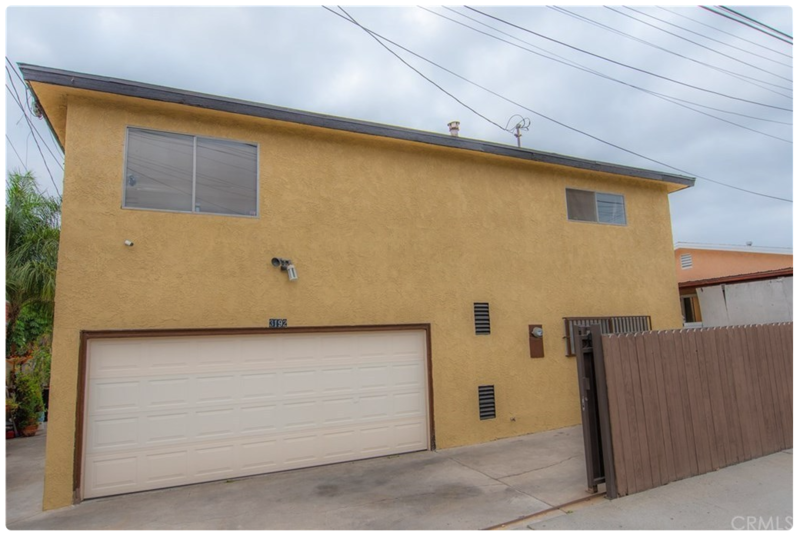
This is the least expensive kind of ADU conversion because the foundation and walls are already to code. Creating a studio apart in that garage will cost less than $100K and produce another $1400 in gross rents. That's easily a 10% cash-on-cash and more if it's financed.
So lots of upside on this listing! It's a solid house hack opportunity!
And you're mistaken on a few points:
Estimating 20% for capex and maintenance on LA apartments is definitely overdoing it because rents here are so high. Rents are easily 3x what you find in Phoenix, but it doesn't cost 3x in LA to install new carpeting or fix a drain. I estimate 8%, and in my own experience with my Hollywood duplex, I'm averaging less than that.
Yes, rent control measures have been on the ballot, but they've been consistently defeated, including the split-roll prop affecting Prop 13.
I'm sorry you've been brainwashed by the "scalability" argument. It's bunk. Lemme explain:
Doors are irrelevant. Revenue and operating income are what matters. If Phoenix and LA are seeing equivalent rent increases, it doesn't mean that each door is seeing the same dollar-amount rent increase; it means that each unit is seeing an equivalent percentage increase. So if you have a duplex in LA generating $5000/month in revenue and an eight-unit in Phoenix generating $5000/month in revenue, the two buildings will see the same revenue increase regardless of doors. The advantage of the LA duplex is that you have 2 water heaters instead of 8, fewer kitchens, fewer bathrooms, less roofing, etc. (This is another reason why maintenance and capex is cheaper in LA!)
FYI, another bunk "scalability" argument is that you have less vacancy when you have more units because, for example, if you're renting out an SFR, it could be 100% vacant. That's just not true. In a good LA neighborhood, if you suffer vacancy on an SFR, it's unlikely to last more than one month. That's an 8.3% vacancy rate for the year. If you have an eight-unit in Phoenix with seven units always occupied, that's a 12.5% vacancy rate for the year. (Obviously, the caveat is that if you're the LA landlord, you need reserves to cover a potentially longer vacancy period.)
Last point: after two years (and sometimes one with some lenders), you're considered a "seasoned" landlord, and 100% of rental income counts as income. It's just a regular income stream at that point.
Anyway, I'm glad you're finding success in Phoenix! Like with everything, different strokes for different folks in real estate investing. Veronica seems interested in house hacking in South Bay, and I don't want her to be overly influenced by out-of-state thinking. Socal really is a market unto itself, and a lot of the common knowledge (like the blind belief that more units is always better) just doesn't apply here.
Best,
Jon
@Jon Schwartz
Thanks for the response. When I was explaining that huge down payment I was referring to the point when you said it would not effect the buying power significantly. When I -20% that was for all expenses not just maintenance and CapEx. When I usually underwrite a commercial property I am overly conservative but I find most buildings run around 35-45% expenses (which includes taxes and insurance) on actuals. Which is pretty close to what you came up with.
$4,800 Total rent from both units
- 35% for expenses ($1,680)
$3,120 left to pay mortgage
Your analysis was $1,564/mo and if you added $70/unit (if you are renting both sides) thats $1,634. Pretty darn close I may have wrote it out weird or not explained when I was trying to talk about the buying power, thats my fault. Also my calculator was set to a 4% int rate, which I agree is too high for the current lending climate.
Would you not agree though that you are including principal reduction in your analysis but not in the commercial purchase, so at min wouldn't it that be even. On the commercial loan I did not pay any loan costs and was given an interest rate lower than what I saw most people were getting on a residential loan at the time.
I may have misrepresented the M&M information. They compile effective monthly rents, asking rents minus concessions, for different metros. I am using M&M because I had their booklet by me at the time. In the LA area they saw the EMR in 2019 as $2,310 and est. 2020 as $2,380. In PHX they had it at $1,179 in 2019 and $1,280 in 2020. Using those numbers I was saying its a similar rent increase in total value. You list on your form allowed rent inc. 3% on $2,400 thats a $72/mo increase. In Phx there is no rent control and rent inc has been over 6% for the past 6 years. Using your allowable rent inc of 3%, and we will say $1,200 rent thats increase of $36/mo x 8 units = $288 compared to $144/mo if renting both units in LB. Which I believe is an advantage for the scalability argument. Also the $/unit drops when you buy multiple units.
In terms of appreciation commercial buildings value are also based off of the NOI where residential properties are based on comps in the area of similar properties. As stated in my previous response the avg. appreciation in PHX is less but still since 2000 has been just under 5%. I was also not suggesting buying in a non appreciating market.
I am not sure the other scalability argument about vacancy is valid. I do understand what you are saying but by having more doors, which are multiple streams of income, you avoid/minimize the chances of having to pay money out of your pocket for an open house/unit. Once I make an investment I want the investment to work for me and not have to pay to keep it going at anytime.
With buying a commercial property I am getting the principal reduction, CoCr, and appreciation. Good to know about the "seasoned" landlord getting to count a 100% of the rental income instead of 75%.
I agree with you that appreciation is a great way, probably the best way to build wealth. That is how I bought the 8-units by buying a duplex that I lived in and did a 1031 exchange 4-5years after. No matter what I think the key is to buy real estate and not overleverage yourself. Have money set aside to protect you from "downtimes" and you will make money in real estate.
I also have more flexibility and options considering buying that commercial property does not count against my personal DTI
Harbor City isn't much to look at, though there is a Whole Foods there now!
There's a Whole Foods in Harbor City? Seems like a weird place to open one since there is already one right where Torrance and Lomita meet (on PCH).
@Rachel S., I think that’s the one I’m talking about! So not in Harbor City, but adjacent.
Yes. It's technically South Torrance though, which is a completely different real estate animal to Harbor City. :-P
@Jon Schwartz
Thanks for the response. When I was explaining that huge down payment I was referring to the point when you said it would not effect the buying power significantly. When I -20% that was for all expenses not just maintenance and CapEx. When I usually underwrite a commercial property I am overly conservative but I find most buildings run around 35-45% expenses (which includes taxes and insurance) on actuals. Which is pretty close to what you came up with.
$4,800 Total rent from both units
- 35% for expenses ($1,680)
$3,120 left to pay mortgage
Your analysis was $1,564/mo and if you added $70/unit (if you are renting both sides) thats $1,634. Pretty darn close I may have wrote it out weird or not explained when I was trying to talk about the buying power, thats my fault. Also my calculator was set to a 4% int rate, which I agree is too high for the current lending climate.
Would you not agree though that you are including principal reduction in your analysis but not in the commercial purchase, so at min wouldn't it that be even. On the commercial loan I did not pay any loan costs and was given an interest rate lower than what I saw most people were getting on a residential loan at the time.
I may have misrepresented the M&M information. They compile effective monthly rents, asking rents minus concessions, for different metros. I am using M&M because I had their booklet by me at the time. In the LA area they saw the EMR in 2019 as $2,310 and est. 2020 as $2,380. In PHX they had it at $1,179 in 2019 and $1,280 in 2020. Using those numbers I was saying its a similar rent increase in total value. You list on your form allowed rent inc. 3% on $2,400 thats a $72/mo increase. In Phx there is no rent control and rent inc has been over 6% for the past 6 years. Using your allowable rent inc of 3%, and we will say $1,200 rent thats increase of $36/mo x 8 units = $288 compared to $144/mo if renting both units in LB. Which I believe is an advantage for the scalability argument. Also the $/unit drops when you buy multiple units.
In terms of appreciation commercial buildings value are also based off of the NOI where residential properties are based on comps in the area of similar properties. As stated in my previous response the avg. appreciation in PHX is less but still since 2000 has been just under 5%. I was also not suggesting buying in a non appreciating market.
I am not sure the other scalability argument about vacancy is valid. I do understand what you are saying but by having more doors, which are multiple streams of income, you avoid/minimize the chances of having to pay money out of your pocket for an open house/unit. Once I make an investment I want the investment to work for me and not have to pay to keep it going at anytime.
With buying a commercial property I am getting the principal reduction, CoCr, and appreciation. Good to know about the "seasoned" landlord getting to count a 100% of the rental income instead of 75%.
I agree with you that appreciation is a great way, probably the best way to build wealth. That is how I bought the 8-units by buying a duplex that I lived in and did a 1031 exchange 4-5years after. No matter what I think the key is to buy real estate and not overleverage yourself. Have money set aside to protect you from "downtimes" and you will make money in real estate.
Woah woah woah woah! Hold the mayo, Nick!
So you got your start by house hacking a duplex in CA, and you're arguing against house hacking a duplex in CA?!
I know, I know... you 1031'd into a bigger property, and you can't 1031 into a forever home.
But still!
Anyway... I appreciate all your points, totally valid.
Though I think your argument for scalability is actually an argument against rent control. And actually, that 3% cap is an error. LA City has a 3-4% annual rent increase cap, but Long Beach doesn't. I forget to change that number. Long Beach goes by CA's statewide rent control law, so the annual cap is 8.5%.
Best,
Jon
@Jon Schwartz
I never said I thought house hacking a duplex was a bad idea. I think that it is a great wealth building tool and can help you get into the game. I was responding to Victoria wanting to buy her forever home. I am making an assumption but it seemed like they are not a 100% on buying real estate in the first place. I came to this conclusion because they seem like they have not bought any real estate yet and in her original post even brings up the idea of not investing in real estate and investing in the stock market. Her main focus seems to be more about getting into a forever home in the South Bay then actually investing in real estate. My original post said that she should save these next 2-3, where they should be able to save a good amount since they make $500,000+, and buy a commercial property. The commercial property, usually once you break 16 units, is big enough to afford to pay a property manager and be more "hands off". Then they would cash flow big day one, which they can use for whatever, get the tax benefits of a bigger building, and it will not effect their personal buying power. Something else I was thinking that they are high income earners now but they are taking a pay cut and will be taxed more in CA so if they buy a bigger commercial property that will help offset some of those taxes. Also if it is their "forever home" and they buy a $3m dollar house and pay it off what happens when they retire? Without even including the 2% increase in property tax a year @ $3m purchase price you are probably looking at $37,500/yr. If they want to keep their "dream" and not lose it or have it turn into a nightmare they need to have passive income in retirement.
I agree with a lot of your points but I like having positive CF at the beginning of a deal. I do not know what will happen in the future with my life, the market etc. so having that CF allows me to hold on to the property and wait for "the power of appreciation". Which is why I chose PHX and you will notice the markets I mentioned earlier AZ, TX, FL are appreciating markets and are the top 3 states people are moving too.