Skip to content
Two investors reviewing resources on a laptop

Get industry-leading resources — for free

Unlock resources for every investing strategy and stage with a free account.

By continuing, you agree to BiggerPockets LLC's Terms of Use and Privacy Policy

Followed Discussions Followed Categories Followed People Followed Locations
General Real Estate Investing
All Forum Categories
Followed Discussions
Followed Categories
Followed People
Followed Locations
Market News & Data
General Info
Real Estate Strategies
Landlording & Rental Properties
Real Estate Professionals
Financial, Tax, & Legal
Real Estate Classifieds
Reviews & Feedback

User Stats

6,214
Posts
5,188
Votes
Brie Schmidt
  • Real Estate Broker
  • Chicago, IL
5,188
Votes |
6,214
Posts

Support the FAIR Ordinance - Chicago

Brie Schmidt
  • Real Estate Broker
  • Chicago, IL
ModeratorPosted

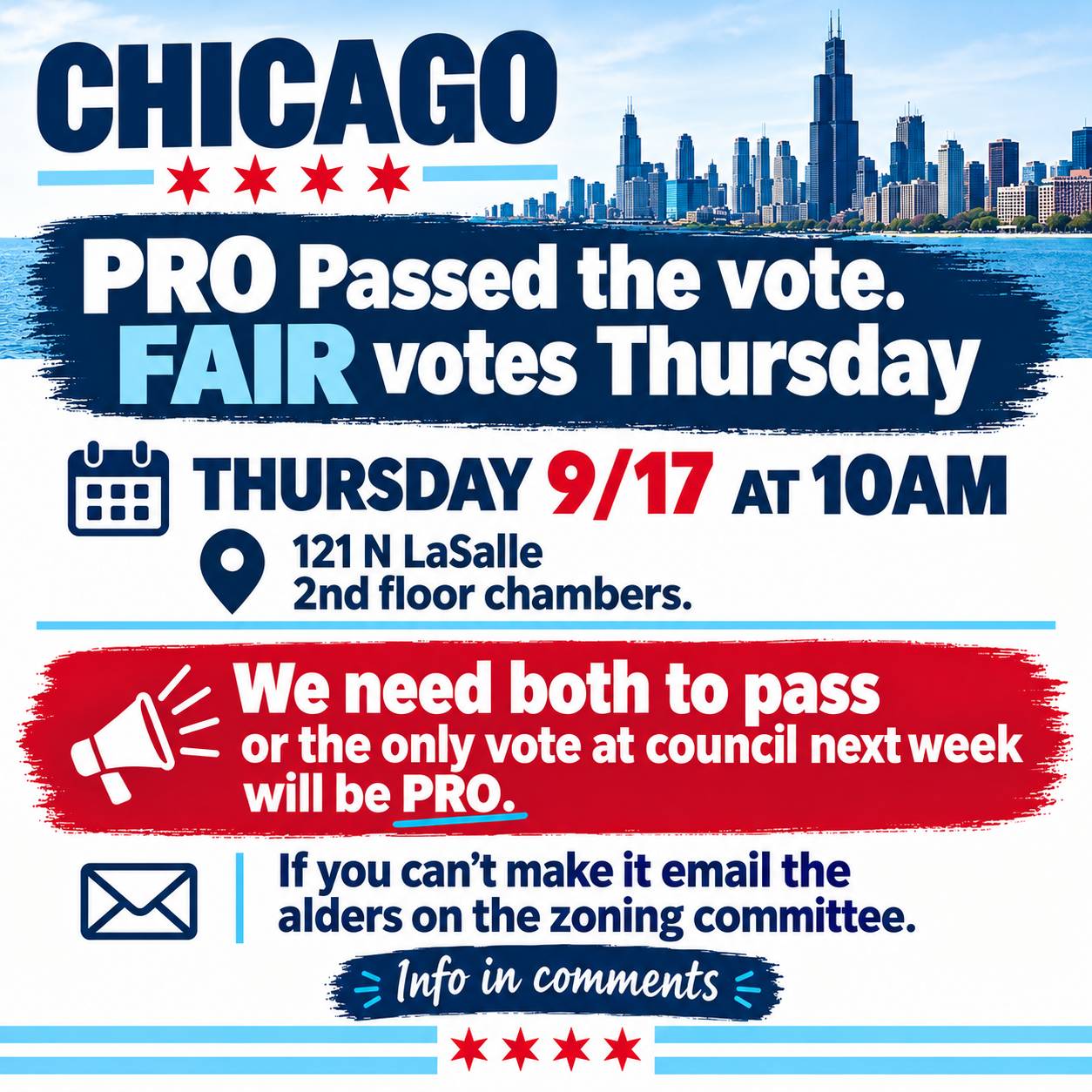
PRO was approved today and the vote for FAIR is tomorrow.  If FAIR does not pass PRO will be our only option.  Show up and voice your opinion or at least email the committee with your thoughts.  Share with everyone you know.

If you can't attend send an email to the committee members:

[email protected];  [email protected]; [email protected];  [email protected]; [email protected]; [email protected];  [email protected]; [email protected];  [email protected]; [email protected];

[email protected],  [email protected]; [email protected]; [email protected]; [email protected]; [email protected]; [email protected]; [email protected]; [email protected]; [email protected]; [email protected]; [email protected]; [email protected]; [email protected]; [email protected]; [email protected]; [email protected]; [email protected];

Templates: 

Alderman,

FAIR creates different landlord tiers, including a broader definition of a “small landlord” that can include owners with up to 12 rental units citywide. Chicago's rental housing is provided by everyone from individual two-flat owners to large institutional operators. Treating those owners differently is an important issue for Council to consider.

Please make sure the final ordinance recognizes the realities facing small and midsize housing providers.  Vote YES to FAIR

Thank you.

Alderman,

One important difference between FAIR and PRO is that FAIR includes incentives related to vacant and out-of-code properties, including encouraging owners to rehabilitate properties and bring them into compliance.

I think the Council should consider whether encouraging owners to improve vacant and problem properties can complement enforcement efforts.  Chicago needs policies that protect renters while also encouraging owners to maintain and improve the city's rental housing stock.  Vote YES to FAIR

Thank you.

Alderman,

FAIR and PRO share several provisions, but they differ significantly on landlord classifications, enforcement mechanisms and other requirements.

I hope you will look beyond the competing headlines and consider how each proposal would affect renters, small landlords, larger housing providers and the availability of rental housing.  Please carefully consider the practical consequences of each proposal before the Council votes.  Vote YES to FAIR

Thank you.
business profile image
Second City Real Estate
4.8 stars
21 Reviews

Most Popular Reply

User Stats

488
Posts
273
Votes
Michael Eskenasy#1 All Forums Contributor
  • Investor
  • Pacific Northwest
273
Votes |
488
Posts
Michael Eskenasy#1 All Forums Contributor
  • Investor
  • Pacific Northwest
Replied

The useful part of this conversation is getting past the FAIR-vs.-PRO headline and looking at the actual operating mechanics.

One thing I’d watch very closely is the classification system itself. FAIR would treat a “small landlord” differently and allows that category to include owners with as many as 12 rental units citywide. Both proposals also contemplate a rental registry, although the information collected and enforcement structure differ. 

That sounds administrative, but implementation is where the real consequences show up: How is beneficial ownership tracked across LLCs? What happens when an owner crosses a tier? Do penalties scale appropriately? Do rehabilitation incentives actually return vacant units to productive use? And does the compliance burden unintentionally advantage operators large enough to absorb it?

There’s also an important moving target here: the version of PRO that advanced from committee yesterday was materially revised, including removal of the just-cause and relocation-payment provisions that had driven much of the earlier debate. 

Whatever ultimately passes, I’d be watching the second-order effects on housing supply, small-operator participation, tenant protection, compliance cost and consolidation just as closely as the language of the ordinance itself.

This is exactly the kind of thing our system looks at—policy as an operating system rather than a headline. Feel free to reach out if you ever want to compare notes once the final language is settled.

Loading replies...