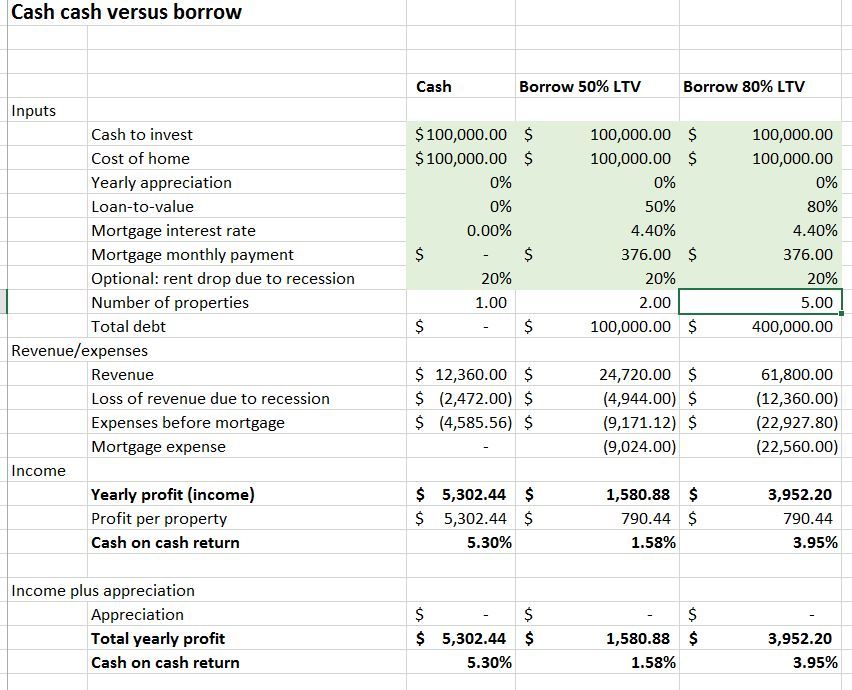
Would anyone recommend taking on properties only as you can afford to buy them cash? Or is taking on debt in order to secure new properties recommended.
Currently I do not like debt because of the obvious cost of borrowing money, however I know I could have many more properties if I went the loan route.
Leverage is your friend in real estate. Think of it this way. If you have to save your way to buy a $100k property how long will it take you? Conversely, you can use leverage and put down $20k and take control of a $100k property. While your cashflow maybe a couple hundred per month, you will also enjoy paying down of the debt over time.
Instead of buying 1 100k property cash you could buy 5 houses with 20k down each and make perhaps $1000/month cashflow. In addition presuming you had a 30yr loan. In 30 years you'd have 500K in paid off assets.
Which is better? One builds wealth faster using leverage and time.
@Jason V. - Bump. I too always feel that if I buy a house for 100K with 30 year terms the total cost is 220 or more thousand dollars. That means I gave some bank 120K minimum to buy a house which I still had to pay 100K for. Assuming rent is 1000/mo and zero percent vacancy I make 12K per year on it (which I won't because of taxes and insurance). It would take me another 10 years after the 30 year term to "earn" back what the bank loaned me. By then it would have been 40 years before I see a dime of true free and clear profit. Other than the cash flow I was receiving on top of costs all those years. Which in my opinion is chump change, a few thousand per year... not even worth my time and headaches (I consider my time very valuable)
So 40 years... I am not even 30 years old (30 years is a long f-ing time). In 40 years I will be 79 years old. Most likely I will be dead much before then. My grandfather passed away at 69... RIP
So yeah I will have a 100K house in 30 years paid off with no cost out of pocket assuming I 100% financed it. I also may very well be dead by then. Which means I spent my whole life managing every tenant complaint and repair and never saw the rewards of making bank!
I want my properties to start making me bank aka maximum possible cash the day I buy them. No loans or anything because I consider my time too valuable to waste making less than the maximum possible cash from day one.
As for raising capital, I do that at my day job where I will be making six figures very soon and able to finance deals from my actual income. Therefore jump starting my REI business with earned capital that I worked so hard getting my MBA to make.
@Chase Gochnauer I get what you're saying, but there's another way to think about it: Would you rather pay $300,000 for something worth $300,000, or pay $4.5 million for something worth $1.5 million?
And the answer isn't "But your tenant is paying for it" because their rent would be the same either way - you're just paying more to the bank in interest if you have a loan, rather than it going into your pocket, or towards loan paydown in the event of a shorter term loan. It might take longer, but who says you can only pay cash for one property? Maybe you wind up with 3 you paid cash for instead of 5 you mortgaged. I don't know.
This is where it gets complication to me - because I'm not against having mortgages on properties. I have mortgages on both the properties I currently own, and plan on having mortgages on the next several. But I think it is something that requires some thought, and that's why I'm interested in figuring out how to calculate the potential savings (if any) of shorter term loans versus the time value of money.
You need to think of this as a business. Gross income minus expenses equal profit. You want to worry about profit not expenses or gross income.
If you pay cash you will have lower expenses, but also much lower gross income. The net profit is what you get to keep and is what you should be concerned with. Your getting hung up on just the expenses without thinking about gross income.
@Chase Gochnauer I get what you're saying, but there's another way to think about it: Would you rather pay $300,000 for something worth $300,000, or pay $4.5 million for something worth $1.5 million?
And the answer isn't "But your tenant is paying for it" because their rent would be the same either way - you're just paying more to the bank in interest if you have a loan, rather than it going into your pocket, or towards loan paydown in the event of a shorter term loan. It might take longer, but who says you can only pay cash for one property? Maybe you wind up with 3 you paid cash for instead of 5 you mortgaged. I don't know.
This is where it gets complication to me - because I'm not against having mortgages on properties. I have mortgages on both the properties I currently own, and plan on having mortgages on the next several. But I think it is something that requires some thought, and that's why I'm interested in figuring out how to calculate the potential savings (if any) of shorter term loans versus the time value of money.
You need to think of this as a business. Gross income minus expenses equal profit. You want to worry about profit not expenses or gross income.
If you pay cash you will have lower expenses, but also much lower gross income. The net profit is what you get to keep and is what you should be concerned with. Your getting hung up on just the expenses without thinking about gross income.
I very much look at it like a business (which is the only reason I use debt at all. I have none in my personal life.) But if we're talking business, I want to be the type of business other people will invest in. Since I have no clue what to invest in (just like I have no clue about real estate) I try to learn from the folks who are way better at it than me.
So if I want to be the type of company smart investors (like, say, Warren Buffet) invest in, what does that mean? One of the things Berkshire Hathaway weighs most heavily when evaluating business is their level of debt to equity. Why? Because if you have a really high debt to equity ratio, and start having trouble with those all important profit margins, things go south, fast.
Not to beat a dead horse, but I have mortgages, and will continue to have mortgages. But I'll do so conservatively for the sake of the long term stability of my business. Everyone's level of comfort is different with this, and I can understand and appreciate the positions of folks who feel differently than I do. And I've learned a lot from this discussion, so thanks to all who contributed :-)
@Jason V. - Bump. I too always feel that if I buy a house for 100K with 30 year terms the total cost is 220 or more thousand dollars. That means I gave some bank 120K minimum to buy a house which I still had to pay 100K for. Assuming rent is 1000/mo and zero percent vacancy I make 12K per year on it (which I won't because of taxes and insurance). It would take me another 10 years after the 30 year term to "earn" back what the bank loaned me. By then it would have been 40 years before I see a dime of true free and clear profit. Other than the cash flow I was receiving on top of costs all those years. Which in my opinion is chump change, a few thousand per year... not even worth my time and headaches (I consider my time very valuable)
So 40 years... I am not even 30 years old (30 years is a long f-ing time). In 40 years I will be 79 years old. Most likely I will be dead much before then. My grandfather passed away at 69... RIP
So yeah I will have a 100K house in 30 years paid off with no cost out of pocket assuming I 100% financed it. I also may very well be dead by then. Which means I spent my whole life managing every tenant complaint and repair and never saw the rewards of making bank!
I want my properties to start making me bank aka maximum possible cash the day I buy them. No loans or anything because I consider my time too valuable to waste making less than the maximum possible cash from day one.
As for raising capital, I do that at my day job where I will be making six figures very soon and able to finance deals from my actual income. Therefore jump starting my REI business with earned capital that I worked so hard getting my MBA to make.
This statement in the first paragraph doesn't make sense to me. The bank helped you take your $20k down payment on a $100k house, and turned it into a little cash flow per month for 30 years and a $200k house 30 years later. You've turned your $20k down payment into a paid off $200k house, and maybe made $5k/yr for 30 years($150k). So you've made $350k off your $20k investment in 30 years AFTER paying the bank their $120k interest. This is 1750% return over 30 years.
Had you paid cash for that same property, you'd turn $100k into a $200k property, and maybe $10k/yr cash flow(5% interest) for 30 years, or $300k. So you'd turn $100k into $500k, which is great, but is only a 500% return which is less than a third of scenario 1.
@Chase Gochnauer I get what you're saying, but there's another way to think about it: Would you rather pay $300,000 for something worth $300,000, or pay $4.5 million for something worth $1.5 million?
And the answer isn't "But your tenant is paying for it" because their rent would be the same either way - you're just paying more to the bank in interest if you have a loan, rather than it going into your pocket, or towards loan paydown in the event of a shorter term loan. It might take longer, but who says you can only pay cash for one property? Maybe you wind up with 3 you paid cash for instead of 5 you mortgaged. I don't know.
This is where it gets complication to me - because I'm not against having mortgages on properties. I have mortgages on both the properties I currently own, and plan on having mortgages on the next several. But I think it is something that requires some thought, and that's why I'm interested in figuring out how to calculate the potential savings (if any) of shorter term loans versus the time value of money.
You need to think of this as a business. Gross income minus expenses equal profit. You want to worry about profit not expenses or gross income.
If you pay cash you will have lower expenses, but also much lower gross income. The net profit is what you get to keep and is what you should be concerned with. Your getting hung up on just the expenses without thinking about gross income.
I very much look at it like a business (which is the only reason I use debt at all. I have none in my personal life.) But if we're talking business, I want to be the type of business other people will invest in. Since I have no clue what to invest in (just like I have no clue about real estate) I try to learn from the folks who are way better at it than me.
So if I want to be the type of company smart investors (like, say, Warren Buffet) invest in, what does that mean? One of the things Berkshire Hathaway weighs most heavily when evaluating business is their level of debt to equity. Why? Because if you have a really high debt to equity ratio, and start having trouble with those all important profit margins, things go south, fast.
Not to beat a dead horse, but I have mortgages, and will continue to have mortgages. But I'll do so conservatively for the sake of the long term stability of my business. Everyone's level of comfort is different with this, and I can understand and appreciate the positions of folks who feel differently than I do. And I've learned a lot from this discussion, so thanks to all who contributed :-)
Okay, so if you have no clue what to invest in or about real estate. How come you aren't listening to many of the experienced investors here who are telling you exactly how to use debt?
No one is saying you should leverage your houses to the tilt. Berkshire Hathaway invests in companies with debt all the time. Debt helps companies grow bigger and faster. In fact, if you want an investor to invest in your company that is a form of debt. You are either paying them interest, giving them stocks or something else in free turn for money they invest into the company so the company can grow bigger. I would much rather use a loan and retain 100 percent of my company or business than have to sell shares of my company and give up equity and future profits for investment money.
I think know the thing that is really standing out to people is the thought that it is bad to pay the bank 200k in interest on a house that costs 100k. All your looking at is the interest cost of one house. You are forgetting that the interest is allowing you to make more money, buy more houses, have more tax deductions and is possibly safer because you are diversifying your investment by buying more properties.
Yes, the bank makes money. So what if you make more money.
When I started, I literally had nothing, no savings and a low paying job. I could not have bought the first house without getting a 90% bank mortgage at 9% interest fixed for 30 years and a loan for the other 10% equally a total of 100% financing.
So the choice for me was to buy using heavy debt or not buy anything and continue renting. But when I bought my P+I was $15 more than my rent. so for $15 a month over my rent I was able to pay the P+I. The story of buying the first house in told in Bigger Pockets Podcast # 82. Then I got roommates and house hacked and lived there for free. So it turned out that it didn't cost anything to live there and was cheaper than renting. Later I sold that property for about 4x of what I paid for it.
The second property was a multi-unit, financed again at 100%. Improved the property rented positive cash flow for years then sold for about 6x of what I paid.
I would not have been able to buy either property without the financing. but when I reached the point of not needing financing, I stopped using financing.
I am all about the debt! Nowhere else can we borrow money so cheaply as in real estate.
If I had $100k cash I could buy one property free and clear that (for example) brings in $1500 gross rental income - using the 50% rule I will cash flow $750
Using the same numbers as above, If I have $100k cash and buy 5 properties at a 80% LTV that would be $500k in property. Giving me $7500 a month gross rents, using the 50% rule that gives me $3750 a month cash flow before my mortgage. A $400k loan at 4.5% will be a $2,025 payment giving me $1,725 a month cash flow. Plus I never pay the mortgage, my tenants do.
I am all about the debt! Nowhere else can we borrow money so cheaply as in real estate.
If I had $100k cash I could buy one property free and clear that (for example) brings in $1500 gross rental income - using the 50% rule I will cash flow $750
Using the same numbers as above, If I have $100k cash and buy 5 properties at a 80% LTV that would be $500k in property. Giving me $7500 a month gross rents, using the 50% rule that gives me $3750 a month cash flow before my mortgage. A $400k loan at 4.5% will be a $2,025 payment giving me $1,725 a month cash flow. Plus I never pay the mortgage, my tenants do.
And if you buy below market value, which many of us do you gained $100k in equity instead of $20k. And you have depreciation on five properties instead of just one which gives you awesome tax advantages. If houses ever appreciate you have five appreciating instead of one.
I am all about the debt! Nowhere else can we borrow money so cheaply as in real estate.
If I had $100k cash I could buy one property free and clear that (for example) brings in $1500 gross rental income - using the 50% rule I will cash flow $750
Using the same numbers as above, If I have $100k cash and buy 5 properties at a 80% LTV that would be $500k in property. Giving me $7500 a month gross rents, using the 50% rule that gives me $3750 a month cash flow before my mortgage. A $400k loan at 4.5% will be a $2,025 payment giving me $1,725 a month cash flow. Plus I never pay the mortgage, my tenants do.
And if you buy below market value, which many of us do you gained $100k in equity instead of $20k. And you have depreciation on five properties instead of just one which gives you awesome tax advantages. If houses ever appreciate you have five appreciating instead of one.
Oh yea! and you get to write off the interest you paid so aren't taxed on that, thus lowering the amount of taxes you pay.
Although I plan to eventually employ a hybrid model, a couple primary reasons that I have chosen to pay cash is that it essentially reduces purchase price and ongoing costs as well as often you can obtain an overall lower purchase price .
In states like FL with very high closing costs (3-4%) paying cash just got you a 3-4% discount on the property (cash closing costs are roughly .1% in my case). So my last property that I got a 14% discount on - I actually got a 17% discount over asking when one considers the closing cost advantage.
As far as ongoing costs are concerned, I don't have to carry all the insurance policies that a loan would require. Here in FL flood insurance is very costly and necessary if you have a mortgage. But why pay $2000/year for a policy with a $10,000 deductible. I keep basic insurance and liability on my properties but I could completely rebuild one of my houses for $20,000 so the flood insurance proposition makes very little sense for me in this case. And then when you have to file a claim it is almost a full-time job from most stories I have heard. I realize I am increasing my risk profile for that particular property but will maintain additional reserves to offset. You essentially the freedom to choose your risk profile for insurance on your property instead of being mandated by a bank.
Lastly, you can generally get a slightly lower overall purchase price in more competitive markets as a cash offer is always viewed as stronger and owners would be more likely to accept. Can't put specific metrics on this but I am certain in my case it has provided me at least 2-5% additional purchase discount.
In my opinion, the banks, title companies, and insurance companies are the greatest beneficiaries (as designed) in the current mortgage-based paradigm. They make a lot of money on the transactional components of a real estate deal and essentially increase your costs. By purchasing cash you can potentially reduce your purchase price as well as your closing costs and insurance expenses.
Wow, so many answers to the question (yes to debt, no to debt, yes to moderate debt, no to moderate debt, etc.). And way too many people who are convinced that their way is the best and only way.
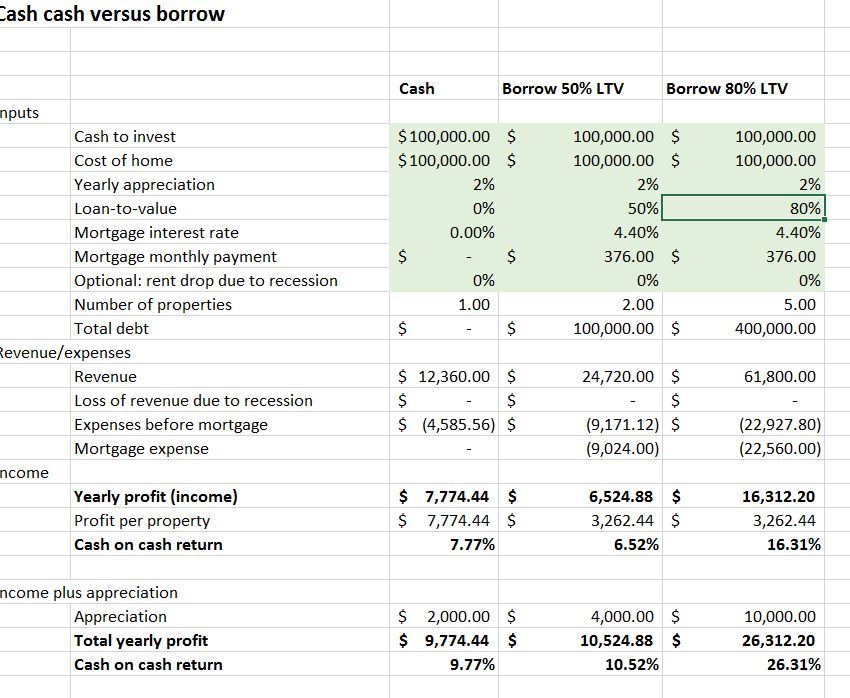
As an experiment, I took the real numbers from one of my properties here in Tampa Florida and ran it through three scenarios: no debt, moderate debt (50% LTV) and maximum debt (80% LTV). Then to quantify the risk, I ran those through three economic scenarios: "good times", small recession (rents fall but prices remain stable), bad recession (rents fall and prices fall). I took into account both income and appreciation using what I can get in Tampa.
Bottom line: in good times, the best income came from the extremes. First was maximum debt (16.31%), no debt (7.77%), and finally moderate debt (6.52%). If I take into account the total return (which includes appreciation of the property), it changes into the expected theme of more debt equals more return: maximum debt (26.3%), moderate debt (10.52%) and no debt (9.77%).
And in a bad recession (10% price drop and 20% rent drop), the performance is reversed. As expected, the best outcome came with the least amount of debt. First was no debt (-4.7%), moderate debt (-18.42%) and maximum debt (-46.05% ouch!).
I'll add that in my numbers it was nice to see that even in a bad recession, none of the properties went cash flow negative. So it would be a significant loss of income and painful on paper regarding the value loss, but the properties could still pay for themselves (as long as I wasn't counting on the income for anything).
Here are the scenarios:
good times:
Wow, so many answers to the question (yes to debt, no to debt, yes to moderate debt, no to moderate debt, etc.). And way too many people who are convinced that their way is the best and only way.
As an experiment, I took the real numbers from one of my properties here in Tampa Florida and ran it through three scenarios: no debt, moderate debt (50% LTV) and maximum debt (80% LTV). Then to quantify the risk, I ran those through three economic scenarios: "good times", small recession (rents fall but prices remain stable), bad recession (rents fall and prices fall). I took into account both income and appreciation using what I can get in Tampa.
Bottom line: in good times, the best income came from the extremes. First was maximum debt (16.31%), no debt (7.77%), and finally moderate debt (6.52%). If I take into account the total return (which includes appreciation of the property), it changes into the expected theme of more debt equals more return: maximum debt (26.3%), moderate debt (10.52%) and no debt (9.77%).
And in a bad recession (10% price drop and 20% rent drop), the performance is reversed. As expected, the best outcome came with the least amount of debt. First was no debt (-4.7%), moderate debt (-18.42%) and maximum debt (-46.05% ouch!).
I'll add that in my numbers it was nice to see that even in a bad recession, none of the properties went cash flow negative. So it would be a significant loss of income and painful on paper regarding the value loss, but the properties could still pay for themselves (as long as I wasn't counting on the income for anything).
Here are the scenarios:
good times:
The only other thing to account for in each scenario, is the tax consequences. Using your scenario, the 5 property scenario gives you $500k in RE, so lets say $400k in building value. That's a $14,545/yr depreciation tax deduction, or if in 30% tax bracket, $4363 savings in taxes. Added to the yearly profit, that's $8315 in actual income return, assuming you have other income to offset. This gives you an 8.3% cash on cash return.
In the cash scenario, your depreciation deduction would be $2909 on one property per year, or $872 in tax savings, which would bump you up to 5.6% cash on cash return.
So, with tax consequences calculated for, the 80% LTV scenario still gives best income returns on paper, even in the worst case.
One hybrid method that we have employed many times is to write the contract as all cash with NO mortgage contingency to get the cheapest all cash price possible, BUT settle with a new first mortgage for 80% (investment property.)
Obvious risk is that you don't get the mortgage, you have to have a plan B with a source for cash. On one property I offered $100,000 the first day the property was listed, with a $100,000 earnest money deposit. Obviously I felt very strongly about the property and the value. We settled with a 80% first bank mortgage and I got back at settlement the 80% balance of my earnest money despot excess to the purchase price. I sold the property for $200,000.
Interesting analysis.
It appears that you are using interest only financing. Not very practical for long term holds. The idea is to have your tenants buy the property for you which usually requires a fully amortizing loan. A 30 year fixed rate loan at 4.4% with a $500 monthly payment is more realistic.
I suggest, in the Income group, that you change your use of the term "profit" to "cashflow". In the context of your spreadsheets, you are not selling the properties, so there is no profit. Instead, the properties generate an annual income stream that most of us call cashflow.
You can calculate cashflow before taxes and cashflow after taxes as well as the yield, or cash-on-cash return, before taxes and after taxes. In the next section, adding any appreciation gained does not change your cashflow. Appreciation does not put any money in your pocket but it does increase your equity, so the cash-on-cash return is unaffected by appreciation. However, the total return (what you are calling total profit) is the sum of your appreciation and annual cash flow. You can calculate total return before and after taxes, too. After tax calculations would add in the tax savings due to depreciation provided the taxpayer is able to take full advantage of the net passive loss allowance.
It looks to me like the scenarios are accounting for actual mortgage payments, not interest only.
I would argue though that, on paper, interest only loans would give you the best returns on a long term hold. There's no reason to pay down principal on a 4.4% loan when you can get double/triple that in returns reinvesting the cash flow.
@Ian Ippolito I like the breakdown! So deciding future moves, it would be prudent to make an educated guess as to whether or not the market will be good, bad, or very bad.
Guessing with my market that we will be coming back economically and housing market wise, my next move will probably be to source private financing over the next year or two
@Ian Ippolito Very cool to see some real numbers on this.
One of the things I found interesting was that the returns between no debt and moderate debt were very similar, and in one case, having no debt outperformed having moderate debt.
Makes me reconsider, or at least want to look deeper into, the strategy of using 'reasonable' debt. It looks like I would be just as well off not using debt, and quite a bit better off using debt aggressively. So maybe the way to invest in real estate 'conservatively' is to use debt aggressively, but to have plenty of reserves in the event something starts heading south. (I.e. not using every nickel I can scrape together for the next property.)
I'll probably start trying to figure out how to take the analysis a little deeper, because I'm not as concerned about CoC return as I am about total return - and that's a lot harder to figure out (for me anyway) because it depends heavily on the future value of the house, which is a place where folks have gotten in trouble in the recent past - by overestimating what they can sell a property for. If you're a regular listener to the podcast, I'm sure you've heard some of the discussions about projecting appreciation, and if the best guys in the business can't agree on if or how it can be done, then I'm sure I don't have any better chance.
But hey, this all comes from a guy who's plan is to buy 3 small multi-families that cashflow well this year (using only my personal income, savings and conventional mortgages) which would make my total "investment portfolio" 4 properties. I'm really still trying to figure out who I am as an investor, so this has been an awesome discussion to be a part of!
@Chase Gochnauer, @Dave Toelkes, Thanks both of you for the great feedback, and I've incorporated all of your points into the new version of the analysis.
Dave, you are right that the mortgage payment is too low. I thought the calculator I was using was interest plus principle, but it must not have been. I made the correction which did change the results quite a bit.
New results:
1) Good times:
From a cash flow/net income/cash on cash point of view, there is not very much of a difference between going all cash and maximum leverage. All cash yield 7.77% and max leverage yields a slightly better 8.81%. Moderate leverage is the worst choice, at only 3.52% (more than 50% worse).
However, after incorporating in depreciation and price appreciation, the total return scenario is very different. Now, max leverage (23.9%) doubles the profit of all-cash (10.79%). Again, moderate leverage is the worst choice, at 9.56%. At this point, max leverage looks like the clear king. (But of course, the price appreciation is a paper profit until you can actually sell).
However, this only works out so well for mass leverage when the properties appreciate. If times get bad, or if I went for the depressed neighborhoods with slight negative appreciation, then the advantage of mass leverage gets wiped out. If the properties fell in price just a tiny 1%, max leverage drops to 8.9% versus 7.79% for all cash: virtually the same.
2) Moderate recession: (10% rent drop, 10% price drop)
Here's where the situation gets reversed. All cash is the clear winner on cash flow. It's (6.54%) triples the cash flow of maximum leverage (2.63%), and now moderate leverage is the worst with a 6 s lower return of 1.05%. (Thankfully none of them go negative with my properties: but if you have a smaller profit margin it might be different).
With total return, all-cash is even more of a better choice. All-cash takes a modest -2.4% loss. Moderate loan performs eight times worse with a -16.9% return. And max leverage performs a truly terrible 20 times worse with a loss of -42%.
If you are leveraged, the key here is to hold on and don't sell until prices recover. If for some reason you have to sell, it is going to hurt very very badly.
3) Severe recession: (10% rent drop, 40% price drop)
Hopefully we don't see one of these again in our lifetimes. But I modeled this based on the last recession where prices in Tampa fell 40%.
The cash flow is the same as a moderate recession.
Looking at total return, all-cash is even more of a winter than a moderate recession. All of them take terrible losses, but significantly more horrific the more leverage. All-cash: -42%, moderate: -96%, and mass leverage produces six times the loss of all-cash at -242%.
You can see why so many leverage people went bankrupt in the last recession. Again, if you are leveraged you absolutely do not want to sell or have to sell during the bad times. If you are forced to, it is going to be really really bad.
Here are the details:
1) good times:
2) moderate recession: 10% price drop. 10% rent drop.
3) severe recession: 40% price drop. 10% rent drop.
@Jason V., Thanks! I wasn't sure myself which way it would turn out, so it was really interesting to me (and I just posted an update above because I used the wrong information for the mortgage payments).
Assuming that your market is somewhat similar to Tampa, then the best choices are probably either all-cash or maximum leverage. Moderate leverage is like walking in the middle of a two-lane highway: you end up getting hit in both directions. It severely underperforms all-cash in both good times and bad. It's only advantage over maximum leverage is in a recession (and even then the income is still less…it's just that the price loss is not a severe).
Yes, appreciation is really difficult to predict. And it makes a really big difference. If appreciation drops from 2% to -1%, almost all the advantage of maximum leverage in good times disappears.
So I can't see any reason to use any leverage when investing in a low income area (at least here in Tampa). On the other hand, if I felt fairly confident that appreciation would continue to occur over time, it can double the return of all-cash.
@Ian Ippolito I do not think your mortgage payment amount is accurate. First, a $50,000 30 year at 4.4% should be about $250 ($500 for two loans) but you doubled the $500 number for your total mortgage expense to get $12,024, when the number should be closer to $6,000
Also, your 80% Loans would need to reflect an $80,000 loan on each property, using a 30 year at 4.4% that should be $400 per property, or $2,000 for the portfolio, for a total debt service of $24,000.
Last, I would also argue that if you are going to include a non-cash item like appreciation/depreciation then you also need to factor in principal paydown, about $1,600 for the moderate scenario (in year 1) and $6,400 for the 80% scenario.
Then if you really wanted to make an in-depth analysis, look at how each scenario plays out at 10 years, 20 years, and 30 years. Taking in to account rent and non-mortgage expense increases.
@Ben Parr, Thanks so much for the feedback and I think you are right on the mortgage issue. Ugh, I will revisit it later today and repost after correcting.
How would you suggest including principal paydown into the analysis? In the all-cash scenario, there is an immediate "principal paydown" of 100% of the purchase price of $100,000. The others take time to accrue, and are not (at least directly) comparable.
@Ben Parr,
How does this look to you now?
I would not count downpayments as paydown. If I buy for $100,000 for cash my equity is fixed at $100,000 (not counting appreciation ,discounts, etc.) If I buy 1 house with an $80,000, 30 year, 4.4% mortgage I will "own" about $20,000 of it at the start of year 1 and about $21,320 at the end of the year. I would essentially add this "below the line" as non-cash income in the amount that I paid down in any given year.
Note in year 10 it would increase to $2,000 and in year 30 it would be about $4,650.
Looks right at a glance. The numbers sure are lining up a lot nicer now.