Real Estate Investor · Dayton, OH · Member since 2015 · 31 posts · 6 votes
Would anyone recommend taking on properties only as you can afford to buy them cash? Or is taking on debt in order to secure new properties recommended.
Currently I do not like debt because of the obvious cost of borrowing money, however I know I could have many more properties if I went the loan route.
Investor · Houston, TX · Member since 2011 · 26 posts · 37 votes
10y
Leverage is your friend in real estate. Think of it this way. If you have to save your way to buy a $100k property how long will it take you? Conversely, you can use leverage and put down $20k and take control of a $100k property. While your cashflow maybe a couple hundred per month, you will also enjoy paying down of the debt over time.
Instead of buying 1 100k property cash you could buy 5 houses with 20k down each and make perhaps $1000/month cashflow. In addition presuming you had a 30yr loan. In 30 years you'd have 500K in paid off assets.
Which is better? One builds wealth faster using leverage and time.
Investor · Des Moines, IA · Member since 2015 · 380 posts · 201 votes
10y
It really depends if you're truly a buy and hold investor. If you're buying with the intent of holding onto it for 20 years, Then as long as one of those down markets doesn't hit at year 18-19-20 you're probably OK.
The reason why leveraging doesn't look as good in a depressed pricing market is because you're buying more houses. If you put a fourth scenario on there, of putting all of your $100k in a 1-year CD at 1% , it'd have the best total return in your worst case scenario.
So the best strategy would be to keep your cash in the bank and leverage to the max in the middle of a market downturn. :)
Investor · Tampa, FL · Member since 2015 · 1k+ posts · 1k+ votes
10y
@Ben Parr, Thanks. Hopefully I finally nailed the mortgage portion. The results now look more like the original numbers I posted (I'll post an updated summary below).
Anyway, regarding the principal paydown. If I do it the way you suggest and simply record as additional income on the two debt scenarios, but do nothing on the all-cash scenario, it will give the impression that equity is being accumulated in the former, and not the latter. But actually, the all-cash scenario generates the most equity, right in year one.
There are actually two issues here: the amount of equity being accumulated and the time it takes to accumulate it. Maybe someone has a suggestion, but I'll talk to my accountant friend as well. I suspect the proper way to account for a principal paydown is to incorporate in the time value of money. Having all that equity on day one, enables an investor to use it right away (either via a sale, or taking it out via a home-equity line). Versus the two debt scenarios where that is accumulated slowly over 30 years.
Investor · Tampa, FL · Member since 2015 · 1k+ posts · 1k+ votes
10y
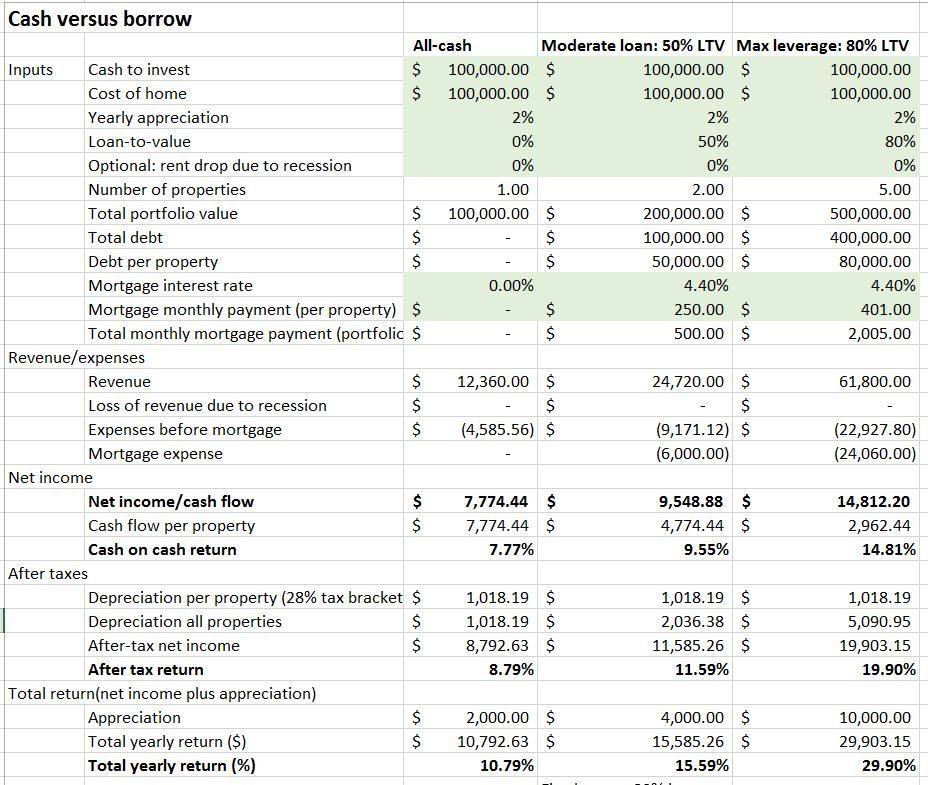
Okay, hopefully third time is the charm. (This does not include principal paydown/equity, as Ben Parr was addressing, but I think it includes everything else. I should also add that depreciation often is just a deferment, rather than a payment. If you sell the property and don't do a 1031 exchange, you're going to have to pay the depreciation back.)
Anyway:
1) "good times": the more leverage the better you do. Max leverage outperforms all cash by a factor of two (14.81% versus 7.77%) on income. Looking at total return, Max leverage outperforms all cash by almost a factor of three (29.9% versus 10.79%). But as stated above, part of this assumes that your depreciation is permanent rather than just deferred (which you may not know for a long time).
2) "mild recession": split decision. The less leverage the better you do on your cash on cash return (your income). Income: all cash (5.3%) outperforms Max leverage by a factor of two: (2.45%). However, depreciation causes the situation to reverse on total return, and Max leverage (7.5%) slightly edges out cash on cash (6.3%). But again, this is with the caveat that your depreciation may not be permanent.
3) "severe recession": the less leverage the better you do. Income return is the same as a mild recession where all cash outperforms Max leverage by a factor of two. Total return is horrendous for all. But cash on cash loss of (-43%) is six times better than Max leverage (-242%). Notably: the cash on cash loss is less than the original investment, but with Max leverage you lose 2.5 times what you originally invested. However, I caveat here is that if you can avoid selling during the severe recession, and wait for prices to come back up, then you can avoid that horrible outcome. The downside is that it can be eight or nine years before prices recover.
1) good times: 0% rent drop, 2% yearly appreciation.
Investor · Tampa, FL · Member since 2015 · 1k+ posts · 1k+ votes
10y
@Chase Gochnauer, I think you're absolutely right about that. It goes completely against what I thought before I ran through all the numbers, but i think max leverage is a very solid strategy for a buy-and-hold investor.
Max leverage will outperform all cash in a normal business cycle (the 2X outperformance during the 5 to 6 years of the good times, makes the small underperformance during a minor recession an afterthought).
Even a major recession can be survived by a max leverage strategy, with the vital caveat that you just cannot sell during the time that prices are depressed. If you can wait, they eventually come back up, and everything is fine. The tricky part is that you don't how long it will be. For example, here in Tampa it's eight years later and prices still haven't recovered. In other places, prices didn't spike as much so they didn't take as long to bottom and recover. If you are forced to sell (say you are retiring and need the money, etc.) you will probably go bankrupt unless you have some other source of money.
Real Estate Investor · Dayton, OH · Member since 2015 · 31 posts · 6 votes
10y
@Ian Ippolito Yeah I like the max leverage numbers in your scenario, and here in the Midwest, we almost never see those large market swings like people on the coast have. The idea of having large cash reserves incase of times where the economy and markets get severely recessed seems like a solid plan. Thank you for the evaluations! Helps a lot when planning on what to do going forward. I appreciate all the input from everyone
Yeah being in the Midwest also, I agree on the swings here. It's not nearly as bad as some metros. As long as you keep decent reserves so you don't get in a major pinch in which you have to sell, I think you're alright.
To that point, though, I guess the scenario should account for that. If you really only have $100k in the bank, then likely you should only buy maybe 4 properties at $20k down and stick the rest in reserves to be safe. If you buy one all cash at $100k, you should have a little reserve but likely nothing more than a large capex expense.
Investor · Tampa, FL · Member since 2015 · 1k+ posts · 1k+ votes
10y
@Bradley Marion, That is awesome that you don't experience those wild pricing swings. It definitely makes it easier to sleep at night when there is much less volatility. And it's my pleasure.
@Chase Gochnauer, Reserves are a good idea to give a little cushion in case of a downturn. The effect on returns will depend on how much of a reserve is needed. If you want me to send you a copy of the spreadsheet so you can run your own scenario, just let me know.