Dave Ramsey Is Misleading The Public

Dave Ramsey Is Misleading The Public

Flipper/Rehabber · Las Vegas, NV · Member since 2016 · 174 posts · 251 votes

I wanted to address this to educate people who have been mislead by the financial services industry...not just Dave Ramsey 

Step 7 - Build wealth and give. This is where he want's you to "invest in mutual funds," and to be fair real estate (all cash and 5% of your investments). So let's assume the other 90-95% goes into mutual funds. Just go to his website and it's obvious he's drank the mutual fund koolaid. Again, not sure whether he knows how bad his advice is and is lying or is completely ignorant. My guess is it's the former because of the mental gymnastics required for articles like this from his blog.


And if you read the blog post it becomes obvious why I tend to believe he's blatantly lying to his audience and his whole schtick is a rouse. see below

Notice he brushes off the lost decade by saying you have to look at the bigger picture and you can't cherry pick time frames. But that's exactly what he does to make his claim about the 12% average returns. The whole basis for for the blog post and a big part of what he sells to his audience.

But it goes from a subtle white lie to blatant fraud when you look at how he's selling a "12%" return.

Meaning, most of his listeners are unsophisticated, they don't know a 12% drop one year and a 12% gain the next doesn't put you back at zero. They think that their money will just compound at a 12% clip annually. Let's look at reality.

If we took what DR says at face value, the market goes up on average of 12% a year going back to 1923, we should be able to type the value of the 1923 S&P into a compound interest calculator, input 12%, and we should have roughly 3000 (where the S&P is today). I only have data from 1928 on, but I think you'll still get my point. The S&P was 17 in 1928. Let's see what happens...

If what DR says is true, the way he sells it to his audience, if S&P would have to be at 512,000 right now!!! It's at 3000!!!

And I'm not even adjusting for inflation. Adjusted for inflation (meaning 12% annual increases in purchasing power) the S&P would be at over 7,500,000!!! YES, 7.5 MILLION.

You maybe saying to yourself, "what George is saying can't be true" DR would never get away with that much of a lie. Here's why DR can get away with his claims. They're true in literal terms but they're wildly false in the way he presents it to his audience and how his audience perceives what he's saying.

DR presents this 12% claim as though, over the long haul, your money will grow by 12% a year. FALSE! Why? Because when a number is reduced by 10% and then increased by 10% you're not left with the same number...it's lower.

As an example. Take $1000 and decrease it by 50%, you now have $500. Increase that $500 the next year by 60% and you now have a total of $800. A $200 (20%) loss but a 5% average return (-50 + 60 = 10/2 = 5%).

This becomes very clear when we look at graph of annual S&P returns.
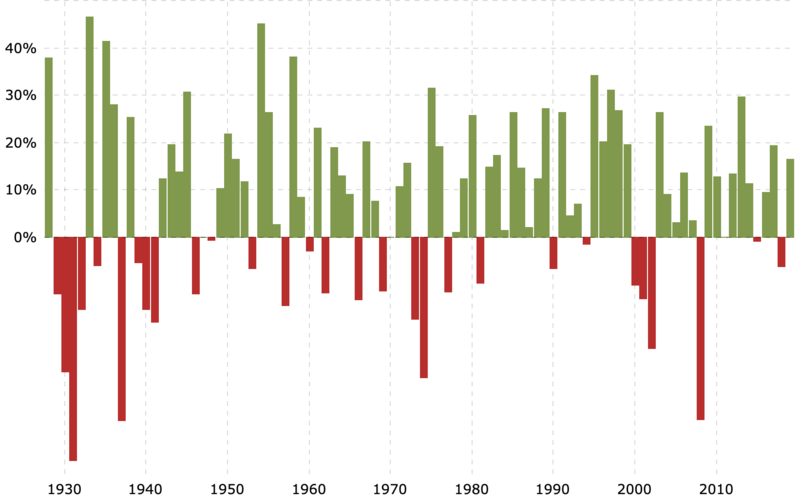

Or better yet, look at an inflation adjusted chart. Please notice how much you'd make if you invested in 1928 and left your money in for 52 years, until 1980.
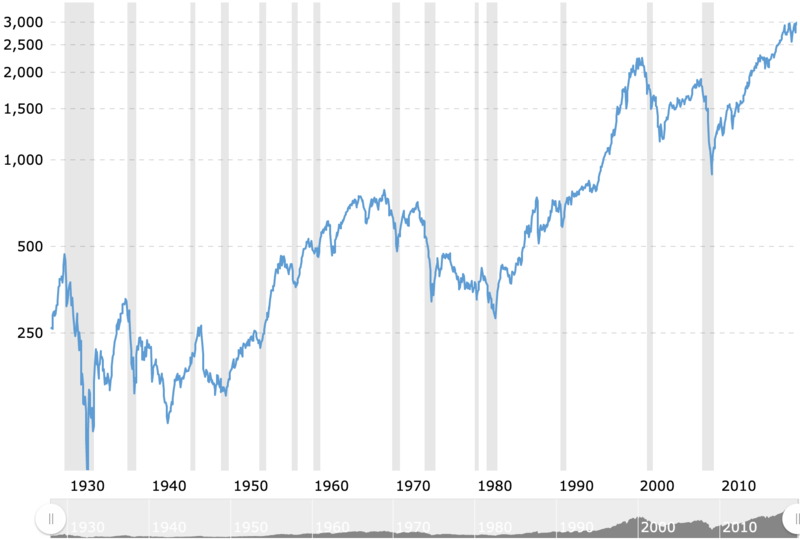
You would've made zero (adjusted for inflation). Dave Ramsey what happened to 12% per year??

What infuriates me the most is he targets people in the south and people who go to church, in other words people with traditional values who are more susceptible to his "be prudent, save money, no debt, invest in mutual fund" snake oil.

To be clear, 10% of what he says is spot on, have a rainy day fund and don't take on consumer debt, but the other 90% is so bad it's completely inexcusable.

If you're one of the millions of Americans, not just DR fans, who have drank the koolaid of the financial services industry and invested into the "safety" of mutual funds, I apologize, I don't relish being the bearer of bad news. But as I said in my first post on this thread, I feel a moral obligation to set the record straight.

Please note: I didn't even hit the tip of the iceberg of why mutual funds are quite possibly the worst investments on a risk/reward basis. I understand I exclusively focused on S&P and mutual funds typically contain bonds. I did this because interest rates have been driven down so low by the Fed, mutual funds no have to overweight equities because they can't get a return from bonds. This problem will be exacerbated if/when US bonds go into a negative yield like Europe and Japan.

I realize this is complex stuff. It's why DR can dupe so many, including maybe himself. I'd like to point out I learned none of the above in college. ;)

If you have any questions don't hesitate to reach out, all my contact info is on my profile.

Good luck,

22Reply
457 views

Most Popular Reply

Rental Property Investor · RVA · Member since 2016 · 5k+ posts · 4k+ votes
7y

I see Dave's advice as being good for those who have problems balancing their checkbooks and generally accumulating money. For those of us who are taking more control of our financial situations, we need to massively upgrade our knowledge and our level of thinking.

See this reply in the discussion

108 Replies

Jump to latestLatest
  • Rental Property Investor · Baltimore, MD · Member since 2017 · 142 posts · 125 votes
    7y

    @Russell Brazil That's an excellent point that I never thought about before.

  • Shiloh LundahlPro Member
    Rental Property Investor · Gilbert, AZ · Member since 2016 · 3k+ posts · 4k+ votes
    7y

    @JD Martin That was a great job in keeping things in perspective.

  • Jason B.Pro Member
    Rental Property Investor · Boise, ID · Member since 2017 · 228 posts · 180 votes
    7y
    Originally posted by @JD Martin:

    Without trying to be insulting, most of the people that I personally know are financial idiots. They could all benefit from the bulk of what Dave sells. I would tend to agree that more people than not that are here, at BP, have probably moved on from Dave's simple scenarios, which as @Shiloh Lundahl has pointed out is designed to play defense, not offense. But let's put it this way: even if there were 1 million BP members - and there's realistically far, far fewer "active" members - that's only 3/10ths of 1 percent of the population of the United States. In other words, during the course of your day, if you come into contact with 1,000 people, you might meet 2 people who have been members of BP. 

    Dave Ramsey is talking to people who are living paycheck to paycheck, buried by consumer debt, with close to zero in the bank account. Even if his investment strategy sucks it's a better financial picture for 99% of his intended audience than the course they are currently following.

    @JD Martin I agree...I look at Dave Ramsey’s plan as the financial foundation I.e. getting your financial house in order. It puts you on a path where once done (principals such as get rid of debt, emergency fund for financial security) you can save more money for things like down payment/rehab costs or qualify for larger mortgage/better terms, etc. and begin to more efficiently invest in real estate.  

  • Flipper/Rehabber · Las Vegas, NV · Member since 2016 · 174 posts · 251 votes
    7y
    Originally posted by @JD Martin:

    Without trying to be insulting, most of the people that I personally know are financial idiots. They could all benefit from the bulk of what Dave sells. I would tend to agree that more people than not that are here, at BP, have probably moved on from Dave's simple scenarios, which as @Shiloh Lundahl has pointed out is designed to play defense, not offense. But let's put it this way: even if there were 1 million BP members - and there's realistically far, far fewer "active" members - that's only 3/10ths of 1 percent of the population of the United States. In other words, during the course of your day, if you come into contact with 1,000 people, you might meet 2 people who have been members of BP. 

    Dave Ramsey is talking to people who are living paycheck to paycheck, buried by consumer debt, with close to zero in the bank account. Even if his investment strategy sucks it's a better financial picture for 99% of his intended audience than the course they are currently following. 

    It's not that his investment strategy "sucks."   He's intentionally misleading the least financially sophisticated of our society by conflating an average rate of return with compound annual growth rate.  He's profiting by misleading people but it's ok because the net result of his misrepresentation some people are better off?  

    What about the 1000's, who bought into an index fund because of his misrepresentations?  What happens when they build their entire retirement around a 12% return (as how it was presented) and then can't retire because for the last 30 years the index only produced a 7% return?  I'm shocked at how many on this thread sweep this under the rug.  

    How is this any different than real estate guru's who sell courses promising higher returns than are realistic?  Everyone does realize DR takes a cut of everything his followers invest with one of his companies/affiliates.  

    For some reason BP hates real estate gurus who mislead by using over inflated numbers but defends Dave Ramsey who misleads by using over inflated numbers??  

    After reading many of the posts in this thread, I think the disconnect is most on BP don't understand the difference between an average return and a compound annual growth rate, so when DR does it they don't see it as a big deal? 

  • Jason B.Pro Member
    Rental Property Investor · Boise, ID · Member since 2017 · 228 posts · 180 votes
    7y
    Originally posted by @George Gammon:
    Originally posted by @Jason Bohling:

    @George Gammon 

    Jason, thx for the post.  I’ll respond to the key points people have made when I get a little time.  

    But to start, can you please tell me the difference between a 10.6% “average historical return” and a 10.6% compound annual growth rate?  

    Or maybe a better question:  Is it possible for the S&P, Dow, Russel 2000 etc.  to have a 10.6% “average historical return” over 5 years, yet be lower after 5 years than where it started?  In other words can the Dow start at 1000 and 5 years later be at 900 and still have a 10.6% “average historical return?”  

    @George Gammon Here’s an example, hope this helps:

    Average annual return

    So say you wanted to know the average annual return over a 3 year period of a mutual fund. 

    Year 1 returned 10%, Year 2 returned -5%, and Year 3 rallied and it ended up returning 20%.

    You add them up and divide by 3: 10 plus -5 plus 20=Which gets you an annualized rate of return of 8.33% averaged over the 3 year period.

    Compound annual growth rate 

    This would be if you invested, say, $10 paying 8.33% interest each year (10x1.0833%-the 1 reflects the principle) after year 1 you would have  made .833 in interest for a total of $10.833.  Year 2 you would then multiply the 10.833 by 1.0833 again, now resulting in a total of $11.74 (rounded up).  Year 3 you would then multiply the 11.74 by 1.0833 again for a final total of $12.72.  So, with a compounded growth rate of 8.33%, after 3 years you’ve made $2.72 on your principal of $10 for a total return of 27.2%.

    Compound annual growth rate is linear, whereas average annual growth rate is not.  Hope this helps!

  • Attorney · Sacramento, CA · Member since 2014 · 300 posts · 172 votes
    7y

    I think Dave's real gift is teaching folks to get rid of their personal debt! No credit card debt and definitely no car loans. Even a personal home is generally not an investment for most people. If folks just looked at their amortization schedule they'd pay those 30 year fixed mortgages a lot quicker so they didn't have to pay so much interest. Obviously folks with ridiculous incomes or have businesses that pay off cars/housing expenses are the exception, but Dave is generally talking to a caller with very littler financial expertise who is stuck making poor financial decision after poor financial decision.

  • Member since 2019 · 1 post · 0 votes
    7y

    Dave Ramsey is a very wise man. If America were to adopt his ideas and implement them, the U.S economy would be mind blowingly prosperous. DR works with top notch financial advisors in order to beat the market. This is how he gets a 12% return and sometimes more. Also, he invests in real estate! He owns apartments and residential properties, this guy has cash money for days. He is wise. I agree maybe 80% of what he says but his practices are a bit slow for me. That is where the other 20% lies. I am entrepreneurial minded and waiting 25+ to become a millionaire is way too slow for me. If you know what you are doing. 10 years is more than enough time to reach those goals.

    Also I want to say that when the recession hit back in 07,08 and 09, DR was not affected AT ALL. He positioned himself well enough to protect his business and financial household. He became richer because of this. 

  • Investor · Bowie, MD · Member since 2016 · 143 posts · 51 votes
    7y

    This post will Irritate 2 types of people.

    The bank lovers VS The cash lovers.

  • Engineer · Portland, OR · Member since 2014 · 1k+ posts · 1k+ votes
    7y

    @George Gammon The average stock market return over time is about 10%. That far exceeds inflation and treasury rates. I think DR’s advice is pretty accurate dispute Gurus selling poor people on get rich quick scams

  • Flipper/Rehabber · Las Vegas, NV · Member since 2016 · 174 posts · 251 votes
    7y
    Originally posted by @Jason Bohling:
    Originally posted by @George Gammon:
    Originally posted by @Jason Bohling:

    @George Gammon 

    Jason, thx for the post.  I’ll respond to the key points people have made when I get a little time.  

    But to start, can you please tell me the difference between a 10.6% “average historical return” and a 10.6% compound annual growth rate?  

    Or maybe a better question:  Is it possible for the S&P, Dow, Russel 2000 etc.  to have a 10.6% “average historical return” over 5 years, yet be lower after 5 years than where it started?  In other words can the Dow start at 1000 and 5 years later be at 900 and still have a 10.6% “average historical return?”  

    @George Gammon Here’s an example, hope this helps:

    Average annual return

    So say you wanted to know the average annual return over a 3 year period of a mutual fund. 

    Year 1 returned 10%, Year 2 returned -5%, and Year 3 rallied and it ended up returning 20%.

    You add them up and divide by 3: 10 plus -5 plus 20=Which gets you an annualized rate of return of 8.33% averaged over the 3 year period.

    Compound annual growth rate 

    This would be if you invested, say, $10 paying 8.33% interest each year (10x1.0833%-the 1 reflects the principle) after year 1 you would have  made .833 in interest for a total of $10.833.  Year 2 you would then multiply the 10.833 by 1.0833 again, now resulting in a total of $11.74 (rounded up).  Year 3 you would then multiply the 11.74 by 1.0833 again for a final total of $12.72.  So, with a compounded growth rate of 8.33%, after 3 years you’ve made $2.72 on your principal of $10 for a total return of 27.2%.

    Compound annual growth rate is linear, whereas average annual growth rate is not.  Hope this helps!

    Thank you, you’ve connected the first dot.   

    But you didn’t answer the last question.  Is it possible to have a 10.6% average rate of return over 5 years and have less money than when you started?  

    The answer is, of course,  yes.  

    Or better yet, look at the example given on the CAGR calculator in one of my earlier posts.  

    100% gain year one, and a 50% loss year two, leaves you with a 0% total gain and a 25% average rate of return.

    How many of DR followers would expect their investment to have a 0% gain if the index was averaging 25% returns?  (Read the posts on this thread, you might be the only person that understands this)...This is my point.  

    DR followers and 99.9% of BP hears average rate of return and thinks their money will grow by 25% per year.  

    DR, and the entire financial services biz, knows this. Its a smoke and mirrors tactic to give xyz investment the illusion of making more money that it actually does.  

    Just like showing RE returns w/o adjusting for inflation. 

    IMO, this is misleading, and just plain wrong.  

    Like I said in my previous post.  I don’t understand how anyone can justify it while condemning RE gurus who sell their edu using inflated return numbers?  

  • Engineer · Portland, OR · Member since 2014 · 1k+ posts · 1k+ votes
    7y

    @George Gammon you’re also conflating purchasing power and inflation and putting them at 12%, which is a ridiculous nonsensical figure. Any literate person can simply google “historic stock market return” for any major index for any starting year, and include dividend reinvestment or appreciation filtering to see the truth.

  • Engineer · Portland, OR · Member since 2014 · 1k+ posts · 1k+ votes
    7y

    @Ryan Lee it actually should irritate any one with half a brain that understands rudimentary math.

  • Flipper/Rehabber · Las Vegas, NV · Member since 2016 · 174 posts · 251 votes
    7y
    Originally posted by @Steve B.:

    @George Gammon The average stock market return over time is about 10%. That far exceeds inflation and treasury rates. I think DR’s advice is pretty accurate dispute Gurus selling poor people on get rich quick scams

     Steve, thx for your post.  Sincere question:  

    If the market has an average return of 10%, do you think this means your money will increase by 10% per year?  

    Or do you think after 5 years of a 10% average return, you could have less money than when you started?  (In nominal terms) 

  • Engineer · Portland, OR · Member since 2014 · 1k+ posts · 1k+ votes
    7y

    @George Gammon obviously it depends on what years we are talking about as well as the rate of inflation and tax rates. Again, any simple use of one of the many online calculators tracking stock market returns will expose the truth, there is no need to argue about ostensible returns based on arbitrary investment windows.

  • JD MartinBusiness Member
    Moderator
    Rock Star Extraordinaire · Northeast, TN · Member since 2015 · 10k+ posts · 16k+ votes
    7y
    Originally posted by @George Gammon:

    Thank you, you’ve connected the first dot.   

    But you didn’t answer the last question.  Is it possible to have a 10.6% average rate of return over 5 years and have less money than when you started?  

    The answer is, of course,  yes.  

    Or better yet, look at the example given on the CAGR calculator in one of my earlier posts.  

    100% gain year one, and a 50% loss year two, leaves you with a 0% total gain and a 25% average rate of return.

    How many of DR followers would expect their investment to have a 0% gain if the index was averaging 25% returns?  (Read the posts on this thread, you might be the only person that understands this)...This is my point.  

    DR followers and 99.9% of BP hears average rate of return and thinks their money will grow by 25% per year.  

    DR, and the entire financial services biz, knows this. Its a smoke and mirrors tactic to give xyz investment the illusion of making more money that it actually does.  

    Just like showing RE returns w/o adjusting for inflation. 

    IMO, this is misleading, and just plain wrong.  

    Like I said in my previous post.  I don’t understand how anyone can justify it while condemning RE gurus who sell their edu using inflated return numbers?  

    Well, it's tough when everyone around you is dumber than you. What is your source that 99.9% of BP thinks this?

    All you are describing is your overall gain/loss in the sequence of returns. Yes, you are correct. If you invest $1000 this year and have a 100% gain (so you now have $2000) and suffer a 50% loss the following year (back to $1000) you have a 25% annualized return and $0 actual gain. So what? What is your point? Of course your individual rate of return is going to depend on when you invest, when you withdraw, and the composition of your portfolio during that time. Is that supposed to be earth-shattering? 

    Your "example" cherry-picks someone investing $500 in 1928, at the very peak of a frenzied bubble market, with ridiculous levels of speculation and buying on time, with the return in 1980 at the bottom of a slumping market. Big deal. How about we cherry pick 1937 with 1968? That 31 year period had a 600-800% return, or 20-25% annualized. Or how about 1980 to 2018, 38 years with about a 1200% return? 31% annualized return! Even if we factor inflation it's amazing. 

    Sequence of returns matters. There's half a dozen or more podcasts out there that gives great advice on dealing with sequence of returns and allocating your portfolio initially or rebalancing over time to reduce risk and exposure. As far as inflation, which you keep shouting, someone else already mentioned it (@Russell Brazil?) but you cannot separate RE returns from inflation because the inflation index is primarily built on housing. Further, the inflation indexes are meaningful or meaningless depending on where you are on life's journey and financially. Does it matter to me if the price of automobiles is climbing rapidly? Nope, because I already own mine. The items in the inflation basket may be meaningless to you, or highly relevant. Further, the basis gets rebalanced which also might be meaningless. If you don't substitute chicken for beef or maintain old technology that's irrelevant to the index it may not change things for the individual at all.

    I still don't get how this turns Dave Ramsey into a fraud. 

    Skyline Properties
    View Page
  • Flipper/Rehabber · Las Vegas, NV · Member since 2016 · 174 posts · 251 votes
    7y

    @JD Martin @Steve B. 

    If someone invested $100 in the market, and the market had an annual rate of return of 10% over the next 100 years, how much would they have at the end of those 100 years?  (excluding taxes, excluding dividends, and excluding inflation) 

    A) Unknowable

    B) approx $1,378,061.23

  • Flipper/Rehabber · Las Vegas, NV · Member since 2016 · 174 posts · 251 votes
    7y
    Originally posted by @Russell Brazil:

    @Joe Splitrock One issues I always have when people say look at the returns on real estate when adjusted for inflation is the fact that real estate prices are the #1 component of inflation. 42% of the inflation component is housing.  It would be like saying lets measure the stock markets return rate and adjust it to remove the return of the S&P 500.

    @JD Martin 

    Russell, you bring up an interesting point.  Correct me if I'm wrong, but the premise of your statement is actual RE returns are higher than the inflation adjusted RE returns would lead one to believe because housing is 42% (majority component) of CPI?  

    Although it isn't a pure measurement, because the number used as a deflator contains what you're attempting to deflate, but I think it's more accurate than not.  Here's my thought process.  

    1.  I read an article on seeking alpha this morning claiming we're mid cycle in US housing.  One of the main reasons given was the expansion of home prices 1976-1989 was much higher than the nominal compounded annual growth of the most recent expansion starting in 2012.  In other words, the market hasn't gone up as much as other times in the past, therefore we've got a long way to go in the current cycle.  

    But when you adjust for inflation it goes from 15%+ annual growth to 0% annual growth...a massive delta.  If housing and the CPI were rather similar due to the housing over weight, this type of extreme delta wouldn't exist.  

    *Also, not sure how long ago they switched, but now they're using a rent equivalent metric.  IMO so they can run inflation hot to mange real value of the national debt.  

  • Contractor · Member since 2019 · 4 posts · 1 vote
    7y

    @Jonathon Weber

    Well said!

  • Erie, PA · Member since 2018 · 413 posts · 348 votes
    7y

    @georgegammon  If I invested in nothing but real estate 11 years ago in your city, how did I do?

  • Flipper/Rehabber · Las Vegas, NV · Member since 2016 · 174 posts · 251 votes
    7y
    Originally posted by @Joe M.:

    @georgegammon  If I invested in nothing but real estate 11 years ago in your city, how did I do?

    I'm not sure Joe, my family lives in Las Vegas, but I've been traveling to different countries since I retired in 2012, my residence is in Puerto Rico...currently I'm spending time in Colombia.  

    I started investing in real estate in August of 2012, in the Midwest, I've never invested anywhere else in the US.  On those properties I'm up 100% (nominal) in appreciation, additionally 12% per year in cash flow.  Outside the US I've invested in South America where I've made about 30% compounded annually since 2015.  

    Hope that answers your question,

  • Erie, PA · Member since 2018 · 413 posts · 348 votes
    7y
    Originally posted by @George Gammon:
    Originally posted by @Joe M.:

    @georgegammon  If I invested in nothing but real estate 11 years ago in your city, how did I do?

    I'm not sure Joe, my family lives in Las Vegas, but I've been traveling to different countries since I retired in 2012, my residence is in Puerto Rico...currently I'm spending time in Colombia.  

    I started investing in real estate in August of 2012, in the Midwest, I've never invested anywhere else in the US.  On those properties I'm up 100% (nominal) in appreciation, additionally 12% per year in cash flow.  Outside the US I've invested in South America where I've made about 30% compounded annually since 2015.  

    Hope that answers your question,

    Google "las vegas housing bubble 2008"    

  • Springfield, VA · Member since 2019 · 74 posts · 77 votes
    7y

    Let's not forget that, if you follow the @George Gammon method, you will also burn bellyfat like a BLOWTORCH. If you order in the next 30 minutes, you will also get his FREE guide GUARANTEEING you become IRRESISTIBLE to any member of the opposite or same sex you identify as being attracted to. Call your credit card provider to raise the limit on your credit card now, then call George. Operators are standing by!

  • Russell BrazilBusiness Member
    Moderator
    Real Estate Agent · Washington, D.C. · Member since 2012 · 17k+ posts · 30k+ votes
    7y
    Originally posted by @George Gammon:
    Originally posted by @Russell Brazil:

    @Joe Splitrock One issues I always have when people say look at the returns on real estate when adjusted for inflation is the fact that real estate prices are the #1 component of inflation. 42% of the inflation component is housing.  It would be like saying lets measure the stock markets return rate and adjust it to remove the return of the S&P 500.

    @JD Martin 

    Russell, you bring up an interesting point.  Correct me if I'm wrong, but the premise of your statement is actual RE returns are higher than the inflation adjusted RE returns would lead one to believe because housing is 42% (majority component) of CPI?  

    Although it isn't a pure measurement, because the number used as a deflator contains what you're attempting to deflate, but I think it's more accurate than not.  Here's my thought process.  

    1.  I read an article on seeking alpha this morning claiming we're mid cycle in US housing.  One of the main reasons given was the expansion of home prices 1976-1989 was much higher than the nominal compounded annual growth of the most recent expansion starting in 2012.  In other words, the market hasn't gone up as much as other times in the past, therefore we've got a long way to go in the current cycle.  

    But when you adjust for inflation it goes from 15%+ annual growth to 0% annual growth...a massive delta.  If housing and the CPI were rather similar due to the housing over weight, this type of extreme delta wouldn't exist.  

    *Also, not sure how long ago they switched, but now they're using a rent equivalent metric.  IMO so they can run inflation hot to mange real value of the national debt.  

     The discrepancy when you get a low number when adjusting for inflation is because INFLATION IN ACTUALITY IS RISING HOUSING PRICES.  If you remove rising housing prices from a comparison of how high housing prices are rising, of course you will come up with a very low number.  Compare any rising asset price and say we will factor out that asset and compare it to that asset, and you will come up with a very low number. Stock prices verse stocks not including the s&p, or rising food prices except fruits, vegetables, meat and grains. Rising milk prices except milk from cows. Housing prices except housing prices.

    Its an absurd practice to compare housing against the inflation rate. Housing should in fact closely track inflation because it is the very metric inflation is tracking.

  • Rental Property Investor · PA · Member since 2019 · 4 posts · 1 vote
    7y

    My opinion is ok if you want to be average listen to Dave. He's making money by telling people what they should have a basic understanding of. Don't use credit cards, pay down High interest loans, don't buy Starbucks coffee because you can make your own cheaper, and the list goes on. 

  • Real Estate Syndicator · Milwaukee, WI · Member since 2018 · 1k+ posts · 907 votes
    7y

    Just like GC says -- his advice isn't for people that want to become wealthy!

Join the conversationCreate a free account to reply, vote on answers and follow this thread.